
October 5, 2026 · 16 min read
How to Become a Freelance Photographer: From Good Photos to Paid Work
A practical path from "I take good photos" to paid freelance work: choosing a niche, the kit you actually need, and building a portfolio before you have clients. Plus the business basics photography adds: contracts, model releases, copyright and licensing, insurance and pricing.
To become a freelance photographer, choose one kind of photography that a specific type of client pays for, build a small portfolio of that work through test shoots and personal projects, and put it on a simple website with a clear way to book you. Then set up the business basics (a written contract, releases, a licensing note, insurance and an invoice) and look for clients directly rather than waiting to be found. You do not need a degree or a studio, but you do need proof, a price and paperwork.
That is the short version, and most guides stop roughly there. This one goes further on the parts that decide whether "I take good photos" turns into paid work: which niche to start in and what each one demands, the kit you actually need, how to build a portfolio with no clients, the copyright and release basics that photography adds to ordinary freelancing, and what a realistic first year looks like. If you are new to self-employment in general, our explainer on what freelancing is covers the wider picture first.
What a freelance photographer actually does
A freelance photographer is a self-employed photographer who is hired job by job, by many clients, rather than employed by one. The US occupational database O*NET describes the photographer's job as to "photograph people, landscapes, merchandise, or other subjects", using lighting and editing software to produce finished images. The freelance part adds everything around the shutter: finding the work, quoting it, agreeing terms, delivering files and getting paid.
It helps to see that you are selling three different things at once, and that beginners usually only think about the first:
- Your time and skill on the day. Directing people, controlling light, working to a brief.
- The finished images. The edit, retouching and delivery, which often take longer than the shoot.
- The right to use them. You usually own the copyright, and the client pays for permission to use the images in particular ways. In commercial work, that licence is often where the money is.
Keeping those three apart is what lets you price a headshot session and a national advertising shoot differently even if both take an afternoon.
Pick a niche before you buy anything
"Freelance photographer" covers several businesses that share a camera and little else. A wedding photographer sells to couples once in their lives; a product photographer sells to brands every season. The buyer, kit, portfolio and paperwork differ in each, so choosing first saves you building a portfolio, and buying lenses, for a market you then abandon.
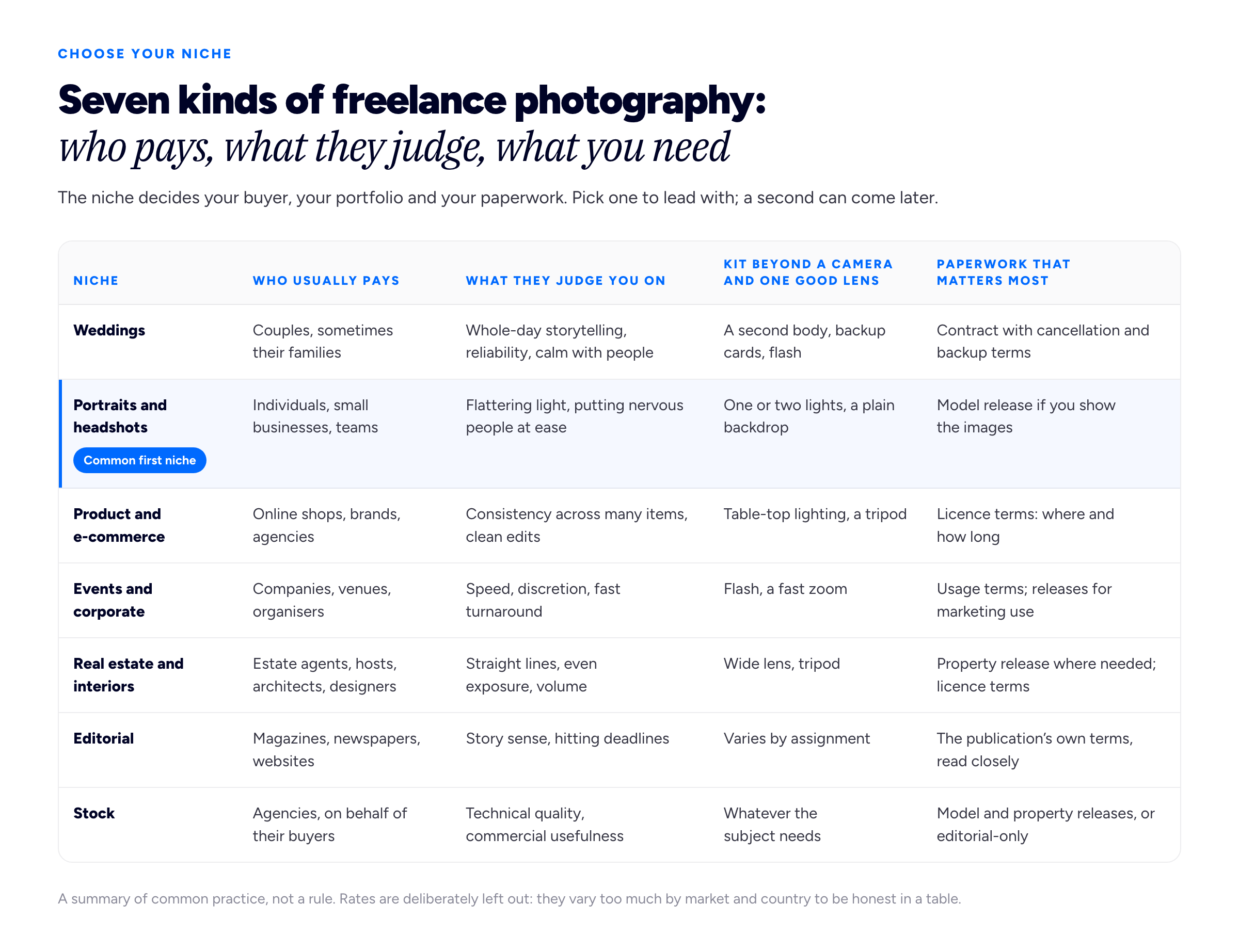
The niche decides who pays you, what they look for in your portfolio and which paperwork you cannot skip.
A few notes the table cannot hold.
Weddings
The niche most people think of, and the least forgiving to learn in: if a card fails during the vows, there is no reshoot. Most wedding photographers start by second-shooting for an established one, which teaches the rhythm of a day.
Portraits and headshots
A sensible first niche. Sessions are short and controllable, practice subjects are easy to find, and buyers include both individuals and businesses needing team headshots. The skill bought is as much about people as light: helping someone who hates being photographed look like themselves.
Product, real estate, events, editorial and stock
Product, real estate and corporate events are the steady, repeatable markets: a shop that likes your product shots needs more next season, and an estate agent has listings every week. Editorial is sold to editors through pitches, and stock through agencies that license your images on your behalf; both sit well alongside a client niche but are rarely the quickest route to a first paid job. Our guide on whether freelancers should niche down covers when to narrow further.
The kit you need, and the kit you do not
Gear is where beginners spend money to avoid the harder work of finding clients. Buy for the niche you chose, and buy late.
What you genuinely need to start:
- A camera you know thoroughly. Changing settings without looking matters more than a newer model. Clients cannot see the body you used; they can see a missed focus.
- One lens that suits your niche. A mid-range zoom for events, a short telephoto for portraits, a wide lens for interiors.
- Spare batteries and memory cards. Cheap, and a common cause of disaster on a paid job.
- Editing software and a backup routine. Files in two places before you leave the job, three once home. Losing a client's images is very hard to apologise for.
- For people indoors, a flash or one light. Using one light well teaches more than owning four.
What can wait: a studio (hire one by the hour), a drone (which brings its own registration rules in many countries), specialist lenses you would use twice a year (rent them) and presets that promise a "style". For weddings and events, a second body is part of the job, but rent one for your first few before you buy.
Building a portfolio before you have clients
The classic trap: nobody hires you without a portfolio, and you cannot build one without being hired. In photography the trap is weaker than in most fields, because you can make the exact kind of image a client buys without anyone commissioning it. Here are the honest ways, roughly in order of how much they prove.
Personal projects that look like the work you want
Want product work? Shoot ten items you own as if for a shop's website: consistent background, consistent light, a cropped detail shot of each. Want interiors? Photograph your own flat or a friend's, properly lit and straightened. The test is simple: would the client you want recognise this as the kind of image they need?
Test shoots and TFP
TFP stands for "time for prints" (now usually "time for photos"): you, a model and often a makeup artist or stylist each give your time, and everyone gets images to use in their own portfolios. It is the standard way portrait and fashion photographers build a book. Agree in writing who may use the images and where, how many edits each person gets and by when, and get a signed release; "unpaid" does not mean "informal". The makeup artist and model are building their own books too.
Assisting and second shooting
Working for an established photographer teaches lighting, client handling and workflow faster than anything else, and introduces you to people who pass on overflow work. Ask what you may show from those jobs; it is their client relationship.
A small, real job
Headshots for a friend's team, product shots for a local maker. Charge something if you can and treat it like a commission: a written brief, a deadline, a delivered gallery. One real job is worth more in a portfolio than ten test shoots.
Twelve to eighteen strong images in one niche is enough to start. Label anything that was not a commission honestly ("personal project", "test shoot"). Our guide to the photography portfolio website covers editing the set, structuring galleries and fast exports; our free image compressor shrinks files in your browser. For a site live this week without paying, you can make a free portfolio site on Bunfolio; any fast page you control will do.
The business side photography adds
Most of the business of freelancing is the same for photographers as for anyone: contracts, pricing, invoices, tax. Photography adds three things most freelancers never think about: other people's faces and property in your work, the copyright in what you make, and expensive equipment that can be dropped, stolen or sued over. None of what follows is legal advice; rules differ by country, so check your own.
A written contract for every paid job
Even a short email both sides reply "agreed" to beats nothing. It should cover date, times and location; what you deliver, in what format, by when; fee, deposit and payment dates; cancellation; retouching rounds; and how the client may use the images. Our freelance contract essentials lists the clauses that prevent most disputes, and our guide to scope creep covers the "could you just shoot a few more" problem.
Model and property releases
A release is a signed document in which the person in a photograph, or the owner of property in it, gives permission for the image to be used. The stock agency Alamy's explanation is a useful starting point: generally you do not need a release for editorial use, though there are exceptions, but "for commercial use, if your image features people or property, you will likely need a release". If a recognisable person appears in an image used to sell something, assume you need their signature. Get releases at the shoot, not afterwards. If you submit to stock agencies, use their own release requirements and forms.
Copyright and usage licensing
This is the part that clients new to commissioning photography most often misunderstand. In the US, according to the Copyright Office, copyright "exists automatically in an original work of authorship once it is fixed in a tangible medium", which for a photograph means once it is taken. The UK government's guidance says the same in its own words: copyright protection is automatic, and there is no register of copyright works in the UK.
What surprises clients is who owns it. In the US, a commissioned work only counts as "work made for hire", where the client becomes the author, in narrow circumstances: the Copyright Office lists an express written agreement and the work being commissioned for one of a short list of specific uses. Otherwise the photographer generally owns the copyright and the client receives a licence. So say it plainly in your contract: who owns copyright, and what the client may do with the images (where, for how long, in what media, whether exclusively). A two-year web licence is a different product from unlimited worldwide advertising use, and should be priced differently; outright ownership is a buyout, worth considerably more again.
Registration is optional in the US but matters if you need to enforce your rights: the Copyright Office says registration made before an infringement, or within three months of publication, makes you eligible for statutory damages and attorneys' fees. Elsewhere, the rules differ.
Insurance
Ask a broker about three kinds: equipment cover (including away from home), public liability (a guest trips over your light stand) and professional indemnity (a client claims your work cost them money). Some venues will not let you work without proof of liability cover. Get quotes before your first paid job.
Working out your price
We are not going to quote you a rate, because published "average photographer rates" vary wildly and rarely say where they come from. Work yours out instead, in this order:
- Count the real hours per job. Add enquiries, travel, set-up, culling, editing, delivery and admin to the shoot itself, which is often the smaller half.
- Add up your costs: equipment wearing out, software, insurance, website, travel, backups.
- Decide what you need to earn in a year and how many jobs you can realistically do, allowing for quiet months.
- Divide, then check against the market. If your number is far below what photographers in your niche and area publish, you are probably underestimating your hours.
- Price the licence separately in commercial work. The day rate covers your time; the usage fee covers what the client does with the images.
Our guide to how much to charge as a freelancer walks through this arithmetic in detail. For portraits and weddings, publish packages with a starting price.
Invoicing, deposits and tax
Take a deposit when the date is booked, especially for weddings and events, where you are turning down other work for that day. Send a proper invoice with your details, the client's, an invoice number, the date, what was delivered, the amount and how to pay; our free invoice generator makes one in a few minutes without an account. Many photographers deliver the final gallery once the balance is paid. Our guide on getting paid on time covers deposits and chasing late payments.
Set aside part of every payment for tax the day it arrives, because nobody deducts it for you. In the US, the IRS says the self-employment tax rate is 15.3% (12.4% for Social Security and 2.9% for Medicare), due if your net earnings from self-employment are $400 or more, on top of income tax. In the UK, GOV.UK says you must register for Self Assessment as a sole trader if you earn more than £1,000 in a tax year. Elsewhere, check your own tax authority.
Finding your first clients
Photographers are often told to "post consistently and the clients will come". Some do, eventually. Direct routes are faster.
- Your own network. Individual messages, not a group post, to former colleagues and friends who run businesses: what you now photograph, for whom, with a link. Ask who they know rather than whether they need you.
- Businesses with visibly weak photos. The café with dark menu photos, the shop with inconsistent product shots. A short, specific note about their images and an offer of a small first job beats a general pitch.
- Other suppliers in your niche. Wedding planners, venues, makeup artists, estate agents and event organisers all meet your clients before you do. Two or three good relationships can fill a calendar.
- Local search. "Headshot photographer" plus a town is a query people really type. A site that says plainly what you shoot and where makes you eligible for it.
- Marketplaces and job boards, as a second channel, after reading their fees and cancellation terms.
Our guide to getting your first freelance clients covers outreach messages in detail, and starting freelancing with no experience covers the wider path if photography is your first freelance work. After every good job, ask for a short testimonial while the client is pleased; our guide to asking clients for testimonials has a method that produces useful ones.
A realistic first year
Nobody can honestly tell you how long replacing a salary will take; it depends on niche, area, hours and outreach. What we can give you is a sequence where each stage ends in something you can check off, timed roughly for part-time effort.
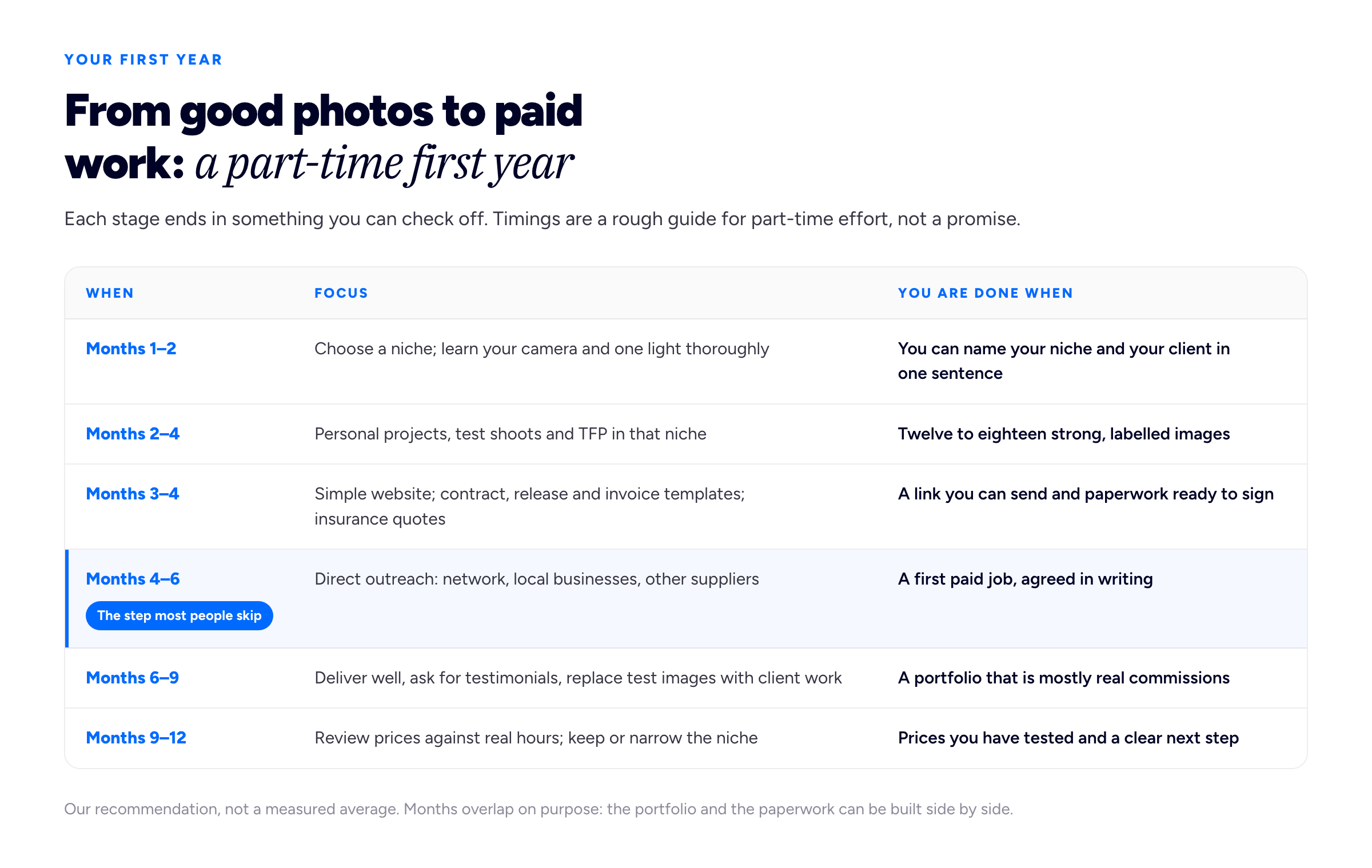
The fourth row is the one that turns a hobby into a business, and the one most people postpone until the portfolio feels "ready".
Two habits help across the whole year. If you have a job, keep it while you build (after checking your contract for outside-work clauses); it removes the pressure to accept bad work. And track hours and income per job from the first one: by month nine, that record tells you whether your prices are right. Our collection of freelancing tips covers the habits that help most once the work starts arriving.
Frequently asked questions
What is a freelance photographer?
A self-employed photographer who works for many clients, job by job, rather than for one employer. They sell their time and skill on a shoot, the finished images and, in most cases, a licence to use those images, while also handling the marketing, contracts, invoicing and tax that an employer would otherwise handle.
How do I become a freelance photographer with no experience?
Pick one niche, then build a small portfolio in it through personal projects, test shoots and assisting an established photographer. Put twelve to eighteen strong images on a simple website, prepare a contract and release, and approach people you know and local businesses directly. Experience comes from the first few small jobs.
Do you need a degree to be a freelance photographer?
No. Clients hiring a freelancer judge the portfolio, reliability and how you deal with people, not qualifications. Courses can speed up learning, but assisting a working photographer often teaches more.
How much should a beginner freelance photographer charge?
Work it out from your real hours per job (including editing and admin), your costs and how many jobs you can do in a year, then compare it with what photographers in your niche and area publish. We do not quote a figure, because the published averages we found did not explain their method. In commercial work, price the usage licence separately from your time.
Do freelance photographers own the copyright to their photos?
Usually, yes. In the US and the UK, copyright arises automatically when the photograph is taken, and in the US a commissioned photo only becomes the client's "work made for hire" in narrow circumstances that include a written agreement. Most clients receive a licence to use the images. State ownership and usage in your contract, and check the rules where you work.
Do I need insurance as a freelance photographer?
It is strongly advisable and sometimes required: some venues and corporate clients ask for proof of public liability cover before you can work. Ask a broker about equipment cover (including away from home), public liability and professional indemnity before your first paid job.
How we put this guide together
The niche breakdown, the "three things you sell" framing, the kit priorities, the order of portfolio-building methods, the five-step pricing method and the first-year sequence are our own recommendations, drawn from how freelance photography work is bought, not from an industry standard or a survey. Weigh them as opinions with reasons attached.
We deliberately left out numbers that fill other articles on this topic: "average" hourly and session rates, beginner earnings, how long it takes to go full-time and salary-site figures for freelance photographers. None of the versions we found explained their method well enough for us to repeat them. We set out to quote the US Bureau of Labor Statistics' Occupational Outlook Handbook page for photographers, but it refused automated access on the day we checked, and we do not quote a figure we have not read at source. O*NET shows a wage figure for photographers too; we left it out because the page did not say whether it includes the self-employed, which is the whole question for a freelancer.
Sources, all read on 5 October 2026: O*NET OnLine's summary for Photographers (27-4021.00) (the occupation description); the US Copyright Office's Circular 1, Copyright Basics (automatic protection on fixation, the two routes to work made for hire, and the registration timing for statutory damages and attorneys' fees); GOV.UK's guidance on copyright (automatic protection, photography covered, no UK register) and setting up as a sole trader (the £1,000 Self Assessment threshold); Alamy's help page on model and property releases (what a release is and the editorial versus commercial distinction); and the IRS page on self-employment tax (the 15.3% rate and the $400 threshold). Copyright, release and tax rules change and differ by country; nothing here is legal or tax advice, so check current official guidance and take qualified advice for your own situation.
No real photographers, clients or businesses are described in this guide; the example jobs are invented to show the shape of the work.
Related reading: the photography portfolio website, how to start freelancing with no experience, how much to charge as a freelancer, freelance contract essentials, getting your first freelance clients and the videographer portfolio website.
More from the blog
September 30, 2026 · 16 min read
What Is Freelancing? A Plain-English Guide to Freelance Work
Freelancing is selling a skill to several clients one job at a time instead of working for one employer. How a freelancer differs from an employee, contractor or gig worker, one freelance job from enq...
September 29, 2026 · 16 min read
How to Become a Freelance Writer: A Realistic Step-by-Step Path
A realistic path into freelance writing: choose one kind of writing and one type of client, write three honest samples with no clips, and put them on a one-page portfolio. Includes a sample cold email...
September 26, 2026 · 15 min read
What Is a Freelance Artist? How the Work, Pay and Rights Actually Work
A freelance artist is paid by the job, not by a salary, and keeps the copyright unless they sign it away. How freelancing differs from commission, in-house and gallery work, where the money comes from...