
September 17, 2026 · 15 min read
Videographer Portfolio Website: Reels, Players and Credits
The technical layer no other discipline has to think about. Reel length by role, why a YouTube embed advertises your competitors, the Vimeo settings for unreleased cuts, the music licence that will mute your reel, and telling the truth about what you shot.

There is a specific way a videographer's portfolio fails, and it is not the one people worry about. It is not that the work is weak. It is that a producer opened the site on a phone, on hotel wifi, a four-megabyte autoplaying hero loop began fighting for bandwidth with a YouTube player that had not finished booting, and by the time anything moved they had gone back to their inbox. The reel was excellent. Nobody saw it.
Video portfolios have a technical layer that no other discipline has to think about, and almost every guide to building one skips it entirely in favour of advice about choosing a minimal dark template. This one goes the other way. What follows is about the reel, the player, the licence, the credits and the ownership — the parts that decide whether your work is seen, whether you are allowed to show it, and whether the person watching can tell what you actually did.
The general structure of a portfolio site — what pages it needs, how the work is ordered — is covered in our guide to the pages a portfolio website needs. This is the film-specific layer on top of it.
The reel
The reel is the single decision that matters most, and the published advice on length is a mess: one minute, ninety seconds, two to three minutes, all asserted with equal confidence and none of it segmented by what you actually do.
Length follows from role, because different roles are demonstrated at different speeds. A motion graphics or VFX reel can move very fast — each shot is a finished object and the work is visible in a second. An editor's reel cannot, because editing is a property of duration and a cut is meaningless without the shot that preceded it. A director's material is the hardest to compress at all, since what you are being judged on is whether a scene sustains.
The more useful question is whether you should lead with a reel at all. A reel averages your work. If you have one genuinely strong piece and a body of competent commercial jobs, the reel converts the strong piece into a two-second fragment surrounded by competent ones. Directors and documentary makers are often better served by leading with a single complete piece, or with a scene, and putting the reel lower down as a summary of range.
What is not contested, and is worth stating: the opening seconds carry disproportionate weight, and the last shot is what the viewer leaves with. Epidemic Sound's own guide to making a showreel puts it as bookending — arrange so that the first and last clips are the ones you want remembered. Everything in between is being skimmed, and you should assume the viewer is scrubbing.
One thing to fix before anything else: give every piece a role line. Dir. / DP / Edit is not the same as DP only; dir. Someone Else, and a client who hires you off a reel where you were second camera will discover the discrepancy on day one of the shoot. More on credits below.
Hosting the video, which is where portfolios actually break
This is the section that competing guides reduce to "embed, don't upload". The advice is right and radically incomplete.
YouTube will advertise your competitors
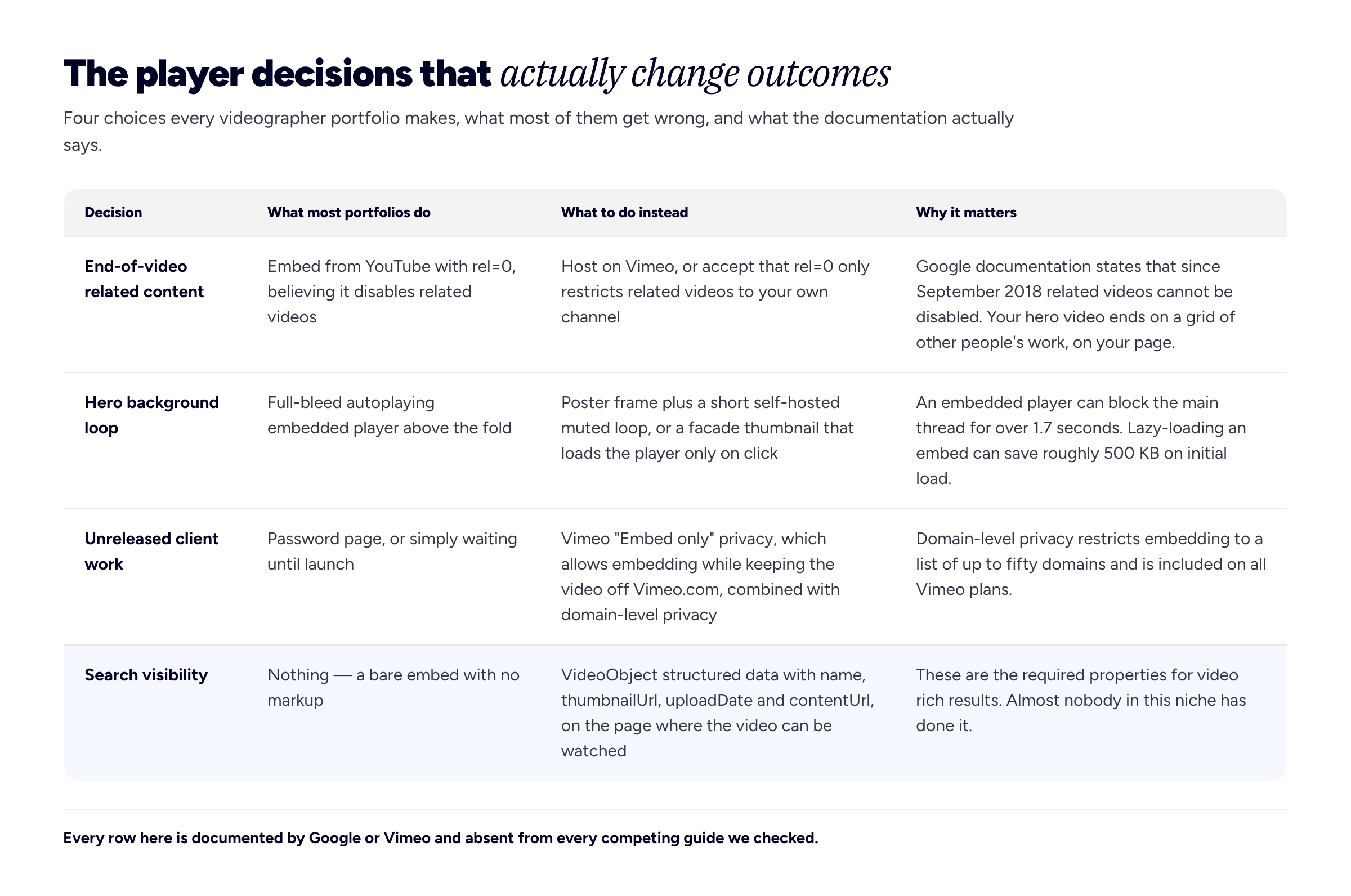
A great many videographers embed from YouTube with rel=0 appended, in the belief that this suppresses related videos at the end of playback. It does not, and has not for years. Google's own player parameters documentation states that following a change in September 2018 you can no longer disable related videos; if rel is set to 0, related videos simply come from the same channel as the video just played. The same document notes that modestbranding is deprecated and has no effect.
So the end card on your portfolio's hero video is a grid of other people's films, served on your page, at the exact moment a producer has finished watching your work. If your own channel is thin, the "same channel" fallback does not save you either.
Vimeo has the controls this job needs
Vimeo's relevant features are the ones nobody mentions. Domain-level privacy restricts embedding to a list of up to fifty domains, with sites not on the list receiving an error when they attempt to embed — and Vimeo states it is included with all plans. Separately, an Embed only privacy setting makes a video embeddable on other sites while not viewable on Vimeo.com itself.
That second one is the right setting for an unreleased client cut you have permission to show privately. Player branding controls — hiding the logo, byline and title — generally require a paid tier, so check your plan against what you are promising a client.
Autoplay hero loops cost more than they are worth
The full-bleed autoplaying background video is the signature move of this genre and it is usually a mistake on mobile. Google's guidance on video performance is worth reading in full; the practical points are that embedded players are expensive before anyone presses play, and that an embedded YouTube player can block the main thread for more than 1.7 seconds on a median site.
The fix is well documented and almost nobody in this niche uses it. Serve a poster image, set preload to none or metadata rather than letting the browser pull the file, lazy-load embeds below the fold, and use a facade — a clickable thumbnail that only loads the real player on interaction. Google's embed best practices note that lazy-loading an embed can save roughly 500 KB on initial load, and that the lite-youtube-embed facade is dramatically faster than the full player.
If you want motion above the fold, a short muted silent loop that you host yourself as a compressed file, with a poster frame, will almost always beat an embedded player doing the same job.
Nobody is marking up their video
Google's VideoObject documentation sets out what is required for a video to be eligible for video rich results: name, thumbnailUrl and uploadDate, with contentUrl described as the most effective way for Google to fetch the video file, and the markup required to sit on a page where users can actually watch the video. A portfolio of bare Vimeo embeds with no markup is invisible to that surface. This is a small amount of work that essentially none of your competitors have done.
The portfolio that loads is the portfolio that gets watched.
Music, which will get your reel muted
Not one of the competing guides on this topic mentions music licensing, and it is the single most common way a reel is quietly destroyed after publication.
Two distinct problems. The first is that a licence granted for a client's film does not automatically extend to your recut of that film as a promotional reel for your own business. Those are different uses, and the second one is commercial promotion of a company — yours.
The second is tier coverage on subscription libraries. These are structured around use case, and personal or creator tiers frequently exclude advertising and client work. Epidemic Sound's own pricing page, for example, states that using their music for ad campaigns requires a Pro or Enterprise plan. Read your own library's licence rather than assuming, because the terms differ between providers and change.
The practical consequence is not usually a lawsuit. It is Content ID muting your reel on YouTube, or a takedown on Vimeo, at some unpredictable point after you stopped checking — which is why the same guide from Epidemic Sound warns that unlicensed music can see a showreel muted or removed. A muted reel on a portfolio you are still sending to clients is worse than no reel.
Keep the licence receipts with the project files. When you recut the reel, re-check the tracks rather than assuming last year's clearance carries.
Credits, and telling the truth about what you did
Film is a collaborative medium, which makes a portfolio a claim about attribution as much as about quality. The conventions here are real, and the closest thing to a published standard I have found comes from the Documentary Cinematographers Alliance's credit guidelines. They reserve Director of Photography / Cinematographer for the person who sets the look of the film or shoots the majority of it; Additional Cinematography for someone shooting after the look is established but not supervised in the field; and Camera Operator / Additional Camera for someone working under the direction of the principal DP, whether or not their footage made the final cut.
These are conventions from an alliance rather than rules from a union, but they are a defensible standard to apply to yourself, and applying a stricter standard than necessary has never cost anyone a job.
The same document contains a piece of advice that belongs in every videographer's contract and appears in no portfolio guide: production should provide a full-resolution copy of the final material once released, for the DP to use in their work samples. Ask for your deliverable in the contract. Chasing a broadcast-quality copy of a spot eighteen months after delivery, from a producer who has changed agencies, is a familiar and avoidable waste of a week.
Who owns the spot
Freelance videographers are in an unusual legal position compared with most freelancers, and it is worth understanding precisely.
Under 17 U.S.C. §101, a commissioned work is a work made for hire only if it falls within one of nine enumerated categories and the parties expressly agree in a signed written instrument. One of those nine categories is a contribution to a motion picture or other audiovisual work. So unlike, say, a freelance copywriter — whose work often does not fit the categories at all — a videographer's contribution sits squarely inside them, which means a signed work-for-hire clause is straightforwardly effective. Without one, the position is different.
Practically: read the clause before you sign, and understand that "can I put this on my site?" is usually a separate question from copyright anyway. Most disputes are about publicity and embargo rather than ownership. Get a portfolio or publicity clause into your contract that says you may show the finished work after public release, and the whole problem disappears at the start of the job rather than at the end.
For work you genuinely cannot show, our guide to portfolios under NDA covers the options.
Three different businesses
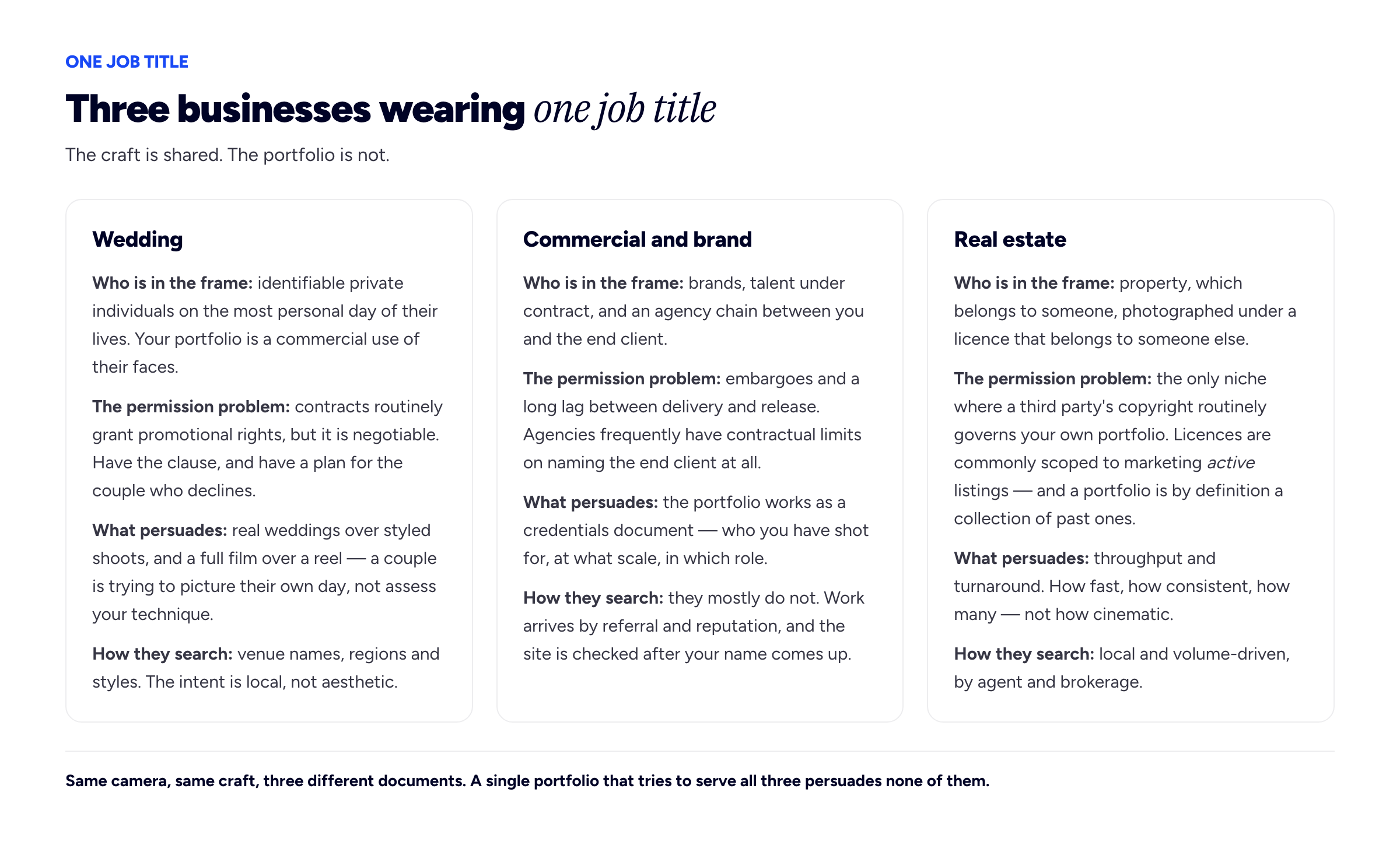
"Videographer" covers work with almost nothing in common, and the portfolio follows the business rather than the craft.
Wedding. Your subjects are identifiable private individuals having the most personal day of their lives, and your portfolio is a commercial use of their faces. Contracts in this field routinely grant promotional rights, but it is negotiable and some couples will decline — so have the clause, and have a plan for the couple who says no. Note too that the buying intent here is local: venue names, regions and styles are what people search, not "cinematic storytelling". Real weddings beat styled shoots, and a full film matters more than a reel because a couple is trying to imagine their own day.
Commercial and brand. Embargoes, agency chains, brand-safety rules and a long lag between delivery and release. The portfolio functions as a credentials document: who you have shot for, at what scale, in what role. Confirm what you may name, because agencies frequently have contractual limits on naming the end client.
If you genuinely work across two of these, build two pages rather than one averaged page.
Real estate. The only niche where a third party's copyright routinely governs your own portfolio. The National Association of Realtors has written about how ownership of property imagery is fractured across the industry, and describes licensing arrangements scoped to marketing active listings — a limitation that matters when a portfolio is, by definition, a collection of past ones. Here the portfolio is also proving throughput and turnaround rather than artistry: how fast, how consistent, how many.
Frequently asked questions
How long should a videographer's showreel be?
It depends on role, because roles are demonstrated at different speeds. Motion graphics and VFX work reads almost instantly; editing does not, because a cut only means something in context; directing is the hardest to compress. Published advice clusters between one and three minutes. Treat the opening and closing shots as the load-bearing ones and assume the viewer is scrubbing.
Should I use YouTube or Vimeo for a portfolio?
Vimeo, for portfolio work. YouTube cannot disable related videos — Google's documentation states that since 2018 the rel parameter only restricts them to your own channel — so a YouTube embed ends by showing other people's films on your page. Vimeo also offers domain-level privacy and an embed-only mode, which YouTube has no real equivalent of.
Should my portfolio have an autoplaying background video?
Usually not on mobile, and rarely as an embedded player. Embedded players are expensive before anyone presses play. If you want motion, use a poster frame with a short, compressed, muted loop you host yourself, and load any real player only on click.
Can I put client work in my portfolio?
After public release, and ideally under a clause you negotiated at the start. Copyright is usually the client's or the production's, so this is a permission question more than a rights question. Ask for a publicity clause and for a full-resolution deliverable in the same contract.
Can I use any music on my showreel?
No. A licence for the client's film does not automatically cover your recut of it as promotion for your own business, and subscription libraries commonly restrict advertising and client use to higher tiers. The usual outcome of getting this wrong is a muted or removed reel rather than a lawsuit — which you may not notice for months.
How should I credit work where I was not the DP?
Use the conventional distinctions: Director of Photography for the person who set the look or shot most of it, Additional Cinematography for shooting after the look was established, Camera Operator or Additional Camera for work under the principal DP's direction. Name the director and DP where they were not you. Overstating a credit is discovered quickly in a small industry.
Do I need a website, or is Vimeo enough?
A Vimeo profile hosts your video; it does not present your business, rank under your own name, or let you group work by service and sector. Use Vimeo as the player and a site of your own as the address — the video hosting and the portfolio are different jobs, and the URL you put on a rate card should be one you own.
Do styled shoots and spec work belong in a wedding videographer's portfolio?
They belong, labelled. Couples are trying to picture their own wedding, so real weddings are the persuasive material; a styled shoot shown without labelling implies a client relationship that did not exist, and vendors in the same market will recognise the shoot. The same rule applies to planners building a wedding planner portfolio out of styled shoots.
How we put this guide together
Bunfolio builds portfolio sites, so our own ground is how a page is structured, how fast it loads and how a buyer reads it — not cinematography. We have tried to keep the line visible between the two.
The technical claims are all quoted from primary documentation rather than from summaries, because this is exactly the kind of material that degrades as it is repeated: the related-video and modestbranding behaviour from Google's YouTube player parameters reference; the privacy and embedding controls from Vimeo's own help pages on domain-level privacy and video privacy settings; the performance figures from Google's video performance guidance and embed best practices; and the markup requirements from the VideoObject documentation. Player features and plan tiers change, so check your own account rather than trusting a figure we published on a given day.
The credit conventions come from the Documentary Cinematographers Alliance guidelines, and we have been careful to describe them as convention rather than rule — we could not find a union or guild with a published policy governing reels and work samples, and we are not going to imply one exists. The ownership description is from 17 U.S.C. §101 itself rather than a paraphrase, because the nine-category test is where this is usually got wrong. The real-estate licensing point is from the National Association of Realtors' own article on property photo ownership; we have deliberately not quoted the statutory damages figures that circulate alongside it in third-party write-ups, because they did not come from that source. Nothing here is legal advice, and a contract question is a question for a lawyer in your jurisdiction.
We have cited no figures for how long a producer spends on a reel, what share of videographers have websites, or conversion rates from portfolio to booking. Numbers of that kind are abundant in this topic and we could not trace them to a study we would stand behind, so they are absent rather than invented.
The recommendations that are ours, and should be weighed as judgement rather than fact, are: that reel length follows role, that a single strong piece often outperforms a reel for directors, the player-decision table, the advice to get both a publicity clause and a full-resolution deliverable into the contract at the start, and the argument that wedding, commercial and real-estate portfolios are three different documents.
Related reading: the video editor's portfolio for the post-production side, motion design portfolios for the animation-adjacent case, photography portfolio websites for the stills equivalent of the same licensing problems, and showing confidential work for embargoed and unreleased material.
More from the blog

September 21, 2026 · 18 min read
Nursing Portfolio: What to Include, Who Reads It and How to Build One
An interview panel, a clinical ladder committee, a certification auditor and an NMC confirmer all read a nursing portfolio, and only one of them wants the binder every guide describes. What each actua...

September 16, 2026 · 20 min read
How to Put Your Portfolio Link on a Resume
Everyone tells you to put the link in your header and label it clearly. Nobody tells you what happens next — that the hyperlink often dies in the PDF export, that an applicant tracking system may neve...

September 18, 2026 · 22 min read
How to Put Freelance Work on a Resume
Nobody rejects a resume because the applicant freelanced. They reject it because they could not work out what they were looking at. The one decision that sets your layout, what to call yourself, and h...