
September 21, 2026 · 18 min read · Updated October 5, 2026
Nursing Portfolio: What to Include, Who Reads It and How to Build One
An interview panel, a clinical ladder committee, a certification auditor and an NMC confirmer all read a nursing portfolio, and only one of them wants the binder every guide describes. What each actually requires, how to de-identify a reflective account, and which documents are not yours to keep.
Most advice about nursing portfolios describes a three-ring binder that a new graduate carries into an interview. That advice is not wrong, exactly. It is about twenty per cent of the picture, and it is the twenty per cent with the lowest stakes.
A nursing portfolio is an organised collection of evidence about your practice: your licence and certifications, education, clinical experience, continuing education, feedback and reflection. It is read by four quite different audiences, and only one of them is an interview panel. A clinical ladder committee reads it to decide whether to promote you, against a written rubric with hour thresholds. A certification body reads it — but only if you are selected for audit, and only the specific documents it names. In the UK, a confirmer reads it as part of revalidation, against a standard set by the regulator. Each of these has an actual, published specification. None of them wants the same artefact, and the one that most guides describe is the one with no specification at all.
This guide is organised around those four readers. It also takes seriously the thing that almost every ranking page on this topic omits entirely, which is that nursing is the only portfolio discipline where the raw material is other people's protected health information, and where getting that wrong is a regulatory matter rather than a matter of taste.
Four readers, four different documents
The interview panel wants to know, quickly, that you are licensed, current, and that someone who supervised you thought well of you. They will spend a few minutes, usually while you are sitting there. This is the audience every existing guide addresses.
The clinical ladder or professional advancement committee wants evidence against a rubric. These programmes are formal, and their requirements are specific in a way that will surprise you if you have only read general advice. To take one published example, MedStar Georgetown University Hospital's Clinical Ladder Portfolio Completion Guide opens by instructing applicants to use a three-ring binder in a prescribed order — title page, table of contents, an element road map with signatures, then a divider for each element. Its elements carry hard thresholds: a minimum of 60 hours to claim formal preceptor status, at least 80% attendance to claim committee involvement, a minimum of 360 hours a year for formal charge nurse. Clinical Nurse III and IV each require a minimum of two elements in professional development and two in leadership. The clinical exemplar has a format — essay, sans serif, double spaced — and is assessed against Patricia Benner's areas of nursing practice.
Your own employer's programme will differ in detail. The point is that it exists in writing, it is probably on your intranet, and reading it is worth more than any generic checklist including this one.
The auditor is the reader most guides forget, and the one with real consequences. ANCC's Certification Renewal Handbook requires 75 continuing education contact hours plus at least one of eight professional development categories completed in its entirety. Crucially, it states that ANCC "conducts random audits of certification renewal applications", and that if yours is selected you will be asked to produce documentation — instructing you to "maintain all supporting documentation for these activities through your next renewal cycle". Failure to respond may result in disciplinary action against your certification. Each of the eight categories names the exact document required: preceptor hours need a completed preceptorship form, practice hours need a letter from your immediate supervisor on organisational letterhead.
This is a portfolio specification written by a certifying body, and it is not satisfied by a nice web page. It is satisfied by a complete, retrievable archive of scannable documents.
The confirmer, if you are on the UK register, is reading against NMC revalidation. Over a three-year cycle that means 450 practice hours (more for dual or triple registration), 35 hours of CPD of which at least 20 must be participatory, five pieces of practice-related feedback, five written reflective accounts on the NMC's own mandatory form, a reflective discussion with a registrant, health and character declarations, indemnity, and a signed confirmation. The NMC says it "strongly recommends" you keep the evidence in a portfolio, and adds that this "does not necessarily need to be an e-portfolio".
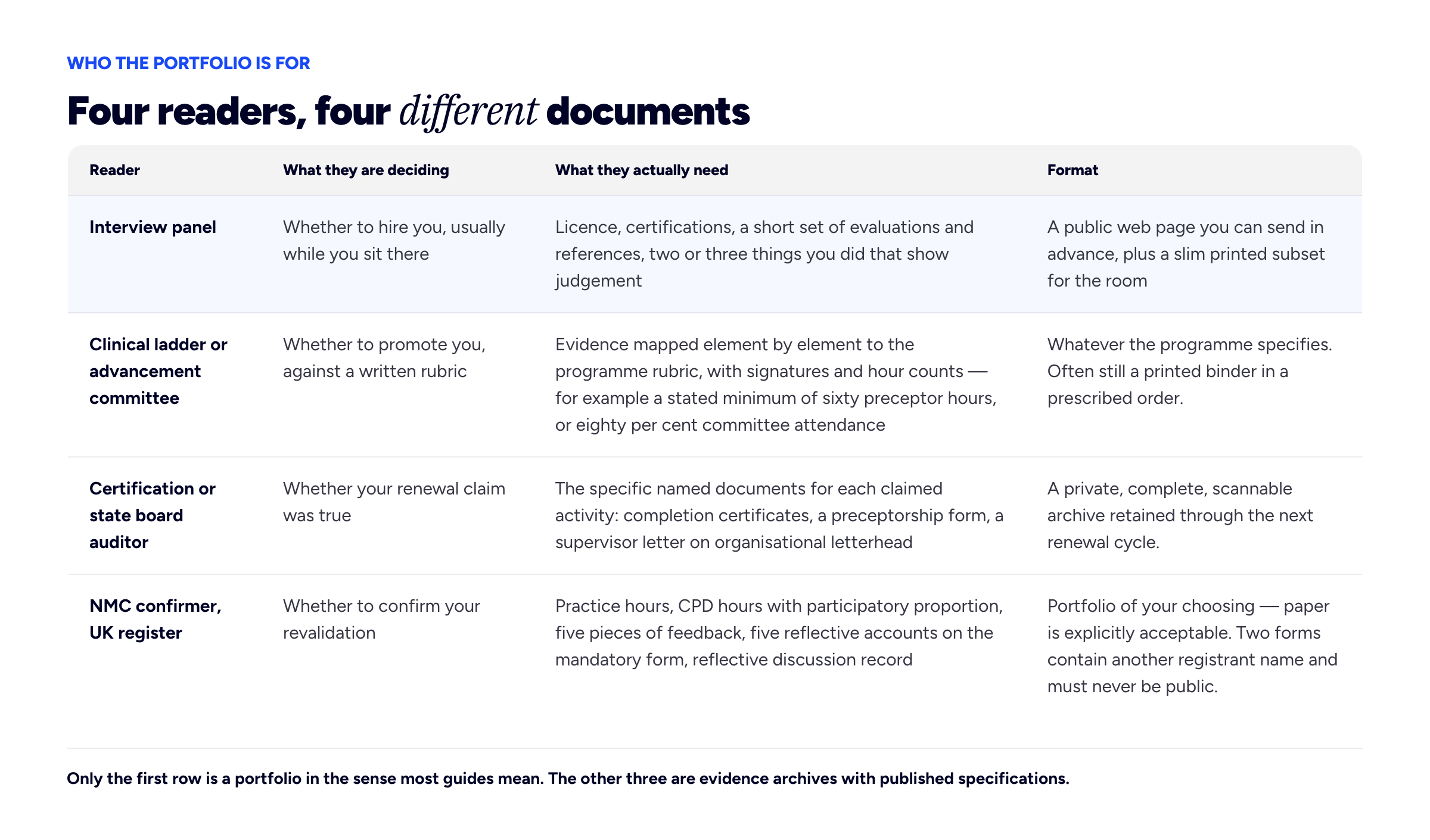
Build the archive first. The public page is a curated extract of it, not the other way round.
How to make a nursing portfolio, step by step
Whichever reader you are building for, the order of work is the same. Start with the private archive, because everything else is an extract of it.
- Find the specification. If the portfolio is for a clinical ladder, certification renewal or revalidation, get the published requirements from your employer, certifying body or regulator before you collect anything. If it is for job applications, there is no specification, so the reader's few minutes are the constraint.
- Set up the archive. One folder, backed up, with a subfolder per category: licence and registration, certifications, education, employment and clinical experience, continuing education, feedback and evaluations, committees and projects, reflections. ANCC's renewal categories make a workable structure even if you are not ANCC-certified.
- Gather the documents. Licence verification, certification cards with expiry dates, transcripts, CE certificates, preceptor feedback, letters. Ask for copies of anything that belongs to your employer rather than taking it, and keep the replies.
- Write your CV and a short professional summary. Two or three sentences on your specialty, setting and the kind of role you want next. This becomes the top of the public version.
- Write two or three reflective pieces. Each one a real situation, what you did, and what you would do differently, with every patient identifier removed using the rules in the next section.
- Build the version for your reader. For an interview, a short web page and a slim printed subset: summary, credentials, experience, reflections, references available. For a ladder committee or revalidation, the documents in exactly the order the rubric or regulator lists them.
- Check it for confidentiality, then publish or submit. No patient information, no employer documents you lack permission for, and no other registrant's name or NMC Pin on anything public.
- Put a date in your calendar to update it. File each new certificate the week you earn it, and reconcile the whole archive once a year.
A portfolio for nursing school admission or a placement is a smaller version of the same thing: a CV, certificates such as BLS, any healthcare or caring experience described honestly, a short reflective piece, and references. Follow the programme's own instructions where it gives them.
Confidentiality, which is most of the job
Nursing is unusual among portfolio disciplines: your best material is a story about a patient. Getting the de-identification wrong is not an aesthetic failure.
The US framework is 45 CFR 164.514, which sets out two methods for de-identifying protected health information — expert determination, and the Safe Harbor method. Safe Harbor lists eighteen categories of identifier that must be removed. Some are obvious: names, addresses, medical record numbers, full-face photographs. Some are the ones people miss. All elements of dates except the year must go, which includes admission and discharge dates. Geographic subdivisions smaller than a state are restricted. And the final category is a catch-all: any other unique identifying number, characteristic, or code.
That last one is the one that matters for a reflective account, because a reflection is made of characteristics. A rare presentation, in a named unit, in a stated month, in a small town, identifies a person as surely as a name does.
The American Nurses Association is explicit that the statutory floor is not the professional standard. Its position statement on privacy and confidentiality, revised in 2024, states that "HIPAA compliance is a necessary but insufficient safeguard to maintain confidentiality and protect privacy due to limited protections in the statute. Therefore, professional standards and ethical practice establish a higher bar." It also restates the duty to maintain confidentiality of all patient information "in the work setting and off duty in all venues, including social media or any other means of communication" — which covers a portfolio website.
The most usable operational guidance I know of comes from the NMC's revalidation booklet, and it is worth following wherever you practise. Its rule is that you must not record any information that might identify an individual, "whether that individual is alive or deceased", and it names what to strip: the individual's name, the date of the incident, the particular ward or place where it occurred, and descriptions of unique circumstances from which the individual could be identified.
In practice, that turns a reflection like "Mrs Jones on ward 8 in January fractured her hip after a fall" into something closer to "a patient with a serious injury made a complaint about lack of hydration" — and the reflection still works, because the learning was never in the identifiers.
The documents that are not yours
A second confidentiality problem gets almost no coverage anywhere, and it catches careful people. Performance evaluations, preceptor feedback forms, incident reports, complaint logs, audit data and care plans are employer records. They are not your property because they are about you or written by you. The NMC guidance puts the principle plainly: you must not forward work emails to a personal account, or download and take copies of employer records, and you must seek consent to access or use your employer's information.
The workable version: ask for a copy of your evaluation at the time, in writing, and keep the reply. Ask a preceptor for a reference letter addressed to you rather than photographing the internal form. Where a document is genuinely the employer's, describe it rather than reproducing it.
One specific NMC trap for anyone building a public page: the completed reflective discussion form and the confirmation form both contain identifiable information about another registrant, including their name and NMC Pin. Those two documents must never appear on a public URL.
The new graduate's version
If you are about to qualify, your problem is the opposite of the experienced nurse's: not too much confidential material, but too little material at all. Some things help more than others.
Clinical rotations are your work history. Name the setting and the patient population rather than the hospital — "a 28-bed medical-surgical unit", "community mental health, adult caseload". Say what you were responsible for by the end of the placement, not on the first day.
Preceptor feedback is your most valuable asset and the easiest to lose. Ask for it in writing at the end of every rotation, while the person still remembers you and is still reachable at that email address. Six months later they have moved units and you are a name they half recall.
Skills and competency lists earn their place here. For an experienced nurse a skills checklist is filler; for a new graduate it is information the panel actually lacks. Be specific and be honest about supervision level — "IV insertion, independently" and "central line dressing changes, under supervision" are different claims and an experienced interviewer will read the distinction as maturity.
Two or three short reflective pieces, properly de-identified, do more than a longer list of rotations. They are the only part of the document that shows how you think.
Certifications belong in a clean, dated list: licence and state, NCLEX status, BLS and ACLS with expiry dates. Expiry dates matter more than you would guess — a hiring manager is mentally checking whether you can start.
The cover page, and how to organise it
Searches for a nursing portfolio cover page are common enough that it is worth answering directly, and the answer is duller than the search volume suggests. A cover page carries your name, your credentials in the correct post-nominal order, the portfolio's purpose and the date. If it is a clinical ladder submission, it carries the clinical level you are applying for and the application year, because the committee is processing a stack of them.
Credentials go in a conventional order: highest earned degree, then licence, then state requirements, then national certifications, then awards and honours. So Jane Okafor, MSN, RN, CCRN rather than an order chosen for how it looks. It is a small thing that a nursing audience notices immediately.
What a cover page does not need is decoration. Templates sold for this purpose lean heavily on script fonts and stethoscope graphics; a committee reading forty submissions is not scoring the artwork, and a plain, well-set page reads as more professional, not less.
Behind it, a table of contents and consistent section order. If you are submitting against a rubric, mirror the rubric's order exactly — do not reorganise it into something you find more logical. The person marking it is working down a list.
Digital, paper, or both
This is the question the existing guides do not pose, and the answer falls out of the four readers.
You need a private evidence archive, and it is the foundation. Complete, organised, backed up, containing every certificate, letter, evaluation and form in a format you can produce within an audit's response window. This is what ANCC's audit requirement actually demands, and what NMC revalidation is checked against. Nothing about it is public.
You need a public web portfolio if you are in the job market, building a professional identity, or working in any advanced practice, education or leadership role where people look you up. This is a curated extract: who you are, where you have practised, credentials, a short set of reflective or project pieces, a way to make contact. It contains no patient information, no employer documents and no other registrant's details. A domain of your own is worth having here for the same reason it is in any profession — it is the address you can put on a CV that does not change when a platform does. The CV sits alongside the portfolio rather than inside it, and if yours needs rebuilding you can build one free and export a plain one-page PDF with nothing held behind an account.
You need a printed subset only when a specific programme requires one, which clinical ladder programmes frequently still do. Build it from the archive when asked; do not maintain it as your primary format.
The common failure is to maintain only the middle one — a pretty page, no archive — and then discover at audit or promotion that the supporting documents were never collected.
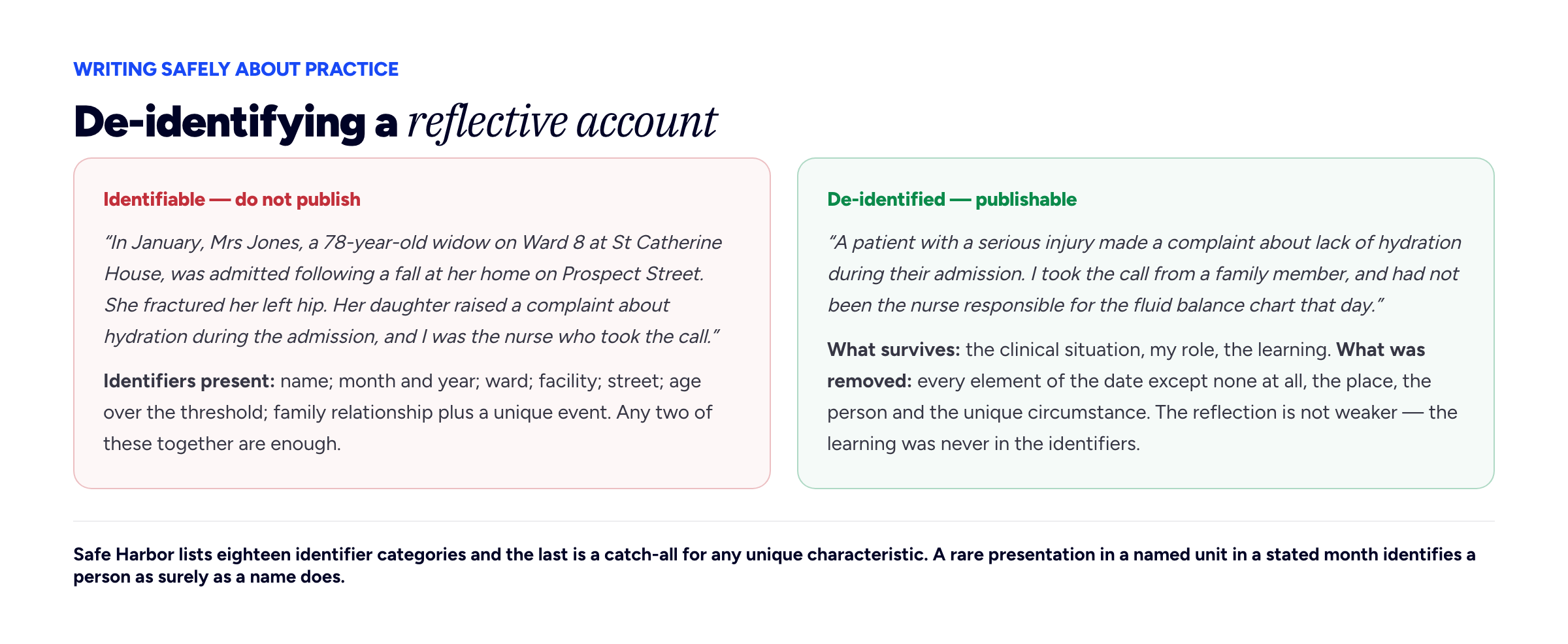
The rewrite loses nothing that was ever the point of the reflection.
Keeping it alive
The portfolio that works is the one that is updated at the moment evidence is generated, not the one assembled the week before it is needed. Two habits do most of the work.
After any CE activity, committee meeting, preceptorship or project, file the document the same week, named with the date and the category it satisfies. ANCC's eight renewal categories make a serviceable filing structure even if you are not ANCC-certified, because they map closely to what ladder programmes ask for.
Once a year, reconcile: are the licence and certification expiry dates current, do the claimed hours have documents behind them, has anything fallen out of the retention window. The retention question is the one people get wrong — ANCC asks you to hold documentation through your next renewal cycle, the NMC recommends keeping your portfolio until after your next revalidation, and individual state boards set their own CE record-retention periods that you should check directly with your board rather than trusting a summary.
Frequently asked questions
What is a nursing portfolio?
A structured collection of evidence about your nursing practice: licence and certifications, education, clinical experience, continuing education, feedback and reflective writing. Depending on who asked for it, it may be a short web page for a job interview, a binder submitted to a clinical ladder committee, or a private archive you keep for certification audits and revalidation. Most nurses need the archive whatever else they build.
What should be included in a nursing portfolio?
Cover page and contents, curriculum vitae, licence and certifications with expiry dates, education and transcripts, clinical experience with settings and populations, performance evaluations and preceptor feedback you have permission to hold, continuing education records, committee, quality improvement and evidence-based practice involvement, awards, and two or three de-identified reflective pieces. If you are submitting to a clinical ladder programme, include exactly what its rubric lists, in its order.
How do I make a nursing portfolio as a new graduate?
Build it from clinical rotations rather than employment. Name settings and patient populations rather than facilities, state what you were responsible for by the end of each placement, collect written preceptor feedback before you leave each rotation, list skills with an honest supervision level, and include two or three short reflective accounts. Add licence and certification details with dates.
Can I include patient information in a nursing portfolio?
No. Remove every identifier, working from the Safe Harbor list at 45 CFR 164.514 — including all date elements except the year, any geographic detail below state level, full-face images, and any unique characteristic from which someone could be identified. The NMC's rule is a good practical test: no name, no date, no ward or place, and no description of circumstances unique enough to identify the individual.
Can I put my performance evaluations in it?
Ask first. Evaluations, preceptor forms and incident documentation are employer records rather than your property, even when they are about you. Request a copy in writing at the time, keep the reply, and where you cannot obtain one, describe the feedback instead of reproducing the document.
Do I need a digital portfolio or a binder?
Probably both, for different readers. Keep a private, complete evidence archive for audits and revalidation; publish a curated web portfolio for the job market and professional identity; print a subset only when a programme specifies it. Several clinical ladder programmes still mandate a printed binder in a prescribed order, so check your employer's guide before assuming digital is acceptable.
Does ANCC Magnet recognition require nurses to keep portfolios?
Not directly. Magnet is an organisational designation rather than an individual requirement, and ANCC does not publish a rule that individual nurses must maintain portfolios to support it. The connection is indirect: Magnet's structural empowerment component pushes organisations towards clinical advancement programmes, and those programmes commonly require portfolios. Check your own employer's programme rather than assuming.
What is a nursing portfolio cover page?
A plain first page carrying your name, credentials in conventional order, the portfolio's purpose and the date — plus the clinical level and application year if it is a ladder submission. Post-nominals run highest degree, licence, state requirements, national certifications, then honours. Decoration adds nothing; a committee is reading for content.
How long should I keep the supporting documents?
Longer than you think. ANCC asks certificants to retain supporting documentation through the next renewal cycle, and the NMC recommends keeping your revalidation portfolio until after you complete the following revalidation. State boards set their own continuing education record-retention periods, so confirm yours with the board directly.
How we put this guide together
Bunfolio builds portfolio websites, so our own expertise is in how a professional page is structured and read, not in nursing practice. That division is worth stating plainly, because this topic has a regulatory edge that a web company has no standing to interpret.
Everything in this guide that concerns a requirement is quoted or paraphrased from the body that sets it, and linked so you can read the original: the renewal, category and audit requirements from the ANCC Certification Renewal Handbook; the confidentiality standard from the ANA's 2024 position statement on privacy and confidentiality and the de-identification methods from 45 CFR 164.514; the UK requirements and the non-identifiable-information rules from the NMC's revalidation booklet and its requirement pages; and the clinical ladder example from MedStar Georgetown's published completion guide, which is one employer's programme and is cited as an illustration of how specific these rubrics get, not as a general standard.
We checked one widely repeated claim and are reporting the negative result, because it is the kind of thing that propagates: ANCC's published Magnet programme material does not state that individual nurses must maintain portfolios. We have therefore described that link as indirect rather than repeating a requirement we could not find. Similarly, state board record-retention periods vary and several boards' pages were not reachable when we checked, so we have told you to confirm with your own board rather than printing a number we could not verify.
The recommendations that are ours rather than anyone's requirement are: the four-readers framing, the argument that the private evidence archive is the foundation and the public page is an extract of it, the advice on requesting evaluations in writing at the time, the filing habit built on ANCC's eight categories, and the guidance on supervision levels in a new graduate's skills list. Weigh those as judgement. Nothing here is legal, regulatory or employment advice, and where your employer's programme or your board's rules differ from anything above, they govern and this does not.
The reflective account used in the de-identification diagram is invented, including the patient, the ward, the facility, the street and the complaint. It exists to demonstrate the rewrite and reports nothing that happened.
Related reading: the teaching portfolio for the closest adjacent profession with a formal evidence requirement, the career portfolio for the general version of documenting a working life, showing confidential work for the wider problem of portfolios built on material you cannot publish, and what pages a portfolio website needs for the structure of the public extract.
More from the blog
November 5, 2026 · 19 min read
Student Portfolio Examples: How to Build One From Coursework
What counts as work when you have no clients, from coursework and group projects to societies and part-time jobs, how to write each project up in five short parts, how many pieces to show, how to stru...
August 26, 2026 · 23 min read
What Is a Career Portfolio? What Goes In It, and Who Reads It
Most advice assumes a designer, or a three-ring binder. This is the version for nurses, teachers, project managers and analysts: what it must contain, how it differs from a CV, and how to use it to ar...

July 14, 2026 · 17 min read
One-Page vs Multi-Page Portfolio: Which Should You Build?
One long scrolling page or a page per project? An even-handed look at what each structure costs you in depth, upkeep and search surface, and why most freelancers end up with a hybrid.