
November 5, 2026 · 19 min read
Student Portfolio Examples: How to Build One From Coursework
What counts as work when you have no clients, from coursework and group projects to societies and part-time jobs, how to write each project up in five short parts, how many pieces to show, how to structure the site, notes for six disciplines, the common mistakes, and how to keep it current every term.
A student portfolio is a small website, or sometimes a PDF, that shows three to six pieces of your best work, each with a short note on what the problem was, what you personally did and what came of it, alongside a brief about section, a link to your CV and a way to contact you. You do not need clients to build one. Coursework, group projects with your role spelled out, personal projects, competition entries, volunteering and part-time jobs all count, as long as each piece is presented as evidence rather than dropped in as a file. Build it before you need it, aim it at the next thing you are applying for, and update it at the end of every term.
Most of the student portfolio examples you will find are galleries of finished sites by people who already had good work and a designer's eye. They are useful for ideas about layout, but they skip the part students actually get stuck on: what to put in when everything you have made was set by a tutor, and how to make an assignment read like work rather than homework. That is what this guide covers. The example students in it, Elio Castellanos, a graphic design student, and Margit Sorensen, a computer science student, both at Ravensworth College, are invented composites rather than real people's sites.
Who needs a student portfolio, and for what
"Student portfolio" covers four quite different jobs, and the right portfolio depends on which one you are doing next. Decide that first, because it changes what you put at the top.
Internship and graduate job applications
This is the most common reason. An employer reading an internship application knows you have little or no professional experience, so they are looking for signs that you can learn quickly, finish things and explain your decisions. A portfolio link on your CV lets them see that rather than take your word for it. Pair it with a letter that points at one or two specific pieces; our guide to the cover letter for an internship shows how to do that without repeating the CV.
University and college admissions for creative courses
Art, design, architecture, fashion, film and similar courses often ask for a portfolio as part of the application, and some invite applicants to a portfolio review or an interview where you talk through your work. Requirements vary a great deal between institutions and between courses at the same institution: some want a digital upload in a fixed format, some want a physical folder, some want sketchbooks, and some set a project. Read each course's own admissions page and follow it exactly. A personal website is still worth having here, but treat it as a supplement, never a replacement for the format the course asks for.
Scholarships and funding
Arts scholarships in particular may be judged partly on a portfolio. UCAS, the UK admissions service, lists among the ways eligibility can be assessed "portfolios or work you've submitted" and "an interview you've attended, where you talk through your portfolio and interests", and advises applicants to "Be prepared to talk about your work" (UCAS: scholarships, grants and bursaries for the arts). That last point applies everywhere: whatever you include, you should be able to explain it out loud for two minutes.
Your first freelance jobs
Plenty of students take small paid jobs while studying: a logo for a friend's band, a website for a family business, tutoring, event photography. A portfolio is what turns one job into the next, because the person who recommends you can send a link instead of describing you. If this is your main goal, our guide to starting freelancing with no experience covers the business side.
If you use one site for several of these, change the project order and the first line of the about section when the audience changes.
What counts as work when you have no clients
The reviewer is not asking whether someone paid you. They are asking whether, given a real task, you would produce something good and finish it. Lots of what you have already done answers that question. Here are the sources, and what each one is good at proving.
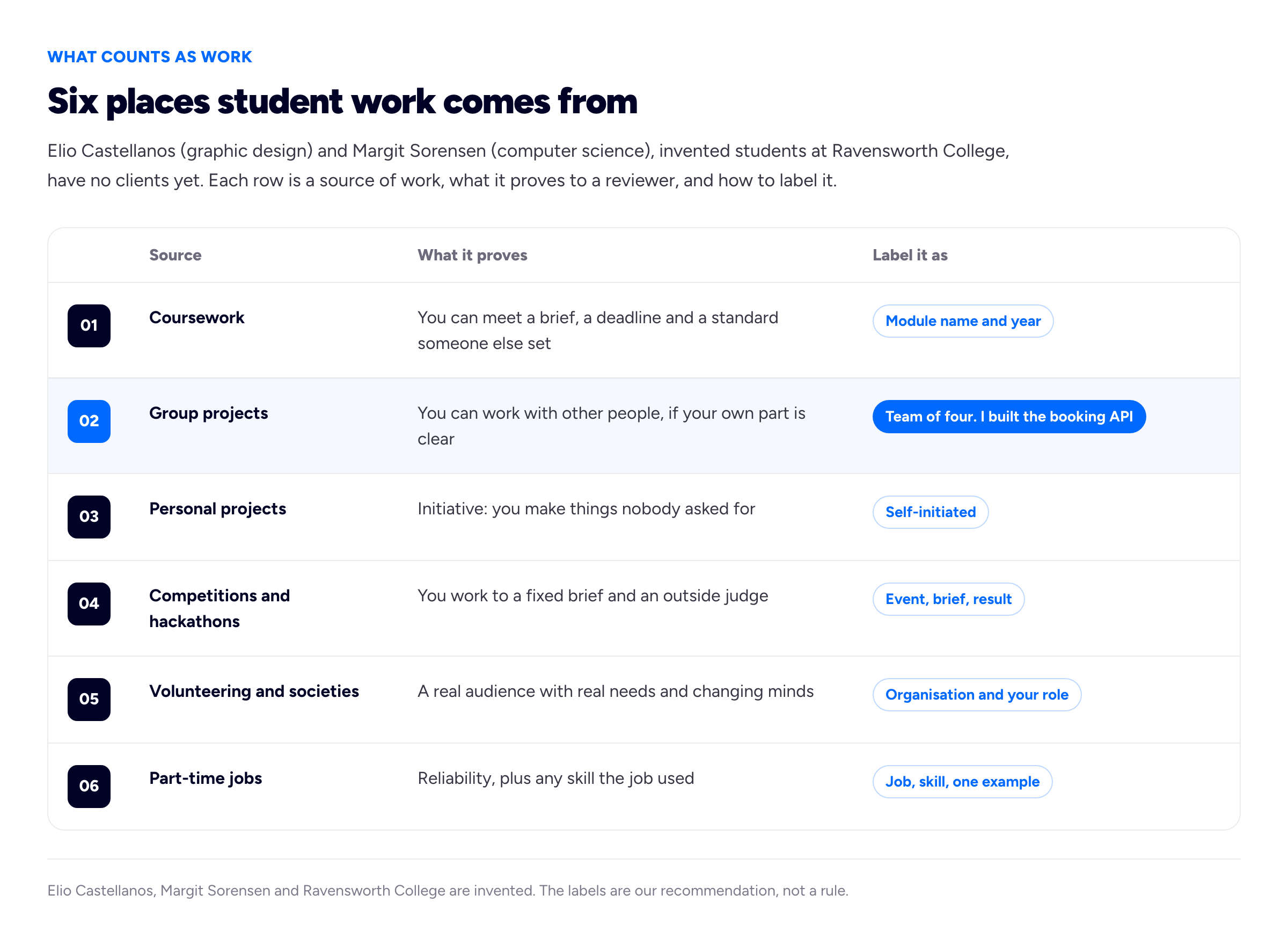
Every source counts. What changes is the label, and the label is what keeps the reviewer's trust.
Coursework
Coursework is the backbone of most student portfolios, and there is nothing second-rate about it. An assignment has a brief, a deadline and an assessor, which is more structure than many personal projects ever get. What makes coursework look like homework is presentation: the original assignment PDF, the module code as the title, the marking rubric still visible. What makes it look like work is a short write-up of the problem, your approach and the result, with the best images or code first.
Elio's strongest piece is a second-year typography project: a set of wayfinding signs for the college library. On his site it is titled "Library wayfinding system", not "TYP204 Assignment 2", and the first image is a photograph of a printed sign on a real wall, not a page of the submitted report. The module is named in the note underneath.
Group projects, with your role made explicit
Group projects are some of the most valuable things a student can show, because almost every job involves working with other people. They are also where portfolios most often go wrong. If four people built something and your page says "I built", the reviewer will either believe you, which is unfair to your teammates, or ask about it in an interview, where the truth comes out. Neither ends well.
The fix is one sentence near the top: the size of the team and exactly which part was yours. Margit's third-year software engineering project was a room-booking app built by four students. Her page says, before anything else: "Team of four. I designed and built the booking API and its tests; teammates handled the mobile front end, the admin screens and the user research." Everything below that sentence is about her part. It reads as more capable, not less, because it shows she knows where her work begins and ends.
Personal and self-initiated projects
A personal project shows something coursework cannot: that you make things when nobody is grading you. Label it as self-initiated, and if it is a redesign or rebuild of a real product, say plainly that it was not commissioned. Our guide to building a portfolio with no experience covers how to write yourself a brief so a personal project produces something worth showing, and why tutorial follow-alongs are better left off.
Competitions, hackathons and briefs set by outside bodies
A competition entry has an external brief and an external judge, which makes it useful evidence even if you did not win. State the event, the brief in a sentence, the time you had and the result, whether that was a placing, a shortlist or simply "submitted". Margit's hackathon project, a tool that turns a bus timetable into alerts, carries the line "Built in 36 hours with two others; my part was the data parsing. Not placed." That honesty costs her nothing.
Volunteering and societies
Designing posters for a student society, running its social media, building a club's membership form or editing its newsletter is real work for a real audience who will change their minds halfway through. That is closer to professional experience than most coursework. Name the organisation, your role and what you produced.
Part-time jobs
A part-time job in a café or a shop is not usually portfolio material on its own, but it often contains something that is. If you rewrote the shop's product descriptions, built a staff rota spreadsheet or redesigned the menu board, that is a project. If not, mention the job on your CV and in your about section, where it shows reliability, and leave it out of the project list.
How to write each project up
The write-up matters more than students expect. A reviewer looking at a strong image with no context cannot tell whether you made the key decisions or followed instructions. Five short parts answer that, and a student project rarely needs more than 150 to 300 words across all five.
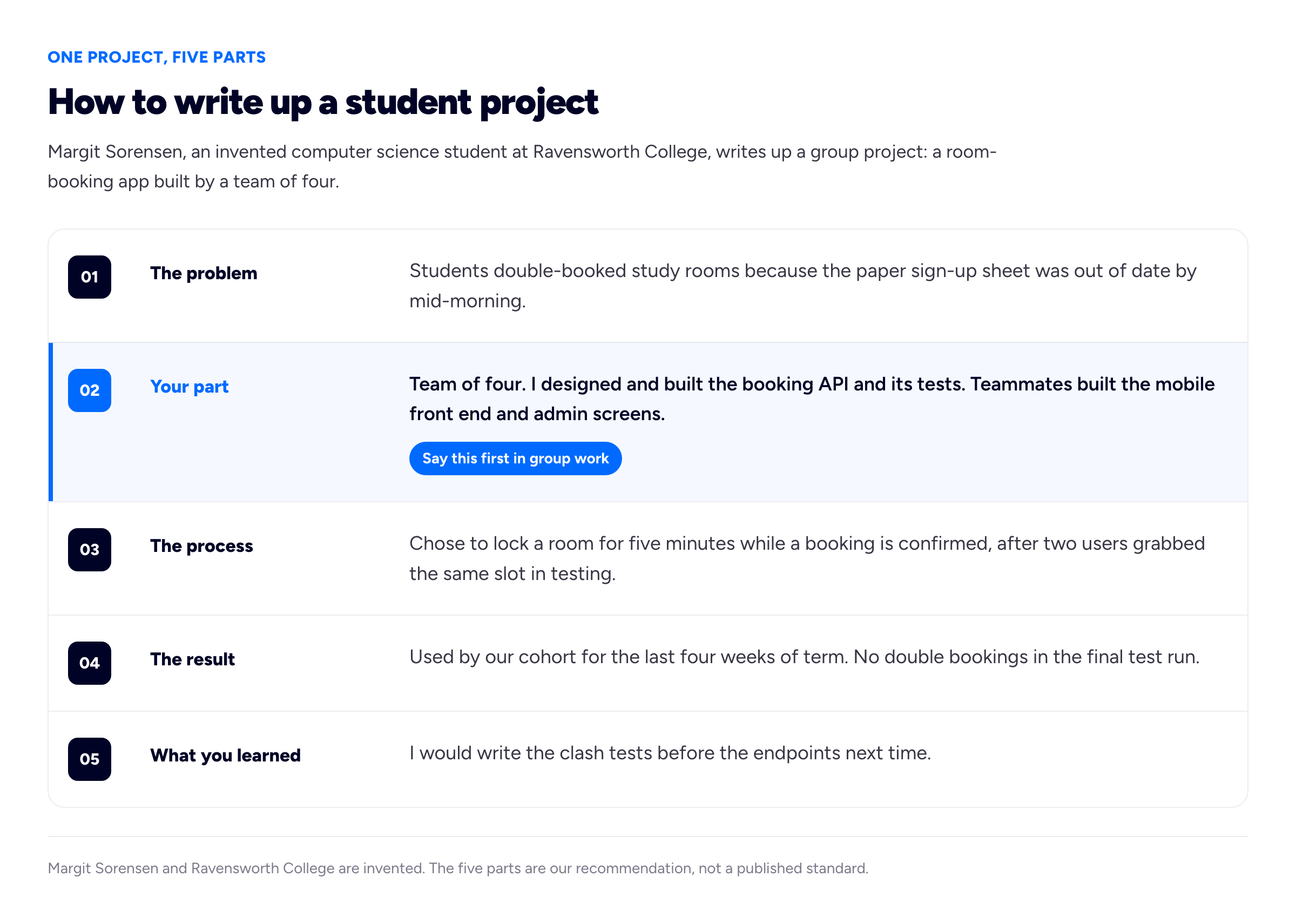
Five short parts, about 200 words in all. The second is the one group projects cannot skip.
- The problem. One or two sentences on what needed solving and for whom. If it was an assignment, restate the brief in plain words rather than pasting it in.
- Your part. What you did. For solo work, a line on the scope ("research, concept and final artwork"). For group work, the team size and your specific responsibilities.
- The process. Two or three decisions you made and why. This is where you show thinking: the option you rejected, the test that changed your mind, the constraint you worked around. Include one or two process images or a short code excerpt if they help.
- The result. What exists now, shown well, and any honest outcome: a grade if it was good, feedback from a tutor or user, a placing, the fact that people used it. Never invent numbers. "The society's sign-ups doubled" needs to be true and checkable; "the poster was used for the spring fair" is enough if that is what happened.
- What you learned. One sentence on what you would do differently. It shows you can judge your own work.
This is a shortened version of a full case study. Once you have a project with more depth, perhaps a final-year project or a placement, our guide to writing a portfolio case study shows how to expand the same structure without padding it.
How many pieces to include
Three to six. Three is the point at which a reviewer sees a pattern rather than a one-off; much beyond six and the weakest pieces start to pull the impression down, because a portfolio is judged by its average rather than its total. Our longer answer to how many projects a portfolio website needs goes through the reasoning and the exceptions, such as photography and illustration, where reviewers expect a larger body of work.
For students, two more rules help:
- Pick for the next application, not for your whole degree. If you are applying for a front-end development internship, your best interface work goes first, even if your highest grade was in algorithms. Keep the other pieces on the site but further down.
- Make the set varied in a way a reviewer can see. Elio shows a typography project, a brand identity for a society, a set of illustrations and a self-initiated poster series. Four different problems, one consistent level of finish. Four posters would have shown less.
If you only have two pieces you are proud of, publish two and add a third this term rather than padding with a weak one. A short, strong portfolio reads better than a long, uneven one.
How to structure the site
A student portfolio does not need many pages. Keep it to five things a reviewer can find in seconds.
- Home. Your name, what you study and where, and one line on what you are looking for: "Graphic design student at Ravensworth College, looking for a summer internship in a branding studio." Then your strongest projects straight away, as large thumbnails with short titles.
- Three to six projects. Each with its own page or section using the five-part write-up. Lead with an image or a working link, not a block of text.
- About. A short paragraph in the first person: what you study, what you are interested in, what you have done outside the course, and a photo if you are comfortable with one. Our guide to the portfolio about page has examples.
- A CV link. A downloadable PDF, kept up to date. The portfolio shows the work; the CV shows dates, grades and the part-time jobs. Each should point to the other; see how to put a portfolio link on your resume.
- Contact. An email address you check, plus LinkedIn and, for developers, GitHub. Use a personal address rather than a college one, which may stop working when you graduate.
Use a web address that will outlive your course. A page on your college's student web space or inside a course platform can disappear when your account is closed, taking every link in every application with it. A free site on your own subdomain, a personal domain or a portfolio platform you control is safer; Bunfolio is one option for a free subdomain, and our guide to building a resume website compares the routes.
Notes by discipline
The structure above works everywhere, but what a reviewer looks for first differs by subject.
Graphic design, illustration and visual arts
Lead with images, large and well cropped, and show work in context where you can: the poster on a wall, the identity on a society's banner, the book cover on a mock-up you made yourself (and say it is a mock-up). Include a little process, such as sketches, rejected directions or a page of a sketchbook, because reviewers for creative courses and junior roles want to see how you think, not only the polished result. Our graphic design portfolio guide and guide to making an art portfolio go further.
Computer science and software development
Reviewers want to see code they can read and things they can run. For each project, link the repository and, where possible, a live version or a short screen recording. Make sure each repository has a readme that says what it does, how to run it and what your part was. Pin your best repositories on GitHub so they match the portfolio. Our guide to what hiring managers look for in a developer portfolio covers the details.
Writing and journalism
Show published pieces first: student newspaper articles, society blogs, anything with a real editor and a real audience. Link to the live article where it exists and keep a copy, because student publications move and break links. Edited-down coursework essays can follow. Our freelance writer portfolio guide applies to students as well.
Architecture
Architecture portfolios are usually judged on a few projects shown in depth: drawings, models, site analysis and the thinking that connects them. Expect admissions and practices to have specific format requirements, often a PDF of a set length. Our architecture portfolio guide covers layout and sequencing.
Marketing and communications
Show campaigns, even small ones: a society's recruitment drive, a social media plan for a family business, a coursework campaign with a real brief. Say what you set out to do, what you made and what happened, with honest figures only where you actually measured them. The marketing portfolio examples guide has more on presenting results.
Science and research
A research portfolio is less about images and more about clear explanation. Include a lab project, dissertation or summer research placement written up for a general reader: the question, your method, what you found and your part in it. Add a poster or a figure you made, link any public code or data, and list presentations. Be careful with unpublished results that belong to a research group; ask your supervisor what you may share.
Common mistakes in student portfolios
- Showing group work as solo work. The most damaging mistake, because it is easy to discover and colours everything else on the site. Always state the team and your part.
- Uploading the assignment PDF unedited. A twenty-page report with a cover sheet and a marking grid is not a portfolio piece. Pull out the best images and write a short summary; link the full report only if it adds something.
- Titles that are module codes. Name the project after what it is.
- Too many pieces. Every weak piece lowers the average. Cut until only work you would happily talk about is left.
- Using other people's images or code without credit. Stock photos in a mock-up, a teammate's illustrations, a template you started from: say so.
- Sharing work you are not allowed to share. Placement work and research data may be confidential. Ask first, and see our guide to showing confidential work for ways around it.
- A link that dies. Student web space, expiring trial accounts and broken demo links all make you look careless. Click every link before each application.
- No contact details, or a college email only. Make it easy to reach you after you graduate.
Keep it updated every term
The easiest time to add a project is the week you finish it, while you still remember the decisions and still have the files. Leave it a year and you will be writing from memory, if you can find the work at all. A routine that takes an hour or two at the end of each term keeps the portfolio ready whenever an application comes up.
- Save the evidence as you go. Keep process photos, screenshots, sketches and the final files for every project in one folder, even ones you do not expect to use.
- At the end of term, pick the best new piece. Write the five-part note while it is fresh.
- Decide what it replaces. If the portfolio already has six pieces, the new one has to beat the weakest one to get in. Retire older work rather than letting the list grow.
- Re-read the home page and about section. Your year, your goal and what you are looking for may all have changed.
- Update the CV to match, and check every link.
When you graduate, the student portfolio becomes your career portfolio, and the habit of adding work as you finish it carries straight over.
Two example student portfolios
To make this concrete, here is how the two invented composite students at Ravensworth College lay out their sites. Neither is a real person's portfolio.
Elio Castellanos, graphic design, applying for a branding internship
Elio's home page opens with his one-line goal and four large thumbnails. First is the identity he made for the college climbing society, because it is the closest thing he has to a client project: a logo, colours and posters the society actually used. Then the library wayfinding coursework, a self-initiated gig poster series labelled as such, and editorial illustrations from a module. His about page mentions his weekend job in a print shop, where he learned to prepare files for print, which a branding studio cares about.
Margit Sorensen, computer science, applying for software internships
Margit leads with three projects: the room-booking app, with her role in its opening sentence, a repository link and a short screen recording; a personal command-line tool for tidying photo folders, published with documentation; and the hackathon bus-alert tool, its "Not placed" line intact. Her about section mentions that she tutors first-year students in programming, which shows she can explain code, and her GitHub and LinkedIn links sit beside her email address.
Neither portfolio has a client in it. Both make the case that the student would do good work if given the chance, which is what a reviewer of student work is trying to find out.
Frequently asked questions
What should a student portfolio include?
Three to six of your best pieces of work, each with a short note on the problem, your part, your process, the result and what you learned, plus a short about section, a link to your CV and contact details.
Can I put coursework in my portfolio?
Yes. Coursework is the main source of work for most students. Give it a descriptive title instead of the module code, lead with the best image or a working link, and write a short summary rather than uploading the assignment as submitted.
How do I show group projects in a portfolio?
State the team size and your specific part in the first sentence, then write the rest of the page about the part you did. Showing group work as if it were solo work is easy to discover and damages trust in everything else on the site.
Do I need a website, or is a PDF enough?
For internships and jobs, a website is easier to share and update, and you can still export a PDF from the same material. For course admissions, follow exactly the format each course asks for, which is often a PDF or a physical folder, and treat a website as an extra.
How many projects should a student portfolio have?
Three to six. Three is enough for a reviewer to see a pattern; beyond six, weaker pieces tend to lower the overall impression. If you only have two strong pieces, publish those and add a third this term rather than padding.
When should a student start a portfolio?
As soon as you have one piece you are proud of, and well before your first application deadline. Add a project at the end of each term while you still remember the decisions and have the files.
How we put this guide together
We build portfolio websites and free career tools, and we see a lot of first portfolios, many of them made by students. To be clear about what is here: the advice is our recommendation, not a published standard. The six sources of work and how to label them, the five-part write-up, the range of three to six pieces, the site structure, the discipline notes, the list of mistakes and the end-of-term routine are our view of good practice. No official body sets rules for what a student portfolio must contain, and the requirements of individual universities, colleges and employers override anything here.
The one external fact we state, that arts scholarships may be assessed on submitted portfolios and on interviews where you talk through your work, comes from the UCAS page on scholarships, grants and bursaries for the arts, which we read for this guide. We have deliberately not quoted statistics about how many employers look at portfolios or how long a reviewer spends on one, because we could not trace the figures that circulate to a published method, sample and date. We have also not listed specific universities' portfolio requirements, because they change from year to year; check each course's own admissions page.
The students and college in the examples, Elio Castellanos, Margit Sorensen and Ravensworth College, are invented composites, and so are their projects and every quoted line. They are not descriptions of real students' sites.
Related reading: building a portfolio with no experience, how many projects a portfolio website needs, how to write a portfolio case study, cover letter for an internship and what a career portfolio is.
More from the blog
October 31, 2026 · 19 min read
Professional Summary: How to Write One (With Examples)
A professional summary is three or four lines built from the job advert: your role and level, two pieces of proof, and what you bring to this employer. Summary, profile and objective compared, when an...
October 24, 2026 · 19 min read
Artist Statement Examples (and How to Write One Without Artspeak)
What an artist statement is and how it differs from a bio and a project statement, the four lengths to keep ready, a four-move method for drafting one, plain-language rules, an artspeak paragraph rewr...
September 21, 2026 · 18 min read
Nursing Portfolio: What to Include, Who Reads It and How to Build One
An interview panel, a clinical ladder committee, a certification auditor and an NMC confirmer all read a nursing portfolio, and only one of them wants the binder every guide describes. What each actua...