
August 2, 2026 · 20 min read
How to Write the About Page on Your Portfolio
The page that decides whether someone likes you, not whether you are capable. Six blocks, about three hundred words, and why writing in the third person gives you away.
The About page is the last thing most freelancers write and the first thing they get wrong. It usually ends up as one of two things: a paragraph of third-person biography lifted off LinkedIn, or a warm little list of hobbies that could belong to any of ten thousand people.
Both fail for the same reason. They are written as though somebody arrived at your site wanting to learn about you. Almost nobody does. They arrived with a problem, they have already scrolled your work, and they are reading About because they are close enough to hiring you that they want to know what you would be like to deal with for the next six weeks.
This guide covers what that reader is actually testing for, a six-block structure with word budgets that keeps the whole thing to around 300 words, a sentence-level rewrite of the paragraph everyone writes, and the one block almost nobody includes that clients care about enormously.
What the About page is actually for
Think about where it sits in a visit. Someone lands on your site from a referral or a search, looks at two or three projects, decides you are technically capable, and only then goes looking for who you are. The About page is read late, by a warm reader, at the point where the remaining question has stopped being about skill.
That reader is not asking whether you can do the work. They settled that upstairs. They are asking a much less flattering set of questions: will this person reply to my emails, will they tell me when something is going wrong, and am I going to enjoy the next two months. Hiring a freelancer is a short forced relationship with a stranger, and everyone who has done it before has at least one story about a stranger who went quiet.
So the About page has a narrow job. It converts a competent supplier into a specific person with a way of working. The portfolio structure guide treats it as one section among eight; this post is that section opened all the way up, because it is the section people find hardest to write and the one where the difference between a good version and a bad version is most visible.
Two consequences follow, and they explain most of the advice below. First, the page should be short — the reader is near a decision, not starting research. Second, it should be specific, because the only thing that distinguishes your About page from every other About page is detail that could not have been written by anybody else.
Why third person is the most common mistake
"Jane is a passionate, results-driven designer with a proven track record of delivering innovative solutions." You have read that sentence a hundred times. Nobody has ever said it out loud.
Third person is inherited from two places that are not your situation: the corporate team page, where a consistent voice across forty staff bios is worth more than any individual one, and the conference speaker bio, which is written to be read aloud by someone else. On a one-person portfolio it produces a strange effect — the reader knows perfectly well that you wrote it, so the distance reads as either a small pretence or an agency you are pretending to be.
The practical damage is bigger than the awkwardness. Third person quietly pushes you towards adjectives, because it is uncomfortable to write "I am passionate" and easy to write "Jane is passionate". Adjectives are the cheapest content on a portfolio site. Every freelancer is passionate, detail-oriented and creative; none of those words survive contact with a reader who has hired people before.
Write in the first person. It is not a stylistic preference — it forces the honest register, and the honest register is the whole product here.
The six blocks, and what each one owes the reader
Here is the structure we recommend. It is deliberately small. The word budgets are the point of the exercise: they stop the page becoming an autobiography, and they force each block to carry only its own weight.
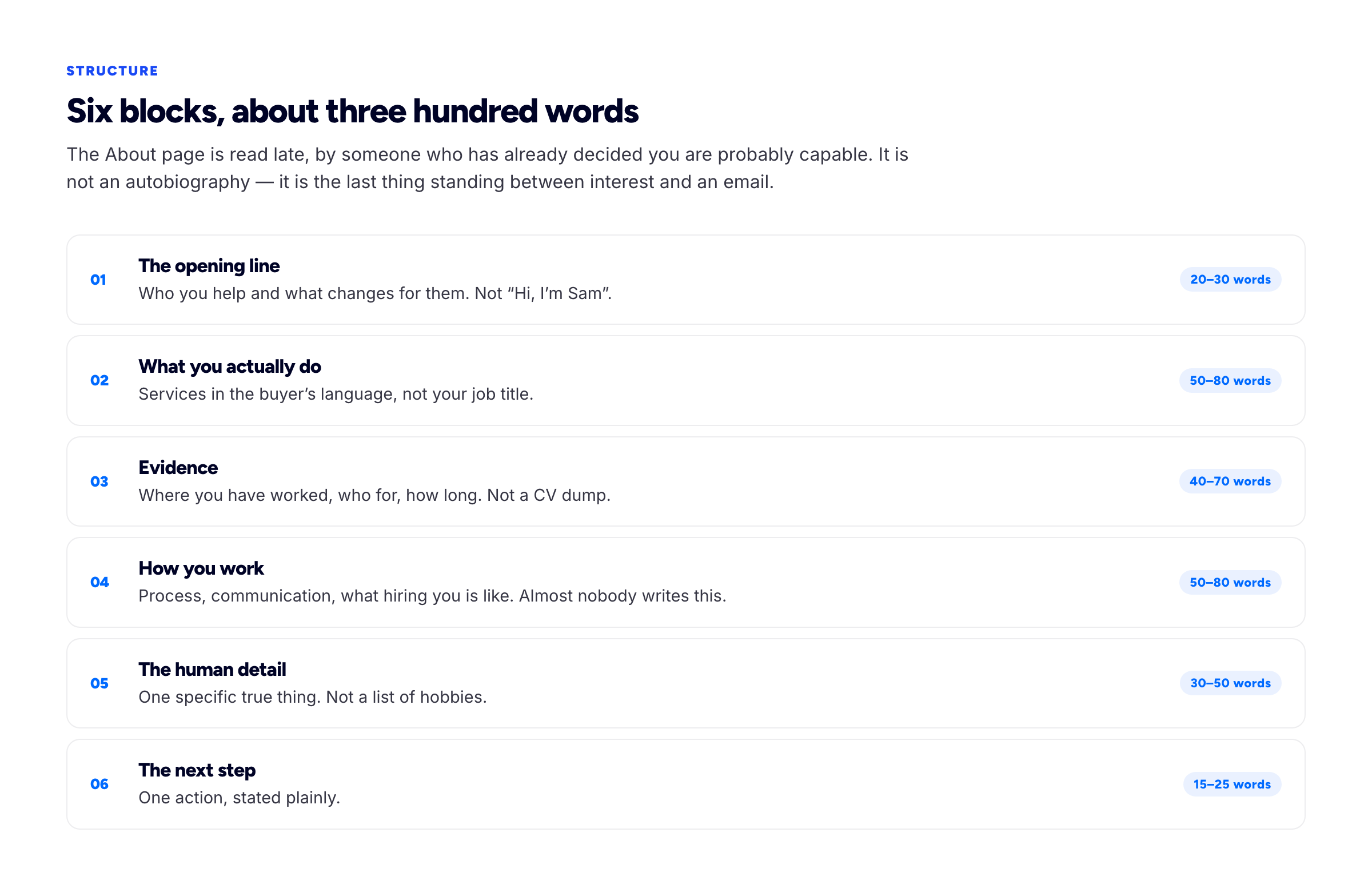
Around 300 words in total. The About page is not an autobiography.
1. The opening line — 20 to 30 words
Say who you help and what changes for them. That is the whole job of this line.
It is not "Hi, I'm Sam". A greeting spends your best line on information the reader already has from your domain name and your face. It is also not a job title on its own: "freelance developer" tells the reader what to call you, not whether to email you.
I help independent retailers sell more without rebuilding their store — usually by making the checkout faster and the product pages clearer.
Compare that with "I'm a freelance web developer with several years of experience across a wide range of industries." Same person, potentially. Only one of them has told a specific reader that they are in the right place.
This line depends entirely on having decided who you are for, which is a positioning question rather than a writing one. If you genuinely cannot name a buyer, the sentence will not come — no amount of drafting fixes an unmade decision. Whether to niche down is worth reading before you fight with this paragraph for a third evening.
2. What you actually do — 50 to 80 words
Two or three sentences naming the work, in the words a client would use to describe wanting it.
The failure mode here is the capability list. "React, TypeScript, Node, Postgres, AWS" is an inventory of tools, and it is the version of yourself you would present to another developer. A client buying front-end work does not want a tool list; they want to recognise their own situation.
Most of my work is one of two things. Either a store is slow and losing people at checkout, and I spend three or four weeks fixing that. Or a team has a design in Figma and no front-end developer, and I build it — accessible, tested, and handed over so their backend developer can maintain it.
Notice the shape: a situation, then what you do about it, then roughly how long. Tools can appear, but as a detail inside the sentence rather than as the sentence itself. Someone who needs React will recognise it in the work; someone who does not need React was never going to be filtered in by the word.
3. Evidence — 40 to 70 words
Where you have worked, who you have worked for, how long you have been doing this. Flat delivery, no adjectives.
This block exists to make the previous one believable, and it works best when it is boring. Years in the trade, two or three recognisable names if you have them, the in-house job before you went freelance, a sector you know unusually well. Facts, in a row.
Nine years in total: five in-house at a retail group with about forty stores, four freelance. I have worked with Shopify Plus merchants doing seven figures and with a two-person business selling ceramics from a garage. Both projects had the same checkout problem.
What this block is not is a curriculum vitae. Every job you have held, in reverse chronological order, with dates, is the wrong artefact in the wrong place — see the section on About pages versus CVs further down. Pick the three or four facts that make the work above credible and discard the rest.
If your strongest evidence is what clients say rather than where you have worked, the testimonials belong just beneath this section rather than inside it — a named quote next to a personal bio does more than a personal bio alone. Getting hold of those quotes is its own small skill; we cover the asking in how to ask clients for testimonials.
4. How you work — 50 to 80 words
Process, communication, what it is actually like to hire you. This is the block almost nobody writes, and it is the one a nervous client is looking for hardest.
Remember what the reader is anxious about. Not your competence — your reliability. Will you disappear for a fortnight. Will you say the estimate is slipping, or will you say nothing and then miss it. Do you work in a way that fits how their team works. Every one of those fears can be answered directly in four sentences, and answering them is unusual enough that it is close to a competitive advantage.
I work in one-week chunks with something you can click at the end of each. Written updates on Fridays, and if something is going to slip you hear it that week, not at the deadline. I am online 9 to 5 UK time and reply to email within a working day. I am comfortable being the only technical person in the room and explaining trade-offs in plain language.
Be truthful, including where the truth is a filter. If you do not take calls before eleven, or you do not work weekends, or you only take projects longer than two weeks, saying so loses you the enquiries that were going to end badly anyway. A constraint stated in advance reads as professionalism; the same constraint discovered in week two reads as a problem.
5. The human detail — 30 to 50 words
One specific true thing. Not a hobby list.
"When I'm not coding you'll find me with a coffee, my dog, or planning my next trip" is the single most replaceable sentence on the freelance internet. It is friendly and it says nothing, because it distinguishes you from nobody — the same three items appear on thousands of pages, and the reader's eye slides straight off.
The test for a good human detail is whether it could plausibly appear on someone else's About page. If it could, it is not doing any work. The details that survive are usually oddly specific, and often connect back to how you think:
- Weak: "I love travel, coffee and good design."
- Better: "I spent two years as a bicycle mechanic, which is where I learned that most things that look broken are one adjustment away from fine."
- Weak: "Outside work I enjoy reading and music."
- Better: "I play in a covers band that has done the same forty-minute set for six years. It has made me unreasonably relaxed about doing the unglamorous version of a thing well."
One is enough. This block is a handshake, not a personality profile, and a second anecdote starts to feel like you are trying to be liked — which is a different and less attractive thing than being specific.
6. The next step — 15 to 25 words
One action, stated plainly, with an idea of what happens afterwards.
If any of that sounds like your situation, email me at hello@example.com. I usually reply the same day with two or three questions.
The reader who finished your About page is the warmest reader you will get all week. Do not hand them back to the navigation to go looking for a contact form. One address, one link, one sentence about the reply — and pick the channel you genuinely answer fastest rather than offering four and letting them choose badly.
Rewriting the paragraph everyone writes
Most weak About pages are not badly structured. They are written in a register that removes every fact. The repair happens at sentence level, and it is mostly a matter of replacing evaluative words with concrete ones.
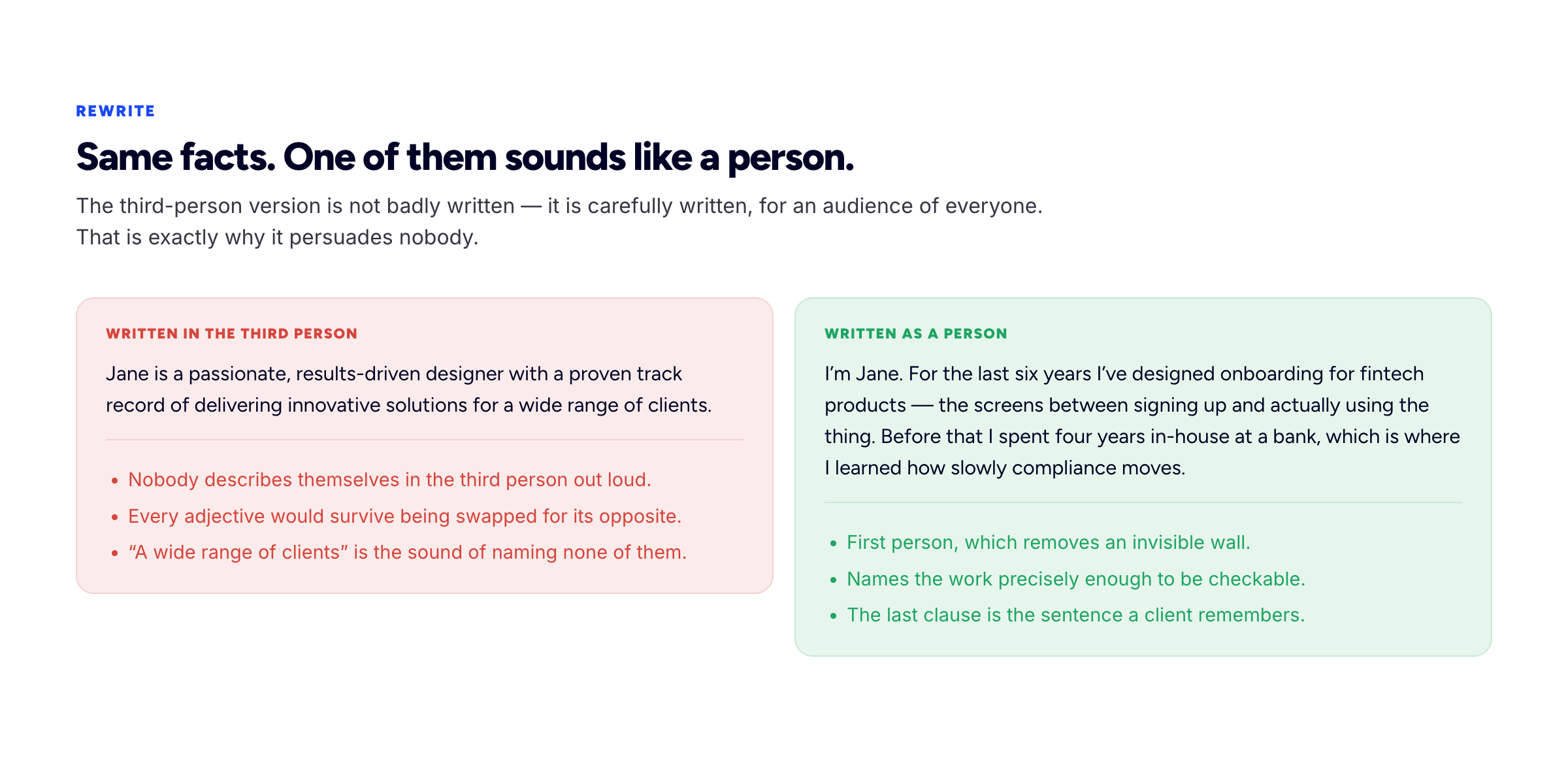
Same facts. One of them sounds like a person.
Look at what changed. "Passionate" and "results-driven" disappeared entirely, because they are claims the reader has no way to check and every competitor also makes. "A proven track record" became a number of years. "Innovative solutions" became a named thing — onboarding for fintech products — and then, crucially, an explanation of what that means for someone who does not work in fintech: the screens between signing up and actually using the thing. "A wide range of clients" became one previous employer and one thing that employer taught her, which is the only sentence in the rewrite that no other designer could have written.
Three moves will do most of this work on your own draft:
- Delete every adjective about yourself. Passionate, dedicated, creative, detail-oriented, results-driven. Read what is left. If the paragraph has collapsed, it was made of adjectives, and you now know what you have to replace them with.
- Replace ranges with instances. "A wide range of industries" becomes the two industries you have actually spent time in. Specificity feels like it narrows your market; in practice it is the only thing that makes anyone believe you.
- Add the thing you learned somewhere unglamorous. The compliance job, the agency you left, the years in a call centre. Origins explain judgement, and judgement is what is being bought.
A useful final pass: read the paragraph aloud. If you would not say it to someone at a table, it will not read well to someone at a laptop. The sentences that make you wince when spoken are the ones to cut.
The photograph
Include one. A face turns an abstract supplier into a person the reader can imagine emailing, and freelance hiring runs on that kind of small reassurance.
What kind matters less than people fear. A plain, well-lit, honest photograph of you looking at the camera beats an elaborate one, and it comfortably beats the awkward middle option — the stiff, slightly corporate portrait that looks like it was taken for a company you do not work at. Phone cameras in daylight near a window are entirely sufficient. Recent is more important than polished: a photo eight years and one haircut out of date creates a tiny dissonance at the first video call.
A few practical notes. Use the same photograph across your site, your LinkedIn and your invoices, so that people recognise you between contexts. Make sure it survives being cropped small and round, because most places will do that to it. And if you genuinely do not want your face on the internet, that is a legitimate choice — replace it with something else concrete, like a photograph of your desk or your work in situ, rather than leaving the space empty or filling it with a stock illustration of a person who is not you.
A worked example, start to finish
Here is the whole structure filled in. The freelancer is invented — Priya does not exist and neither do her clients — but the shape and the word budgets are real.
I build accessible websites for councils, charities and other organisations that have to work for absolutely everyone, including people using a screen reader on a five-year-old Android phone.
Two kinds of job. Either you have a site that has failed an accessibility audit and a deadline to fix it, and I work through the findings and hand back something that passes and stays passing. Or you have a new service to build, and I do the front end from the design files through to launch, with the accessibility work built in rather than bolted on afterwards.
Eleven years, the first six of them in-house at a county council. Since going freelance I have worked with two NHS trusts, a national homelessness charity, and a handful of smaller organisations who had never commissioned a website before. I sit on the accessibility panel for a local government network, which is mostly how I stay current.
I start with a half-day audit before quoting anything, because accessibility estimates made without looking are worthless. After that: two-week blocks, a working staging link from day three, and a written note every Friday saying what moved and what did not. If something is going to slip, you will hear it in that note rather than at the deadline. I am used to being the only technical person in a room of policy people, and I will not make you feel slow for asking what an ARIA label is.
I learned most of what I know about clear language from four years of writing bin collection notices that had to be understood by everybody in the borough. It is the best training in plain English I can imagine, and I have never really stopped doing it.
If you have an audit report you are staring at, send it to priya@example.com. I will read it and tell you honestly how big a job it is.
That is a little under 300 words. Notice what is doing the work: a named buyer in the first line, work described as situations rather than technologies, evidence that is flat and checkable, a process block that answers the fears rather than the questions, one human detail that explains her judgement rather than filling space, and a next step that asks for something the reader already has on their desk.
What to leave out
The About page gets longer by accretion. Every year something else gets appended and nothing is ever removed. These are the things to cut first:
- Your education, unless it is unusually relevant. Nobody hiring a freelancer with eight years of work behind them is weighing the degree. If it is genuinely load-bearing — a specialist qualification, an accreditation clients ask about — it belongs in the evidence block as one clause.
- The origin story. "I have loved design since I was a child taking apart my father's radio" is a paragraph about you at a moment when the reader is thinking about themselves.
- A full technology list. It belongs on a skills strip or in the project cards, where a reader scanning for a specific tool will actually look.
- Anything about a previous employer that reads as a grievance. A future client reads that as a preview of how you will describe them.
- Mission statements. "My mission is to craft meaningful digital experiences that make a difference" contains no information, and the reader has been trained to skip that sentence shape entirely.
- Availability you will not maintain. "Currently booking for spring" is excellent while it is true and quietly corrosive eighteen months later.
About page or CV?
They are different documents doing different jobs, and merging them produces something that does neither well.
A CV is a complete, chronological, employer-facing record designed to be scanned against a role. An About page is a short, selective, client-facing argument designed to make someone comfortable enough to send a first email. The CV is optimised for completeness; the About page is optimised for the reader deciding they like you.
Most freelancers need only the About page. If some of your income comes from contract or in-house roles, keep a CV as a separate PDF or a separate page, link to it once from About in a plain sentence, and let the two documents stay in their own registers. Do not let the CV's habits — dates, bullet lists of responsibilities, reverse chronology — leak into the About page, because those habits are exactly what makes an About page unreadable.
Keeping it current
An out-of-date About page is a specific kind of damage: it is the page where a reader is deciding whether to trust you, so a stale detail lands harder there than anywhere else. "Recently relocated to Berlin" from four years ago, a client you no longer work with described in the present tense, a technology you have quietly stopped using.
Once or twice a year is enough. Re-read the whole thing aloud, update the years, swap the client names for the ones you would most like more of, and check that the human detail is still true. That last one matters more than it sounds — the band broke up, the dog died, you sold the bicycle. A detail that was charming when written becomes slightly sad when it has been wrong for three years.
One more reason to keep it in good order: the About page is usually the page that ranks for your own name. When a prospective client hears about you in a meeting and types your name into Google that evening, this is what they land on, and you want it to be your page rather than a third-party profile. Making sure it is indexable and properly titled takes about ten minutes — the portfolio SEO guide covers the specifics.
Frequently asked questions
How long should an About page be?
Around 300 words for most freelancers, which is roughly what the six blocks above add up to. If you have a lot of relevant history, 400 is fine. Past about 600 you are writing an autobiography, and the reader who was one paragraph from emailing you has started scrolling instead.
Should I write in the first or third person?
First person, on a one-person portfolio, without exceptions worth worrying about. Third person is for company team pages and for bios other people will read aloud. If you need a third-person version for a conference or a guest post, keep it as a separate 60-word paragraph somewhere else.
Do I need a separate About page, or is a section on the homepage enough?
A section on the homepage is enough for most freelancers, and it has the advantage of being read in the flow rather than requiring a click. Give it its own anchor so you can link to it directly. A separate page is worth it if you have a lot to say, or if you want a distinct page targeting your own name in search.
What if I have no clients yet?
Write the same six blocks with the evidence block doing less. Say honestly how long you have been doing the work — including in-house, at university, or on your own projects — and lean harder on blocks two and four, which do not require a client list. What you must not do is imply a client roster you do not have; a reader who checks and finds nothing has learned something much worse about you than inexperience.
Should I include my rates on the About page?
No. Rates belong with your services, where the reader is thinking about scope rather than about you, and putting a number in the middle of a personal bio changes the register of the whole page. A single sentence in the services section — "projects typically start at" — does the filtering work without it.
Is it worth using AI to write my About page?
It is genuinely useful for the second draft and dangerous for the first. Given nothing to work with, a language model will produce exactly the passionate, results-driven paragraph this post spends its length trying to remove, because that is the average of everything ever written in this genre. Write the facts down yourself in whatever order they arrive — the years, the sectors, the process, the one true detail — and use the tool to tighten and cut. The specifics have to come from you; nothing else on the page is worth reading. That second-draft job is what our about me generator is built for — it asks for the route, the work and what you care about, and will not invent a personality you did not give it.
How we put this guide together
The structure, the six blocks and the word budgets are our recommendation, based on what we see working on portfolio sites built with Bunfolio and on the consistent pattern in how people describe reading them — they arrive at About already convinced of the work and looking for a reason to feel comfortable. We have not attached percentages to that observation, and you should be sceptical of anyone who does; the confident figures circulating about how visitors read portfolio pages generally trace back to no identifiable study.
Every piece of example copy in this post is invented, including Priya and her clients, and is written to demonstrate a structure rather than to describe a real freelancer. The before-and-after paragraph is likewise a constructed example, chosen because it is close to the phrasing we see most often.
Where this guide touches search — the point about your About page ranking for your own name — it is consistent with Google's guidance on creating helpful, reliable, people-first content, which values content that shows first-hand experience and makes clear who is behind it.
Related reading: how to build a freelance portfolio website that wins clients, how to write a portfolio case study, how to ask clients for testimonials, and what pages a portfolio website should have.
More from the blog
October 4, 2026 · 16 min read
How to Write a Cover Letter for an Internship (With Example)
Little or no work experience? Here is how to read an internship advert and match each requirement to your coursework, projects, societies or part-time job, with a full example letter annotated paragra...
October 3, 2026 · 16 min read
How to Make a Resume Stand Out: What to Change on the Page
A resume stands out by being the easiest one in the pile to say yes to, not by looking different. Here is how to rebuild the top of page one, turn duties into results (even without numbers), tailor ho...
September 27, 2026 · 22 min read
How to Write a Letter of Presentation (With 6 Examples)
A letter of presentation is what Spanish, Italian and Portuguese speakers call a cover letter, and it also means a letter introducing yourself or your services to a prospective client. What each meani...