
September 27, 2026 · 22 min read · Updated October 5, 2026
How to Write a Letter of Presentation (With 6 Examples)
A letter of presentation is what Spanish, Italian and Portuguese speakers call a cover letter, and it also means a letter introducing yourself or your services to a prospective client. What each meaning is called in English, the seven-part structure, an annotated example of each, how to send it, common mistakes and using AI honestly.
A letter of presentation is a short, one-page letter that introduces you to someone who does not know you yet and asks for a specific next step. To write one, say who you are and why you are writing to this reader, give two or three pieces of proof that match what they need, point to where they can see more of your work, and close with one clear request. In a job application it is what English-speaking employers call a cover letter; in business it is a letter of introduction, for example a freelancer presenting their services to a prospective client.
The rest of this guide explains why the term is confusing, sets out the seven parts in order, gives six complete letter of presentation examples for different situations, and covers formatting, sending and AI.
What a letter of presentation is, and why the term is confusing
The phrase is usually a literal translation. In Spanish the letter you send with a CV is a carta de presentación; in Italian a lettera di presentazione; in Portuguese a carta de apresentação. Translated word for word, each becomes "letter of presentation". Native English speakers rarely use that phrase, and most pages answering the question pick one meaning without mentioning the other.
In practice, "letter of presentation" covers two different jobs:
- The job-application letter. You send it with your CV or resume to an employer. In English this is a cover letter (American usage and increasingly everywhere) or a covering letter (a traditionally British form). Its job is to make the reader want to read the CV.
- The introduction letter. You send it to introduce yourself, your business or your services to someone who has not asked for an application, such as a prospective client or partner. In English this is a letter of introduction, or simply an introduction email. Its job is to open a conversation.
The structure of both is nearly identical; what changes is the reader, what they expect and what you ask of them. Applying for a job in an English-speaking market, call it a cover letter, because that is the word in the advert and in the recruiter's head. Introducing your services, call it nothing at all: send a short email and let the subject line describe it.
What it is called in other languages, and what to call it in English
The clearest single source for the European terms is Europass, the European Union's free CV and cover letter service, which publishes the same "create a cover letter" page in each of its languages. Its English page is titled Create Cover Letter. The Italian version is "Creare una lettera di presentazione", the Portuguese version is "Criar uma carta de apresentação", the French version is "Créer une lettre de motivation" and the German version is "Bewerbungsschreiben erstellen". For Spanish, the SpanishDict entry for carta de presentación gives "cover letter" (US), "covering letter" (UK) and "letter of introduction", which is the two-meaning problem in one dictionary entry.
French is the interesting exception. The job letter there is normally a lettre de motivation, literally a "motivation letter", and lettre de présentation tends to lean towards introducing a person or a company. That is also why some European universities ask for a "motivation letter" in English, which for a course usually means something closer to a personal statement.
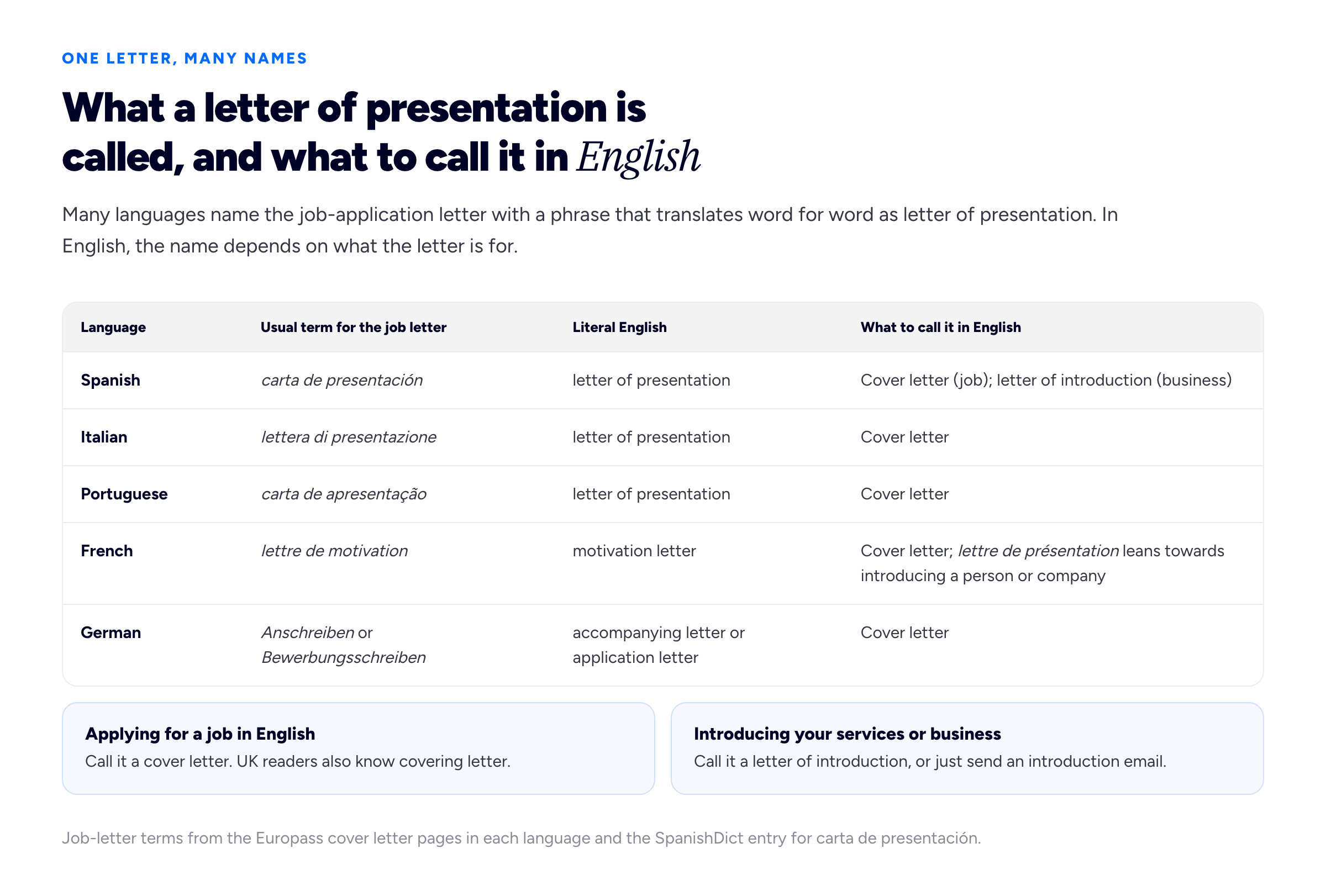
The words differ, the document does not. In an English-language application, use the reader's word: cover letter.
Two consequences follow. Searching for templates, search "cover letter": you will find far more examples. And if an English-language advert asks for a "letter of presentation", its author may be translating from their own language, so answer what the advert asks you to address, whatever it calls the document.
How to write a letter of presentation: seven parts, in order
Whichever meaning you need, the skeleton is the same and fits on one page.
- Your details. Name, email, phone, city, and a link to your work. In an email these go in the signature, not at the top.
- A named greeting. Use a real person's name if you can find it. Otherwise "Dear Hiring Manager" is acceptable.
- The opening. One or two sentences: who you are, what you are writing about, and why this reader in particular.
- The proof. Two or three specific things you have done that match what the reader needs. Each should be concrete enough to be checkable.
- The pointer. Where to see more: your portfolio, a case study, the attached CV.
- The request. One clear next step the reader can say yes to, such as an interview or a twenty-minute call.
- The sign-off. "Kind regards" or "Best regards" and your name.
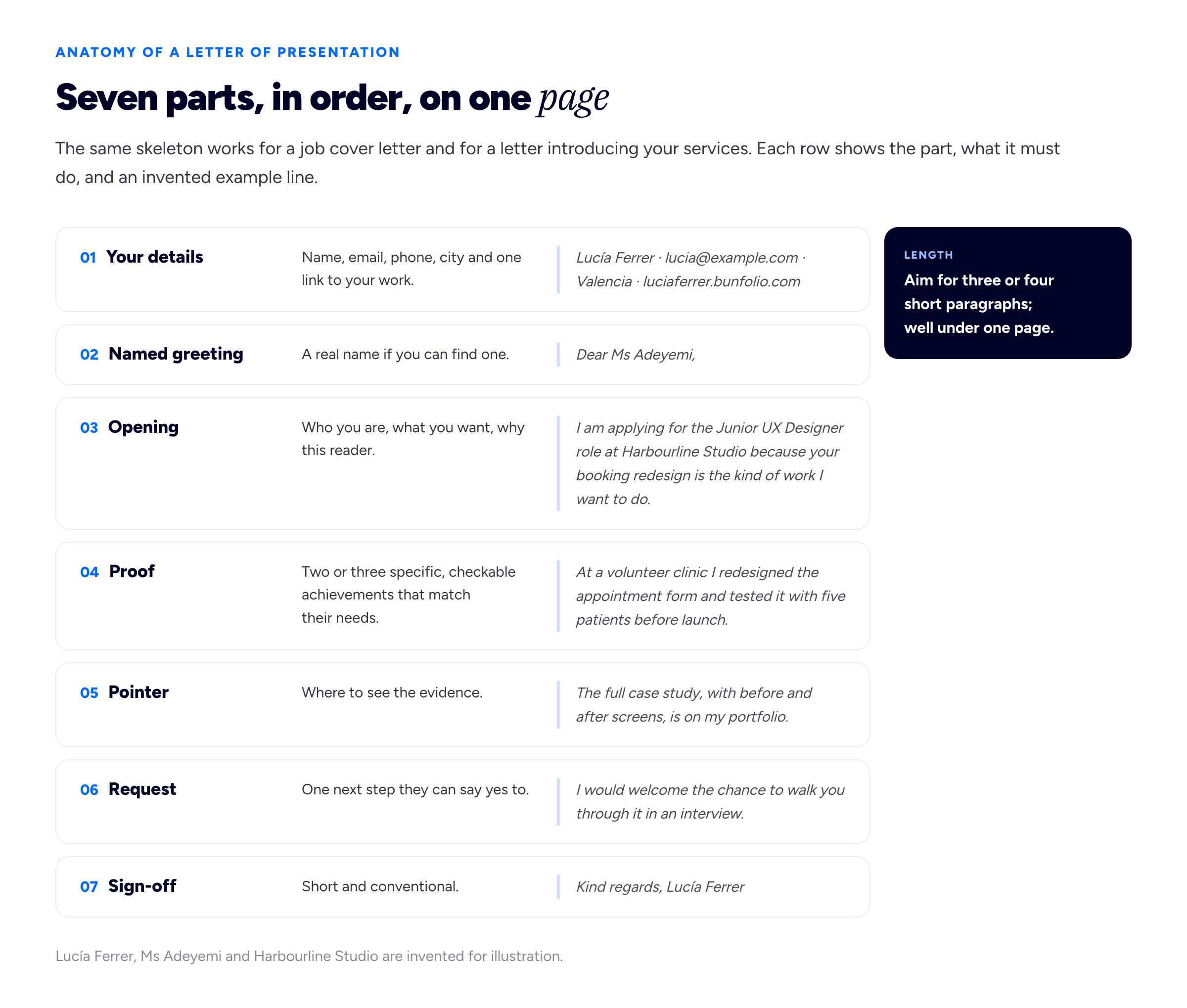
Weak letters often skip row four and spend their words on row three. The proof is the part the reader is looking for.
Letter of presentation examples
Six complete letters follow, one for each situation people most often need one for: an advertised job, an introduction of freelance services, a speculative application where no job is advertised, a career change, an introduction through a mutual contact, and a business presenting itself to a potential partner. Every name, company and detail in them is invented. Copy the structure, not the sentences: a letter is only as good as the specific facts you put into it.
Example 1: a letter of presentation for a job (a cover letter)
A complete example. The candidate, studio and contact are invented.
Subject: Junior UX Designer application: Lucía Ferrer
Dear Ms Adeyemi,
I am applying for the Junior UX Designer role at Harbourline Studio. I have followed your redesign of the Portside ferry booking flow since you published the case study, and that kind of work, making a stressful task calmer for people in a hurry, is exactly what I want to spend the next few years doing.
Your advert asks for research experience, prototyping in Figma and comfort presenting to clients. Over the past year I volunteered with a community health clinic in Valencia, where I interviewed eight patients and two receptionists about the appointment process, rebuilt the online booking form in Figma and tested it with five patients before it went live. I presented the findings to the clinic's board myself, including the parts they did not want to hear. Before that, I completed a UX certificate in which I led a four-person team on a transport app concept.
Both projects are written up as case studies, with screens and research notes, on my portfolio at luciaferrer.bunfolio.com. My CV is attached.
I would welcome the chance to talk through the clinic project in an interview. I am available from 1 November and happy to relocate to Bristol.
Kind regards,
Lucía Ferrer
lucia@example.com
What each paragraph is doing:
- The opening names the role and proves she has looked at the studio's work. One specific reference beats a paragraph of admiration.
- The middle paragraph mirrors the advert. It answers the advert's three requirements with things she actually did, and numbers she can stand behind. It does not claim a percentage improvement she cannot evidence.
- The pointer does the heavy lifting. The letter cannot show the work; the case study can. How to present that link is covered in our guide to putting a portfolio link on your resume.
- The close removes practical doubts. Start date and relocation are the two questions a hiring manager would otherwise have to ask.
It does not repeat her CV line by line. If you are unsure what belongs where, our comparison of a portfolio vs a resume sets out what each is for, and our guide to the resume skills section covers the lists that belong on the CV rather than in the letter.
Example 2: a letter of presentation introducing your services
The second meaning is the one freelancers need. Nobody has advertised anything, which changes three things: the letter must be shorter, the proof has to be about their kind of problem rather than your career, and the request has to be small, because a stranger will agree to a short call long before a project.
Subject: Packaging for Fennick & Rowe's new sourdough range
Dear Mr Rowe,
I am a freelance brand and packaging designer in Leeds. I read in the local paper that Fennick & Rowe is taking its sourdough into three supermarkets next spring, and I am writing because moving from a bakery counter to a supermarket shelf is a packaging problem I have solved before.
Last year I designed the shelf packaging for Holt Mill, a flour producer that was moving from farm shops into regional grocers. The brief was to keep the hand-made feel their regulars loved while making the bags readable from two metres away. The case study, with the original bags, the rejected routes and the final range on shelf, is here: martaoliveira.bunfolio.com/holt-mill.
If it would be useful, I would be glad to spend twenty minutes on a call next week looking at your current packaging and telling you honestly what I would change and what I would leave alone. No preparation needed on your side.
Best regards,
Marta Oliveira
Freelance brand and packaging designer · martaoliveira.bunfolio.com
Everything in that letter, including Marta, Fennick & Rowe, Holt Mill and the newspaper story, is invented. The points worth copying:
- A reason to write now. The expansion is a trigger event: a moment when the reader has a problem you can name.
- One piece of proof, closely matched. One case study about the same kind of move beats a client list.
- A link to one page, not a homepage. This only works if each project in your portfolio has its own page.
- A request that costs the reader almost nothing. Easy to accept, easy to decline politely.
Example 3: a speculative letter when no job is advertised
Writing to an employer who has not advertised a role is the closest thing to the original meaning of the phrase: you are presenting yourself, not answering an advert. The letter has to explain why you chose them, because nothing else does.
Subject: Junior motion designer: speculative application from Tomás Reyes
Dear Ms Whitlock,
I am a motion designer in Manchester, and I am writing to ask whether Corbel Animation expects to take on a junior in the next few months. I know you have not advertised a role. I am writing anyway because your explainer series for the city's recycling service is the reason I moved from print into animation.
Since finishing my course in June I have made three short pieces for local charities, each under ninety seconds, storyboarded, animated and delivered to their deadline. The one I would most like you to see is a sixty-second film for a food bank, which they now play at their volunteer inductions: tomasreyes.bunfolio.com/food-bank.
If nothing is open now, I would be grateful to be kept in mind, and glad to come in for fifteen minutes whenever suits you.
Kind regards,
Tomás Reyes
tomas@example.com
Why it works: it admits there is no vacancy, gives a real reason for choosing this studio, offers one link to one piece of work, and asks for something smaller than a job.
Example 4: a letter of presentation for a career change
When your experience is in another field, the letter has one extra job: translating what you have done into what the new reader needs. Lead with the overlap, not with an apology for the gap.
Subject: Customer Success Associate application: Priya Nair
Dear Mr Okafor,
I am applying for the Customer Success Associate role at Lattice Bookings. For six years I have been a primary school teacher, and the parts of your advert that ask for patient onboarding, clear written guides and calm handling of frustrated people describe most of my working week.
Last year I led my school's move to a new parent messaging app: I wrote the setup guide, ran four drop-in sessions for parents and answered the questions that came in afterwards. Separately, I have completed a short course in customer support tooling, and I have written up the parent onboarding project, with the guide itself, on my portfolio at priyanair.bunfolio.com.
I would welcome an interview to talk about how that experience transfers. I can start after the end of the school term on 19 December.
Kind regards,
Priya Nair
priya@example.com
Why it works: it names the career change in one clause and moves on, maps three phrases from the advert onto things she has done, and turns a teaching project into evidence a software company can read.
Example 5: an introduction through a mutual contact
A referral is the strongest opening a letter of presentation can have, so put it in the first sentence and the subject line. Keep the rest short: the introduction has already done half the work.
Subject: Introduction from Hannah Cole: copywriting for your new website
Dear Daniel,
Hannah Cole suggested I get in touch. She mentioned that Brightwater Physio is rebuilding its website before opening the second clinic, and that the service pages are the part nobody has had time to write.
I am a freelance copywriter who works mainly with healthcare practices. I wrote Hannah's own clinic website last year, so you may already have seen my work; a short write-up of that project, including the service pages, is at sambrooks.bunfolio.com/cole-clinic.
Would a twenty-minute call next week be useful? I can tell you what I would need from you, and roughly how long the pages would take.
Best regards,
Sam Brooks
Freelance copywriter · sambrooks.bunfolio.com
Why it works: the mutual contact is named before anything else, the proof is work the reader can check with someone they trust, and the request is a call rather than a commission.
Example 6: a business presenting itself to a potential partner
A letter of presentation is also how a small business introduces itself to a stockist, venue or partner. The rules do not change: one reason this reader, one piece of proof, one small request. What changes is that "we" replaces "I", and the proof is about the business rather than your career.
Subject: Stocking Low Fell Candles at Thornbury Home
Dear Ms Patel,
I run Low Fell Candles, a two-person workshop in Cumbria making soy candles in refillable stoneware. I am writing because Thornbury Home already stocks two of the potters we work with, and our range was designed to sit alongside that kind of table.
We currently sell through our own website and four independent shops in the Lake District, and we can supply on standard wholesale terms with a minimum order of twelve units. Our product sheet, with photographs, dimensions and trade prices, is at lowfellcandles.example.com/trade.
If it would help, I would be happy to post a sample set to the shop so you can see the finish in person. There is no obligation either way.
Best regards,
Ellen Marsh
Founder, Low Fell Candles
Why it works: the reason for writing is specific to this shop, the practical facts a buyer needs (channels, terms, minimum order) are in one sentence, and the request is a free sample, which is easy to accept.
Whichever example is closest to your situation, the test is the same: could this letter have been sent to anyone else? If it could, add the sentence that only this reader would recognise. For more on the first and last lines, see our guides on how to start a cover letter and how to end one; if you are a student applying for placements, our internship cover letter guide has examples built for that situation.
Writing one as a freelancer: making the introduction land
For a freelancer, the introduction earns a reply, the reply becomes a conversation, and the conversation becomes a proposal. A few habits make the first step work.
Pick the reader before you write the letter
Before writing, you should be able to answer three questions: what does this business do, what is changing for them right now, and which piece of your work is closest to what they need. If you cannot answer the third, you are writing to the wrong business, or you need a different example in your portfolio first. Our guide to getting your first freelance clients covers how to build that list without relying on marketplaces.
Let the portfolio carry the proof
A letter can only claim; a portfolio can show. That is why the link matters more than any sentence in the letter, and why it should go to the most relevant project rather than your front page. It also has to open on a phone without logging in: not a PDF download, not a shared drive folder. If you do not have one yet, Bunfolio gives you a free portfolio website on your own subdomain, with a page for each project, from a Google sign-in.
Keep the proposal for later
The introduction is not the place for prices, packages or a scope of work. Those belong in the proposal you write once you have spoken and understand what they actually need; our guide to writing a freelance proposal that wins picks up from exactly that point.
Follow up once
One short follow-up about a week later, adding something useful, is reasonable. After that, leave it; no reply to two messages is an answer.
Formatting and sending it
In the email, or as an attachment?
For an introduction letter, always put it in the body of the email. Strangers rarely open attachments from people they do not know.
For a job application, follow the instructions. An application system with an upload field wants a file. By email, put the letter in the body and attach your CV; attaching the letter as a PDF too, so it can be forwarded with the CV, is fine. An empty email with two attachments is not.
If you attach a file
- Use PDF unless the employer asks for a Word file.
- Name the file so it makes sense in someone else's downloads folder:
Lucia-Ferrer-Cover-Letter-Harbourline.pdf, notcover letter final v3.pdf. - Match the CV. Same font, same header with your name and contact details, so the two read as a set.
- Keep it to one page, with ordinary margins and a readable body size. (Our guide to how long a resume should be covers the CV.)
Subject lines
For a job: the role, the word "application", your name and any reference number. For an introduction: the specific thing you want to help with, in their terms. No capitals, no exclamation marks, no "quick question".
Presentation
Plainly: left-aligned, no photos, no graphics. Designers sometimes want the letter to double as a design sample; your portfolio does that better, and a heavily designed letter can be awkward for application systems to read.
Common mistakes
- Repeating the CV. The reader has the CV. Pick the two or three things that matter for this role.
- Writing about what you want instead of what they need. "This role would be a great opportunity for my growth" is about you. Say what you would bring.
- Sending the same letter everywhere. One specific sentence about the reader's organisation is the minimum.
- Claims without evidence. "Excellent communicator" and "passionate about design" are unfalsifiable. Replace each with something you did.
- Wrong name, wrong company. Easy to make when adapting a previous letter; check both twice.
- A literal translation. If English is not your first language, have a fluent reader check it. "I permit myself to present my candidature" is a direct translation you will see; "I am applying for" is what an English reader expects.
- No next step. "I hope to hear from you" leaves the reader to decide. Ask for the interview or the call.
Using AI to help, honestly
An AI tool is useful for the mechanical parts: a first structure, cutting a long letter, turning stiff translated phrasing into natural English. It fails where the letter matters. Given nothing specific, a language model writes a fluent letter that could have come from anyone, and readers who see many applications recognise that voice. Given false specifics, it will happily put them in your letter as fact.
So collect the facts first: what the reader needs, and what you have actually done that matches. Give the tool those, then rewrite its draft in your own words and check every claim. Our free AI cover letter generator is built that way: you paste the role, optionally the employer and the requirements from the advert, add rough notes on your real background and pick a warm, plain or formal tone, and it returns a short three-paragraph draft for you to edit. It will not know anything you did not tell it, which is the point.
Two rules apply whatever tool you use. Never let it add experience, results or skills you do not have; you may be asked about any line in an interview. And never send the draft unedited. The detail only you know is what makes a letter worth reading.
Frequently asked questions
Is a letter of presentation the same as a cover letter?
When it is part of a job application, yes. "Letter of presentation" is a word-for-word translation of the term used in Spanish, Italian and Portuguese for what English calls a cover letter. The phrase is also used for a letter introducing yourself or a business to a prospective client or partner, which in English is a letter of introduction. Same structure, different purpose.
How long should a letter of presentation be?
Under a page. For a job, three or four short paragraphs, roughly 200 to 350 words, is plenty; our cover letter generator aims at 180 to 250. For an introduction to a prospective client, shorter still, because the reader did not ask to hear from you. If it needs scrolling on a phone, cut it.
How do you write a letter of presentation?
Open with who you are and why you are writing to this particular reader, then give two or three specific, checkable pieces of proof that match what they need. Point them to where they can see more, usually one page of your portfolio or your attached CV, and finish with a single request they can say yes to, such as an interview or a short call. Keep it under a page and send it in the body of the email unless you are asked for a file.
How do you start a letter of presentation?
With the reader's name and one sentence that says what you are writing about and why them: the role you are applying for, the person who referred you, or the change in their business that made you write. Avoid opening with your name or "I am writing to express my interest"; the reader learns nothing from either. Our guide to how to start a cover letter has more opening lines.
Can I use ChatGPT to write a cover letter?
You can use ChatGPT or any other AI tool to help draft one, and it is good at structure and at tidying language. Give it the real requirements and your real experience, then rewrite the result in your own voice and remove anything untrue. An unedited AI letter tends to read as generic, and an AI letter with invented details can cost you the job when the interviewer asks about them.
What should a 2026 cover letter look like?
Short, plain and specific. A clean one-page layout or a plain email, a named greeting, an opening that says which role and why this employer, two or three concrete achievements matched to the advert, a link to your work, and a request for an interview. With so many letters now drafted by AI, specific detail is what sets a letter apart.
What are 5 common cover letter mistakes?
Repeating the CV instead of selecting from it; writing about what you want rather than what the employer needs; sending one generic letter to every company; making claims like "hard-working" with no evidence; and getting the company or contact name wrong.
How should a cover letter be presented?
As a plain, left-aligned letter on one page, either in the body of an email or as a PDF matching your CV's header and font, named with your name and the employer. Follow the employer's instructions if they give any, and keep design out of it; show design skills in your portfolio instead.
How we put this guide together
The seven-part structure, the advice on subject lines, file naming, following up and using AI, and the six example letters are our own recommendations, drawn from how these letters are read rather than from any official standard. Word ranges are guidance, not a rule.
We have deliberately left out statistics we could not trace. There are widely repeated figures for how many seconds a recruiter spends on a cover letter, what percentage of hiring managers read them, and how much a tailored letter raises your chances; none of those we found pointed to a published method we could check, so none appear here.
The terms used in other languages come from sources we read: the European Union's Europass cover letter page in English, Italian, Portuguese, French and German, the SpanishDict entry for carta de presentación, and Wiktionary's translations for "cover letter". The observation that French lettre de présentation leans towards introducing a person or company is our reading of usage, not a dictionary definition.
Lucía Ferrer, Ms Adeyemi, Harbourline Studio, the Portside ferry project, Marta Oliveira, Fennick & Rowe, Holt Mill, the newspaper story about the bakery, Tomás Reyes, Corbel Animation, Priya Nair, Lattice Bookings, Hannah Cole, Brightwater Physio, Sam Brooks, Low Fell Candles, Thornbury Home and Ellen Marsh are all invented to show the structure of each letter. Email addresses and the candle workshop's trade link use the reserved example.com domain.
Related reading: how to put a portfolio link on your resume, writing a freelance proposal that wins, getting your first freelance clients, portfolio vs resume, how long a resume should be, the resume skills section and how to end a cover letter, how to start a cover letter and writing a cover letter for an internship.
More from the blog
October 4, 2026 · 16 min read
How to Write a Cover Letter for an Internship (With Example)
Little or no work experience? Here is how to read an internship advert and match each requirement to your coursework, projects, societies or part-time job, with a full example letter annotated paragra...
October 2, 2026 · 15 min read
How to Start a Cover Letter: Greetings, Opening Lines and Examples
Start with your details and the date, a greeting to a named person or "Dear Hiring Manager", then an opening that names the role, gives one specific hook and says why this employer. Greetings compared...
September 28, 2026 · 15 min read
How Long Should a Cover Letter Be? Words, Pages and Paragraphs
One page is the published guidance and four or five short paragraphs is the shape. Where a 250–400 word target comes from, when faculty, federal, emailed and form applications change it, what to cut,...