
October 31, 2026 · 19 min read
Professional Summary: How to Write One (With Examples)
A professional summary is three or four lines built from the job advert: your role and level, two pieces of proof, and what you bring to this employer. Summary, profile and objective compared, when an objective still makes sense, before-and-after rewrites, ten annotated examples and how to reuse it on LinkedIn and a portfolio.
A professional summary is the three or four lines under your name that tell the reader what you are, what you have done that proves it, and why that matters for this particular job. Write it last, from the job advert rather than from your own history: line one names the role and your level, lines two and three give two pieces of proof, and the last line says what you would bring to this employer. Leave out "I", leave out adjectives nobody can check, and leave out anything about what you want from the job. A summary, a profile and an objective are the same slot under three names, and for most people the summary version is the one to write. The exceptions are a career change, a first job, and a named programme you are applying to, where a short line about your aim earns its place.
Below: the formula in detail, rewrites, ten annotated examples, what to cut, and how to reuse the lines on LinkedIn and a portfolio site.
The short answer
- Length: three or four lines, or two or three sentences.
- Place: directly under your name and contact details, above your experience.
- Content: the role and level, two proof points, and what you offer this employer. Numbers only if you really have them.
- Source: the job advert. Each application gets its own version, even if only one line changes.
- Cut: "I", "seeking", "passionate", "results-driven", "team player" and anything the reader cannot check.
Summary, profile or objective: the same slot
"Professional summary", "resume profile", "personal profile" and "objective" all describe the same few lines at the top of page one. The differences are in emphasis, not in kind.
The UK's National Careers Service, in its guide to CV sections, calls it an introduction: "a few short lines that sum up who you are and what you hope to do", placed "just under your name and contact details". Prospects, the UK graduate careers site, calls it a personal profile that "picks out a few relevant achievements and skills, while expressing your career aims". Duke University's career centre, in its page on summary statements, asks for two or three sentences that outline "the value you bring to the position and organization", and tells students to avoid the word "objective" in the heading. The Purdue Online Writing Lab's introduction to résumés lists objectives and summaries side by side, each "one to three sentences", says objectives "may be becoming less common", and adds that none of these sections is strictly necessary.
Read together, those sources agree that the section is short, sits at the top, and should say what you offer rather than only what you want. A summary leads with experience; a profile, the usual UK name, is the same thing with a phrase about direction; an objective leads with the goal; and a summary of qualifications breaks the proof into bullets, which suits technical roles and long careers. "Objective summary", the phrase many people search for, describes what works best in most cases: a summary with one clause about where you are heading. The heading can simply be "Profile" or "Summary".
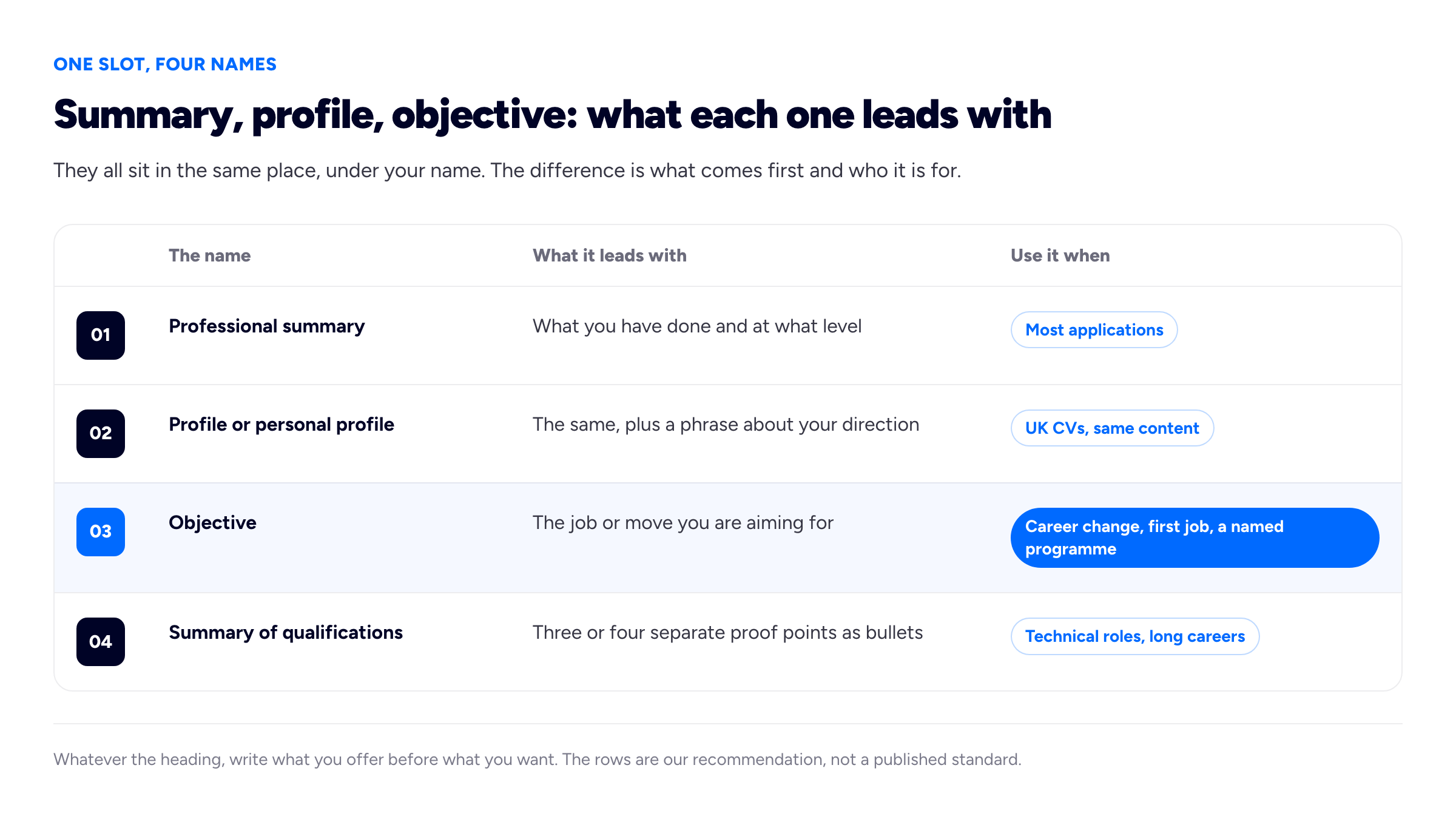
The heading matters less than the order: what you offer comes before what you want, whatever the section is called.
When an objective still makes sense
An objective is worth writing when the reader would otherwise be confused about why your resume is on their desk. The US Department of Labor's Creating Your Resume participant guide, written for people leaving the military, says the career objective "is typically unnecessary" but "can be effective for job seekers who are shifting careers or industries", where it explains how past skills transfer. In our reading of applications, it earns its place in three cases:
- Career change. A teacher applying for a learning design job needs one clause that says so, or the reader wonders if the resume reached the wrong vacancy.
- First job or entry level. With little experience to summarise, a clear statement of the role you want, followed by the evidence you do have, is more honest than inflating a summary.
- A specific programme. A graduate scheme, an apprenticeship, a residency or a returner programme has a name. Naming it shows the resume was written for them.
Even then, the objective should be one clause inside a summary, not a whole paragraph about your hopes. "Moving from secondary teaching into learning design" is an objective. "Seeking a challenging role in a forward-thinking organisation where I can develop my skills" is not; it could sit on any resume.
The formula: four lines built from the advert
Weak summaries are written from the candidate's history outwards. The ones that work are written from the job advert inwards: what does this employer need most, and which of your facts answers it? So write it last, after tailoring the rest of the resume, with the advert open.
Read the advert and underline the two or three requirements it repeats or puts first. Those are the things the reader is checking for. Then build four lines.
- Role and level. The job title you are, or the closest honest version of the title in the advert, plus years or level. "Claims handler with six years in commercial property claims." Match the advert's language where it is true.
- Proof point one. The fact that answers the advert's first requirement. A scale, a result, a responsibility you held alone.
- Proof point two. The fact that answers the second requirement, ideally a different kind of evidence: if the first was a result, make this one a responsibility, a qualification or a tool.
- What you bring to this employer. Not "a valuable asset to your team", but the specific thing your experience would let you do in their job, in their words.
Use numbers only if you have them and can explain them at interview. A summary with an invented percentage is worse than one with none, because the number is the first thing an interviewer asks about. If you do not have figures, use scale (how many accounts, sites, clients or people), frequency (weekly, every quarter), responsibility (sole owner of, signed off) or a recognisable outcome (passed audit, promoted, kept on after the contract). The guide on making a resume stand out has more substitutes for a missing number.
Write it without "I". The convention on resumes is the implied first person ("Led a team of four", not "I led a team of four"), and Duke's guide lists personal pronouns among things to avoid.
A worked example: Priyanka Lowell and Brindlewood Insurance
Priyanka Lowell is a claims handler applying for a senior claims handler post at Brindlewood Insurance. Both are invented for this guide. The advert, written by the claims manager, Odette Marchetti, asks first for "experience handling complex commercial property claims end to end", then "confidence negotiating with loss adjusters and brokers", then "willingness to coach newer handlers". It mentions a move to a new claims system twice.
Priyanka's first draft, written before she read the advert closely:
Dedicated and hardworking insurance professional with a strong customer focus and excellent communication skills. Looking for an opportunity to progress my career with a reputable insurer.
All true, and no help to Odette Marchetti. "Insurance professional" does not say claims, commercial or property. "Excellent communication skills" is what everyone writes. The second sentence is about what Priyanka wants. Here is the rewrite, built line by line from the advert:
Commercial property claims handler with six years' experience, the last three handling complex losses end to end. Carry a caseload of around 60 open claims and negotiate settlements directly with loss adjusters and brokers. Trained four new handlers on the team's previous system migration. Would bring the same case ownership, and experience of a system change, to Brindlewood's senior claims team.
Each sentence answers one line of the advert: complex claims end to end, negotiation, coaching, and the system change. The figures are ones Priyanka can check against her own records. The last line names the employer, which is the change readers notice, and it says what she would do rather than how she would feel.
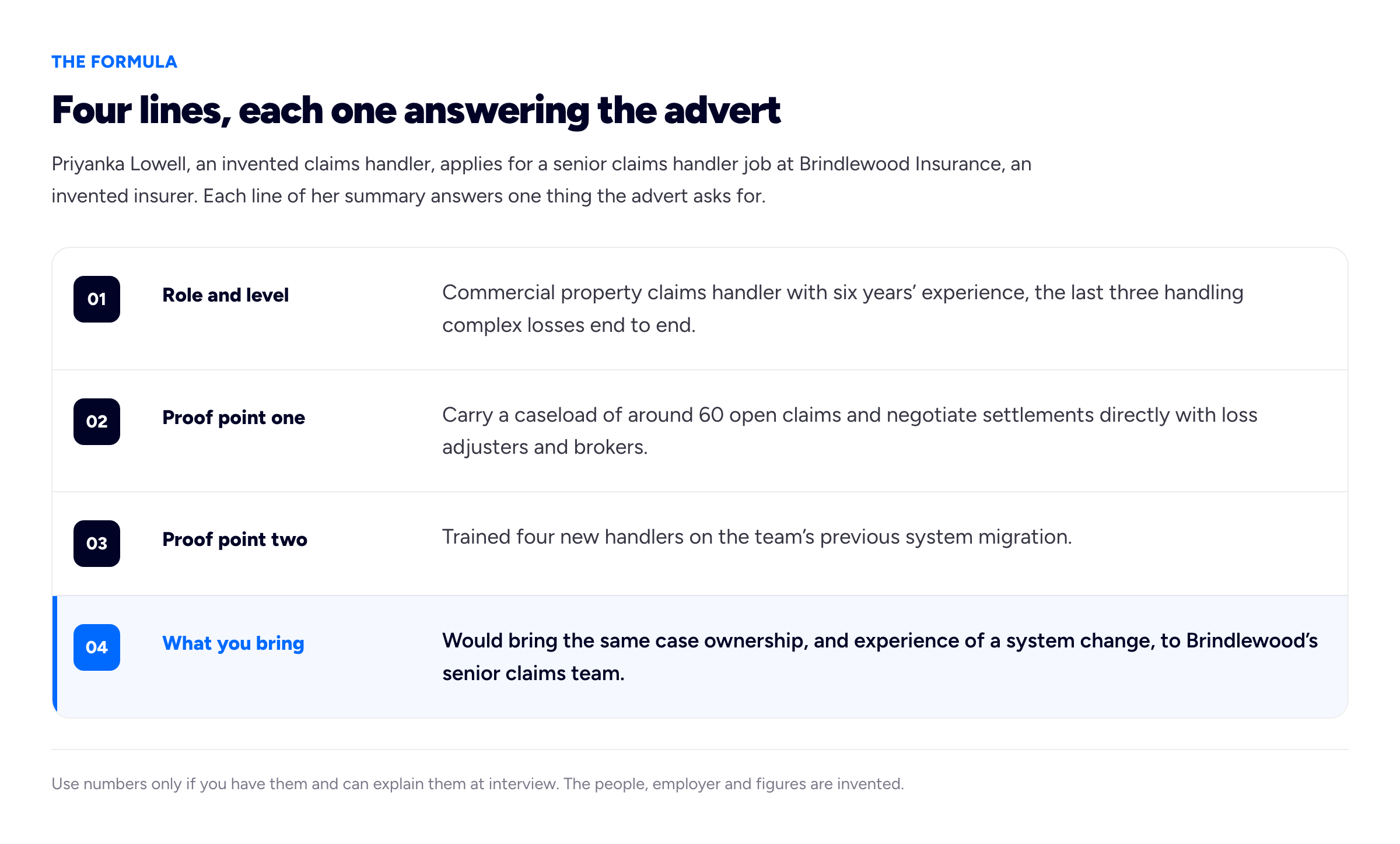
Each line maps to one requirement in the advert, and the last line is the only one that changes completely for another employer.
Before and after: two more rewrites
The pattern behind each rewrite is the same: take out what cannot be checked, put in what the advert asked for.
Before:
Results-driven marketing professional passionate about creating engaging content and driving growth.
After:
Content marketer with four years in B2B software, writing and running the email programme for a product with a self-serve trial. Rewrote the onboarding sequence and the trial-to-paid rate rose over the following two quarters. Comfortable owning a channel alone, as the advert's one-person team requires.
"Results-driven" and "passionate" are replaced by the result and the evidence of commitment. If the candidate does not have the exact conversion figure, the direction and the time span are still checkable.
Before:
Creative and detail-oriented designer with a strong eye for aesthetics.
After:
Brand designer with five years in-house at a consumer goods company, owning packaging for three product ranges from brief to print. Portfolio linked above shows the 2025 range relaunch. Experienced in briefing printers and checking proofs, which the advert lists as daily work.
In the design example, the portfolio link carries the proof that a summary cannot: "a strong eye for aesthetics" is a claim, and the work is the evidence. The guide on adding a portfolio link to a resume covers where to put it.
Ten professional summary examples, with notes
Each example below was written for this guide, for an invented candidate. Figures are illustrative: replace them with your own, or with scale and responsibility if you do not have numbers. The note under each says why it is built the way it is.
1. Graduate
Civil engineering graduate (MEng, expected June) applying for the structures graduate scheme. Designed a two-storey timber frame for a group design project that was assessed by a practising engineer, and spent a summer placement on a highways site checking temporary works. Working towards chartership and looking for a scheme with structured site rotations.
Why it works: it names the scheme (an objective in its proper place), uses coursework and a placement as proof because they are the proof available, and the closing line about chartership tells the reader the candidate understands the programme's purpose.
2. Career changer
Secondary science teacher of eight years moving into learning design. Planned and wrote a full year's curriculum for a new course, including assessments, and led the department's move to an online learning platform. Bring classroom-tested judgement about what learners actually finish.
Why it works: the move is in the first line, so the reader is not confused. The proof points are chosen for the new job (curriculum design, platform rollout), not the old one (behaviour management, results). The closing line turns the old career into the advantage.
3. Returner after a gap
Payroll administrator with seven years' experience returning after a career break for family care. Ran monthly payroll for around 300 staff and handled year-end submissions. Completed a refresher course on current payroll software this year and ready to start immediately.
Why it works: it names the gap in a neutral phrase and moves on, leading with the experience the break does not erase. The refresher course answers the reader's unspoken question about whether the skills are current. You do not have to explain a gap in the summary at all; if you do, one phrase is enough.
4. Senior or executive
Finance director with fifteen years in mid-sized manufacturing, the last six on the board. Led the finance side of two acquisitions and a refinancing, and built a finance team of twelve from three. Looking to bring that growth-stage experience to a privately owned business preparing for investment.
Why it works: at senior level the reader wants scope and situations, not skills. It names the kinds of event the candidate has led (acquisitions, refinancing, team build) and the stage of business they suit.
5. Freelancer moving in-house
Freelance copywriter for six years, writing website, email and product copy for over 30 clients in software and retail. Managed own pipeline, briefs and deadlines, often embedded in clients' in-house teams for months at a time. Now looking for an in-house role on one brand, to own its voice rather than visit it.
Why it works: it answers the worry hiring managers have about freelancers (can they work inside a team?) with evidence, and gives a reason for the move that is about the work. The guide on freelance work on a resume covers how to list the clients themselves.
6. Technical
Backend developer with five years in Python and PostgreSQL, building payment and billing services. Owned a service handling recurring billing for a subscription product and led its move from a monolith to a separate service with zero-downtime deploys. On call for production for three years.
Why it works: names the stack the advert asks for in the first line, so a reader or a keyword filter finds it, then gives ownership and an operational fact. For technical roles, a bulleted summary of qualifications works just as well; the resume skills section guide covers where the full tool list should go instead.
7. Creative
Motion designer with four years at a broadcast agency, animating titles, idents and social cut-downs for sports and entertainment clients. Lead animator on a channel rebrand that shipped across on-air and social. Work in After Effects and Cinema 4D; reel linked above.
Why it works: the summary does the sorting (what kind of motion, for whom) and points to the reel for the proof. Its job is to make the reader open it.
8. Healthcare
Registered nurse with five years on an acute medical ward, the last two as a band 6 deputy ward manager. Lead the shift for a 28-bed ward and mentor student nurses on placement. Moving into community nursing, where the advert's emphasis on independent caseload management matches the discharge planning already led on the ward.
Why it works: registration and band come first, because they are what a healthcare reader checks before anything else. The move from ward to community is stated, with a bridge from current work to the new setting. Use whatever grading system your own health service uses; band 6 is a UK NHS term.
9. Sales
Account executive with four years selling software to mid-market logistics companies. Hit or exceeded quota in eleven of the last twelve quarters, closing deals with sales cycles of three to six months. Built the territory's first partner channel with two resellers.
Why it works: sales is the field where numbers are expected, and a sales reader will ask. "Eleven of the last twelve quarters" is more believable than "consistently exceeded targets" and easy to explain. Only write a figure like that if your records support it.
10. Operations
Operations coordinator with six years in facilities and office operations for a professional services firm across three offices. Ran supplier contracts for cleaning, security and catering, and coordinated two office moves without a lost working day. Looking to step up to the operations manager role and its budget responsibility.
Why it works: operations work is often invisible when it goes well, so the summary names the scope (three offices, supplier contracts) and two events that show competence. The last line names the step up honestly.
What to cut from a professional summary
When a summary runs to six lines and still says nothing, the problem is usually one of these:
- Adjectives about yourself. Hardworking, motivated, dedicated, passionate, results-driven, detail-oriented, dynamic. Replace each with the fact that made you want to use it.
- "Excellent communication skills" and "team player". Show these in the experience section, where they become "presented quarterly results to the board" or "covered three roles during a restructure".
- What you want. "Seeking a challenging role", "looking to develop my career". One clause about direction is fine in the cases above; a sentence about your needs is not.
- A list of every tool. Name the one or two the advert asks for most. The full list belongs in the skills section.
- Claims you cannot back. If the interviewer asks "tell me about that", you should have a story ready for every phrase.
- Personal details. Age, marital status and similar details do not belong in a US or UK resume summary. Conventions differ by country, so follow local guidance where you are applying.
A useful test: cover your name and read the summary. If it could belong to anyone else applying for the same job, it needs another fact.
Does it help with applicant tracking systems?
An applicant tracking system reads your summary as text, like the rest of the resume. Using the advert's own words for the job title and its key skills helps a recruiter's search find you; stuffing in a keyword list does not, and a human reader will notice. Keep it as plain text, not inside a text box, a table or a header area, where some systems read it poorly. The guide to an ATS-friendly resume format covers layout in more depth.
How long, and do you need one at all?
Purdue OWL is right that a summary is not compulsory. But it is cheap, and it lets you choose what the reader learns first. We would include one in almost every case, and drop it only when space is so tight that it would push a strong experience entry off page one. For how much space you have to play with, see how long a resume should be.
Keep it to three or four lines on the page at your resume's font size. If it wraps to a fifth line, cut a clause rather than shrinking the type.
Reuse it on LinkedIn and your portfolio
LinkedIn About. The opening lines of your About section are what people see before they expand it, so put your summary's first two sentences there almost unchanged. Then switch to the first person, which reads naturally on a profile, and make the last line general, because many employers read it at once: "I am looking for senior claims roles in commercial lines." The guide on adding a resume to LinkedIn covers how the two fit together.
Portfolio intro. If you have a portfolio or personal site, its first line under your name does the same job as a summary: tells a visitor what you do and for whom. Shorten your summary's first line into one sentence in the first person ("I design packaging for consumer brands, from brief to print") and use the proof points as the lead-in to your best projects. A site built on Bunfolio uses that kind of line as its hero text. The guide on portfolio bios has examples for different fields.
Keep all three versions consistent. A reader who checks your LinkedIn after reading your resume should find the same job title, the same years and the same facts, phrased for a different setting.
Frequently asked questions
What is a professional summary on a resume?
It is a short section of three or four lines at the top of your resume, under your name and contact details, that says what you do, at what level, with two pieces of proof and what you would bring to the job. It is sometimes called a profile, a personal profile or a summary of qualifications; the content is the same.
What is the difference between a summary and an objective?
A summary leads with what you offer: your experience and its results. An objective leads with what you want: the job or the move you are aiming for. Most careers advice now prefers the summary, but a short objective clause inside a summary is useful for career changes, first jobs and named programmes.
How long should a professional summary be?
Three or four lines, or two to three sentences. Duke's careers guidance suggests two to three sentences, and Purdue OWL one to three. If yours runs longer, cut a clause rather than shrinking the font.
Do I need a professional summary if I have no experience?
Yes, and it matters more, because it is where you say what you are applying for and point the reader at the evidence you have: coursework, a placement, a part-time job, a project. Write it as a short objective followed by one or two facts.
Should I change my summary for each job?
Yes. At minimum, change the last line to name the employer and match it to the advert, and check the first line uses the advert's job title where that is honest. The proof points often stay the same across similar jobs.
How we put this guide together
Bunfolio builds portfolio websites and gives away free career tools, so we read a lot of resumes and job adverts. Most of this guide is our recommendation, and we want to be plain about which parts: the four-line formula, the advice to write the summary last and from the advert, the rewrites, the ten examples and their notes, and the list of what to cut are our judgement from that reading, not a published standard. No official body publishes a correct professional summary.
Where we state what other guidance says, we have linked the primary source we read: the National Careers Service's CV sections guide (the introduction, its place on the page), Prospects' how to write a CV (the personal profile), Duke University's career centre on summary statements (length, headings, avoiding "objective" and personal pronouns), the Purdue Online Writing Lab's introduction to résumés (objectives and summaries as optional sections) and the US Department of Labor's Creating Your Resume participant guide (when an objective helps). Some are written for UK CVs and some for US resumes; the advice on this section transfers, but conventions on personal details differ, so follow guidance for the country you are applying in. We have left out the statistics that usually decorate this topic, such as how many seconds a recruiter spends on a summary, because we could not trace any to a published method, sample and date.
Everyone named here is invented: Priyanka Lowell, Odette Marchetti and Brindlewood Insurance, along with the unnamed candidates in the rewrites and the ten examples. Every summary in this guide, and every figure inside them, was written by us as a model to adapt. Replace the numbers with your own, or leave them out.
Related reading: how to make a resume stand out, the resume skills section, ATS resume format, how long a resume should be, freelance work on a resume and portfolio bio examples.
More from the blog
October 24, 2026 · 19 min read
Artist Statement Examples (and How to Write One Without Artspeak)
What an artist statement is and how it differs from a bio and a project statement, the four lengths to keep ready, a four-move method for drafting one, plain-language rules, an artspeak paragraph rewr...
October 4, 2026 · 22 min read
How to Write a Cover Letter for an Internship (With 3 Examples)
Little or no work experience? Here is how to read an internship advert and match each requirement to your coursework, projects, societies or part-time job, with the format to copy, a fill-in template,...
September 27, 2026 · 23 min read
How to Write a Letter of Presentation (With 6 Examples)
A letter of presentation is what Spanish, Italian and Portuguese speakers call a cover letter, and it also means a letter introducing yourself or your services to a prospective client. What each meani...