
August 24, 2026 · 29 min read · Updated September 25, 2026
Portfolio Bio Examples: Thirty Bios You Can Adapt Today
Thirty complete bios across ten professions, at three lengths each, plus the four-part formula behind them and three bad bios rewritten. Every one is invented, so you can take the shape without taking the words.
The bio is the smallest piece of writing on your portfolio and the one people rewrite the most times. Fifty words, no structure to hide behind, and every version sounds either like a job application or like a wedding speech.
Part of the problem is that nobody shows you enough finished ones. Advice about bios is usually a list of principles — be specific, be human, avoid clichés — and principles are hard to apply to a blank box at eleven at night. What helps is seeing thirty finished bios, in different trades, at different lengths, close enough together that you can see what they share.
So that is what this is. Every bio below is invented — the people, the clients, the numbers and the sectors are all made up to demonstrate a shape, and none of them describes a real person. Read them, find the two or three nearest your situation, and rewrite them with your own facts. There is also a formula, a first-person-versus-third-person comparison, three genuinely bad bios repaired in public, and a section for people who have no experience to point at yet.
One thing this post is not. Our guide to the portfolio About page is about the whole page — six blocks, roughly 300 words, what order they go in and what each one owes the reader. This post is about the bio itself: the paragraph, at three different lengths, as a piece of copy you can lift and adapt. If you want the architecture, read that one. If you want words on the screen tonight, stay here.
The four-part formula
Almost every bio that works is doing the same four things in the same order, whether it is twelve words or a hundred and fifty.
- Who you help. A named kind of buyer, not "clients" and not "businesses of all sizes".
- What changes for them. The outcome in their language, not the activity in yours.
- The evidence. Years, sectors, previous employers, one checkable fact. Flat delivery, no adjectives.
- The next step. What you want the reader to do, and what happens after they do it.
Applied, in one sentence each: independent restaurants (who) whose online ordering loses people at the last screen (what changes), after six years building checkouts for a delivery platform (evidence), send me a link and I will tell you where the drop-off is (next step).
The order is not sacred but it is reliable, because it matches the order the reader's questions arrive in. Is this person for me. What would I get. Why believe it. What now. A CV-shaped bio starts with the evidence, which answers question three before questions one and two have been asked.
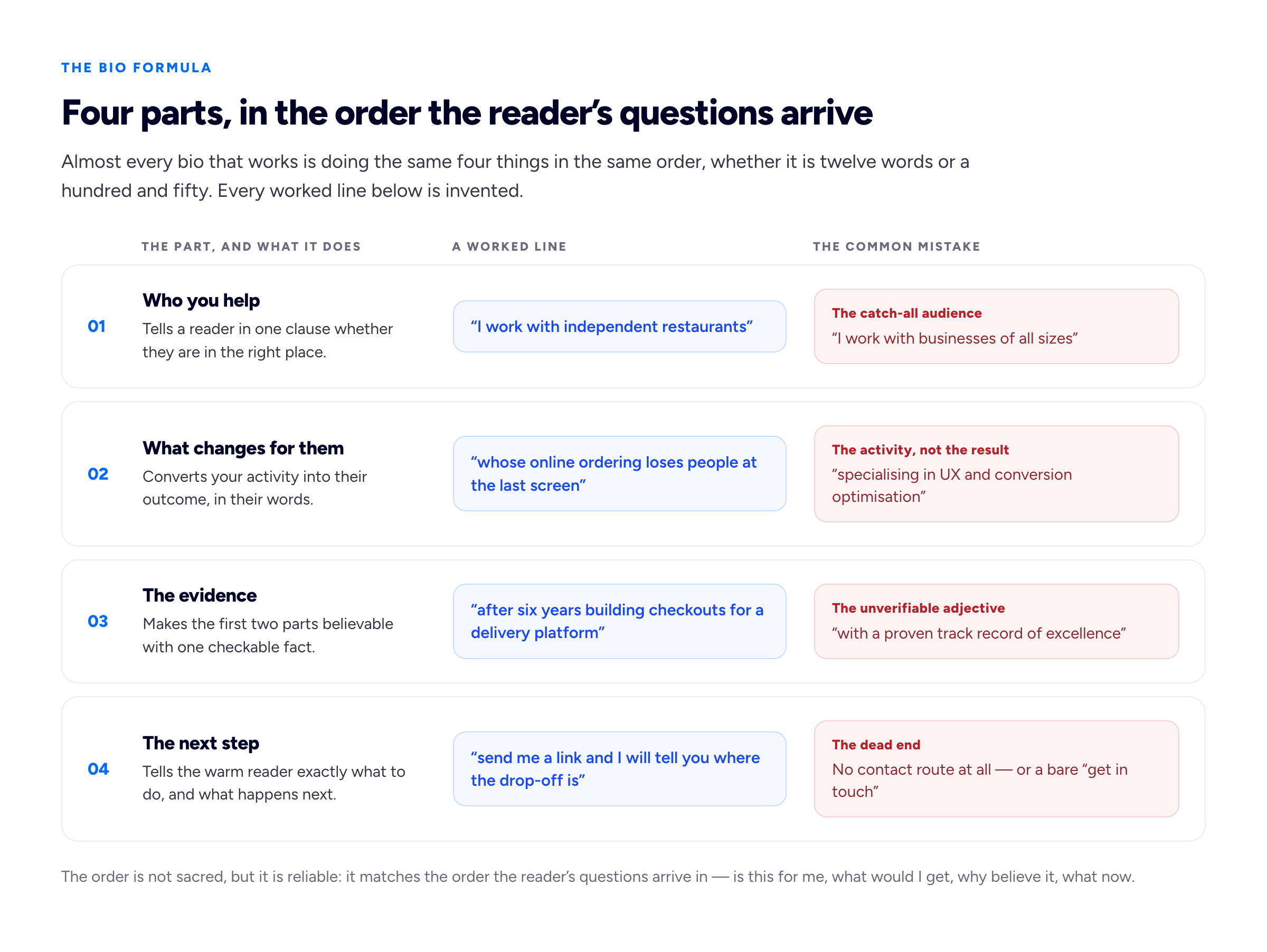
Four parts, in the order the reader's questions actually arrive. Every worked line here is invented.
Three lengths, three different jobs
You need more than one bio, and the mistake is writing the long one and hacking it down. The three lengths are not one text at three sizes; they answer different amounts of question. Our bio generator writes a short, a medium and a long version from the same set of facts at once, which is a quicker way to get something to argue with than hacking down the long one.
The one-liner sits under your name in a site header, on a social profile, in an email signature. It is read by someone who has not decided to read anything yet, so it has one job: place you. Who you help and what changes. Nothing else fits.
The fifty-word bio is the standard portfolio About block, the directory listing, the author box. The reader has chosen to read it, so it can carry all four parts of the formula, thinly. It is the one most people need and most people get wrong, because fifty words feels like room for a story and is not.
The hundred-and-fifty-word bio is a full About page, a speaker or podcast-guest bio, a pitch document, a marketplace profile. It has room for the thing the shorter versions cannot hold: how you work. That is what a nervous client is looking for hardest, and what makes the long version worth writing rather than merely longer.
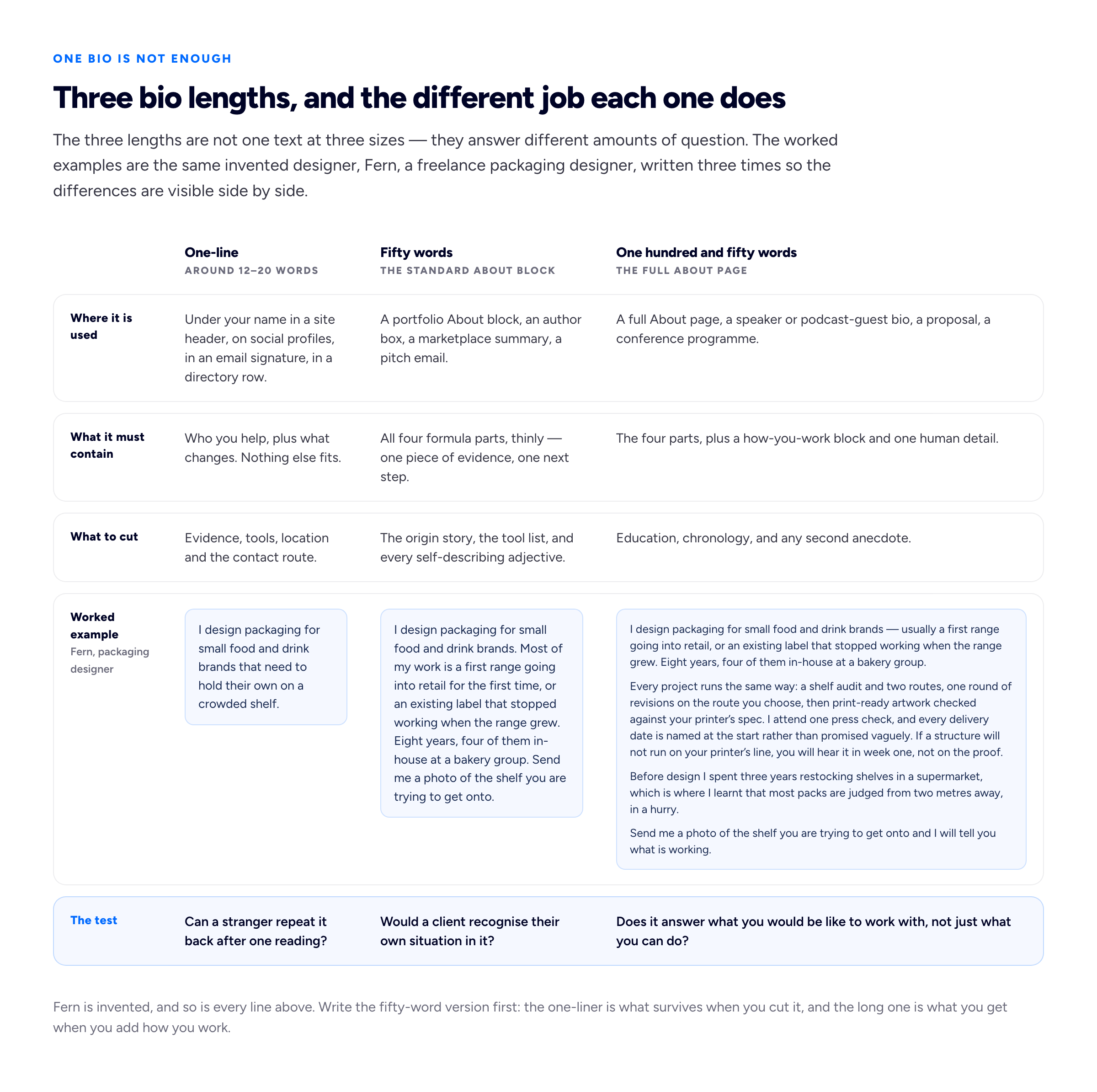
The same invented designer at three lengths, so the differences are visible side by side. Fern is not a real person.
First person or third person
On your own portfolio, write in the first person. The reader knows you wrote it, so third person reads as a small pretence — or as an agency you are pretending to be. It also quietly pushes you towards adjectives, because it is uncomfortable to type "I am passionate" and very easy to type "Fern is passionate".
Third person is right in three places: a conference or podcast bio someone else reads aloud, an agency roster needing one voice across forty people, and a guest-post author box where house style requires it. Somebody else is introducing you, and the grammar should match.
The same bio, both ways. First:
I build reporting tools for finance teams who have outgrown their spreadsheets. Nine years, the first five in-house at an insurance broker, so I have been the person doing the month-end close as well as the person automating it. If your close takes a fortnight and you cannot say why, email me.
And third:
Ada Nwosu builds reporting tools for finance teams who have outgrown their spreadsheets. She spent five years in-house at an insurance broker before going independent in 2019, and has since worked with brokers, a small building society and two accountancy practices. She is a regular speaker on month-end automation.
Notice what the third-person version had to change. The direct address at the end is gone, because you cannot ask for an email while pretending someone else is speaking; a third-party credential replaced it instead. That is the trade you are making, and it is why the third-person version belongs on someone else's page rather than yours.
Thirty bios you can adapt
Ten trades, three lengths each. Every person, employer, client and figure below is invented; they exist to show a shape, not to describe anyone real. Take the structure, replace the facts, and keep the sentence rhythm if it suits you.
Freelance developer
I build front ends for small e-commerce teams who have a designer but no developer.
I build front ends for small e-commerce teams who have a designer but no developer. Usually that means turning finished design files into an accessible, tested storefront, or working out why a site has quietly got slower since launch. Seven years, three of them in-house at a homeware retailer. Send me a URL and I will tell you what I would fix first.
I build front ends for small e-commerce teams who have a designer but no developer. Two kinds of job come my way. Either there are finished design files and nobody to build them, and I do that — accessible, tested, handed over so an in-house developer can maintain it. Or a storefront has quietly got slower since launch and nobody can say why, and I spend two or three weeks finding out. Seven years in total, three of them in-house at a homeware retailer with about thirty shops, so I have been on the other side of the handover as well. I work in one-week blocks with something clickable at the end of each, and a written note on Friday saying what moved and what did not. If something is going to slip, you hear it that week. Send me a URL and I will tell you what I would fix first.
The move: naming the gap in the client's team rather than the technology in yours. "A designer but no developer" is a situation a specific person recognises about themselves in half a second.
UX and product designer
I help early-stage product teams decide what to build next, and then design it.
I help early-stage product teams who have more ideas than engineering time. My job is turning a vague roadmap line into something specific enough to build: a week of talking to the people who use it, then screens and a prototype your engineers can estimate against. Six years, two of them in-house at a scheduling product. Tell me the decision you are stuck on.
I help early-stage product teams who have more ideas than engineering time. Most engagements start with a decision nobody can settle in a meeting — whether to rebuild onboarding, whether the new pricing needs a new dashboard — and end with screens and a clickable prototype specific enough to estimate. In between there is a week of talking to the people who actually use the thing, which is usually where the argument dissolves. Six years: two in-house at a scheduling product, four independent, mostly with teams of five to twenty. I work in two-week blocks, share work in progress rather than a reveal at the end, and write down what I decided and why so it survives after I leave. I am comfortable being told the research is wrong. Tell me the decision you are stuck on and I will say whether a fortnight would settle it.
The move: leading with a decision the client is stuck on instead of a process noun. Nobody buys "a user-centred design process"; plenty of people buy an end to a three-week argument.
Graphic designer
I design identities and print for small arts organisations — theatres, galleries and festivals with real print deadlines.
I design identities and print for small arts organisations. Season brochures, posters that have to survive a hoarding, and the identity underneath them, built so a part-time marketing officer can keep using it without me. Nine years, four of them in-house at a regional theatre. Send me your print deadline first — it decides everything else.
I design identities and print for small arts organisations: theatres, galleries, festivals and the occasional literature prize. In practice that means season brochures, posters that have to survive a hoarding in the rain, programme text set to a page count somebody has already sold advertising against, and an identity underneath all of it that a part-time marketing officer can keep using once I have gone. Nine years, four of them in-house at a regional theatre, which is where I learned that a beautiful identity nobody can apply is a liability. I supply artwork print-ready, deal with your printer directly, and give you a small set of files with plain instructions rather than a forty-page brand manual. I read the deadline as the real brief. Send me your print date and we will work backwards from it.
The move: describing the deliverable in the client's words — a season brochure, a poster on a hoarding — instead of the trade's words. "Brand identity systems" is what you call it; "the programme has to be at the printer on the 3rd" is what they call it.
Photographer
I photograph interiors for architects and small hotels who need pictures that still look right in two years.
I photograph interiors for architects, small hotels and furniture makers. A typical job is one shooting day, fifteen to twenty finished images, delivered inside a fortnight, with a licence that covers your website, press and social use without a second conversation. Eleven years. Tell me the space and the date and I will tell you if a day is enough.
I photograph interiors for architects, small hotels and furniture makers — buildings and rooms, mostly in natural light, shot so they still look like the place when you walk into it. A typical job is one shooting day producing fifteen to twenty finished images, delivered within a fortnight, with a licence that covers your own website, press and social use so you are not emailing me for permission a year later. Larger sets and additional days are quoted the same way. Eleven years, the first three assisting an architectural photographer, which is where I learned to wait for the light rather than fight it. I visit or study the space before the shoot day so we are not making decisions with the crew standing around. Tell me the space and the date and I will tell you honestly whether one day is enough.
The move: putting the commercial constraints in the bio — day rate structure, delivery time, what the licence covers. Every client is silently worrying about those three things, and answering them early reads as experience rather than as small print.
Copywriter
I write website copy for software companies whose product is harder to explain than they think.
I write website copy for software companies whose product is harder to explain than they think. Usually a homepage and four or five pages, starting with a day of interviews with your sales team, because the words that already work are normally in somebody's call recordings. Eight years, three in-house. Send me your current homepage.
I write website copy for software companies whose product is harder to explain than they think — the ones where the demo lands beautifully and the homepage does not. A typical project is a homepage plus four or five supporting pages. It starts with a day of interviews: two people from sales, two customers if you can get them, and whoever wrote the last version. The language that works almost always already exists somewhere in a call recording; my job is mostly finding it and removing everything around it. Eight years, three of them in-house at a logistics platform. You get two rounds of revisions, tracked changes rather than a new document each time, and a short note explaining why each page is ordered the way it is so your team can extend it. Send me your current homepage and I will tell you what I think it is failing to say.
The move: stating the client's symptom rather than your service. "The demo lands and the homepage does not" is a sentence a founder has already thought, in those words, at eleven at night.
Marketer
I run email and lifecycle marketing for subscription businesses that already have customers and are quietly losing them.
I run email and lifecycle marketing for subscription businesses. Welcome sequences, win-backs and the unglamorous middle of the customer lifecycle where most of the money leaks out. I do not do paid social, brand campaigns or anything with the word storytelling in it. Seven years, four in-house. Tell me your cancellation rate and where you think it comes from.
I run email and lifecycle marketing for subscription businesses that already have customers and are quietly losing them. Welcome sequences, onboarding nudges, dunning, win-backs — the unglamorous middle of the lifecycle where most of the money leaks out and where nobody has had time to look. I do not do paid social, brand campaigns, events, or anything sold as storytelling; there are people better than me at all of it. Seven years: four in-house at a meal-kit company, three independent with box subscriptions, software and one gym chain. I work on a monthly retainer with a shared board so you can see what is running, and every test has a stated baseline and an end date, because a test without either is just a change. Tell me your cancellation rate and where you think it comes from, and I will tell you whether I agree.
The move: saying plainly what you do not do. A refusal is the fastest credibility signal in a trade where most bios claim everything, and it saves you the enquiries you would have lost anyway.
Virtual assistant
I keep the admin side of one-person consultancies running — inbox, diary, invoicing and the chasing nobody enjoys.
I keep the admin side of small consultancies and coaching practices running: inbox triage, diary, invoicing, expense wrangling and chasing the invoices you would rather not chase. I work UK hours, reply within two hours during them, and write down how everything is done so nothing lives only in my head. Six years, mostly with clients who stayed.
I keep the admin side of small consultancies and coaching practices running so the person whose name is on the door can do the billable work. Inbox triage against rules we agree in the first week, diary and travel, invoicing and expense wrangling, and chasing the payments you would rather not chase. I work UK hours, reply within two hours inside them, and I document every recurring task in a shared handbook so nothing lives only in my head and you are never held hostage by my holiday. Six years, currently four regular clients, two of whom have been with me since the start. I will tell you when something you are asking me to do is not worth the money. Most people start with a fixed ten hours a month for two months, which is long enough to find out whether it is working.
The move: making reliability the product. Response times, documented handovers and a low-risk starting package speak to the only real fear a client has about delegating, which is not competence but disappearance.
Video editor
I edit interview-led video for training teams and documentary producers — long footage, short deadlines.
I edit interview-led video: training modules, internal comms and short documentary work. Send me six hours of footage and a rough intention and you get a first cut inside a week, with subtitles, versions cut to the aspect ratios you actually publish in, and a project file you can take elsewhere. Nine years, four at a production company.
I edit interview-led video — training modules, internal communications, and short documentary work for producers who need a second pair of hands on a deadline. Send me six hours of rushes and a paragraph about what it is meant to do, and you get a first cut within a week, then two rounds of notes. Delivery includes burnt-in and separate subtitle files, versions cut for the aspect ratios you actually publish in, and a tidy project file with named bins, because you should be able to take the job to somebody else without penalty. Nine years, four of them staff at a production company cutting a weekly series, which is where I learned to work fast without the edit looking rushed. I am happiest with material where the story is buried in the transcript rather than storyboarded in advance. Send me a link and a deadline.
The move: putting turnaround, deliverable formats and file ownership up front. In post-production those are the terms of the deal, and a bio that states them is doing the first half of the negotiation for you.
Illustrator
I draw warm, slightly wonky people and places for children's publishers and editorial commissions.
I draw warm, slightly wonky people and places — ink and gouache, scanned and finished digitally. Mostly children's picture books and editorial commissions, plus the occasional pub sign. Ten years, four picture books, two of them with the same author. Roughs within a week of a brief. Commissions open from January; the work above shows the range.
I draw warm, slightly wonky people and places — ink and gouache, scanned and finished digitally, with a palette that leans towards dusty greens and reds. Mostly children's picture books and editorial commissions, plus signage and packaging when it suits the work, plus one pub sign I am unreasonably proud of. Ten years and four picture books, two of them with the same author, which I take as the useful credential. I send roughs within a week of a brief, work to the publisher's schedule without needing to be chased, and prefer to be given the awkward spread rather than the easy one. Rights and usage are agreed in writing before I start, always, including for editorial work at short notice. Commissions open from January. The work on this page is a fair sample of what you would get; if you want something outside it, say so and I will be honest about whether it is mine.
The move: leading with style, in plain descriptive words, because style is the buying decision. An art director is not deciding whether you are competent; they are deciding whether your line belongs on their page.
Career-changer, no experience in the new field
Eleven years in hospital pharmacy, now working in data analysis — same questions, better tools.
I spent eleven years as a pharmacy technician and now work with data. I know what a medicines stock report is for, which is most of the battle; the SQL and the dashboards came after. Two finished projects on this site, both using published NHS data, both written up so you can see the reasoning. Looking for analyst work in health and care.
I spent eleven years as a hospital pharmacy technician and moved into data analysis in 2025. The domain is the part I did not have to learn: I have written the stock reports, chased the discrepancies and sat in the meetings where a number on a slide was wrong and nobody could say why. Since then I have finished a data analysis certificate, and built two projects using published NHS prescribing data — both on this site, both written up with the reasoning and the dead ends left in rather than tidied out. I am comfortable with SQL and Python, and better than most beginners at knowing which question is worth asking. What I have not yet done is work as an analyst inside a team, and I would rather say that than dress it up. I am looking for analyst work in health and care. My email is on the contact page.
The move: treating the previous career as the credential rather than the thing to apologise for. The gap is named once, plainly, and never returned to.
Three weak bios, rewritten
Most bad bios are one of three shapes. Here is each one, invented but close to what we see most often, with the repair explained.
The job-title-only bio
Freelance graphic designer. Based in Leeds. Available for work. Let's create something amazing together.
Nothing here is false and nothing here is useful. A title tells the reader what to call you, not whether to email you; "something amazing" is a promise with no content; "available for work" with no next step is a sign in a window with no door. The repair adds the two missing facts — who it is for, and what they get:
I design brand identities and packaging for small food producers, mostly people taking a first range into shops. Six years, two of them at a design studio in Leeds. If you have a product and a shelf you want it on, send me a photo of both.
What changed: a named buyer, a named deliverable, one piece of flat evidence, and an ask so specific that it is easier to do than not do. The location survived, but as a detail inside the evidence rather than as a line of its own.
The passion-and-coffee bio
Hi! I'm a passionate creative with an eye for detail and a love of clean design. I thrive on turning ideas into beautiful experiences. When I'm not designing you'll find me with a coffee, my dog, or planning my next adventure.
Read it with every adjective removed and see how little is left. Passionate, detail-oriented, clean, beautiful: all claims the reader cannot check, all made by every competitor. The closing sentence appears near-identically on thousands of pages, so it distinguishes you from nobody. Hobbies are not the problem. Generic hobbies are.
I design interfaces for companies that sell something complicated — insurance, freight, industrial kit. The work is usually taking a form that takes twenty minutes and making it take five. Five years, three of them in-house at a freight broker. I spent two years before that as a bicycle mechanic, which is where I learned that most things that look broken are one adjustment away from fine.
The human detail stayed, but it was replaced with one that could not appear on anybody else's page and that explains how the person thinks. That is the test: if your personal detail could be copied onto a stranger's bio without anyone noticing, it is not doing any work.
The life-story bio
Ever since I was a child taking apart my grandfather's radio, I have been fascinated by how things work. After studying media at university I fell into video, spending several years at an agency before deciding, during the pandemic, that I wanted to build something of my own. Today I bring that same curiosity to every project.
This is the hardest to cut, because it is true and it matters to you. It just answers no question the reader has: sixty words in, they still do not know what you do, who for, or what happens next. The origin story is not banned — it is one clause, deep in the paragraph, earning its place by explaining a judgement:
I make short films for charities that need to explain something difficult without making anyone the subject of pity. Six years, four at an agency doing the same work for brands, which taught me most of what I know about a schedule. I still take things apart to see how they work, which is roughly how I approach a rough cut. Send me the thing you are struggling to explain.
The radio survived, in eleven words, doing a job. The chronology went, because the reader is not assessing your career — they are assessing whether to send one email.
Writing a bio when you have no experience yet
The reflex is to apologise: "aspiring", "recently completed a course in", "no professional experience yet, but". Each of those spends your opening on the one thing you would rather the reader not dwell on. The other reflex is worse — inflating. "Several years of experience" when it is eight months is checkable, and a reader who checks has learned something far worse about you than inexperience.
There is a third option, which is to write the same four-part bio using evidence you actually have. Four kinds usually exist even at the very start:
- Work you did without being hired. A self-initiated project, a rebuild of something that annoyed you, three speculative pieces for a brand you admire. It counts as evidence as long as you describe it accurately as your own initiative.
- The adjacent expertise. The trade you are leaving is usually worth more than the qualification you just finished. A former nurse doing health software knows things no bootcamp teaches.
- Volume, stated honestly. "Forty hours of footage cut in the last six months" is a real fact, and it is more persuasive than a vague year count.
- A constraint you can commit to. Turnaround, availability, price transparency. New freelancers can often promise responsiveness that busier ones cannot, and that is a genuine advantage rather than a consolation.
Say the honest thing once, in plain words, and move on: "I have been doing this for eight months." Then let the rest of the bio be about the work. The career-changer bios above are built exactly that way, and there is a longer treatment in our guide to building a portfolio with no experience.
Keeping it current
The commonest bio failure is not bad writing. It is a good bio that stopped being true. "Recently graduated" is charming in the first year, odd in the second and slightly sad in the third. So is "currently booking for spring" eighteen months later, a client described in the present tense who left in 2023, and a tool you have quietly stopped using.
Four phrases go stale faster than anything else, so treat them as dated the moment you type them: recently, currently, new, and any hard year count. "Seven years" becomes wrong every twelve months; "since 2019" never does, and is exactly as informative. Prefer a start date to a duration wherever the sentence allows it.
Twice a year is enough. Read it aloud, check the numbers, swap the client examples for the ones you would like more of, and confirm the human detail is still true — the band broke up, the dog died, you sold the bicycle. Keep a canonical copy somewhere you will find it, because bios go stale less from laziness than from nobody remembering all seven places the old one is living.
Frequently asked questions
How long should a portfolio bio be?
Around fifty words for the About block on a one-page portfolio, and one line under your name in the header. Write a hundred-and-fifty-word version as well, but keep it for the places that need it — a full About page, a speaker bio, a proposal. Past about two hundred words on a portfolio you are writing an autobiography, and a reader who was one paragraph from emailing has started scrolling instead.
Should I write in the first person or the third?
First person on your own site. Third person only when someone else is doing the introducing: a conference programme, a podcast's show notes, an agency roster, a publication's author box. Keep a third-person version saved so you can paste it when an organiser asks, but do not let it become the one on your homepage.
Should I include a photo with my bio?
Yes, for most people. A plain, recent, well-lit photograph of you looking at the camera does more than an elaborate one, and it comfortably beats a stiff corporate portrait taken for a company you no longer work at. Use the same picture on your site and your professional profiles so people recognise you between contexts, and check it survives being cropped small and round. If you genuinely do not want your face online, use something else concrete — your desk, your work in situ — rather than a stock illustration of a person who is not you.
Should I mention my hobbies?
One, if it is specific enough that it could not belong to anyone else, and ideally if it explains something about how you work. The bicycle mechanic line in the rewrite above is a hobby doing a job. "Coffee, travel and good design" is three words that appear on thousands of other pages and will be skipped by every reader who has seen them before, which is all of them.
Should I say I am available for work?
Say it if it is true and if you will maintain it. An availability line is genuinely useful to a reader deciding whether to bother emailing, and it is one of the few pieces of information on a portfolio that changes the reader's behaviour. The risk is entirely maintenance: "available from March" is helpful in January and quietly damaging the following December. If you know you will not update it, write something that stays true instead — "I usually have capacity for one new project a month".
How often should I update my bio?
Twice a year, plus whenever something in it stops being true. Set a recurring reminder rather than relying on noticing, because you will not notice; you stop reading your own bio within a month of writing it.
Can I use the same bio everywhere?
The fifty-word version travels well and should be reused deliberately — consistency across your site, your professional profiles and directory listings makes you easier to recognise and easier to search for. What does not travel is the next step: the sentence asking for an email works on your site and reads oddly in a conference programme. Change the last sentence per context and leave the rest alone. If your professional profile is the version you keep most current, it can be a reasonable starting draft; our guide to turning a LinkedIn profile into a portfolio website covers what to keep and what to rewrite.
Does the bio matter for search?
Indirectly, and less than people hope. Your bio is usually the passage that makes your site rank for your own name, which matters when someone hears about you in a meeting and types you into a search box that evening. Naming your trade and the kind of client you serve in plain words helps that; stuffing keywords into a paragraph a human is about to read does not. The portfolio SEO guide covers the parts that actually move.
How we put this guide together
The four-part formula, the three lengths and the word budgets are Bunfolio's own recommendation. They come from reading a great many portfolio bios on sites built with our templates and noticing the same repairs being needed over and over: a missing buyer, an outcome described as an activity, evidence delivered as adjectives, and no next step. Treat that as a considered opinion rather than a finding.
Everything presented as an example in this post is invented. All thirty bios, plus the rewrites, the first-and-third-person pair and the worked examples inside the two diagrams, were written by us to demonstrate a shape. The names — Fern, Ada Nwosu and the ten unnamed freelancers — are not real people, the employers and clients described do not exist, and no bio here is quoted from anyone's website. We do not reproduce other people's bios, photographs or branding.
We have also included no statistics, and that is deliberate. The round numbers that circulate about how long visitors spend on a page, or what percentage of clients read an About section, generally cannot be traced to a primary source, and we would rather make the point without the number than borrow a figure we cannot stand behind. Where this post says something is common, it means we see it often, and it says so in those words.
Two external sources genuinely informed the advice above and are worth reading directly. Nielsen Norman Group's research on "About Us" information on websites (Anna Kaley and Jakob Nielsen, May 2019) reports that people want this material to be clear, authentic and transparent, prefer plain language to corporate jargon, and are put off by stock imagery and walls of text — which is the evidence behind our insistence on short, concrete, first-person copy. For the sentence-level work, the UK Government Digital Service's A to Z style guide is the best free plain-English reference we know: it mandates the active voice and lists the abstract verbs to avoid, including "deliver", "drive" and "robust", each of which turns up in weak bios constantly.
Related reading: how to write a portfolio About page for the structure this copy sits inside, how to build a portfolio with no experience, should freelancers niche down for the positioning decision behind the first line, and how to build a freelance portfolio website that wins clients.
More from the blog
October 6, 2026 · 26 min read
What Is a Portfolio Website? Definition, Types and Examples
A portfolio website is a site you own that shows samples of your work. Here is the plain definition, what a personal portfolio means, the eight different kinds of portfolio and who asks for each, what...
October 2, 2026 · 15 min read
How to Start a Cover Letter: Greetings, Opening Lines and Examples
Start with your details and the date, a greeting to a named person or "Dear Hiring Manager", then an opening that names the role, gives one specific hook and says why this employer. Greetings compared...
September 27, 2026 · 22 min read
How to Write a Letter of Presentation (With 6 Examples)
A letter of presentation is what Spanish, Italian and Portuguese speakers call a cover letter, and it also means a letter introducing yourself or your services to a prospective client. What each meani...