
October 2, 2026 · 15 min read
How to Start a Cover Letter: Greetings, Opening Lines and Examples
Start with your details and the date, a greeting to a named person or "Dear Hiring Manager", then an opening that names the role, gives one specific hook and says why this employer. Greetings compared, openings graded weak to strong, and 12 first lines to adapt.
Start a cover letter with your contact details and the date, then a greeting to a named person ("Dear Ms Okafor") or, if you cannot find a name, "Dear Hiring Manager". Your first paragraph should name the job you are applying for, give one specific reason you fit it, and say why this employer in particular. Two or three sentences is enough.
The hard part is the first line itself: the moment you type "I am writing to apply for…" and feel the application go grey. This guide covers the header, the greeting (with and without a name, British and American), openings graded weak to strong, the main types of first line and twelve lines to adapt. It is the companion to our guide on how to end a cover letter; the two ends of a letter are written as a pair.
Before the greeting: the header and the date
An attached letter follows the shape of a printed business letter. At the top go your full name, phone number, email address and, if it matters for the job, a portfolio or LinkedIn link. A full postal address is no longer expected in most fields. Then the date, then the reader's name and job title if you have them, the organisation and its address. Purdue's Online Writing Lab gives that order: the date and the company's details directly follow your own.
The UK writes the date day first ("2 October 2026"), the US month first ("October 2, 2026"); spelling out the month avoids any confusion between 02/10 and 10/02. Make your contact details match your CV exactly. If the letter is the body of an email, skip the header: your details move to the signature block, which our guide to ending a cover letter covers.
The greeting: who to address
Use a name if you can find one
The UK's National Careers Service is direct: "It's important to try to address your cover letter to someone by name." MIT's career office says the same. A name tells the reader the letter was written for this job, not copied across forty applications. Look in the advert (many name a contact or say who the role reports to), on the company's team or about page, on LinkedIn (search the company plus the title the role reports to, and check the person still works there), or simply ask: a short call or email to say you would like to address your letter correctly is answered more often than people expect.
Give it ten or fifteen minutes, then stop. A good generic greeting costs you nothing; addressing someone who left last year costs more than no name at all.
How to write the name
Use a title and surname: "Dear Ms Okafor", "Dear Dr Lindqvist", "Dear Mr Haddad". Use "Ms" rather than "Miss" or "Mrs" unless the person has told you otherwise; it makes no assumption about marriage. If you do not know someone's title, Purdue's advice is to drop it and use the full name: "Dear Sam Okafor". "Mx" is a gender-neutral title used in the UK; use it if the person uses it themselves, say in an email signature, but not as a guess. The full name is the better hedge.
American letters traditionally end the greeting with a colon ("Dear Mr. Haddad:"), the form Purdue shows; British letters use a comma or nothing, and drop the full stop after Mr, Ms and Dr. First names alone suit only a company that plainly works that way and someone you have already spoken to.
How to address a cover letter without a name
- "Dear Hiring Manager" is the most widely used modern choice and the one MIT suggests. Neutral and understood everywhere.
- "Dear [Team name] team" ("Dear Product Design team") is warmer and shows you know where the role sits.
- A role-specific greeting ("Dear Head of English") when you know the function but not the person. Purdue's own example is "Dear Hiring Professionals".
- "Dear Sir or Madam" is the traditional British formal greeting and still the National Careers Service's fallback. It is correct but old-fashioned; if you use it in the UK, close with "Yours faithfully".
Avoid "To whom it may concern". It is a greeting for a document that could land on anyone's desk, such as a reference. In a job application it tells the reader you did not check who they were.
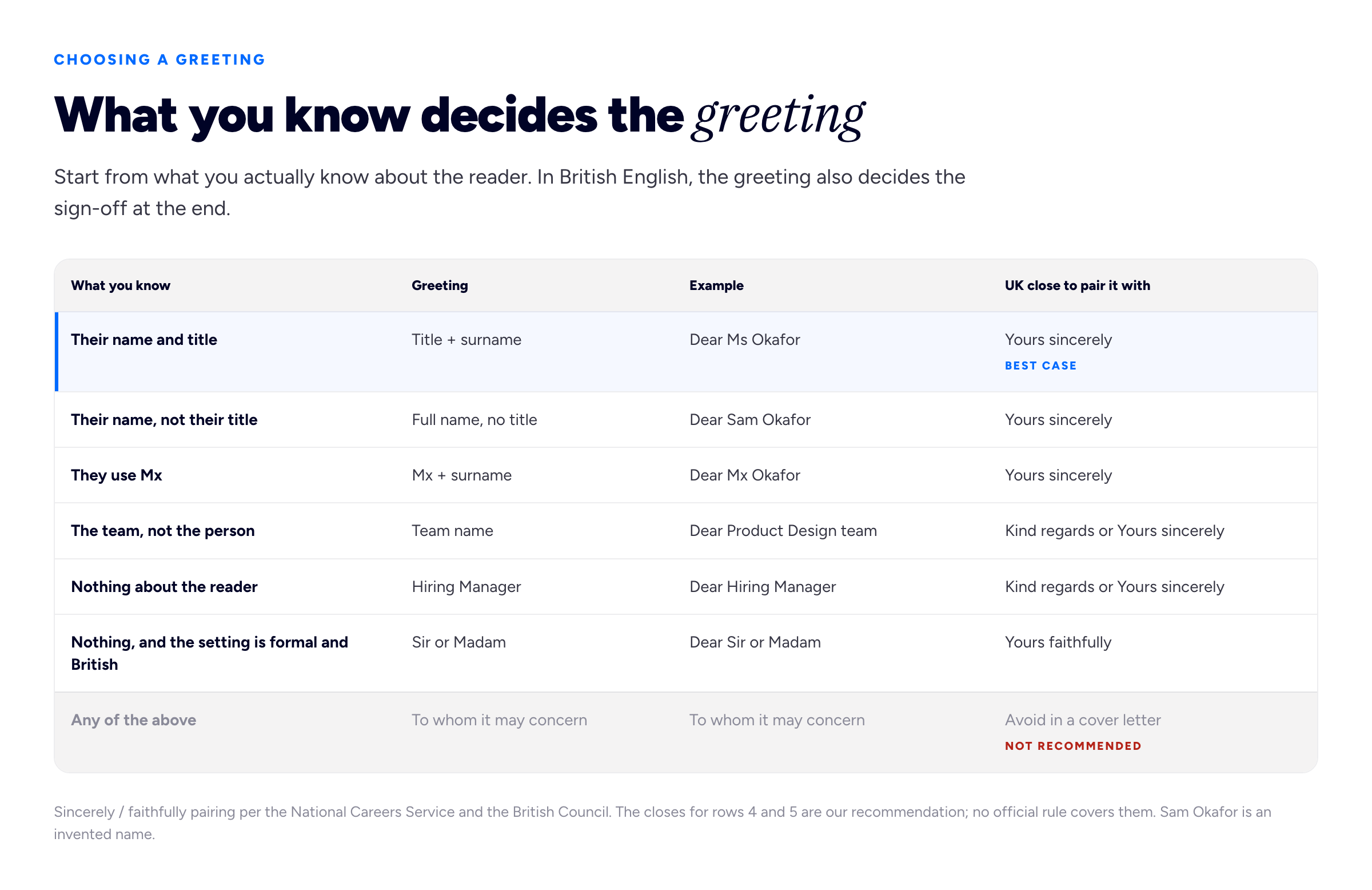
Work down the left column until you reach what you actually know. The further down you go, the more the rest of the letter has to prove it was written for this employer.
In British English the greeting and the sign-off are a pair. The National Careers Service and the British Council's LearnEnglish guide to cover letters give the same rule: open with a name, close "Yours sincerely"; open "Dear Sir or Madam", close "Yours faithfully". "Dear Hiring Manager" sits outside that old rule; in our view "Kind regards" or "Yours sincerely" both follow it naturally. In the US, "Sincerely" follows any greeting.
What the opening paragraph has to do
The National Careers Service says to introduce yourself, say how you found the job, and give the job title and any reference number. Purdue adds why you are interested and how your goals align with the organisation's. The British Council's version is simply "Give a clear reason for writing." We compress that into three jobs:
- Name the role. The exact title, and the reference number if there is one.
- Give one hook. One specific, checkable reason you fit: a result, a piece of work, a qualification the advert asks for, a referral. One, not three; the rest of the letter is for the others.
- Say why them. One clause showing you know what this employer does. Not "your prestigious company", but a product, a client, a plan they announced.
Here is one opening written three ways, for an invented designer applying to an invented company.
Weak.
I am writing to apply for the position advertised on your website. I am a hard-working and passionate designer with excellent communication skills, and I believe I would be a great fit for your company.
No role named, three claims nobody can check, and it could go to any employer unchanged.
Better.
I am applying for the Product Designer role (ref. PD-214) at Larkfield Health. I have four years' experience designing booking and onboarding flows, and I am keen to work on products that people rely on.
The role is named and the experience is relevant, but "booking flows" is a category, not a result, and "products people rely on" could describe a bank.
Strong.
I am applying for the Product Designer role (ref. PD-214) at Larkfield Health. At Dovecote, I redesigned the appointment booking flow used by 40 clinics, and missed appointments fell enough that the clinics stopped asking for reminder calls. Your plan to move repeat prescriptions into the app is the same kind of problem, and it is the one I would most like to work on next.
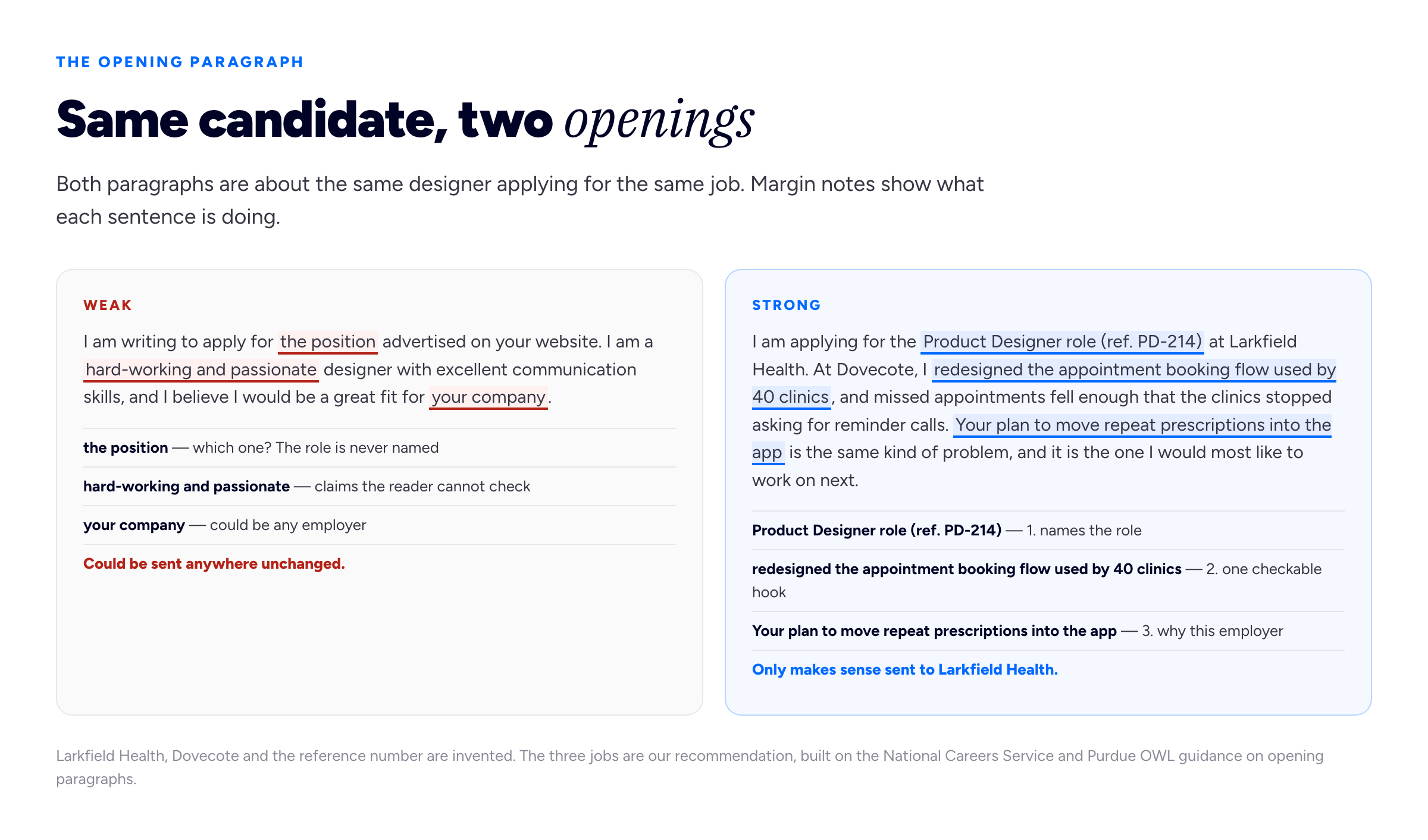
The strong version is barely longer. It swaps adjectives about the writer for facts the reader can check, and ends on the employer rather than the applicant.
Types of opening line, and when each works
Lead with whatever is genuinely your strongest card for this job, not whatever sounds cleverest.
An achievement
The most widely useful type. "As the operations coordinator who cut Hartwell Freight's late deliveries by a third, I was glad to see your Logistics Lead vacancy." Use a number only if you can stand behind it at interview; otherwise describe the change.
A referral
The strongest opener there is, because it borrows trust you have not yet earned: "Priya Shah, who leads your data team, suggested I write to you about the Analytics Engineer role." Ask the referrer's permission first.
A connection to the mission or product
Only when it is real and specific: "I have run my studio's bookings on Tidewell for three years, so I read your Customer Success vacancy with more than usual interest." Generic praise ("I have long admired your commitment to excellence") only shows you found their website.
The work itself (designers, developers and other creatives)
If your field hires on what you have made, put a piece of work in the opening: "The packaging series for Fernbrook Tea on my portfolio is the closest thing I have made to the range you are launching." A link to a portfolio site lets the reader see the work before they finish reading about it; our guide to the portfolio link on your resume covers formatting the address.
The bridge (career change)
Name the move once and make the bridge the hook: "After eight years managing client accounts in advertising, I am applying for your Project Coordinator role, which asks for most of what that job taught me." Do not apologise or explain why you are leaving; the reader cares what carries over.
What you already know (internal move)
Skip the introduction the reader does not need: "I have worked alongside the Partnerships team for two years as finance lead on their contracts, and I would like to apply for the Partnerships Manager role."
A reason to write (speculative application)
With no advert, the opening has to supply the reason the letter exists: "Your expansion into Leeds made me want to ask whether you will be hiring site surveyors there. I have spent three years surveying residential developments across West Yorkshire." Keep it short and quick to say yes to.
The closest relevant thing (entry level)
Lead with a module, project, placement or society role: "I am a final-year statistics student applying for your Data Intern position, and my dissertation on missing survey data is the kind of cleaning work your advert describes." Never open with an apology for inexperience. Our guide to portfolio vs resume shows how a little shown work outweighs a list of claims.
Openings to avoid
- "My name is…" It is already at the top of the letter. Do not spend the most-read sentence on it.
- "To whom it may concern." It says you did not find out who would read this.
- "I am the perfect candidate." A claim you cannot know, which invites the reader to disprove it.
- A question or a quotation. One reads as a sales leaflet; the other puts someone else's words where the reader wants yours.
- A string of adjectives. "Passionate, driven, detail-oriented" — everyone says it and nobody can check it.
- Your life story. "Ever since I was a child…" belongs in a personal statement, not here.
- The wrong company name. The commonest fatal error in a reused letter. Reread the first paragraph before every send.
Opening lines you can adapt
Each leaves a slot for something only you can supply. A real detail in the slot is what makes the line work.
- "I am applying for the [job title] role (ref. [number]). At [company], I [specific result], which is close to [need named in the advert]."
- "[Referrer's name], who [their role at the company], suggested I write to you about the [job title] position."
- "As the [your role] who [specific achievement], I was glad to see your vacancy for a [job title]."
- "I have used [product] for [time] as a [type of user], so your [job title] vacancy stood out to me."
- "I am applying for the [job title] role. The [project] on my portfolio at [link] is the closest thing I have made to [what the company is doing]."
- "After [number] years in [old field], I am applying for your [job title] role, which asks for much of what that work taught me: [transferable skill]."
- "I have worked alongside the [team] for [time] as [your role], and I would like to apply for the [job title] position."
- "Your [specific news or project] prompted me to ask whether you are looking for [kind of role]. I have spent [time] doing [relevant work]."
- "I am a [year] [subject] student applying for your [internship], and my [project or placement] involved [the work the advert describes]."
- "We met at [event], where you mentioned [topic]. I am now applying for the [job title] role."
- "I am applying for the [job title] role. For the last [time] I have freelanced for [type of clients], doing [the work the role involves]."
- "The advert's emphasis on [specific requirement] matches the work I am proudest of: [one-line example]. I would like to be considered for the [job title] position."
For line 11, see freelance work on a resume. If you are translating the idea of a carta de presentación, our guide to the letter of presentation explains how it maps onto the English cover letter.
Starting a cover letter in the body of an email
When the email is the letter, the subject line does the header's job: "Application: Product Designer (PD-214) — Jordan Reyes", or exactly the format the advert asks for. The greeting stays the same ("Dear Ms Okafor," or "Dear Hiring Manager,"); "Hi Sam," only if Sam has already written to you that way. And the opening gets shorter, because a phone's preview pane may show only two lines: "I am applying for the Product Designer role. At Dovecote I redesigned the booking flow used by 40 clinics; the case study is linked below." If the letter is attached instead, the email needs only a short note naming the role and the attachment.
Either way, the hook you open with is the fit you restate at the end; our guide to how to end a cover letter shows how to land it, and how long a cover letter should be covers what goes between. The same instinct for cutting applies to how long a resume should be.
If you are stuck before the first line, our free AI cover letter generator drafts a short, three-paragraph letter from the job advert and your own background notes. Treat its opening as scaffolding: it can only use the facts you give it, so swap anything general for your own specific result before you send it.
Frequently asked questions
What is a good first sentence for a cover letter?
One that names the role and gives a specific reason you fit it. "I am applying for the Logistics Lead role; at Hartwell Freight I cut late deliveries by a third" beats any clever hook, because the reader learns what you want and why you are worth reading in one line.
How do you start a cover letter with no experience?
Lead with the most relevant thing you have done, paid or not: a module, project, placement or volunteering role. Name the role, connect that one thing to the advert, and do not apologise for what you have not done yet.
Is "Dear Hiring Manager" OK?
Yes. It is the most common modern greeting when you cannot find a name, and careers offices such as MIT's suggest it. A real name is better if you can find one quickly; a team name is a warmer alternative.
Should I use "To whom it may concern" or "Dear Sir or Madam"?
Avoid "To whom it may concern" in a cover letter. "Dear Sir or Madam" is still correct in formal British English and is the National Careers Service's fallback, but it reads as old-fashioned. If you use it, close with "Yours faithfully".
Is "I am writing to apply for…" a bad opening?
No. It is clear and conventional. The risk is what follows it, so make the next sentence specific. "I am applying for…" is a shorter variant that does the same job.
How do you address a woman when you do not know if she is married?
Use "Ms", which says nothing about marital status and is the standard business choice in British and American English. If you are unsure of someone's title altogether, write their full name: "Dear Sam Okafor".
How we put this guide together
The three jobs of the opening paragraph, the weak-to-strong grading, the types of opening line, the openings to avoid and the twelve adaptable lines are our own recommendations, drawn from how cover letters are read rather than from any official standard. Weigh them as opinions with reasons attached. Where we suggest something the official guidance does not cover, such as which close follows "Dear Hiring Manager", we say so.
We have deliberately left out statistics we could not trace. Claims such as "recruiters spend X seconds on a cover letter" or "Y% of hiring managers dislike 'To whom it may concern'" circulate widely, but none of the versions we found pointed to a published survey method, so none appear here.
The factual claims point at primary sources we read: the National Careers Service's advice on writing a covering letter (addressing a named person, "Dear Sir or Madam" as the fallback, the contents of the introduction, and the "Yours sincerely" and "Yours faithfully" rule); the British Council's LearnEnglish page on cover letters (the same pairing, and "give a clear reason for writing"); the Purdue Online Writing Lab's guidance on formatting and organising cover letters (the order of the header, the colon after a US greeting, using a full name when unsure of a title, "Dear Hiring Professionals" and the contents of the opening paragraph); and MIT Career Advising and Professional Development's guide to writing an effective cover letter (addressing the hiring manager by name, or "Dear Hiring Manager" when you cannot). Conventions vary between employers, sectors and countries, so if an advert or application pack specifies a format, follow it.
Larkfield Health, Dovecote, Hartwell Freight, Tidewell, Fernbrook Tea, Sam Okafor, Priya Shah, Jordan Reyes and every reference number in the examples are invented to show the shape of an opening, not taken from real applications.
Related reading: how to end a cover letter, how long a cover letter should be, how to write a letter of presentation, how to put a portfolio link on your resume, portfolio vs resume and putting freelance work on your resume.
More from the blog
September 27, 2026 · 17 min read
How to End a Cover Letter: Closing Lines That Sound Confident, Not Pushy
A cover letter ending has three jobs: restate your fit in one line, name a next step and thank the reader. Closing sentences graded from too passive to too pushy, sign-offs compared including Yours si...
October 4, 2026 · 16 min read
How to Write a Cover Letter for an Internship (With Example)
Little or no work experience? Here is how to read an internship advert and match each requirement to your coursework, projects, societies or part-time job, with a full example letter annotated paragra...
September 28, 2026 · 15 min read
How Long Should a Cover Letter Be? Words, Pages and Paragraphs
One page is the published guidance and four or five short paragraphs is the shape. Where a 250–400 word target comes from, when faculty, federal, emailed and form applications change it, what to cut,...