
September 28, 2026 · 15 min read
How Long Should a Cover Letter Be? Words, Pages and Paragraphs
One page is the published guidance and four or five short paragraphs is the shape. Where a 250–400 word target comes from, when faculty, federal, emailed and form applications change it, what to cut, and a worked edit that halves a paragraph.
A cover letter should fit on one page: in practice, three to five short paragraphs and, by our own rule of thumb, roughly 250 to 400 words of body text. The page limit and paragraph count are what careers services publish — MIT's careers office says a cover letter "should be no longer than one page", UK university careers services say one side of A4, and the National Careers Service calls it "a short letter, usually 3 to 5 paragraphs long". The word range is ours, and this guide explains where it comes from and when to break it.
There are real exceptions: faculty letters, emailed letters and character-limited forms. Below: length by situation, a word budget per paragraph, what to cut, the formatting that quietly changes length, and a worked edit.
The short answer, and where each part comes from
Three numbers get quoted in answers to this question, and they come from different places.
- One page. The most widely published guidance. MIT's Career Advising and Professional Development office says no longer than one page, in a font size between 10 and 12 points. The University of Reading's careers guidance says "One side of A4", and jobs.ac.uk says a cover letter "should be no more than one side of A4".
- Three to five paragraphs. From the National Careers Service, and consistent with MIT's structure of an introduction, two or three body paragraphs and a closing.
- 250 to 400 words. Our recommendation, not a published standard. It comes from arithmetic: one page at 11 points with one-inch margins, after the address block, date, greeting and sign-off, leaves room for about 400 words before it looks crowded. Below about 200 words a letter usually reads like a form; above 400 it usually means a paragraph is retelling your resume.
You will see more precise figures elsewhere, sometimes with a percentage of recruiters who supposedly prefer a particular length. We have not used any of them, because none we found pointed at a survey whose method we could read.
Why short wins
A cover letter is read alongside a resume. The reader already has your job history. What they lack is the answer to two questions: why this job, and what is the one piece of evidence that you can do it. Neither needs 700 words, and a long letter buries both answers under material the reader has already seen.
Writing short also forces you to choose your best example. A long letter lets you avoid choosing, so four examples arrive at equal weight and the reader has to do the ranking you skipped. One project explained properly persuades more than four named in passing. And if a portfolio is part of the application, every paragraph spent describing work is time the reader could have spent looking at it. The letter's job is to point, not reproduce — see portfolio vs resume for how the documents divide the work.
Length by situation
"One page" is the default, not the law. Here is how it shifts with the kind of application.
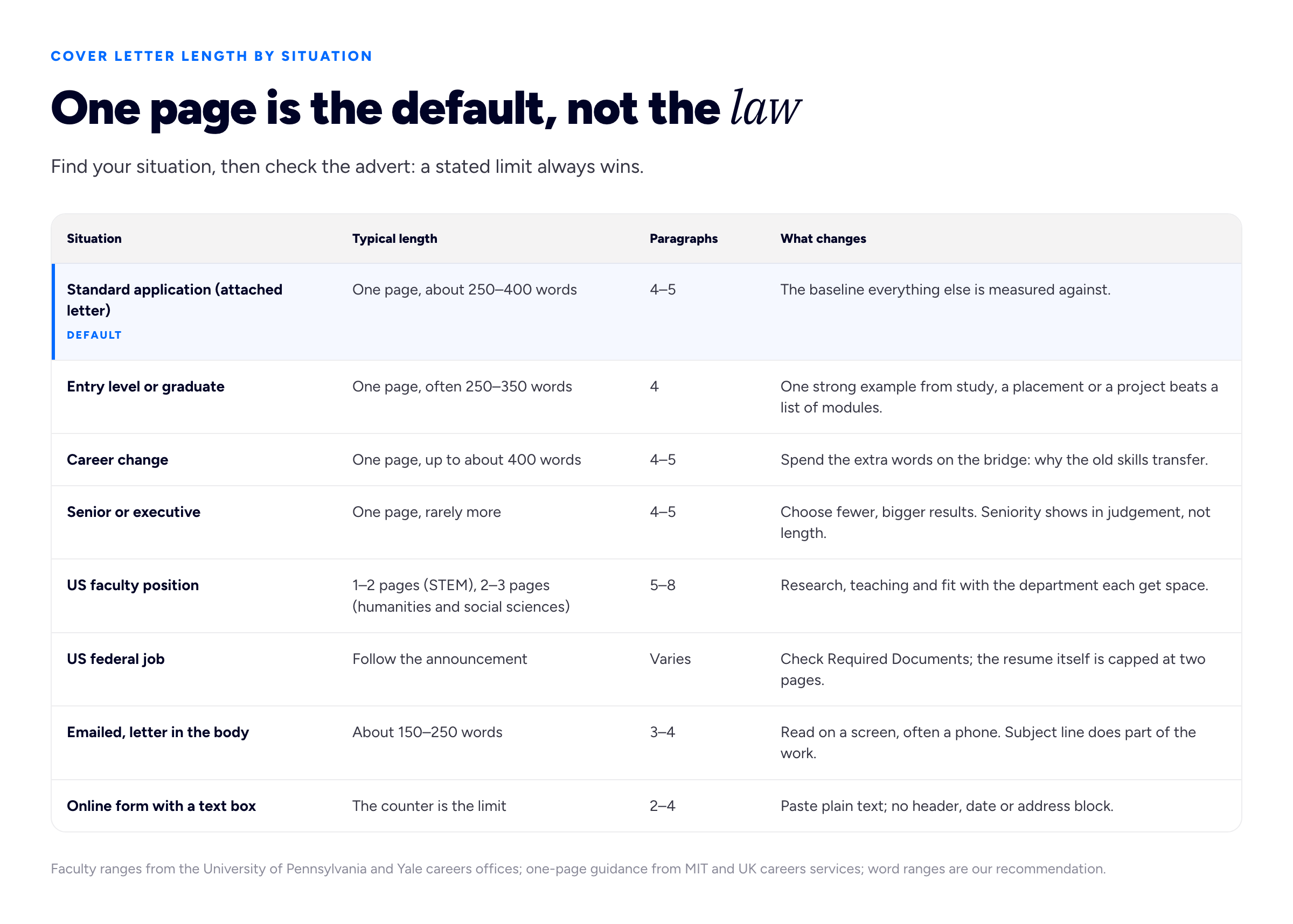
Most rows stay on one page. The two that do not — faculty letters and announcement-driven federal applications — are where the employer, not convention, sets the length.
Entry level and graduate applications
With little work history, the temptation is to make up for it with volume: every module, every society, every part-time job. Aim instead for the shorter end, about 250 to 350 words, built around one example you can describe in detail — a final-year project, a placement, some freelance work — and why it matters for this role. If you are short of material, the fix is a better example, not more sentences.
Career changers
This is the one ordinary situation where the full 400 words is usually justified. Your resume shows a history in another field, and the letter has to build the bridge: which parts of that work transfer, and what you have done to close the gap. That takes a paragraph of its own. It does not take two pages.
Senior and executive roles
The letter should not grow with the career. A senior letter is the same length as anyone else's, with fewer and larger examples: a turnaround, a team you built, a programme you delivered. Two results read as more credible than eleven. The detail belongs on the resume — see how long a resume should be for where that page count genuinely does grow.
US faculty applications: the legitimate long letter
Academic job letters in the United States are the clear exception. The University of Pennsylvania's career services say a faculty letter is "typically 2–3 pages long" in the humanities and social sciences and "1–2 pages" in STEM, and advise checking your own department's norms. Yale's Office of Career Strategy calls academic cover letters "typically longer (2-3 pages)" than industry ones, while also advising applicants to "adhere to discipline norms (typically 1-2 pages)" — a reminder that the ranges overlap and depend on field.
The reason is structural: a faculty letter summarises research, teaching and departmental fit. It is not permission to write a long letter for a marketing role. UK academic applications are often organised around a person specification's criteria instead, so follow the advert.
US federal jobs
For federal jobs, the announcement decides. Its "Required Documents" section lists what you must submit, and whether a cover letter is wanted varies between announcements. The limit that does exist is on the resume: the Office of Personnel Management's applicant guidance says "Resumes must be no longer than two-pages in length". The OPM guidance we read sets no length for cover letters, so we will not invent one. If you include an optional letter, the one-page advice applies — and do not use it as overflow for a capped resume. Anything that matters for the qualifications belongs on the resume, where it is assessed.
Emailed applications: body text versus attachment
If you attach a formal letter, the covering email should be three or four lines: the role, what is attached, a thank-you. The National Careers Service notes you can "write it as an email if you're applying online", and when the email body is the letter, trim it. A phone screen is less forgiving than a page; we recommend 150 to 250 words, the role in the subject line, no postal address block or date, and paragraphs of two or three sentences.
Online forms with character limits
Many application systems replace the letter with a text box. When there is a counter, that is your limit. It usually counts characters, not words, and spaces count too. Draft in a plain text editor, check the count there, and paste plain text — no header, address or date. If the box asks a question, such as why you want the role, answer that question rather than pasting a letter written for a different one. With no counter and no stated limit, treat it like an emailed letter.
When the advert states a limit
This overrides everything above. If the advert asks for "no more than 500 words" or "one page", that is the limit, and ignoring it tells the reader you do not follow instructions.
What each paragraph does, and how many words it gets
The fastest way to control length is to give every paragraph one job and a budget before you write. Published structures are close to one another: Purdue's Online Writing Lab describes an introduction, an argument and a closing; MIT describes an introduction, two or three body paragraphs and a closing; Reading asks that each paragraph address "only one important factor". Here is our version, with budgets that add up to 250 to 400 words.
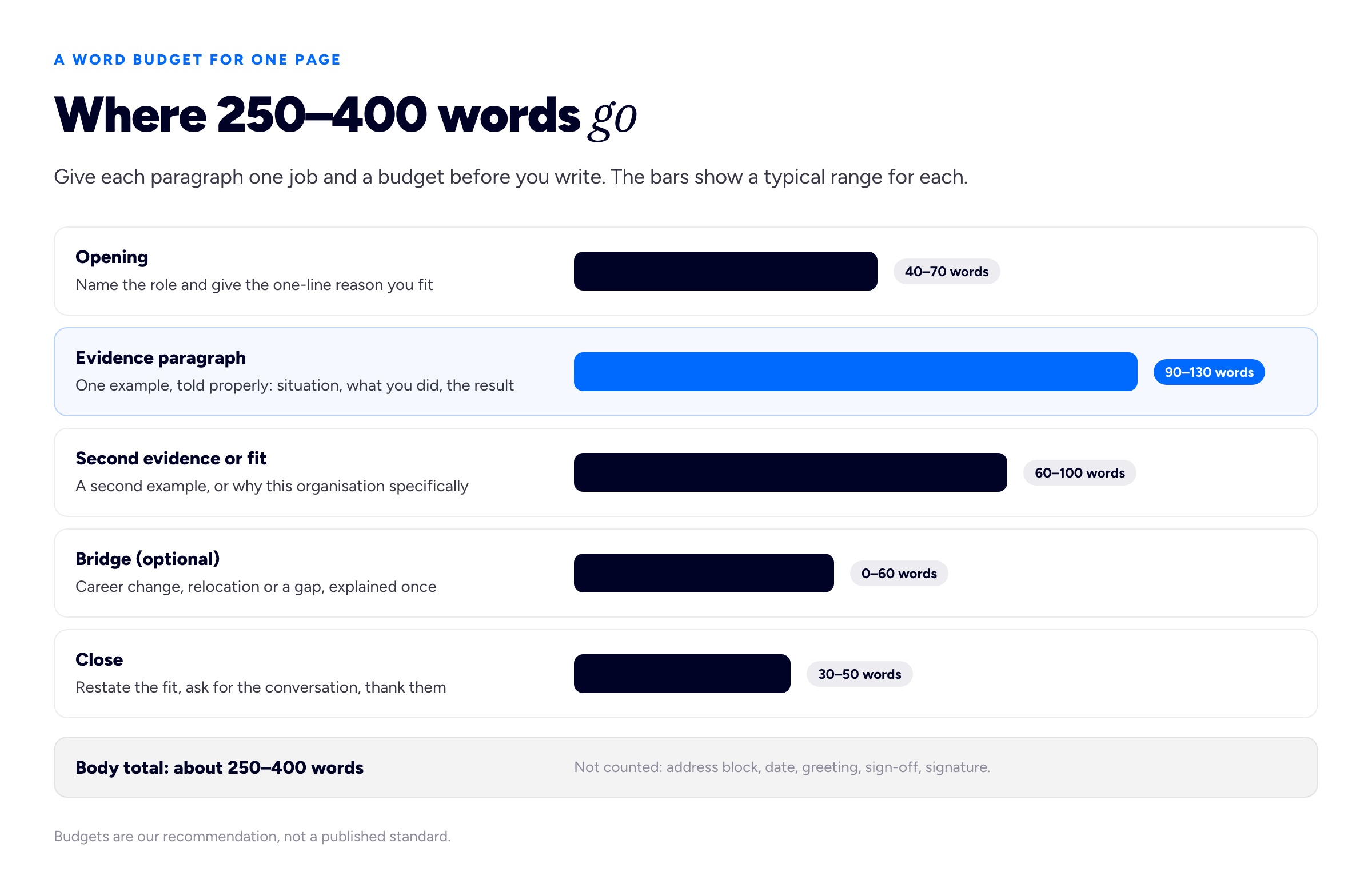
The evidence paragraph is the only one allowed to be long. If the opening or the close competes with it for space, the letter has its priorities backwards.
The opening (40–70 words) names the role and gives the one-sentence reason you fit — not your life story, and not a statement that you are "writing to apply". Openings have their own guide: how to start a cover letter.
The evidence paragraph (90–130 words) is where the letter earns its place. Take the most relevant thing you have done and tell it properly: the situation, what you specifically did, and what changed.
The second paragraph (60–100 words) gives either a different example or a specific reason you want this organisation. Pick whichever the advert makes more important.
The bridge (0–60 words) exists only if the reader would otherwise wonder about something: a change of field, a move, a gap. Explain it once and move on. Most letters do not need it.
The close (30–50 words) restates the fit in a line, asks for the conversation and thanks the reader. Our guide on how to end a cover letter has the wording.
What to cut
When a letter runs long, the excess is almost always one of these, roughly in order of how much space they take:
- Resume repetition. Job titles, dates and duties in prose. MIT's guidance says body paragraphs should complement your resume rather than repeat it. If deleting a sentence would leave its information on the resume, delete it.
- Second and third examples. Keep the strongest; the rest can live in your portfolio, which has no page limit. See how to put a portfolio link on your resume for where the link goes.
- Unprovable adjectives. "Passionate", "hard-working", "detail-oriented". Every applicant claims them. Replace one with a fact that shows it, or remove it.
- Skills lists. A sentence running through eight tools is a skills section in the wrong document. Name the one or two the advert stresses, inside an example, and leave the rest to your resume skills section.
- Throat-clearing. "I am writing to express my interest in…", "Please find attached my resume". The reader knows why the letter exists.
- Hedges. "Although I do not have direct experience…" spends words making your case weaker. State what you do have.
Formatting that changes the length
The same 350 words can look comfortable or cramped depending on a few settings, and the usual squeezing tricks make it worse.
- Font size. MIT recommends 10 to 12 points. Eleven is a good default; going below 10 to save space means the letter needs editing, not shrinking.
- Font choice. The National Careers Service suggests using "the same font and size as you do for your CV, so it looks consistent" — which also stops you picking a narrow font to fit more in.
- Margins and spacing. Purdue's OWL suggests "one-inch margins on all sides", single spacing and a blank line between paragraphs. Narrow margins make wide, dense lines that read as longer even when the letter fits on a page.
- The header block. Contact details, date and employer address can take a quarter of the page. Keep it compact, and leave the address block out of emails and forms.
- File format. Attach a PDF unless asked otherwise, so the page break lands where you saw it. A letter that spills four lines onto page two in someone else's software is a two-page letter. Our guide to ATS-friendly resume formatting covers the same file mechanics.
How to trim a long letter: a worked edit
Here is an overlong evidence paragraph from an invented applicant, Maya Okafor, applying for a junior product designer role at an invented company, Larkspur Health. It is 135 words.
In my current role as a Marketing Assistant at Brightwater Retail, which I have held since 2024, I have been responsible for a wide range of tasks including social media scheduling, email campaigns, liaising with external agencies and supporting the design team. I am extremely passionate about user experience and I have always been very detail-oriented. During my time there I also taught myself Figma, and I redesigned the returns page on our website, which was something I was very proud of because customers had been complaining about it for a long time. I also completed a Google UX certificate and I have done some freelance work for local businesses. I believe these experiences have given me a strong foundation of skills that would make me a valuable addition to your team at Larkspur Health.
Run it through the cut list. The first sentence is resume repetition. "Extremely passionate" and "very detail-oriented" are unprovable adjectives. The certificate and the freelance work are second and third examples. The last sentence is a hedge. The one thing only a cover letter can do here is tell the returns-page story, and it is the least developed part. So the edit cuts nearly everything else and gives that example room:
The most relevant thing I have done is redesign the returns page at Brightwater Retail. Customers were contacting support because they could not find the returns label, so I mapped the steps in Figma, tested two versions with five colleagues from the support team, and moved the label download to the top of the page. Support contacts about returns fell noticeably in the following month. It is the kind of small, evidence-led fix your advert describes for the patient booking flow, and I would like to do more of it.
That is 90 words, a third shorter, and it contains more the reader can check: a problem, a method, a result and a link to the job. "Fell noticeably" is honest if that is what she observed; if she had the support team's figures, she should give the real number, and if not, she should not invent one.
Nothing was lost. The certificate is on her resume, and the freelance projects are in the portfolio her signature links to. You can repeat this on any paragraph: mark each sentence as repeating the resume, claiming without evidence, or showing something new; delete the first kind, convert or delete the second, and spend the space on the third.
If you would rather start from a draft than a blank page, our free cover letter generator produces a structured first version from the job and a few details about you, with no account needed. Treat it as a draft to cut against the list above.
Frequently asked questions
How long should a cover letter be?
One page. MIT says no longer than one page; UK university careers services say one side of A4; the National Careers Service says usually three to five paragraphs. In words, we recommend about 250 to 400 for the body. US faculty letters are the main exception.
Is 500 words too long for a cover letter?
For most industry applications, yes, unless the advert allows it. At 500 words a letter with a normal header fills the page, and at least one paragraph is probably repeating the resume. The cut list above will usually get it below 400 without losing anything the reader needs.
Is a 200-word cover letter too short?
Not necessarily. For an email or online form it is often right. For an attached letter, check that it names the role, gives one specific example with a result, and asks for the conversation. If it does all three, it is long enough.
Can a cover letter be two pages?
For a US faculty position, yes: Penn's guidance gives one to two pages in STEM and two to three in the humanities and social sciences. For most other applications, no — a two-page industry letter is usually doing the resume's or portfolio's job. If the advert asks for more, follow the advert.
How many paragraphs should a cover letter have?
Three to five, according to the National Careers Service. Four is a good default: an opening, one evidence paragraph, a second paragraph on fit or another example, and a close.
What font size and margins should a cover letter use?
MIT recommends 10 to 12 points; Purdue's Online Writing Lab suggests one-inch margins, single spacing and a blank line between paragraphs. If the letter only fits at 9 points with half-inch margins, it is too long.
How we put this guide together
The one-page guidance, the paragraph count, the faculty letter ranges, the font and margin settings and the federal two-page resume limit are sourced facts, attributed in the text to whoever published them. The 250 to 400 word range, the per-paragraph budgets, the shorter range for emailed letters, the word figures in the situation table and the cut list are our own recommendations, worked out from what fits on a page. Weigh them as opinions with reasons attached.
We have deliberately left out statistics we could not trace. Figures such as "X% of recruiters prefer a half-page cover letter" or "hiring managers spend Y seconds on a cover letter" appear in many articles on this topic, but none of the versions we found pointed to a published survey method, so none appear here.
Primary sources we read: MIT CAPD's guide to writing an effective cover letter; the National Careers Service's advice on writing a covering letter; the Purdue Online Writing Lab's cover letter formatting and organisation guidance; the University of Reading's covering letters guidance and jobs.ac.uk's cover letter advice; the University of Pennsylvania's guidance on faculty cover letters and Yale Office of Career Strategy's academic cover letters page; and OPM's applicant guidance on the two-page resume limit. OPM's guidance does not address cover letters, which is why we send federal applicants to each announcement's Required Documents section rather than quoting a figure. Conventions vary by employer, sector and country; if an advert states a length, follow it.
Maya Okafor, Brightwater Retail, Larkspur Health, the returns-page project and every detail of the worked edit are invented, as is everything in both diagrams apart from the attributed source ranges. No employer, recruiter or applicant tracking system was tested to produce this guide.
Related reading: how to end a cover letter, writing a letter of presentation, how long a resume should be, putting a portfolio link on your resume, writing a resume skills section, ATS-friendly resume formatting and portfolio vs resume.
More from the blog
October 4, 2026 · 16 min read
How to Write a Cover Letter for an Internship (With Example)
Little or no work experience? Here is how to read an internship advert and match each requirement to your coursework, projects, societies or part-time job, with a full example letter annotated paragra...
October 2, 2026 · 15 min read
How to Start a Cover Letter: Greetings, Opening Lines and Examples
Start with your details and the date, a greeting to a named person or "Dear Hiring Manager", then an opening that names the role, gives one specific hook and says why this employer. Greetings compared...
September 27, 2026 · 17 min read
How to End a Cover Letter: Closing Lines That Sound Confident, Not Pushy
A cover letter ending has three jobs: restate your fit in one line, name a next step and thank the reader. Closing sentences graded from too passive to too pushy, sign-offs compared including Yours si...