
November 1, 2026 · 19 min read
Cover Letter vs Resume: What Goes in Each, and When You Need Both
The resume is the record; the cover letter is the argument for this role. What belongs in each and what must never be repeated, when a letter is really needed, how the two should point at each other, where a portfolio link fits, and one achievement written both ways.
A resume and a cover letter do two different jobs. The resume is the record: what you have done, where, when and with what result, laid out so a reader can scan it in under a minute and use it for any similar role. The cover letter is the argument: a single page, written to one person about one job, explaining why the record in front of them adds up to the right hire for this role at this employer. The resume answers "what has this person done?" The letter answers "why should that matter to us?" Send the letter whenever the advert asks for one, and in our view send it when the advert says it is optional too. Skip it only when there is genuinely nowhere to put it, when a recruiter is presenting you and has said not to, or when you are told not to.
Most pages on this question stop at a two-column definition. This one goes on to what belongs in each document and what must never be repeated across them, when a letter is really needed, how the two should refer to each other, where a portfolio link fits, and a worked pair: the same achievement written once as a resume line and once as a letter paragraph, so you can see the difference rather than read about it.
The short answer, in three lines
- The resume: a reusable record of your experience, skills and education, tailored lightly for each application, read first and fast.
- The cover letter: a one-page argument written fresh for each role, picking two or three things from the record and explaining why they matter to this employer.
- Together: the same facts, the same dates and the same name at the top, but never the same sentences.
Two documents, two jobs
The easiest way to stop the two documents blurring is to give each one a single job and hold it to that job.
The resume is the record
A resume is a structured list. Roles in reverse date order, each with a job title, organisation, dates and a handful of bullet points; then education, skills and anything else the role needs, such as certifications or a portfolio link. It is written in a clipped, impersonal register ("Led", "Rebuilt", "Cut") with the "I" taken out. It is meant to be scanned, by a person and very often by an applicant tracking system first, which is why our guide to ATS resume format asks for plain headings and a simple layout.
Because it is a record, the resume is largely reusable: you adjust the summary and the order of bullets for each application, but the bones stay the same.
(If you are applying outside North America and the advert asks for a "CV", it almost certainly means this same short document. Our guide to CV vs resume explains when the two words mean different things.)
The cover letter is the argument
A cover letter is prose, written in the first person, to a named reader if you can find one. It does not try to cover your whole history. It chooses. Out of everything on the resume, it picks the two or three things that matter most for this particular job and explains why, in sentences that could not be sent to any other employer without being rewritten.
The UK's National Careers Service puts its purpose simply: a cover letter "introduces you to an employer and asks them to think about your application", and it should let them know "they can get more details from your CV". MIT's careers office makes the same point from the other side: try not to "simply repeat your resume in paragraph form", and instead "complement your resume by offering a little more detail about key experiences".
That is the whole distinction. The letter introduces and interprets; the resume supplies the detail.
Who reads which, and in what order
In most hiring processes the resume is read first, often as part of a pile, to decide who is worth a closer look. The letter tends to be read by fewer people and with more attention: the hiring manager deciding between a shortlist, or a recruiter trying to understand an application that does not obviously fit, such as a career change, a gap or a move from freelance work. Some readers skip letters altogether; we have not found a reliable figure on how many, so we will not quote one. Either way, each document has to work on its own. A resume that only makes sense with the letter beside it, or a letter that only makes sense with the resume open, fails the reader who sees just one.
Cover letter vs resume, side by side
Here is the comparison laid out by what each document actually contains and how it behaves.
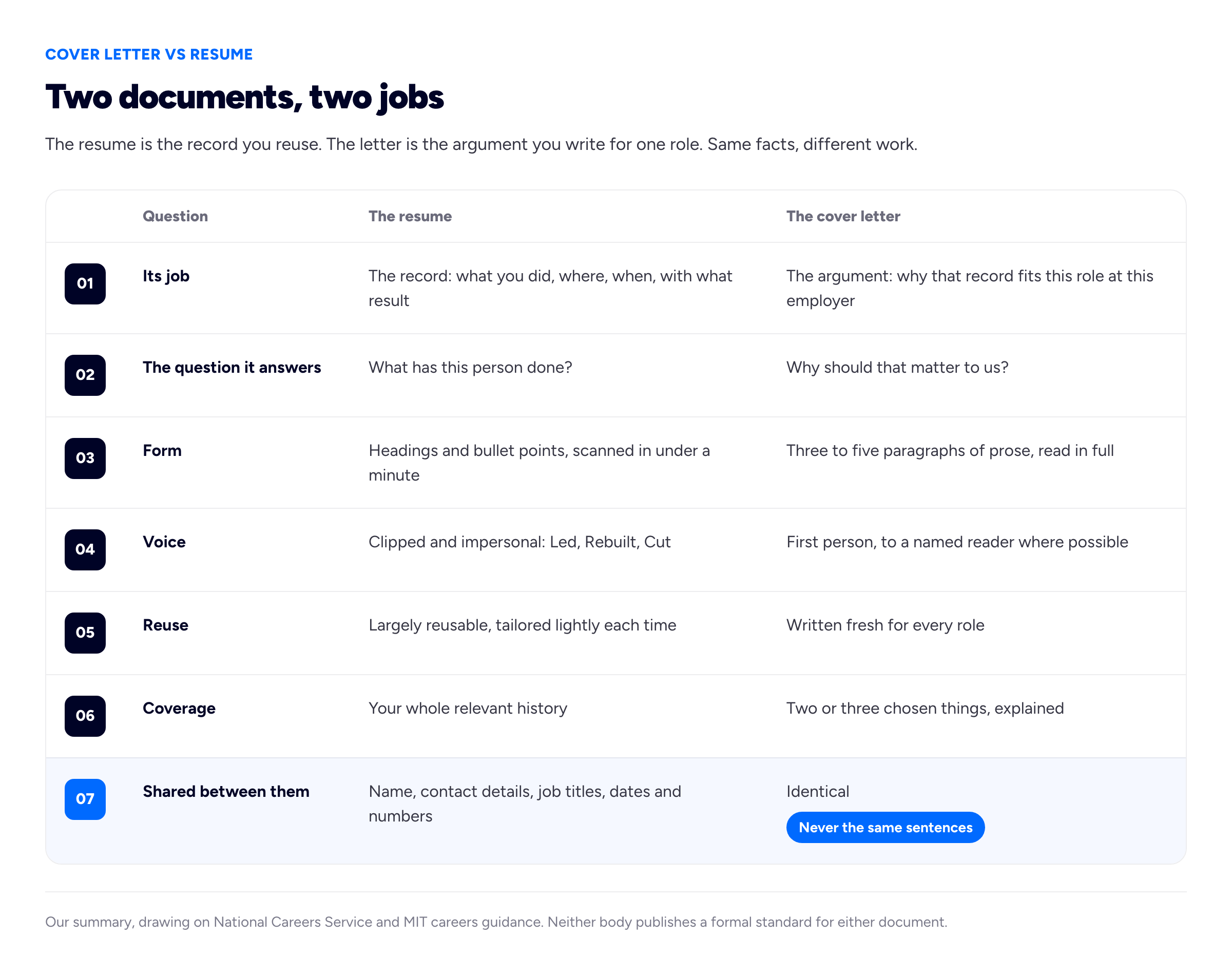
The facts are shared; the sentences never are. If a line could be pasted from one document into the other, one of them is doing the wrong job.
What must not be duplicated
The single most common problem we see is a cover letter that is the resume again, rewritten as paragraphs. It reads like this: "In my current role I manage the email newsletter and the social channels. Before that I worked as a marketing assistant, where I supported campaigns. I am skilled in email platforms, analytics and copywriting." Every fact is already on the resume, and the reader has learned nothing new.
Keep out of the letter
- Your chronology. The letter does not walk through your jobs in order. The resume has done that. Name a role only when it is the setting for the point you are making.
- Your skills list. "I am proficient in..." followed by six tools is the skills section in disguise. If a tool matters, show it inside a sentence about what you did with it.
- Bullets turned into sentences. If a sentence in the letter is a resume bullet with "I" added at the front, rewrite it around the reason it matters, or cut it.
- Your education, unless it is the point. For a graduate role or a career change built on a new qualification, the course may be the argument; see our guide to the cover letter for an internship. Otherwise leave it to the resume.
Keep out of the resume
- Motivation. Why you want this job, why this employer, why now. That is the letter's material, and an objective statement full of it wastes the top of the page.
- Explanations. A career change, a gap, relocation or a move from freelance to employed work can be stated factually on the resume. The reasoning belongs in the letter.
- Anything addressed to one employer. The resume is reusable. A line that names the company you are applying to belongs in the letter or in a tailored summary, not scattered through your experience.
The things that must match exactly
Some details should appear in both and be identical: your name as you use it professionally, your phone number and email address, your job titles, your dates and any numbers you quote. The National Careers Service reminds you to make sure your contact details "are correct on both your cover letter and CV". A letter that says you grew a list "to over 20,000" while the resume says 18,500 is the kind of mismatch that makes a careful reader wonder which document to trust.
What is a cover letter for a resume?
The phrase "cover letter for a resume" is how many people search for this, and it reflects how the letter started out: a covering note sent with a printed resume, saying what the enclosed document was and which job it was for. That narrow meaning survives in places. A "resume cover letter" is simply a cover letter sent alongside a resume, and the two terms mean the same thing.
The modern letter does more than cover. It still introduces the application and names the role, but its real weight is in the middle paragraphs, where it makes the case. If you only take one thing from the old meaning, take this: the letter exists because of the resume and refers to it. It is never a stand-alone autobiography. Our guides on how to start a cover letter, how to address a cover letter and how to end a cover letter cover the parts around that case, and how long a cover letter should be covers the page limit.
Is a cover letter necessary?
Not always, but more often than people hope. The National Careers Service's position is the firm end of the range: "You should always include a cover letter when you apply for a job using a CV." We think that is the right default, and the situations below are our judgement on when to keep to it, when to adapt it and when it genuinely does not apply.
When the advert asks for one
Send one. An application missing a requested document can be screened out before anyone reads the rest, and the request is also a signal that someone intends to read it. Follow any instruction about what to cover: if the advert says "explain how you meet the criteria", the letter should go through those criteria rather than make its own case in its own order.
When the advert says "optional"
Send one, and keep it short. "Optional" usually means the employer will not reject you for leaving it out, not that nobody will read it. Between two similar resumes, the one with a specific, well-aimed letter has given the reader more reason to choose it. The exception is when the honest choice is between a generic letter and none: a template letter that could go to any employer can do more harm than an absent one, because it shows the reader you did not think about them.
When the portal has no upload for one
Many application systems ask for a resume and nothing else. Look first for a free-text box ("additional information", "anything else you would like us to know", "why are you interested in this role?"). That box is where a shortened version of the letter goes: two short paragraphs, no greeting block, no sign-off formalities. If there is no box at all, do not paste the letter into your resume file to force it through, because the system may try to read it as your work history. Instead, if you can find the hiring manager or recruiter, send a brief note after applying that says you have applied and gives the one-paragraph case. If you cannot find anyone, let the resume stand alone; the tailored summary at its top becomes the only place to make the argument, so make it count.
Where the instructions explicitly say to upload one file containing both, follow them: the letter normally goes first and the resume after, in a single PDF. Without that instruction, keep them as separate files.
Speculative applications
When you write to an employer that has not advertised a role, the letter is not an extra. It is the application. Nobody asked for your resume, so the letter has to explain why you are writing, what kind of work you are offering, and why this employer rather than any other. The resume goes with it as evidence. A speculative email with only a resume attached tends to be filed rather than answered, because it asks the reader to do the work of deciding what you want.
Internal moves
Applying for a role in your own organisation changes the balance. The hiring manager may already know your work, and your resume matters less than it would from a stranger. Follow the internal process, which may have its own form, but write the letter anyway, or at least a short email to the hiring manager. It is where you show what you already know about the team's work and what you would do differently in the new role.
Recruiter-led roles
When an agency or external recruiter is putting you forward, they usually present you to the employer in their own words, sometimes reformatting your resume. A formal letter is often not wanted. Ask the recruiter directly. If they say no, give them the argument in another form instead: a few lines by email setting out why you fit this role, which they can use in their pitch. The thinking is the same as a letter; only the reader has changed.
One-click apply, or when you are told not to
Some job boards apply with a saved profile in one click, and some employers say plainly that they do not want letters, or replace them with questions on the form. There is nothing to send, so put the effort into the form answers and your resume summary instead: the same job in a different shape.
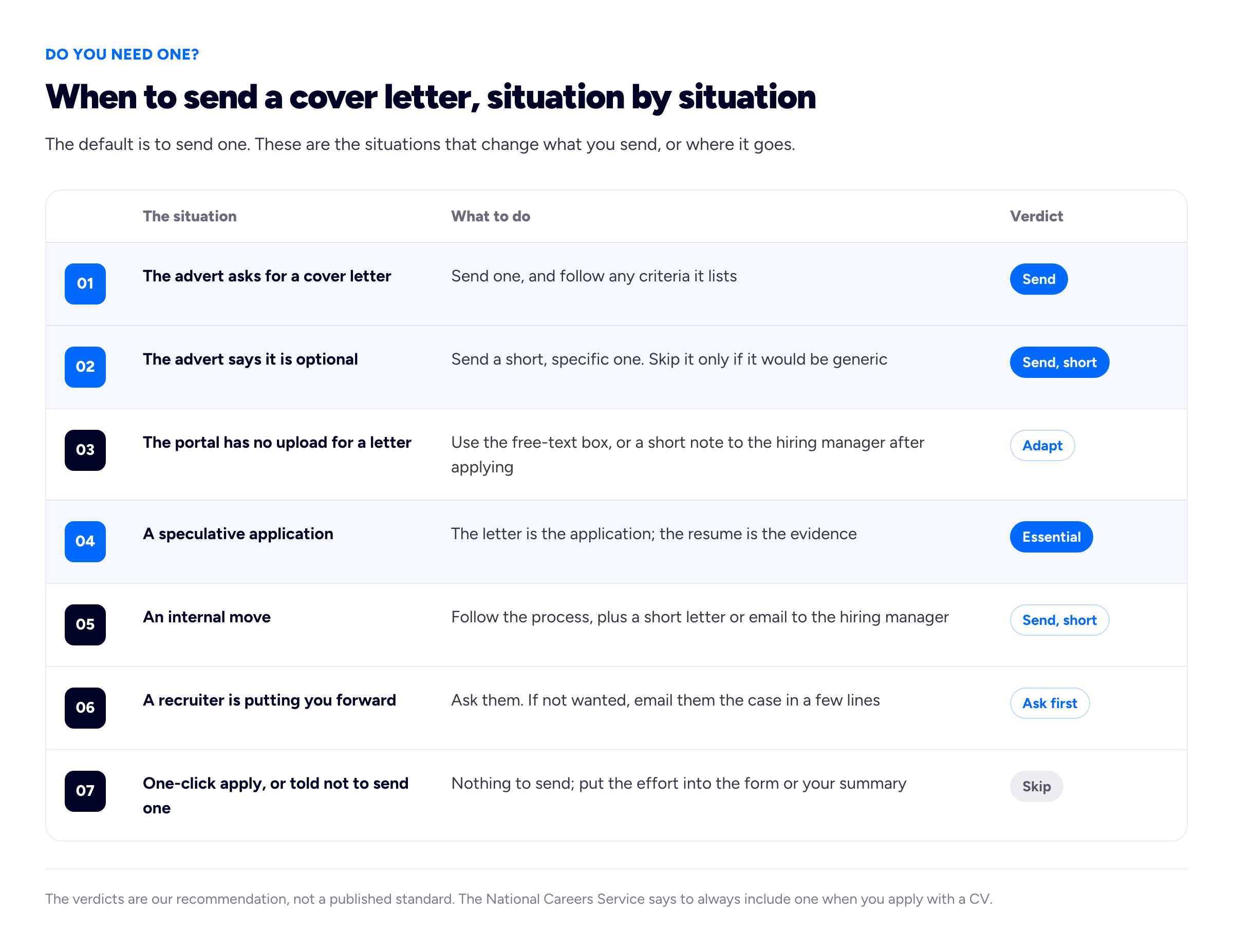
Most of the rows are not about whether to argue your case but about where the argument goes when there is no slot labelled "cover letter".
How the two should reference each other
The documents travel together, and they should look like they belong together without echoing each other.
- Use one header. The same name, contact details and, ideally, the same font and layout at the top of both. The National Careers Service suggests using "the same font and size as you do for your CV, so it looks consistent".
- Point to the resume once, specifically. "My resume has the full history" is filler. A better pointer does work: "the resume lists the three launches; the one most like your spring list is the second." One such pointer is plenty.
- Expand, do not restate. The letter takes a resume bullet and adds what the bullet could not hold: why you did it, what was hard about it, and what it would mean for this employer. If the reader turns to the resume afterwards, they should find the same achievement there in compressed form.
- Keep the big claims on both. Do not introduce a major achievement in the letter that is missing from the resume. A reader who sees it in the letter and cannot find it on the resume will wonder why, and the resume will often be read alone later in the process.
- Name the files as a pair.
caspian-rourke-resume.pdfandcaspian-rourke-cover-letter.pdfare easy to find in a downloads folder and obviously belong to each other.resume-final-v3.pdfandletter.pdfare not.
The same goes for anything else you send. If references are requested later, the reference sheet should carry the same header too; our guide to references on a resume covers that sheet.
Where a portfolio link fits alongside both
If your work can be shown, there is a third document in the application, and it has a third job. The resume describes the work, the letter argues for it and the portfolio is the evidence. Our guide to portfolio vs resume covers that relationship in depth; here is how the link sits with the other two.
- On the resume: the link goes in the header, next to your email address, as a short, readable address. Our guide to putting a portfolio link on your resume covers the format and placement.
- In the letter: link to one specific piece of work rather than the home page, and only once. The letter has argued that one project matters; the link takes the reader straight to it. "You can see the campaign, with the before-and-after emails, at..." is more useful than "please visit my portfolio".
- On the portfolio itself: the same names, titles and dates again. If the project is called one thing in the letter and another on the site, the reader has to work out that they are the same.
A portfolio site does not need to be elaborate to do this. Bunfolio gives you a free one on your own subdomain, but any site that lets you give each project its own address will let the letter link to exactly the right thing.
A worked pair: one achievement, written twice
Here is how the same piece of work reads in each document. Caspian Rourke, an invented candidate, is applying for a marketing manager role at Fallowfield Press, an invented independent publisher. The hiring manager is Wren Kalinowski, the publisher's head of sales and marketing. The advert says Fallowfield wants to sell more of its backlist (books published in earlier years) directly to readers rather than relying on bookshops and large retailers.
In his current role at an online bookseller, Caspian rebuilt the weekly email newsletter. On his resume, that work is one bullet.
Marketing Executive, online bookseller, March 2023 to present
Rebuilt the weekly newsletter around staff reading recommendations instead of new-release lists; subscribers grew from 8,400 to 21,000 in 14 months, and sales from newsletter links tripled, mostly on titles more than two years old.
That bullet does its job. It names what he did, what changed, the scale and the result, in one sentence that someone can read in five seconds. It does not say why he did it, what was difficult or why it matters to a publisher. It should not: that is not the resume's job.
Here is the same work in the second paragraph of his letter to Wren.
Your advert says Fallowfield wants readers to find the backlist directly, and that is the problem I have spent the last year on. When I took over our weekly newsletter, it was a list of new releases that looked like every other bookseller's, and almost everything it sold was under six months old. I rebuilt it around a single recommendation from a member of staff each week, with a few lines on why they loved the book, and let the publication date stop mattering. Subscribers more than doubled, and most of the sales the newsletter now drives are books more than two years old. Your list has the kind of older titles that respond to this: the translated fiction in particular has exactly the reader loyalty our staff picks were built on, and I would like to try the same approach with your editors as the voices.
Compare the two.
- The letter starts with the employer's problem, quoting the advert, not with Caspian's job title. The resume starts with his job title, as it should.
- The letter explains the reasoning: why the old newsletter was not working and what the change was meant to do. The resume reports only the change.
- The numbers are consistent but not repeated in full. "More than doubled" and "more than two years old" agree with the resume's figures without reciting them; the reader who wants the exact numbers finds them on the resume.
- The letter ends on Fallowfield, with a specific idea about its list. That sentence could not be sent to any other publisher. The resume bullet could go to any of them, which is exactly right for a resume.
If Caspian had a portfolio page for the newsletter, with two or three sample issues, the end of that paragraph is where the link would go. And before sending, he should do what everyone should: read the two documents side by side and check that every title, date and number agrees. If you could swap the employer's name in the letter and send it elsewhere, it is not yet an argument for this role.
Frequently asked questions
What is the difference between a cover letter and a resume?
A resume is a structured record of your experience, skills and education, reusable across applications. A cover letter is a one-page letter, written for one role, that picks two or three things from that record and explains why they make you the right hire for this employer. The facts are shared; the wording is not.
Is a cover letter necessary?
When the advert asks for one, yes. When it says optional, we recommend sending a short, specific one. You can skip it when there is nowhere to send it, when a recruiter presenting you says it is not needed, or when the employer says not to send one.
Should a cover letter repeat my resume?
No. It should expand on a few points from the resume: why you did the work, what was hard about it and why it matters to this employer. Facts such as dates, titles and numbers must match, but sentences should not be copied across.
Can I put my cover letter and resume in one document?
Only when the application instructions ask for a single file. Then the letter usually goes first and the resume second, in one PDF. Otherwise keep them as two files with matching names.
Do employers actually read cover letters?
Some read every one, some read them only for shortlisted candidates and some skip them. We have not found a reliable published figure, so we do not quote one. Because you cannot know which reader you will get, write each document so it works on its own.
How we put this guide together
Bunfolio builds portfolio websites and gives away free career tools, so we read a lot of resumes, cover letters and job adverts. Most of this guide is our recommendation, and we want to be plain about which parts: the record-versus-argument framing, the lists of what to keep out of each document, the situation-by-situation verdicts on whether to send a letter, the advice on portals without an upload, recruiter-led roles and internal moves, and the five rules for how the documents reference each other are our judgement, not a published standard. No official body publishes a correct split between the two documents.
Where we state facts or quote guidance, we have linked the source we read: the National Careers Service's page on the covering letter for what a cover letter does, keeping contact details consistent, matching the font, and its advice to always include one with a CV, and MIT Career Advising and Professional Development's guide to writing an effective cover letter for not repeating the resume in paragraph form. We have left out the statistics that usually decorate this topic, such as the share of recruiters who read cover letters or how many applications include one, because we could not trace any to a published method, sample and date.
Everyone named here is invented: Caspian Rourke, Wren Kalinowski and Fallowfield Press, along with the unnamed online bookseller and recruiter. The resume line, the letter paragraph, the newsletter figures and the file names were written by us as models to adapt, not taken from anyone's real application.
Related reading: how to start a cover letter, how to address a cover letter, how to end a cover letter, how long a cover letter should be, CV vs resume, portfolio vs resume and a portfolio link on your resume.
More from the blog
October 29, 2026 · 19 min read
How to Address a Cover Letter (Greetings and Salutations)
Find the name first, then choose the greeting. Where hiring managers' names actually hide and when to stop looking, title and surname versus full name, what to write when there is no name, panels and...
October 4, 2026 · 22 min read
How to Write a Cover Letter for an Internship (With 3 Examples)
Little or no work experience? Here is how to read an internship advert and match each requirement to your coursework, projects, societies or part-time job, with the format to copy, a fill-in template,...
October 2, 2026 · 15 min read
How to Start a Cover Letter: Greetings, Opening Lines and Examples
Start with your details and the date, a greeting to a named person or "Dear Hiring Manager", then an opening that names the role, gives one specific hook and says why this employer. Greetings compared...