
October 29, 2026 · 19 min read
How to Address a Cover Letter (Greetings and Salutations)
Find the name first, then choose the greeting. Where hiring managers' names actually hide and when to stop looking, title and surname versus full name, what to write when there is no name, panels and recruiters, comma or colon, the address block and the sign-off that has to match.
Address a cover letter to the person who will read it, by title and surname: "Dear Dr Delacroix-Vance". Look for that name in the advert, the careers page, the team page and LinkedIn, and if those fail, call or email the organisation and ask; give the search about fifteen minutes. If you know the name but not the title, or the person does not use a gendered one, write the full name instead ("Dear [First name] Delacroix-Vance"). If you cannot find a name at all, address the role or the team: "Dear Hiring Manager" or "Dear Collections Team". Avoid "To whom it may concern", and do not use a first name on its own unless the person has already written to you that way.
Below is the detail behind each branch: where names hide, doctors and double-barrelled surnames, panels and recruiters, emails versus uploaded files, comma or colon, the address block and the matching sign-off. It does not cover the first sentence after the greeting; our guide to how to start a cover letter does that.
One invented application runs through the examples. Hal Sterling-Moss is applying for a Digital Collections Officer role at the Oakhurst Library Trust, a charity that runs a group of public libraries. The person the role reports to is Dr Delacroix-Vance, Head of Collections. Hal does not know that yet when he starts.
The decision flow in four questions
Every greeting comes out of the same four questions, asked in order. Stop at the first one you can answer.
- Can you find the name of the person who will read it? If yes, go to question two. If no, after a real search, go to question four.
- Do you know the title they use? If yes, write title and surname: "Dear Ms [Surname]", "Dear Dr Delacroix-Vance".
- Is the title unknown, or does the person not use a gendered one? Write the full name with no title: "Dear [First name] [Surname]".
- No name at all? Address the role ("Dear Hiring Manager") or, if you know where the job sits, the team ("Dear Collections Team").
Step one: find the name
The UK's National Careers Service puts it plainly: "It's important to try to address your cover letter to someone by name." Purdue's Online Writing Lab, the guide most American careers offices point to, says the same: "Whenever possible, you should address your letter to a specific individual." MIT's careers office tells applicants to address the letter "directly to the hiring manager, using their name."
A name matters for a reason beyond politeness. It is evidence. A letter that begins "Dear Dr Delacroix-Vance" proves, before the reader has taken in a single claim, that the applicant looked at this organisation and not at a list of forty.
Look in these places, roughly in this order, because the early ones are quicker and more reliable.
1. The advert and the application pack
Read the whole advert, including the small print at the bottom. Many name a contact for "informal enquiries", and that person is very often the hiring manager. Public bodies, charities, schools and universities frequently attach a job description or candidate pack as a PDF; open it, because the "reports to" line and the contact details usually live there, not in the advert itself. Oakhurst's pack says the role reports to the Head of Collections, which gives Hal a job title to search for even before he has a name.
2. The careers page
Some organisations name their recruitment contact or their HR lead on the careers or vacancies page. The National Careers Service suggests looking for "details of the head of the department, head of human resources or a recruitment manager." If the only person you can find is in HR, that is still a better greeting than none, though the hiring manager is better again.
3. The team, about or "who we are" page
Charities, agencies, studios and smaller companies often list their staff with job titles. Search the page for the title from the "reports to" line. This is where Hal finds "Dr Delacroix-Vance, Head of Collections", together with the "Dr", which he will need in a moment.
4. LinkedIn
Search the organisation's name together with the title the role reports to. Two checks before you use what you find. First, make sure the person still works there: an old profile is the commonest way to address a letter to someone who left a year ago. Second, check the spelling against a second source if you can, such as the team page or a conference programme, because a misspelt name is worse than no name.
5. Ask
Purdue suggests calling the company to ask for the name of the person responsible for hiring, and it is more effective than people expect. Receptionists and general inboxes field this question all the time. Keep the call short and give them an easy way to say no.
"Hello, I'm applying for the Digital Collections Officer role and would like to address my cover letter correctly. Could you tell me who is handling the applications, and how they spell their name? If you can't share it, that's absolutely fine."
If they cannot share names, thank them and use a no-name greeting; you have lost nothing. The same request works as a two-line email to a general inbox, which is better if the advert asks candidates not to call.
Stop at about fifteen minutes
Our recommendation is to give the search ten to fifteen minutes and then stop. A good role-based greeting costs you very little, and a guess dressed up as a find costs more than no name at all. If the advert says "no agencies, no calls", respect it and skip the phone.
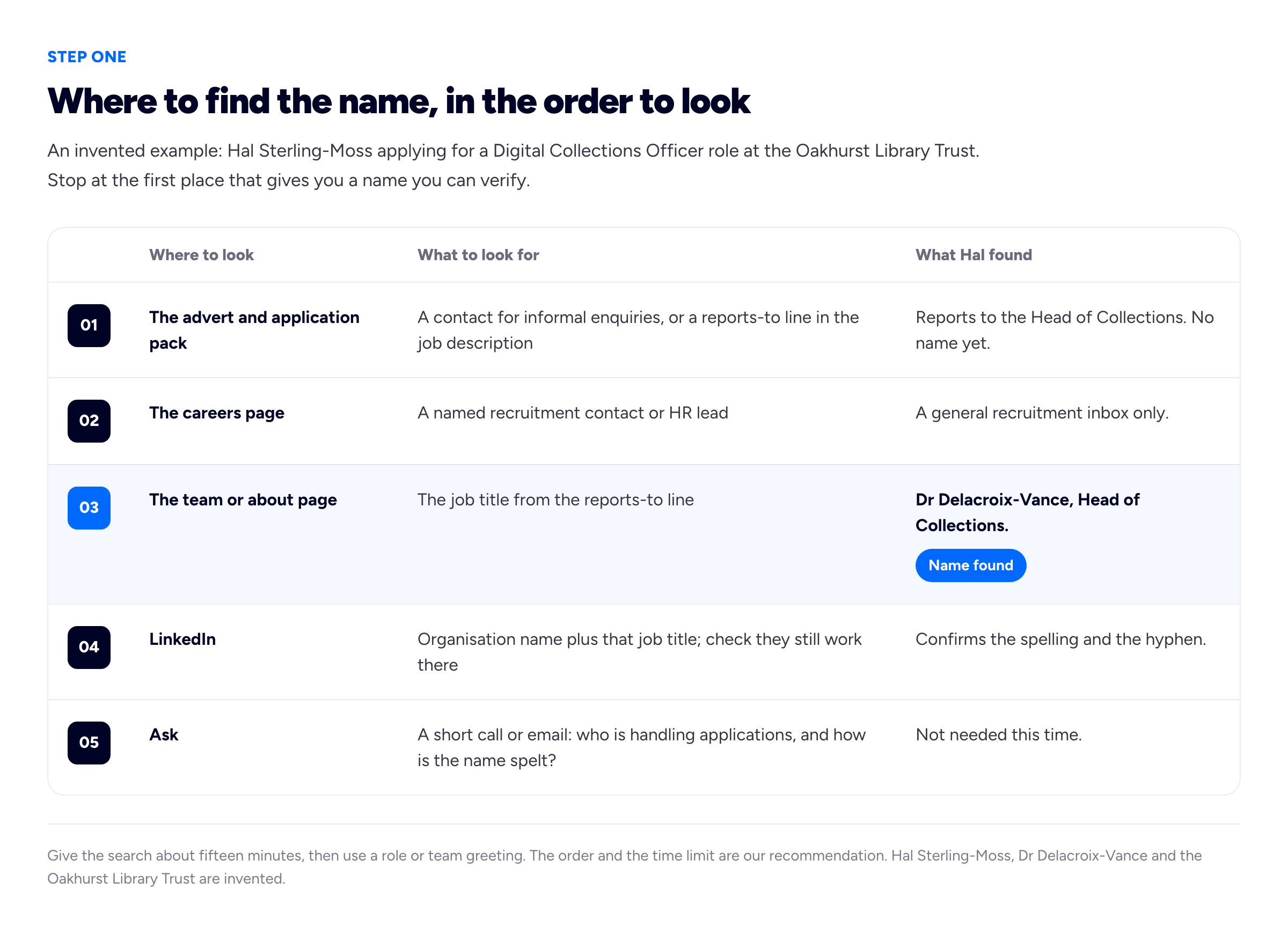
Five places to look, quickest first. Hal's name turned up on the team page; the LinkedIn check was for the spelling, not the discovery.
Step two: the salutation for a named person
Title and surname is the default
"Dear", the title, the surname. "Dear Ms [Surname]", "Dear Mr [Surname]", "Dear Dr Delacroix-Vance". Not the first name and surname together when you know the title ("Dear Ms [First name] [Surname]" reads like a form letter), and not the first name alone.
For women, use "Ms" unless the person has told you otherwise, for example by signing her own emails "Mrs". "Ms" makes no assumption about marriage, and it is the standard business choice in both British and American English. Guessing "Miss" or "Mrs" is the error, not "Ms".
Doctors and professors
If the person uses "Dr", use it. Swapping it for "Ms" or "Mr" drops something they chose and forces a gender guess you had no need to make. Hal writes "Dear Dr Delacroix-Vance". The title also solves his other problem: he does not know which gendered title would be right, and with "Dr" he does not need to.
"Professor" works the same way at a university: "Dear Professor [Surname]". If someone is listed as both, use the one their own page uses.
When to drop the title and use the full name
Write the full name with no title when you are not sure which title to use. Purdue's advice is direct: "If you are uncertain of your contact's gender, avoid using Mr. or Mrs. by simply using the person's full name." "Dear [First name] [Surname]" is correct, polite and unremarkable, which is exactly what a greeting should be.
That covers three common cases:
- A name that does not tell you the gender.
- A person who does not use a gendered title. If their own signature or profile says "Mx", use "Mx" (it is a gender-neutral title, most established in the UK). If they give no title at all, the full name is the respectful choice.
- A name where you cannot tell which part is the surname. Naming conventions differ: in some the family name comes first, some people use two family names, and some use a single name. If you cannot be sure which part to put after "Ms" or "Mr", write the name exactly as the person writes it, with no title.
Our view is that the full name is the better hedge than "Mx" as a guess. "Mx" chosen by you is still a guess about them.
Hyphenated and multi-part surnames
Keep the whole surname, exactly as it is written. Dr Delacroix-Vance is "Dr Delacroix-Vance", not "Dr Vance". Check the hyphen, the capitals and any accents against the person's own page; "Delacroix Vance" without the hyphen, or "Delacroix-vance", is a slip that person will notice at once. Particles such as "de", "van" or "da" stay where and how the person puts them.
Step three: when you cannot find a name
Sometimes there is no name to find: a large employer's portal, an anonymised graduate scheme, a recruitment agency advert that names no client. Then you address the role or the team. Our recommendation, in order of preference:
- The team, if you know where the job sits. "Dear Collections Team", "Dear Product Design Team", "Dear Finance Recruitment Team". It is warmer than a generic greeting and shows you know which part of the organisation you are writing to.
- The role of the reader, if you know it. "Dear Head of Collections" is better than "Dear Hiring Manager" when the advert tells you who the job reports to but not their name. It is still specific to this vacancy.
- "Dear Hiring Manager". The standard fallback, and the one MIT suggests when you cannot find a name. Neutral, understood everywhere, and nobody marks you down for it. "Dear Recruitment Team" or "Dear Hiring Team" are equally fine if the application clearly goes to a team rather than one person.
Purdue offers "Dear Hiring Professionals" as its own version. It does the same job; "Dear Hiring Manager" is simply the more common form.
With a generic greeting, the first paragraph has to show sooner that the letter was written for this employer.
What to avoid
"To whom it may concern"
It is a greeting for a document that could land on anyone's desk, such as a reference or a formal complaint. In a job application, where the reader is a known role at a known organisation, it says you did not look. It is not rude, and it will not sink a strong letter, but there is no situation in a cover letter where "Dear Hiring Manager" is not better.
"Dear Sir or Madam"
Correct in formal British English, and the National Careers Service still lists it as the fallback when you cannot find a name. But it assumes a binary nobody needs you to assume, and it reads as old-fashioned in most sectors now. Our recommendation is to use a role or team greeting instead. If the application pack itself uses it, it is acceptable, and the British sign-off must then be "Yours faithfully".
"Dear Sirs" and "Dear Sir"
Never. It assumes the reader is a man, and plenty of the people reading it will not be.
The first name alone
"Dear [First name]" is how colleagues write to each other, and it is presumptuous from a stranger applying for a job. Use it only when the culture is clearly informal and the person has already written to you that way: they emailed you first and signed with their first name, or you have spoken and they said "call me by my first name".
Several readers: panels and joint recipients
If the advert names two contacts, or says applications go to a panel of named people, you have three options.
- Name both, if there are two: "Dear Dr Delacroix-Vance and Ms [Surname]". Use each person's own title, and put them in the order the advert lists them, or the more senior first if you know it.
- Name the panel, if there are three or more: "Dear Members of the Selection Panel", or "Dear Selection Panel".
- Address the person the job reports to and let the others read it as they will. This is our usual recommendation when one contact is clearly the hiring manager and the others are HR or a second interviewer.
Recruiters, agencies and internal moves
Through an agency. If a recruiter is handling the vacancy and you are sending your letter to them, address the recruiter by name, as you would anyone else: they are the first reader, and they decide whether the client sees you.
Internal applications. You probably know the hiring manager, perhaps by first name. Our recommendation is to keep the greeting one notch more formal than your day-to-day emails, because the letter is a formal document that may be read by HR or a panel: "Dear Dr Delacroix-Vance" if that is how they appear on the staff list, or "Dear [First name] Delacroix-Vance" if title and surname would feel odd between colleagues. Not "Hi [First name]".
Speculative letters. With no advert, a name matters more, not less: a speculative letter to "Dear Hiring Manager" is a letter to nobody, because there may be no vacancy and therefore no hiring manager. Find the head of the team you want to join and write to them.
Emails, uploaded letters and portal text boxes
The greeting itself does not change with the format. "Dear Dr Delacroix-Vance" is right on an uploaded PDF, in the body of an email and in an online form. What changes is what sits above it.
An uploaded or attached letter is a formal document and keeps the full letter layout: your details, the date, the address block (see below), then the greeting. This is what most portals and "attach your cover letter" fields expect.
A letter sent as the body of an email drops the address block entirely. The subject line names the role, the greeting is the first line of the email, and your contact details move to the signature at the bottom. "Dear Dr Delacroix-Vance," then the letter.
A short email with the letter attached needs its own greeting too, and it should match the letter's: the same name, the same title. Do not write "Hi there" in the email and "Dear Dr Delacroix-Vance" in the attachment; the reader sees both within seconds.
A portal text box ("Tell us why you are applying", with no file upload) is the one place people often skip the greeting. Our recommendation is to keep it. It takes one line, and the text is often exported to a reviewer who reads it as a letter.
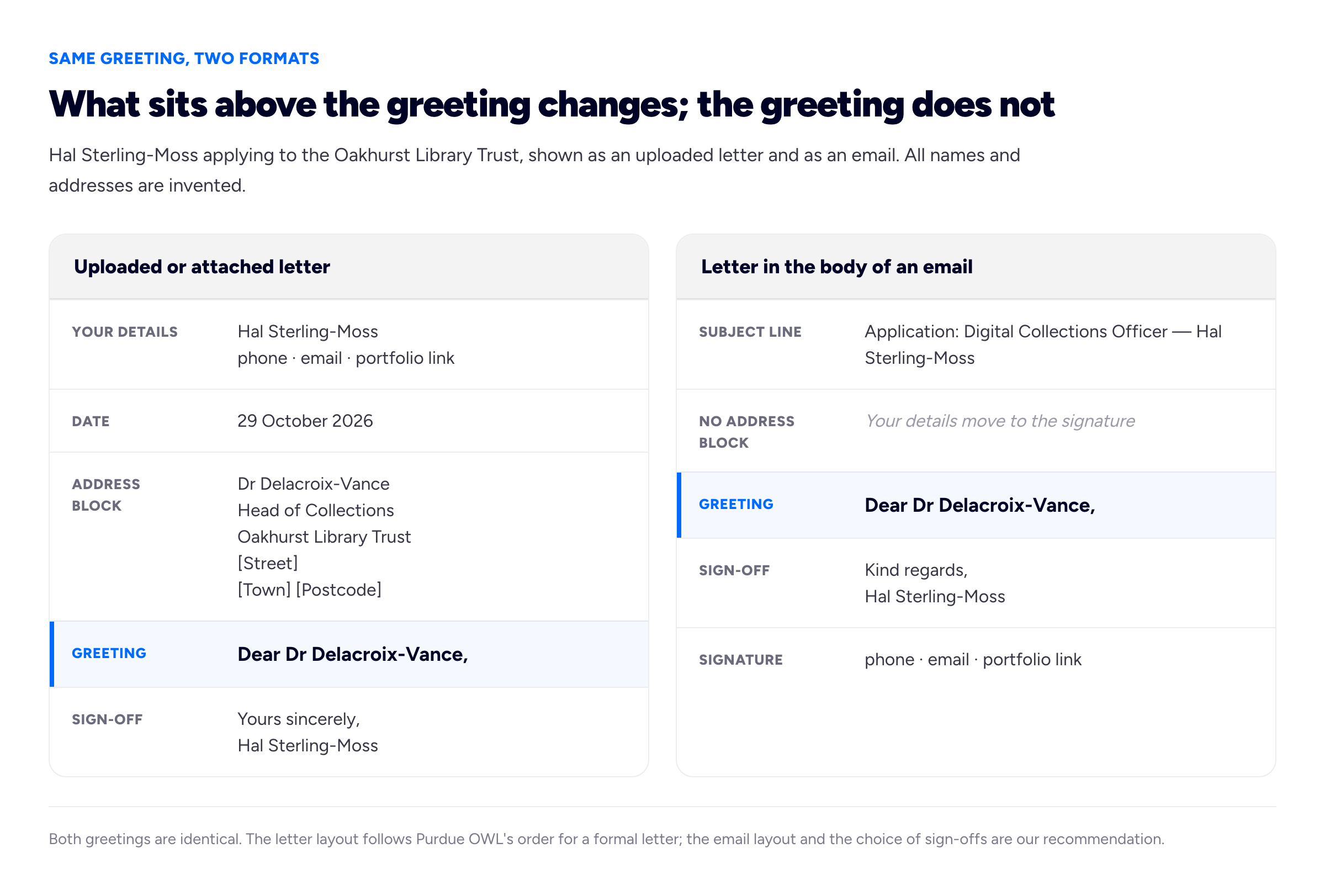
The greeting line is the same in both. The letter carries an address block above it; the email swaps that for a subject line and a signature.
Comma or colon after the greeting
This is a genuine difference between British and American practice, and either is correct in its own setting.
- American business letters traditionally use a colon: "Dear Dr. Delacroix-Vance:". Purdue's own model letter shows a colon after the greeting.
- British letters use a comma ("Dear Dr Delacroix-Vance,") or, in a lot of modern business writing, no punctuation at all. A colon after a greeting looks American to a British reader.
The full stop after the title follows the same split. American English writes "Mr.", "Ms." and "Dr."; British English usually writes "Mr", "Ms" and "Dr" with no full stop. The GOV.UK style guide, which sets the house style for UK government writing, writes them as "Mr", "Ms" and "Dr" without full stops. Our recommendation: match the country of the employer, and be consistent through the letter. If you write "Dr." in the greeting, do not write "Mr" two lines later.
The address block on a formal letter
The address block (also called the inside address) sits above the greeting on an uploaded or printed letter, and it is the other place the reader's name appears. Purdue gives the order for the top of the letter: your contact information first, then the date and the company's contact details directly after it.
For the recipient's part, our recommendation is this order, one item per line:
- The person's name with their title: Dr Delacroix-Vance (add the first name here if you know it; it is fine in the address block even when the greeting uses only the surname).
- Their job title: Head of Collections.
- The organisation: Oakhurst Library Trust.
- The postal address, as the organisation writes it.
If you do not have a name, the block starts with the role or team: "Hiring Manager, Collections Team" or "Recruitment Team". The greeting and the address block should always agree: a letter addressed in the block to Dr Delacroix-Vance and greeted "Dear Hiring Manager" tells the reader you had the name and did not use it.
Two format notes. The UK writes the date day first ("29 October 2026") and the US month first ("October 29, 2026"); spelling out the month avoids any confusion. Including the postal address is never wrong on a formal letter; leaving it out of an email is normal. If an employer's application pack gives a template, follow that over any of this. How much space the header takes matters on a one-page letter, which our guide on how long a cover letter should be covers.
Match the sign-off to the greeting
The greeting decides the sign-off, most strictly in British English. The National Careers Service gives the rule: if you know the name, close "Yours sincerely"; if you opened "Dear Sir or Madam", close "Yours faithfully". So Hal, who opens "Dear Dr Delacroix-Vance", closes "Yours sincerely".
"Dear Hiring Manager" and team greetings sit outside that old rule, because they are neither a name nor "Sir or Madam". Our view is that "Yours sincerely" or "Kind regards" both follow them naturally. In American English, "Sincerely" follows any greeting. In an email, "Kind regards" or "Best regards" is normal everywhere. The full comparison of sign-offs, and what the closing paragraph above them should do, is in our guide to how to end a cover letter.
Hal's greeting, start to finish
Putting the flow together for the example application:
- Search: the advert gave "reports to the Head of Collections"; the team page gave the name and the title; LinkedIn confirmed the hyphen. About ten minutes.
- Title: listed as "Dr", so "Dr", which also means no gender guess.
- Surname: the whole of it, hyphen included.
- Country: a UK charity, so a comma and no full stop after "Dr".
- Format: uploaded PDF, so a full address block above the greeting.
- Sign-off: a named greeting in British English, so "Yours sincerely".
The greeting that comes out of all that is four words long: "Dear Dr Delacroix-Vance,". That is the point. Nobody notices a correct greeting, and it is only the wrong ones that get remembered.
Frequently asked questions
How do you address a cover letter with no name?
Address the team if you know it ("Dear Collections Team"), the role of the person the job reports to if you know that ("Dear Head of Collections"), or otherwise "Dear Hiring Manager". All three are standard. Avoid "To whom it may concern".
Is "Dear Hiring Manager" still acceptable?
Yes. It is the most common modern fallback, and careers offices such as MIT's suggest it when you cannot find a name. A real name is better if a short search turns one up, and a team name is a warmer alternative.
Should I write "Dear Mr" or "Dear Ms" if I am not sure of the gender?
Neither. Write the person's full name with no title, as Purdue's Online Writing Lab advises: "Dear [First name] [Surname]". It is correct, polite and makes no guess.
Can I address a cover letter by first name?
Only if the person has already written to you that way, or the culture is plainly informal and you have spoken. Otherwise use title and surname, or the full name. A first name alone from a stranger reads as presumptuous.
Do I use a comma or a colon after the greeting?
A colon is the traditional American business form ("Dear Dr. Delacroix-Vance:"); a comma, or nothing, is British ("Dear Dr Delacroix-Vance,"). In an email, a comma is fine in both. Match the employer's country.
How we put this guide together
Bunfolio builds portfolio websites and gives away free career tools, so we read a lot of job adverts and the letters people send against them. The four-question decision flow, the order of places to search for a name, the fifteen-minute limit, the call script, the preference order among no-name greetings, the advice on panels, recruiters, internal moves and portal text boxes, the order of lines in the address block and the sign-offs we suggest after "Dear Hiring Manager" are our own recommendations, drawn from how cover letters are read rather than from any official standard. Weigh them as opinions with reasons attached.
The factual claims point at primary sources we read for this guide: the National Careers Service's advice on writing a covering letter (addressing a named person, where to look for one, "Dear Sir or Madam" as the fallback, and the "Yours sincerely" and "Yours faithfully" rule); the Purdue Online Writing Lab's page on formatting and organising cover letters (addressing a specific individual, calling to ask for the name, using the full name when unsure of gender, "Dear Hiring Professionals", the colon in its model greeting, and the order of the heading); MIT Career Advising and Professional Development's guide to writing an effective cover letter (addressing the hiring manager by name, or "Dear Hiring Manager"); and the GOV.UK A to Z style guide (titles such as Mr, Ms and Dr written without full stops). Conventions vary by country, sector and employer, so if an advert or application pack specifies a format or greeting, follow it.
We have deliberately left out the statistics that usually decorate this topic, such as the share of hiring managers who dislike "To whom it may concern" or who say a name makes them read further. We could not trace any of them to a published method, sample and date, so none appear here.
Everything named in the examples is invented: Hal Sterling-Moss, Dr Delacroix-Vance, the Oakhurst Library Trust and its Digital Collections Officer vacancy, and the placeholder names [First name] [Surname] and [First name] Delacroix-Vance used to show greeting formats. The call script, greetings and address block were written by us as models to adapt.
Related reading: how to start a cover letter, how to end a cover letter, how long a cover letter should be, cover letter for an internship and how to write a letter of presentation.
More from the blog
October 2, 2026 · 15 min read
How to Start a Cover Letter: Greetings, Opening Lines and Examples
Start with your details and the date, a greeting to a named person or "Dear Hiring Manager", then an opening that names the role, gives one specific hook and says why this employer. Greetings compared...
October 4, 2026 · 22 min read
How to Write a Cover Letter for an Internship (With 3 Examples)
Little or no work experience? Here is how to read an internship advert and match each requirement to your coursework, projects, societies or part-time job, with the format to copy, a fill-in template,...
September 28, 2026 · 15 min read
How Long Should a Cover Letter Be? Words, Pages and Paragraphs
One page is the published guidance and four or five short paragraphs is the shape. Where a 250–400 word target comes from, when faculty, federal, emailed and form applications change it, what to cut,...