
October 4, 2026 · 16 min read
How to Write a Cover Letter for an Internship (With Example)
Little or no work experience? Here is how to read an internship advert and match each requirement to your coursework, projects, societies or part-time job, with a full example letter annotated paragraph by paragraph and versions for design, marketing, software and finance.
To write a cover letter for an internship, name the internship and where you saw it, then spend two short paragraphs matching the advert's main requirements to evidence from your studies, projects, societies or part-time work, and close by asking for a conversation. Keep it to one page, roughly 250 to 350 words. The reader already knows you have little work experience; what they are looking for is proof that you can learn quickly, turn up reliably and do the tasks in the advert.
That last point changes how you write the whole letter. This guide covers how to read the advert, what to use in place of experience, a paragraph-by-paragraph structure, a full annotated example, and variants for no experience at all, different fields, paid and unpaid roles, and letters sent by email or form. For the first line and the last, see our guides to how to start a cover letter and how to end a cover letter; this guide is about the middle, where students usually get stuck.
What an internship cover letter is for
A cover letter for a full-time job argues that you have already done the work. An internship letter cannot make that argument, and nobody expects it to. Prospects, the UK graduate careers site, calls an internship as "a period of entry-level work experience" lasting between a week and twelve months. The employer designed the role for someone who has not done it before.
So the question in the reader's head is not "has this person done the job?" It is closer to three smaller questions. Do they understand what this internship involves? Have they done anything, anywhere, that looks like the tasks in the advert? And will they be worth the time it takes to supervise them? Every paragraph of your letter should answer one of those.
Read the advert before you write anything
Prospects' advice on internship letters is to "look carefully through the job advert to see what employers are asking for" and "do your best to show how you match each requirement". The University of San Francisco's career services put it the same way: the job description "highlights the keywords and requirements you can weave into your cover letter". Do it on paper.
- Copy the advert into a document and delete everything about the company's benefits and culture. What is left is the list of what they want.
- Mark each requirement as essential or desirable. Adverts often say which; if not, the ones listed first, or repeated, are usually the essentials.
- Write one piece of evidence next to each essential. Not a quality ("organised") but a thing you did ("ran the society's ticketing for a 200-person ball"). If you have nothing for one, leave it blank; you do not have to cover every line.
- Pick the two strongest pairs. Those become your two body paragraphs. Everything else stays on your CV.
Use the advert's own words where they are true of you. If it asks for someone "comfortable with spreadsheets", say spreadsheets, not "data tools". Prospects notes that in a large company "letters will be pre-selected by auto-scanning". It is not keyword stuffing as long as each word is attached to something you actually did.
What to use instead of work experience
Prospects' guidance for jobseekers with no experience says it plainly: "All experience is transferrable in some way; you just need to figure out how the experience you possess can be used in the job you're applying for." MIT's careers office says the same for internships specifically: focus on transferable skills such as "leadership, communication, problem-solving, project management". The trick is choosing the right source for the requirement you are answering, because different sources prove different things.
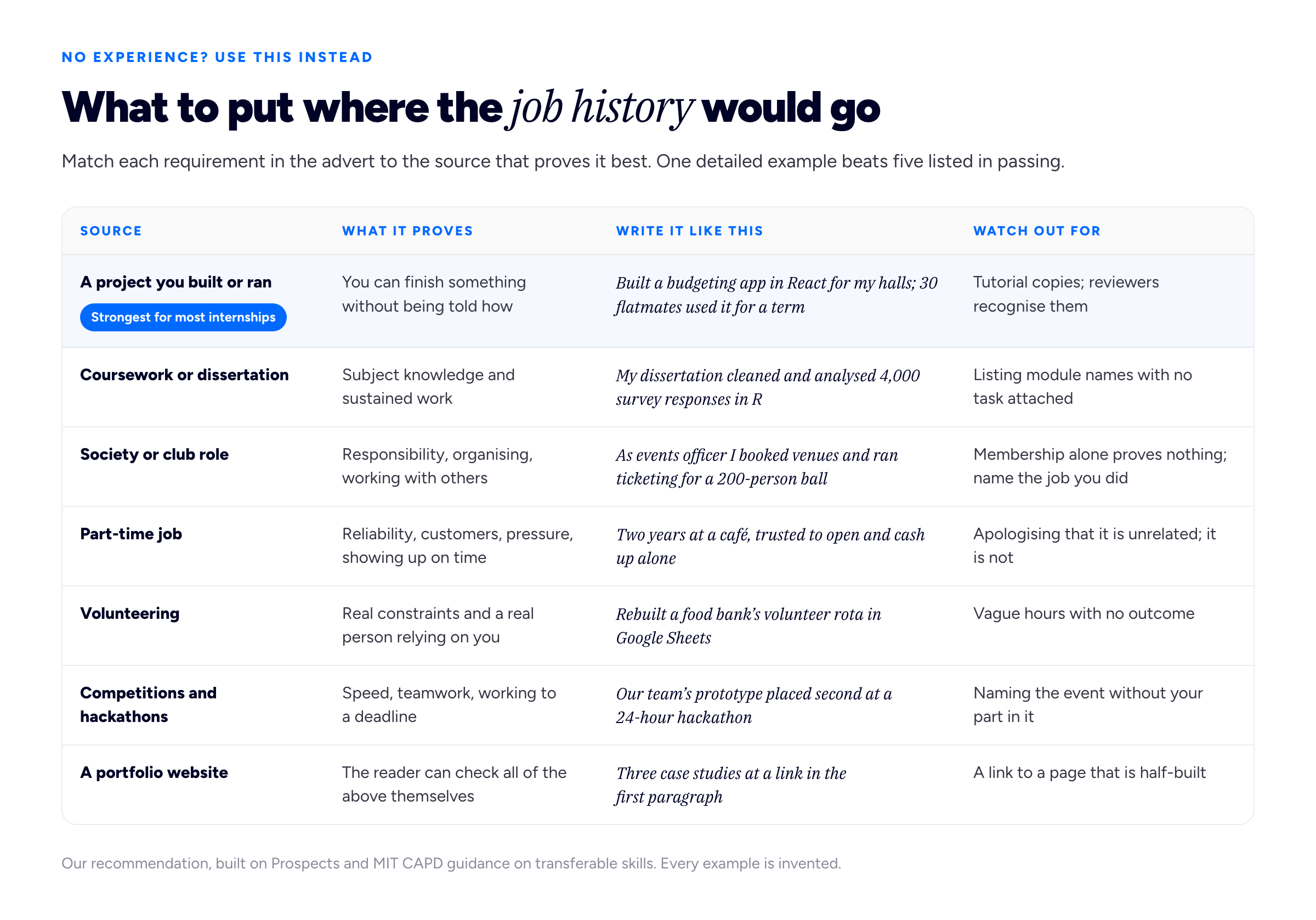
The middle column is what the reader is really buying. Choose the row whose "what it proves" matches the requirement, not the row you are proudest of.
Coursework, but as tasks, not module names
Prospects suggests "listing any relevant modules", and on a CV that is fine. In a letter, a module name is almost empty: "I studied Consumer Behaviour" tells the reader nothing about what you can do. Convert it into a task with an output. "For my Consumer Behaviour module I ran a twelve-person diary study on how students choose energy drinks and presented the findings to the class" is the same module, now evidence.
Projects you started yourself
For technical and creative internships, a self-initiated project is often the strongest evidence you have, because it shows the one thing coursework cannot: that you finish things nobody marked. Describe who it was for, what you made and one thing that happened as a result. If a project was a concept rather than real work, say so; our guide to building a portfolio with no experience explains why labelling concept work honestly makes it more persuasive, not less.
Societies, sport and student roles
Membership is not evidence; a role is. Treasurer, events officer, captain, course rep, student ambassador: each comes with tasks you can describe. "As treasurer I managed a £3,000 annual budget and submitted the society's grant claim" is a finance internship paragraph in one sentence. If you were just a member, find one time you did something: organised a trip, designed a poster.
Part-time jobs that look irrelevant
Students routinely leave out retail, hospitality and care work because it is not "in the industry". Prospects disagrees: part-time work "will show employers that you have some knowledge of the working world". A café job proves things a reader of internship letters genuinely worries about: that you arrive on time, handle difficult people and can be trusted with the till. One sentence, attached to the requirement it answers, is enough.
A portfolio, as the place the evidence lives
A cover letter can only describe your work. For design, marketing, writing and development internships, a link lets the reader check it. A small site with three projects turns every claim in the letter into something verifiable. Put the link in the first or second paragraph next to the project you are describing, not only in the signature. Our guide to the portfolio link on your resume covers formatting the address so it survives a PDF and an applicant tracking system.
The structure, paragraph by paragraph
The National Careers Service describes a cover letter as "a short letter, usually 3 to 5 paragraphs long", and MIT says no longer than one page. For an internship we recommend four paragraphs and about 250 to 350 words; our guide to how long a cover letter should be explains the arithmetic.
- Opening (40 to 60 words). Who you are (year, course, university), the exact internship title and any reference, where you saw it, and one sentence on why this employer. Purdue's Online Writing Lab lists the same contents: who you are, why you are writing, how you learned about the position, and how your goals align with the organisation's.
- First evidence paragraph (70 to 100 words). The advert's most important requirement, matched with your strongest example. Say what you did, at what scale, and what came of it.
- Second evidence paragraph (60 to 90 words). A second requirement, ideally a different kind: if the first was a technical skill from a project, make this one a working skill from a job or society.
- Close (40 to 60 words). What you would like to contribute or learn in this specific internship, your availability (dates matter more for internships than for jobs) and a request for a conversation.
Notice that "why I want to learn" sits in the close, after the evidence. Placed there it reads as ambition; placed first it reads as need.
A full example, with notes
Here is a complete letter from an invented second-year marketing student to an invented coffee roaster. The advert asked for "a marketing intern to help run our Instagram and email newsletter, comfortable with Canva and basic analytics, available June to August".
Dear Ms Adeyemi,
I am a second-year Marketing student at the University of Leeds, applying for the Summer Marketing Internship (June to August 2027) advertised on your careers page. I have bought Copperline's beans since your Hyde Park pop-up, and your newsletter's "meet the farmer" series is the reason I want to work on your channels rather than anyone else's.
Your advert asks for someone who can run Instagram and a newsletter. Since September I have run both for the university's Coffee Society: I plan a weekly content calendar, design posts in Canva and write a fortnightly email to around 400 members. Over the autumn term I tested posting times and switched our tasting announcements to Thursday evenings, after which attendance at tastings roughly doubled. Examples of the posts and emails are at amirahassan.bunfolio.com.
You also mention basic analytics. In my Digital Marketing module I built a Google Sheets dashboard tracking a local bakery's Instagram reach over six weeks, and presented three recommendations to the owner, two of which she adopted. Alongside my studies I work fifteen hours a week at a city-centre café, where I am trusted to open the shop and handle supplier deliveries, so I know what a busy Saturday looks like from behind the counter.
I would particularly like to help with the autumn subscription launch your advert mentions, and to learn how you plan campaigns across a whole season. I am available for the full ten weeks and would welcome the chance to talk about the role.
Yours sincerely,
Amira Hassan
That is about 250 words of body text. Now the same letter as a map.
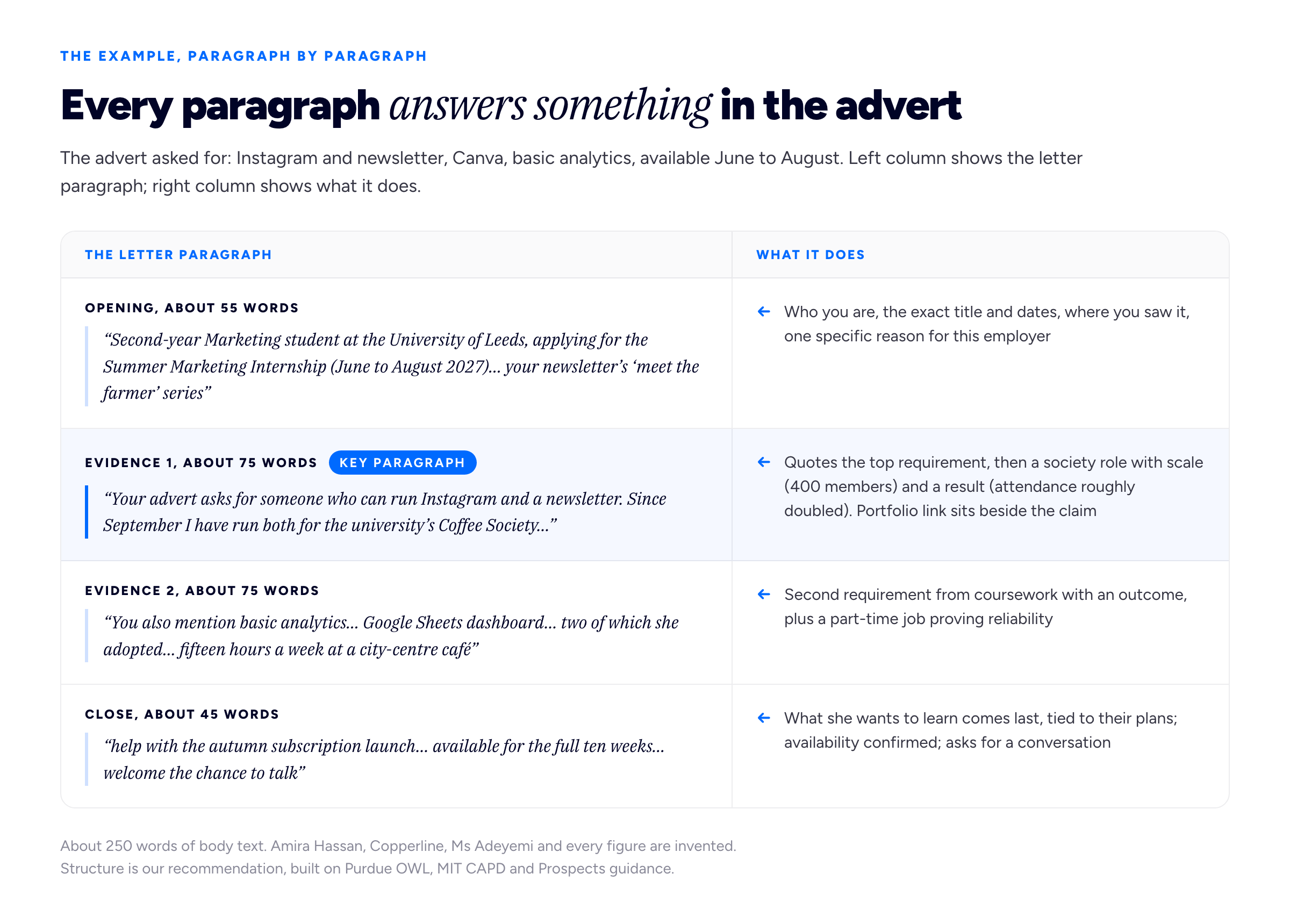
Each paragraph starts from the employer's words and ends on a fact about the applicant. The "why I want this" line appears twice, briefly, and never on its own.
A few things worth copying from it:
- The opening proves interest with a detail, not an adjective. "Your 'meet the farmer' series" can only be written by someone who has read the newsletter. "Your innovative brand" can be written by anyone.
- Each evidence paragraph opens by naming the requirement. The reader sees the match before the evidence.
- Numbers are modest and checkable. Four hundred members, fifteen hours, six weeks. Use a number only if you could explain it at interview.
- The café job earns one sentence. It answers the unspoken worry about reliability, and for a coffee company it doubles as product knowledge.
Variants for different situations
When you have no experience at all
If you have no society role, project or job, the letter rests on coursework and one small thing you do before applying. Pick a task from the advert and do a miniature version: write three sample social posts for the brand, analyse a public dataset in the field, redesign one screen of their app and label it as a concept. One afternoon's real work, described and linked, beats any amount of enthusiasm. Prospects' line is the right frame: focus on "the knowledge and skills you do have, rather than focusing on the experience you don't".
Design internships
Design reviewers hire on the work, so the letter's job is to make them open your portfolio and to point them at the right piece. Name one project and say why it is relevant to them: "the wayfinding project on my portfolio is the closest thing I have made to your museum signage work". Add a sentence on process, because a junior designer who can explain decisions is rarer than one who can use Figma. See our graphic design portfolio guide.
Marketing and communications internships
As in the example, the strongest evidence is a channel you have actually run, at any size: a society account, a family business's page, your own newsletter. Give the audience size, what you changed and what happened. See our marketing portfolio examples.
Software and data internships
Lead with a project, name the stack the advert names if you have used it, and link the repository or a live demo. Say what was hard: "the difficult part was handling timetable changes without breaking saved schedules" tells the reader more about your ability than a list of languages. Hackathons and open-source contributions count; a tutorial clone does not. See what hiring managers look for in a developer portfolio.
Finance and consulting internships
Some of these schemes replace the letter with motivational questions in an online form ("Why this firm?", "Why this division?"). If so, answer each question as asked rather than pasting a letter. Where a letter is wanted, the evidence that travels best is numerical and responsibility-heavy: a treasurer role, an investment society pitch, a part-time job handling cash. A letter that could go to three competing firms by changing the name will read that way.
Paid and unpaid internships
Do not raise pay in the letter; offering to "happily work unpaid" only undersells you. But know your position before you apply. In the UK, GOV.UK says an intern is entitled to the National Minimum Wage if they count as a worker, and that employers cannot avoid this simply by stating it does not apply; the exceptions include students doing a required placement of under a year as part of their course, and internships that are only work shadowing. In the US, the Department of Labor uses a "primary beneficiary test" to decide whether a for-profit employer must pay an intern, including whether the internship is tied to your education and whether your work displaces paid staff.
Emailed, uploaded or typed into a form
The National Careers Service notes you can write a cover letter "as an email if you're applying online". If the email is the letter, drop the address block and date, put the internship title in the subject line and trim to around 200 words, because it will probably be read on a phone. If you upload a file, make it a PDF named with your name and the role. If the application has a text box instead, paste plain text, respect the character counter, and answer the box's question rather than the one you prepared for.
Mistakes that are specific to internship letters
- Opening with an apology. "Although I have limited experience…" spends your best sentence on your weakest point.
- Calling yourself "aspiring". If you have run a society's Instagram, you are a marketer with a society account, not an aspiring one.
- One letter, forty firms. Prospects tells applicants to "make sure each letter is tailored to the specific company". One specific detail is the quickest fix.
- Forgetting the dates. Internships run on fixed calendars. If you can only start after exams finish, say so; it is better than discovering it at offer stage.
- Applying too late. Prospects advises applying "at least six months in advance", with summer internships often applied for between September and December of the previous year.
If you would like a first draft to react to, our free AI cover letter generator drafts a short letter from the advert and your own notes. It can only use the facts you give it, so give it your real examples and replace any general line with a specific one before sending.
Frequently asked questions
How long should a cover letter for an internship be?
One page at most. MIT's careers office says no longer than one page, and the National Careers Service says three to five paragraphs. For an internship we recommend about 250 to 350 words in four paragraphs, and around 200 if the email body is the letter.
What do I write in an internship cover letter with no experience?
Match the advert's main requirements to evidence from coursework, personal projects, societies, part-time jobs or volunteering. Describe one or two of those in detail, with what you did and what came of it, rather than listing everything. If you have nothing, do a small piece of relevant work and describe that.
Do I need a cover letter for an internship if it is optional?
We would write one. The University of Florida's career centre argues that submitting a letter when it is optional "shows employers that you cared enough about their job". Keep it short; a generic optional letter adds nothing.
Should I mention my grades in an internship cover letter?
Only if they are strong and relevant, or if the advert asks for a minimum. A grade in a module that matches the internship is worth a clause; your overall average belongs on the CV, where the reader expects to find it.
Can I use the same cover letter for every internship?
You can reuse the structure and some of the evidence, but the opening, the requirements you answer and the closing should change for every application. Prospects and the National Careers Service both tell applicants to tailor each letter to the employer.
How do I end a cover letter for an internship?
Say what you would like to contribute to or learn in this particular internship, confirm your availability, and ask for a conversation. Then "Yours sincerely" if you used a name, in British English. Our guide to how to end a cover letter has closing lines to adapt.
How we put this guide together
The four-paragraph structure and its word budgets, the method for decoding an advert, the evidence table, the field-by-field variants and the list of mistakes are our own recommendations, drawn from how internship letters are read rather than from any official standard. Weigh them as opinions with reasons attached. Sourced facts are attributed in the text.
We have deliberately left out statistics we could not trace. Several pages ranking for this topic quote figures such as the percentage of hiring managers who read cover letters or say a letter can rescue a weak application. None of the versions we found pointed to a published survey method we could read, so none appear here.
Primary sources we read: Prospects' pages on the internship cover letter, the cover letter for a jobseeker with no experience and internships and how to apply; the National Careers Service's advice on writing a covering letter; MIT CAPD's guide to writing an effective cover letter; the Purdue Online Writing Lab's cover letter formatting and organisation guidance; the University of San Francisco's internship cover letter guidance; the University of Florida career centre's post on writing a cover letter when it is optional; GOV.UK's page on employment rights and pay for interns; and the US Department of Labor's Fact Sheet #71 on internship programs. Pay rules are summarised, not legal advice; if your situation is unclear, read the source for your country. Conventions vary by employer, sector and country, and if an advert or application form asks for something specific, follow it.
Amira Hassan, Copperline, Ms Adeyemi, the Coffee Society, the bakery dashboard and every figure in the example letter and both diagrams are invented to show the shape of a letter, not taken from a real application.
Related reading: how to start a cover letter, how to end a cover letter, how long a cover letter should be, writing a letter of presentation, building a portfolio with no experience, putting a portfolio link on your resume and writing a resume skills section.
More from the blog
October 2, 2026 · 15 min read
How to Start a Cover Letter: Greetings, Opening Lines and Examples
Start with your details and the date, a greeting to a named person or "Dear Hiring Manager", then an opening that names the role, gives one specific hook and says why this employer. Greetings compared...
September 28, 2026 · 15 min read
How Long Should a Cover Letter Be? Words, Pages and Paragraphs
One page is the published guidance and four or five short paragraphs is the shape. Where a 250–400 word target comes from, when faculty, federal, emailed and form applications change it, what to cut,...
September 27, 2026 · 17 min read
How to End a Cover Letter: Closing Lines That Sound Confident, Not Pushy
A cover letter ending has three jobs: restate your fit in one line, name a next step and thank the reader. Closing sentences graded from too passive to too pushy, sign-offs compared including Yours si...