
September 12, 2026 · 22 min read
What to Put in the Skills Section of a Resume
Every guide on this is a list of a hundred skills to copy, which is exactly why the section is the one a reader trusts least. The three kinds of skill people conflate, where each of them actually belongs, and how to write claims somebody could check.
The skills section is the cheapest block on your resume to write and the least believed once written. You can type anything into it. Nobody checks at the point of reading. A candidate who has opened Photoshop twice and one who has spent nine years in it produce the same line of text, and it costs them both four seconds.
Readers know this, which is the whole problem. Someone reaching a block of twenty-four comma-separated words has learned, from every resume before yours, that the block is uncorroborated and roughly free to produce. So they skim it for the two or three terms they were told to look for and move to the bullets under your jobs, where an employer's name is attached to the claim.
Most advice about what to put in the skills section makes this worse, because most of it is a list of a hundred skills to pick from. A section assembled from someone else's hundred is, by construction, indistinguishable from everyone else's who found the same article.
Use this frame instead. Every skill you list is a claim. A claim is worth making if it is specific enough that someone could establish it is false, if it is load-bearing for the job in front of you, and if something else on the page backs it up. Claims failing all three are not neutral extra lines — they spend the reader's trust, because a section full of unfalsifiable assertions tells them what kind of resume they are holding.
What a reader is actually doing with that block of words
Two things happen, at two moments. The first is searching: your resume becomes a record in a database, and the skills you named become text in a field that gets queried later. This is not a metaphor: the "internet applicant" definition in the US federal contractor rules at 41 CFR 60-1.3 works through an example in which a contractor "searches the internal resume database for individuals who have the basic qualifications" for a post. Your skills line is one of the things that search runs against, which is the mechanical case for calling a tool by its actual name.
The second is judging, twenty seconds later with your file open. Nobody counts your skills. They ask something narrower: is there anything here showing this person has done the specific thing the role needs, rather than heard of it? A list cannot answer that. Evidence can.
The same regulation contains the best short definition of a useful claim we have found anywhere, and it was not written for job seekers. To count as a "basic qualification" it must be noncomparative (three years' experience, not "among the five most experienced applicants"); objective, meaning evaluable by "a third-party… without more information about the contractor's judgment"; and relevant to performance of the particular position.
Hold your skills section against those three. "Excellent communication skills" fails the second outright, since no third party can evaluate it, and probably the first, since "excellent" compares you with an unnamed population. This is not a test you must legally pass. It is a borrowed yardstick for deciding what deserves a line.
Three different things are being called a skill
Bad skills sections come from one confusion: the word covers three unrelated categories wanting completely different treatment on the page. This is not our invention — people who build occupational taxonomies for a living separate them too.
The European Commission's ESCO classification — "a comprehensive list of knowledge, skills and competences relevant to the European labour market", running to 13,939 concepts — splits its skills pillar four ways: knowledge, language skills, skills, and transversal skills. The US Department of Labor's O*NET Content Model draws a sharper line still, filing skills, knowledge and education under "worker requirements" and something else entirely under "worker characteristics".
Tools and technologies
Named, bounded, checkable things: Figma, Postgres, Xero, After Effects, Kubernetes, SolidWorks, Klaviyo. Each has a proper name, a version history, and a community of people who can tell within ninety seconds of conversation whether you have used it.
These belong in a list. They are enumerable, they are what searches are built from, and there is no honest way to expand "Figma" into a sentence that adds anything. This is the category the section exists for.
Applied competencies
Things you can do that are not products: negotiating a contract, running a discovery workshop, forecasting cash, teaching a mixed-ability class. Real, valuable, and unserved by being listed.
These belong in the bullets under a job, because that is where evidence lives. "Stakeholder management" in a list is a word. "Ran the fortnightly review for eleven agency clients and kept two through a pricing change" is the same competency with a scale and a consequence, under the employer whose name makes it checkable. You lose a line in the list and gain a claim somebody could verify by phone.
Personal qualities
Team player. Detail-oriented. Hard-working. Passionate. A fast learner.
Cut these — not because they do not matter, they matter enormously, but because self-assertion is the one form of evidence for them worth nothing. O*NET does not call them skills at all. It files attention to detail, cooperation, dependability and perseverance under work styles, defined as "personality tendencies exhibited at work, which can affect how well someone performs a job". A personality tendency is established by people who have watched you work. Not by you, in eleven-point type.
There is a cost beyond the wasted line. The reader has seen "detail-oriented" sitting three lines above an inconsistent date format, so the phrase carries a small negative charge: it is what people write when they have nothing to put there.
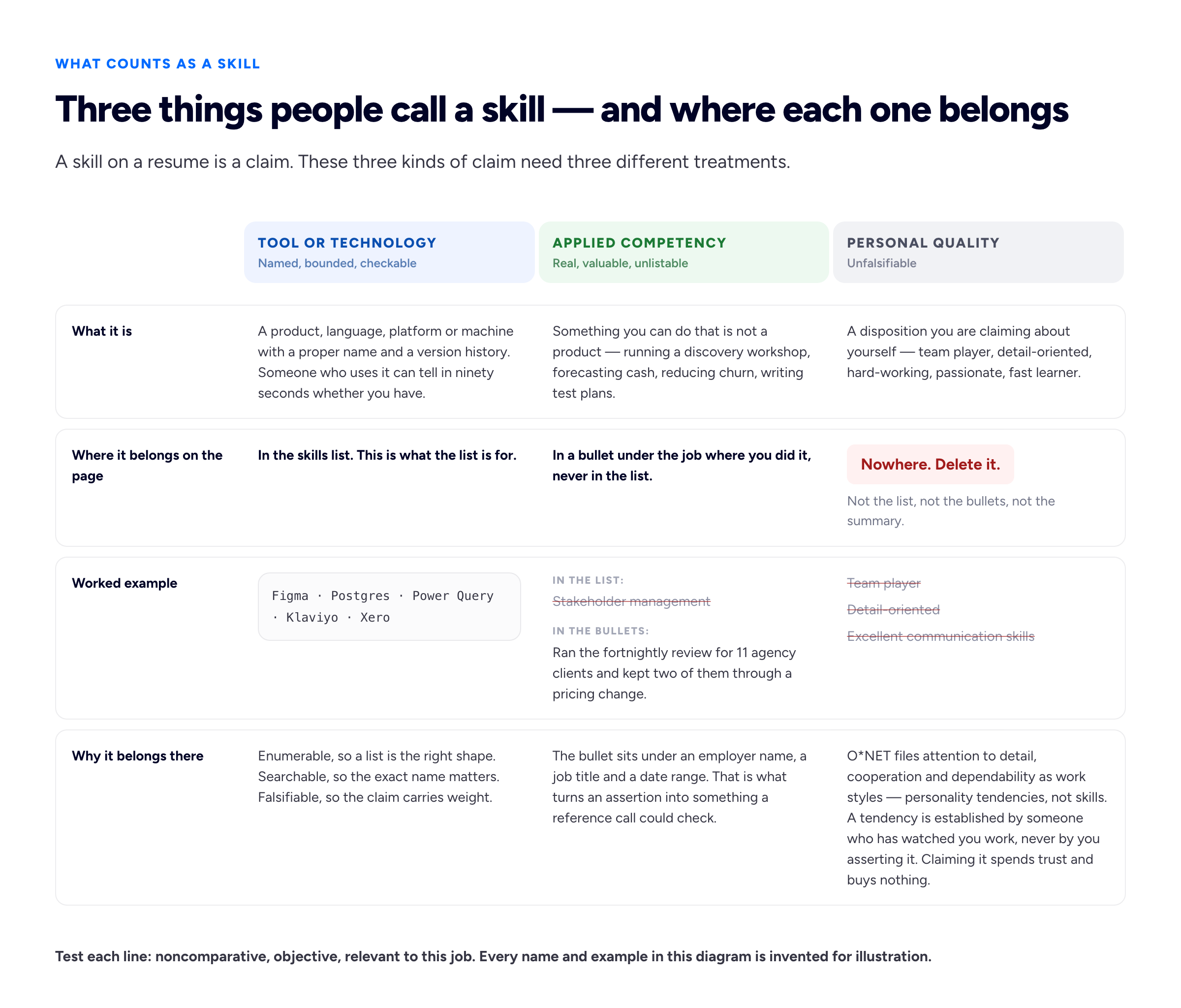
If a line fails all three tests, it is not a neutral extra line — it is the line that tells a reader what kind of resume they are holding.
How to list skills on a resume
Once competencies have moved into your bullets and the personality claims are gone, what remains is a short list of real, named things.
Group them, and label the groups. Eighteen comma-separated words are a wall; three or four labelled clusters are scannable in one pass. Design: Figma, Illustrator, After Effects. Research: usability testing, Dovetail, Maze. Handover: Storybook, design tokens, WCAG 2.2. The labels do a second job: they show which parts of the craft you treat as separate, which is itself information about how you work.
Order by relevance to this application, not by confidence. The first group, and the first item in each group, carry disproportionate weight, because that is what gets read when someone reads only the beginning.
How many skills to list on a resume: roughly eight to fifteen named items, in three or four groups. Below about six the section reads as thin, and usually means competencies are missing from your bullets. Above about twenty, two things happen at once — the reader stops reading, and the believability of every item drops, because someone commanding twenty-five named tools to a professional standard is rare enough that the claim reads as inflation. The ceiling is not a formatting preference; it is what happens to a set of claims as the set grows.
Put the section where the reader expects it. If your tools are the qualification — developer, video editor, data analyst, CAD technician — put it directly under the summary, the fastest answer to the question the reader arrived with. If your track record is the qualification and the tools are incidental, put it after experience. Either is normal. Burying it in a sidebar the layout separates from everything else is not, for reasons set out in the guide to ATS-friendly resume formatting.
If assembling this by hand is the part you keep putting off, our free resume builder lays the section out in labelled groups and produces a single-column file with real selectable text. There is no account step, and one thing worth knowing now rather than at the moment you export: the finished PDF carries a small "Created with Bunfolio" credit at the foot, which is what pays for the tool being free.
Why star ratings and percentage bars make it worse
Five stars next to Photoshop. A bar at 85% for Excel. A doughnut three-quarters filled, labelled "SQL". These look designed and are actively harmful, for four reasons.
There is no scale. Four stars out of five means four-fifths of what? Of everything Photoshop can do, of what your last team needed, of the best person you have met? Each is a different claim and the reader cannot tell which you made. A number without a denominator is less precise than a word, because it looks precise.
It compresses incomparable things. A bar puts "Excel — 90%" beside "Leadership — 70%" as though they shared an axis. The visual grammar asserts a comparison the content cannot support.
It is self-assessed, which is the least reliable instrument available — and precisely what the serious frameworks were built to fix. Instead of a rating out of five, the language frameworks below substitute observable behaviour: not "advanced", but "I can write an essay or report, passing on information or giving reasons in support of or against a particular point of view". That is testable. Four stars is not.
And the graphic often does not survive the file. A rating drawn as a shape carries no text, so the part of your resume claiming expertise becomes, in the stored record, a bare skill name.
The honest replacement is context. Photoshop — daily for six years, retouching and compositing for print says more than any number of stars, cannot be misread, and gives an interviewer something real to ask about.
Mirroring the advert without claiming what you cannot do
Two operations look identical on the page and are entirely different in kind, and most "tailor your resume" advice fails to distinguish them.
The first is adopting the employer's vocabulary for something you actually do. The advert says "requirements elicitation"; you have always called it working out what the client wants. Same work, different words. Changing your word to theirs is translation, not trickery, and it is what every search mechanism depends on. The US Department of Labor's tips for writing a federal resume say it plainly: review the announcement for key words, and match them.
The second is adding a skill you do not have because the advert asked for it. That is not tailoring. It is a claim that gets tested, usually in the first fifteen minutes of a conversation you waited a week for.
The procedure takes ten minutes. Pull every named tool and competency out of the advert — usually eight to fourteen — and sort each honestly: I do this and say it differently, I do this and have not mentioned it, or I do not do this. The first gets a wording change. The second gets added, to the list if it is a tool and to a bullet if it is a competency. The third is left out — and if that pile holds most of the advert, the useful conclusion is about the application, not the resume.
One point specific to skills: write both forms where an abbreviation is not universal — Search Engine Optimisation (SEO), Google Analytics 4 (GA4). A search for one form does not find the other, and you do not know which the person searching typed.
What "proficient in" commits you to
The proficiency words have drifted almost to uselessness, and the gap between your meaning and the reader's is where a bad interview comes from.
In ordinary hiring usage, proficient is read as "can do the normal daily work in this unsupervised". Advanced as "handles the unusual cases and helps others out of a hole". Expert as "is the person the team asks", which invites a hard question by design. Familiar with is read, accurately, as "has not really used this" — fine, and far better than the alternative, provided it is not attached to the core requirement of the job.
Overclaiming is almost never punished at the resume stage. It is punished in the room. Someone asks a second-level question about the thing you rated highest, you answer at first-level depth, and the rest of the conversation is quietly re-rated — not because you cannot do the job, but because your self-description proved unreliable, and everything else you wrote inherits that.
The safest formulation drops the adjective and states circumstances. Used daily for four years. Built and maintain the reporting pack the finance team uses. Learning, three months in, on a side project. All honest, all specific, each giving an interviewer a reasonable question rather than a trap.
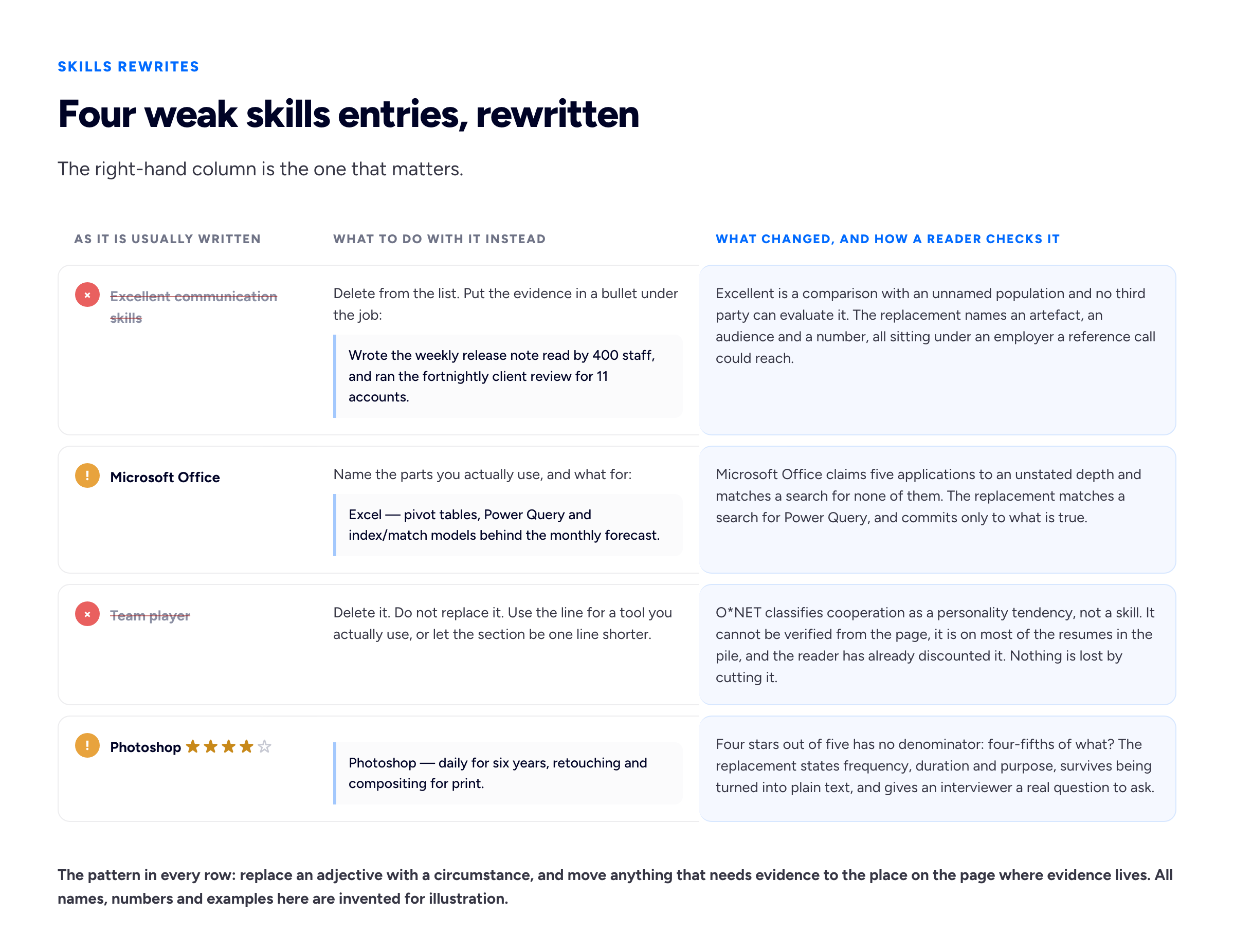
Every rewrite does the same two things: it swaps an adjective for a circumstance, and it moves the claim to wherever it can be corroborated.
Skills with no employer behind them
All of this assumes the bullets under a job are available to carry your competencies. For many people they are not, and "put it in your work experience" is no answer when the work experience is the missing piece.
If you freelance, the competencies are real but the corroborating structure is unusual — a run of short engagements rather than an employer with a letterhead. Group client work under one heading with a continuous date range and let two or three named engagements carry the evidence; the full structure is in how to put freelance work on a resume. A freelancer's skills section should skew harder towards named tools than an employee's, because tools need nobody to vouch for them.
If you are changing career or starting out, the temptation is to pad the list until it matches an experienced person's in length. It does not work, and it is exactly where a thin resume gets caught, because a list is the cheapest place to pad and the first place anyone looks. Shorten it to what is true and put the weight into one or two things you have actually built. Building a portfolio with no professional experience covers producing that material deliberately.
If your skills came from study, volunteering or a side project, say so plainly in a bullet: the project, the scale, what you did. "Built and ran the booking system for a 40-member sports club across two seasons" is unimpeachable, and more interesting than a job, because you chose it. If you are rewriting your profile alongside it, our LinkedIn headline generator drafts the line doing most of the work there.
Where a skills claim actually gets checked
Back to the three tests: specific, load-bearing, corroborated. The skills section can satisfy the first two by itself, and can never satisfy the third, because a list has no room for evidence. Corroboration has to come from elsewhere on the page, and there are only three candidates: the bullets under your jobs, anchored to an employer and a date; a named certification from a body that can be asked; and a link to work somebody can open.
The third is the only one that scales with how good you actually are. "React" in a list is a word. "React" beside a link that opens a working thing you built, with a write-up of the decision you made when the requirements changed, is a different kind of claim — because the reader can go and check, and they know you knew they could. Claims made in the knowledge that they are checkable read differently even before anyone checks them.
That is why the single line holding your portfolio URL is worth more than any rearrangement of the skills block. Where to put your portfolio link on your resume covers placement and form; what hiring managers look for in a developer portfolio covers what happens after the click. If the work exists but was never written up, turning one project into a case study does more for your credibility than any change to the list.
Two notes. The site has to load and show something within seconds, because the click happens inside a thirty-second read. And it should be a real address rather than an attached file: our portfolio templates make that a same-afternoon job, and the longer argument is in building a resume website.
Languages and certifications, which actually have standards
Two kinds of skill escape the falsifiability problem entirely, because someone has already built the machinery for verifying them. Use it rather than reinventing it badly.
Language proficiency
"Fluent Spanish" is the star-rating problem in words. Fluent by whose measure, in which register, reading or speaking?
Two real frameworks exist. In Europe and increasingly beyond it, the Council of Europe's Common European Framework of Reference for Languages runs A1 to C2, and its self-assessment grid — reproduced by the European Commission on the Europass site — defines each level with first-person "can do" statements across listening, reading, spoken interaction, spoken production and writing. The B2 writing descriptor: "I can write clear, detailed text on a wide range of subjects related to my interests… passing on information or giving reasons in support of or against a particular point of view." You can hold that against your own last month and answer honestly.
The US equivalent is ACTFL. The ACTFL Proficiency Guidelines, whose 2024 edition describes "what individuals can do with language… in real-world situations in a spontaneous and non-rehearsed context", use five major levels — Novice, Intermediate, Advanced, Superior and Distinguished — with Low, Mid and High sublevels at the first three.
Write the level, and whether it was tested or self-assessed. Spanish — CEFR B2 (self-assessed) and Spanish — DELE B2, 2023 are both honest and are not the same claim. Fluent Spanish is neither.
Certifications
A certification is the most verifiable line on your resume, which makes the details costly to get wrong.
Write the full current name, the issuing body and the year. Not "AWS certified" but the specific credential and who issued it. The value of the line is that someone can check it, and an abbreviation nobody can resolve throws that away.
Check the name still exists. Programmes are renamed and retired more often than people expect, and a defunct credential under a name that died years ago suggests you have not looked since you earned it. Microsoft is the clearest case: in 2020 it announced that the MCSA, MCSD and MCSE families would give way to role-based certifications, with all remaining associated exams retiring on 31 January 2021; existing certifications stayed on holders' transcripts but moved in time to an "inactive" section. Listing one is not dishonest — you earned it — but it needs its year beside it.
Separate expired from current. Anything renewing on a cycle carries an implicit currency claim, and that is one of the few things a reader can check in twenty seconds.
A short procedure for fixing the section today
Sort your list one line at a time. Named tool I genuinely use — keep. Competency — delete it, and write a bullet for it under the job where you did it. Personal quality — delete, do not replace. Rating or star — replace with a circumstance. Then open the advert, reorder so the things it leads with come first, and adopt its wording wherever you have called the same thing something else. Count the adjectives left; more than two means you have not finished.
Re-export and read the file as plain text — the two-minute test in the ATS formatting guide — to confirm every skill name is real characters rather than part of a picture. Our resume builder shortcuts the rebuild if the layout is fighting you, and whether the document now runs too long is taken apart in how long a resume should actually be.
Frequently asked questions
What are good skills to put on a resume?
The named tools, technologies and systems you genuinely use for the work the advert describes, taken from the advert's own vocabulary wherever you have been calling the same thing something else. Good means checkable and load-bearing, not impressive-sounding. Anything you can only assert about yourself — team player, hard-working, detail-oriented — is not a good skill to put on a resume in any form, because there is no way for the reader to test it.
How many skills should I list on a resume?
Roughly eight to fifteen named items in three or four labelled groups. Below about six it reads as thin, and usually means competencies are missing from your job bullets. Above about twenty the believability of the whole set falls. It is a consequence of how claims are believed, not a rule — if you genuinely use eighteen tools daily, list eighteen.
What skills should I put on my resume if I have no experience?
Named tools you can actually operate, plus anything with a standard behind it such as a language level or a certification. Resist padding the list to match an experienced person's length: a list is the cheapest place to pad and the first place a thin resume gets caught. Put the weight into one or two things you have genuinely built, in enough detail that nobody could have invented them — building a portfolio with no professional experience covers producing that material on purpose.
Should I put soft skills on my resume?
Not as a list of adjectives. "Team player", "detail-oriented" and "excellent communication skills" cannot be falsified from the page, appear on most resumes in the pile, and are discounted in advance — O*NET does not classify them as skills at all, filing cooperation and attention to detail as work styles, meaning personality tendencies. The qualities matter enormously; the way to convey them is a bullet showing one in action under a named employer.
Should I rate my skills with stars or percentage bars?
No. Four out of five has no denominator — four-fifths of what? — so it looks precise while saying less than a word would. It puts incomparable things on one axis, it is self-assessed, and drawn as a graphic it often carries no text, so the part claiming expertise can disappear when the file is parsed. Replace it with a circumstance: how long, how often, what for.
What does "proficient in" mean on a resume?
A reader takes it as "can do the normal daily work in this without supervision". "Advanced" means handling the unusual cases and helping others; "expert" means being the person the team asks, which invites a hard question by design. The penalty for overclaiming lands in the interview: a second-level question answered at first-level depth gets everything else you wrote quietly re-rated.
How do I list language skills on a resume?
Use a recognised framework and say whether the level was tested or self-assessed. In Europe that is the CEFR, A1 to C2, whose self-assessment grid defines each level with "can do" statements across listening, reading, speaking and writing. In the United States it is ACTFL: five major levels — Novice, Intermediate, Advanced, Superior, Distinguished — with Low, Mid and High sublevels at the first three. "Spanish — CEFR B2 (self-assessed)" is a real claim. "Fluent Spanish" is not.
Should I still put Microsoft Office on my CV?
Not in that form. It claims five applications to an unstated depth and matches a search for none of them. If a specific application matters, name it and name what you do with it — "Excel: pivot tables, Power Query, index/match models behind the monthly forecast" — which matches the search a recruiter would run and commits only to what is true. Otherwise the line occupies a slot a relevant tool could have.
How we put this guide together
Bunfolio builds portfolio sites and runs a set of free career tools, so we read a great many skills sections and see which ones survive contact with a reader. The sourced facts here are narrow and flagged where they appear: how occupational taxonomies classify kinds of skill, the regulatory definition of a "basic qualification", the two language frameworks, and Microsoft's certification retirements. The rest is judgement — the test of specific, load-bearing and corroborated; the eight-to-fifteen range; the claim that believability falls as a list grows; the readings we give "proficient", "advanced" and "expert". The yardstick borrowed from the federal contractor rules is an analogy, not a rule applying to your resume, and none of it is legal advice.
We have not cited the statistic this topic runs on: that a recruiter spends six, or 7.4, seconds on a resume. We traced it to eye-tracking studies published by Ladders, Inc. in 2012 and 2018 — a company selling job-search services, reporting on roughly thirty recruiters, with no peer-reviewed method and no disclosure of how those recruiters or resumes were chosen. It is not fabricated and may be directionally right, but it is vendor research quoted as a finding about hiring in general, usually with the sample size left out. We also looked for a trustworthy figure on what share of employers read or search the skills section specifically, and there is not one we could stand behind: every version traced back to a survey by a company selling resume software, or to nothing. So this guide argues from how the mechanisms work rather than from a percentage.
Every source was fetched and checked while writing. Work styles as "personality tendencies exhibited at work" is O*NET OnLine's work styles descriptors, with the wider structure in the O*NET Content Model; both are US Department of Labor resources. The four-way split of knowledge, language skills, skills and transversal skills is the European Commission's ESCO classification. The noncomparative, objective and relevant test, and the contractor searching a resume database, are in the "internet applicant" definition at 41 CFR 60-1.3. Language levels come from the CEFR self-assessment grid as published on Europass — the framework is the Council of Europe's, whose own site refused our automated requests, so we quoted the Commission's reproduction — and from the ACTFL Proficiency Guidelines, whose 2024 edition we read in the copy published by the Oregon Department of Education, ACTFL's own sitting behind an account. Matching a posting's wording follows the Department of Labor's tips for writing a federal resume; the certification retirement is Microsoft's own announcement. These are US and European sources: the technical behaviour transfers, the regulatory detail does not.
Every example, name and figure above is invented for illustration, including everything in both diagrams. The four hundred staff who read a release note, the eleven agency clients, the six years of Photoshop, the forty-member sports club and the monthly forecast model are fabricated to show the shape of a rewrite, not drawn from a real resume, candidate or hiring process. The product names used as examples are real, chosen only because they are the sort of named, checkable thing the argument is about, and we have no relationship with any of them.
Related reading: the ATS resume formatting guide for what happens to your skills line once the file is parsed, where to put your portfolio link on your resume for the line that makes every other claim checkable, putting freelance work on a resume for the case with no employer to anchor a competency to, and building a career portfolio for collecting evidence before you need it.
More from the blog

September 18, 2026 · 22 min read
How to Put Freelance Work on a Resume
Nobody rejects a resume because the applicant freelanced. They reject it because they could not work out what they were looking at. The one decision that sets your layout, what to call yourself, and h...

September 16, 2026 · 20 min read
How to Put Your Portfolio Link on a Resume
Everyone tells you to put the link in your header and label it clearly. Nobody tells you what happens next — that the hyperlink often dies in the PDF export, that an applicant tracking system may neve...
November 1, 2026 · 19 min read
Cover Letter vs Resume: What Goes in Each, and When You Need Both
The resume is the record; the cover letter is the argument for this role. What belongs in each and what must never be repeated, when a letter is really needed, how the two should point at each other,...