
August 26, 2026 · 23 min read · Updated October 5, 2026
What Is a Career Portfolio? What Goes In It, and Who Reads It
Most advice assumes a designer, or a three-ring binder. This is the version for nurses, teachers, project managers and analysts: what it must contain, how it differs from a CV, and how to use it to argue for a promotion.
A career portfolio is a selected collection of evidence of your professional ability: outcomes you achieved, samples of your work, credentials, feedback and a short statement of where you are heading. You use it to back up a job application, a promotion case, a registration renewal or an assessed course, because where a CV tells a reader what you have done, a career portfolio shows them.
Somebody has told you to build a career portfolio: a manager, ahead of a promotion round; a course leader, as an assessed piece of work; a professional body, as a condition of staying registered. And when you go looking for what one actually is, you get definitions that could describe any document ever written, advice that quietly assumes you are a graphic designer with a gallery of images, or instructions for assembling a three-ring binder with tabbed dividers.
If you are a nurse educator, a secondary teacher going through a pay-progression review, a project manager, an operations analyst, a sales lead or somebody in HR, none of that helps much. Your work does not photograph. There is no gallery. Much of what you are proudest of involves people whose details you are not permitted to publish. And nobody is going to sit across a table turning pages of laminated certificates with you.
So this guide does the thing most of the available advice does not: it shows you what actually goes inside one, section by section, with example entries written out for five non-creative professions. Every name, figure and line of copy below is invented for illustration, but the structure and the ways it goes wrong are the same in every field we have seen.
What is a career portfolio?
A career portfolio is a set of documents and work samples that proves the claims on your CV, organised so that someone deciding about you can check them quickly. It is not a gallery of creative work and it is not a longer CV; it is the evidence behind both, and it can be a folder, a PDF or a website.
That definition hides an ambiguity, though. The word is doing two jobs at once, and most of the confusion starts there.
The first meaning is a curated evidence pack assembled for one specific decision: this job, this promotion round, this registration renewal, this module assessment. It is short, tailored, and rewritten for the next one. Texas State University's career service describes a portfolio in exactly this mode — something used "in the job search as a creative alternative to the standard resume and cover letter", with the instruction to "select and tailor the items you include to match each job for which you apply". Tailoring is the whole operation. An untailored portfolio is a filing cabinet with a cover page.
The second meaning is an ongoing archive you keep all the time and draw from whenever the first kind is needed. Nothing is curated here. It is a folder that accumulates: the project closure report, the thank-you email from a ward manager, the certificate, the before-and-after numbers from the process you fixed.
Almost every miserable portfolio experience comes from trying to build the first without ever having kept the second — three weeks' notice of a panel, spent trawling a mailbox for evidence of something you did fourteen months ago. The fix is unglamorous and reliable: keep the archive continuously, so building the pack is an afternoon of selecting rather than a fortnight of archaeology.
Both meanings share one purpose. A career portfolio exists to convert claims into evidence. Everything else about you — your CV, your profile, your interview answers — consists of assertions about your own competence. The portfolio is where you show the thing itself.
Career portfolio vs CV, LinkedIn, and a single work sample
These four get treated as alternatives, as though choosing one means not needing the others. They are not. They have different readers, prove different things, arrive at different moments and decay at different speeds. Getting this wrong is why people build a fifty-page portfolio and then wonder why nobody opened it — they built a longer CV and sent it at the CV moment.
Your CV or résumé is read by a screener whose job is elimination. It must prove you meet the stated criteria, fast, and it is sent before anyone has decided you are worth time. It is deliberately compressed and it goes stale — most CVs need rewriting for each serious application. Because it is rewritten that often it is worth keeping somewhere you can re-export it quickly, which is what a free résumé builder that needs no account is for; ours puts one small "Created with Bunfolio" line at the foot of the exported PDF.
Your LinkedIn profile is read by people you did not send it to: recruiters searching, a hiring manager checking you exist, an old colleague. You never send it; it is always on. Its job is findability and plausibility, not proof.
A single work sample — the lesson plan, the dashboard, the incident report — is read by a specialist assessing one dimension of your craft, usually because they asked for it by name. It proves you can do that one thing to a standard, and it is useful until you produce something better.
Your career portfolio is read by somebody who has already decided you are plausible and now wants to know whether the CV was true. That is a different reader in a different mood. It must prove outcomes and verify claims, it arrives at or after interview stage, or is submitted into an internal process, and — unlike the other three — it gains value over years, because evidence accumulates.
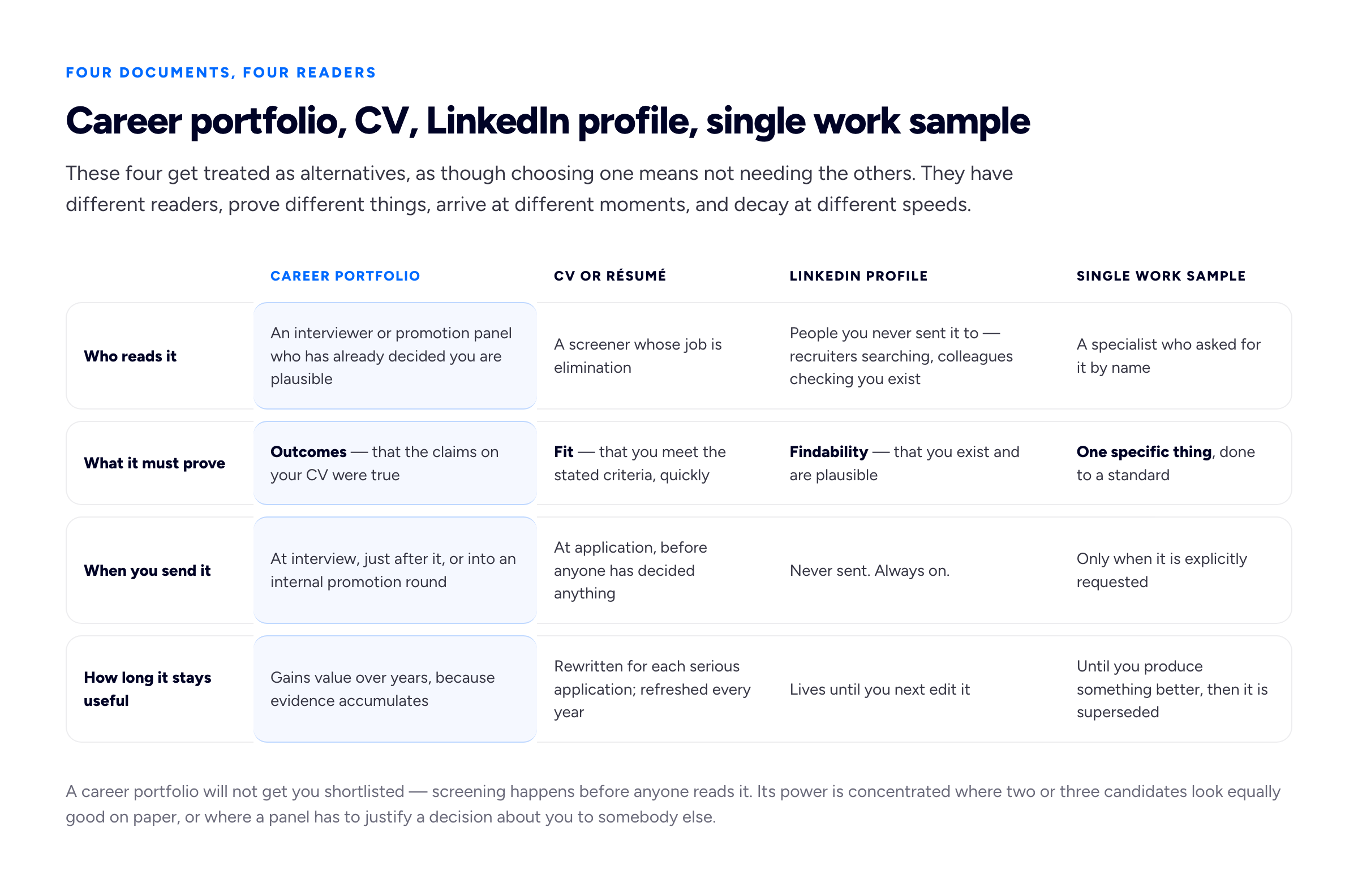
The portfolio is the only one of the four that gets more valuable the longer you keep it.
One consequence worth stating plainly: a career portfolio will not get you shortlisted. Screening happens before anyone reads it. Its power is concentrated at the point where two or three candidates look equally good on paper, or where a panel has to justify a decision about you to somebody else — a narrow window, and the one where most decisions are actually made.
It is also distinct from a personal website. We have written separately about what makes a personal website work, and the difference is direction of travel: a personal website exists to be found by strangers, so it is public, short and written for orientation. A career portfolio exists to be examined by somebody specific, so it is often private, longer, and written for scrutiny. Many people want both. Almost nobody should make one document do both jobs.
The skeleton: what actually goes in, section by section
Here is a structure you can copy directly: eight sections, in this order, each with what it contains, roughly how long it runs, and what goes wrong when it is missing.
1. A front sheet
Your name, current role and employer, the date, a contact route, and — the part people leave out — one line naming what this particular portfolio is for. "Evidence pack for the Band 7 Practice Educator application, March 2027." Half a page.
Failure mode when missing: the reader cannot tell which claims they are meant to be assessing, so they assess everything equally and find it diffuse.
2. A professional statement
A hundred and fifty words in your own voice on what you do, who you do it for, and what you are known for. Not a mission statement, not adjectives. Compare an invented pair: "A passionate, results-driven operations professional with excellent communication skills" against "I run the scheduling and stock systems for a 260-bed independent care group. Most of my work is finding the point where a process is quietly costing an hour a day and rebuilding it so it does not." The second commits to something, and everything after it becomes evidence for a specific claim.
Failure mode when missing: the reader assembles their own summary of you from whatever they read first, and it is less flattering than yours.
3. Evidence of outcomes
The core of the document, and the section most portfolios lack entirely. Three to six entries, each 150–250 words, each the same shape: the situation, what you specifically did, what changed, and how the change is verified. That last part separates a portfolio entry from a CV bullet. "Reduced onboarding time" is a bullet. "Reduced onboarding time from eleven days to four; the figure comes from the HR system's own start-to-first-shift report, which the People Partner can confirm" is evidence.
Failure mode when missing: the portfolio degenerates into a folder of certificates, which proves attendance rather than competence — the commonest way these documents fail.
4. Work samples and artefacts
Four to eight actual things you made, redacted where necessary: the risk register, the induction handbook, the lesson sequence, the reporting template. One short paragraph each on what problem the artefact solved and what you would change now.
Failure mode when missing: your outcome claims float free of anything anyone can inspect, and a sceptical reader has nothing to land on.
5. Credentials, licences and registration
A plain list: qualification, awarding body, date, and registration or membership number where it is safe to include one. Keep scans in the archive; one line each is usually enough in the pack until somebody asks.
Failure mode when missing: somebody has to chase you for it at the offer stage, adding a week to a process that was otherwise finished.
6. Professional development
Not a list of courses attended, but a short record of what you learned and what you now do differently. The professional bodies have already formalised this habit: the CIPD's CPD policy asks members to submit at least three CPD records each year and to reflect on the impact of their learning, and states that members are randomly selected for an annual audit. Whether or not your field requires it, the four-line format — what I did, why, what changed, what I do differently — is the right one.
Failure mode when missing: the portfolio reads as a snapshot of somebody who stopped developing, a worse impression than having attended fewer courses.
7. Feedback and references
Attributed quotes from managers, colleagues, students or clients — with their permission — plus appraisal extracts and summarised evaluation results. Three or four strong ones beat a dozen. Include the source and the date; an unattributed compliment is worth nothing.
Failure mode when missing: everything in the document is self-reported, and the reader has only your word for all of it.
8. Where you are going
Five or six lines on what you want next and what you are building towards. Easy to skip if the reader does not care. For a promotion case it is not optional.
Failure mode when missing: the panel sees a record of the past with no argument about the future, which is precisely the argument they need to make on your behalf.
What does not go in: full appraisal documents, everything you have ever done, salary details, and anything containing another person's identifiable information. On that last one, see the confidentiality section below — it is not a formality.
Worked examples: five professions, weak entry and strong rewrite
Advice about "quantifying impact" is easy to nod at and hard to apply, so here are entries written out. All five people, employers and figures are invented.
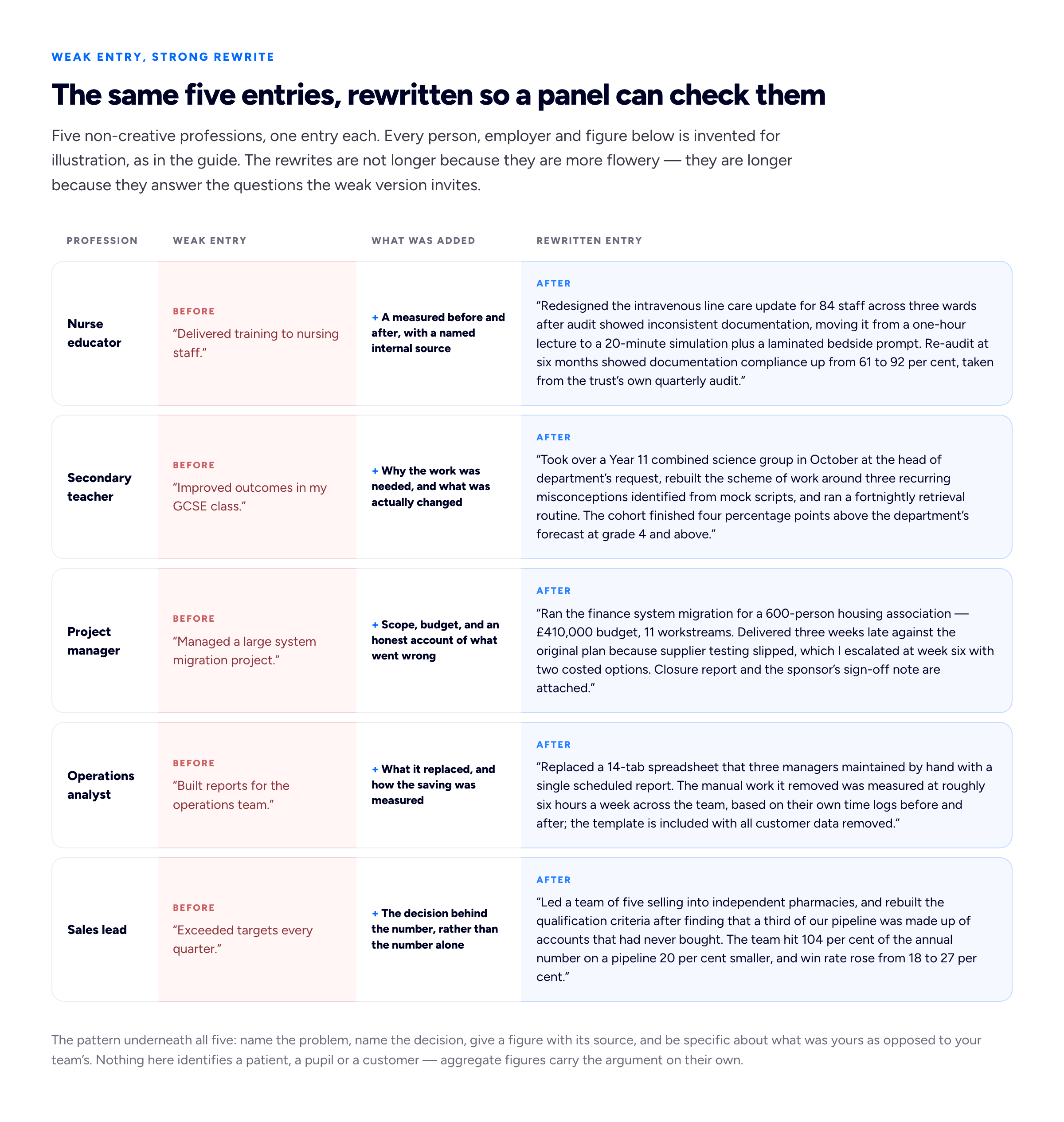
In every row, the rewrite is not longer because it is more flowery — it is longer because it answers the questions the weak version invites.
Three are worth expanding, because the reasoning transfers.
The nurse educator. "Delivered training to nursing staff" is true and completely inert: it says nothing about why the training was needed, how you did it, or whether it worked. The rewrite's most important sentence is the last, naming the audit as the source of the numbers, because a reader can check that. It also reveals what the weak version conceals — that you changed the format because the old one was not landing. That decision is the actual skill on display.
The project manager. The rewrite admits the project ran three weeks late. New portfolio writers almost always take that out, and it is a mistake. Everyone on the panel has run a late project; what distinguishes people is when they saw it coming and what they did, so the escalation at week six with two costed options is the strongest line in the entry. A portfolio of unblemished successes reads as either very junior or lightly fictional.
The sales lead. "Exceeded targets every quarter" is a number with no decision behind it, and anyone can inherit a good territory. The rewrite gives away the reasoning, which is the part that transfers to a new employer. The win-rate movement matters more than the quota attainment, because it is evidence about you rather than about your patch.
The pattern underneath all five: name the problem, name the decision, give a figure with its source, and be specific about what was yours as opposed to your team's. For longer narrative pieces, our guide to structuring a portfolio case study covers the same shape in more depth.
Evidence and confidentiality in regulated fields
If you work with patients, students, clients or customers, this section matters more than everything above it, because getting it wrong has consequences beyond a bad interview.
The rule is simple to state: you may describe your own work; you may not publish other people's personal information. Those are two different things, and the anxiety that stops people building a portfolio at all usually comes from conflating them. Your reasoning, decisions, methods and outcomes are yours to describe. The named individual in the case is not yours to put in a document.
Professional bodies say this directly. The Nursing and Midwifery Council's guidance on written reflective accounts — five of which are required across a three-year revalidation cycle — instructs registrants to "be careful not to record any information which may identify another person". That is a good default even where nobody is formally checking.
What to do instead, in rough order of preference:
- Aggregate. Cohort-level figures carry the argument and identify nobody. "92 per cent of 84 staff" is stronger evidence than any individual story.
- Describe rather than reproduce. You do not need the actual care plan. A paragraph explaining what you changed about care plans, and why, does the same work.
- Anonymise properly. Removing the name is not anonymising. If the entry says "the only patient on the unit that January who had transferred from the regional burns centre", you have identified somebody. Change or omit the details that combine to point at a person, not just the label on top.
- Rebuild a clean version. Make a blank or dummy-data copy of your template, dashboard or report. It shows the craft with none of the risk, and is often clearer than the real thing.
- Ask. Where an internal document is genuinely your best evidence, ask your manager whether you may include a redacted extract, and keep the reply.
Two further practicalities. Check your employer's policy before including anything produced at work, because in most jurisdictions your employer owns the artefact even where the skill is obviously yours. And if you are bound by a non-disclosure agreement, there are established ways to show work without breaching it; we have covered portfolios under an NDA separately, and the techniques translate directly to clinical, educational and public-sector work. None of this is legal advice — it is the practical version, and in most cases the practical version is enough.
From binder to digital: what changes and what should not
A great deal of career-portfolio advice still assumes a physical binder, which is where many readers get stuck. Binders are not wrong — in some settings, particularly teaching interviews and certain clinical assessments, somebody genuinely will turn pages with you — but for most people the artefact is now a folder, a PDF and possibly a web page.
What gets better. A link is sendable, so evidence reaches the panel member who could not attend. Versions stop multiplying, things are searchable, and you can send the three relevant entries rather than the whole binder.
What gets riskier. Anything on a public web page can be found by a search engine, indexed, cached, and read by your current employer. That is fine for the public half of your professional presence and wrong for the evidence half. Decide, per item, which side of that line it sits on before you upload it.
A workable split is two artefacts. A public page — name, professional statement, areas of practice, credentials, public writing or speaking, a contact route. It exists to be found, and it is short. A private evidence pack — outcome entries, artefacts, feedback, reflective accounts — kept as a PDF or a permissioned folder and sent deliberately to named people. Nothing with third-party data, salary details, internal documents, registration numbers or your home address belongs on the public side.
Since we make one, we should be straight about where our own product fits. Bunfolio builds the public half: a free one-page portfolio site on a subdomain carrying your statement, credentials and public work, with a custom domain if you want one. It is not the right tool for the private evidence pack, because it is a published website rather than a controlled document. For that, a well-organised PDF or a permissioned cloud folder is the correct answer, and no portfolio builder improves on it.
For the interview itself: bring a printed contents page even if everything else is digital, so a panel can see the shape of what you have without anyone handling a device. Have the PDF ready to email the moment you leave, and say so. Do not hand over your laptop and do not rely on the room's wifi. If you send a link in advance, add one sentence naming the two entries most relevant to the role — a portfolio that tells you where to start gets read further than one that does not.
Using a portfolio for promotion and internal review
This is the use case most general advice ignores, and for many readers it is the actual reason they are here. Arguing internally for a promotion or a regrade is a different exercise from applying outside, and it rewards a different document.
Start with the reader. Your panel already knows you and does not need convincing that you are competent at your current level. What they need is material to justify a decision to somebody else — usually a senior manager or budget-holder who has never met you. The portfolio's job is to hand them that argument pre-assembled, in the organisation's own language.
Which leads to the single most useful tactic here: use the promotion framework's own headings as your section headings, word for word. If the criteria say "leads improvement across team boundaries", make that a heading and put two pieces of evidence under it. It feels mechanical and it is enormously effective, because it removes the translation step from a panel reading a dozen cases in an afternoon.
Four things then carry disproportionate weight:
- Evidence at the level above, not the level you are on. Panels are not deciding whether you did your job well; they are deciding whether you are already doing the next one. Lead with work outside your remit.
- Scope, in numbers. Budget, headcount, sites, cohort size, case volume. Grading structures are built around scope, so state yours rather than leaving it to be inferred.
- Work with no owner. The rota nobody would fix, the induction that did not exist, the cross-team meeting you started. The clearest signals of readiness, because nobody asked you to do them.
- Named peer and stakeholder feedback. An internal panel can verify it, which makes it worth more here than to an external employer. Ask for it in writing at the time, not the week before.
Add a one-page cover memo at the front: what you are asking for, the three strongest reasons, and where each is evidenced. Some panels read only that page, and you want to control what happens if they do.
On timing, begin the folder roughly a year out, and put the "where you are going" section to work: a paragraph on what you would take on at the next level gives your manager something concrete to agree to, and turns a conversation about deserving into a conversation about scope. If a pay conversation is what you are building towards, the evidence-gathering overlaps heavily with our guide to deciding what your work is worth, different setting notwithstanding.
Keeping it alive
Portfolios die between uses. The maintenance list is short enough to be realistic:
- Monthly, ten minutes. Drop the month's material into the archive folder. Do not curate, do not write it up — just capture it while you still remember the numbers.
- After anything finishes. Write the outcome entry within a fortnight of a project, cohort or campaign ending, while the figures are to hand.
- At every appraisal. Save the written record and ask for one sentence you can quote. The cheapest feedback you will ever collect, and almost nobody does it.
- Annually. Cull. Replace the weakest outcome entry rather than adding a seventh, and check your registration dates are current.
None of this is design work. A career portfolio is not improved by better typography, and a plain, well-organised document with real evidence beats a beautiful one with none.
Frequently asked questions
What is the purpose of a career portfolio?
To turn claims into evidence at the moment a decision is being made about you. A CV, a LinkedIn profile and an interview answer are all you describing yourself; the portfolio is the documentation a panel, an employer or an assessor can check. Its secondary purpose is for you: keeping the archive behind it means that when a promotion round or a job application arrives, you are selecting evidence rather than trying to remember it. If you are weighing it against a CV, portfolio vs resume sets out which document answers which question.
What does a career portfolio look like in practice?
For most people outside the creative fields, a short PDF or a password-protected page: a front sheet, a one-paragraph professional statement, three to six outcome entries each with a supporting artefact, a list of credentials and a page of feedback. The worked examples above show entries for five professions. For a profession with its own rules, such as nursing revalidation or teacher appraisal, follow the body's required format first; our nursing portfolio and teaching portfolio guides cover those.
How long should a career portfolio be?
The pack you send should be readable in fifteen minutes — realistically eight to fifteen pages, with three to six outcome entries. The archive behind it can be as large as you like. Over twenty pages and you have stopped selecting and started including.
Do I need one if I already have a LinkedIn profile?
They do not overlap. LinkedIn is how you are found and consists of claims; a portfolio is what you show once somebody is interested and consists of evidence. If you only have time for one, keep the profile current — but the profile will not help you where two shortlisted candidates look identical, and the portfolio will.
Should it be public or private?
Split it. A short public page with your statement, credentials and public work, and a private evidence pack you send deliberately. Anything containing another person's data, internal documents, or details you would not want your current employer to read stays private. If you are looking quietly while employed, keep the whole evidence side private.
PDF or website?
PDF for the evidence pack: it is fixed, it survives being forwarded, it can be attached into a system that does not accept links, and you control who has it. A website for the public half, where being findable is the point. Most people end up with both, which is the right outcome rather than an indecisive one.
What if all my work is confidential?
Describe rather than reproduce. Aggregate figures, sanitised templates rebuilt with dummy data, and a clear account of your own reasoning will carry almost any portfolio. Assessors in regulated fields are used to reading evidence with no identifiable detail — it is the normal case, not a weakened version of one.
Do employers actually read them?
Not always, and rarely at screening. We have seen no trustworthy figure on how often they are opened and will not invent one. What is worth knowing is that the reading happens late — when a decision is close and somebody wants confirmation, or when a panel needs something to point at. Build it for that moment rather than expecting it to open doors on its own.
I am a student and have never had a job — what do I put in it?
Coursework written up properly, placement work, volunteering, part-time roles, and anything you organised. Treat a substantial assignment like a work project: the brief, your approach, the outcome, what you would do differently. Our guide to building a portfolio with no professional experience covers what counts as evidence before anyone has paid you.
Does it need to look designed?
No. Consistent headings, readable type, page numbers and a contents page are the entire brief. In non-creative fields heavy design works against you, because it suggests effort spent on presentation by somebody whose evidence could not carry itself.
If you take one thing from this guide: the difference between a portfolio that works and one that does not is almost never presentation. It is whether each entry names a decision you made and a figure somebody else can verify.
How we put this guide together
The framing here is ours, and it is worth separating judgement from sourced fact. The pack-versus-archive distinction, the four-way comparison against a CV, a LinkedIn profile and a single work sample, the eight-section skeleton with its failure modes, and the advice on internal promotion cases are all our own recommendation, formed from working with people building portfolio sites on Bunfolio. Treat them as considered opinion, not a standard.
Where a claim belongs to somebody else, it is cited. The description of a portfolio as a tailored alternative to a résumé and cover letter, and the instruction to select and tailor items for each application, come from Texas State University Career Services' portfolio guide. The requirement for five written reflective accounts across a revalidation cycle, and the instruction to "be careful not to record any information which may identify another person", come from the Nursing and Midwifery Council's guidance on written reflective accounts. The development requirements — at least three CPD records a year, reflection on the impact of learning, and a random annual audit of members — come from the CIPD's CPD policy. All three pages were read directly rather than summarised from elsewhere.
We have deliberately included no statistics about hiring behaviour: no percentage of employers who review portfolios, no figure for how long anyone spends reading one, no claim about how much a portfolio raises your chances. Numbers for all three circulate widely and we could not trace any of them to a primary source we were prepared to stand behind. The reading times and page counts suggested above are working recommendations, not measurements.
Every person, employer, figure and portfolio entry used as illustration is invented — the nurse educator, the teacher, the project manager, the operations analyst and the sales lead do not exist, and neither do their audit results, budgets or win rates. We have not reproduced, screenshotted or quoted any real person's portfolio.
Related reading: what makes a personal website work for the public half of your professional presence, showing confidential work without breaching an agreement for the practical techniques behind the confidentiality section, how to write a portfolio case study if your outcome entries need to run longer, and building a portfolio with no professional experience if you are starting from coursework, and the teaching portfolio for the version of this document that education uses, which splits into two quite different forms.
More from the blog
September 21, 2026 · 18 min read
Nursing Portfolio: What to Include, Who Reads It and How to Build One
An interview panel, a clinical ladder committee, a certification auditor and an NMC confirmer all read a nursing portfolio, and only one of them wants the binder every guide describes. What each actua...
September 1, 2026 · 21 min read
What Pages Should a Portfolio Website Have?
Two different questions hide behind this one, and most answers online are quietly solving the wrong one — a PDF portfolio's page count, not a website's. Here is the test that decides page or section,...
August 22, 2026 · 22 min read
Social Media Manager Portfolio: Proving Work You Do Not Own
Your best posts sit on a client's account, unattributed, and can be deleted without notice. How to gather evidence before you lose the login, which metrics survive a sceptical reader, and how to show...