
September 23, 2026 · 18 min read · Updated October 5, 2026
Portfolio vs Resume: Which One You Need, and When
A resume and a portfolio are not two formats of the same thing: one answers the screening question, the other answers "show me". This guide covers who needs which by profession, where the CV fits, and how to make the two documents point at each other.
Most answers to "portfolio vs resume" give you the same two definitions side by side and stop. A resume is a short summary of your history; a portfolio is a collection of your work. Both statements are true, and neither helps with the decision you are actually facing, which is usually some version of: do I need both, which one does this employer want, and what happens if I send the wrong one?
The definitions miss the useful part. A resume and a portfolio are not two formats of the same thing, like a PDF and a Word file. They answer two different questions, asked by different people at different moments in a hiring process. Once you see which question each one answers, most of the confusion about the difference between a portfolio and a resume goes away — including who needs which, how the two should point at each other, and why a document that tries to do both jobs tends to do neither.
The difference between a portfolio and a resume, in short:
- What it contains. A resume describes your work: roles, dates, skills, qualifications. A portfolio contains the work itself, or as close to it as you can publish.
- The question it answers. The resume answers "could this person do the job, on paper?" The portfolio answers "show me."
- When it is read. The resume early, at screening, often alongside dozens of others. The portfolio later, once you are on a shortlist.
- How it is organised. The resume by time, most recent first. The portfolio by piece, best first, usually two to five of them.
- Its length. The resume is a page or two. The portfolio is as long as its few pieces need, because its reader has chosen to spend the time.
- Its format. The resume is almost always a PDF or Word file, because application systems parse it. The portfolio is usually a website or a PDF, shared as a link from the resume.
Or in one line: a resume tells, a portfolio shows. The rest of this guide is about what follows from that.
Portfolio vs resume: two answers to two different questions
Hiring usually happens in at least two passes. The first is screening: someone, often helped by software, works through the applications asking one question of each. On paper, could this person do the job? They are checking titles, dates, qualifications, tools, the shape of a career. They are moving fast, and they are mostly looking for reasons to keep or drop a name.
The resume is built for that pass. It is compact so it can be scanned, it follows predictable conventions so the reader knows where to look, and it is plain text underneath so a tracking system can extract it.
The second pass is evaluation. Fewer candidates remain, and the question changes: show me. A hiring manager, a creative director, a senior engineer or a client wants to see how you think and what your work is actually like. Everyone left has made similar claims; what separates them is evidence.
The portfolio is built for that pass. It is slower to read, organised around a handful of pieces rather than a timeline, and it shows the problem, the decisions and the result rather than asserting them.
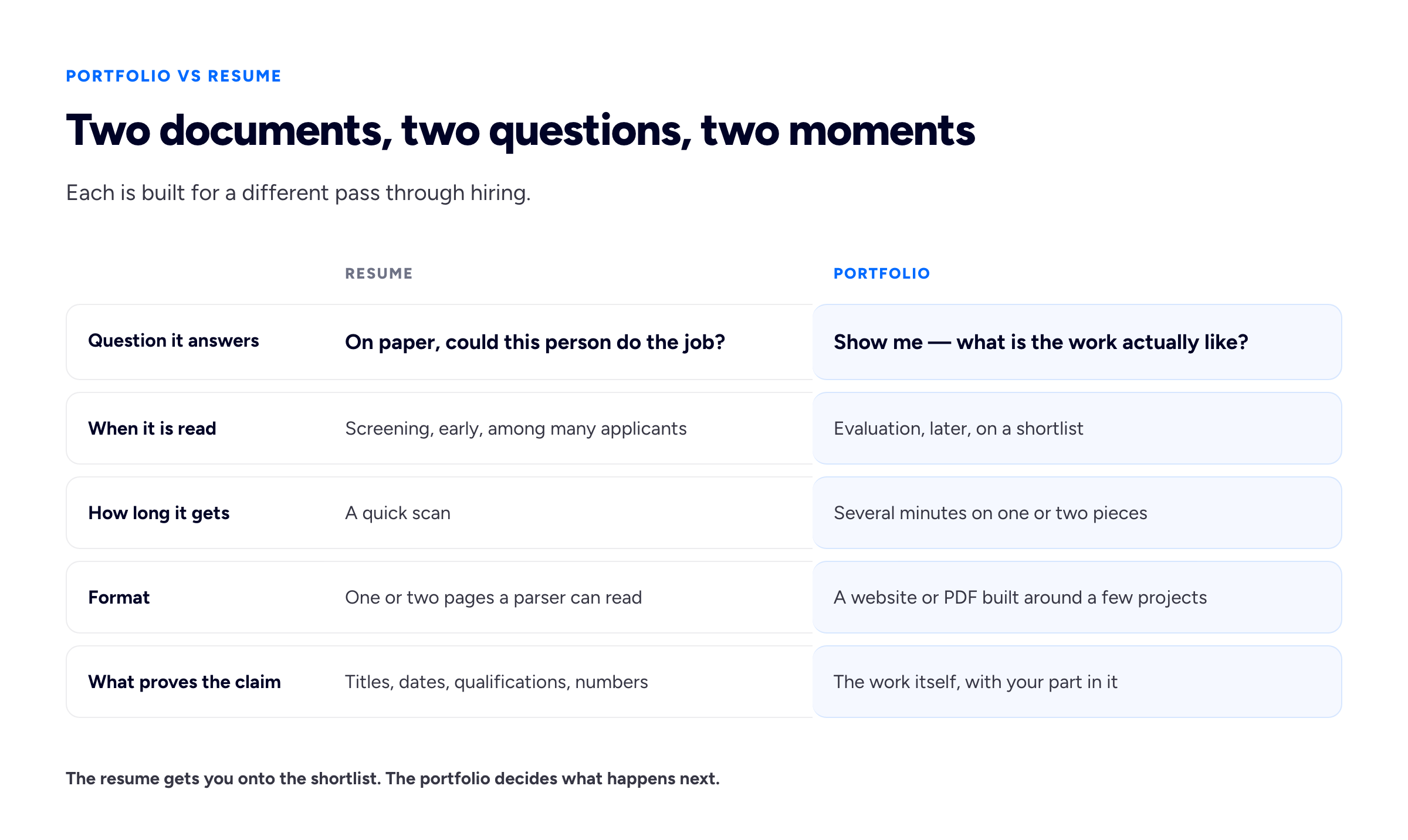
The resume is read to decide whether to look further. The portfolio is what they look at.
This framing explains the practical rules better than any definitions table. The resume is short because the screener has little time. The portfolio can be longer because the evaluator has chosen to spend time on you. And the portfolio need not repeat your employment history, because anyone opening it has already read that.
What a resume is, and why "CV" confuses everything
Part of the muddle around resume vs portfolio vs CV is that the same words mean different things in different places.
In the United States, a resume is the short document you send for most jobs. University career services describe it in near-identical terms: the University of North Carolina's Writing Center calls it "a general and concise introduction of your experiences and skills as they relate to a particular career or position", and notes that resumes "are usually no more than one page in length" for people early in their careers.
A US curriculum vitae is something else: a full, cumulative record used for academic and research jobs, fellowships and grants. The same UNC guide describes a CV as "a fairly detailed overview of your life's accomplishments, especially those most relevant to the realm of academia", and says a senior researcher's can "run into the double digits" of pages. The University of Illinois career centre lists faculty applications and graduate fellowships as the places a CV is requested, and ordinary employers as the places a resume is.
In the UK and much of Europe, CV is simply the everyday word for what Americans call a resume. The UK's National Careers Service defines it as "a summary of your skills, achievements and experience that you use to apply for jobs" — which is a resume by any American definition. Across the EU, the Europass CV is a widely used standard format for the same purpose.
So "CV vs resume" is mostly a question of geography and, in the US, of academia. "Portfolio vs resume" is a different axis entirely. A UK designer sends a CV and a portfolio. An American designer sends a resume and a portfolio. An American professor sends a CV and, depending on the field, a teaching portfolio as well. In every case, the first document summarises and the second shows.
What a portfolio is, with examples
A portfolio is a selection of your actual work, presented with enough context that a stranger can judge it. The word covers more ground than most people expect, and we take the whole range apart in what a portfolio website is; here we only need the version that sits opposite a resume. The shape varies a great deal by profession, which is why "what is an example of a portfolio?" is one of the most common questions on this topic:
- A product designer: three or four case studies, each showing the problem, the research, the rejected directions, the final screens and what changed after launch.
- A developer: a few projects with live links, the repository, a short write-up of the hard part, and an honest note on what they built versus what the team built.
- A copywriter: published pieces, grouped by type, with a line on the brief and the outcome.
- An architect: drawings, models and photographs of built or competition work, with their role on each scheme stated plainly.
- A data analyst: two or three analyses written up as a question, a method, a finding and a recommendation, with the code available for anyone who wants it. Our data analyst portfolio guide goes through how a reviewer reads one.
- A teacher: lesson plans, anonymised student work, observation feedback and a short statement of approach — the teaching portfolio guide separates the interview version from the promotion dossier.
What these share is not a format — some are websites, some PDFs, a few still binders. It is that the reader sees the work rather than a description of it. That is the line between the two documents: if a page could be written without the work existing, it is a resume, however it is styled.
There is also a broader sense of the word. A career portfolio is a structured collection of evidence — achievements, feedback, certificates, samples — used for promotion rounds, professional registration or assessed courses, often by people whose work does not photograph. It follows the same logic: it shows, where the resume tells.
Resume vs portfolio: who needs which
Everyone applying for a job needs a resume or its local equivalent. It is the entry ticket; almost every application route asks for one. The real question is whether you also need a portfolio, and the answer depends on how much of your ability can be judged from a description.
Portfolio expected. Designers of every kind, illustrators, photographers, video editors, writers, architects and most front-end or product-focused developers. In these fields, the work is the qualification. A resume without a portfolio link reads as incomplete, and once you reach evaluation the portfolio usually matters more.
Portfolio helps, sometimes decisively. Marketers, data analysts, product managers, UX researchers, teachers, communications staff, engineers in less visual specialisms. Many employers here hire without one. But when two candidates look similar on paper, the one who can show a campaign, a dashboard or a lesson sequence has handed the evaluator something to discuss, and that is a real advantage. It matters most when you are changing field or light on job titles.
Portfolio rarely part of hiring. Accountants, nurses, lawyers, many trades and most roles in regulated professions. Here the screen is qualifications, registration and references, and the "show me" moment happens in an interview, an assessment or a practical test rather than in a collection of samples. Confidentiality also rules out most of what you could show. Some of these professions do keep portfolios, but for a regulator or a promotion panel rather than an employer's first look.
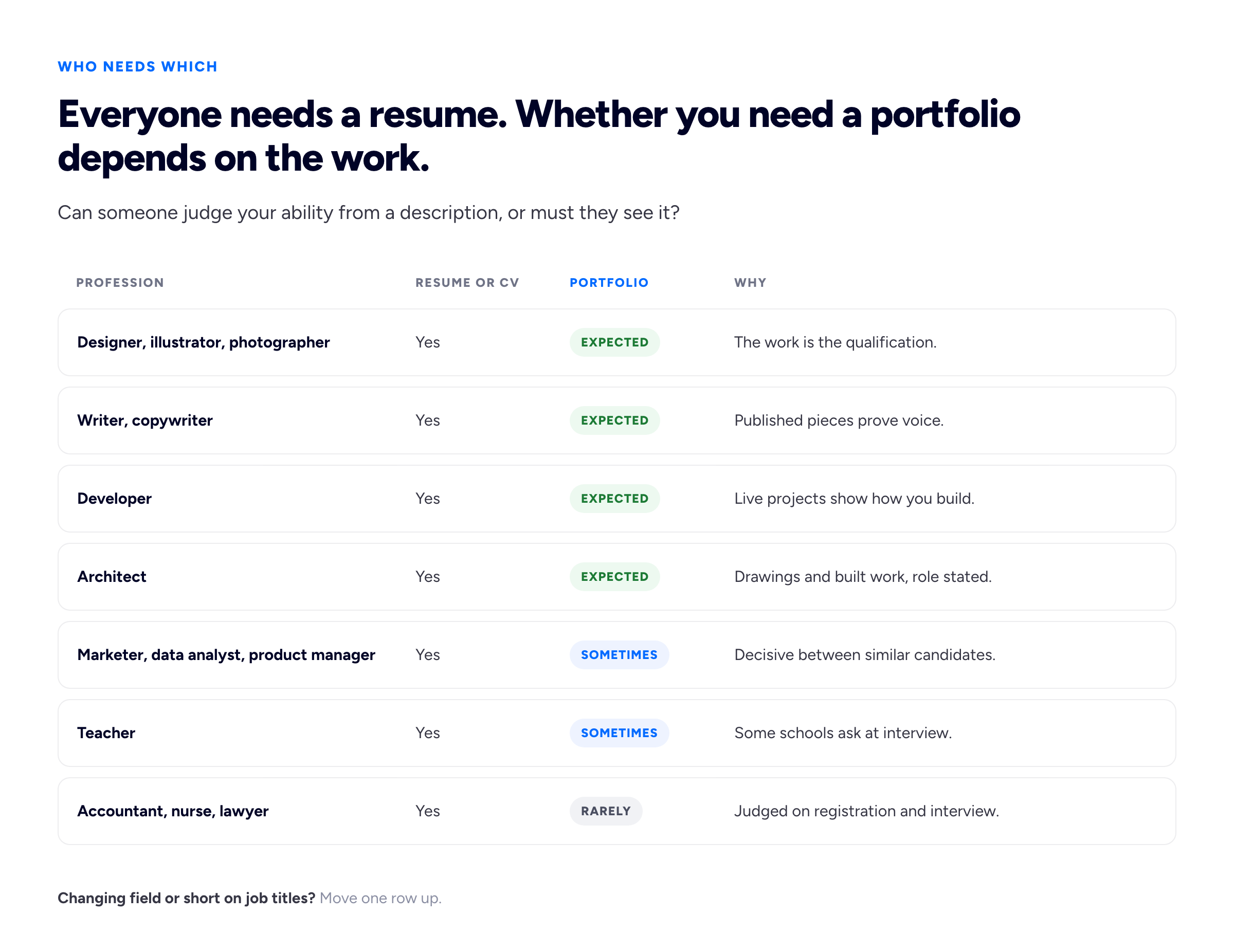
The rows are our reading of common practice, not a rule. Always follow what the listing actually asks for.
One adjustment overrides the table: the less your resume can prove, the more a portfolio is worth. A career changer, a graduate, a freelancer with clients instead of employers, or someone returning after a break has a resume that screens weakly. A small, well-chosen portfolio can carry them through evaluation, because it replaces the missing job title with the missing evidence. If that is you, the guide to building a portfolio with no experience covers what to put in it.
Portfolio vs resume: how the two should reference each other
If you have both, treat them as one application in two parts. The evaluator will read them together, and inconsistencies between them are noticed.
The link is the bridge
The resume must carry a working, visible link to the portfolio, at the top, in the body text rather than the page-header layer, written out in full so it survives printing and parsing. That single line is how screening hands over to evaluation, and it fails more often than people expect — exported without its hyperlink, broken by a moved page, or pointing at a homepage when it should point at the one project that matters. The whole chain is covered in how to put a portfolio link on a resume.
The same claims, told twice
Job titles, dates, employer names and headline results must match across both. If the resume says you led a redesign and the case study says you were one of four designers on it, the evaluator will remember the case study. If the resume says a campaign lifted sign-ups by a figure and the portfolio gives a different one, both documents lose credibility. The resume states the claim briefly; the portfolio shows the work behind it. Neither should say something the other contradicts.
Name the same project in both
The most effective link between the two documents is a project that appears in each under the same name. Take an invented example: Tom Reyes, a marketing coordinator, has a resume bullet that reads "Planned and ran the spring re-engagement email series for lapsed customers — case study: tomreyes.com/spring-series". The portfolio page at that address carries the same title, shows the emails, explains the segmenting decision and gives the same result the bullet does. The screener sees a specific claim; the evaluator clicks and finds exactly that claim, expanded. Nothing needs to be reconciled.
Two or three of these paired entries are worth more than a portfolio of twelve pieces the resume never mentions. As for how many pieces to include overall, how many projects belong on a portfolio website makes the case for fewer, better ones.
What goes wrong when one tries to do the other's job
The most common mistakes in this area come from asking one document to answer both questions.
The resume stuffed with work
Screenshots, thumbnails, a two-column layout with a "selected work" gallery down the side, a PDF heavy with embedded images. It feels efficient: why make them click? In practice it fails the screening pass it was supposed to survive. Tracking systems extract text and discard images, so the gallery vanishes and the two-column layout can scramble what is left. And the thumbnails are too small to judge, so the evaluator still has to ask for a portfolio. The resume has become worse at its own job without doing the other one.
The fix is to keep the resume plain and let it point. A strong bullet and a link to the case study do more than a postage-stamp image.
The portfolio that is a resume on a web page
The opposite failure is a site with a photo, an About paragraph, a list of employers with dates, a skills section with progress bars, and a download button for the PDF. There is no work on it. It answers the screening question a second time, at greater length, to a reader who has already answered it.
A resume website is legitimate when your field does not produce showable work. But if your field expects a portfolio, a site like this reads as a portfolio with nothing in it. The evaluator clicked to be shown something and was told the same things again.
The fix is to lead with the work: best project first, a few lines of biography, and the PDF resume linked rather than rebuilt. That also answers a common question — should you put your CV in your portfolio? Link to it; do not make it the content.
Do I need a portfolio and a resume? A decision table
Find the row closest to your situation. Where two rows apply, the one further down usually wins.
| Your situation | What to send | Where to spend effort |
|---|---|---|
| Applying for a design, writing, development, architecture or visual role | Resume or CV plus portfolio link | The portfolio, especially the first two projects |
| Applying for a marketing, analytics, product or teaching role | Resume or CV; add a portfolio link if you have work to show | The resume first, then two or three strong samples |
| Applying for an accounting, nursing, legal or regulated role | Resume or CV, plus whatever the listing asks for | The resume, and preparing for the interview or assessment |
| Applying for an academic or research post in the US | Academic CV; teaching or research portfolio if requested | The CV's publications and teaching record |
| Changing field, recently graduated, or light on job titles | Resume or CV plus a small portfolio | The portfolio, because it supplies the evidence the resume cannot |
| Freelancing and pitching clients rather than employers | Portfolio first; resume only if asked | The portfolio — a client rarely reads a resume at all |
The last row is the exception worth noticing. A freelancer pitching clients starts in the evaluation pass: the client already needs someone and wants to know whether you are good. Freelancers can often manage without a resume, and never without a portfolio.
Getting both done without doing everything twice
Build them in the order they are read. Write the resume first, because it forces you to decide what your career actually amounts to in a page, and those decisions tell you which projects belong in the portfolio. If you want a clean, parser-friendly starting point, the free resume builder exports a PDF without asking you to sign up.
Then pick the two or three pieces of work that best support the resume's strongest claims, and write those up properly. Put them on a simple site with an address you can type into the resume's header. Bunfolio exists for exactly this step — a free portfolio site on its own subdomain, filled in from a form or a LinkedIn profile — but any host that lets you lead with the work will do.
Finally, read them together as the evaluator will: resume first, then the link. Titles, dates and numbers should match, and the project the resume names should be the one the link opens.
Frequently asked questions
Is a resume the same as a portfolio?
No. A resume summarises your experience, qualifications and skills in a page or two so a screener can decide whether to look further. A portfolio shows examples of your actual work, with context, so an evaluator can judge its quality. Most people applying in creative and technical fields need both, linked together.
What is the difference between a portfolio and a resume?
The resume answers "could this person do the job, on paper?" and is read quickly, early in hiring. The portfolio answers "show me" and is read slowly, later, once you are on a shortlist. One tells; the other shows.
What is a resume portfolio?
The phrase is used for two things. Usually it means a portfolio sent alongside a resume: the resume as the summary, the portfolio as the evidence, joined by a link in the resume header. Sometimes it means a single document that combines them, with a one-page resume at the front and a few work samples behind it, which some architecture practices and course applications ask for. The combined version works when the employer asks for one file; otherwise keep them separate, because an application system parses the resume and will not do well with pages of images attached to it. Our guide to putting your portfolio link on a resume covers how to join the two.
What is a good portfolio example for someone with no work history?
Two or three self-initiated projects written up properly beat ten unexplained screenshots. Pick a real problem, such as a redesign of a local service's booking page, an analysis of a public dataset, or a set of lesson plans you taught on placement, and write each one up as the problem, what you did, what you decided against and what you would do next. That shape is what reviewers read for, whatever the work. Building a portfolio with no experience goes through where that material comes from.
Can a CV be called a portfolio?
Not accurately. A CV is either the UK and European word for a resume or, in US academia, a long record of publications and teaching. Neither contains your work itself. A portfolio does, which is why the two are sent together rather than used as synonyms.
Should I put my CV in my portfolio?
Link to it from the portfolio rather than making it the main content. A download link or a short experience page is helpful for readers who received the portfolio on its own, but the work should come first.
What is a portfolio for a job application?
It is a small, selected set of your best work — often two to five pieces — with a short explanation of the problem, your role and the result for each, usually shared as a link from your resume. It is what the hiring manager looks at after deciding your resume is worth a closer look.
Do I need a portfolio if my job is not creative?
Not always. In fields such as accounting or nursing, hiring rests on qualifications, registration and interviews. In fields such as marketing, analytics or teaching, a small portfolio is optional but can separate you from similar candidates, particularly if you are changing careers.
How we put this guide together
Bunfolio builds portfolio websites, so we have an interest in people deciding they need one; we have tried to be plain about the many cases where they do not. The central framing — that a resume answers a screening question and a portfolio answers an evaluation question — is our own way of explaining the difference, not an industry standard. So are the three profession tiers in the second diagram, the decision table, and the advice to pair two or three projects by name across both documents. Weigh them as recommendations with reasons attached. Hiring processes vary widely between employers, and the listing in front of you always beats general advice.
We have cited no statistics. Figures circulate about the share of employers who want a portfolio, the seconds a recruiter spends on a resume, and the proportion of applications rejected by software. We could not trace any of them to a primary source with a published method we would stand behind, so they are absent rather than repeated.
The definitions of a resume and a CV come from primary sources we read for this guide: the University of North Carolina Writing Center's CVs versus resumes handout, the University of Illinois Career Center's resume vs CV page, the UK National Careers Service guide to CV sections, and the European Commission's Europass CV page. Both US sources describe American usage specifically, which is why we have treated the UK and European meaning of "CV" separately.
Tom Reyes, his spring email series and the address tomreyes.com are invented for illustration, as is every example inside the diagrams. They show the shape of a well-paired resume bullet and case study, not a real person or campaign.
Related reading: putting a portfolio link on a resume for making the bridge between the two survive, what a career portfolio is for non-creative professions, building a portfolio with no experience if your resume is thin, and how to build a resume website for when a portfolio is not the right thing to build.
More from the blog
October 16, 2026 · 16 min read
CV vs Resume: The Difference and Which One to Send
In the US a CV is an academic record and a resume is the short document; in the UK and most of the world, "CV" is the name for that short document.
November 1, 2026 · 19 min read
Cover Letter vs Resume: What Goes in Each, and When You Need Both
The resume is the record; the cover letter is the argument for this role. What belongs in each and what must never be repeated, when a letter is really needed, how the two should point at each other,...

July 14, 2026 · 17 min read
One-Page vs Multi-Page Portfolio: Which Should You Build?
One long scrolling page or a page per project? An even-handed look at what each structure costs you in depth, upkeep and search surface, and why most freelancers end up with a hybrid.