
October 16, 2026 · 16 min read
CV vs Resume: The Difference and Which One to Send
In the US a CV is an academic record and a resume is the short document; in the UK and most of the world, "CV" is the name for that short document.
CV and resume mean the same thing in some countries and two different things in others. In the United States and Canada, a resume is the short, tailored document you send for most jobs, and a CV is a long record of academic and research work. In the UK, Ireland, most of Europe, India, South Africa, Australia and New Zealand, "CV" is the normal word for that short document. So the question is not which word the advert used, but who is hiring and where the role sits.
That is why most pages answering this question mislead anyone applying outside North America: they explain the American academic distinction and stop. This guide covers what CV stands for, a side-by-side of the two documents, how to read an advert written in another country, what an academic CV contains, which personal details get you rejected where, what Europass is, where a portfolio fits, and six situations with the document to send in each.
What CV stands for, in plain words
CV is short for curriculum vitae. The phrase is Latin, the language of ancient Rome, and it translates roughly as "the course of a life". It is said out loud as "see-vee". Some American universities shorten it to "vita"; the plural is "CVs".
"Resume" comes from the French résumé, meaning a summary. In North America that contrast is close to the real difference: one document summarises you for a particular job, the other records your working life in full.
Elsewhere the name tells you nothing. "Curriculum vitae" does not mean "long document". It is the older and more formal of the two words, and which document it means is decided by local convention.
The two documents behind one word
Set the words aside. Two kinds of document exist here, built on opposite principles.
The short document is an argument. It exists to win you an interview for one job, so it selects: it keeps what the advert asked for, cuts the rest, and changes every time you apply. Americans and Canadians call it a resume. Nearly everyone else calls it a CV.
The academic CV is a record. It shows the full extent of your scholarly work, so it includes everything: every publication, course taught, grant and conference paper. It is read by people in your own field who want to check what you have produced, and it grows for your whole career.
Purpose and length
The short document is conventionally one page early in a career and two pages once you have the experience to fill them. UK careers guidance, including Prospects and the National Careers Service, treats two sides of A4 as the standard. Our guide to how long a resume should be covers when a second page is earned.
An academic CV has no length limit, and that is not an oversight: if completeness is the point, a cap defeats it. A doctoral candidate's CV might run to four or five pages; a senior professor's to dozens, because it lists work that genuinely exists.
What goes in, and what is left out
The short document carries contact details, a short profile, work history written as results rather than duties, education, and a skills section that only claims what you could demonstrate. It leaves out whatever does not serve the application: old jobs, hobbies that say nothing, full addresses, referees' names. The academic CV carries everything factual, in the detail set out later; what it leaves out is the persuasion, which is done by the cover letter and the research and teaching statements alongside it.
Who reads it
This is the difference that explains all the others. The short document is read quickly, often by someone who is not an expert in your field and is checking whether you match a list. The academic CV is read slowly, by specialists who recognise the journals and funders, and who notice a paper listed as accepted when it was only submitted.
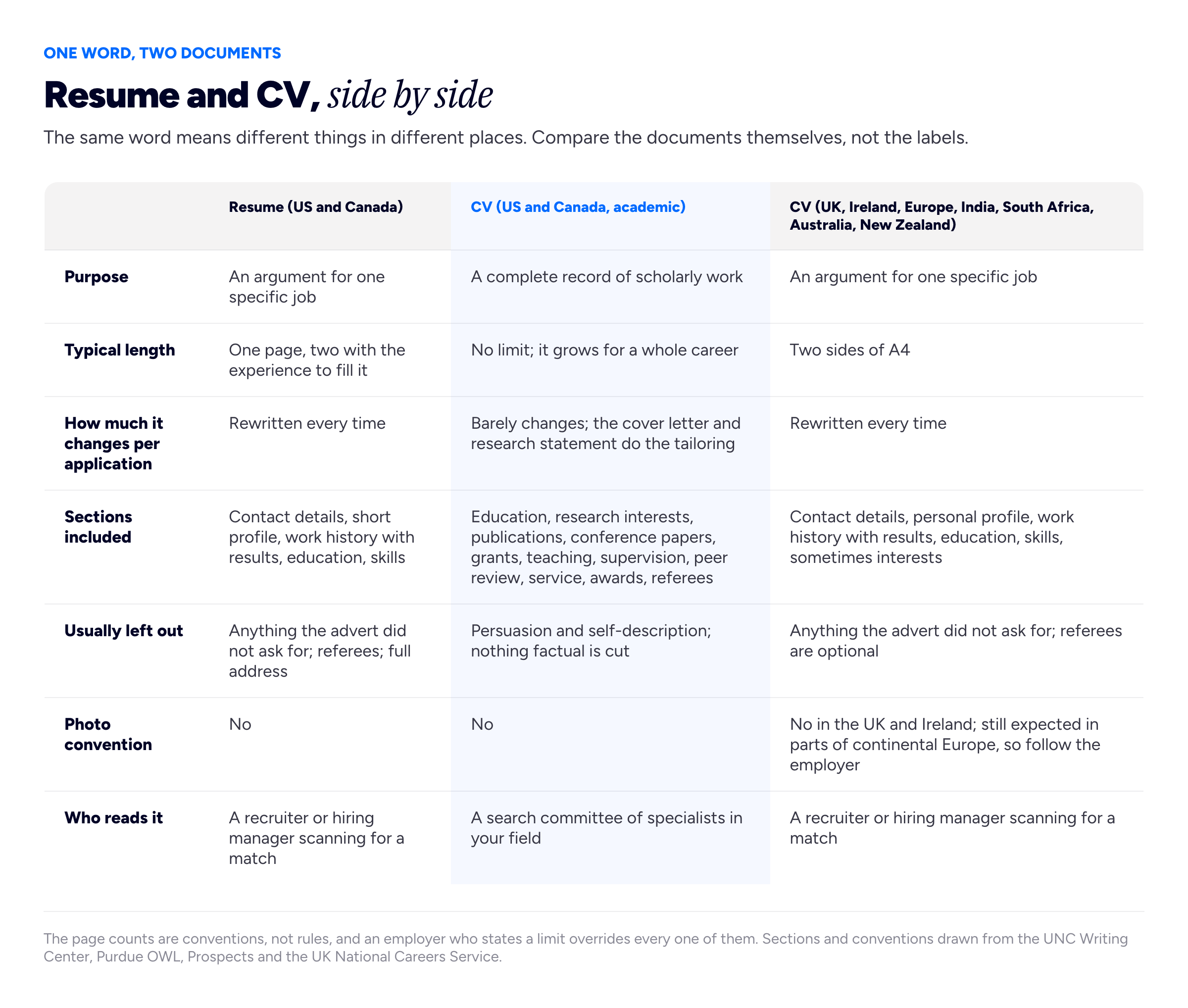
Read left to right: the first and third columns are nearly identical. The middle column is the genuine exception.
Which document does this advert actually mean?
Here is the practical test, our recommendation rather than a published standard. Ignore the word in the advert and answer three questions.
- Where is the hiring team? Not the head office, the team. A London office of an American company hires the way London hires.
- What sector is the role in? A university, research institute, teaching hospital, museum or funded fellowship means an academic CV is possible. Almost anything else does not.
- What else does the advert ask for? This is the strongest signal. "A publication list", "a statement of research interests" and "teaching portfolio" mean an academic CV. "No more than two pages", "your resume and a cover letter" or an online form with a work-history section mean the short document.
The advert says CV but the employer is American
If it is a normal commercial job at a US or Canadian company, send a resume. Some American employers use "CV" loosely, some are copying a template, and none wants eleven pages of publications for a marketing post. The exception is the university, the lab, the hospital and the research charity: there "CV" means what it says, and a one-page resume signals you have not applied for this kind of post before.
The advert says resume but the employer is British, Irish, Indian or Australian
Send your normal CV. It is already the right document. Two adjustments help: keep it to two pages, and strip out the personal details covered below. You do not need to rename or rebuild anything.
When you genuinely cannot tell
Send the short document. It is right for most jobs in every country, and it is the recoverable mistake: a committee wanting a full academic record will ask for one. If an agency is between you and the employer, ask the recruiter what the client expects. That is the one case where somebody paid to know the answer is standing right there.
The academic CV: a record, not a pitch
For a doctoral programme, a postdoctoral post, a lectureship, a research fellowship, a medical residency or a grant, this is the document. The UNC Writing Center's tip sheet "Curricula Vitae (CVs) versus Resumes" is the clearest free guide to it, and Purdue's Online Writing Lab covers the same ground in its section on résumés and vitas.
A conventional order, adapted to whatever your discipline expects:
- Name and contact details, with your institutional email.
- Education, most recent first, with your thesis title and supervisor.
- Research interests, in two or three lines.
- Publications, grouped by type: peer-reviewed articles, book chapters, books, then the rest. Use your field's citation style, and label each item's real status as published, in press, accepted or under review.
- Conference presentations, separating talks you gave from posters.
- Grants, funding and awards, with the funder and the year.
- Teaching experience, naming the courses, the level and your role.
- Supervision and service: students mentored, peer review, editorial work, committees, outreach.
- Memberships, languages and technical skills.
- Referees, with their positions and contact details, because unlike a resume an academic CV is expected to carry them.
Two habits separate a good academic CV from a merely long one. The first is accuracy: every line is a claim a specialist can verify, so an inflated status is a risk rather than a stylistic choice. The second is structure, because the reader is hunting for one section rather than reading from the top.
Teaching is where many early-career academics under-sell themselves. Module codes say little; the courses, the level, the class size and what you were responsible for say a great deal. If the post wants evidence of teaching as well as a list, our guide to building a teaching portfolio covers what that looks like.
Photographs, dates of birth and other personal details
This is the part that gets applications quietly discarded, and it has nothing to do with the CV-or-resume question.
In the United States, Canada, the UK and Ireland, you do not put a photograph, date of birth, age, marital status, nationality, religion or gender on an application document. Harvard's careers office lists pictures and age or gender information among the things to leave off a resume. The reason is anti-discrimination practice: employers there work to show that decisions were made on evidence of ability, and unsolicited personal information is something they would rather never have seen. Some strip it out before a manager reads the file; some move on to the next application.
In much of continental Europe, Latin America, the Middle East and parts of Africa and Asia, a photograph has been entirely normal, and in some countries a date of birth, nationality and marital status are still expected. German applications traditionally carried a formal photograph, although employers there have moved away from it. Where you know the local convention holds, follow it.
Two rules cover every case. Follow the employer's written instructions above any general advice, including ours — if a form asks for a date of birth, give it. And with no instructions and no local knowledge, leave personal details out; an employer who wanted them will ask. The same goes for your postal address: your town and country answers the only question they have.
Europass and the European standard form
Europass is a free service run by the European Commission at europass.europa.eu. You make an account, fill in a structured profile, and it generates a CV in a standard layout, plus a cover letter and tools for describing your language skills against the European reference levels. There is no charge.
Some European public-sector and institutional applications ask for a Europass CV by name, as do some EU-funded research and mobility programmes. If the advert names Europass, use Europass, in exactly the format it provides.
It is equally worth knowing where it is not expected. UK and Irish employers do not ask for it, American and Canadian employers generally have not heard of it, and most private-sector employers in Europe accept your own CV. Many recruiters find the layout generic, because every Europass CV looks the same and the form invites you to fill in fields rather than make a case. Our recommendation: use it when it is asked for by name, or for an EU institution, and use your own two-page CV everywhere else.
Formatting, file format and file names
These choices survive both documents, so settle them once.
- Send a PDF unless the advert or the agency asks for a Word file.
- Make sure the text is real text. If you cannot select a word in your own PDF, it is a picture, and software and screen readers are blind to it.
- One column. Side-by-side layouts get read in the wrong order once a file is parsed.
- Write dates with the month as a word. "March 2024 – June 2026" cannot be misread; "03/06/2026" is two different dates depending on the reader's side of the Atlantic.
- Match the employer's spelling, and give your phone number with its country code when applying abroad.
Name the file so it still makes sense in a folder of two hundred: your name, the document type in the employer's word for it, and the company. An invented example, for an invented applicant called Amara Okafor applying to an invented studio called Halloway and Pike: Amara-Okafor-CV-Halloway-and-Pike.pdf. For a US application the same file becomes Amara-Okafor-Resume-Northbrook-Analytics.pdf. Anything called cv_final_v3.pdf has told the reader something before they open it.
We have not repeated how application software reads a file, because it has its own guide: ATS-friendly resume formatting covers headings, columns, fonts and the parsing failures worth avoiding, and it applies to a CV under either meaning of the word. If your layout is fighting you, our free resume builder produces a single-column PDF with selectable text that works as a two-page UK CV.
What about a portfolio?
If you design, write, photograph, edit video, build software or make anything people can look at, neither document does the job alone. Both describe work. A portfolio is the work.
So the CV-or-resume question is often a distraction for creative applicants. What matters more is whether the reader can see something you made in one click; the difference between the two kinds of document is set out in portfolio versus resume. Outside the creative industries, a career portfolio does the same job with write-ups and outcomes instead of images.
The practical version is one short web address in your contact line, which where to put your portfolio link covers, pointing at a page that shows real work immediately. Designers should keep the craft in the portfolio rather than the application document, for the reasons in our graphic designer resume guide. If you have no site yet, building a resume website is an afternoon's work; Bunfolio gives you one free on a subdomain, though any fast page you control will do.
Which one to send
Most of the time the answer is the short document, tailored, two pages at most. The academic CV is the exception, defined by sector rather than by seniority.
A few cases catch people out. If a contact says "send me your CV" and you are both in North America, they mean your resume. Applying speculatively, with no advert to read, send the short document and let your covering message carry the specifics. Leaving academia for industry, you have to rewrite rather than shorten: the resume needs results and relevance where the CV had completeness. And a freelancer applying for an employed role should group clients rather than list each engagement as a job, which putting freelance work on a resume explains.
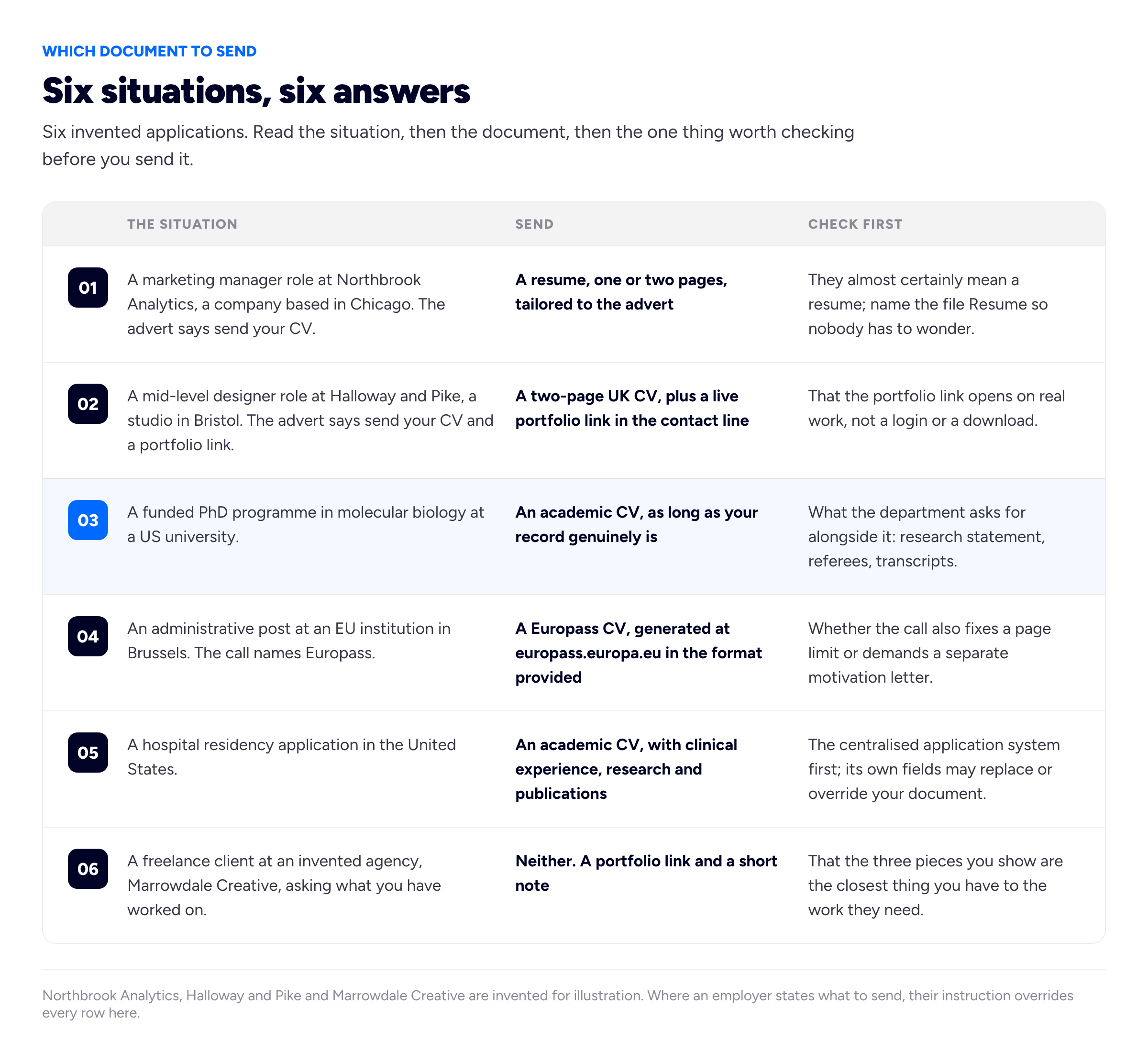
Row 05 is worth re-reading. Medical and academic applications often run through a central system whose fields matter more than the file you upload.
Whichever document you send, something has to carry the argument for you specifically, and that is the cover letter. Our guide to how to start a cover letter deals with the opening, and our cover letter generator gives you a first draft to edit. If the short document is what needs work, how to make a resume stand out is the companion piece to this one.
Frequently asked questions
Does CV mean the same thing in the UK and the US?
No. In the UK, a CV is the ordinary one-or-two-page document you send for almost any job: what Americans call a resume. In the US, a CV is a long record of academic and research work, used for university posts, research, medicine and some fellowships. That is why an American advert asking for a "CV" usually still means a resume.
Can I send a resume when they ask for a CV?
Usually yes, if the employer is in North America and the role is a normal commercial job, because that is what they mean. If the employer is a university, research institute or hospital, no: send a proper academic CV, since a one-page resume reads as unfamiliarity with the field. Outside North America, your resume already is a CV.
How long should a CV or resume be?
A resume is conventionally one page, and two once you have the experience to fill them. A UK or European CV is conventionally two sides of A4. An academic CV has no limit, because its purpose is completeness rather than persuasion. These are conventions rather than rules, and a stated page limit overrides all of them.
Should a CV have a photo?
Not in the US, Canada, the UK or Ireland, where unsolicited photographs and personal details are usually unwelcome and sometimes removed before a manager sees the file. In parts of continental Europe, Latin America, the Middle East and Asia a photograph is normal and occasionally expected. Follow the employer's instructions first, the local convention second, and when in doubt leave it out.
What does "CV" on a resume mean?
Nothing special. People searching this phrase have usually seen the two words together and assumed "CV" is a section inside a resume. It is not. CV is the name of a whole document, short for curriculum vitae, and in most of the world it is the word for what Americans call a resume. A form asking you to "upload your CV or resume" offers two names for one upload.
Is a biodata the same as a CV or resume?
Not quite. "Biodata" is a term still used in parts of South Asia for a document that leads with personal particulars such as date of birth, religion, marital status and family details, with education and work history after them. A CV leads with education and professional experience and keeps personal details to a minimum. For an international employer, send a CV.
How we put this guide together
Bunfolio builds portfolio sites and runs free career tools, so we read application documents from many countries, which is where this guide's country question began. The sourced parts are narrow and attributed where they appear: the CV-versus-resume distinction and an academic CV's sections, from the UNC Writing Center and Purdue OWL; UK conventions, from Prospects and the National Careers Service; what to leave off, from Harvard's careers office; and what Europass provides, from Europass. Everything else is our judgement: the three-question test for reading an advert, the advice to default to the short document when in doubt, the file-naming pattern, and our view that Europass is best kept for applications that ask for it.
We have deliberately left out every figure of the kind that circulates on this topic: the share of employers who prefer one document to the other, the proportion of applications rejected for carrying a photograph, and the percentages attached to how long a reader spends on a page. We could not trace any of them to a survey whose method and sample we could check, and a number nobody can source is worse than no number, because it looks like evidence. Where we would have used a statistic we described the convention instead, and said plainly that it is a convention. We have also not stated what any country's employment or data protection law provides: the guidance above describes employer practice, which varies within one country, and the employer's instructions are the authority.
The primary sources, all read while writing: the UNC Writing Center's tip sheet on curricula vitae versus resumes, for the purpose-and-completeness distinction and an academic CV's sections; the Purdue Online Writing Lab's introduction to résumés and vitas, for reader expectations and tailoring; Prospects' guide to writing a CV and the National Careers Service's CV sections guide, for the UK two-page convention; Harvard College's guide to creating a strong resume, for what to leave out; and Europass, for the European form and language reference levels.
Amara Okafor, Halloway and Pike, Northbrook Analytics and Marrowdale Creative, the example file names and every situation in the diagrams are invented for illustration, not drawn from a real applicant or employer.
Related reading: how long a resume should be, portfolio versus resume, ATS-friendly resume formatting, what to put in the resume skills section, how to make a resume stand out and how to build a resume website.
More from the blog
September 23, 2026 · 18 min read
Portfolio vs Resume: Which One You Need, and When
A resume and a portfolio are not two formats of the same thing: one answers the screening question, the other answers "show me". This guide covers who needs which by profession, where the CV fits, and...
July 14, 2026 · 17 min read
One-Page vs Multi-Page Portfolio: Which Should You Build?
One long scrolling page or a page per project? An even-handed look at what each structure costs you in depth, upkeep and search surface, and why most freelancers end up with a hybrid.
October 15, 2026 · 16 min read
How to Add Your Resume to LinkedIn (and When Not To)
A resume can live in three different places on LinkedIn and they do different jobs. Here is how each works, who sees it, and when a link beats a file.