
September 18, 2026 · 22 min read · Updated October 5, 2026
How to Put Freelance Work on a Resume
Nobody rejects a resume because the applicant freelanced. They reject it because they could not work out what they were looking at. The one decision that sets your layout, what to call yourself, and how to write bullets when the engagement ended before the outcome did.

To put freelance work on a resume, list it in your experience section like any other job: a title that names your discipline ("Freelance Copywriter"), your own name or trading name where the employer would go, one continuous date range, and the clients underneath as projects, each with a bullet that says what you did and what came of it. If your freelancing was really a run of separate contracts, list the larger ones as separate entries instead. That is the format; the rest of this guide is about the doubt a reader brings to it, and how to remove it.
Nobody rejects a resume because the applicant freelanced. They reject it because they could not work out what they were looking at.
Picture the thirty seconds your document actually gets. Somebody runs their eye down the left-hand column, reading dates. They are not assessing your skills yet; they are building a timeline, checking it is continuous, and forming a first guess about how substantial each block of it was. A row reading Senior Designer, Monzo, 2021–2024 answers all of that instantly. A row reading Freelance, 2021–2024 answers none of it. Busy or idle? One client or thirty? Full-time rates or the occasional weekend favour? The reader cannot tell, and the ambiguity itself is the problem.
That is why the advice you have already read — reverse-chronological, list your clients, include dates — is correct but not sufficient. It solves the layout. It does not solve the doubt, and the doubt is the obstacle. Read any forum thread where working freelancers argue about this and the question underneath is never "which format", it is "will this make me look unemployed".
So this guide starts there. Every decision below — one entry or several, what to call yourself, whether to name clients, how to write a bullet — is judged against one test: does it reduce the reader's uncertainty about what you were doing with your time and how much of it mattered?
What the person reading actually fears
It is worth being precise about the objection, because most of it is not snobbery. Hiring managers burned by a freelance hire usually name one of three things.
The first is camouflage. "Freelance" is the word people use for the year after a redundancy when they took two small projects and spent the rest of it applying for jobs. Everyone in hiring knows this, so an unadorned freelance block is read as possibly-that until proved otherwise. That is unfair to the many people running real practices, and it is also simply true, and you cannot fix it by being annoyed about it. You fix it with evidence on the page.
The second is flight risk. If you have been independent for four years, the reader wonders whether you want a job or a bridge — whether you will leave the moment a good retainer appears. Nothing in your work history addresses this, so it has to be addressed in the cover letter or the summary line, briefly and without protesting too much.
The third is unmanageability. Someone who has not had a manager in five years and has set their own priorities throughout is a genuine question mark for a team lead. The counter-evidence is specific: engagements where you worked inside a client's team, to their process, reporting to someone.
Notice that none of these is "freelancing is lesser work". They are versions of the same thing — the reader cannot see enough to judge. Everything below is about putting the missing information where their eye already is.
The one decision that determines your layout
Before you format anything, answer this: was your freelancing a business, or a series of jobs? Everything else follows from it, and most people get it wrong in the direction of making themselves look worse.
Here is the test. Ask, for the period in question:
- Did you have more than one client running at a time, or in close succession?
- Did you find those clients yourself — pitching, referrals, a portfolio, a platform profile?
- Did you set your own rates, invoice, and carry the commercial risk when a client did not pay?
- Would a gap of six weeks between two clients feel like a quiet patch in a business rather than being out of work?
Three or four yeses and you were running a business. It belongs on the page as one entry, with one continuous date range, and your clients listed underneath it as projects. One or fewer, and what you actually had was a sequence of contract roles that happened to be invoiced rather than salaried — a six-month stint embedded in one company's team, then another. Those are separate entries, and formatting them as one business understates them.
The honest middle case is common: two years of scattered small projects, then a nine-month near-full-time engagement with one client. Do both. One consolidated entry for the practice, and the large engagement broken out as its own entry underneath, because it is the strongest thing in the block and burying it inside a client list wastes it.
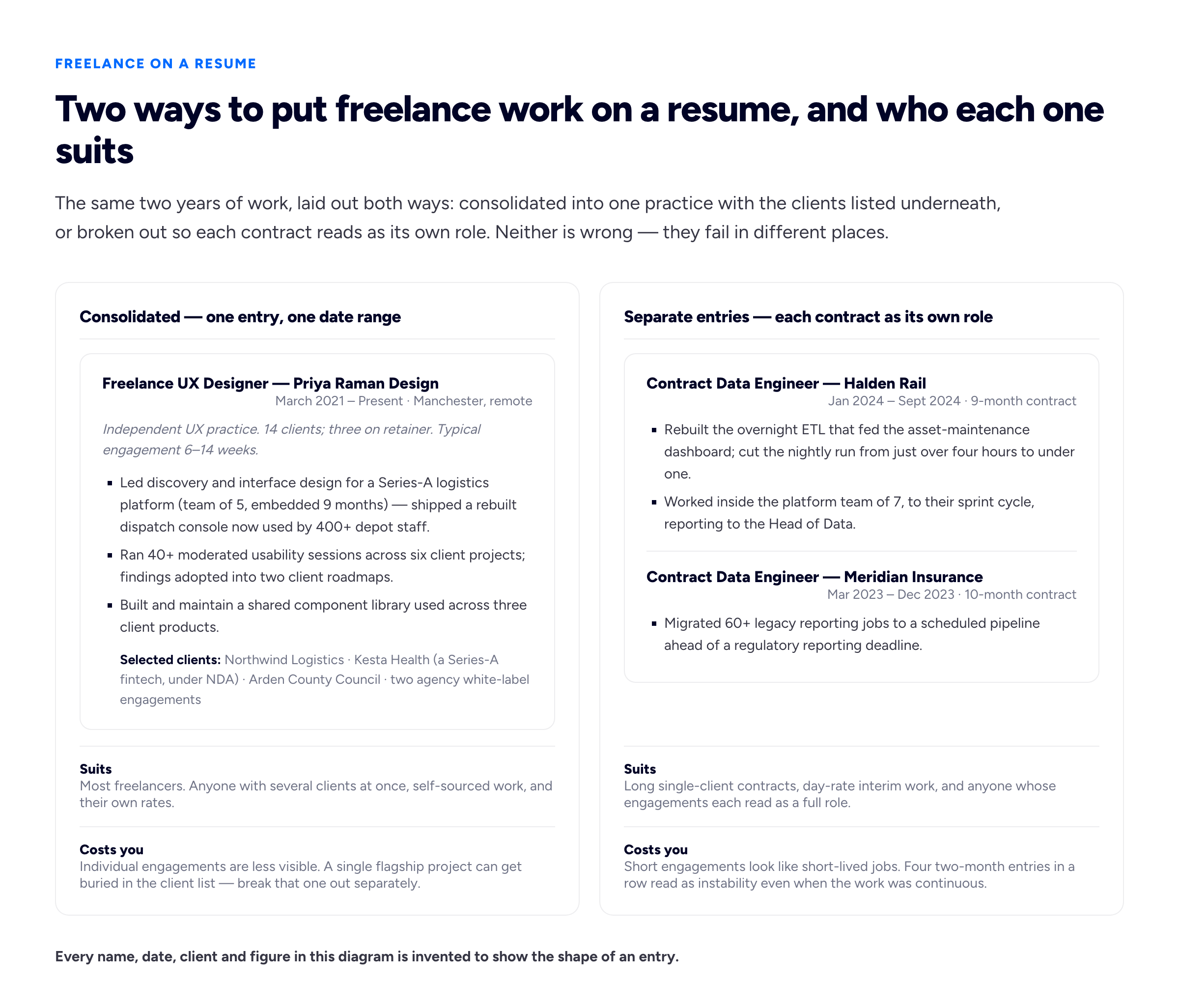
The same two years of work, laid out both ways. The left column closes the gap; the right column makes each engagement legible. Pick the failure mode you can live with.
What to call yourself
"What is a better way to say freelancer" is one of the most searched questions on this topic, and most answers to it are a thesaurus. The useful answer is that the title has one job: to tell the reader what you do before it tells them how you were paid.
"Freelance [discipline]" — Freelance Copywriter, Freelance iOS Developer — is the default and it is fine. It is unambiguous, it is searchable, and "freelance" is not a slur. Put the discipline in it so the row scans as a job rather than an employment status.
"Contract [role]" is better when your engagements were long, embedded and inside a client's team. Contract Data Engineer signals a known arrangement in industries where contracting is normal, and it quietly answers the unmanageability worry, because contractors work under someone else's process by definition.
"Independent consultant" earns its keep when you were advising rather than producing — strategy, audits, a recommendation someone else implemented. It reads as more senior, which is exactly why it backfires over production work. A reviewer who sees "Independent Consultant" and then three bullets about building landing pages concludes you inflate things, and now the rest of the page is suspect.
A trading name is legitimate and often good. "Priya Raman Design" reads as a going concern, which is what you want. Two cautions. Do not invent a name that implies a company you do not have: in the UK, a sole trader's business name must not include "Ltd", "Limited", "LLP" or "plc" unless the entity actually is one, and that is a rule rather than a style preference. And do not write "we" in the bullets underneath. A one-person studio saying "we delivered" is the oldest tell there is. The strongest format is the hybrid — Freelance UX Designer — Priya Raman Design — which gets you the seriousness of the trading name and the clarity of the discipline in one line.
Avoid "self-employed" as a title. It describes your tax status, not your work, and it is the most common way to make a real practice look like a holding pattern. The formal definitions of the status live in the UK government's employment status guidance and the IRS page on independent contractor versus employee; neither belongs in your job title.
Dates, and the gap problem
The date column is the first thing read and the most commonly mishandled part of a freelance resume.
If you are using the consolidated format, use one continuous range — March 2021 – Present — and give per-project dates, if at all, inside the entry rather than in the date column. This is not a trick. If you were available for work and trading under your own name throughout, the range is accurate, and breaking it into the specific weeks a client was billing you would misrepresent a business as a set of temp jobs.
The quiet months are the anxiety, so name the thing directly: a freelancer with no client in August was not unemployed in August, any more than a shop with a slow week has closed. No employed candidate is asked to disclose the fortnight they spent doing nothing between projects, and you owe nobody a week-by-week account of utilisation.
What you must not do is pad. Stretching a range over a period when you genuinely were not working, or listing a client you spoke to once, is where freelancers get caught — because the follow-up at interview is always "tell me about that project", and there is no good answer when there was no project. A real gap handled plainly in a covering letter costs you far less than a fabricated one discovered in the room.
Two mechanical points. Use months as well as years throughout, consistently; a resume that uses years only for the freelance block looks like it is hiding something, because usually it is. And put the dates where a machine can read them — unusual date formats and dates inside a graphic sidebar are a known way to lose your history entirely in an applicant tracking system, which we cover in the guide to ATS-safe resume formatting. Our free resume builder outputs month-level dates in a plain single-column layout for that reason.
Naming clients when you cannot name clients
Client names are the fastest credibility you have and the easiest thing to get wrong.
Start with what you are permitted to say. Many freelance contracts contain a confidentiality clause covering the existence of the engagement, not only its contents, and some contain a publicity clause governing use of the client's name and marks. Read yours before you type. Our guide on showing confidential work goes through the distinction between confidential information, ownership and permission to reference, and it applies to a resume exactly as it applies to a portfolio.
Where you may name clients, do — and order them for the reader rather than chronologically. Three or four is plenty; a list of fourteen reads as filler, and the reader stops at the fourth anyway.
Where you may not, describe the client instead. "A Series-A fintech (30 staff, UK)", "a national retailer's in-house design team", "an NHS trust". This is not weaselling, and it is worth understanding why: the reader's question is never literally "who". It is "what kind of organisation trusted you with this, and at what scale" — and a description answers that completely, where a name only answers it if they happen to recognise it, which for most B2B work they will not.
Resist the recognisable-client temptation, which takes two forms. One is leading with the biggest logo when the engagement was trivial — a two-day job for a household name, placed first, which collapses the moment anyone asks about it. The other is agency work: if you subcontracted to an agency that served a famous brand, your client was the agency. Write it that way. "White-label work for an agency serving a global drinks brand" is true, informative, and cannot be taken apart. The brand's name in your client list cannot survive one question.
Bullets that survive scrutiny
Here is the distinction that does more work than any formatting advice: a bullet either describes an activity or presents evidence. Activity bullets are what almost every freelance resume is made of, and they are close to worthless, because they describe what anyone with your job title would also have done.
"Managed social media accounts for various clients" tells the reader nothing they had not already assumed from the title. Now: "Ran organic social for four B2B clients simultaneously, writing and scheduling roughly 20 posts a week; took one client's LinkedIn following from under 400 to just over 3,000 across a year." Same work. The second version carries scale, a named channel, a period, and an outcome with a baseline. Each of those is a fact a liar would have to invent specifically, which is what makes the reader believe it.
Which brings us to the outcome problem nobody writing about this is honest about. Freelancers frequently never find out whether the work worked. You shipped the site, the invoice cleared, the engagement ended, and you have no analytics access and no relationship with whoever watched the numbers afterwards. The standard advice — "quantify your achievements" — assumes an employee's vantage point, and following it without the data is how people end up inventing percentages.
Do not invent the percentage. Write one of these instead, in descending order of strength:
- Attribute the number to the client. "Client-reported: 18% lift in trial starts in the following quarter." The attribution makes it stronger, not weaker — it tells the reader you know the difference between your measurement and theirs.
- Report scale instead of outcome. Volume, audience, team size, budget, duration, number of locations. Facts you hold directly, and they size the work immediately.
- Report the commercial signal. "Re-engaged for three further projects", "converted to a 12-month retainer". A client paying you again is the most credible outcome data a freelancer owns, and the one most often left off.
- Report the decision your work produced. "Findings adopted into the 2025 product roadmap." "Recommendation accepted; the second vendor was dropped."
Ask for the number while you still can, too. The end of a good engagement is the moment a client is most willing to tell you what happened, and it is the same conversation that produces a testimonial — see asking clients for testimonials.
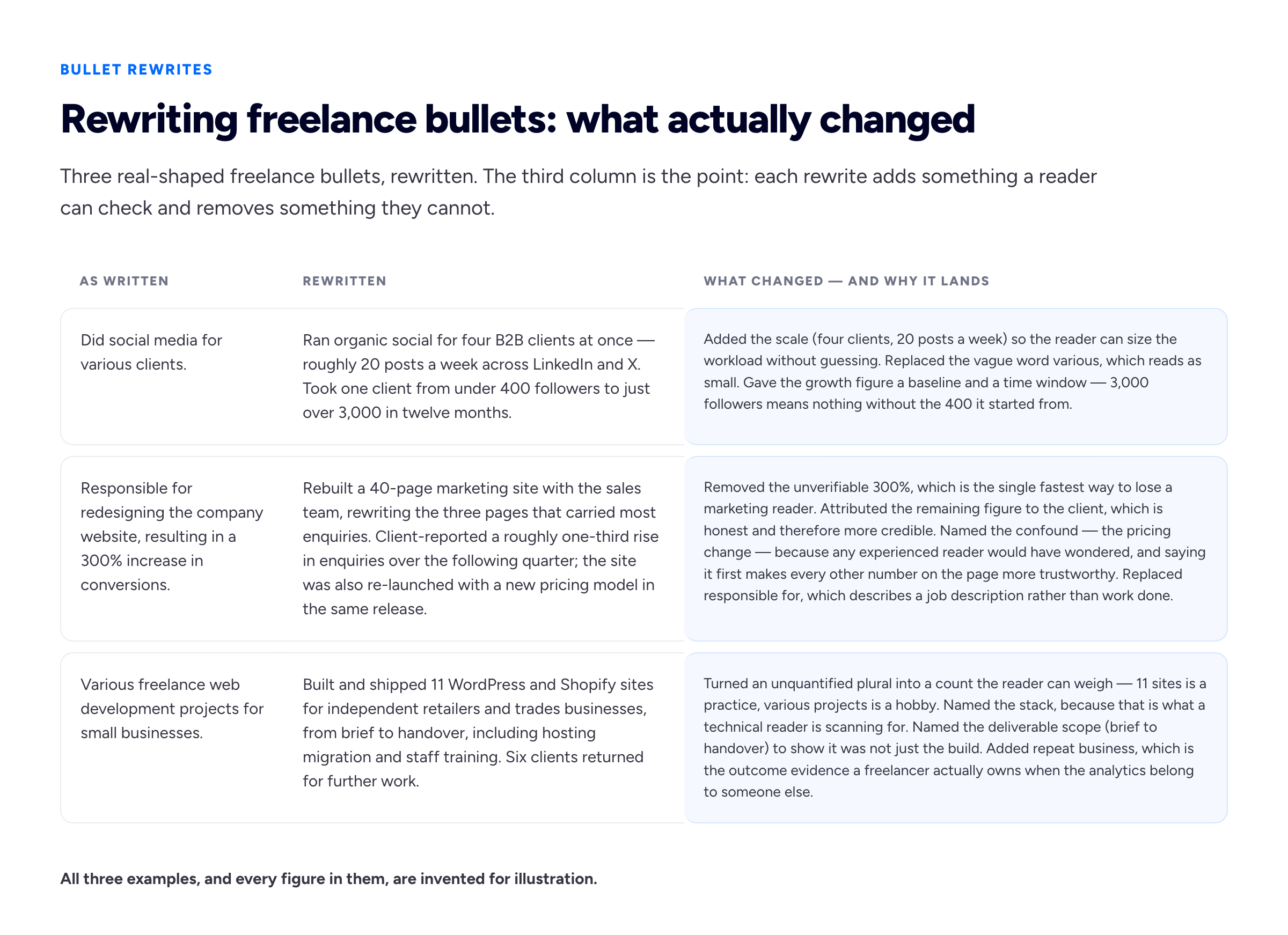
The notes column is the point. Each rewrite adds something a reader can check and removes something they cannot.
A complete example of freelance work on a resume
Here is one entry written out in full, so you can see the decisions above in one place. The person, clients and figures are invented.
Freelance UX Writer, Hollis Words — Manchester and remote — March 2022 to present
Independent practice writing interface copy and help content for software companies; eleven clients, typically two at a time.
- Payroll software company (client name under NDA), 9 months, embedded in product team: rewrote onboarding and error messages across the web app, working to the team's style guide and sprint process; client-reported drop in onboarding support tickets in the following quarter.
- Brightwater Energy: wrote and structured 140 help-centre articles for a tariff launch; re-engaged for two further launches.
- Smaller projects for eight clients including Tandem Learning and Ostrava Bikes: microcopy audits, tone-of-voice guides and app store listings.
Read it as the screener would. The title says what the work is before it says how it was paid. The date range is continuous, so there is no gap to explain. The summary line answers "busy or idle?" with a number. The first bullet is the largest engagement, broken out because it is the strongest evidence and because "embedded in product team" quietly answers the worry about working under someone else's process. The second bullet carries the most credible outcome a freelancer has, a client coming back. The third admits the small work exists without spending three bullets on it.
If you have been freelancing alongside a job, the same entry works with "(part-time)" after the dates, placed where its dates put it. And if you are short of anything to put in the bullets, that is a portfolio problem rather than a resume one: portfolio vs resume explains why the evidence usually belongs in the other document, linked from this one.
How much to leave off
Freelancers over-include, because every project felt like work and leaving one out feels like admitting the year was thin. But a resume is an argument, not an archive, and the logo you did for your cousin's cafe is not evidence for the argument.
Three rules. Leave off anything you would not want to be asked about for five minutes. Leave off work two or more levels below the role you are applying for — it does not add range, it drags your apparent level down. And leave off the tiny favours, unless you have almost nothing else, in which case say plainly what they were rather than dressing them up.
If your independent work genuinely is thin so far, make the rest of the page carry the weight; our guide to building a portfolio with no experience covers what counts as legitimate evidence when paid client work does not yet exist.
The resume asserts; the portfolio proves
There is a hard limit to what a resume can do for a freelancer, and it is worth naming rather than fighting. A resume is a claim document. Every line is an assertion the reader either believes or does not, and nothing inside the document lets them check it. For a salaried candidate that is survivable, because the employer's name does the vouching. For a freelancer, the vouching has to come from somewhere else.
That somewhere is a portfolio. One link, in the header, next to your email — a live page showing three or four of the engagements the resume lists, with the context, the constraint and the artefact. The moment the reader clicks it, "14 clients" stops being a claim. The mechanics of placing and formatting that link are in putting a portfolio link on your resume, and the long-form version of a single entry in how to write a portfolio case study. If you need somewhere for it to live, our portfolio templates will get a site up on a free subdomain in an afternoon.
For the resume file itself, you can build the resume itself with our free tool: it handles the repeatable client list inside a single role, and nothing in it is gated or time-limited. To be straight with you, the exported PDF carries one small "Created with Bunfolio" line in the footer — if that is not acceptable for a particular application, copy the text out and set it yourself. If you also need the covering note that explains the freelance years in two sentences, the cover letter generator is next door.
Three situations, three different problems
Going from freelance back to employment
This is most readers, and the two anxieties to defuse are flight risk and manageability. Use the consolidated format, put the largest embedded engagement front and centre, and make sure at least one bullet shows you working inside someone else's team and process. Then say the quiet part in the covering letter, once, without apology: that you want to work on one problem for longer than an engagement allows, or that you want a team again. That one honest sentence is the thing the resume format cannot express.
Employed, and freelancing on the side
Two overlapping date ranges read as normal, provided the side practice is real. The questions to settle first are not about formatting: check your employment contract for exclusivity and outside-work clauses, and check whether the side work competes with your employer — a hiring manager at a new company will notice if it did, and draw a conclusion about how you treat obligations. If the freelance work is small, a compact "Selected freelance projects" block beats a full parallel entry; if it is substantial and points where you want your career to go, give it a real entry.
When your entire history is freelance
You have no employer names to lean on, so the page substitutes structure for reputation. Open with a summary line stating the shape of the practice — discipline, years, type of client, typical engagement. Use the consolidated entry and break out two or three flagship engagements as sub-entries with real detail. Lead the client list with the most institutionally recognisable organisation, even if it is a council or a university rather than a brand. And keep the portfolio link in the header, because here it is not supporting evidence, it is the primary evidence. If you are still building the client base, getting your first freelance clients covers the other side of that problem.
Frequently asked questions
Does freelance work count as job experience?
Yes — for the work itself, without qualification. Shipping a product for a paying client is shipping a product, and a reviewer assessing your craft is assessing the same craft. It differs in the adjacent evidence an employer also wants: sustained work on one system over years, being managed and managing others, and a referee who watched you for eighteen months. Where a role leans on those, the gap is real and worth addressing rather than denying. For most roles, most of the time, it counts.
Does freelance work look bad on a resume?
Unexplained freelance work looks bad. Evidenced freelance work does not. The negative reading — that it was a holding pattern between jobs — is what the reader falls back on when the entry gives them nothing to go on. Client count, engagement lengths, named or described clients, scale figures and repeat business all remove that reading, and they take about twenty minutes to add.
Should I list every freelance client?
No. Three to five, chosen to make an argument about the kind of work you want next, and grouped under a single entry. If you have thirty clients, say "30+ clients" in the entry summary and then name the handful that matter. A long undifferentiated list reads as padding.
How do I describe freelance work without any metrics?
Use the facts you hold directly: how many clients, how long, how large, how many of them came back. "Converted to a 12-month retainer" and "re-engaged for three further projects" are outcome evidence, and they are yours to state. Where a client gave you a number, attribute it to them explicitly. Do not estimate a percentage you never saw.
Should I put a company name on my freelance work?
Only if you actually trade under it, and never one implying a company structure you do not have or staff who do not exist. A trading name paired with your discipline — Freelance Illustrator — Ellis Studio — is the strongest version. Then write the bullets in the first person singular, because "we" from a sole trader is transparent.
Where does freelance work go on the resume?
In the main work experience section, in reverse-chronological order with everything else. Putting it in a separate "Freelance projects" section at the bottom is the most common self-inflicted wound in this topic: it visually demotes the work and re-opens the gap in your main timeline, which is the exact problem you were trying to solve. If you are starting the document from scratch, our free resume builder keeps it in the right place by default.
Do I need a portfolio as well as a resume?
If your work has any visual, written or built artefact, yes. The resume's claims are unverifiable inside the resume; the portfolio is where they become checkable. A single link in the header is enough. Building a career portfolio covers what to put in it when the work is not conventionally visual.
How we put this guide together
Bunfolio builds portfolio sites for freelancers, so we spend a lot of time reading how independent workers describe themselves and where a reader stops believing them. The framework here is our own judgement rather than an industry standard, and should be weighed as such: the business-versus-series-of-jobs test and the four questions it turns on, the argument that the consolidated single-entry format suits most people, the case against "self-employed" and against invented company names, the descending ladder of what to write when you have no outcome metric, and the claim that repeat business is the most credible evidence a freelancer owns. These come from a consistent pattern in what makes a hiring reader keep going, not from a study.
We have not cited a single statistic in this guide, and that is deliberate. Two figures dominate writing on this topic: that recruiters spend about six or seven seconds on a resume, and that some large percentage of resumes are rejected by applicant tracking systems before a human sees them. The first traces back to a small commercial eye-tracking exercise run by a job board rather than to independent research, and is routinely quoted without its methodology or sample size. The second we have never been able to trace to any primary source at all; it appears to have been repeated into existence by resume-service marketing. Both are used to frighten readers into buying something. We describe how a resume is read above, but we are describing an observed pattern, not measuring one, and we would rather say so than borrow someone else's number.
Where a factual claim is made here, it points at a primary source. The rule that a UK sole trader's business name cannot include "Ltd", "Limited", "LLP" or "plc" comes from the government's guidance on setting up as a sole trader, which sets out the naming rules. The definitions of employed, self-employed and worker status come from GOV.UK's employment status guidance, and the US equivalent from the IRS page on independent contractor, self-employed or employee. Those define your status for tax and employment law and have no authority over how you describe yourself on a resume, which is why we cite them for the legal point only. Nothing here is legal advice, and a question about your own contract — an exclusivity clause, a confidentiality clause, whether you may name a client — is one for a lawyer in your jurisdiction.
Every name, employer, client, date, job title, percentage and figure used as an example above is invented for illustration. That includes Priya Raman Design, Northwind Logistics, Kesta Health, Arden County Council, Halden Rail, Meridian Insurance, Ellis Studio, the 400-to-3,000 follower figure, the 18% trial-start lift, the eleven websites, and everything in both diagrams. They exist to show the shape of a well-evidenced entry, report nothing that happened, and should not be reused as claims about real work.
Related reading: putting a portfolio link on your resume for where the link goes and how to format it, ATS-safe resume formatting for getting your dates and history parsed correctly, showing confidential work for what you may say about clients you cannot name, and a freelance portfolio that wins clients for the version of all this aimed at buyers rather than employers.
More from the blog
October 5, 2026 · 16 min read
How to Become a Freelance Photographer: From Good Photos to Paid Work
A practical path from "I take good photos" to paid freelance work: choosing a niche, the kit you actually need, and building a portfolio before you have clients. Plus the business basics photography a...
September 30, 2026 · 16 min read
What Is Freelancing? A Plain-English Guide to Freelance Work
Freelancing is selling a skill to several clients one job at a time instead of working for one employer. How a freelancer differs from an employee, contractor or gig worker, one freelance job from enq...
September 26, 2026 · 18 min read
What Is a Freelance Artist? How the Work, Pay and Rights Actually Work
A freelance artist is paid by the job, not by a salary, and keeps the copyright unless they sign it away. How freelancing differs from commission, in-house and gallery work, where the money comes from...