
September 26, 2026 · 15 min read
What Is a Freelance Artist? How the Work, Pay and Rights Actually Work
A freelance artist is paid by the job, not by a salary, and keeps the copyright unless they sign it away. How freelancing differs from commission, in-house and gallery work, where the money comes from, why a quote separates the making fee from the licence, the paperwork and tax basics, and how artists find clients.
A freelance artist is a self-employed artist who is paid by the job rather than by a salary: a publisher, a business or a private person hires you to make a specific piece of art, and you agree the brief, the fee and what they may do with the result. You are not anyone's employee, so you choose the work, set the prices, keep the copyright unless you sign it away, and handle your own tax, contracts and invoices.
The rest of this guide is the working picture the definitions leave out: how freelancing differs from commissions, studio jobs and gallery sales, where the money comes from, why a sensible quote has two numbers in it, and how freelance artists find clients. If what you need right now is the portfolio itself, start with our guide to how to make an art portfolio, because every route to work described below runs through it.
Freelance artist, commission artist, in-house artist, gallery artist
These labels overlap, and plenty of artists wear two at once. They are worth separating because each is paid by a different person, in a different way, with different rules about who owns the work.
- Freelance artist. Works for clients, usually businesses: publishers, agencies, brands, studios, magazines. The client briefs you, you deliver to their spec and deadline, and they pay a fee plus, ideally, a separate fee for the use they make of the art.
- Commission artist. Usually means making one-off pieces for private individuals: a portrait, a pet painting, a character drawing of someone's game avatar. The buyer wants the object or the file for personal enjoyment, not to put it on a product. Technically this is freelancing too, but the paperwork is lighter and the rights question is simpler.
- In-house artist. An employee of a studio, agency or company on a salary. You get stability, equipment and colleagues, and in exchange the employer normally owns what you make at work. In the US, the Copyright Office's Circular 30 explains that a work prepared by an employee within the scope of their employment is a "work made for hire", and the employer is treated as its author.
- Gallery artist. Makes finished work on their own terms and sells it through galleries, fairs or direct sales. Nobody briefs you; you carry the cost and risk of making the work before anyone has agreed to buy it. Galleries typically sell on consignment and keep a share of the sale price set out in your agreement with them.
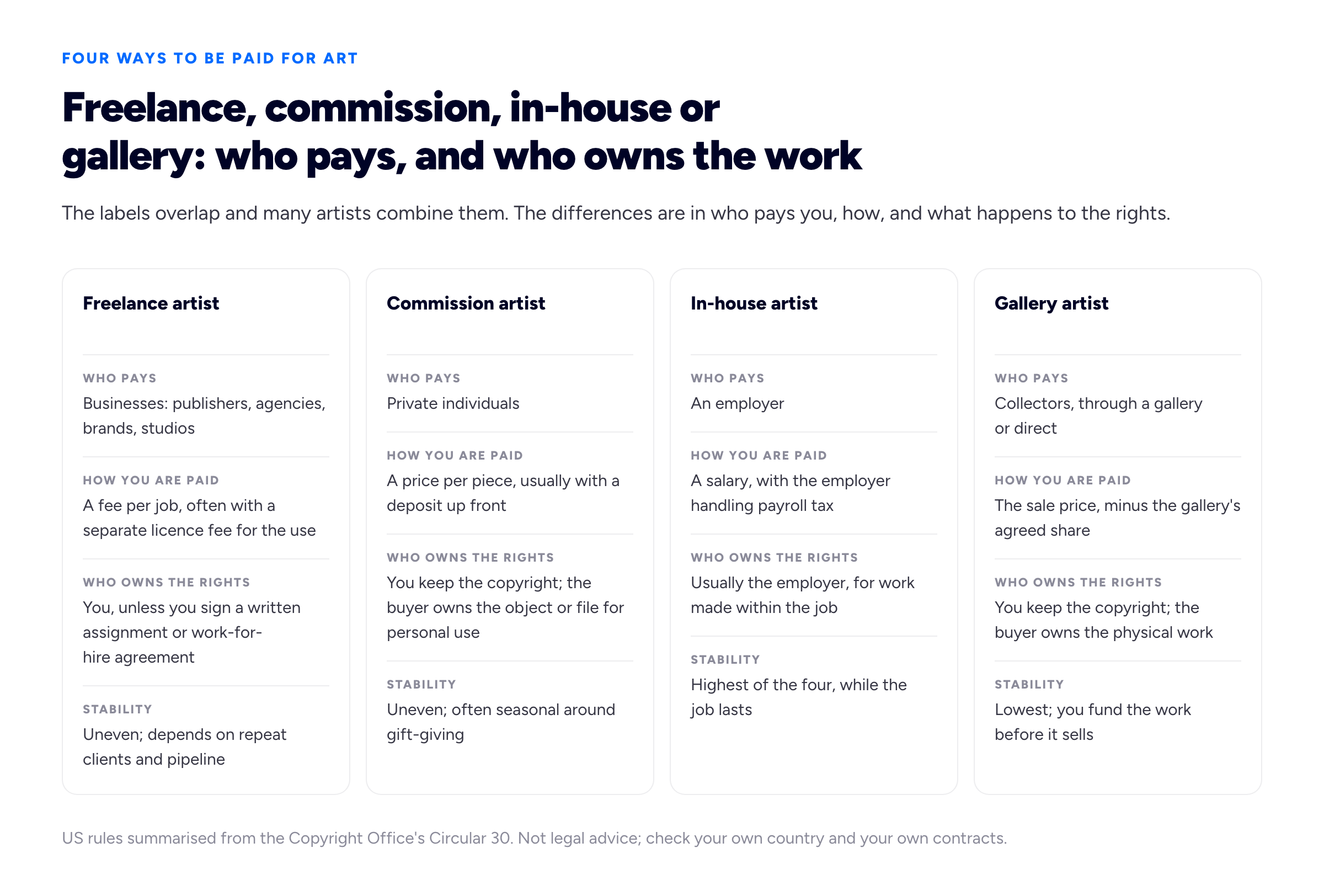
Most working artists combine at least two of these. The column that pays most reliably is rarely the one that pays best per hour.
One point in that diagram surprises people. In the US, buying a painting or a commissioned file does not transfer the copyright in it. The Copyright Act treats ownership of the physical object and ownership of the copyright as separate things (section 202), and a transfer of copyright is not valid unless it is in writing and signed by the owner (section 204). So the person who commissioned a portrait of their dog owns the portrait, but by default you still own the right to reproduce it. Other countries differ; in the UK, section 11 of the Copyright, Designs and Patents Act 1988 makes the author the first owner, with an exception for employees.
The main kinds of freelance art work
"Freelance artist" covers very different markets, each with its own clients and customs. Most artists specialise in one or two of these.
- Editorial illustration. Images for magazines, newspapers and websites, usually to accompany an article. Fast turnarounds, art directors as clients, and fees that reflect a single use in one publication.
- Book covers and children's book illustration. Publishers and authors, longer projects, and contracts that spell out which formats, territories and editions the art may appear on. Children's picture books can involve advances and royalties rather than a flat fee.
- Concept art. Characters, environments and props for games, film and animation. Often freelance on contract to a studio, and often under a work-for-hire or assignment clause, because the studio needs to own the designs outright.
- Surface pattern design. Repeat patterns for fabric, wallpaper, stationery and homeware, sold outright or licensed to manufacturers, sometimes with royalties on units sold.
- Murals. Painted walls for businesses, councils and homeowners. Priced by the job, with materials, access equipment, surface preparation and travel to account for.
- Portraits and pet portraits. Private commissions, often sold through social media and a website, with a price list by size and number of subjects.
- Tattoo flash. Sheets of ready-to-tattoo designs that artists draw and sell to tattoo artists or studios. Drawing flash is art work; tattooing skin is a regulated trade in its own right.
- Packaging, merchandise and brand illustration. Illustrations for labels, products and campaigns, where the usage licence matters most, because the art may be printed on thousands of items.
If you work in commercial illustration, our illustration portfolio guide goes into how to present work for each of these markets separately; an editorial art director and a pattern buyer look for different things.
How the money actually comes in
Few freelance artists live on a single income stream. Most sustainable practices mix a reliable one with a less predictable one.
- Client projects. A fee for a defined job: a cover, a set of spot illustrations, a campaign. This is the core of commercial freelancing and the stream most sensitive to how well you negotiate usage.
- Private commissions. A price per piece to an individual. Simpler contracts and smaller sums, and a lot of time answering enquiries that never become orders.
- Licensing and royalties. Letting someone use existing art for a fee, or a percentage of sales. A pattern or illustration you made once can be licensed several times to non-competing buyers, which is how some artists earn from work they made years ago.
- Prints and merchandise. Selling reproductions of your own work: prints, stickers, zines, pins. You set the price and keep the rights, but you also take on stock, shipping, and in many places sales-tax registration.
- Teaching. Workshops, classes, online courses and paid tutorials.
How you price each of these is its own subject. Our guide to how much to charge as a freelancer works through building a rate from what you need to earn rather than from what someone on a forum charges.
Day rate, per-piece and licensing: three ways to price
These are often discussed as rivals. They answer different questions, and a good quote may use two at once.
- Day rate (or hourly). You are paid for your time. It suits open-ended work where the amount of effort is hard to predict: on-site mural days, studio concept work that changes shape as it goes, art direction. The risk moves to the client, who pays for every extra day.
- Per-piece (flat fee). You are paid for a defined output: one cover, one portrait, one set of six spot illustrations. It suits work you can estimate well. The risk moves to you: if the job takes twice as long, you earn half as much per hour, which is why a per-piece quote needs a clear limit on revisions.
- Licensing. You are paid for what the client does with the art: where it appears, for how long, in which territories, how exclusively. It answers a different question from the other two, which is why commercial illustrators often quote a making fee and a licence fee separately.
Usage rights, and why the licence is a separate fee
This is the part newcomers most often get wrong. What follows is a general explanation, not legal advice; contracts and copyright law vary by country, and for anything significant you should read the contract properly or have someone qualified read it.
When a business commissions an illustration, it is buying two different things. The first is your work: the time and skill to make the image. The second is permission to use it: to print it on a cover, run it in an advert, put it on packaging. The first is roughly the same whether the image ends up on a local café's menu or on a national campaign. The second is not. A national campaign gets vastly more value out of the same image, and a licence fee is how that difference shows up in the price.
A licence answers five questions, and a contract that does not answer them is a contract to argue about later:
- Media: print, web, social, packaging, broadcast, merchandise.
- Territory: one country, a region, worldwide.
- Duration: one year, five years, the life of an edition, indefinitely.
- Exclusivity: whether you may license the same image to anyone else.
- Quantity or scope: one edition, a print run, a single campaign.
At the far end sits a buyout or full assignment: the client takes the copyright entirely. In the US, that transfer only happens in a signed writing, and a commissioned work only counts as "work made for hire" if it falls into one of the nine categories listed in Circular 30 and both sides sign an agreement saying so. Clients sometimes send contracts with a work-for-hire clause as standard. That may be reasonable for a studio that needs to own a game's characters; it is worth querying, and pricing accordingly, for a one-off editorial spot. You can say yes to a buyout. You should just know that you are saying yes to it, and charge for what you are giving up.
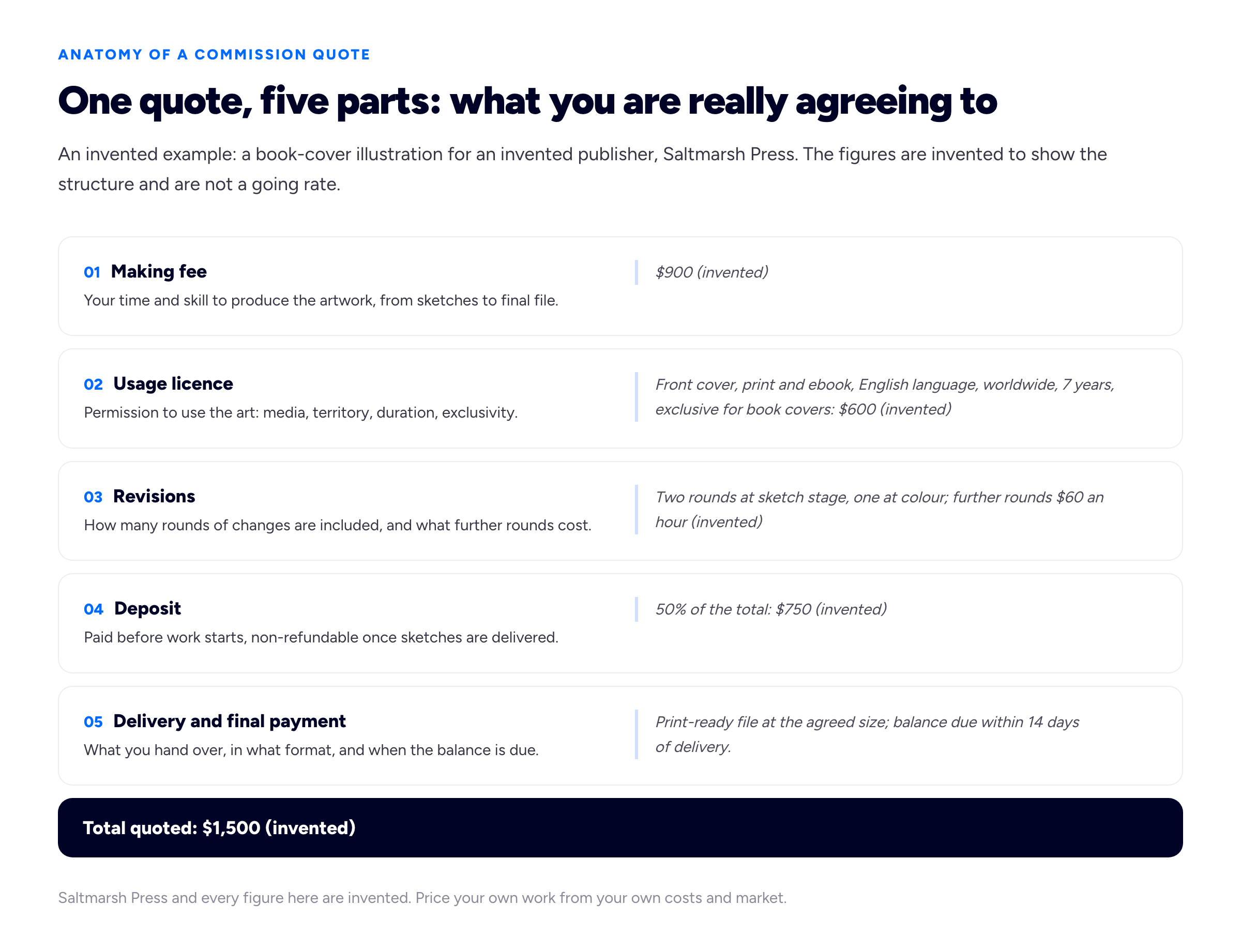
Separating the making fee from the licence means a wider use can be quoted, or re-licensed later, without renegotiating the work itself.
Separating the two also gives you somewhere to go when a client says the price is too high. Rather than cutting the making fee, offer a narrower licence: fewer media, a shorter term, one territory. The client pays less and gets less, which is fairer than simply dropping your price.
The paperwork: contract, deposit, revisions, invoice, tax
Freelance art is a small business, and the admin is not optional. Most of it is a template you set up once and reuse.
The contract
Even a short email that both sides agree to beats nothing. It should cover the brief, the deliverables, the deadline, the fee, the licence (the five questions above), the number of revision rounds, the deposit, the payment terms, what happens if the client cancels halfway, and whether you may show the work in your portfolio. Our guide to freelance contract essentials goes through each clause.
Deposit and revisions
Take a deposit before you start. It filters out people who were never going to pay, and it means a cancelled job still covers the work you did. Then cap revisions in writing. "Unlimited changes" is how a two-day illustration becomes a two-week one; our guide to freelance scope creep covers how to hold that line without souring the relationship.
Invoices and getting paid
Invoice promptly, number your invoices, state the payment terms and reference the job. A free invoice generator will produce a clean one in a couple of minutes without an account. For late payers, our guide to how to get paid on time covers reminder wording and escalation.
Tax, if you are in the US
As a self-employed artist you pay your own Social Security and Medicare contributions through self-employment tax. The IRS's self-employment tax page gives the rate as 15.3%, made up of 12.4% for Social Security and 2.9% for Medicare, applies it once your net earnings from self-employment reach $400 or more, and has you calculate it on Schedule SE; you can deduct the employer-equivalent portion when working out your adjusted gross income. Because nobody withholds tax from your fees, the IRS's estimated taxes page says individuals generally have to make estimated payments during the year if they expect to owe $1,000 or more, using Form 1040-ES. Setting aside a share of every payment as it arrives is the habit that prevents a painful April.
Business licences
Whether you need a business licence to sell art depends on where you live and what exactly you do, and the answer is local. The US Small Business Administration's guide to licences and permits says the ones you need "will depend on your business activities and business location", and suggests starting with your Secretary of State's website before checking county and city rules. Selling physical prints and goods can also bring sales-tax registration duties in your state.
How freelance artists find clients
There is no single channel that works for everyone, and anyone quoting you a conversion rate for one of them is guessing. What follows is an honest description of each route and what it asks of you. Our guide to getting your first freelance clients covers the first few jobs in more depth.
A portfolio site of your own
Every other channel ends here. An art director who sees your work on social media, a publisher your agent pitches to, a buyer searching for "pet portrait artist" in your town: all of them want somewhere to look at more work, read what you do, see a starting price or a rate card, and contact you. A site on your own address also outlives any platform's algorithm changes. Our guide to building an art portfolio website covers what to put on it; if you want one without the build, Bunfolio gives you a free portfolio website on your own subdomain from a Google sign-in.
Direct outreach to art directors
Short, personal emails to the people who commission work in your market: magazine art directors, publishers' art departments, agency creatives, brand managers. Look at what they publish, pick two or three pieces of yours that would fit, and link to your site. Slow, but it reaches exactly the people who can hire you.
Agents and representatives
An illustration agent pitches your work, negotiates fees and licences, and handles contracts, in return for a commission on the jobs they bring in. A good one opens doors you could not open alone. Agents are selective, and you should read the agreement carefully: the commission rate, whether it applies to work you find yourself, exclusivity, and how you leave.
Platforms and marketplaces
General freelance marketplaces and art-specific job boards bring volume and handle payment, but you compete on visible price against a very large pool, and the platform takes a fee. They can be useful for early work and testimonials.
Social media
Where many private commissions start, and where art directors sometimes find illustrators. It rewards consistent posting and a recognisable style, and it can disappear overnight when an account is suspended or reach drops. Treat it as a shop window that points at your site, not as the shop.
Frequently asked questions
How much do freelance artists get paid?
It varies too widely for a single honest number. The closest official figure is from the US Bureau of Labor Statistics' Occupational Outlook Handbook for craft and fine artists, which gives a median annual wage of $55,290 in May 2025. That figure does not describe freelancers: the handbook says its wage data do not include pay for self-employed workers, even though it counts 58% of craft and fine artists as self-employed. On self-employed artists it says only that "earnings for self-employed artists vary widely". What you earn depends on your market, your licensing, your pricing and how steady your client pipeline is.
Can I sell my art without a licence?
You do not need a professional licence to be an artist, but selling may still bring local business registration, permits or sales-tax duties depending on your state, county and city. The SBA's licences and permits guide is the place to start in the US. Separately, if you are selling art based on someone else's characters or brand, you may need their permission, which is a copyright and trademark question rather than a business-licence one.
Does freelance mean no pay?
No. Freelance means self-employed and paid per job, not unpaid. The "free" is about being free of a single employer. Requests to work for "exposure", or to produce finished work on speculation before anyone agrees to pay, are not what freelancing means, and you are entitled to turn them down.
Do you need a degree to freelance?
Not for most freelance art work. Clients hire from your portfolio and your reliability, not from a certificate, and many working illustrators and concept artists are self-taught or trained outside university. A degree can still help with teaching, feedback and contacts. Some adjacent trades are regulated in their own right; tattooing, for example, is licensed in many places, but that concerns tattooing skin, not drawing designs.
How we put this guide together
The distinctions between the four kinds of artist, the categories of work, the split between making fee and licence fee, the five licence questions and the advice on finding clients are our own recommendations and explanations, not an industry standard or legal advice. Weigh them as opinions with reasons attached.
We have deliberately left out statistics we could not trace. There are widely repeated figures for what freelance artists "typically" earn, what share of commissions come from social media, and how many cold emails it takes to win a client; none of the ones we found pointed to a published method, so none of them appear here. The only earnings figure in the guide is the BLS median, and we have spelled out why it does not describe freelancers.
Where the guide states a fact, it points at a primary source we read: the Bureau of Labor Statistics' Occupational Outlook Handbook for craft and fine artists (the May 2025 median wage, the 58% self-employed share and the note that its wage data exclude the self-employed; page last modified 27 August 2026); the US Copyright Office's Circular 30 on works made for hire and the Copyright Act, chapter 2 (sections 202 and 204); section 11 of the UK's Copyright, Designs and Patents Act 1988; the IRS pages on self-employment tax and estimated taxes; and the SBA's guide to licences and permits. Tax thresholds and rules change, so check the current pages, and consult a qualified adviser for your own situation.
Saltmarsh Press, its book cover and every figure in the quote diagram are invented to show the structure of a quote. They describe no real publisher, and they are not a going rate.
Related reading: how to make an art portfolio, building an art portfolio website, the illustration portfolio guide, how much to charge as a freelancer and freelance contract essentials.
More from the blog
October 5, 2026 · 16 min read
How to Become a Freelance Photographer: From Good Photos to Paid Work
A practical path from "I take good photos" to paid freelance work: choosing a niche, the kit you actually need, and building a portfolio before you have clients. Plus the business basics photography a...
September 30, 2026 · 16 min read
What Is Freelancing? A Plain-English Guide to Freelance Work
Freelancing is selling a skill to several clients one job at a time instead of working for one employer. How a freelancer differs from an employee, contractor or gig worker, one freelance job from enq...
September 18, 2026 · 22 min read
How to Put Freelance Work on a Resume
Nobody rejects a resume because the applicant freelanced. They reject it because they could not work out what they were looking at. The one decision that sets your layout, what to call yourself, and h...