
August 23, 2026 · 24 min read
How to Get Paid on Time as a Freelancer
The payment terms that prevent a late invoice, and the five-rung escalation ladder for chasing one — from a neutral nudge on day one to a formal letter before action.
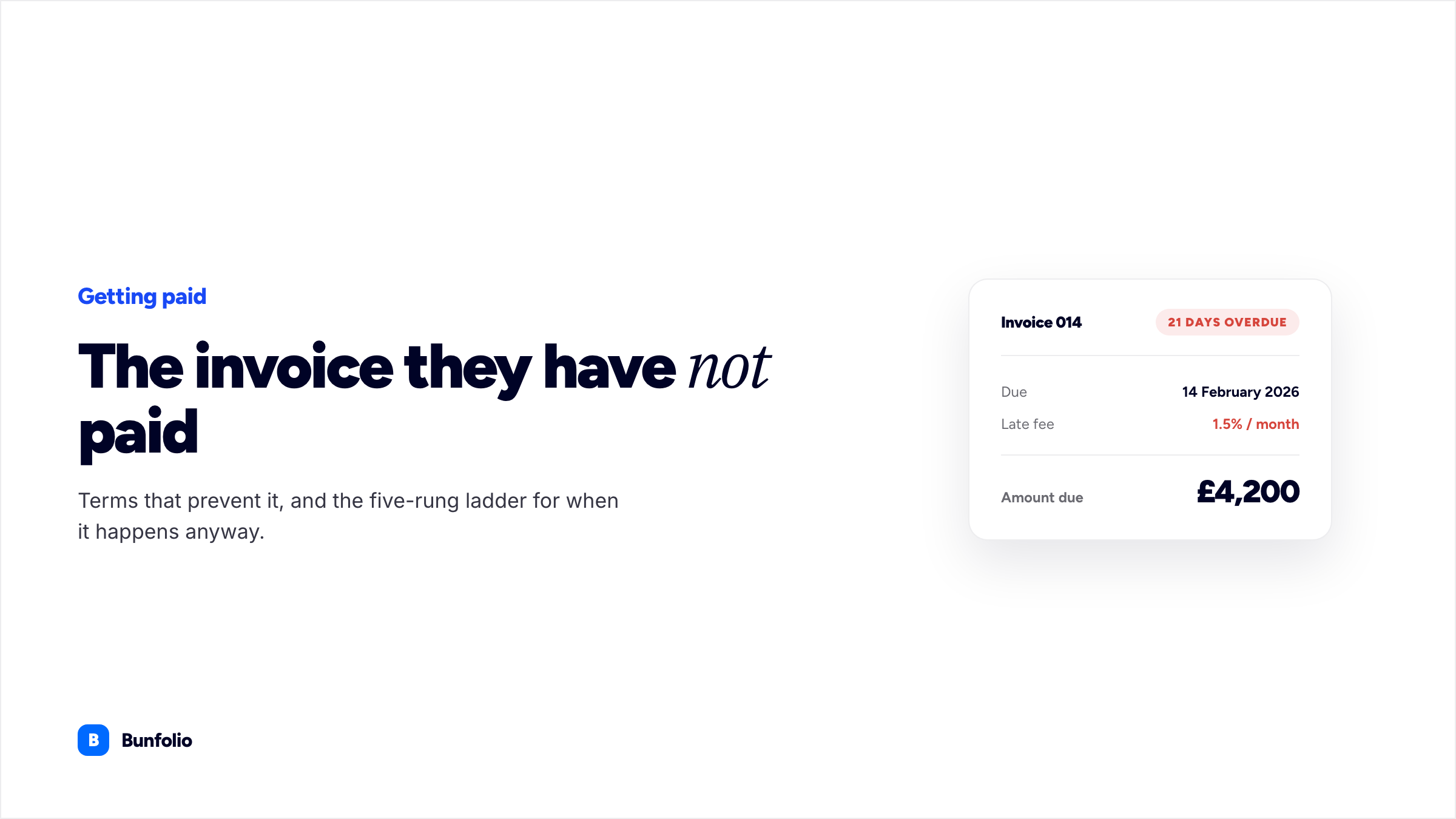
Almost every freelancer eventually has the same week. The work is finished, the client is delighted, the invoice went out three weeks ago, and there is nothing in the account. You have written two polite emails. You are drafting a third and rewriting it for the fourth time, because you cannot work out how to sound firm without sounding desperate.
The uncomfortable thing about that week is that almost all of it was decided months earlier. A freelance client not paying is usually the last symptom of a chain that started with vague terms, no deposit, an invoice sent to the wrong person, and a project where nobody ever wrote down a date. The freelancers who get paid on time are rarely better at chasing. They are better at setting the thing up so chasing is unnecessary — and when it is necessary, they already know exactly what the next three messages say.
This guide is practical guidance from running a business, not legal advice — we are not lawyers, and the rules that apply to you depend on your country, your client's country and the contract you both signed. Where we mention statutory rights below, they are specific to the UK, the EU or New York City, and you must check what applies where you actually work. With that said, here is what to do: the deposit, terms that hold, what belongs on the invoice, a late fee that is worth having, a five-rung escalation ladder with the message to send at each rung, and how to make the next client easier than this one.
Getting paid is designed at proposal stage, not chased afterwards
The pattern we see is that late payment concentrates in projects where the commercial terms were never a conversation. Someone said "sounds great, when can you start", work began, and the money was left to sort itself out at the end. It rarely does.
Payment terms belong in the document that wins the work. If you are already writing a proposal that wins the job, the payment schedule is one short paragraph inside it — a deposit, a milestone if the project is long enough to need one, a final amount, and how long the client has to pay each. That paragraph is not an awkward add-on. It is the part that tells a professional buyer they are dealing with a business rather than a hobby.
Two things follow from putting the terms in early. The first is that you find out what kind of client you have while you can still decline. A client who negotiates hard on scope is normal; a client who objects to the very idea of paying anything before delivery is telling you something. The second is that when the invoice is late, you are not inventing a rule mid-argument. You are pointing at a sentence they agreed to.
There is a step before even that. What you charge, and whether the number is high enough that one late payment does not sink your month, is a separate problem with its own answers — how much to charge as a freelancer covers it. Underpricing and late payment feed each other: the thinner your margin, the more damage a slow client does, and the more likely you are to accept bad terms because you need the work.
The deposit, and what a refusal tells you
A deposit before starting work is the single most effective protection available to a freelancer, and it costs nothing to ask for.
How much, and when
Consider 30% to 50% of the project total, invoiced on acceptance and paid before anything begins. Not before delivery, not before the first review — before the first hour of work. Our own recommendation for most project work is 50%, split 50% on booking and 50% on handover, with a middle milestone added on anything longer than about six weeks.
The deposit does three jobs at once. It converts a verbal yes into a commitment, which is why projects with deposits get cancelled far less often than projects without. It funds the part of the work that happens before anything is visible, which is the part clients undervalue. And it caps your exposure — if the relationship collapses in week three, you are arguing about half the money rather than all of it.
Say it plainly and without hedging. "I'll send the contract and an invoice for the first 50%. I book the dates once that clears." Do not call it "just a small deposit to secure things, if that's okay". Apologetic framing invites negotiation on a point that should not be negotiable.
The client who will not pay one
Some refusals are procedural and fine. Large organisations sometimes genuinely cannot raise a payment before a purchase order exists, and a public body may have rules about advance payments. Those clients will say so, name the process, and give you a route through it.
The refusal to worry about is the one with no process behind it — "we don't pay upfront, we've been burned before", or "let's see how the first phase goes". Framed as caution, it is really a request that you carry all of the risk in a relationship where they hold all of the money. In our experience that request rarely arrives on its own; it travels with vague scope, a rushed timeline and a decision-maker you have not met. The client red flags worth spotting before you sign covers the rest of the set. If you take the job anyway, take it in small pieces: a paid first phase with its own invoice, delivered and paid before the second phase starts.
Payment terms that actually work
Most freelance payment terms fail for a boring reason: they are written in a language the person paying does not read carefully. "Net 30" is jargon. It requires the reader to know the convention, find the invoice date, count, and act. Every one of those steps is a place where nothing happens.
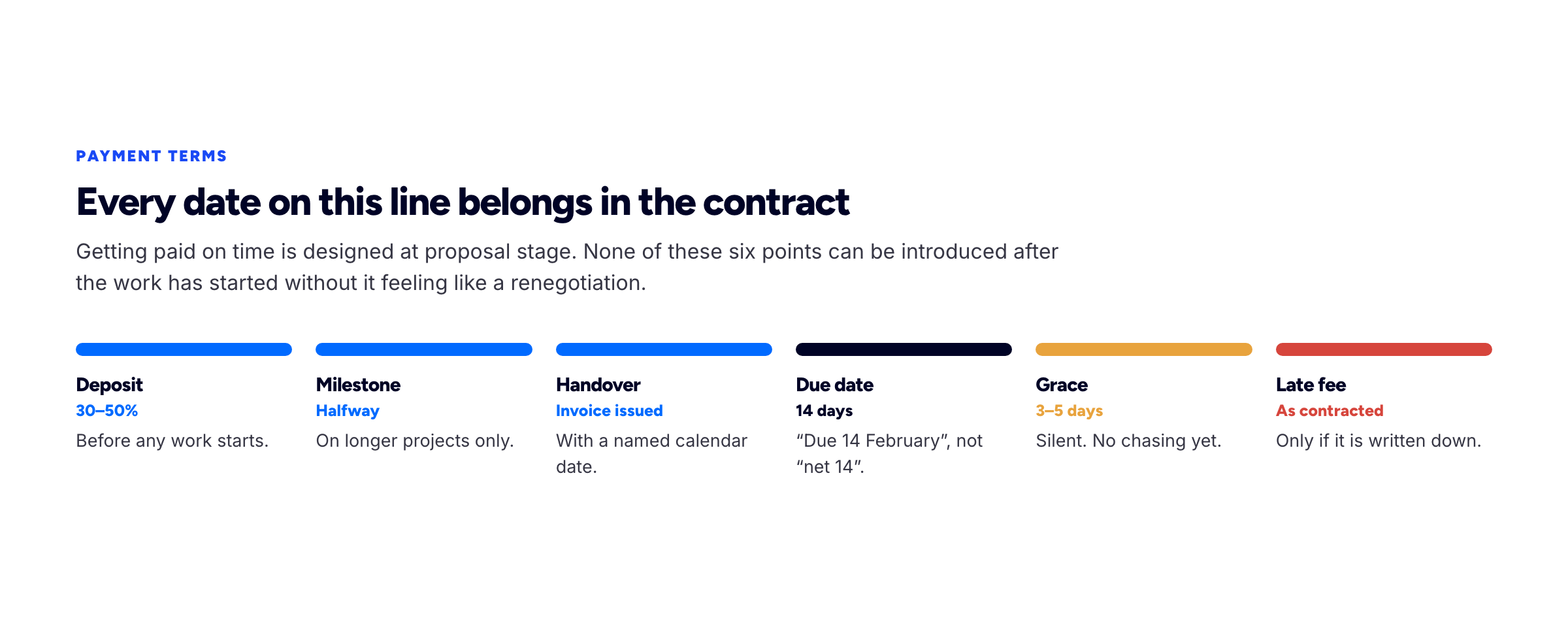
Every date on this line belongs in the contract before the work starts.
Name a real date
Write "payable by Friday 19 September 2026", not "net 14". A calendar date is unambiguous, it survives being forwarded to someone in finance who has never spoken to you, and it removes the entire category of argument about when the clock started. Put the same date on the invoice, in the covering email, and — if it matters — in the contract's payment clause.
On the length of the terms: 14 days is a reasonable default for freelance work and is what we recommend. Thirty days is common in corporate procurement and is often genuinely fixed by their system rather than chosen by your contact. Sixty days is a financing arrangement in which you are the lender, and it deserves either a higher price or a decline. If a client insists on long terms, the honest response is to price for them and to weight the schedule towards the front: a larger deposit, more milestones, less money left hanging at the end.
The grace period nobody talks about
Build in three to five days of silence after the due date before you do anything. Bank transfers take time to appear, approval queues have weekends in them, and the person you are emailing may be on annual leave. Chasing an invoice that was paid yesterday is a small, avoidable embarrassment.
The grace period is for you, not for the client — it does not appear in the contract and you never mention it. What appears in the contract is the due date and the point at which a late fee begins, which sits after the grace. Then, when the grace ends, you act immediately and without further hesitation. The freelancers who suffer most are not the ones who wait a few days; they are the ones who wait a few days, then a few more, then a month, because each delay makes the next message harder to write.
Where the terms live
In three places, saying the same thing: the proposal, so it is agreed; the contract, so it is binding; the invoice, so it is in front of the person paying. Terms that exist only in the contract are terms nobody in the accounts department will ever see.
What belongs on the invoice itself
A surprising number of "late" invoices were never actually late. They were incomplete, or sent to a person with no ability to pay them, and they sat in an inbox until someone remembered. Removing that failure mode is the cheapest improvement available. If you are still assembling invoices in a spreadsheet, our free invoice generator lays out the fields below and handles the tax and the rounding, and the PDF is produced in your own browser rather than on our server.
- A unique invoice number, sequential. Finance systems key on it, and "the invoice I sent in August" is not a reference anyone can look up.
- The issue date and the due date as a named calendar date. Both, explicitly.
- Your legal name or business name, address and any tax registration number your jurisdiction requires. This varies by country — check your own rules, because an invoice missing a mandatory field can legitimately be rejected.
- The client's correct legal entity name, not the brand. "Northfield Ltd" and "Northfield" may be different things in their system.
- A purchase order or reference number if they use them. In many companies an invoice without a PO cannot be paid at all, regardless of goodwill. Ask for the PO number before you invoice, not after.
- A line-item description that matches the contract wording. If the contract says "five page templates", the invoice says "five page templates", not "design work — phase 2".
- The amount, any tax, and the total, in the agreed currency, stated once.
- Full payment details — account name, account number, sort code or IBAN and BIC, and any reference the client should quote.
- The payment terms and late fee in one plain sentence, repeating what the contract says.
Then send it to the right person. Ask, during the project and before the first invoice, a single question: "Who should invoices go to, and is there a PO number or reference they need to quote?" Copy your day-to-day contact so they know it went, but address it to whoever actually processes it. This one habit removes a meaningful share of late payments in our experience, because those invoices were never being refused — they were simply never routed.
The late fee clause, and whether it is worth enforcing
A late payment fee is worth having in the contract, and it is worth mentioning in writing when an invoice goes past due. Whether you actually collect it is a separate decision.
A common shape, offered as something to consider rather than as a rule: interest at 1.5% per month on any overdue balance, beginning after the stated grace period, plus any costs of recovery. What is enforceable, and at what rate, depends entirely on where you and your client are based — some jurisdictions cap it, some imply a statutory rate whether or not your contract mentions one, and some treat an excessive charge as unenforceable. That is exactly the kind of question to put to someone qualified in your own country.
Three jurisdictions have particularly well-documented positions, and they are worth reading if they apply to you:
- In the UK, businesses have a statutory right to claim interest and fixed recovery costs on late commercial payments — see the government guidance on late commercial payments, which sits on top of the Late Payment of Commercial Debts (Interest) Act 1998.
- Across the EU, the Late Payment Directive 2011/7/EU sets a framework for payment periods and interest in commercial transactions, implemented differently in each member state.
- In New York City, the Freelance Isn't Free Act gives freelance workers specific rights around written contracts and timely payment — the city publishes guidance for freelance workers explaining what it covers.
Those are UK, EU and New York City specific. If you work anywhere else, none of them apply to you and you need to find the equivalent for your own jurisdiction — do not assume the shape is the same.
On enforcement, our practical position: the fee's value is mostly in existing. Naming it in a reminder changes the client's arithmetic, because "this invoice is now accruing interest" moves you from the bottom of the payment run to somewhere near the top. Actually invoicing the interest is worth doing when the sum is meaningful, when the relationship is already over, or when you are building a paper trail for a formal claim. Waiving it explicitly — "I'm not applying the late fee on this one, but I will on future invoices" — is a legitimate move once, with a client you want to keep. It is a bad move twice.
The escalation ladder
When an invoice goes past due, the mistake is not being too soft or too harsh. It is being inconsistent — three weeks of nothing, then a furious email. Escalate on a schedule you decided in advance, one rung at a time, and let each message do one job.
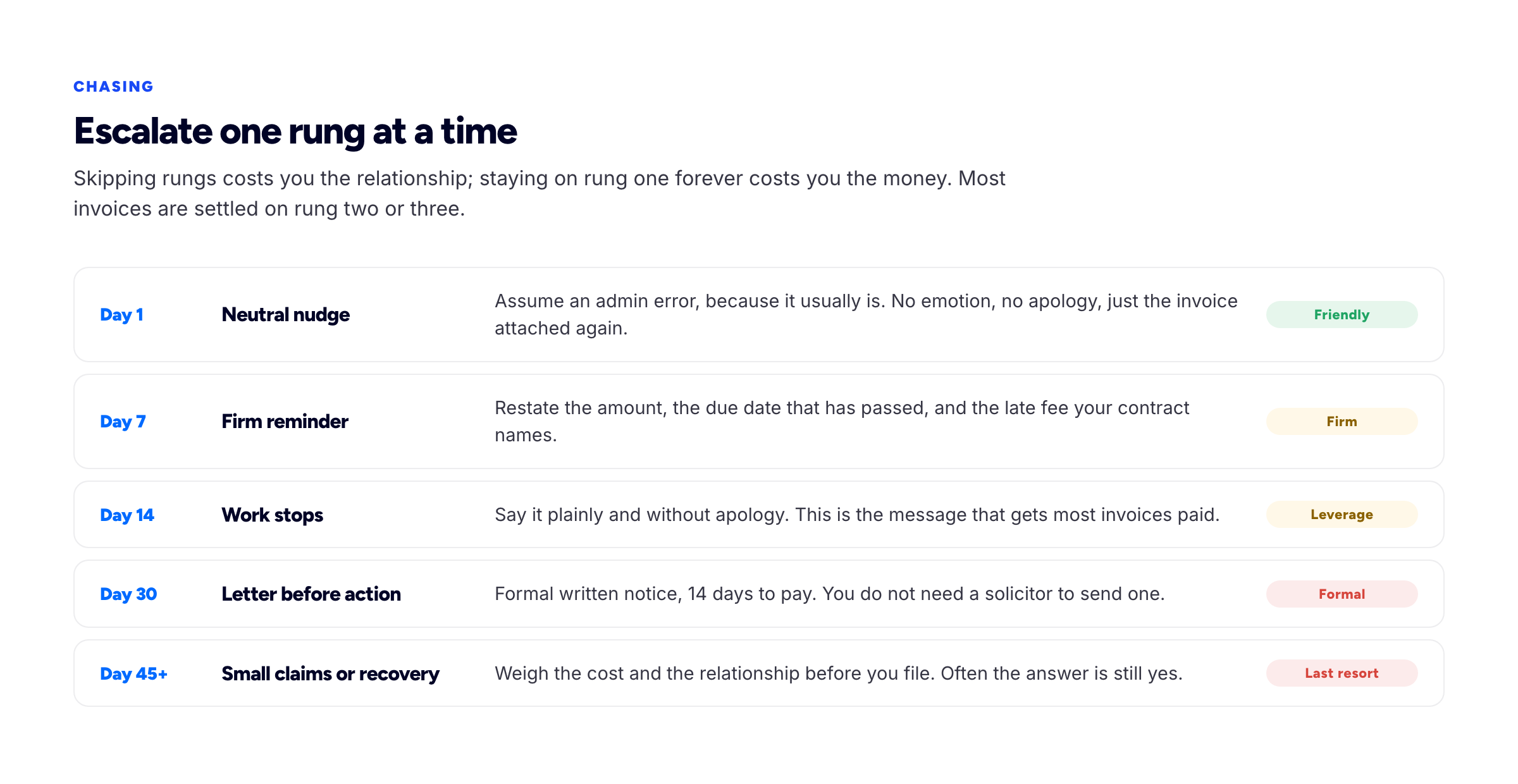
Escalate one rung at a time. Most invoices are paid on rung two or three.
Rung one — day one late: assume it is admin
Neutral, short, and written on the assumption that something went wrong in a system rather than in the relationship. Most of the time that assumption is correct.
Hi Dan — invoice 0142 (£3,200) was due yesterday, 19 September, and I haven't seen it come through. It's probably just sitting in a queue somewhere. Could you confirm it reached the right person, or forward it on if not? Copy attached. Thanks.
No apology, no "sorry to chase", no explanation of your cashflow. You are reporting a fact and asking a question with an easy answer.
Rung two — day seven: firm, with the numbers
Restate the amount, the due date and the terms, and name the late fee for the first time. Still polite, but the softening language is gone and the message is now clearly a record.
Hi Dan — following up on invoice 0142, £3,200, which was due on 19 September and is now seven days overdue. The agreed terms are 14 days from issue, with interest of 1.5% per month on overdue balances after a five-day grace period. Could you let me know today when payment will be made, or put me in touch with your accounts team directly so I can sort it out with them? Invoice attached again for convenience.
The request for a date is deliberate. "When will this be paid?" is much harder to leave unanswered than "any update?", and a promised date gives you a clean thing to hold them to at the next rung.
Rung three — day fourteen: work stops
This is the highest-leverage message in the entire sequence, and it only works if you actually stop. If the project is ongoing, downing tools converts your unpaid invoice from an accounting problem into an operational one, which is the only version their organisation reacts to quickly.
Hi Dan — invoice 0142 (£3,200) is now 14 days overdue and I haven't had a payment date. I've paused work on the remaining pages as of this morning, and I'll pick it straight back up the day the invoice clears. I'd rather not hold the launch date up over an admin issue, so if it's easier, send me the accounts contact and I'll chase it there directly.
Say it plainly and do not apologise for it. Notice what the message does not do: it does not accuse, threaten or express hurt. It states a consequence, offers to remove it immediately, and helps them solve the problem. Clients almost never argue with this message — in our experience it is the one that produces payment more often than any other, because your contact now has to explain a stalled project to their own manager.
Two conditions make it work. Your contract has to say you can pause for non-payment, which is a clause worth having. And you have to mean it — a pause you back out of after two days teaches the client that your deadlines are decorative.
Rung four — day thirty: a formal letter before action
At thirty days the friendly channel has failed and the message changes register entirely. This one is formal, addressed to the company rather than your contact, and written to be read later by someone else. Send it by email and by post if you have an address.
Dear Sirs — Invoice 0142, dated 5 September 2026, in the sum of £3,200, remains unpaid. It was due on 19 September 2026 under the terms of our agreement dated 21 August 2026. Reminders were sent on 20 September, 26 September and 3 October, and no payment or payment date has been provided. Unless payment of £3,200, together with interest and recovery costs as provided for in that agreement, is received within 14 days of the date of this letter, I intend to commence proceedings to recover the sum without further notice. I would prefer to resolve this without a claim and remain willing to agree a short payment plan if that is what is needed.
Keep the tone unemotional and the facts exact — dates, amounts, the agreement, what was sent when. The offer of a payment plan is genuine and worth including; a client with a cashflow problem will sometimes take it, and getting paid in three instalments is far better than getting paid after a claim. Note that the phrase "letter before action" and the process around it are specific to the UK — the UK guidance on making a court claim for money sets out what follows. Elsewhere the equivalent step will have a different name and different requirements, and this is the point at which a short conversation with a solicitor or local equivalent is money well spent.
Rung five — day forty-five and beyond: claim or recovery
Two routes. A small claims process, which in most countries is designed to be used without a lawyer for modest sums and is largely a paperwork exercise, or a commercial debt recovery agency, which takes a percentage and is worth it when you would rather not run the process yourself. Which is available, what the fees are, what the value limits are and how long it takes vary enormously by jurisdiction. We are not going to tell you what any court will decide, because nobody honestly can.
What we will say is that the decision at this rung is commercial, not emotional. Add up the filing fee, the hours you will spend, and the realistic chance the other side has any money at all, then compare that with the invoice. Sometimes the arithmetic says pursue. Sometimes it says write it off, and writing it off deliberately — as a decision, on a date — is much healthier than carrying it around for a year.
When to walk away, and when to pursue
Pursue when the sum is large relative to your month, when you have clean documentation (a signed agreement, a delivered scope, a paper trail of reminders), and when the client is a going concern that can actually pay. Those three together make recovery reasonably likely and the process relatively painless.
Walk away when the amount is small enough that the time costs more than the debt, when your paperwork is thin because the job was agreed on a phone call, or when the client is visibly failing and you would be joining a queue of creditors. Walking away is not weakness; it is a decision to stop spending on a bad position.
Either way, do two things before you close the file. Send one final message stating that the debt remains outstanding and that you consider the matter unresolved — it costs nothing and preserves the record. And write down, honestly, what you would need to have done differently for this not to have happened. Almost always the answer is a deposit, a written scope, or a client you should have declined.
Protecting yourself on bigger projects
The bigger the project, the more of your year is exposed to a single client's finance department. Three structural protections, all agreed at proposal stage.
Stage the payments
Never let the outstanding amount grow beyond what you can afford to lose. On a long project that means thirds or quarters tied to observable milestones — not to dates, which slip for reasons on both sides, but to things that visibly exist. "On approval of the design phase" is a milestone; "at the end of month two" is a hope. Each milestone invoice is a checkpoint: if one is not paid, you find out at 25% exposure rather than 100%.
Hold the final files until the final payment
Deliver the work, demonstrate it, let them see it in full — and transfer the source files, the production assets and the intellectual property on final payment, not before. This should be an explicit clause, phrased as a plain fact rather than a threat: ownership of the deliverables transfers on receipt of the final payment. Clients understand this instantly because it is how the rest of commerce works. The important part is that it is written down in advance; introducing it as a surprise at handover reads as hostage-taking and will cost you the relationship even if it gets you paid.
Charge a kill fee
A cancellation clause covering work done and time reserved. A common shape is that the deposit is non-refundable once work has started, plus payment for any completed phases, plus a percentage of the remaining fee if the cancellation lands inside booked time. Projects get cancelled for reasons that have nothing to do with you — a restructure, a funding round that did not close, a new marketing director — and a kill fee is what stops someone else's change of plan from emptying your month.
What to do differently with the next client
Every late payment is a specification for the next contract. The changes worth making are small and there are not many of them.
- Ask for the deposit every time, in the same plain sentence, without adjusting it for how nice the client seems.
- Put a named calendar due date on everything — proposal, contract, invoice, covering email.
- Get the accounts contact and the PO number before you invoice, as a routine question during the project.
- Include a pause-for-non-payment clause so rung three is contractual rather than improvised.
- Diarise the chase. Put the due date plus five days in your calendar the moment you send the invoice, so the first reminder is a task rather than a decision you have to summon the nerve for.
- Send the reminders on schedule, in writing, every time. Consistency is what makes you a client who gets paid rather than a client who can be deferred.
- Say no earlier. The clients who do not pay usually announce themselves during negotiation, and the cost of declining is always lower than the cost of collecting.
The other half of the answer is having enough demand that you can afford to enforce any of this. A freelancer with one client cannot pause work; a freelancer with a full pipeline can. If that is the real constraint, getting more freelance clients does more for your payment terms than any clause will.
Frequently asked questions
What do I do if a freelance client is not paying at all?
Work the ladder above on a fixed schedule rather than by feel: a neutral nudge the day after it is due, a firm reminder with the numbers at a week, a stated stop-work at two weeks, a formal letter giving 14 days at a month, and a claim or a recovery agency after that. Keep every message in writing, keep it unemotional, and decide in advance which rung is your last. The most common failure is not harshness, it is drift — weeks of vague follow-ups that never escalate.
Is it reasonable to ask for a deposit before starting work?
Yes, and it is standard commercial practice rather than a favour. Consider 30% to 50% of the project value, invoiced on acceptance and cleared before the first hour of work. Some large organisations genuinely cannot pay in advance for procedural reasons and will explain the process; a client who simply refuses without one is describing how the rest of the engagement will feel.
What payment terms should a freelancer use?
Fourteen days from issue is a sensible default for freelance work, written as a named calendar date rather than "net 14". Thirty days is normal in corporate procurement. Sixty days means you are financing your client, and should be priced accordingly or declined. Whatever you choose, put the same wording in the proposal, the contract and the invoice.
Can I charge a late payment fee?
You can put one in your contract — something like 1.5% per month on overdue balances plus recovery costs is a common shape to consider. Whether it is enforceable, and whether a statutory rate applies instead, depends entirely on your jurisdiction and your client's. UK and EU freelancers have statutory rights in this area, linked above. Everyone else needs to check locally, and this is a question for a qualified adviser rather than a blog.
Should I stop work when an invoice is overdue?
If the project is ongoing, yes — it is the most effective single step available, because it turns a finance problem into a delivery problem that someone senior has to care about. Two conditions: your contract should permit it, and you must actually stop. Say it once, plainly, offer to resume the day the invoice clears, and do not apologise.
My invoice was ignored for weeks and then paid instantly when I asked the accounts team. What happened?
Almost certainly nothing sinister. A large share of the late invoices we hear about were never routed — sent to a project contact with no authority to pay, missing a PO number their system requires, or naming the wrong legal entity. Ask for the accounts contact and the reference before you issue the first invoice, and address the invoice there with your day-to-day contact copied in.
How we put this guide together
This is practitioner guidance, not legal advice. Bunfolio builds portfolio sites for freelancers, so the vantage point here is the working end of the problem — the terms people put in proposals, the invoices they send, and the messages they cannot bring themselves to write. Nothing above should be treated as a statement of your legal position, and none of it can tell you how a dispute would be decided. Payment law differs by country, by contract and sometimes by the sector you work in, so take advice from someone qualified where you actually work.
The primary sources we have linked are the ones we could verify and are deliberately few: the UK government's guidance on late commercial payments and the Late Payment of Commercial Debts (Interest) Act 1998 behind it, the UK guidance on making a court claim for money, the EU Late Payment Directive 2011/7/EU, and New York City's guidance for freelance workers under the Freelance Isn't Free Act. Those cover the UK, the EU and one US city, and nowhere else. If you are outside those places, treat them as illustrations of the kind of protection that may exist rather than as rules that apply to you.
Everything else here — the 30% to 50% deposit, 14-day terms, the five-day grace period, the 1.5% monthly late fee, the five-rung escalation schedule and the example messages — is our recommendation, offered as judgement so you can weigh it as such. The invoice numbers, sums, dates and client names in the examples are invented; they are there to show the shape of a message, not to report on a real engagement.
We have deliberately avoided late-payment statistics. Confident percentages about how many freelancers are paid late, and how late, circulate widely on this topic, and most of them cannot be traced to an identifiable study of freelance invoices. Repeating them would make this guide less trustworthy rather than more, so where we describe what is common we say plainly that it is the pattern we see.
Related reading: writing a freelance proposal that wins, where the payment terms get agreed in the first place, how much to charge as a freelancer, and freelance client red flags for spotting the client who will not pay before you sign anything.
More from the blog

October 5, 2026 · 16 min read
How to Become a Freelance Photographer: From Good Photos to Paid Work
A practical path from "I take good photos" to paid freelance work: choosing a niche, the kit you actually need, and building a portfolio before you have clients. Plus the business basics photography a...
July 30, 2026 · 22 min read
How to Get Your First Freelance Clients
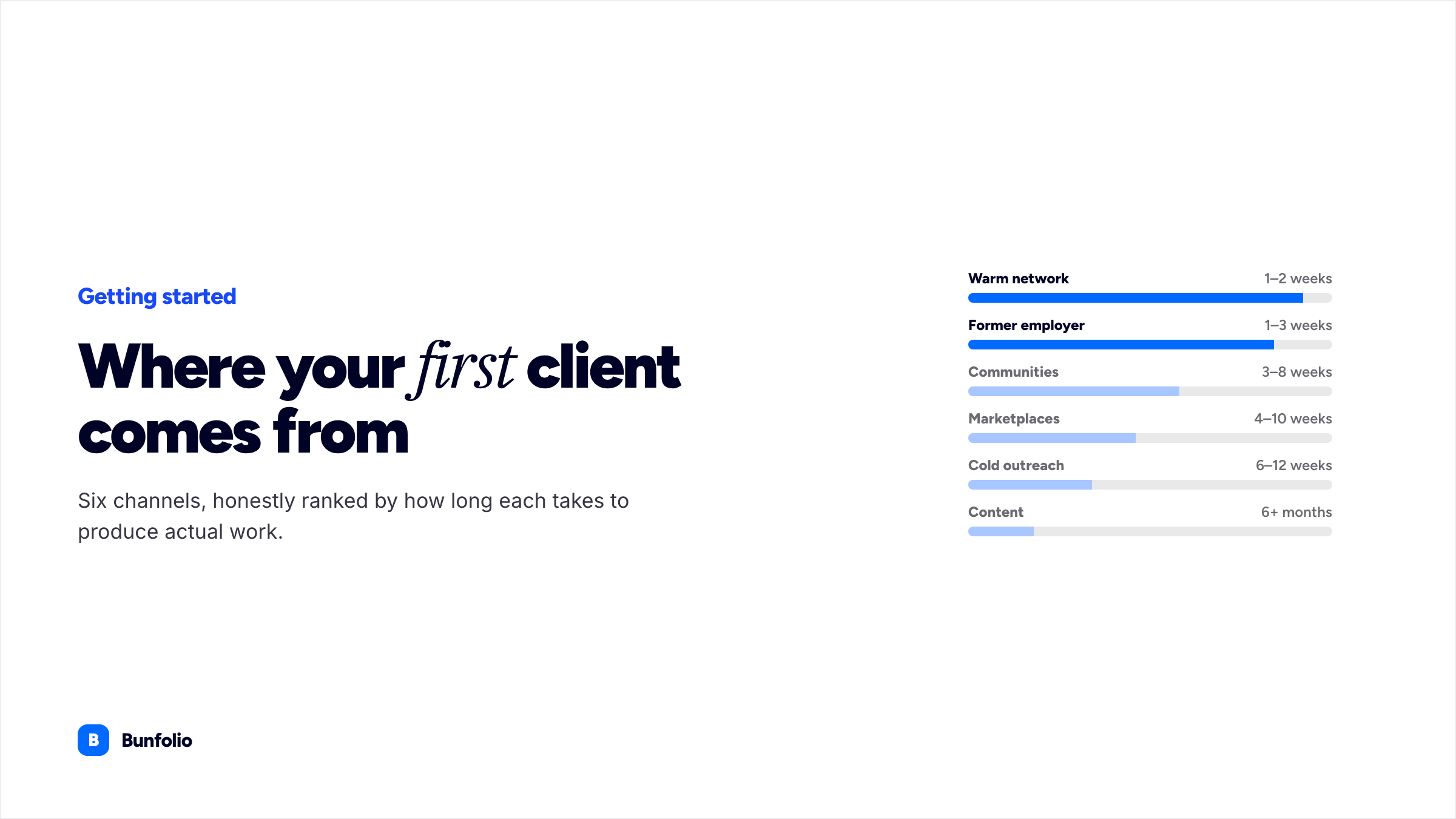
Six channels ranked by how fast each one realistically produces work, cold outreach that earns a reply, and how to turn a first job into the evidence that wins the second.
September 30, 2026 · 16 min read
What Is Freelancing? A Plain-English Guide to Freelance Work
Freelancing is selling a skill to several clients one job at a time instead of working for one employer. How a freelancer differs from an employee, contractor or gig worker, one freelance job from enq...