
August 18, 2026 · 31 min read
Freelance Client Red Flags: What to Check Before You Sign
Most warning signs are an inexperienced buyer rather than a bad one. Which ones a single conversation fixes, which ones mean walk away, and how to decline without burning the relationship.
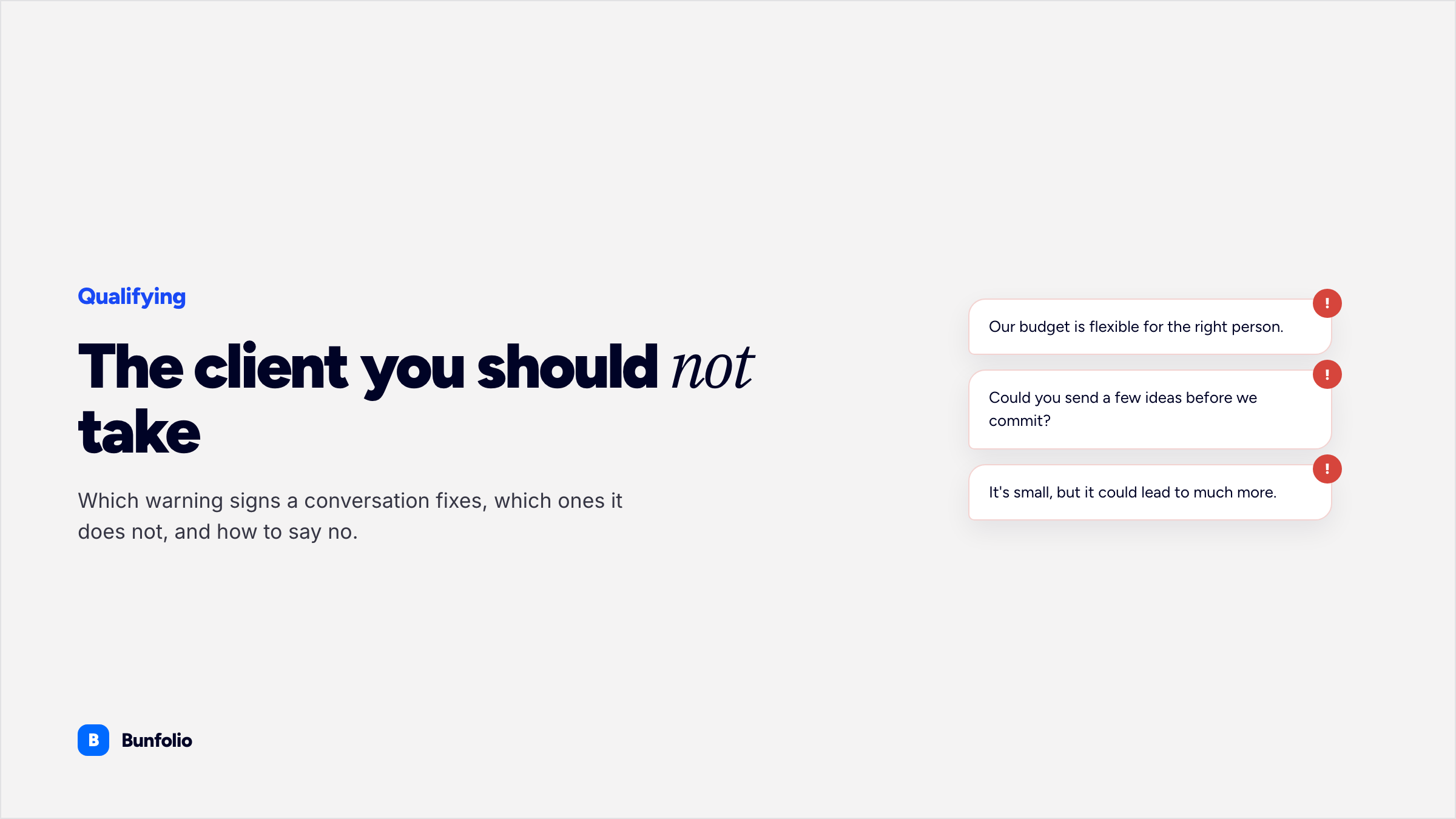
Almost everything written about bad freelance clients is written in the wrong mood. It is a vent — a list of horror stories, a catalogue of people who did not pay, an implied moral that clients are adversaries to be defended against. It is satisfying to read at eleven at night after a difficult call, and it is close to useless the next morning when you have a real enquiry in front of you and have to decide what to do about it.
The useful skill is narrower and harder than pattern-matching for villains. Most of the things that look like freelance client red flags are not signs of a bad person. They are signs of someone who has never hired a freelancer before and does not know how it is supposed to work — and that is a solvable problem, usually solvable in a single honest conversation. A much smaller number of signals are structural: they describe a project that will go wrong regardless of how nice everyone is, because of how the money, the authority or the decision-making is arranged. Those you decline.
This guide is about telling the two apart. It covers why a bad-fit project costs far more than it appears to on the invoice, what separates an inexperienced buyer from a genuinely bad one, six things clients say early in a conversation and what each usually means, the discovery questions that surface trouble before you have written anything, how to decline gracefully — with scripts — how to leave a project that has already started, and the red flags you might be showing, because a difficult project almost always has two contributors.
Why a bad-fit project costs more than it looks like it costs
The obvious cost of a bad client is the one people talk about: the unpaid invoice, the eleventh revision, the weekend lost to a deadline that moved. Those are real, but they are not the expensive part, and they are not what should drive the decision.
The expensive part is what the project displaced. A freelance practice has a fixed number of working days in it. A project that occupies six weeks of them is not competing against doing nothing — it is competing against every other project you could have taken in those six weeks, including the ones that never reached you because you were too busy to look for them. That is the cost that never appears anywhere. There is no line on the invoice that reads "the client I could not take in April".
There is a second displaced cost, less obvious and more corrosive. A project that is going badly consumes attention outside its own hours. You think about it in the shower. You reread the last email before you go to sleep. You are worse at the other work you are doing that month, and you do not send outreach, because sending outreach requires believing the next client will be better than this one. A bad project taxes the pipeline as well as the calendar.
Set against all that, the cost of declining is remarkably small — one awkward message, and the possibility that you were wrong about a project that would have been fine. In our judgement, freelancers systematically overrate the first cost and underrate the second. The bar is not "could I survive this project". It is "is this the best use of six weeks I will never get back".
One caveat worth stating plainly, because it is the reason most of this advice is easier to give than to take. When you have no pipeline, saying no is close to impossible, and telling someone with an empty calendar to hold out for better work is glib. The real fix for that is upstream — a steady enough flow of enquiries that any single one can be refused. If that is where you are, our guide to getting your first freelance clients is the more useful piece to read first. Filtering is a luxury built on top of a pipeline, and it is worth being honest about that order.
Inexperienced buyer, or bad client?
This is the distinction the whole guide rests on, so it is worth drawing carefully.
Most people who hire freelancers do it rarely. A founder might commission a website twice in a decade. An office manager might be asked to "find someone" for a project nobody in the building has ever run. They do not know what a brief looks like, they do not know what things cost, they have not thought about who signs off the work, and they will make requests that seem outrageous to you and perfectly reasonable to them — because nobody has ever told them otherwise.
An inexperienced buyer behaves badly out of ignorance, and the diagnostic is what happens when you explain. You say that starting without a defined scope tends to produce a project neither of us can finish, and you propose a paid discovery phase instead. An inexperienced buyer says something like "that makes sense, I didn't know that was a thing". A bad client argues, or agrees and then behaves exactly as before.
That is the test, and it is nearly the whole test. Give the client one clear, non-defensive explanation of how you work and why, and watch what they do with it. Someone who updates their behaviour when given new information is a person you can work with, whatever they said in the first email. Someone who does not is telling you what the next eight weeks will contain.
A bad client, in the sense that matters here, is not usually a monster. They are someone whose situation makes a good project structurally impossible: there is no money and they know it, or there are four people who each believe they are the decision-maker, or their expectations were formed by a previous freelancer who agreed to everything and then quietly went under. You can be sympathetic to all of that and still decline it. Declining is not a moral verdict on the person. It is a statement that this particular arrangement will not work.
Two practical consequences follow. First, do not decline on the first sentence of the first email — most enquiries are written badly, and a bad email is very weak evidence. Second, do not stay in a project on the theory that the client will settle down once work starts. Behaviour before money changes hands is the best behaviour you will see.
Six things clients say early, and what they usually mean
These are the six lines that come up most often in the enquiries we hear about. Four of them can be fixed with a conversation. Two of them cannot.
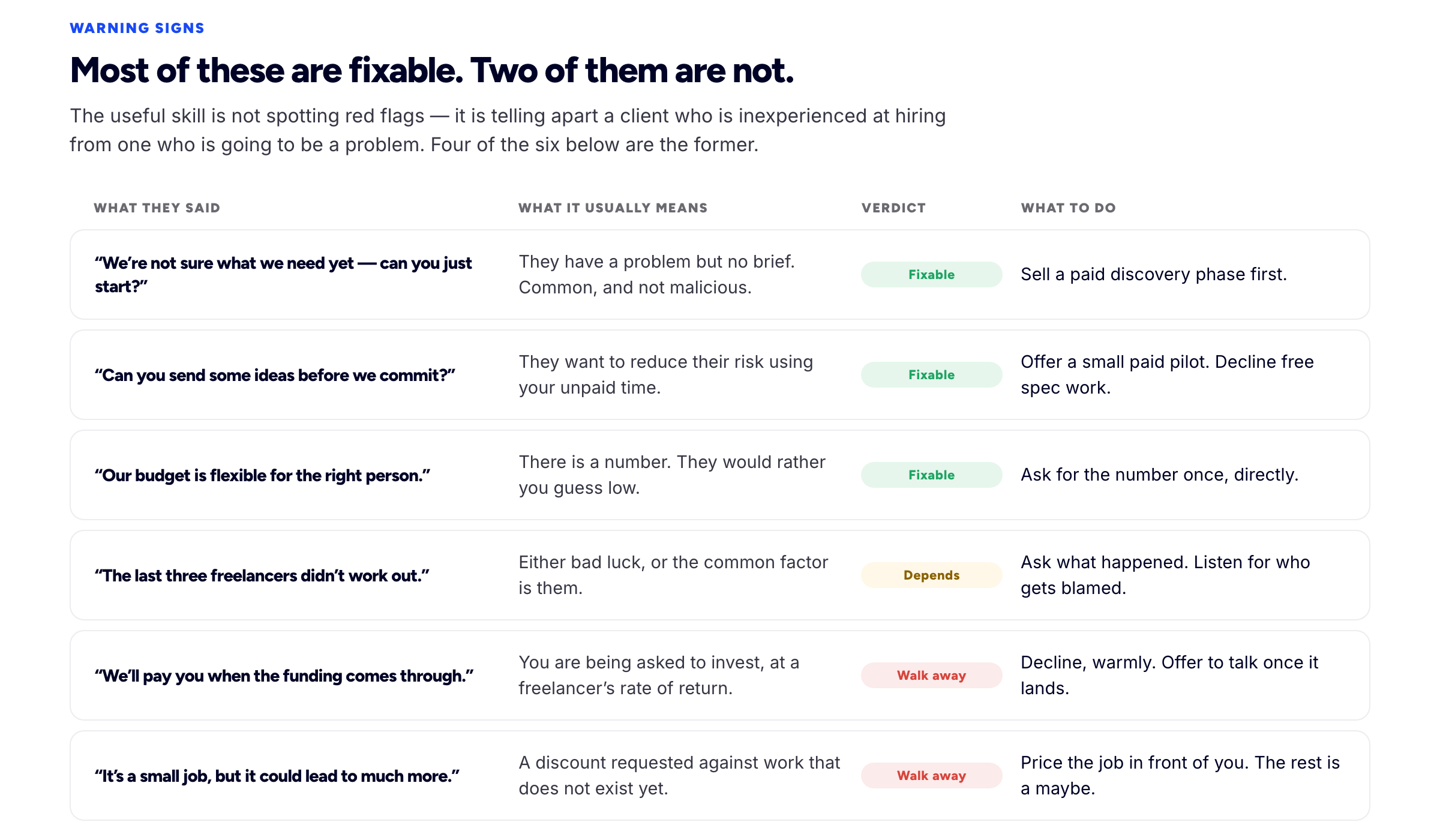
Most of these are fixable. Two of them are not.
"We're not sure what we need yet, can you just start?"
This sounds like chaos and is usually just honesty. The client has a problem they can feel and cannot articulate, which describes most people who commission work. The mistake is to treat it as a reason to walk, and the equal and opposite mistake is to start.
Starting work on an undefined scope means you will define the scope for free, in your own time, while being judged on output. Nothing about that ends well. The fix is a paid discovery phase: a fixed, small, separately-priced piece of work whose deliverable is the definition of the project. A week, a fixed fee, and at the end of it a written scope, a recommendation and an estimate — which they own, and can take elsewhere if they want to.
Offering this does two things at once. It solves their actual problem, which is that they cannot brief you. And it is a cheap test of seriousness: a client who will pay a modest amount to find out what they need is a client with a budget and a real intention. One who refuses on the grounds that scoping should be free has told you how they view your time, which is useful to know now rather than in week five.
"Can you send some ideas before we commit?"
This one splits, and the split matters. Wanting evidence before spending money is entirely reasonable — you would want the same. The question is what form the evidence takes.
If they want to see relevant work, a reference, a walkthrough of how you approached a similar problem, or a conversation where you think aloud about their situation for half an hour, give them all of it generously. That is not spec work, it is selling, and being good at it is most of the job.
If they want deliverables — three homepage concepts, a sample chapter, a strategy outline, a working prototype — that is unpaid production, and the fact that it is framed as part of a competitive process does not change what it is. Decline that part specifically rather than the client generally. The graceful version is a counter-offer: a paid pilot. One small bounded piece of the real project, priced properly, delivered properly, with no obligation on either side afterwards. Many clients say yes to that immediately, because what they wanted was risk reduction and the pilot gives them more of it than three speculative concepts would. The ones who insist on free work were never going to be a good arrangement, and you find that out for the price of one email. There is a short list of related warning signs in our guide to writing a freelance proposal that wins, which covers when a brief is not worth writing a proposal for at all.
"Our budget is flexible for the right person"
Almost always this means one of three things: they genuinely do not know what this costs, they have a number and are worried you will price up to it, or there is no number at all. All three are fixable, and the fix is the same — ask once, directly, without apology.
"To make sure I don't waste your time, what range have you set aside for this?" is a normal professional question, and asking it does not make you grasping. If they name a range, you now know whether to continue. If they say they would rather hear your number first, give one — a range with a reason attached — and watch the reaction. A client who has a budget will react to a number. A client who has nothing will keep the conversation abstract.
What turns this from a fixable signal into a real problem is repetition. Ask twice, get evasion twice, and you are almost certainly being used to establish a market price. Knowing your own floor before this conversation starts is what makes it easy to hold; our guide to how much to charge as a freelancer covers working that number out from real costs rather than from a forum thread.
"The last three freelancers didn't work out"
This is the genuinely ambiguous one, and it deserves a real question rather than a reflex. Freelancers do disappear. Agencies do overpromise. Some clients have had a legitimately terrible run, and they are often the most appreciative people you will ever work for, because they know what the alternative looks like.
So ask, plainly: what happened? Then listen to the structure of the answer rather than the content. Someone who says "the first one ghosted us, the second was fine but we ran out of money, and honestly the third went wrong because we kept changing our minds" is describing a mixed record including their own contribution, and that is a good sign. Someone for whom all three were incompetent, unresponsive and difficult — with no version of events in which the client did anything — is showing you the seat you are about to sit in.
The other thing to listen for is whether they have drawn any conclusion. A client who says "we've realised we need to be much clearer up front, which is why I've written this brief" has learned something. A client repeating the same process for the fourth time and expecting a different result has not.
"We'll pay you when the funding comes through"
Walk away. Not because the client is dishonest — they may be entirely sincere, and the funding may well arrive — but because the arrangement asks you to take equity-shaped risk for fee-shaped money. If the round closes, you get paid what you would have been paid anyway. If it does not, you have donated the work. There is no version of that trade in which you are compensated for the downside.
The same applies to its variants: when the client's own client pays, when the campaign launches, when the quarter clears. Each is a way of making you an unsecured creditor of a business you cannot see the books of.
There is a version that is not a walk-away, and it is worth naming so you can offer it. Wait until the money exists. "I'd genuinely like to do this — let's book it in once the round has closed, and I'll hold a slot for you in the meantime." That is a real answer, it costs you nothing, and clients who were serious frequently come back. If you do proceed with anyone whose cash position worries you, do it with a deposit large enough that abandonment is survivable and staged payments tied to dates rather than milestones — the mechanics are in how to get paid on time as a freelancer.
"It's a small job, but it could lead to much more"
Walk away from the framing — not necessarily from the job. This distinction is the useful one and it gets lost in most advice on the subject.
Small jobs are good. Small jobs are how most long client relationships start, and a bounded first project is a sensible way for two strangers to find out whether they can work together. There is nothing wrong with the work.
What is wrong is the trade being proposed. "It could lead to more" is an invitation to discount the present job against future work that has not been defined, agreed or promised, and which the person saying it frequently does not have the authority to award. If the future work is real, it will happen because the first job went well, and it will be priced then. If the only way the sentence functions is to justify a lower price now, it is not a forecast, it is a negotiating tactic.
The response is cheerful and short: "Happy to start small — that's usually the best way. This piece is £X either way, and if it goes well we can talk about what's next." Clients who meant it well are unbothered. Clients who were leaning on it as leverage reveal themselves immediately, and you have lost nothing.
The discovery call is your filter
Most of what you need to know is available in one thirty-minute conversation, if you ask questions about how decisions get made rather than only about what the client wants built. Four questions do most of the work.
"Who signs this off?" Ask it early and ask it literally. You are looking for one name. The answer "well, it depends" is the beginning of a longer conversation you need to have now rather than in week four.
"What happens if we disagree?" This sounds confrontational and lands as thoughtful, because it is a question almost nobody asks. You are looking for evidence that they have considered it — that there is a person whose view decides, or a way of resolving a split. A client who answers "I suppose we'd talk about it" is fine. A client who cannot imagine disagreement is telling you they expect an order-taker.
"What does done look like?" Ask them to describe the moment the project is finished and what has to be true for that to happen. A specific answer — the new site is live before the conference, the report is with the board on the 14th — gives you a scope boundary you can write down. A vague answer — "when we're happy with it" — is not a red flag by itself, but it is an instruction to define done yourself, in writing, before you start.
"Has anyone tried this before?" The most under-used question in freelancing. Previous attempts explain constraints that would otherwise look arbitrary, surface the internal politics that killed the last version, and occasionally reveal that the real obstacle is not the one you were hired to solve. It also flushes out the "last three freelancers" conversation naturally, without you having to raise it.
You are not interrogating anyone. These are questions a careful professional asks, and asking them is itself a demonstration of how you work — which is why the same call that filters bad projects also wins good ones. The proposal guide has the full discovery structure, since the answers are what a proposal is made of.
No single decision-maker is the strongest warning sign there is
If we had to keep one signal and discard the rest, it would be this one. In our experience it predicts a painful project more reliably than a low budget, a tight deadline, a bad brief, or a client who has been rude in an email.
The reason is structural. When two or more people have effective veto power and no one has final say, the work cannot converge. Every round of feedback contains contradictions you are not permitted to resolve, so you are pushed into arbitrating between colleagues — a role you have no standing in and cannot win. Revisions multiply not because the work is wrong but because there is no mechanism for it to be right. Meanwhile the deadline holds, because deadlines are set by circumstances and not by consensus.
The tells are easy to spot once you look. Feedback arrives as a forwarded email chain with three people's comments and no reconciliation. The person you speak to keeps saying "I'll need to check with". A decision made on Tuesday is reopened on Friday by someone who was not on the call. Your contact apologises for their colleagues.
This is often fixable, which is why it belongs in the conversation category rather than the walk-away one — but it has to be fixed before you start, not diagnosed afterwards. Name it neutrally as a process requirement: you need one named approver who consolidates feedback, and you will work from a single consolidated list per round rather than from individual replies. Put it in the proposal as a condition, in the same tone as the delivery dates. Clients agree to this far more often than freelancers expect, because internally they usually know it is a problem. The ones who cannot produce a single name — because the founder will overrule anyone, or because two departments are fighting a proxy war through your project — have answered your question. That is a project to decline, and it is worth saying that you can decline it without blaming anyone.
Exposure, equity, and the great portfolio piece
Every freelancer meets the payment-in-something-other-than-money conversation. It is worth having a settled position on it so you are not improvising under social pressure.
Exposure. The offer is visibility — a credit, a mention, an audience. Treat it as what it is: a claim about a benefit, made by the person who benefits from you believing it. Occasionally it is true, and when it is true it is specific and verifiable. If someone can tell you exactly what the placement is and you can independently see that their audience is your buyers, you can weigh it as a marketing decision. What you cannot do is bank it. The test is simple and can be asked out loud without rudeness: if the exposure does not materialise, would this still have been worth doing? If not, it is not payment.
Equity. Different, and not automatically a bad deal — but it is investing, not freelancing, and it should be evaluated as an investment. That means a real stake in a real entity with paperwork, a vesting arrangement, and an honest assessment that you may well receive nothing. Equity as a discount on a fee, with the paperwork to follow, is not equity. If you want to take a bet on a company, take it deliberately, in writing, and size it as you would any other bet.
"It'll be a great portfolio piece." The most seductive of the three, because it is sometimes true, and because ambitious work is genuinely valuable early in a career. The problem is that you cannot verify it in advance. A project only becomes a portfolio piece if it is finished, if it is good, if you are permitted to publish it, and if the client does not quietly redesign it three months later. Every one of those depends on the client, and the same client who cannot pay for the work is often the one who cannot make decisions well enough to let it become good. If you decide to take a below-rate project for portfolio reasons, do it as a deliberate investment — with a defined scope, a written publication right agreed at the start, and a hard end date. The mechanics of doing this well are in getting your first freelance clients.
How to decline without damaging anything
The reason freelancers dread declining is that they imagine it as rejection. It is not. It is a routine scheduling and fit conversation, and it goes well nearly every time — as long as you are quick, brief, and free of explanation.
The three rules underneath every good decline:
- Answer fast. A same-day no is a kindness. A no that arrives after eight days of silence has cost the client a week they needed.
- Do not over-explain. A reason is polite; a paragraph of justification invites negotiation and sounds like an opening position. One sentence of reason is the right amount.
- Decline the work, not the person. Nothing you say should imply the project is beneath you, the budget is insulting, or the client has behaved badly — even when all three are arguably true.
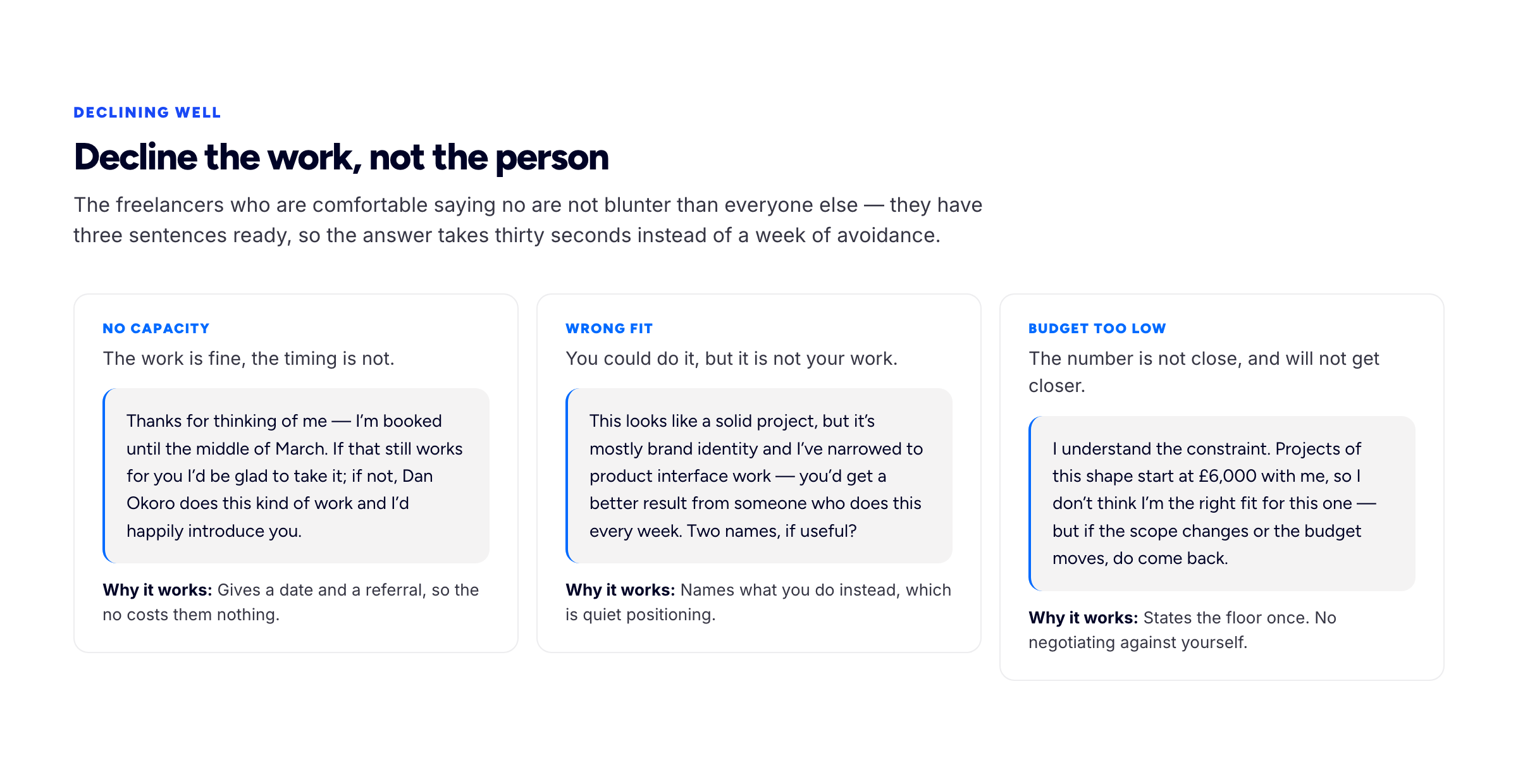
Decline the work, not the person. You will meet them again.
No capacity
The easiest one, and the one where a small addition changes everything. Do not stop at unavailable — give them a date or give them a name, so the message ends with something they can act on.
Hi Marta — thanks for thinking of me. I'm booked through to the middle of October, so I can't take this on in your timeframe. If the date is movable I'd be glad to look at it from the 20th. If not, Owen Reilly does very similar work and I'd happily introduce you — just say the word.
Note that this is not a soft no. It is a hard no with two doors in it, and clients routinely take one of them. Offering a date also tells them you are in demand without you having to say so.
Wrong fit
Use this when the work is outside what you do well, or in a domain you would be learning on their money. Say what you do instead — that is the sentence that makes the message useful rather than merely negative — and refer on if you can.
Hi Sam — I've had a proper look and I'm going to pass on this one. Most of my work is front-end build on existing designs, and what you need is someone who can own the brand and design direction from scratch; you'd get a better result from a specialist. Two people I'd trust with it are below. Do come back to me when the build stage arrives — that part is squarely what I do.
Declining out of fit is the single most underrated reputation move available to a freelancer. It signals that you know the edges of your competence, which makes everything you do claim more credible, and clients remember it. A meaningful share of referrals come from projects that were turned down.
Budget too low
The one people handle worst, usually by apologising, over-explaining, or immediately proposing a reduced scope at a reduced price to avoid losing the lead. State your floor once, do not negotiate against yourself, and leave the door open.
Hi Jonah — thanks for the detail, that's a clear brief. A project of this shape sits at around £4,000 for me, so we're some way apart and I don't think I can do it justice at £1,200 — you'd get a rushed version of the wrong thing. No hard feelings at all. If the budget changes, or if there's a smaller first piece worth doing on its own, I'm glad to talk.
Three things that message does. It names a number, so they can act on it if the budget was softer than stated. It gives a reason grounded in their outcome rather than your worth, which is much harder to argue with. And it declines without shutting anything down. Offering a genuinely smaller first piece is fine; quietly doing the same work for a third of the money is not, and it is how freelancers end up resenting a client who did nothing wrong except accept a price that was offered.
What not to do
Do not go quiet. Ghosting an enquiry is the one version of declining that actually damages your reputation, and it is the most common. Do not lecture the client about industry rates or about what design is worth. Do not accept the project while flagging your reservations in the hope the client will fix them; a proposal is not the place to negotiate whether you want the job. And do not decline by pricing high in the expectation they will refuse — sometimes they say yes, and now you are doing the project you did not want at a price you did not think about.
Leaving a project that has already started
Sometimes the signals only appear after the work begins. Leaving mid-project is a serious step and it is occasionally the right one — a project that is going to fail is cheaper to leave in week two than in week nine.
Before you go, give it one honest attempt. Name the specific problem in writing, propose the specific change, and say what happens if it does not change. Most mid-project trouble is a process failure that survives only because nobody has said it out loud: feedback arriving from four people, scope growing weekly, an approver who never appears. A message that says "we've had three rounds of contradictory feedback and I don't think we can finish this way — can we agree that Priya consolidates and signs off, from this round on?" resolves a surprising number of these. If it works, you have saved the project. If it does not, you have documented that you tried.
If you do exit, exit like a professional. Give notice rather than stopping. Hand over everything you have produced, in a usable state, with a written note of where things stand and what a successor needs to know. Settle the money cleanly — invoice for completed work, and if the position is genuinely ambiguous, be slightly more generous than you have to be, because the cost of the argument exceeds the sum in dispute. Keep the reason short and factual: the project has moved away from what you can deliver well, and it is better to stop now than to deliver something neither party is happy with. Do not use the exit to explain everything the client did wrong, however much you want to. You are buying a clean ending, and that is worth more than being understood.
The red flags you might be showing
A difficult project usually has two contributors, and any guide to spotting bad clients that does not include this section is selling you a comfortable story. Some of what gets filed under "difficult client" is a client responding rationally to a freelancer who is hard to work with. Worth asking honestly whether any of these are yours.
- You do not confirm anything in writing. If the scope, the price and the dates live only in a conversation, then the client's later "I thought that was included" is not dishonesty, it is a genuine difference of memory that you had the power to prevent.
- You are slow to reply and quick to be annoyed. Clients chase because they do not know what is happening. A short status message on a fixed day removes most chasing, and its absence causes most of it.
- You agree in the meeting and disagree afterwards. Saying "that should be fine" to avoid friction on a call, then treating the request as scope creep when the invoice comes, is a freelancer-caused problem with a client-shaped label on it.
- You take work you cannot do, expecting to learn on the way. Ambition is fine; billing someone for your education without telling them is not. The project gets slow, the client gets frustrated, and the story afterwards is about how unreasonable they were.
- You have never said no, so you are always slightly overcommitted. Every client of an overbooked freelancer gets a diminished version of them, and each of those clients will reasonably conclude that they were let down.
- You price from fear and then resent the number. A quote you did not believe in when you sent it becomes a grievance you carry through the project — and the client, who accepted the price you asked for, has no idea.
- You do not say when something has gone wrong. A slip disclosed early is a scheduling problem. The same slip disclosed on the deadline is a trust problem, and it is the one clients remember.
None of this means bad clients do not exist. It means the filter you are building should be pointed in both directions, and that the fastest improvement available to most freelancers is not better clients but a tighter process — written scope, fixed check-in rhythm, one named approver, terms that were agreed before work began.
Turn each bad project into a filter, not a grudge
The point of all of this is not to accumulate stories. It is to change the process so that the same project cannot reach you twice.
After a project that went badly, sit down while it is still fresh and answer three questions. What was the earliest moment I could have known? What did I see and explain away? What would I have had to ask to find out sooner? The answer is almost always a specific, unglamorous thing — you never established who signed off, you never asked what happened with the previous freelancer, you accepted "the budget is flexible" without pressing, you started before the deposit landed.
Then convert the answer into a rule that runs automatically, so it does not depend on you being alert at the wrong moment. A required question in every discovery call. A clause in the proposal template. A deposit that must clear before the calendar is blocked out. A named approver written into the scope. Over a few years this accumulates into a filter that quietly does most of the work, and it stops you having to make a fresh judgement under social pressure every time.
What it should not become is a general suspicion of clients. Cynicism reads through everything you write, and it costs you good projects to avoid bad ones — a trade that is worse than it feels, because good clients are rarer than bad ones and much easier to lose. The freelancers who are best at this are conspicuously warm to everyone and quietly rigorous about process. Both halves matter, and the process is the half that does the protecting.
One last practical note. Much of your filtering happens before anyone contacts you, through what your site says about the work you do and the way you do it. A page that is specific about your discipline, your process and the kind of project you take receives fewer enquiries and better ones. If you do not have that page yet, Bunfolio will give you a free portfolio site on your own subdomain in an evening — sign in with Google, import your LinkedIn profile to pre-fill the sections, edit what is wrong, and publish. The tool matters much less than being explicit; the enquiries you never have to decline are the cheapest ones to filter.
Frequently asked questions
What is the single most reliable freelance client red flag?
No single decision-maker. A project where two or more people hold veto power and nobody has final say cannot converge, regardless of how pleasant everyone is, how healthy the budget is or how clear the brief looks. It is often fixable — insist on one named approver and consolidated feedback as a written condition before you start — but a client who genuinely cannot produce that name is describing a project we would decline.
How do I tell an inexperienced client from a bad one?
Explain once, clearly and without defensiveness, how you work and why — then watch. Someone inexperienced updates their behaviour and is often grateful for the guidance, because nobody has ever explained it to them. Someone bad argues with the explanation, or agrees and then carries on exactly as before. The response to information is the diagnostic, not the original request.
Should I ever work for exposure or equity?
Exposure is not payment unless it is specific, verifiable and genuinely aimed at your buyers, and even then it should be weighed as a marketing spend rather than banked as income. Equity can be a reasonable deal, but it is an investment decision — real paperwork, a real entity, and a clear-eyed acceptance that it may be worth nothing. Equity offered as a discount on a fee, with documents to follow, is not equity.
How do I say no to a client without burning the bridge?
Reply quickly, give one sentence of reason, and end with something the client can act on — a date you are free, a referral, or your actual number. Decline the work rather than the person, and never let a no become silence. Ghosting an enquiry is the only common way of declining that reliably damages your reputation.
Is a low budget always a red flag?
No. A small budget honestly stated is just a constraint, and it can produce a good small project. What matters is whether the budget and the expectations match: a modest number attached to a modest scope is workable, while a modest number attached to an ambitious scope is a project that will fail and be blamed on you. The genuine warning sign is not a low number, it is a refusal to name one after you have asked twice.
Can I leave a freelance project after it has started?
Yes, and occasionally you should, but only after one documented attempt to fix the specific problem — most mid-project trouble is a process failure that survives because nobody named it. If you do leave, give notice rather than stopping, hand over usable work with a written status note, invoice only for what you completed, and keep your reason short and factual. A clean ending is worth more than being understood.
How we put this guide together
Bunfolio builds portfolio sites for freelancers, which puts us in regular contact with people at the point where enquiries arrive and decisions about them get made. The advice above comes from that vantage point — from what freelancers tell us about the projects that went wrong, from the enquiries they show us and ask what we would do, and from reading a great many portfolio pages written by people trying to attract better work than they have been getting.
It is practitioner judgement, not research. The framing that runs through it — that most red flags are inexperience rather than malice, and that the useful test is what a client does with a clear explanation — is our view, and we have tried to phrase it that way rather than as a finding. The example messages are invented; the situations they describe are common, but the names and numbers are not drawn from real clients.
We have deliberately not quoted statistics. There is a large circulating body of confident percentages about difficult clients, unpaid invoices and project failure rates, and very few of them trace back to an identifiable primary source. Repeating them would make this guide look more authoritative and be less trustworthy. Where a claim here is not sourced, it is presented as our opinion, and it should be weighed as one — your own experience of which signals predict trouble is better evidence for your practice than anything we can tell you.
More from the blog
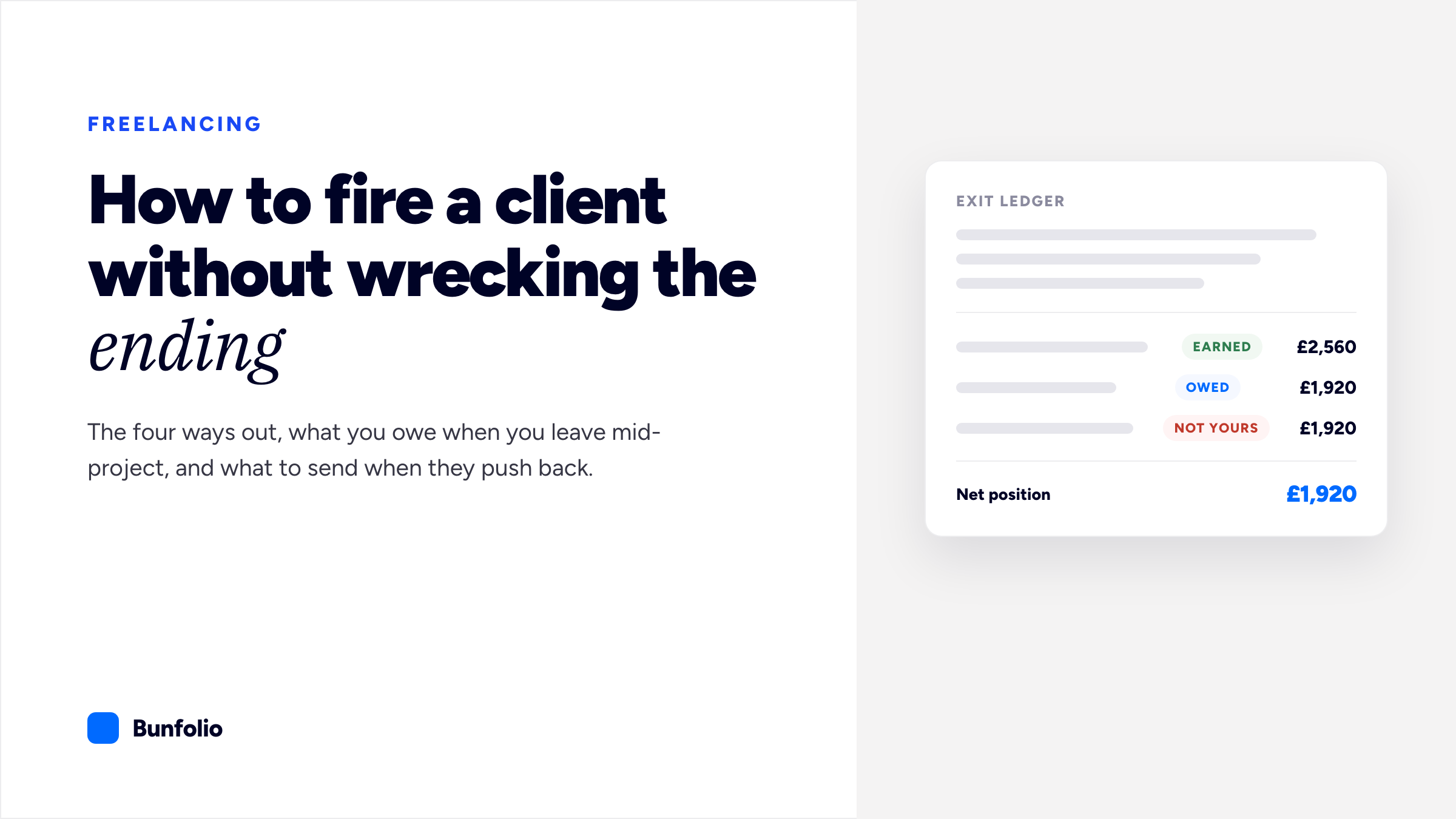
September 13, 2026 · 32 min read
How to Fire a Freelance Client Without Wrecking the Ending
Most advice stops at the first email. The hard parts are either side of it: working out whether you are leaving or just tired, knowing what you owe and what you are owed at the moment you stop, and ha...

August 30, 2026 · 17 min read
Freelance Scope Creep: How to Catch It Before It Costs You
Scope creep is rarely one big demand — it is six small reasonable requests you never priced. The clauses that prevent the argument, and the exact messages to send when a client asks for more.
October 5, 2026 · 16 min read
How to Become a Freelance Photographer: From Good Photos to Paid Work
A practical path from "I take good photos" to paid freelance work: choosing a niche, the kit you actually need, and building a portfolio before you have clients. Plus the business basics photography a...