
August 30, 2026 · 17 min read
Freelance Scope Creep: How to Catch It Before It Costs You
Scope creep is rarely one big demand — it is six small reasonable requests you never priced. The clauses that prevent the argument, and the exact messages to send when a client asks for more.

You are six weeks into a project you quoted for four. Nothing has gone dramatically wrong — no argument, no unreasonable demand, no moment you could point at. There was a Tuesday where the client asked whether you could also do the mobile version, a Thursday where they wondered if the copy could be tightened, and a Monday where a third stakeholder joined the call with opinions.
You said yes to all of it, because each took an afternoon and none seemed worth a conversation. Now you are working for roughly half the rate you agreed, resentful in a way you cannot fairly express, and the project you were excited about has become the thing you avoid opening.
That is freelance scope creep, and it is almost never one dramatic event. It is an accumulation of small reasonable requests, none worth the friction of pushing back, which together amount to a second project you are delivering for free.
This guide is about the sentences. Plenty of advice tells you to define your scope, which is true and unhelpful when the scope is already defined and the client is asking anyway. What you need is the wording — how to flag a request without sounding difficult, how to price it, and how to reset a project where scope creep has already won. Every client, project and message below is invented.
What freelance scope creep actually looks like
In the moment it never looks like scope creep. It looks like a small favour, a clarification, or something you assumed was included.
- The additive request. "Since you are in there anyway, could you also do the pricing page?" One page becomes four over a month, each asked for separately so the total is never visible.
- The new stakeholder. A marketing lead joins in week three, has not seen the brief, and has notes. You are redoing agreed work to satisfy someone who never agreed it.
- The definition drift. You quoted for "a logo". The client meant a logo, a secondary mark, social avatars, a one-page brand guide and files in eleven formats. Neither of you lied; you wrote down one word and filled in different meanings.
- The infinite revision. Round two arrives, then a small tweak, then another, then a note that the founder has "one last thought". Nobody calls it round three, so it never counts.
- The unpaid meeting. A weekly check-in becomes twice weekly, then a Slack channel you are expected to watch. None of it is delivery; all of it is hours.
Each request is individually defensible, which is what makes it hard. You are being asked reasonable things by someone with no idea what the cumulative bill looks like, because you have never shown them one.
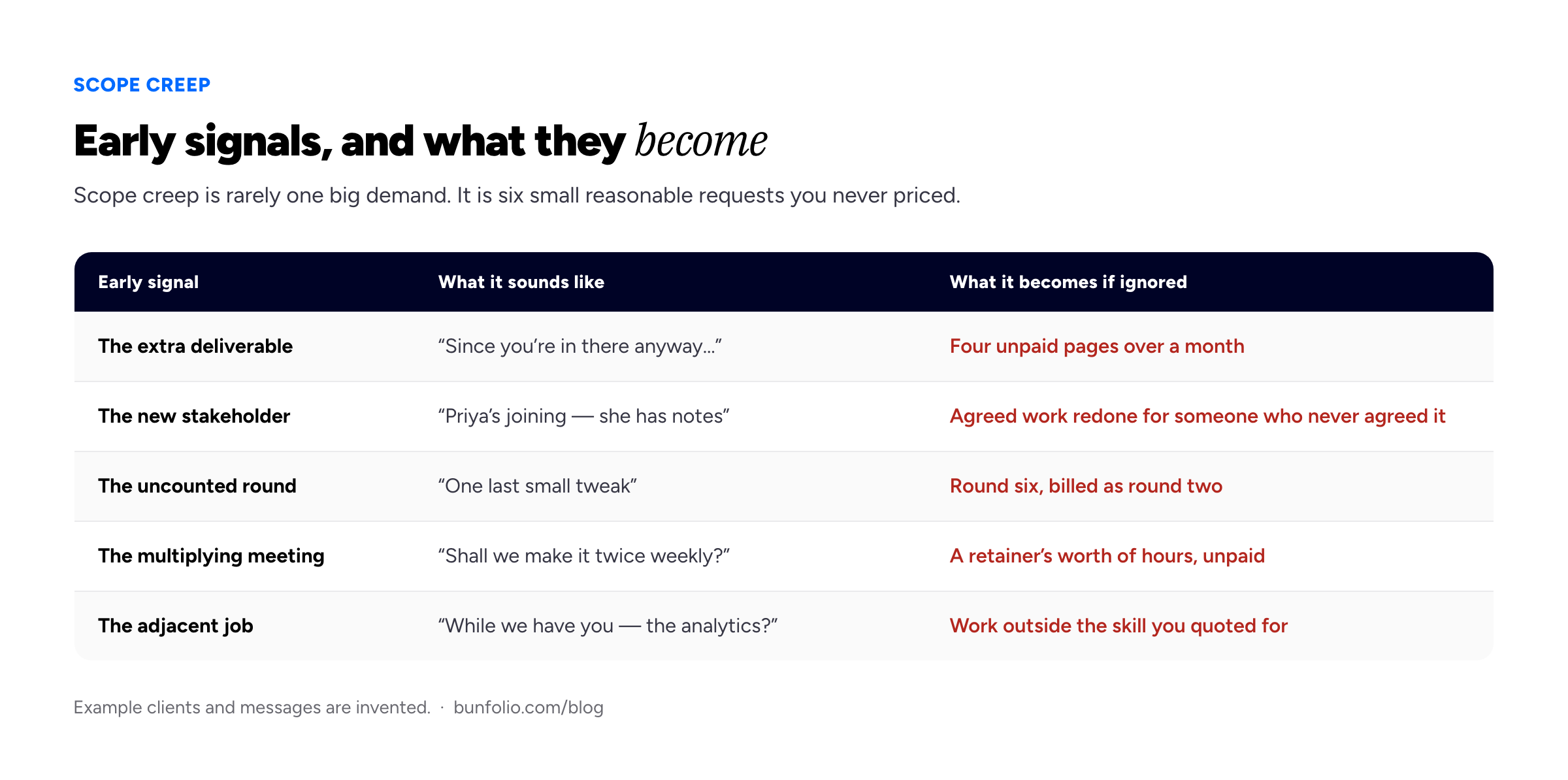
The right-hand column is the reason to say something in week one rather than week six.
Why it happens, and why you let it
Two causes, two fixes.
The first is structural. Most scope creep exists because the scope was written as a description of activity rather than a list of deliverables. "Website design" is not a scope; "five unique page templates delivered as a Figma file, plus one handover call" is, because it can be counted. If your agreement cannot be used to settle a disagreement, it is a summary. Our guide to freelance contract essentials covers the surrounding clauses.
The second cause is emotional, and it keeps people stuck even when their paperwork is good. Saying nothing feels safer. The client controls the invoice, the testimonial and the referral, and raising money mid-project feels like introducing conflict into a relationship that is currently pleasant.
So you absorb it, and tell yourself things worth examining.
"It is only an hour." It is only an hour six times. The first free hour also teaches the client what free looks like, and the eighth request follows from how you handled the first.
"They will think I am difficult." In our experience this is backwards. Clients who have worked with agencies are used to change requests being quoted; it reads as professional. The freelancer who absorbs everything silently and then becomes cold and slow in week seven is the one remembered as difficult.
"I need this reference." References come from projects that end well, and a project where you quietly worked at half rate ends late, with a tired freelancer and a client who has noticed. That is not the project that produces the case study you wanted.
"It is my fault for not scoping properly." Sometimes true, and irrelevant. A scoping mistake is fixed by naming it, not by paying for it in unpaid weekends.
The reframe that helps most: raising scope is not a complaint, it is project management. You are telling the client something they need in order to decide about their own budget and timeline. Withholding it is the unprofessional option.
The scope clauses that end the argument before it starts
A necessary caveat: we are not lawyers, and none of the wording below is legal advice. Treat it as a plain-English starting point to adapt, and if a project is high-value or unusual, have somebody qualified where you are read your agreement.
Five pieces of language prevent most scope arguments. They work by moving the awkward conversation from mid-project, where it feels personal, to the proposal, where it is only terms.
1. Deliverables with quantities and formats. Count everything countable: pages, screens, articles, revisions, formats, calls. "Up to eight product photographs, retouched, delivered as JPEG and WebP" leaves nowhere for a ninth photograph to hide.
2. An explicit exclusions list. People skip this one, and it does more work than any other. Two or three lines under "Not included in this scope": copywriting, photography, ongoing maintenance, CMS setup, third-party integrations. Exclusions are not hostile — they let you say "happy to add that, here is what it costs" without appearing to invent a boundary on the spot.
3. A change process in one sentence. For example: Work outside the deliverables listed above is quoted separately and begins once confirmed in writing. That sentence turns an uncomfortable negotiation into an administrative step.
4. A revision limit with a definition of "round". Two rounds is a common default, but the number matters less than the definition — a round is one consolidated set of feedback in a single message, not fourteen emails over three weeks. State the rate for further rounds. Round seven feels identical to round two from the client's side, and a price is the only thing that reliably slows the cycle.
5. Assumptions and dependencies. The quote assumes content is supplied by a date, that there is one approver, that access is granted in week one. When an assumption fails, timeline and price are open to review. That is how you handle the stakeholder who appears in week three without a personality dispute.
All five belong in the proposal as well as the contract, where they double as evidence that you have run projects before.
In-scope clarification or out-of-scope request?
Not every request is scope creep, and billing for clarifications is its own way to lose a client.
An in-scope clarification refines work you already agreed to do: changing a button colour, adjusting a headline, fixing something that does not match the brief. So is anything that is genuinely your error.
An out-of-scope request adds a new deliverable, reopens a decision after sign-off, or needs a skill you did not quote for. The test is category, not effort: if the thing was not in the deliverables list, it is new, even if it takes twenty minutes.
The second test is direction of travel: is this the first time or the fourth? One small favour is goodwill; the same favour every week is an unpriced retainer.
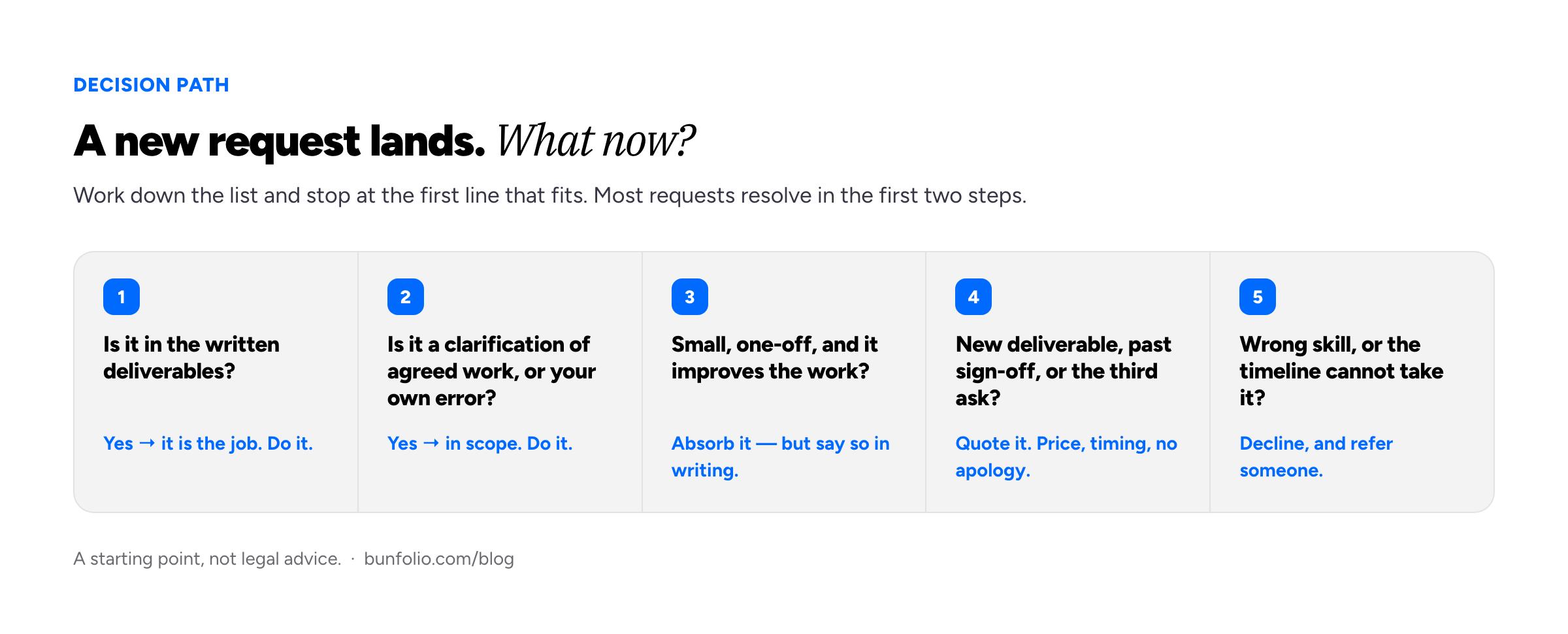
The step people skip is the third — absorbing the work is fine, absorbing it silently is what teaches the client the wrong lesson.
The scripts
This is the part that changes outcomes. The reason you say nothing is rarely that you disagree with the principle; it is that no polite phrasing comes to mind quickly enough, so you say "sure, no problem" and regret it later.
Adapt the tone; keep the structure, which is always the same three moves — enthusiasm for the request, a factual note that it sits outside the agreed scope, and a concrete next step that is easy to say yes to.
Flagging a request in the moment
Send this the first time something lands outside the deliverables, and send it before you start the work. Flagging afterwards is much harder, because you are then asking to be paid for something already delivered.
Hi Dana — happy to take the pricing page on, it makes sense alongside the rest. Just flagging that it sits outside the five templates we scoped, so it would be an addition rather than part of the current fee. Want me to send a quick price and timing? If the budget is not there right now we can park it, and I will make sure the design system covers it so it is straightforward to add later.
Three things are doing the work. You said yes in principle first, so it does not read as a refusal. You stated the scope position as fact, not grievance. And you gave the client a way to decline without embarrassment.
Quoting for the extra work
Once they ask for a price, be short. Long explanations read as apology, and apology invites negotiation.
Here is the pricing page as a separate item: £480, roughly two days of work, delivered by the 14th. It does not affect the delivery date for the five agreed templates. If you would like to go ahead, reply here and I will add it to the schedule and invoice it with the final stage. Equally happy to leave it out — the original scope stands either way.
Note what is missing: no justification of the rate, no "I know this is a bit awkward", no pre-emptive discount. Work from your normal day rate rather than inventing a friendlier one — our guide on how much to charge as a freelancer covers building that figure. A discounted add-on rate teaches the client that extra work is cheap.
Holding a revision limit
This is where most freelancers fold: the requests are small and refusing feels petty. Hold the line while staying useful.
Thanks for these. We are past the two rounds of revisions in the agreement, so I will treat everything from here as additional. Two options: I can group the remaining notes into one final round at £150, or if you would rather keep to the original budget I will apply the three changes that seem most important — the hero headline, the pricing table alignment and the footer links — and we call the design complete there. Which would you prefer?
Offering a choice matters. "No" invites an argument; two acceptable options invite a decision. It also shows you are not trying to squeeze money out of them.
Escalating when it keeps happening
If you have flagged requests two or three times and they keep coming, stop handling them one at a time. A busy client absorbs single flags without noticing the pattern; one message showing the total is what changes behaviour.
Hi Dana — before we go further I want to get us back onto the same page about scope, because we have drifted. Since we started we have added the pricing page, the mobile menu redesign, two extra rounds on the homepage and the weekly stakeholder call. That is around nine days on top of the twelve we scoped. I kept going because none of it seemed worth stopping for individually, and that was my mistake. Two options: I invoice the additional work at the day rate in the agreement, or we cut the remaining extras and I deliver the original scope by the original date. Glad to do either — I just do not want to keep going without it being agreed.
Taking a share of the blame is what stops the message reading as an accusation. You are describing a shared drift and proposing two ways out, both acceptable to you.
Fold it in or bill it separately
Not everything should be quoted. Charging for every fifteen-minute favour makes you exhausting to work with, and goodwill is a real asset. What follows is our own rule of thumb, not a law of nature.
Absorb it when it is genuinely small, it is the first or second time, it improves work you will want to show, or it is plausibly your own oversight. Absorb it visibly: "I have added the favicon and the social preview image — no charge, but flagging it so the scope stays clear." Silent generosity gets spent and forgotten; named generosity slows the next request.
Quote for it when it is a new deliverable, it changes something already signed off, it pushes the timeline, it needs a skill outside the quoted discipline, or it is the third instance of the same ask. Also quote when absorbing it would make you resentful — resentment shows up in your responsiveness and your willingness to work with this client again.
Decline it when the work is outside what you do well, the timeline cannot take it, or the pattern suggests the client will keep going regardless. Declining is legitimate, and a referral makes it helpful.
When scope creep has already got out of hand
Say you are four weeks past the deadline, working for a rate you would not accept from a new client, and you flagged none of it. This is recoverable — but not by absorbing the rest quietly and vowing to scope better next time.
Start by counting. Reconstruct what has been added since the agreement — extra deliverables, additional rounds, meetings — and put an honest number of days against each. Keep it to yourself for now; you will negotiate differently once you know it is nineteen days against twelve rather than a vague feeling of being behind.
Then decide what you want: bill for the extras, cut them and deliver the original scope, or finish and treat the loss as tuition on a client you will not take again. All three are legitimate. Continuing without a decision is not, because that is how a six-week project reaches month five.
Then send a reset message:
Hi Marcus — I want to reset where we are, because this project has grown well beyond what we agreed and I have not been clear enough about that as it happened. The original scope was three landing pages and two rounds of changes. We are now at six pages, five rounds and the campaign email templates. My proposal: I finish the three original pages plus the two extras we have started, we close the project on the 22nd, and I invoice £1,900 for the additional work at the rate in our agreement. Anything left after that I am glad to quote as a second phase. Can we get on a call this week to agree it?
Expect one of three reactions. Reasonable clients are slightly embarrassed and agree quickly, often having had no idea of the total. Some negotiate the number, which is normal. A few are indignant that you asked at all, which is useful information about whether to work with them again.
Whatever happens, set a firm end date in that message. Scope creep on a project with no end date has nothing to bump against, and the date does more than the money to stop the drift. If the invoice then goes quiet, our guide on getting paid on time covers the follow-up.
When it is a client problem, not a scoping problem
Sometimes better paperwork will not help, because the client's behaviour is the cause rather than the ambiguity. Telling the difference stops you rewriting your contract to solve something a contract cannot solve.
Signs it is the client rather than the scope: requests continue at the same rate after you have flagged them in writing; agreed decisions are reopened repeatedly; "just one more thing" arrives weekly; your quotes are met with irritation rather than a yes or a no; or you are told a previous freelancer "would have included that".
The response differs too. A scoping problem is fixed with wording; a client problem is fixed with a boundary, a defined end and a decision not to renew. Several of these overlap with the wider client red flags worth spotting before you sign — and the strongest protection is a pipeline healthy enough that you can end a project cleanly, which is why work on finding clients never really stops.
Frequently asked questions
How do I raise scope when I never had a written contract?
You can still reset, but you argue from what was agreed rather than from a clause. Point to the message where the work was described and quoted, list what has been added since, and propose terms going forward. With less leverage, aim for a clean agreement on the remainder rather than payment for everything already delivered.
What if the client refuses to pay for out-of-scope work?
Separate the money from the work. If they will not pay, you are not obliged to keep doing it — say which deliverables the original fee covers, deliver those to the agreed standard, and close the project. Chasing payment for work already handed over is far harder than declining work not yet started.
Is it ever worth doing extra work for free?
Yes, occasionally and deliberately. A small addition that makes the finished piece much stronger for your own portfolio can be worth more than the fee. The rule is that you choose it, name it, and do not let it become the new baseline.
How many revision rounds should I include?
Two is a common default for design and writing work, and three is normal on larger projects with several stakeholders. What matters more is defining a round as one consolidated set of feedback and stating the price of further rounds. That is our recommendation, not an industry standard.
Should I charge hourly to avoid scope creep entirely?
Hourly billing moves the risk to the client rather than removing it, and introduces a new argument about whether your hours were justified. Most freelancers do better with a fixed price for a tightly defined scope plus a stated rate for additions, which keeps the certainty clients want while making extra work visibly billable.
Does a bigger portfolio actually help with this?
Indirectly, but genuinely. Most conflict-avoidance in scope conversations comes from needing this particular client too much. A portfolio that brings in enquiries steadily makes it easier to say "that would be an addition" and mean it — the practical argument for keeping your work published on a site you control.
How we put this guide together
Almost everything here is our own judgement, formed from working with freelancers who publish their portfolios with Bunfolio and from the patterns they describe when a project goes sideways. The five clauses, the absorb-or-quote rule, the revision-round conventions and the advice to reset with a fixed end date are recommendations rather than established rules, and we have labelled them that way rather than dress them up as findings.
We have deliberately cited no statistics. There are widely repeated figures about how often projects overrun or how many freelancers meet scope creep, and we could not trace any of them to a primary source we were willing to stand behind, so we left them out rather than lend them credibility. Where we say something is common, we mean common in what we see.
The contract wording is a plain-English starting point, not legal advice — we are not lawyers, agreement law varies by country, and anything high-value is worth one paid review by somebody qualified where you are. Every client, project, name, sum and message here is invented; the scripts are written to be copied and adapted, not because any exchange happened as written. Bunfolio gives freelancers a free portfolio site; it is not a contract or invoicing tool.
Related reading: the freelance contract essentials this all rests on, how to set a rate you can quote additions against, and the client red flags worth catching before you sign.
More from the blog
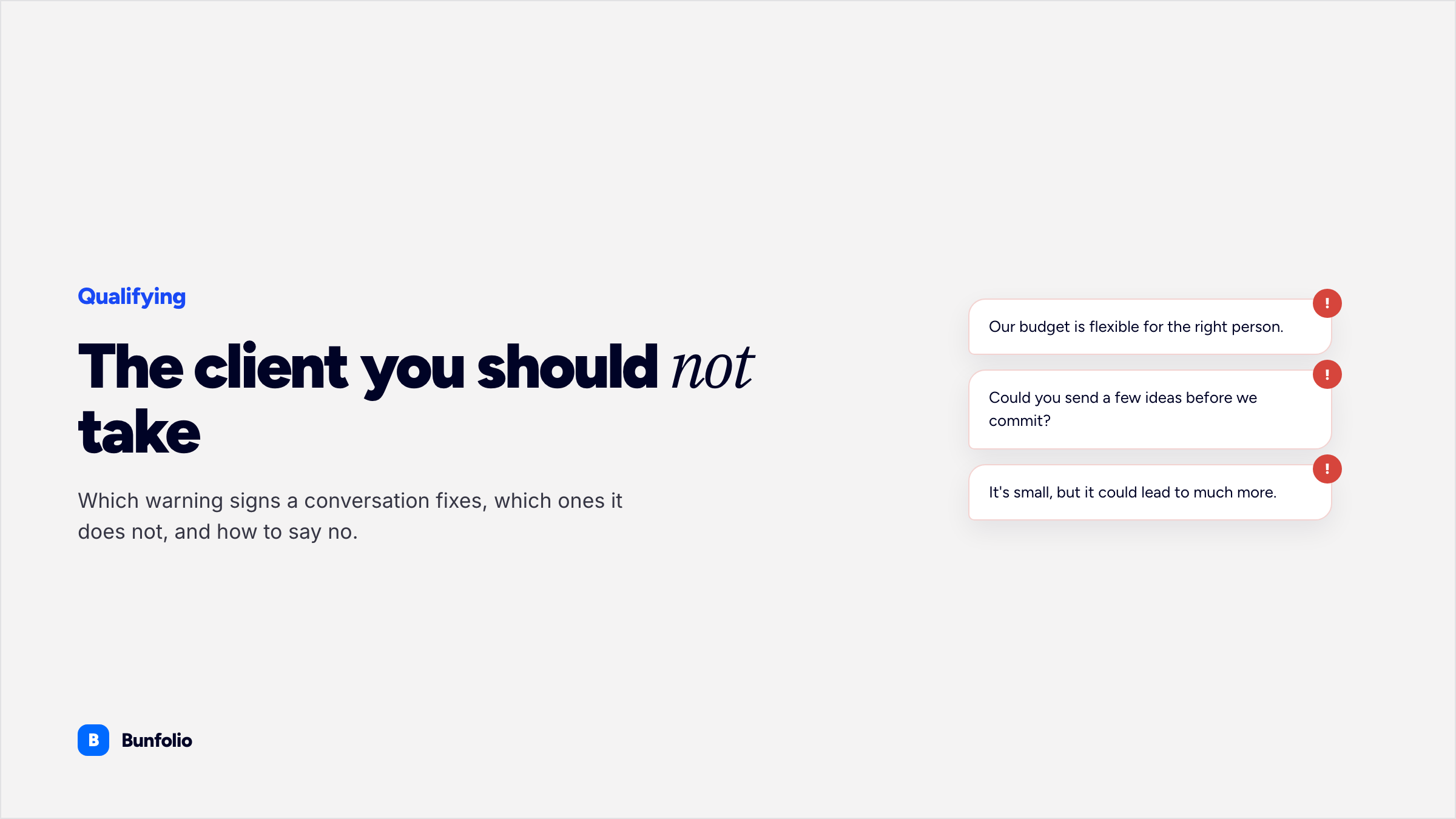
August 18, 2026 · 31 min read
Freelance Client Red Flags: What to Check Before You Sign
Most warning signs are an inexperienced buyer rather than a bad one. Which ones a single conversation fixes, which ones mean walk away, and how to decline without burning the relationship.

October 5, 2026 · 16 min read
How to Become a Freelance Photographer: From Good Photos to Paid Work
A practical path from "I take good photos" to paid freelance work: choosing a niche, the kit you actually need, and building a portfolio before you have clients. Plus the business basics photography a...
September 30, 2026 · 16 min read
What Is Freelancing? A Plain-English Guide to Freelance Work
Freelancing is selling a skill to several clients one job at a time instead of working for one employer. How a freelancer differs from an employee, contractor or gig worker, one freelance job from enq...