
July 30, 2026 · 22 min read
How to Get Your First Freelance Clients
Six channels ranked by how fast each one realistically produces work, cold outreach that earns a reply, and how to turn a first job into the evidence that wins the second.
The first freelance client is the hardest one you will ever get, and almost every guide written about it understates that. You need work to show work. You need a testimonial to earn the job that produces a testimonial. You are asking a stranger to spend money on someone with nothing behind them except a claim.
That problem is real, and it does not dissolve because you built a nicer website. What it does is shrink — noticeably — once you stop trying to prove you are a good freelancer in general and start proving you can solve one specific problem for one specific person. Generalised credibility is what a track record buys you. Specific usefulness is available today.
This guide covers where first clients realistically come from, how to approach the people already in your network without it feeling like begging, what cold outreach looks like when it works, and what to do in the hours after someone replies. It is written for people at zero or near-zero: no client list, no testimonials, maybe one or two projects that are technically personal work.
The chicken-and-egg problem, and the three honest ways out
The bind is straightforward. Clients want evidence. Evidence comes from clients. Every route out of that loop involves manufacturing evidence that is not a paid client project — and there are only three honest ways to do it.
Borrow credibility from your past. If you have had a job, you have done work. It may not have been freelance work, but the skill was the same and the outcomes were real. A developer who spent two years on an internal billing system has shipped software under deadline pressure with real users, which is exactly what a client is buying. The framing is the only thing that changes.
Build the evidence deliberately. Make the thing you want to be hired to make, for a real or realistic brief, and write it up as though it were client work — because in every respect except who paid for it, it is. This is slower than borrowing, but it is entirely within your control, and it lets you choose the kind of work you want more of.
Do one job cheap or free, on purpose, with rules. The most maligned option and the most effective one, when it is bounded. We will come back to what those bounds are, because unbounded free work is how people spend six months building portfolios for organisations that were never going to pay anyone.
Most people who get their first client use a combination: a former employer's project reframed as a case study, one self-directed piece that matches their target work, and one small discounted job that produces the first real testimonial. Three months later they have a page that looks like a track record, because it is one.
Where first clients actually come from
There are six channels worth your time. They are not equal, and the amount of advice written about each is close to inversely proportional to how quickly it produces work.
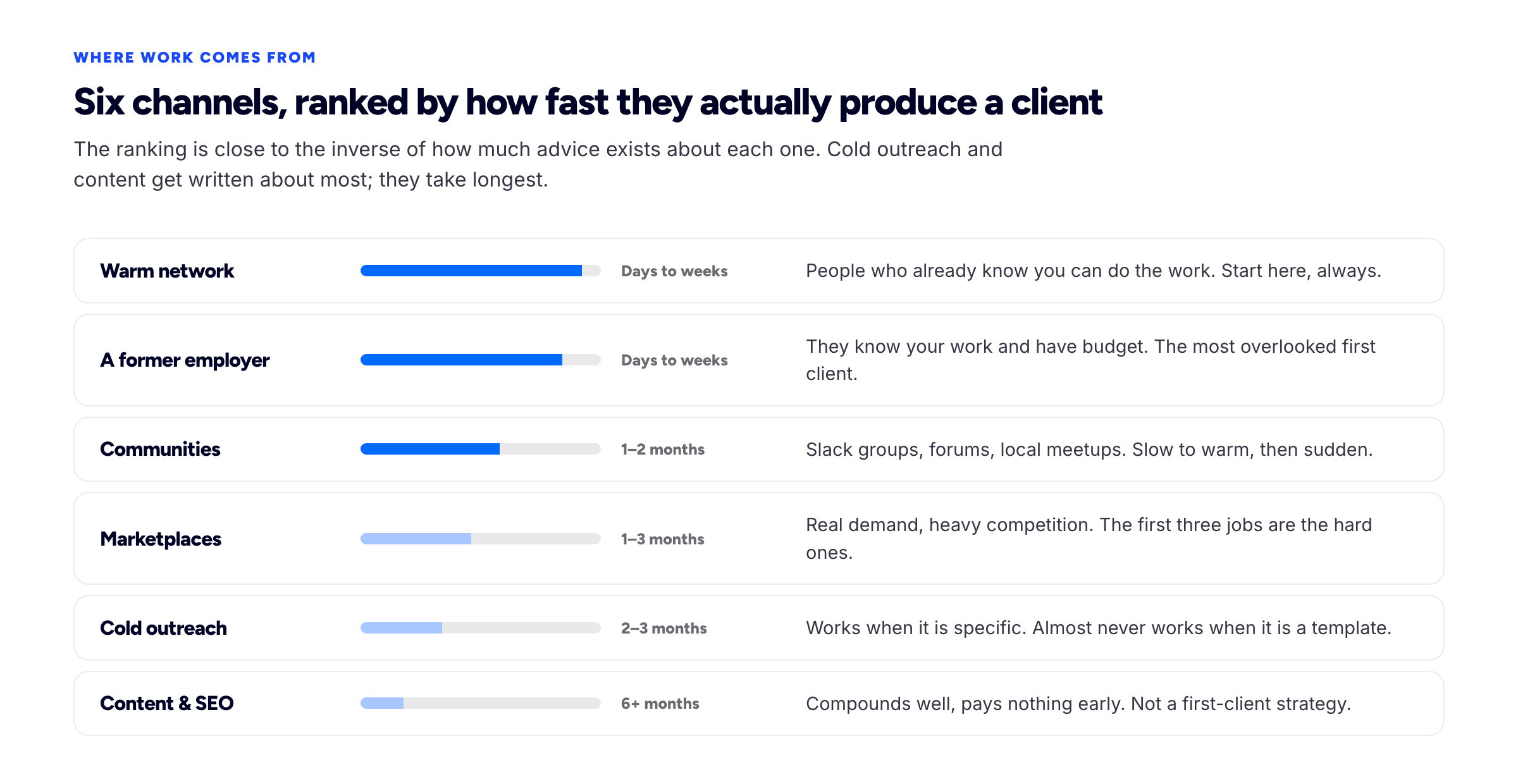
Ranked by time to first client, not by how much advice exists about them.
The pattern we see is that new freelancers invert this list. They spend the first month on the channels that feel least like asking — setting up profiles, posting on social platforms, refining a logo — and reach the warm network last, when the savings are running out. The warm network is where the first job usually comes from. Start there and use the slower channels to build the pipeline behind it.
One thing to be clear about before we go through them: none of these are fast in absolute terms. A realistic expectation for someone starting cold, working at it seriously several hours a week, is weeks to a first conversation and one to three months to a first paid engagement. Anyone promising a client this week is selling something.
Your warm network beats every other channel
Your warm network is everyone who already knows you are not a scammer. Former colleagues, former managers, university friends, the people in your last team's Slack, the person you met at a meetup, your sister's business-owner friend. It is almost always larger than people think and almost always under-used.
It works for one reason. The single biggest obstacle to hiring an unproven freelancer is risk — the fear of paying someone who disappears, misses the deadline, or cannot actually do it. Everything in a portfolio is an attempt to reduce that fear indirectly. Someone who has worked with you has already had it answered directly.
Your former employer is a legitimate first client
This is the most reliably overlooked option on the list. Companies you have left have work they cannot staff, institutional knowledge you still hold, and a procurement process that already has you in it. You do not need to sell your competence — they measured it for a year.
The approach is a short, specific note to your old manager, not an announcement to the company: you are freelancing now, you noticed that the reporting dashboard project was still open when you left, and you have capacity for a fixed piece of it if that is useful. Name a concrete thing. "Let me know if you need anything" produces nothing, because it hands the work of scoping to a busy person.
Two cautions. Check your employment contract for non-compete or non-solicitation terms before you approach anyone, and do not undercut yourself out of loyalty. Ex-employers frequently anchor on your old salary as an hourly rate, which ignores that you now cover your own tax, tooling, holiday and downtime. Our guide to what to charge as a freelancer has the arithmetic for converting a salary into a defensible rate.
The message that does not feel like begging
The reason network outreach feels awkward is that most people write it as a request for charity: I've gone freelance, please think of me if anything comes up. That asks the recipient to do the work of remembering you at an unspecified future moment, and it gives them nothing to react to now.
Rewrite it as information plus one specific offer. Something like this:
Hi Dan — I've gone independent as of this month, doing front-end work for small e-commerce teams. Not asking you for anything, but two things in case they are useful: I'm around if the Shopify theme work ever needs a pair of hands, and if you know anyone struggling with a slow storefront, I'm happy to look at it for free and tell them what's wrong. Hope the new office is treating you well.
That message is easy to answer, easy to forward, and does not put the recipient in the uncomfortable position of having to decline a favour. The "happy to look and tell them what's wrong" line is the one that generates replies, because it converts a vague availability into a concrete, low-commitment thing a person can accept.
Send these individually. A visible group email to forty contacts reads as a mailshot and is treated as one. Twenty personal messages over two weeks outperform two hundred broadcast ones, and you will notice the pattern in the replies — which is itself useful information about which service to lead with.
Ask for introductions, not for work
Most of your contacts do not need what you do. Almost all of them know someone who might. The ask that works is narrow enough to be answerable: not "do you know anyone who needs a designer" but "do you know anyone running a small clinic or practice who is embarrassed by their website?" A specific question triggers specific recall. A general one triggers nothing.
Communities: where freelancers actually get hired
After the warm network, the highest-yield channel is communities where your buyers already gather — and the important word is buyers, not peers. A Slack group full of other freelance illustrators is good for morale and rate benchmarking. It is not where illustration gets commissioned.
Go where your clients congregate about their own problems: industry Slack and Discord groups, subject-matter subreddits, local business associations, indie founder forums, alumni networks, the comment sections of trade publications. Then behave like a member rather than a vendor.
The mechanic that works is answering questions in public, in detail, without pitching. Someone asks why their checkout is slow; you spend fifteen minutes writing a genuinely useful reply that would let them fix it themselves. Some of them will fix it themselves. A meaningful fraction will decide they would rather pay the person who obviously knows how, and they will message you privately. This is slower than cold outreach for the first month and considerably more productive after three.
Two practical notes. Read a community's rules on self-promotion before you post, because being removed from the one place your buyers gather is an expensive mistake. And make sure your profile and signature carry a link to something that explains what you do — the entire mechanism depends on someone being able to check you out without asking.
Marketplaces: realistic expectations
Upwork, Fiverr, Contra, Malt, PeoplePerHour and their equivalents solve one problem genuinely well: they put you in front of people who have already decided to hire a freelancer and have a budget. No other channel gives a beginner that. That is worth a great deal when you have no network to work.
What they do badly is everything after that. You compete on price against a global market, you pay commission, your ranking is controlled by an algorithm you cannot see, and the profile is a page on someone else's website that can be closed without appeal. The portfolio site guide goes into the rented-versus-owned distinction in more detail; the short version is that marketplaces are a demand source, not a home.
The first few jobs on any marketplace are disproportionately hard, because the ranking systems reward completed jobs and reviews and you have neither. That phase is real and it is temporary. Ways through it that we have seen work:
- Compete on narrowness, not price. "Webflow developer" faces four thousand competitors. "Webflow developer who migrates WordPress blogs without losing SEO" faces very few, and matches a search someone actually types.
- Apply early to fresh postings. Buyers read the first handful of proposals properly and skim the rest.
- Take small first jobs deliberately. A £120 fixed job that produces a five-star review is an investment in ranking, not an insult to your rate. Two or three of those, then raise.
- Write proposals about them. Most proposals are a paragraph of self-description. The ones that win open by restating the client's problem in a way that proves you read the brief and understood it — the full structure is in writing a freelance proposal that wins.
- Do not let it become the whole plan. Use the early jobs to build reviews and evidence, and move that evidence onto your own site as you go — whether that site is worth building yet comes down to how much of your work you expect to arrive from outside the platform.
Cold outreach that actually works
Cold outreach has a bad reputation because most of it is bad. The bad version is a template broadcast to hundreds of addresses, introducing yourself and offering your services. It converts at close to nothing, and it earns the response it gets.
The version that works is closer to consulting than to selling. You pick a small number of businesses you could genuinely help, you find something specifically wrong or missing, and you offer one small piece of concrete work to fix it. The unit of measurement is not messages sent — it is minutes of homework per message.
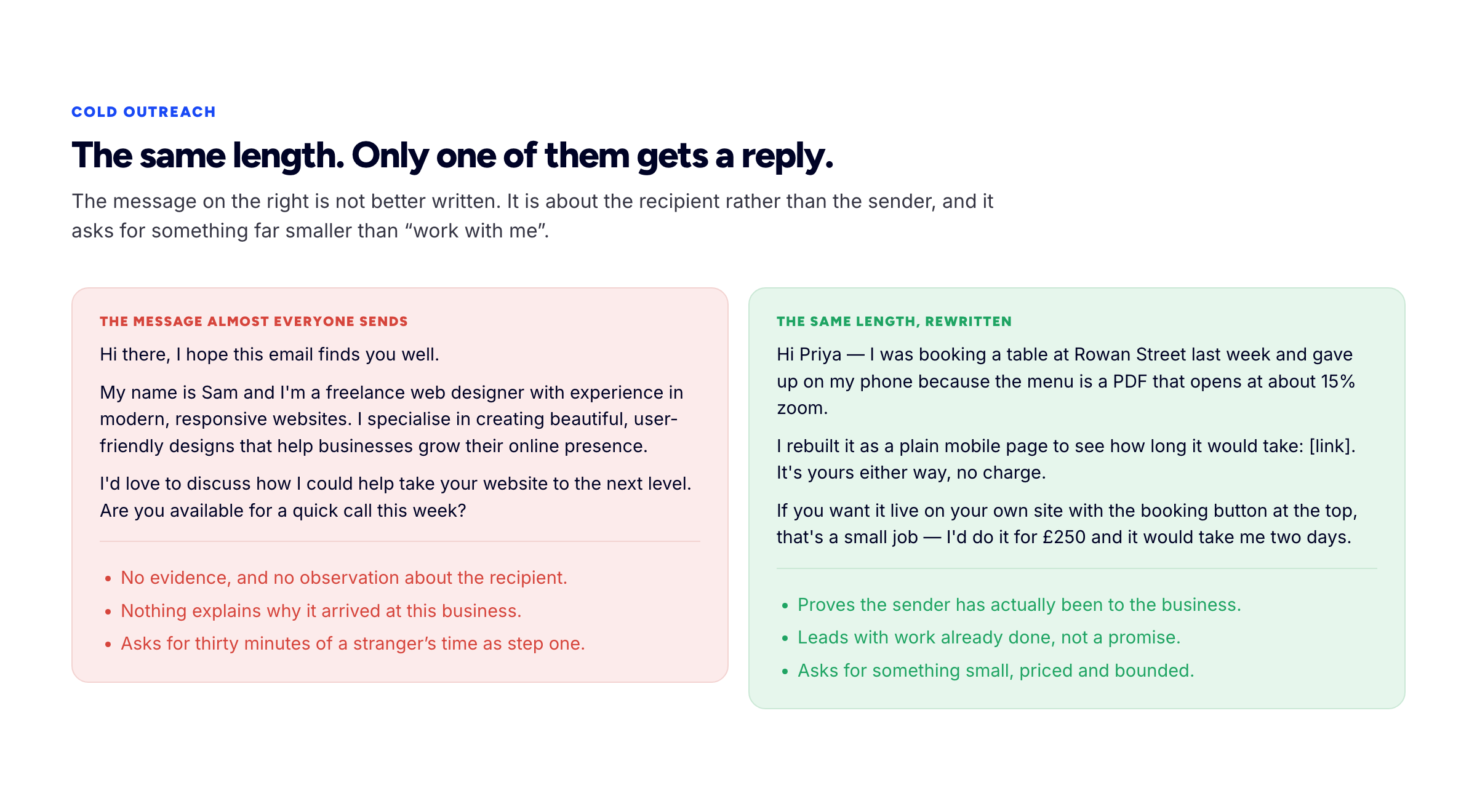
The same length. Only one of them gets a reply.
The message almost everyone sends
Hi there, I hope this email finds you well. My name is Sam and I'm a freelance web designer with experience in modern, responsive websites. I specialise in creating beautiful, user-friendly designs that help businesses grow their online presence. I'd love to discuss how I could help take your website to the next level. Are you available for a quick call this week?
Look at what this asks and what it gives. It gives no evidence, no observation about the recipient, and no reason this email arrived at this business rather than a thousand others. It asks for a call — thirty minutes of a stranger's time — as the first step. The recipient cannot tell whether Sam has ever seen their website.
The same length, rewritten
Hi Priya — I was booking a table at Rowan Street last week and gave up on my phone because the menu is a PDF that opens at about 15% zoom. I rebuilt it as a plain mobile page to see how long it would take: [link]. It's yours either way, no charge. If you want it live on your own site with the booking button at the top, that's a small job — I'd do it for £250 and it would take me two days. If you'd rather just take the file to whoever runs the site, that's completely fine too.
Every difference here matters. It proves the sender has been to the business. It names one specific problem the owner has probably heard complaints about. It leads with work already done rather than a promise. It proposes something small, priced and bounded rather than a relationship. And it gives the recipient a graceful exit, which paradoxically makes them more likely to say yes. If the blank draft is the part that stalls you, our email generator will give you a version to react to — the observation about their business still has to be yours, and it is the only line doing any work.
Note also what it does not do: it does not insult the existing site, it does not use the word "unfortunately", and it does not claim the business is losing customers, because Sam has no idea whether that is true. Inventing a statistic about the recipient's own business is the fastest way to lose the reader who actually has the data.
The principle underneath
A small specific proposal beats a generic introduction, every time. "Can I redesign your website" is a decision requiring budget approval, internal discussion and risk. "Can I fix your menu page for £250" is a decision one person can make in a minute. The small job is not the goal; it is the door. Freelancers who get the first £250 job routinely get the £4,000 job four months later, because they have stopped being a stranger.
Volume expectations, honestly stated: this style of outreach is slow. Ten researched messages a week is a realistic pace alongside other work, and most of them will not be answered. That is normal and not a signal to switch to a template and send four hundred. The reply rate on researched outreach is not high in absolute terms — it is simply many times higher than the alternative, and the conversations it produces are with people who already believe you can do the thing.
Following up
Send exactly one follow-up, roughly a week later, three sentences long, adding something rather than repeating yourself. Then stop. Non-response is not rejection — it is an inbox — but a third chase converts nobody and makes you memorable in the wrong way.
Free work, done deliberately
Doing one piece of unpaid or heavily discounted work is a reasonable way to buy your first case study and your first testimonial. It becomes a trap when it is open-ended, so treat it as a transaction with terms, not as a favour.
The rules that keep it useful:
- Pick the client for the portfolio piece, not for the gratitude. Choose an organisation in the sector you want to work in, doing work you want more of. A free logo for a friend's band does not help you get hired by dental practices.
- Fix the scope in writing. One page, one campaign, one feature. The single biggest cause of resentment in free work is a scope that quietly grew for four months.
- State the trade explicitly. You are doing this without charge in exchange for a written testimonial, permission to publish the work as a case study, and an introduction to one other person who might need similar help. Get all three agreed before you start.
- Set an end date. Say when the free portion ends and what your rate is afterwards, at the beginning. A client who is surprised by that later will feel misled, and a client who agreed to it at the start converts to paid at a rate that will surprise you.
- Deliver it like paid work. Same deadlines, same communication, same finish. The value of this project is entirely in what it proves about you.
- Do it once, maybe twice. After that you are not building a portfolio, you are running a charity with extra steps.
An alternative worth considering if free work sits badly with you: charge a real but small fixed fee, framed honestly as an introductory rate for your first few clients. Paying something, even a little, changes how a client treats the engagement — they show up to meetings and they give feedback. Free work is frequently deprioritised by the person receiving it.
The first 48 hours after a lead replies
Most first clients are lost after the reply, not before it. Someone shows interest, the freelancer sends a long enthusiastic message, and the thread goes quiet. Here is what to do instead.
Reply within a few hours. Speed is the cheapest competitive advantage available to a new freelancer. A same-day reply signals reliability more effectively than any line in your bio.
Ask two or three questions before you propose anything. What are they trying to achieve, when do they need it, and has anyone tried to fix this before? The answers change the scope, and the act of asking is itself evidence that you work like a professional rather than an order-taker.
Do not discount before you have been asked to. New freelancers routinely volunteer a lower price to pre-empt an objection nobody has raised. Name a number, then be quiet.
Send something written. Even for a small job: what you will do, what you will not do, what it costs, when it is delivered, what you need from them. A one-page scope prevents the two most common disasters — an argument about revisions, and an invoice that never gets paid.
Take a deposit. Fifty per cent up front for a new client is standard and unremarkable. Ask for it in the same neutral tone you would ask for their address.
Point them at one place. A single link that shows who you are and what you have done. If you do not have one yet, Bunfolio will give you a free portfolio site on your own subdomain in an evening — sign in with Google, import your LinkedIn profile to pre-fill the sections, edit what is wrong, and publish. Any tool is fine. Having a link is not optional; people check.
Turning the first job into the second
The first client is disproportionately hard. The second is easier only if you deliberately extract three things from the first while the goodwill is still fresh.
A testimonial, requested at the right moment. The right moment is the day you deliver something that worked, not three months later. Ask for something specific: "Would you mind writing two sentences about what changed for you after this?" That phrasing produces an outcome rather than a compliment about your professionalism, and outcomes are what the next client is scanning for. Get the full name, role and company; an anonymous quote persuades nobody.
A case study. One properly written project write-up is worth more than a grid of thumbnails, because it shows how you think and almost nobody bothers to produce one. Cover the problem, the constraints, the decision you were least sure about, and what happened afterwards. There is a full structure with word budgets in how to write a portfolio case study. Ask permission to publish while you are still in touch — it is much harder to get six months on.
A referral. The end of a successful project is the only moment when a client is both delighted with you and thinking about you. Ask then: "If you know anyone else dealing with the same thing, I'd appreciate an introduction." Most freelancers never ask, which is why most freelancers' referral pipelines are accidental.
Do that after every job and the loop starts to close. Client three arrives through client one. That is what an established freelance practice actually is — not a marketing funnel, but a set of finished projects that keep producing.
A realistic first month
If you are starting from nothing, here is a plan that does not depend on luck. It assumes a few hours a day, and it assumes you will not have a signed client at the end of it — you will have a pipeline, which is the actual goal of month one.
Week one — decide and publish. Write one sentence describing who you help and what changes for them. Choose the two or three pieces of work you can show, including reframed employment work. Put up a simple site with those, an About section and one obvious way to contact you. Publish it unfinished.
Week two — the warm network. List thirty people who know you. Write to fifteen of them individually, each message containing one specific offer. Ask five of them for a narrow introduction. Expect a handful of replies and one real conversation.
Week three — communities and marketplaces. Join three places where your buyers talk about their problems, and answer questions properly in each. Set up one marketplace profile with a narrow specialism and send five careful proposals to fresh postings.
Week four — outreach and the first case study. Research ten businesses you could genuinely help, and send ten individual messages that each name a specific problem and propose a small piece of work. Meanwhile, write up your strongest existing project as a full case study.
Then repeat weeks two to four, indefinitely, while doing the work that comes in. The freelancers who get established are not the ones with the best websites. They are the ones still sending messages in month four.
Frequently asked questions
How long does it realistically take to get a first client?
For someone working at it seriously several hours a week, weeks to a first genuine conversation and one to three months to a first paid job is a fair expectation. It is faster if you have a strong network or a former employer to approach, and slower if you are changing discipline at the same time. Most content on this subject implies it happens in days, which sets people up to conclude they have failed at week three.
Can I get a client with no portfolio at all?
Yes, through the warm network and through outreach where you lead with work already done for the recipient — those both substitute personal trust or a demonstration for a track record. But get something published quickly regardless. People will search your name before replying, and an empty result costs you leads you never find out about.
Should I put personal projects in my portfolio?
Yes, and present them as work rather than apologising for them. Describe the brief, the constraints you set, the decisions you made and the outcome. A well-written self-directed project reads as competence. What weakens a portfolio is unexplained artefacts with no reasoning attached, not the absence of a paying client.
What should I charge for my first job?
Enough that the client takes it seriously, and low enough that you would not be devastated if the project were awkward. Fixed price rather than hourly for a first engagement, because it protects both sides from open-ended scope. Work out your floor from real costs rather than by copying a number from a forum — our pricing guide covers the calculation and the common mistake of pricing from an old salary.
Is cold outreach worth it, or is it just spam?
The distinction is entirely in the homework. A message that could have been sent to any business is spam and will be treated as such. A message that names something specific about this business and offers one small concrete thing is a useful email, and people answer it. Ten researched messages will outperform four hundred templated ones.
Should I niche down before I have any clients?
Pick a direction, not a life sentence. A narrow positioning makes every other part of this much easier — outreach has an obvious target, communities are findable, your site can say something specific — and you can change it once you have evidence about which work you enjoy and which pays. Staying broad to avoid turning anyone away tends to produce a message that speaks to nobody in particular.
How we put this guide together
Bunfolio builds portfolio sites for freelancers, which means we spend a lot of time looking at the pages people put up at the very start of a freelance career, and at what they write on them when they have no clients yet. The advice above comes from that vantage point, from the questions people ask us when they are stuck, and from the common structure of the outreach and positioning that produces replies.
It is practitioner judgement, not research. Where we describe what works, we have tried to say so in those terms — "the pattern we see", "in our experience" — rather than dressing an opinion up as a finding. The timelines given are deliberately conservative estimates rather than measurements.
We have specifically avoided quoting statistics about how freelancers find work. There is a large circulating body of confident percentages on this topic — the share of freelancers who get work through referrals, the reply rates of cold email, the proportion of clients who check a website first — and the great majority of them trace back to no identifiable primary source, or to a vendor survey with an undisclosed sample. Repeating those numbers would make this guide look more authoritative and be less trustworthy. Where a claim here is not sourced, it is presented as our view, and you should weigh it accordingly.
More from the blog
August 29, 2026 · 18 min read
The Freelance UX Designer Portfolio: Winning Clients, Not Interviews
A hiring manager is deciding whether you can do the job for two years. A client is deciding whether you can solve one problem, for roughly this money, starting soon. Almost every difference in the por...
August 23, 2026 · 24 min read
How to Get Paid on Time as a Freelancer
The payment terms that prevent a late invoice, and the five-rung escalation ladder for chasing one — from a neutral nudge on day one to a formal letter before action.

July 9, 2026 · 13 min read
How to Build a Freelance Portfolio Website That Wins Clients
The eight sections a hiring client actually reads, how to choose which work to show, and the technical floor your site has to clear — plus a realistic weekend plan for getting it live.