
July 10, 2026 · 18 min read · Updated September 25, 2026
Do Freelancers Actually Need a Website? An Honest Answer
Written by a company that sells websites, so it starts with the freelancers who genuinely do not need one. What a site does that a profile structurally cannot, the minimum version worth publishing, and whether a free subdomain is enough.
Almost every article answering this question is published by a company that sells websites. We are one of them — Bunfolio gives freelancers a free portfolio site — so the incentive here points one way, and a piece written from that position is only worth reading if it is willing to say no.
The abstract question is also the wrong one. "Do freelancers need a website" has no answer, because a fully booked plasterer with a twenty-year referral network and a copywriter cold-emailing SaaS founders are not in the same business. The answerable question is narrower: does this freelancer, with this pipeline, this month, need one — and what would the site have to do to earn the time it costs.
Our position, stated once so you can decide whether to keep reading: most freelancers do need one, the reason is far narrower than the usual advice claims, and the correct effort is an evening rather than a project. A meaningful minority do not need one at all, and we would rather name them. Every person and figure used as illustration below is invented; the patterns are not.
The freelancers who genuinely do not need a website
These cases get skipped in almost every version of this article, because naming them costs a sale. They are real, and if you are in one of them you can close this page.
You are fully booked and every client arrives by word of mouth. If you are turning work away, and the people who refer you can vouch in conversation rather than by sending a link, a website adds nothing you need this year. The condition is genuinely "fully booked" though — not "busy enough to feel uncomfortable prospecting", which is the same sentence with the meaning removed.
You are a contractor with one long-term client. If a single client is most of your income and the relationship is stable, a website is not what protects you. A second client is. The honest verdict is no, with the obvious rider: the day that contract ends the answer flips within an hour. That is an argument for the ten-minute version now, not the four-weekend version.
You subcontract through agencies under NDA. If you white-label through agencies and your contracts prevent you from showing or naming the work, a public portfolio has very little to put on it. A site is optional here, and if you build one it should describe capability and process rather than display projects. Showing confidential work without breaching an NDA is possible, and it is not urgent while the agencies keep calling.
Your entire market is inside one marketplace and you intend to stay. If buyers find you through a platform's own search, hire inside it and never leave it, a website sits outside that loop and will not change how you are found there. The reason to have one anyway is not performance but concentration, which we come back to below.
What a website does that a profile structurally cannot
The case for a site is usually made in terms of credibility, which is soft and arguable. The stronger case is structural: there are things a page you own can do that a page inside someone else's product cannot.
You control the address. Everything anyone has ever sent about you points at a string. If you own that string you can change everything behind it — platform, template, host, positioning — without breaking a single existing link. Google's documentation on moving a site with URL changes shows what a controlled move involves; the point is not that migration is easy but that it is available at all.
It is indexable on your terms. A page you control can be crawled, and you decide what is crawlable — Google's introduction to robots.txt covers the controls. Being indexable is a precondition for being found, not the same thing as being found.
It is not subject to someone else's enforcement decision. LinkedIn's User Agreement states that LinkedIn "reserves the right to restrict, suspend, or terminate your account if you breach this Contract or the law or are misusing the Services". It is a normal clause and every service has one. The consequence is that a profile is occupancy rather than ownership, and the risk is not only deliberate misuse: accounts get caught by automated enforcement, and the appeal happens on the platform's timetable.
Nothing is on the page unless you put it there. A profile is furniture arranged by the platform to serve the platform. Your own page carries what you wrote, in your order, at the length the work needs — your process, the shape of your pricing, what you do not take on, availability with a date, a case study with the constraint, the decision and the outcome. That last one is what actually persuades, and no profile form has a box for it; the format we use is in writing a portfolio case study.
Now the counterweight, which the rest of this genre leaves out. A website does not generate leads. Nobody searches for a freelancer they have never heard of, and a five-page site does not compete with directories and agencies for commercial search terms without a deliberate content strategy behind it — Google's overview of how Search works is the primary description of the machinery involved. Your site converts attention you earned elsewhere: a referral, a pitch, a marketplace buyer checking you out. It is a closing tool, and judging it as a discovery channel is judging it at a job it was never doing.
So who does need one, and why
Flip every case above and the answer becomes yes, usually for one specific reason.
You are pitching direct clients. The moment you send a cold email, a proposal or a DM, there is a link in it, and that link is the entire first impression. It has to answer who you are, what you do and whether you are any good, without a login wall. This is the most common reason a freelance website earns its keep, and it is narrower than "credibility" — outbound work needs a destination.
You are raising your rates or changing niche. Nobody can vouch for a positioning you have just adopted; you have no referrals for the new thing yet. Moving from "graphic designer" to "packaging design for independent food brands" reads as a decision rather than a phase because your own page says so first. Whether to narrow at all is covered in should freelancers niche down.
Your buyer is a committee, or your contact gets forwarded. Above a certain deal size, the person you speak to is not the person who signs. Your link gets pasted into a message you never see, read by someone with no context who will not create an account to look at you.
You are also applying for salaried roles. Many freelancers are, permanently or between contracts, and the same evidence serves a client and a hiring manager — for engineering roles, with the emphasis described in what hiring managers look for in a developer portfolio.
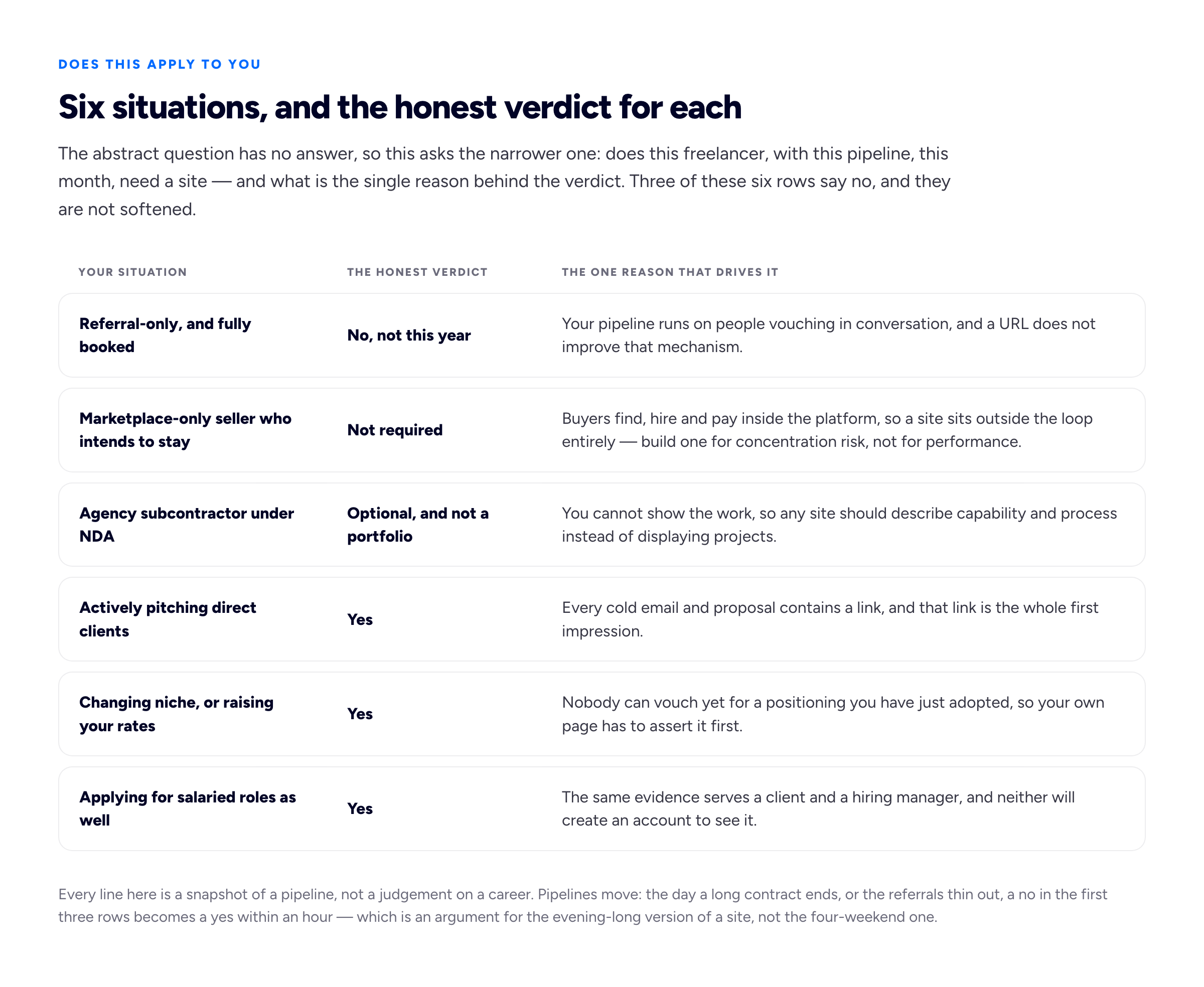
The verdict changes with your pipeline, not with your profession — which is why generic advice on this question is useless.
Is LinkedIn enough on its own?
For some freelancers, genuinely yes for a while. LinkedIn is free, a lot of business buyers are already there, and its settings let you control which sections are eligible to be shown to people who are not signed in or who arrive from a search tool — LinkedIn's own public profile visibility page describes exactly which parts you can expose or hide. If your prospects are all on LinkedIn and your work is not visual, a well-kept profile beats a neglected website.
The limits are structural rather than aesthetic. Your profile is a form, so it looks like everyone else's form and cannot be reordered around what makes you distinct. LinkedIn also notes on that same page that after you change your public profile it can take search engines weeks or months to pick the change up, and that LinkedIn does not control that refresh — a fair description of any page you do not own.
The ownership question is less dramatic than it sounds. The User Agreement says plainly that as between you and LinkedIn, you own the original content you post, and also sets out the broad, worldwide, sublicensable licence you grant them to use, copy, modify, distribute and display it — standard wherever you publish. The practical response is to keep the canonical version of anything you care about somewhere you control, keep LinkedIn as the place you are active, and let a site be the place the link goes. If your profile is already filled in, the fastest route to a site is to reuse it, which is the subject of turning a LinkedIn profile into a portfolio website.
Do I need a website to use Upwork or Fiverr?
No. Marketplaces sell you to their own buyers inside their own system; your profile there is what those buyers see, and a website changes nothing about that transaction.
We are deliberately unspecific about what those platforms' terms permit, because we could not open their documentation while writing this and we will not paraphrase terms of service from memory. If you intend to move a marketplace relationship off-platform, or to point marketplace buyers at your own site, read the current terms of the platform you are on first. Do not take a blog's word for them — including ours.
The argument for having a site anyway is not more marketplace work. It is that a marketplace-only business keeps all of its reputation, reviews and discovery in one account you do not own. That is a normal risk while you are building and a strange one to still be running five years later. The cheapest hedge is a page with your name on it holding the same evidence, so a bad month on the platform is a setback rather than a reset.
What if all my work comes from referrals?
Referrals are the best acquisition channel there is, and "do not rely on referrals" is usually said by people selling an alternative. If referrals fill your calendar, they fill your calendar.
What a website does inside a referral pipeline is narrower than a lead-generation claim. A referral has two halves: someone recommends you, then the person receiving the recommendation checks you. The first half is a conversation you cannot influence. The second is somebody typing your name into a search box, and what they find decides whether the first meeting starts reassured or sceptical. There is a knock-on effect too — "you should talk to Sam, they are great" travels further with a link attached, because the link does the explaining for the person recommending you.
None of that makes a site urgent when the pipeline is full. It makes it worth an evening rather than a weekend. If your referral flow is thinner than you would like, the constraint is usually asking rather than presenting, and asking clients for testimonials is the highest-return version of that conversation.
The minimum viable freelance website
Most people overshoot this enormously. They plan a multi-page site with a services page, a process page, a blog and a newsletter, then publish none of it. The threshold is much lower, and everything past it is optional. Five things have to exist — not five sections in a template, five pieces of information, in whatever layout you like.
- One sentence saying who you help and what changes. Not your job title. "Freelance Copywriter" is a category; "I write onboarding emails for B2B software companies, usually when trial-to-paid has stalled" is a position. It does more work than the rest of the page combined, and it is the one to write first, before you open any tool.
- Two or three pieces of evidence with an outcome attached. Not a thumbnail grid. For each: what the problem was, what you did, what happened. Three properly written beats twelve thumbnails, and we have argued the number in how many projects a portfolio should have.
- A contact route that is a plain email address in copyable text. Keep a form as well if you like the structure it imposes, but never as the only route. Forms fail silently, land in spam and break in updates. This is the failure that most reliably costs freelancers work, and its victims never learn it happened.
- A line about availability and scope. "Taking on new projects from October, typically two-to-six week engagements" answers the two questions every serious enquiry has before it is sent, and filters out the enquiries you would have declined.
- A URL with your name in it, and one photo of you. The address is what everything else hangs off; the photo is a cheap trust signal. A clear phone photo in decent light is fine.
That is the whole minimum. No blog unless you are going to publish. No services page listing nine things you would rather not do. No logo. Written this way the page also quietly ends a lot of exploratory conversations before they start, including the ones that were never going to convert — pair it with a clear rate position, and what to charge as a freelancer covers the harder half of that.
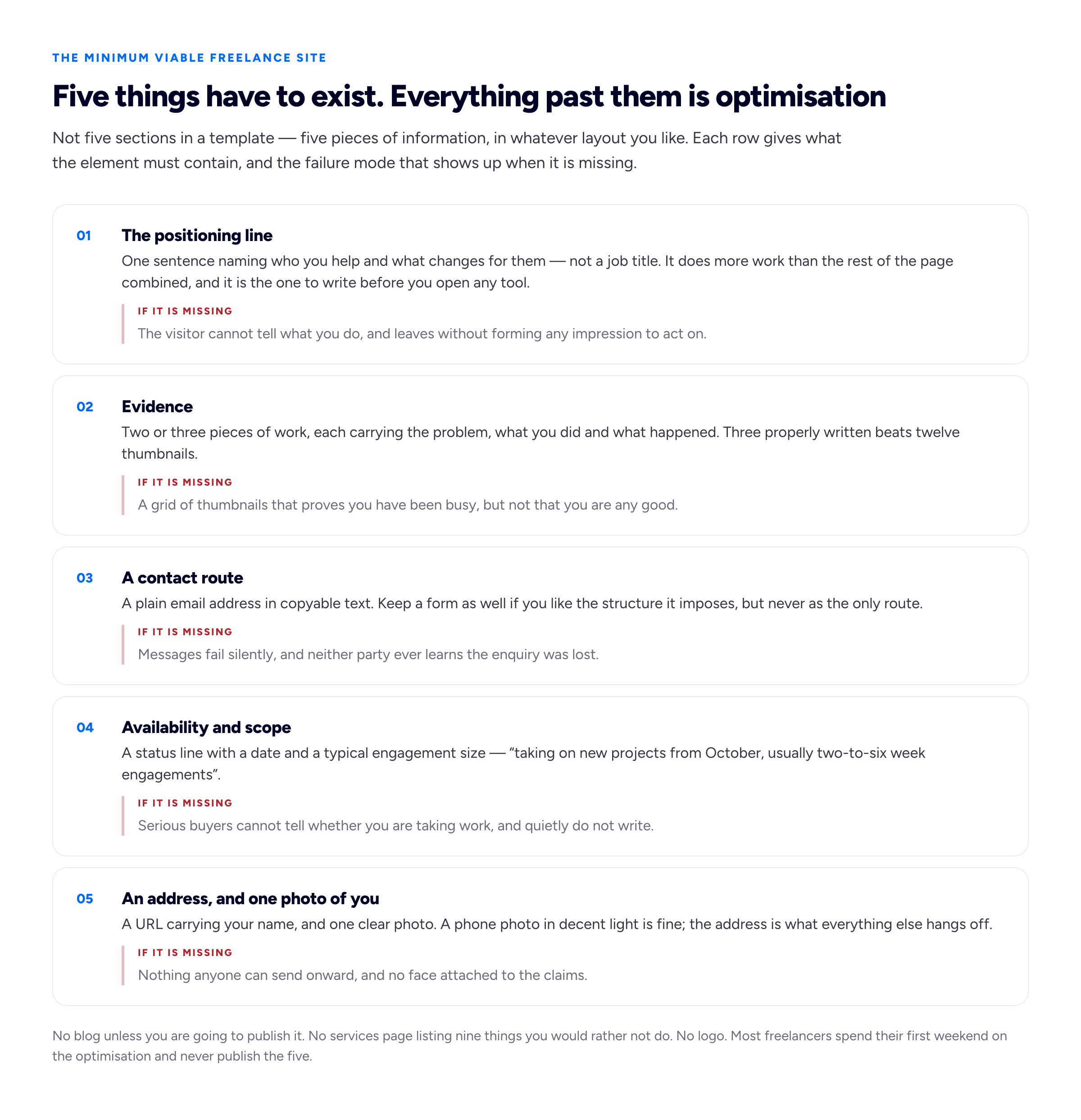
Everything past these five is optimisation, and most freelancers spend their first weekend there instead.
Is a free subdomain professional enough?
We give away subdomains, so here is the straight answer rather than the convenient one. Yes, for most freelancers, most of the time. A page at sam.somebuilder.com that is fast, clear and full of well-written evidence beats samdesign.com with three thumbnails and a broken contact form. A subdomain that exists outperforms a custom domain you are still thinking about. That is why our own free portfolio website hands you the subdomain at the first sign-in rather than holding it back as the reward for an upgrade.
It stops being enough at three specific points, worth knowing in advance rather than discovering.
When you are selling to enterprises, or when you want email at your own domain. Procurement and security reviews are staffed by people trained to look for signals of substance, and a platform subdomain in an email signature reads as smaller than you are. The more practical half is the address itself: sam@samdesign.com requires the domain, and a Gmail address in a proposal is the more visible version of the same signal.
When you are investing in being found. If you are going to publish, build links or run any long-term SEO effort, that effort accrues to a domain, and on an address you do not own it is not portable. Google's SEO starter guide is the sane starting point for what that work consists of; our own portfolio SEO guide covers the freelancer-sized version.
When you might move. The real one. Moving off a subdomain means every existing link — every proposal you sent, every directory listing, every profile field — points at an address you no longer control. Moving between hosts on your own domain is a DNS change and a set of redirects. The difference is not aesthetic; it is whether your past marketing keeps working.
Regardless of tool: publish on the free subdomain now, buy the domain once your name and positioning are stable, then point it at the same site. On Bunfolio, connecting a custom domain is an optional paid add-on and the free subdomain keeps working alongside it; the mechanics are in connecting a custom domain to your portfolio. Whatever the tool, find out what it charges to attach a domain you already bought before you build on it, because that is the price of the exit.
If the answer is yes, do it in this order
- Write the positioning line in a text file. Twenty minutes, no tool open. If you cannot write it, no builder will rescue you.
- List your evidence. What you can show, what you can describe but not show, what you can only claim.
- Write one project up properly. Problem, decision, outcome. One good write-up teaches you the format for the rest.
- Publish something incomplete. On a subdomain, on a ready-made portfolio template, on whatever gets it live. A live page you will improve beats a perfect page in a folder.
- Send it to five people and ask what is unclear. Not "what do you think", which gets you politeness. "What do you think I do, and what would you hesitate about" gets you the problem.
- Buy the domain once the positioning has stopped moving. Usually a few months in, not on day one.
Choosing a design is not a step. For most freelancers it is a way of postponing the writing, and the writing decides whether anybody replies. What does belong on the list is maintenance: a stale site with a 2021 copyright line, an empty blog and an unanswered contact form is a worse signal than no site at all.
Frequently asked questions
Do freelancers need a website in 2026?
Most do, and the reason has not changed in a decade: outbound work needs a destination you control, and referral checks need something to find. What has changed is the cost. When a site meant a designer, a developer and a hosting bill, "do I need one" was a budget question. Now the free version takes an evening, so the question is mostly whether you will maintain it.
Can I just use Instagram, Behance or Dribbble?
For discovery those platforms can genuinely outperform a site, because they have audiences and your site does not. The gap is the structural one described above: you do not control the address, the page or the account. Most working designers use both, and we compared the trade-off in Behance and Dribbble versus your own portfolio website.
How much should a freelance website cost?
Nothing, for the first version. Free tools, including our portfolio website builder, will get the five required elements live. Spend money when you have a specific reason — a domain, a photographer, a developer for something templates cannot do. Paying before you have written the positioning line is buying a container for content that does not exist.
What if I have no work to show yet?
The site's job changes rather than disappears. Self-directed projects, a rewritten public example, a detailed account of how you would approach a typical brief — all legitimate evidence when they are honest about what they are. The specifics are in building a portfolio with no professional experience.
How we put this guide together
The judgement here is ours and should be read as judgement. The list of freelancers who do not need a website, the five-element minimum, the points at which a free subdomain stops being enough, and the build order are our own positions, formed from working with freelancers, designers, developers and writers building portfolio sites on Bunfolio. Reasonable people disagree with parts of it, particularly the claim that a website does not generate leads on its own.
Where a claim is factual rather than editorial, it is sourced and linked. What LinkedIn reserves the right to do with an account, and the licence you grant when you post there, are quoted from the LinkedIn User Agreement. What you can expose or hide from logged-out visitors and search tools, and the note that search engines may take weeks or months to reflect a change LinkedIn does not control, come from LinkedIn's public profile visibility help page. The points about addresses and indexing come from Google's own documentation: moving a site with URL changes, the introduction to robots.txt, how Search works and the SEO starter guide. We have deliberately not described what any ranking system does with a particular page, because that is not knowable from outside.
On the marketplaces: we could not retrieve Upwork's or Fiverr's own terms and help documentation while writing this, so this guide asserts nothing about what either permits regarding off-platform contact, external links or account standing. That is a real gap and we would rather leave it visible than fill it with something plausible.
We have also left out the usual round numbers — the percentage of clients who check a freelancer online before hiring, the seconds a visitor spends on a page, the share of freelancers who have a website. All three circulate widely and we could not trace any of them to a primary source we would stand behind. An invented statistic is worth less than saying we do not know, so the arguments here rest on structure rather than numbers.
Every person, business, line of example copy and domain name used as illustration is invented, including Sam and the onboarding-email copywriter. Bunfolio's own product is described accurately: a free portfolio site on a subdomain, a choice of four templates, and a custom domain you can attach as an optional paid add-on if you own one.
Related reading: building a freelance portfolio website that wins clients if you have decided the answer is yes, turning your LinkedIn profile into a portfolio website for the fastest route from a profile you have already filled in, getting your first freelance clients for the pipeline work the site supports rather than replaces, and connecting a custom domain to your portfolio for the address question above.
More from the blog
September 26, 2026 · 15 min read
What Is a Freelance Artist? How the Work, Pay and Rights Actually Work
A freelance artist is paid by the job, not by a salary, and keeps the copyright unless they sign it away. How freelancing differs from commission, in-house and gallery work, where the money comes from...
September 23, 2026 · 18 min read
Portfolio vs Resume: Which One You Need, and When
A resume and a portfolio are not two formats of the same thing: one answers the screening question, the other answers "show me". This guide covers who needs which by profession, where the CV fits, and...
September 20, 2026 · 24 min read
ATS-Friendly Resume Format: What Actually Breaks
An applicant tracking system is a database with a form on the front, not a judge. Here is the two-minute test that shows you exactly what the parser sees in your own file, the failures that genuinely...