
July 25, 2026 · 17 min read · Updated September 25, 2026
Behance, Dribbble, or Your Own Site? What Each One Actually Does
Creative platforms do discovery and community; your own site does conversion and ownership. An honest breakdown of what each can and cannot do, including who genuinely does not need a site.
You have a Behance profile with a few thousand appreciations, or a Dribbble account where the good shots reliably pick up likes. Someone asks whether you have a website, and you send them a profile link, and it works fine. So the question sits there unresolved: is your own site worth a weekend, or is it a vanity project for people who like buying domains.
The honest answer is structural rather than tribal. Creative platforms are built for discovery and community. Your own site is built for conversion and ownership. Those are different jobs, and neither tool does the other one well, which is why the answer for most working designers is both, in a specific order.
We should say up front that we build portfolio sites, so we have a side in this comparison. That is exactly why this post spends time on what Behance and Dribbble do better than any site you could build, and on the readers for whom a platform profile genuinely is enough. If we only made the case for our own half, you would have no reason to trust the rest of it.
What Behance and Dribbble are genuinely good at
Start with the thing your own site cannot manufacture: an audience that is already there. On the day you publish a personal site, its traffic is you, refreshing it. On the day you post a shot, it enters a feed that people are already scrolling.
That difference is not a detail. It is the entire reason these platforms exist, and it compounds — an audience you built over three years of posting is a real asset, whatever domain it lives on.
Internal search is real demand. Dribbble's Pro page describes surfacing profiles and shots across feeds, Shot Search, Service Search and Designer Search, and giving Pro members a search ranking boost within the platform. People are inside Dribbble typing what they need. Nobody types anything into your website looking for a designer they have not met.
Hiring rails you would never build yourself. Dribbble's hiring page describes clients searching the community, sending a proposal request, agreeing terms and paying on Dribbble, with the platform holding project payment until the project is final. Your own site does not hold funds in escrow, verify a client, or give a nervous first-time buyer a familiar checkout. That is a genuine advantage, particularly on smaller projects with strangers.
Peer calibration. Both platforms show you what your craft looks like next to everyone else's, which is uncomfortable and useful. A personal site is a room with no other work in it, and it is very easy to overrate yourself in a room like that.
Far more control than people assume. Behance is not the bare grid critics describe. Its own post on Pro profile customisations covers organising work into sections, adding a customisable button that links out to an external site, a light or dark profile theme, visibility toggles, and password-protecting a project or restricting it to a shared link. That last one is a legitimately good feature, and better than what many self-built sites offer for work you cannot show publicly.
And the upkeep is zero. No DNS, no hosting, no build step, no broken image after a redesign. You upload work and the platform does the rest, indefinitely, for free at the base tier.
None of that is a consolation prize. If a platform is bringing you paid work, it is doing something your site would take a long time to replicate.
The things a profile page structurally cannot do
The limits worth caring about are not features anyone forgot to build. They follow from what a profile page is.
It lives at their address. Your profile is at behance.net/yourname or dribbble.com/yourname. That is not a complaint about either company; it is a description of the arrangement. Every link you earn, every mention in a newsletter, every business card you hand out points at a page whose layout, adjacent content, sign-up prompts and rules are set by someone else and can change without asking you.
You do not control what comes first. Profiles are ordered by the platform's logic — recency, engagement, whatever the product team decided. When a fintech client lands on your page, you want the fintech project first. On your own site that is a five-minute edit. On a profile it is whatever the grid says.
Depth is fought against, not supported. Both platforms reward work that reads instantly in a thumbnail. A hiring decision needs the opposite: constraints, what you tried, what you dropped, what it did once it shipped. You can write that on a project page, and some people do, but you are writing a long argument inside a container designed for a fast look. Our guide to writing a portfolio case study covers the shape that decision-makers actually read.
The contact path belongs to the platform. Behance Pro lets you add an outbound button, and Dribbble has a whole hiring product, so this is not absolute. But the default path is a message inside someone else's inbox, following someone else's funnel, with none of the qualifying questions you would ask if you designed the form.
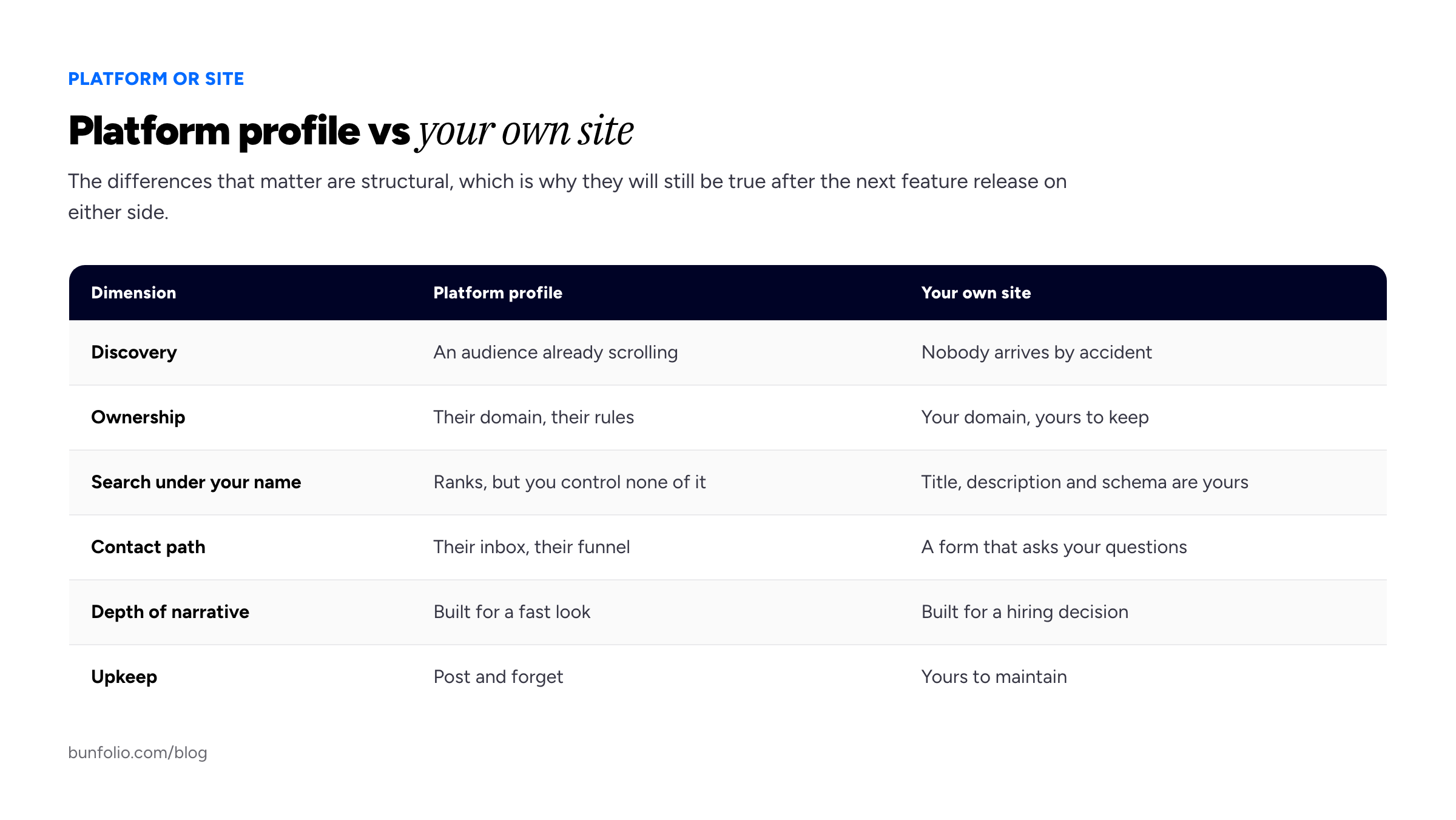
The differences that matter are structural, which is why they will still be true after the next feature release on either side.
"Found on Dribbble" and "hired from Dribbble" are different events
This is the distinction that resolves most of the argument, and the reason forum threads about it go in circles. People compare where clients were found with where clients were convinced, as if those happen in the same place.
Being found is an attention event. It takes a thumbnail that survives a fast scroll, a tag that matches a search, a bit of luck with timing. Platforms are excellent at this and your own site is close to useless at it for the first year.
Being hired is a risk event. Someone is about to spend budget and, more importantly, their own credibility inside their organisation on a person they have never met. What reduces that risk is not more pictures. It is evidence: what the constraints were, what you decided, what happened afterwards, what other clients say, how you run a project, what you cost, whether you are free in March.
A profile is optimised for the first event and largely silent on the second. So the person who saw your shot has to reconstruct your reliability from likes and follower counts, which are not evidence of anything relevant. Some of them will do that work. Most will not, and you will never know they were there.
This is also why "I got clients from Dribbble" and "I got clients from my website" are rarely competing claims. In the accounts we hear from designers, the same client often did both — saw the work in a feed, then read the site before writing.
What your own site adds
Set aside ownership for a moment, because it is the least persuasive argument to someone who has never lost an account. The practical additions are these.
- Order you choose. The first screen is an argument you get to make. For a UX portfolio that might be one process-heavy case study; for an illustrator it might be a wall of work. Either way, it is your call rather than the feed's.
- Room for the boring, decisive pages. An about page that answers what you are like to work with. A services page that says what you actually do and roughly what engagements look like. These pages win work quietly and have no equivalent on a profile.
- A contact path you designed. A form that asks for budget range, timeline and what they have already tried filters out half of your bad-fit enquiries before you read them.
- Search presence under your own name. On your own domain you control the title, the description and the structured data. Our portfolio SEO guide covers the handful of fields that do most of the work here.
- A stable address. One domain that survives a platform's redesign, your change of speciality, and your decision to leave a network. Connecting a custom domain is a half-hour job and the closest thing to a permanent asset in this trade.
Notice that none of these are aesthetic. A well-run Behance profile can easily look better than a rushed personal site. The site wins on what it can hold, not on how it looks.
The workflow: platform for reach, site for the decision
Run them as two stages of one path rather than as rivals. The platform does what it is good at — putting work in front of people who were not looking for you. The site does what it is good at — turning a mildly interested stranger into someone who writes an email with a budget in it.
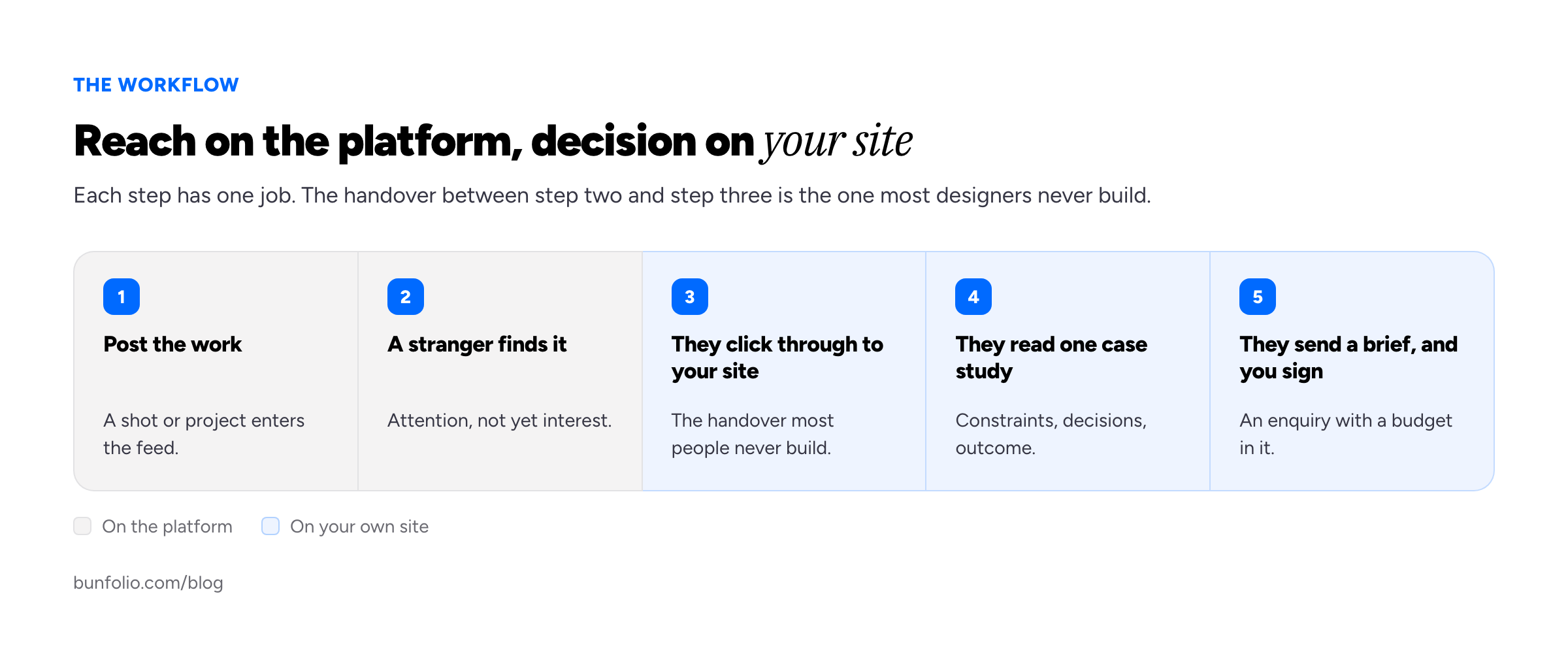
Each step has one job, and the handover between step two and step three is the one most designers never build.
Three practical rules make the handover work.
First, keep posting. Publishing a site is not an exit from the platform, and a profile that stops updating stops being shown. The site does not replace the feed; it catches what the feed sends you.
Second, point the profile at one destination — your domain — rather than a link aggregator that adds a click and answers nothing. Behance's customisable button and the website field on both platforms exist precisely for this.
Third, write the site for someone who has already seen the pictures. Repeating your shot captions wastes the one place where you can talk about money, process, constraints and results.
What to move across first, and what to leave
The mistake that kills most first attempts is trying to reproduce the whole profile. You have sixty shots; you start migrating them; you get bored on shot eleven and the site sits half-built for a year.
Move across, in this order:
- Three to five projects, written up properly. Not your most-liked work — the work you want more of. Full case studies with the brief, the constraint, the decision and the outcome.
- An about page that a client, not a peer, would find reassuring.
- Services and how you work, in plain language, including how a project starts.
- One or two testimonials. If you have none, asking for them is a twenty-minute job with a long payoff.
- Contact details, including an email address that is visible without a click.
Leave behind, deliberately: explorations, unshipped concepts, animation tests, the branding piece from four years ago, and anything whose only argument is that it looks nice. Those belong in the feed, where they do a real job of attracting attention. On a site they dilute the three projects you want to be judged on. We have written more on how many projects a portfolio site should hold, and the number is always smaller than people expect.
Selection is the part of the work a platform cannot do for you. Your profile shows what you have made; your site should show what you want to be hired for. For most people those are noticeably different sets, and that gap is the argument for having both.
The case for platform-only, made honestly
There are readers for whom a personal site is genuinely not the next thing to do, and pretending otherwise would be a sales pitch rather than advice.
You are employed and not taking freelance work. If you post for community, craft feedback and the occasional job offer, a profile does that completely. Recruiters are comfortable there. Build a site when you want inbound clients, not before.
Your inbound already works and comes from one platform's hiring product. If briefs arrive through Dribbble's project flow and the payment rails suit you, adding a site is an optimisation, not a rescue. Do it when you want to raise rates or shift discipline, both of which are easier to argue on a page you control.
You do not have three projects worth writing up yet. A thin site is worse than no site. Make the work first — our guide on building a portfolio with no client experience covers how to generate something real to write about.
You will not maintain it. This is the one people underestimate. A profile stays current because posting is one action. A neglected site with three-year-old work, a dead contact form and a stale availability line does active damage. If the honest forecast is that you will not touch it again, a well-kept profile is the better presentation of you.
And a general point of triage: if the choice this weekend is between building a site and making a better piece of work, make the work. The site is a container. It cannot improve what goes in it.
Linking the two together properly
Once both exist, connect them in both directions. This costs almost nothing and it is where a lot of people leave value on the floor.
Profile to site. Fill the website field on every profile with your domain. Also put the URL in the profile bio text, because people copy text more often than they click buttons.
Site to profiles. Link your Behance, Dribbble, LinkedIn and anywhere else you post, from your contact section or footer. This is not just courtesy to the reader — links are how the web is traversed, and Google's SEO starter guide states plainly that it primarily finds pages through links from other pages it has already crawled.
Declare that the accounts are the same person. This is what the schema.org sameAs property is for: the URL of a reference page that unambiguously indicates the item's identity. Google lists sameAs as a recommended field in its profile page structured data documentation, describing it as the URL to other external profiles or home pages for the profile. In practice you emit a small block of JSON-LD on your site describing you as a Person, with sameAs listing your profile URLs.
Our honest read, from running portfolio sites: treat this as correctness rather than as a growth lever. It helps search engines resolve that the Behance account, the Dribbble account and the site are one person. It is not a ranking trick, and anyone selling it as one is overstating it. It is also cheap — Bunfolio emits Person JSON-LD with your sameAs profile links server-side, and most other tools have a field for it somewhere.
Keep the surface consistent while you are in there: the same display name, the same handle where possible, the same photo. A client checking three tabs should not have to work out whether they are looking at the same person.
A realistic first week
Assume an hour a day. Nothing here requires a redesign of your identity.
- Day one. Choose the three projects you want more of. Not the most popular ones. Write the one-line argument each is making.
- Day two. Write the first case study properly. If you only ever finish one, this is the one that does the work.
- Day three. The other two, shorter. Then the about page.
- Day four. Services, contact, and an availability line you will actually keep updated.
- Day five. Domain, page titles, descriptions and the
sameAslinks. Check it on a phone. - Day six. Update the website field and bio on every profile you hold, including the dormant ones.
- Day seven. Post something on the platform, and mention in the description that the full write-up is on your site.
Publish it at eighty per cent. A portfolio site is never finished, and the version sitting in a draft state helps nobody. If you want a shortcut on the setup, Bunfolio can import a public LinkedIn URL, assign you a free subdomain such as jane.bunfolio.com, and put one of four single-page templates — home, about, services, portfolio, testimonials, contact — around your work; the writing is still yours to do, and it is the part that matters. If you would rather settle the tooling question before you spend the week, we set the main portfolio website builders against each other first, ours included.
Frequently asked questions
Is Behance enough on its own?
For community, craft feedback and being discovered, often yes. For converting a stranger into a paying client, it is doing a job it was not designed for. If the work you get is already good and enough, there is no emergency. If enquiries arrive but stall before a brief, the missing piece is usually the depth a profile cannot hold.
Should I have a website if I am on Behance and getting work there?
Yes, but not urgently, and not as a replacement. Build it as the page you send people to after they find you, and keep posting exactly as you do now. The order that works is platform for reach, site for the decision.
Will publishing the same projects in both places cause a problem?
Putting your own work on your own site and on your profile is completely normal practice, and we would be sceptical of anyone claiming a specific penalty for it without a source. The practical advice is different anyway: write different text for each. The profile caption is for someone scrolling; the site page is for someone deciding.
My Behance profile outranks anything I could build. Does that settle it?
Not really, and it might be true for a while. A large, established domain has advantages your new site will not have. But the query that matters most is your own name, where you are the most relevant page on the internet, and the fix for being outranked there is partly just time and partly linking to your site from every profile you hold. Chasing generic head terms is a different and much less winnable fight.
Dribbble versus a personal website — which brings more enquiries?
They are not comparable in that form. Dribbble brings volume of attention from people who did not know you existed. A personal website brings quality of enquiry from people who already do. Designers who dislike their enquiry quality usually need the site; designers with no enquiries at all usually need the reach first.
Behance Pro comes with Adobe Portfolio, so is that not the same thing?
It is a reasonable option, and worth noting that Adobe — which owns Behance — bundles a separate site builder with it and documents the two working together in its Adobe Portfolio FAQ. That is the same structural argument this post is making, from the company that runs the platform: the profile is for being discovered, the site is your own address. Which builder you use matters far less than whether the site exists and says something a profile cannot.
How we put this guide together
We sell the "own site" half of this comparison, so treat the framing with appropriate suspicion and check the parts we sourced. Everything we say Behance and Dribbble do is taken from their own pages: Dribbble's Pro and hiring pages for in-platform search visibility, proposals and held payments, and Behance's profile customisations post for sections, outbound buttons, themes and password-protected projects. The sameAs guidance comes from schema.org and Google's profile page structured data documentation, and the point about links being how pages are found comes from Google's SEO starter guide.
We deliberately left out pricing tiers, follower thresholds, feed-ranking behaviour and any "designers get N times more enquiries" figure. Those either change without notice or trace back to nobody, and a wrong claim about a competitor is worse than a gap. The judgement calls — that discovery and conversion are separate events, that three to five written-up projects beat a full migration, that a neglected site is worse than a well-kept profile, that sameAs is correctness rather than a ranking lever — are ours, formed from hosting portfolio sites and reading how designers describe their own enquiry flow. They are opinions with reasons attached, not measurements. All example names and copy here are invented.
Related reading: how to build a graphic design portfolio, how to write a portfolio case study, and what makes a freelance portfolio site win clients.
More from the blog
September 26, 2026 · 15 min read
What Is a Freelance Artist? How the Work, Pay and Rights Actually Work
A freelance artist is paid by the job, not by a salary, and keeps the copyright unless they sign it away. How freelancing differs from commission, in-house and gallery work, where the money comes from...
September 23, 2026 · 18 min read
Portfolio vs Resume: Which One You Need, and When
A resume and a portfolio are not two formats of the same thing: one answers the screening question, the other answers "show me". This guide covers who needs which by profession, where the CV fits, and...
September 21, 2026 · 18 min read
Nursing Portfolio: What to Include, Who Reads It and How to Build One
An interview panel, a clinical ladder committee, a certification auditor and an NMC confirmer all read a nursing portfolio, and only one of them wants the binder every guide describes. What each actua...