
July 7, 2026 · 18 min read
How Many Projects Should Your Portfolio Show?
Everything else on this question says "three to five, quality over quantity" and stops. Here is the framework instead: the count by discipline and career stage, what to cut, and how to order what remains.
The question arrives in the same shape every time. Someone has six projects, or four, or two, and wants to know whether that is enough — publish now, or hold back until the set looks more convincing. It gets asked on freeCodeCamp forums, on Quora, in every career-change community, and the answer is almost always the same four words: three to five, quality over quantity.
That advice is not wrong. It is just not an answer, because it says nothing about the seventh project you are unsure of, the one strong project you are embarrassed to publish alone, or the twelve pieces accumulated over four years that no longer describe the work you want.
So this guide takes a position. It gives numbers, defends them, and then explains the things that matter more than the number: how the count changes by discipline and career stage, what to do when you are below the threshold, when a bigger portfolio genuinely helps, what to cut and where the cut work should live, and how to order what survives. The examples here are invented, and the recommendations are our own judgement from building and hosting portfolio sites.
Why there is no universal number
Three variables move the answer, and none is your project count.
The first is how much a single piece proves in your field. A photograph proves very little on its own, so photographers are judged on a body of work. A shipped, complex web application proves rather a lot, because it could not have happened by accident. The stronger the evidence carried by one piece, the fewer pieces you need.
The second is your career stage. Early on, the portfolio's job is to show you can do the work at all, which takes variety. Later it is to show you are the specific person for a specific job, which takes focus. Those goals pull in opposite directions, and a portfolio that has not noticed the shift keeps growing when it should be narrowing.
The third is who you want to hire you. A studio hiring for a three-month contract wants depth on one relevant thing; a small business owner picking a freelancer wants to see something that looks like their own project. If you have decided to niche down, the portfolio should get smaller and sharper as it does.
Underneath all of that sits one principle that settles most of these arguments: a portfolio is averaged, not summed. Nobody totals up your work and awards points. They form an impression of your standard, and the weakest visible item pulls that impression down harder than the strongest one lifts it. That is why "more is safer" is wrong, and why the pruning half of this guide matters more than the counting half.
The number to aim for, and why we defend it
Here is our answer, stated plainly so you can argue with it.
- Three is the working minimum for a portfolio you are asking someone to make a hiring decision from.
- Four to six is the range most freelancers should sit in, and where most portfolios that convert well end up.
- Beyond eight, you are arranging work for yourself rather than for a client, unless your discipline is one of the volume disciplines discussed below.
The floor is about pattern. One project can be luck, or a very good art director. Two can be coincidence. Three is the first number at which a reader sees something consistent — a way of working, a level of finish, a kind of problem you gravitate towards. Below three, every reviewer is guessing, and guesswork resolves against you.
The reasoning for the ceiling is about attention, and here there is real evidence rather than intuition. Nielsen Norman Group's 2018 eyetracking study of scrolling behaviour found that 74% of page-viewing time was spent in the first two screenfuls, with the sharp drop-off after the fold unchanged since their 2010 research. Your eighth project is not being weighed against your first. It is not being seen. What it does instead is dilute the average and make the visitor work harder to find the thing that would have won them over.
The minimum for a portfolio website is therefore three — but three is a floor, not a target. If a fourth is close to ready, finish it. If the fourth would be filler, publish three and spend the time writing the first one up properly.
How the number changes by discipline
The most useless thing about generic portfolio advice is that it treats a photographer and a backend developer as the same case. They are not, because the unit of evidence is different in each field.
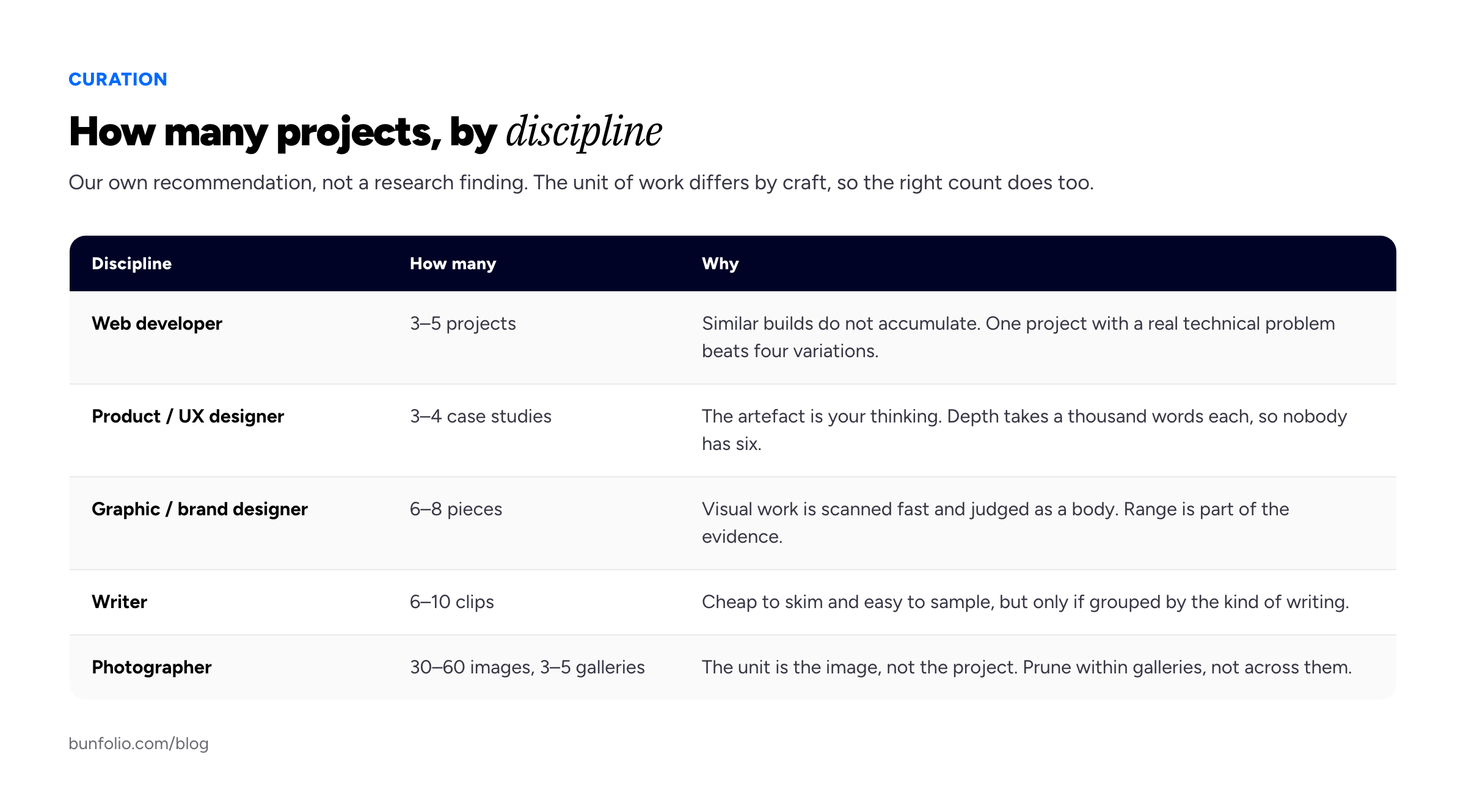
The count follows the unit of evidence. Where one piece proves a lot, you need fewer of them.
Some notes on the rows that need them.
Developers get asked "how many projects on a developer portfolio" more than anyone, usually by people who have just finished a bootcamp and have five similar CRUD applications. Three good ones beat five similar ones every time, because the fourth and fifth demonstrate nothing the first three did not. What moves a technical reviewer is depth in one place — a real problem, a trade-off, something that ran in production and broke and got fixed. We cover the rest of that reader's checklist in our guide to what hiring managers look for in a developer portfolio.
Product and UX designers have the lowest count of anyone, and it surprises people. Three deep case studies is a complete portfolio; four is generous. The artefact being assessed is your thinking, and thinking takes a thousand words and eight screens to show. Four shallow projects here are a weaker signal than two thorough ones, which is why our UX portfolio guide is mostly about the structure of a single case study rather than how many to have.
Photographers and illustrators are the genuine exception to everything above. The unit is the image, not the project, and thirty to sixty images grouped into three to five galleries is normal and correct. Nobody assesses a photographer on four photographs, so pruning here means ruthlessness within each gallery rather than across the set. Modelling sits at the same end of the scale for a different reason — a book is read as a range of looks rather than a set of projects, which is why a model portfolio website is counted in images and lands between fifteen and twenty-five of them.
Writers sit in the middle at six to ten clips, because written work is cheap to skim — but only if it is grouped. Ten unsorted links is worse than six sorted by the kind of writing they represent.
What to do when you have one or two strong projects
This is the situation the "three to five" advice abandons people in, and it is the most common one. You have one piece of work you are genuinely proud of and a second that is decent, and the gap between that and a respectable portfolio feels enormous.
It is not enormous. You have three moves, and they are all cheaper than waiting.
Deepen. Turn your best project into a full case study — brief, constraint, two decisions you can defend, outcome, what you would change. One properly written case study outperforms four thumbnails with titles underneath, because it is the only format that shows how you think.
Split, but only honestly. A large engagement often contains genuinely distinct work — a brand identity and the website that came out of it, or a data migration and the reporting tool on top. Two entries is legitimate if they had different briefs and outcomes. Slicing one project into three by deliverable is not, and readers detect it immediately.
Add on purpose. Write yourself a brief with a real constraint and a real deadline, and build one thing against it. This works far better than people expect, provided you label it as self-initiated and never imply otherwise. Our guide to building a portfolio with no professional experience goes through what counts as evidence when nobody has paid you yet.
What you should not do is publish placeholders. "More coming soon" and empty category pages read as abandonment. Two strong projects with real writing beside them is a credible site; two strong projects plus four "coming soon" tiles is not.
When a bigger portfolio genuinely helps
The quality-versus-quantity framing in most portfolio advice is lazy, because there are real cases where quantity is the quality signal.
When the buyer is pattern-matching to their own project. A small business owner looking for a booking site is not evaluating your range; they are looking for a booking site. The more specific the need, the more valuable something adjacent to it in the set becomes — even if that piece is not your best work. This is the strongest argument for six rather than three.
When you serve more than one market deliberately. If half your income is editorial illustration and half is packaging, a three-piece portfolio is always misrepresenting you to one of those audiences. The fix is not just more pieces, though; it is grouping, so each visitor finds their half without scrolling through the other.
When search is a real acquisition channel. Every project with substantial writing is a page that can rank for the thing it describes — "Shopify theme migration for a furniture retailer" is a phrase somebody types. That only works when the writing is real, which is a good reason to add projects slowly rather than in bulk; our portfolio SEO guide covers what makes those pages worth indexing.
When the work is inherently serial. Photography, illustration, motion design, editorial writing — covered above, and worth repeating because the general advice actively harms people in these fields. Editing is the exception within the exception: the reel does the volume, so a video editor's portfolio carries three or four full pieces beneath it and no more.
Outside those four cases, the honest answer to "should I add another project" is usually that you should improve an existing one instead.
How many of them should be full case studies
"How many case studies" is a different question from "how many projects", and conflating them is why so many portfolios stall. A case study is expensive — realistically a working day to write, edit and lay out. Nobody has six of those in them at once.
Our recommendation is one to three full case studies, with the remaining projects as short entries of a hundred words or so. One is enough to prove you can articulate your work. Three is the point of diminishing returns, because visitors rarely read more than two in a sitting.
The short entries still need writing — the brief in a sentence, what you did, what changed. What they do not need is process narrative, research artefacts and a reflections section. Our guide on how to write a portfolio case study sets out the structure we recommend for the long form.
Order of work matters. If you have five thin projects and no case study, do not add a sixth — pick the best of the five and spend a day on it. That day returns more than any new tile.
How to prune: keep, rewrite, or archive
Pruning is the part everyone knows they should do and nobody does, because deleting work feels like deleting effort. Make it a test rather than a feeling: ask four questions of every piece, in order.
- Would you take more work like this? If the answer is no, the piece is actively working against you. A portfolio is a menu, and everything on it is an invitation.
- Can a stranger tell what you did? Not what the thing is — what your contribution was. If it is ambiguous, the piece is not carrying credit for you.
- Is it the weakest thing here? There is always a weakest item. The question is whether it is close enough to the rest that nobody notices, or far enough below to set the tone.
- Does it duplicate a neighbour? Two pieces you would describe in the same sentence occupy two slots and do one slot's work.
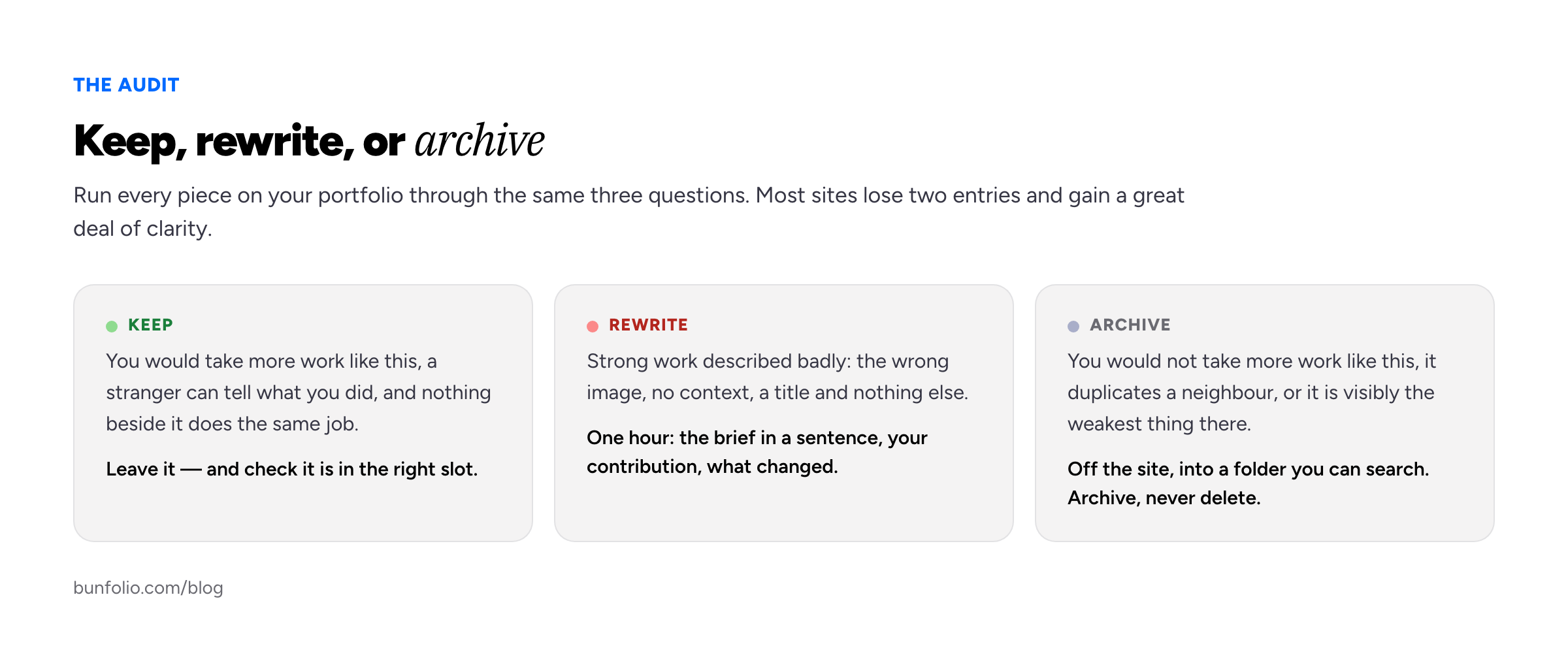
Most pieces that feel like cuts are actually rewrites. Test before you delete.
What this test surfaces is that what to remove from a portfolio is rarely the same as what to throw away. Many weak entries are strong work described badly — the wrong image, no context, a title and nothing else. That is a rewrite, an hour's work rather than a loss.
Archive rather than delete
When something genuinely does not belong on the site, do not destroy it. Keep the files, screenshots and a two-line description in a folder you can search — the moment you need it is when a prospect asks whether you have ever worked in their sector.
Work that is off the site can still live somewhere with lower stakes — a platform profile, a repository, a shots feed. That is one of the more sensible uses of those platforms, which we compare with a site of your own in Behance and Dribbble versus your own portfolio website. Genuinely restricted work is a separate problem: see showing confidential work under an NDA.
Pruning should not be driven by age. A four-year-old project that still represents the work you want is more valuable than a recent one that does not. Relevance is the test.
Ordering: the first slot, the second slot, and the last
Given the attention data above, ordering is worth as much as the pruning. Three slots do nearly all the work.
The first slot is not for your most impressive project. It is for the work you want more of. This is the most common ordering mistake. People lead with the biggest client name or the most demanding build, then wonder why enquiries keep arriving for work they no longer want. The first item sets the expectation for everything after it — and since a reader meets it as a thumbnail before they meet it as a project, the image you choose for that slot is doing as much work as the choice of project.
The second slot decides whether the first was a fluke. It is underrated, and it should be doing a specific job: proving the pattern. It ought to be as strong as the first and visibly different from it — a different sector, a different problem, a different medium — so that the two together say "this is a standard" rather than "this is one good day". Two near-identical projects in the first two slots waste the most valuable position on the page.
The last slot should not be the leftovers. Whatever ends the sequence is what the visitor carries into their decision, and a set that visibly deteriorates reads as someone running out of material. End on something solid, and put the unremarkable-but-necessary pieces in the middle where the attention curve is already flat.
In practice the sequence is strong, strong-and-different, middle, middle, strong. Bunfolio's Projects manager keeps an explicit sort order rather than defaulting to newest-first, because chronological is almost never the right sequence for persuasion. Whatever tool you use, check you can control the order before deciding it does not matter.
Signs you have too many, and signs you have too few
If you are not sure which side of the line you are on, these are the symptoms we see most often.
You have a portfolio with too many projects if:
- You cannot list what is on the page from memory.
- Two entries would get the same one-sentence description.
- Some entries have no writing beside them, only an image and a title.
- You hesitate before sending the link to a particular prospect, because they would have to scroll past work that is irrelevant to them.
You have too few if:
- The same project appears under two categories to make the set look fuller.
- A prospect has asked whether you have anything else to show.
- Every piece is the same type of work, so the set proves you can do one thing once.
The first list is far more common than the second. Most portfolios that feel wrong are not short of work; they are short of editing, which is a smaller job than it feels like from the inside.
A one-hour portfolio audit
Do this in one sitting, because the value comes from judging the pieces against each other rather than one at a time.
Minutes 0–10. Write down every piece on the site, in order, with a one-sentence description of each from memory before you read the page. Anything you could not describe is already telling you something.
Minutes 10–25. Run the four questions over each piece: would you take more of this, can a stranger tell what you did, is it the weakest thing here, does it duplicate a neighbour. Mark each keep, rewrite, or archive.
Minutes 25–40. Remove the archives. Do not negotiate with yourself — you are keeping the files, not burning them. If this takes you below three pieces, stop removing and start rewriting.
Minutes 40–50. Reorder what remains. Work you want more of first, a strong and different piece second, solid piece last, everything else in the middle.
Minutes 50–60. Rewrite the descriptions on the first two items only — they get most of the attention, so they deserve most of the writing. Then open the site on a phone and scroll it once, because that is how most people will meet it.
Do this twice a year. It takes less time than adding a project and usually improves the site more.
Frequently asked questions
Is six projects too many for a portfolio?
No, six sits comfortably in the range we recommend for most freelancers. It becomes too many when two of the six do the same job, or when one is noticeably weaker than the rest. Judge the set by its weakest visible item, not by its count.
What is the absolute minimum number of projects?
Three, if you want a stranger to decide from the page alone. You can publish with one or two, and often should, but then the writing has to do the work the missing projects would have done — one full case study rather than three short entries.
How many projects should a developer portfolio have?
Three to five, weighted towards depth. Similar projects do not accumulate: five variations on the same application prove roughly what one proves. One project with a genuine technical problem and a defended decision beats four tutorials in different colours.
Do old projects hurt my portfolio?
Age is not the problem — irrelevance is. A project from three years ago that represents work you still want is fine to keep. What does hurt is a set where the recent work is visibly weaker than the older work, because that reads as a trajectory.
Should I show personal projects next to client work?
Yes, provided they are labelled as self-initiated and are as finished as the client work. Personal projects often say something client work cannot, because you chose the problem. What fails is a personal project presented ambiguously enough that a reader might assume it was commissioned.
Should the same project appear in two categories?
Avoid it. It reads as padding, and anyone browsing both categories sees the repetition immediately. If a project genuinely spans two services, put it in the more important one and mention the second in the description.
How we put this guide together
The numbers here — three as a floor, four to six as the working range, eight as the point where you are arranging work for yourself, one to three full case studies, and the per-discipline counts in the table — are our own recommendations. They come from building the portfolio template and hosting portfolio sites on Bunfolio, and from the consistent shape of the question when freelancers ask it: almost always someone with enough material and no editing, rather than someone genuinely short of work. Treat them as defaults to argue with, not as findings.
The one external claim we make is about attention. The figure that 74% of page-viewing time falls within the first two screenfuls comes from Nielsen Norman Group's eyetracking research, Scrolling and Attention by Therese Fessenden (April 2018), which reports 130,000 eye fixations across 120 participants and finds the post-fold drop-off unchanged from their 2010 study. We have deliberately not attached percentages to anything else. Portfolio advice circulates many figures about how long reviewers look at a page or how many projects clients prefer; we could not trace those to a study you can open and read, so we have left them out rather than repeat them. Where we describe reviewer behaviour without a citation, that is our observation offered as a rule of thumb. All example scenarios, client types and sample descriptions in this guide are invented.
Related reading: portfolio website examples, how to build a freelance portfolio website that wins clients, one-page versus multi-page portfolios, writing a portfolio About page that does its job, and what pages a portfolio website should have.
More from the blog
September 24, 2026 · 18 min read
Brand Designer Portfolio: Show the System, Not Just the Logo
Most brand designer portfolios are one logo on six mockups, which answers none of the questions a client is actually asking. Here is how to structure an identity case study that shows the whole system...
September 8, 2026 · 18 min read
Event Planner Portfolio: How to Show the Work Nobody Sees
A good corporate event leaves almost nothing behind, which makes it hard to prove you ran it. Here is how to build an event planner portfolio from scale lines, rebuilt run-of-show pages, post-event fi...
September 6, 2026 · 18 min read
Wedding Planner Portfolio: How to Show the Work Nobody Photographs
A wedding planner's portfolio is usually other people's photographs of other people's flowers, and couples cannot see the planning in it. How to show logistics, credit suppliers properly, start with s...