
August 21, 2026 · 18 min read
Model Portfolio Website: Building a Book That Books Work
Your book is a technical document with a conventional structure, read quickly and rejected faster. The eight shots it needs, why stats accuracy is not optional, and which direction the money should always flow.
A model portfolio website is one of the few portfolios where bad advice costs money rather than just opportunities. Search the phrase and you will find pages telling you to lead with your most heavily retouched editorial, to round your measurements up or down to a nicer number, and — worst of the three — that a "top agency" is ready to represent you as soon as you pay for their in-house photographer's package. The first two get your book rejected quietly. The third is the classic shape of a modelling scam, and people lose several hundred pounds to it every week.
So this guide takes the opposite approach from most. It treats your book as what it actually is — a technical document with a conventional structure that professionals read quickly and reject fast — and it spends a proper section on money direction, personal safety and what a public page reveals about you. If you are under 18, read the section on minors with a parent or guardian before you publish anything at all.
A book is a document, not a gallery
Most portfolio advice, including a lot of ours for other fields, is about curation and taste. A modelling book is different. Agents, bookers and casting directors are not browsing for pleasure; they are checking a specific list of things in a specific order, usually in under a minute, usually with dozens of other submissions open. If the list is incomplete they stop, because an incomplete book means they cannot answer the only question they have, which is what does this person actually look like, and can I put them in front of a client.
A quick note on spelling before we go further, because it confuses people submitting online. British sources write "modelling portfolio" and American ones write "modeling portfolio"; agencies, casting sites and search engines treat them as the same thing. Use whichever matches the market you are submitting to and be consistent within your own site. This guide uses the British spelling except where quoting the American convention.
The structure below is close to universal across markets. Individual agencies vary in what they ask for on top of it, and some will give you a shot list of their own when they take you on — follow theirs when they do.
Digitals, also called polaroids or snaps
These come first and they matter most, which is exactly backwards from what almost every new model believes. Digitals are plain, unretouched photographs taken in natural light against a blank wall: no makeup or the barest minimum, hair down and unstyled, fitted plain clothing — a vest and jeans, or simple swimwear if you are comfortable with that and old enough for it — no jewellery, no filters, no posing. You need front, three-quarter, profile and full-length, standing straight, plus one of each smiling and neutral.
They exist for one reason: a client is going to put clothes on you, or a camera in front of you, and they need to know what they are getting. Bone structure, proportion, skin, hair texture, actual body shape. A book made entirely of styled, lit, retouched editorial hides all of that, and an experienced booker reads a book with no digitals as an attempt to hide something — usually not deliberately, but the effect is the same. Digitals are also the cheapest part of the whole exercise. You need a phone, a window, a plain wall and someone to press the button.
Headshots, one neutral and one smiling
Clean, close, eyes to camera, minimal styling. The neutral one shows structure; the smiling one shows whether you can be warm on camera, which is what almost all commercial work is buying. Two separate shots, not one shot where you are doing something in between. Photographers who shoot for agencies will produce both without being asked.
Full-length and three-quarter body shots
Simple styling, clear background, whole body in frame with the feet not cropped, and a three-quarter that shows posture and line. These prove proportion in a way a headshot cannot, and they are what a client checks against your stated measurements.
Editorial and commercial work
Only now do the styled images come in, and their job is to show range rather than to show peak quality. Two or three editorial images demonstrating that you can hold a strong, stylised look. Two or three commercial images — lifestyle, catalogue-style, warm and approachable — demonstrating that you can also be the person in a supermarket advert. Most models are strong at one and weak at the other, and a book that shows only the one you enjoy tells a booker you are half as castable as you might be.
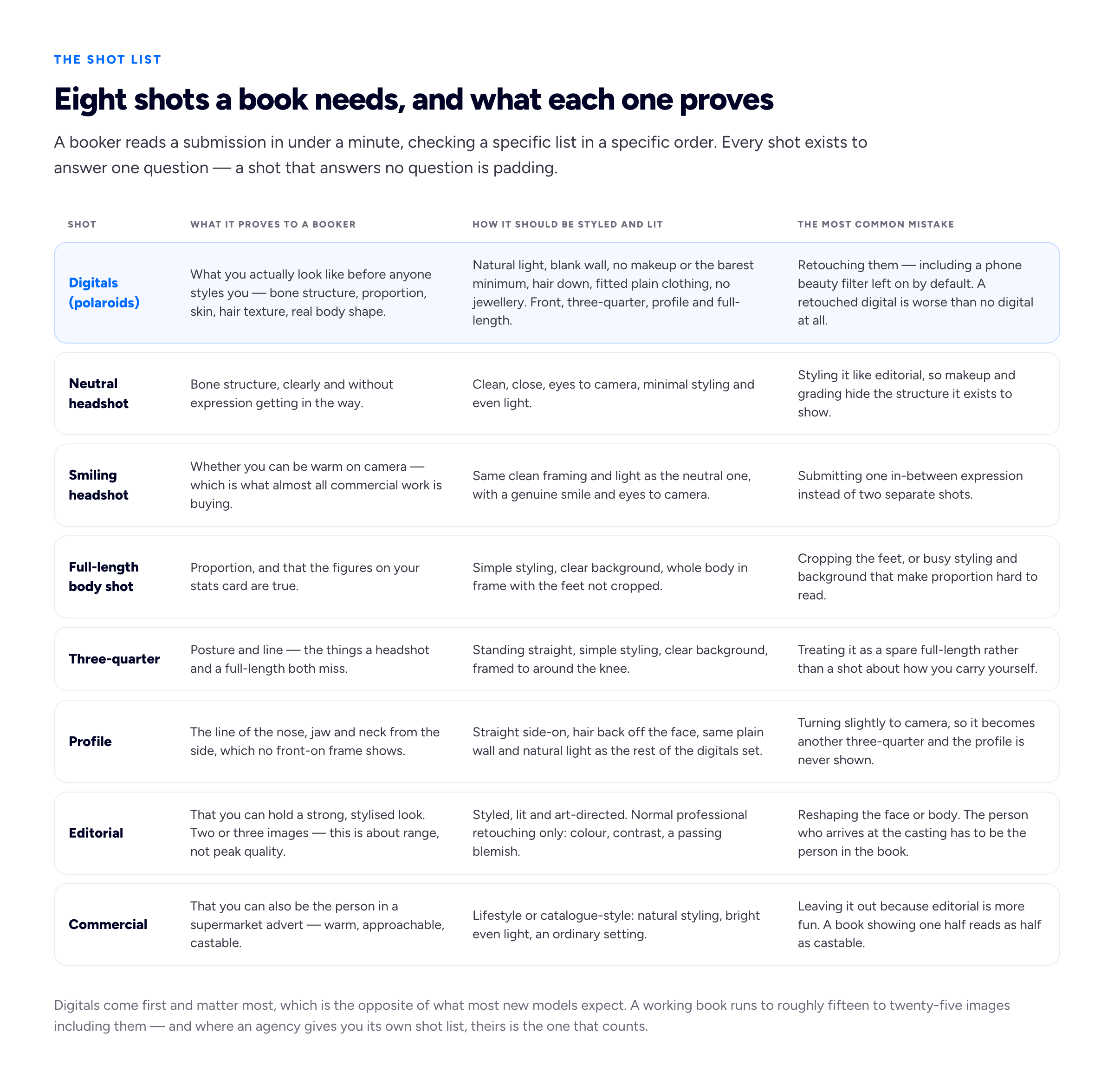
The left-hand column is the one to read first. Every shot in a book exists to answer a specific question, and a shot that answers no question is padding.
The stats card, and why accuracy is not optional
Here is the thing a modelling portfolio carries that no other portfolio does: a short block of physical measurements and details, published plainly on the page. The convention is roughly this — height, bust or chest, waist, hips, dress or suit size, shoe size, hair colour, eye colour, and the city or region you are based in. Some markets add inside leg or collar for men's tailoring, and some add whether you are available to travel.
It looks impersonal because it is. Casting is largely a matching exercise against sample sizes and client briefs, and the stats card is the filter that runs before anyone looks at a single photograph. A booker with a brief for a size-appropriate fitting model will scan twenty cards and open three books.
Which is why the figures must be true. They are verified in person, with a tape measure, at castings and at fittings — routinely and without embarrassment, because it is a normal part of the job. If your card says one thing and the tape says another, you have wasted a booker's afternoon, possibly a client's studio day, and the relationship is generally over. Not because anyone is cruel about it, but because they cannot risk it happening on a paid job.
So: measure honestly, have someone else take the measurements if you can, record them in centimetres and inches if you are submitting internationally, and re-measure every few months. Bodies change. Updating a figure downward or upward is completely unremarkable; being caught two inches out is not. Do not put an aspirational number on a public page and plan to grow into it.
Two practical notes. Give your location as a city or region — "based in Manchester, available in London" — and never a street address or postcode. And if you are represented, check whether your agency wants its own version of your card to be the authoritative one; some do, and a mismatch between your site and their board causes exactly the problem described above.
How many images, and the order they go in
A working book is usually somewhere between fifteen and twenty-five images, and that includes the digitals. Below about twelve it reads as untested. Above about thirty it reads as undiscriminating, and nobody reaches the end anyway.
Sequence matters more here than in most fields because the reading is so fast. A structure that works:
- Open with your single strongest headshot. One image, given room. This is the frame that decides whether the rest gets looked at.
- Digitals next, as a clean set. Grouping them together signals that you know the convention. Scattering them through the book signals that you do not.
- Then full-length and three-quarter, so the physical picture is complete before any styling appears.
- Then editorial, then commercial, alternating if you have enough, so range is visible rather than claimed.
- Close on a strong, warm image. The last frame is what a booker remembers when they are deciding who to call.
What to leave out, and this is where most books get heavier than they should: holiday and party photographs, anything with other people in it that is not a professional shot, heavily filtered social media images, mirror selfies, group shots where a booker has to work out which one is you, images with visible logos of brands you have not worked for, and anything you are keeping purely because you like how you looked that day. Our general guidance on how many pieces belong in a portfolio applies here too: the weakest item sets the ceiling, not the average.
Retouching, and the most common self-inflicted rejection
Take a clear position on this, because it is the mistake we see most often and it is entirely avoidable.
Digitals are never retouched. Not softened, not slimmed, not colour-graded into something moody, not run through a phone's beauty filter — which is on by default on a lot of front cameras and which people genuinely forget about. A retouched digital is worse than no digital at all, because its whole purpose is to be the unedited reference point, and altering it removes the only thing in the book a booker can trust.
Editorial images are a different matter. Normal professional retouching — colour, contrast, a blemish that was not there last week — is expected and fine. What is not fine is reshaping your body or face, because the person who arrives at the casting has to be the person in the book. There is a simple test: if a booker could look at the image, then look at you standing in front of them, and feel misled, it has gone too far.
The uncomfortable version of this advice is that the features you are most tempted to edit out are frequently the ones that get you booked. Gaps, freckles, a nose with character, height at either end of the range, hair that does not behave — distinctiveness is commercially useful. A perfectly smoothed face is interchangeable with thousands of others.
Safety, scams, and which direction the money flows
This section is the reason this guide exists. Modelling attracts more predatory operators than almost any other creative field, because the people entering it are often young, often new to contracts, and frequently told that opportunities are scarce and must be paid for.
The single most useful rule in the industry is about the direction money travels. A legitimate agency makes money when you make money. It takes a commission on work it books for you, out of fees the client pays. That is the whole model. It does not need you to pay to be represented, to be listed, to be added to a database, to attend a paid "screening", or to buy a package of test shots from a photographer it happens to own.
So treat all of the following as a stop signal rather than a negotiating point:
- An upfront fee to sign, register or be listed. Any framing — administration, portfolio setup, website inclusion, "your place on the board".
- A mandatory in-house photographer. The tell is not that they recommend photographers; good agencies do. It is that you must use theirs, at their price, before anything else can happen.
- Guaranteed work. Nobody can guarantee bookings. An agency that does is selling something other than representation.
- Urgency. Sign today, the slot is going, the client needs an answer this afternoon. Urgency exists to stop you checking.
- A contract you cannot take away and read, or one you are asked to sign on the spot, or one that is exclusive, long, and silent about how you get out of it. Our guide to contract essentials covers what to look for generally, though a representation agreement is a specialist document and worth showing to a solicitor.
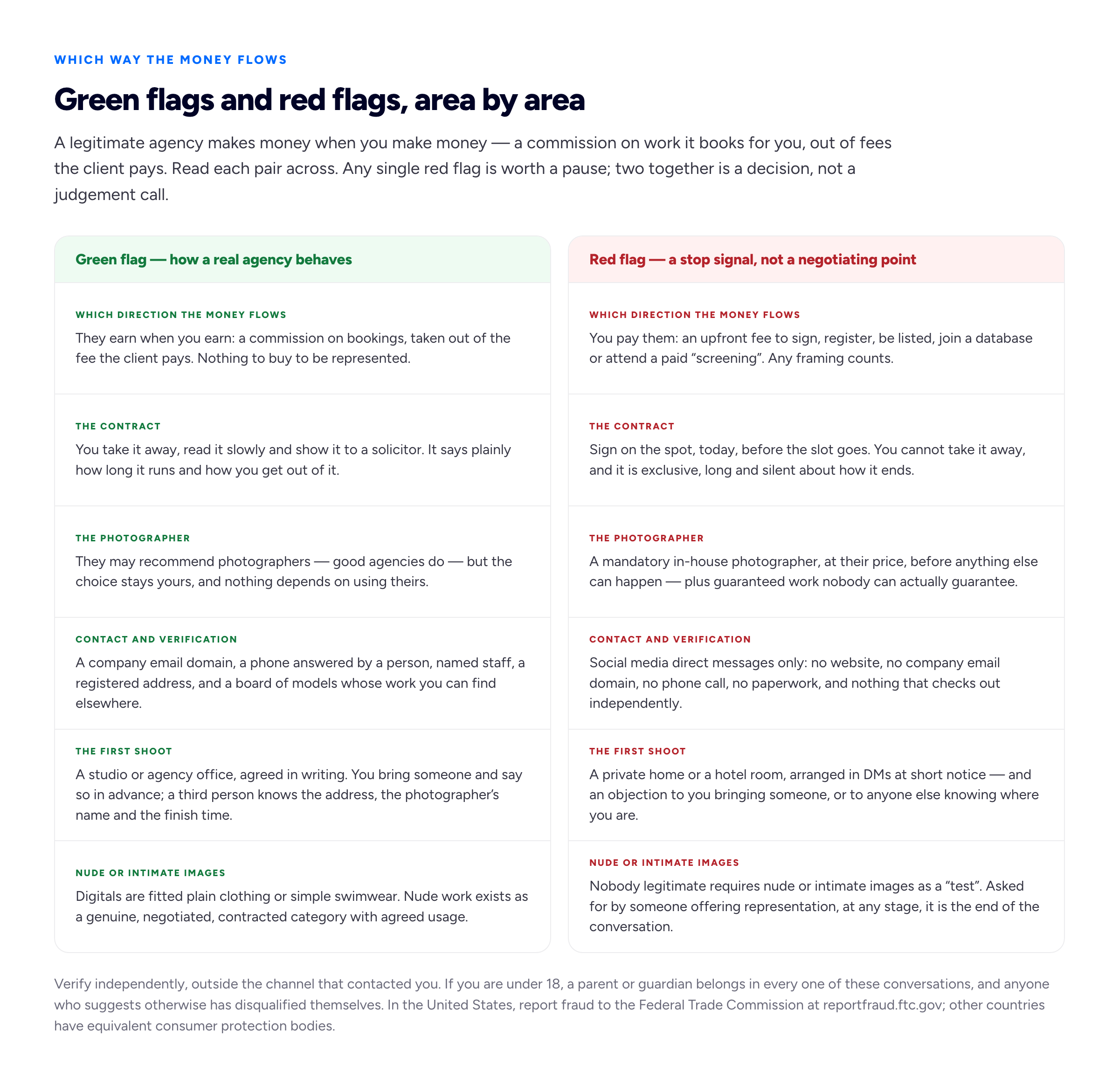
Any single red flag is worth a pause. Two together is a decision, not a judgement call.
Verify independently before you engage. Look the company up outside the channel that contacted you: a registered business address, a phone number that is answered, named staff, a client list you can cross-check, and models on their board whose work you can find elsewhere. Where your country has a trade body or professional association for talent agencies, check whether they are a member. If something looks like a scam, report it — in the United States that is the Federal Trade Commission at reportfraud.ftc.gov, and other countries have equivalent consumer protection bodies. Reporting rarely gets your own money back, and it does make the next person's search return something useful.
Personal safety once your site is public
A public model portfolio website is a document about your body, your face and your whereabouts, published to strangers. That is a reasonable trade for being findable, but it needs handling deliberately.
- Never publish your home address, and give location as a city rather than a neighbourhood. If you shoot at home, do not say so.
- Think hard before putting a phone number on a public page. A contact form or a dedicated email address used only for modelling gives you a filter and a record. If you are represented, route enquiries to your agency and say so.
- Strip location metadata from images before uploading. Most site builders do this on upload, including ours, but check rather than assume.
- Take someone with you to a first shoot, and say in advance that you are bringing someone. A professional will not mind. Someone who objects has told you what you needed to know.
- Tell a third person where you are going, with the address, the photographer's name and the expected finish time. Studios and agency offices are safer than private homes and hotel rooms; a first shoot at a private residence deserves real scrutiny.
- Be cautious about castings arranged only through social media direct messages, with no company email domain, no website, no phone call and no paperwork. This is the most common entry point for the fake-booker approach.
- Nobody legitimate requires nude or intimate images as a "test". Digitals are fitted plain clothing or simple swimwear. A request for anything beyond that from someone offering representation, at any stage, is the end of the conversation. Nude work exists as a genuine, negotiated, contracted category with agreed usage — it is never a screening step and never a favour.
A separate note on age, because it is the part people skip. If you are under 18, a parent or guardian needs to be involved — in the agency conversation, in signing anything, and at shoots. Legitimate agencies expect this and build around it; an operator who wants to deal with a minor directly, or who suggests keeping the arrangement from a parent, has disqualified themselves entirely. A minor's portfolio should carry no contact details, no location beyond a broad region, and no measurements presented in a way that invites contact from strangers. Contact should route to the guardian or the agency. Several countries and US states also regulate work by minors specifically, including permits and trust arrangements for earnings, and that is a question for proper advice rather than a blog post.
Much of the general pattern-spotting in our piece on client red flags transfers directly here — vagueness about money, pressure to skip paperwork, and a reluctance to be verified are the same signals in every freelance field.
If you have no professional shots yet
You can build a credible first book without paying anyone. Start with digitals, which cost nothing and are the most important section anyway. Overcast daylight or a large window, a plain wall, a friend holding the phone at chest height about two metres back, no zoom, no filter. Twenty minutes of that gives you a usable set.
Beyond that, the normal route is a test shoot — often arranged on a time-for-print or time-for-portfolio basis, where nobody pays anybody and everyone keeps images for their own book. TFP is legitimate and widespread, and it is also where inexperienced models get taken advantage of, so evaluate one properly:
- Look at the photographer's existing published work, and check it looks like work you want.
- Ask for references from models they have shot before, and actually contact one.
- Agree the concept, the styling, the location, the finish time and who else will be present, in writing, beforehand.
- Agree how many edited images you receive and by when. "A few" is not an agreement.
- Agree what each side may use the images for. This is the part people forget, and it is the part that causes problems later.
- Bring someone. See above.
Two or three good test shoots plus a clean set of digitals is a book. Our guide to building a portfolio with no professional experience covers the same problem from the other creative fields' angle.
Credits and usage rights
Credit the photographer on every professional image — name at minimum, and stylist, hair and makeup where they were involved. It is the convention, it is good manners, and it is a signal to bookers that you have worked on real sets and understand how they run.
Usage is the less obvious half. The photographer generally owns the copyright in the images; what you have is a licence to use them, and the scope of that licence is whatever you agreed. Portfolio use is almost always included. Commercial use by a brand is a different thing entirely, and images from a shoot for one client may not be usable in ways that client's contract restricts. If you are unsure whether you can publish a particular set, ask before you publish rather than after. Where work is under an embargo or a confidentiality agreement, our notes on showing confidential work explain the safe ways to handle it.
Where a model portfolio website fits alongside everything else
You will end up with several presences, and they do different jobs. The mistake is treating them as interchangeable.
Your agency profile is authoritative but not yours. It shows the images they chose, in their layout, with contact routed to them, and it disappears the day you change agencies. That is fine — it is doing the agency's job well.
Casting platforms are where a lot of submissions actually happen, and you need to be on the ones your market uses. They are also crowded, template-driven, and often gated behind a subscription. They are distribution.
Instagram is discovery. It compresses and crops your work, orders it by recency, and buries your book under whatever you posted last week. Useful for being found, poor as a portfolio.
Your own site is the address you control. It holds the full book in the right order, the current stats card, the credits, and one contact route on your terms. It survives agency changes, platform policy changes and algorithm changes, and it is what someone reaches when they search your name six months after seeing you on a shoot. That last case is more common than new models expect and it is worth being ready for. Free subdomain sites like Bunfolio's exist precisely so this does not need a budget, and you can point a custom domain at it later when your name is worth owning.
Keep the site as the source of truth, link it from every platform profile, and make sure it loads properly on a phone — because a booker forwarding you to a client is almost always doing it from a phone, in a hurry, between other things.
How we put this guide together
Bunfolio builds portfolio websites. We are not a modelling agency, we do not represent anyone, we have no role in the industry beyond hosting the page your work sits on, and nothing above is legal, contractual or career advice. Representation agreements, image licences and anything at all involving a model under 18 are areas where the specifics of your jurisdiction matter and where the cost of getting it wrong is real — take proper advice from a solicitor or a qualified adviser before signing, and involve a parent or guardian throughout where a minor is concerned.
Four things here are our own judgement rather than industry rule: the book structure and what belongs in it, the sequencing advice, the position that digitals should never be retouched and that reshaping a face or body in editorial crosses a line, and the argument that your own site is the address you own while agency boards, casting platforms and Instagram are distribution. That judgement is formed from working with freelancers building portfolios on Bunfolio across a range of fields, and from watching which portfolios persuade buyers and which do not. Individual agencies will ask for things we have not listed; when they do, theirs is the shot list that counts.
The scam guidance is the part we least wanted to get wrong, so the reporting route is attributed to a primary source rather than paraphrased from other blogs: fraud in the United States is reported to the Federal Trade Commission at reportfraud.ftc.gov, and the FTC's general consumer guidance sits at consumer.ftc.gov. We have deliberately not named a national trade body for talent agencies, because membership schemes differ by country and naming one we could not verify would send readers somewhere useless. Check what exists in your own market before relying on it.
We also deliberately did not quote a figure for how many aspiring models encounter a pay-to-be-listed scheme, or how much the average victim loses. Numbers for both circulate widely and we could not trace a single one back to a primary source that would survive checking, and an invented statistic in a section about people being deceived would be worth considerably less than saying plainly that we do not have one. Every model, agency, city, measurement convention and example in this guide is invented for illustration; no real agency or person is described. The measurement and shot-list conventions are general industry practice as we understand it, not a standard any particular agency is bound by.
Related reading: building a photography portfolio website, how to build a portfolio with no experience, and freelance client red flags.
More from the blog
October 5, 2026 · 16 min read
How to Become a Freelance Photographer: From Good Photos to Paid Work
A practical path from "I take good photos" to paid freelance work: choosing a niche, the kit you actually need, and building a portfolio before you have clients. Plus the business basics photography a...
September 30, 2026 · 16 min read
What Is Freelancing? A Plain-English Guide to Freelance Work
Freelancing is selling a skill to several clients one job at a time instead of working for one employer. How a freelancer differs from an employee, contractor or gig worker, one freelance job from enq...
September 26, 2026 · 15 min read
What Is a Freelance Artist? How the Work, Pay and Rights Actually Work
A freelance artist is paid by the job, not by a salary, and keeps the copyright unless they sign it away. How freelancing differs from commission, in-house and gallery work, where the money comes from...