
September 30, 2026 · 16 min read
What Is Freelancing? A Plain-English Guide to Freelance Work
Freelancing is selling a skill to several clients one job at a time instead of working for one employer. How a freelancer differs from an employee, contractor or gig worker, one freelance job from enquiry to payment, pay models, honest pros and cons, and what you need to start.
Freelancing is working for yourself, selling a skill to several clients one job at a time, instead of working for one employer for a salary. A freelancer agrees the work, the price and the deadline with each client, delivers it, sends an invoice and gets paid per project, per hour or per month. Nobody gives you holiday pay, a pension or a manager; in return you choose the work, the clients and the hours, and you handle your own tax.
That is the short answer to "what is freelancing". The rest of this guide is the working picture: how a freelancer differs from an employee, a contractor and a gig worker, what one freelance job looks like from first message to final payment, the common kinds of freelance work, how freelancers charge, the honest trade-offs, and what you need before you start. If you already know you want to try it, our guide to how to start freelancing with no experience is the practical next step.
What does freelance mean?
"Freelance" describes a way of working, not a job title. A freelance designer, developer and bookkeeper do very different work under the same arrangement: in business on their own account, taking work from clients rather than an employer, for as long as the work lasts. That arrangement is what freelance work is.
Three features show up in almost every arrangement:
- You are paid for the work, not through a payroll. Even hourly freelancers invoice for a defined service rather than drawing a wage.
- You decide how the work gets done. The client says what they want and when; you decide how, with what tools, from where and in what order.
- You carry the business side. Finding clients, quoting, contracts, invoicing, chasing payment, tax and insurance are all yours.
"Freelance" does not mean unpaid or casual. The "free" is about being free of a single employer, and many freelancers work with the same clients for years.
Where does the word freelance come from?
It started as a soldier. The Online Etymology Dictionary dates "free lance" to 1820 and Sir Walter Scott's novel Ivanhoe, where it describes a medieval mercenary: a knight whose lance was not pledged to any one lord, available to whoever would pay. Etymonline calls it "apparently a coinage" of Scott's. The figurative sense followed in the 1860s, journalism picked it up by the 1880s, "freelancer" is recorded from 1898 and the verb "to freelance" from 1902. The idea has barely moved: skilled, independent, hired job by job.
What is a freelancer, compared with an employee, contractor or gig worker?
The labels overlap and get used loosely. The table separates the five arrangements people most often mix up, as they usually work; the legal position is in the next section.
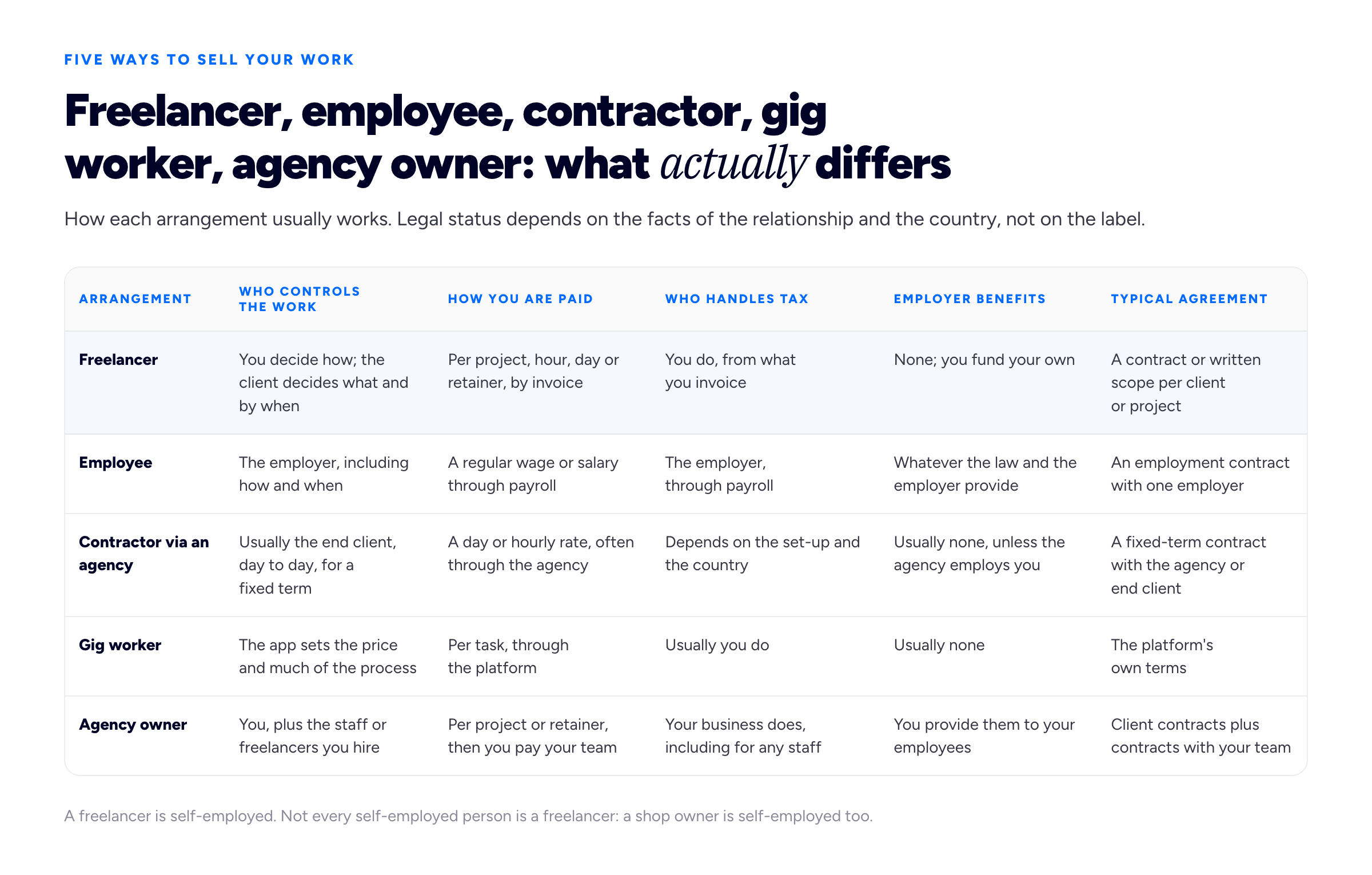
The rows are typical patterns rather than rules. A contractor in one country is a freelancer in another, and the same person can sit in two rows at once.
Freelancer vs employee
An employee is paid a wage with tax taken through payroll, works under the employer's direction, and gets whatever the law and the employer provide: paid holiday, sick pay, a pension. A freelancer gets none of that from the client, and instead gets the right to say no, set their own price, work for competitors and decide how the work is done.
Freelancer vs contractor
"Contractor" usually means a longer, full-time engagement, often in IT or engineering: months on one client's project, often placed by an agency. "Freelancer" more often means several shorter jobs for several clients. In the US both are independent contractors for tax purposes; the difference is pattern, not law.
Freelancer vs gig worker
A gig worker takes small, standardised tasks through an app (deliveries, rides) where the platform sets the price. A freelancer sells a skilled service and sets their own price. Marketplaces like Upwork and Fiverr sit in between.
Freelancer vs agency
An agency employs or subcontracts other people to deliver the work. Many started as one freelancer who got too busy; once you hire others to do the client's work, you are running an agency.
What does it mean to be self-employed, legally?
Being self-employed means running a business on your own account. Freelancers are self-employed, but what a contract calls you does not settle your legal status: tax authorities and courts look at how the relationship actually works, and the tests vary by country. Here are the two systems we checked.
In the United States
The IRS says you are generally self-employed if you carry on a trade or business as a sole proprietor or independent contractor, or are otherwise in business for yourself, "including in a part-time business or as a gig worker". To decide whether someone is an employee or an independent contractor, the IRS looks at three kinds of evidence: behavioural control (does the company control, or have the right to control, what you do and how you do it?), financial control (who controls the business side: how you are paid, whether expenses are reimbursed, who provides the tools?) and the type of relationship (written contracts, employee-type benefits, whether it is expected to continue, whether the work is a key part of their business). The IRS says there is no "magic" number of factors that decides it.
The Department of Labor applies a separate test for minimum wage and overtime under the Fair Labor Standards Act, built on "economic reality": if you are economically dependent on the business for work, you are an employee; if you are in business for yourself, you are an independent contractor. Its fact sheet is explicit that a job title, receiving a 1099 form or signing an independent contractor agreement does not decide the question. Misclassification matters because, as the DOL puts it, misclassified employees may not receive the minimum wage and overtime they are entitled to.
In the United Kingdom
GOV.UK describes a person as self-employed if they "run their business for themselves and take responsibility for its success or failure", and lists signs such as putting in bids or quotes for work, not being under direct supervision, submitting invoices, being responsible for their own tax and National Insurance, and not getting holiday or sick pay. It also notes that your status in tax law can differ from your status in employment law. If you work through your own limited company, the off-payroll working rules (usually called IR35) apply: they are designed so that someone who would be an employee if the company were not there pays broadly the same tax as an employee would. For medium and large clients, the client decides the status, and HMRC's Check Employment Status for Tax (CEST) tool exists to help.
Other countries apply their own tests. The practical point is the same everywhere: a "freelance" role with fixed hours, close direction and one client indefinitely may legally be employment, which changes who owes the tax. When in doubt, check your tax authority's guidance or ask an accountant.
How does freelancing work, day to day?
Here is the life of one job, start to finish, using an invented example: a freelance web designer and a small bakery that wants a new site.
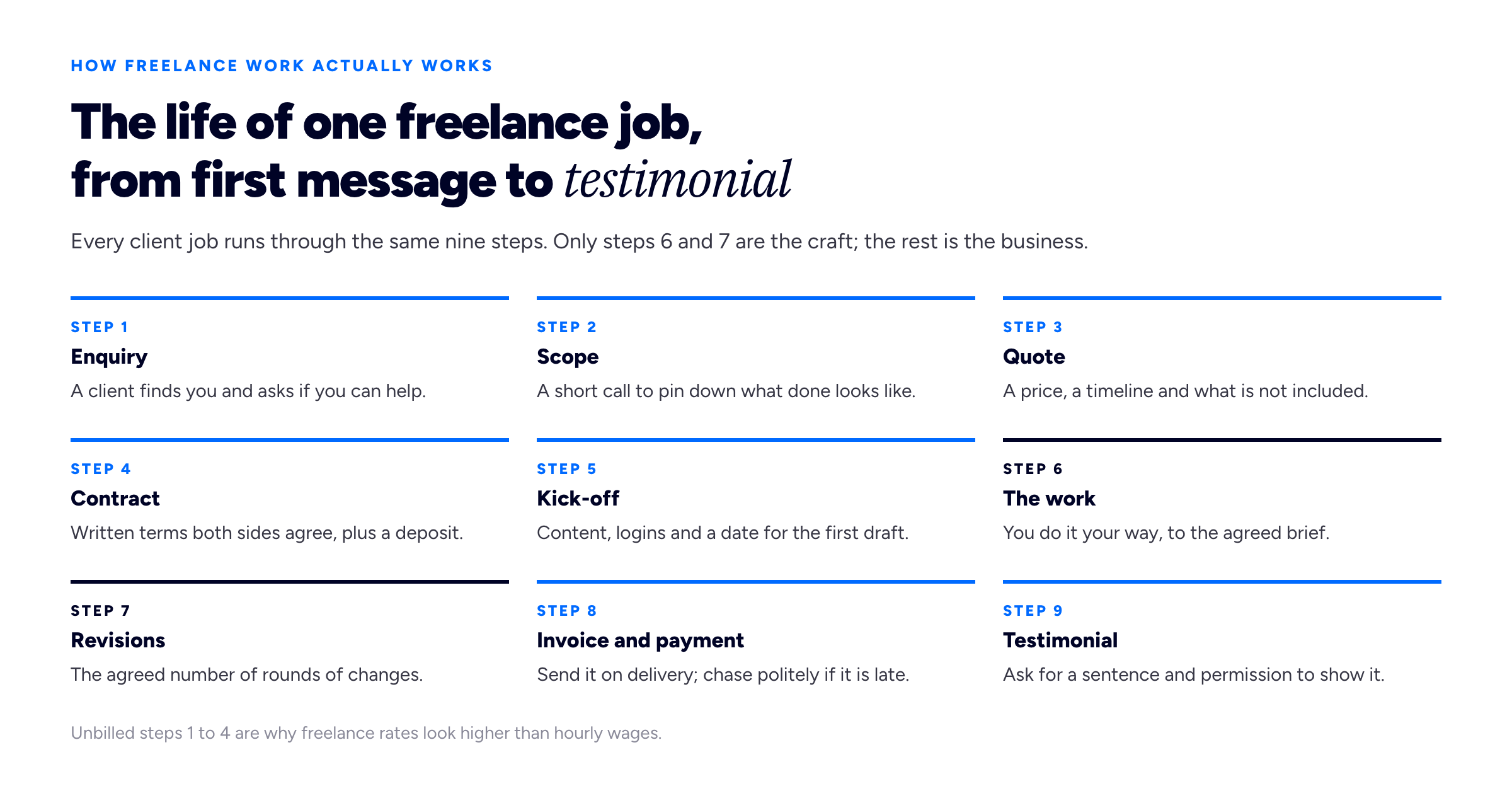
The bakery is invented, but the sequence is the one almost every freelance job follows. Skipping step 4 is where most disputes begin.
1. Finding the work
Clients come from people who already know you, referrals, people who find you (a portfolio site, search, a marketplace profile) and people you approach directly. Early on, the first source usually matters most. Our guide to getting your first freelance clients covers each channel in depth.
2. Scoping and quoting
The bakery owner emails: "Can you redo our website? Nobody can find the opening hours." You do not reply with a price but with questions, or a twenty-minute call: how many pages, who writes the words, is online ordering needed, when must it launch, what is the budget? Then a short quote:
"Five-page website (home, menu, about, visit us, contact), using your existing photos and the text you supply. One design concept and two rounds of changes. Launch by 14 November. Fixed fee, 50% to start and 50% on launch. Online ordering is not included and can be quoted separately."
3. The contract
Once they say yes, you put the terms in writing: scope, deadlines, fee, payment schedule, revisions, who owns the work once it is paid for, and how either side can end the arrangement. It does not need to be twenty pages, but it does need to exist. Our freelance contract essentials lists the clauses that prevent the most common disputes.
4. Doing the work, and holding the line
The tricky bit is rarely the craft; it is requests that drift past the agreement: "Could you also set up our Instagram?" The professional answer is not a silent yes but "Happy to. That is outside what we agreed, so I will send a separate quote." Our guide to freelance scope creep has wording for exactly that moment.
5. Invoicing and getting paid
When the work is delivered you send an invoice: your details, theirs, an invoice number, the date, what was delivered, the amount, the payment terms and how to pay. Our free invoice generator produces one without an account. Late payment is one of the most common complaints freelancers have, and deposits, clear terms and a calm chasing routine help most; see how to get paid on time.
6. Tax, and the next job
From each payment, you set aside money for tax, because nobody has withheld it (see the FAQ below for the US and UK thresholds). Then you ask the happy client for a testimonial, and the cycle starts again, ideally with that client coming back or referring someone.
What is a freelance job? Common types of freelance work
Almost any skill that can be delivered as a defined piece of work can be freelanced. These are the broad families, with examples of what a client actually buys:
- Design and creative: logos and brand identities, illustration, packaging, presentation design, UX and UI design, photography, video editing, motion graphics. See our guide to the freelance artist for how creative work adds licensing on top of the making fee.
- Writing and language: website copy, blog articles, email sequences, technical documentation, editing and proofreading, translation, ghostwriting.
- Development and technical: websites, web apps, mobile apps, integrations and automations, data analysis, IT support, cybersecurity reviews.
- Marketing: social media management, paid advertising, search engine optimisation, email marketing, strategy for small businesses.
- Business support: virtual assistance, bookkeeping, project management, recruitment support, customer service.
- Specialist and consulting: coaching, training, tutoring, legal or financial work by qualified professionals, engineering and architecture, interim management.
Some fields, such as law and some trades, need a qualification or licence first, depending on where you work. Most creative, writing and technical work does not; clients hire from your proof.
How do freelancers get paid?
There are four common pricing models, and most freelancers end up using more than one.
- Hourly or daily rate. Simple and fair for open-ended work, like ongoing support or maintenance. The drawback is that getting faster earns you less, and clients watch the clock.
- Fixed project fee. One price for a defined outcome, like the bakery website. Clients like knowing the cost up front, and you keep the benefit of working efficiently. The risk is that a vague scope turns a fair fee into a loss.
- Retainer. A monthly fee for an agreed amount of ongoing work, such as four blog posts or a set number of support hours. It smooths out income, which is the main thing many freelancers lack.
- Value-based pricing. A price tied to what the outcome is worth to the client. It suits experienced freelancers with a track record of results.
Your price should start from what you need per billable hour once unbilled time is counted, which is why freelance rates look higher than a salary's hourly equivalent: they also pay for holidays, equipment and quiet months. We have not quoted typical rates, because the ones in circulation rarely say where they came from. Our full guide to how much to charge as a freelancer walks through the calculation.
Is freelancing a real job? The pros and cons, honestly
It is a real way to earn a living, and for some people better than employment. It is also harder than freelance-course adverts suggest.
What is good about it
- Control. You choose your clients, your projects, your methods and, within deadlines, your hours.
- No salary band. Income is limited by your hours, prices and demand, not by someone else's pay scale.
- Variety. Different clients and problems build a broader portfolio than one employer might.
- Spread risk. Losing one client out of five hurts; losing your only employer is worse.
What is hard about it
- Income varies. Some months are full, some are empty, and invoices are paid late. A cash buffer is not optional.
- No employer benefits. No paid holiday, sick pay or employer pension. If you do not work, you do not get paid, and you fund those things yourself.
- The admin is yours. Contracts, invoices, chasing, bookkeeping and tax returns take real time, and none of it is billable.
- Selling never stops. Even busy freelancers keep looking for the next client, because projects end.
- Difficult clients. Nobody else handles the client who will not pay or keeps moving the goalposts. Learning to spot freelance client red flags early saves a lot of grief.
Who freelancing suits: a quick self-check
People who do well tend to answer "yes" to most of these.
- Do you have a skill that a business or person would pay for today, not after another year of learning?
- Could you cover three months of essential costs if work dried up?
- Are you comfortable telling people what you do and asking them for work?
- Can you organise your own week without a manager, and stop working at a sensible hour?
- Can you say "that is outside what we agreed" to a client without dreading it?
- Are you prepared to keep records, send invoices and deal with your own tax?
A "no" to the first means the next step is learning a skill, not quitting your job. A "no" to the second means freelancing on the side first, after checking your employment contract allows it. The rest are habits you can learn.
What does a freelancer need to get started?
Four things, in this order.
- A sellable skill. Something specific: "I write website copy for physiotherapy clinics" beats "I am a creative". Narrow is easier to explain and to prove.
- Proof. Three or four pieces of work that look like what the client wants, labelled honestly. A real client project is strongest, but self-initiated and pro-bono work count when labelled for what they are.
- A way to be found. A link you can send that shows the proof, says what you do and how to contact you. A marketplace profile is one option, but it belongs to the platform; we look at the trade-offs in do freelancers need a website, and our guide to a freelance portfolio website that wins clients covers what to put on it. You can make one free on Bunfolio in an afternoon.
- The paperwork. A simple contract template, an invoice template, a separate bank account or pot for tax money, and whatever registration your country requires. In the UK, for example, sole traders must register for Self Assessment once they earn more than £1,000 in a tax year.
You do not need a registered company or a business plan to take a first job. And if you later go back to employment, freelance work counts: our guide to putting freelance work on a resume shows how to present it.
Frequently asked questions
What is a freelancer in simple terms?
A self-employed person who sells a skill to clients job by job instead of working for one employer. They agree the work and price with each client, do it their own way, invoice for it and handle their own tax.
What does a freelancer do all day?
Less of the craft than you might expect. A week mixes the paid work with unpaid business tasks: replying to enquiries, quoting, client calls, invoicing, chasing payments, updating a portfolio and bookkeeping. How much time the business side takes depends on how many clients you have and how long each job lasts.
Is freelancing a real job?
Yes. It is a legitimate way of earning a living, recognised by tax authorities as self-employment, and many freelancers work with established businesses for years. What it is not is a guaranteed income: you are paid only for work you win and deliver, with no employer benefits. Treat anyone promising a particular income from freelancing by a particular date as selling something.
What is the difference between freelance and self-employed?
Freelancing is one kind of self-employment. "Self-employed" covers anyone in business for themselves, including shop owners, tradespeople and landlords running a business; "freelancer" usually means someone selling a skilled service to a range of clients. For tax purposes, a freelancer is normally self-employed, subject to the status tests in their country.
Do freelancers pay taxes?
Yes, and usually nobody withholds them for you. In the US, the IRS says you must file if your net earnings from self-employment were $400 or more, and self-employment tax for Social Security and Medicare applies on top of income tax. In the UK, GOV.UK says you must register for Self Assessment as a sole trader if you earn more than £1,000 from self-employment in a tax year. Set money aside from every payment the day it arrives.
How we put this guide together
The comparison table, the nine-step job lifecycle, the families of freelance work, the four pricing models, the self-check and the four-part starter list are our own explanations and recommendations, not legal definitions or an industry standard. The legal and tax statements are sourced from the government pages listed below and describe the US and UK only; other countries apply their own tests, and none of this is legal or tax advice for your situation.
We deliberately left out the statistics that fill most articles on this topic: how many people freelance, what share of the workforce will freelance by a given year, average freelance earnings and typical hourly rates by skill. We could not trace the ones we found to a published method we trusted, and a figure you cannot check is no basis for deciding whether to leave a job. We also did not quote marketplace fees, because they change; read each platform's own fee page.
Sources, all read on 3 October 2026: the IRS pages on independent contractor (self-employed) or employee (the three categories of evidence and "no magic number of factors") and the self-employed individuals tax center (who is self-employed, the $400 filing threshold); the Department of Labor's Fact Sheet 13 on the employment relationship under the FLSA (the economic-reality test, and that titles, 1099s and contractor agreements do not decide status) and its misclassification page; GOV.UK's pages on employment status, self-employed and contractor status, set up as a sole trader (the £1,000 Self Assessment threshold) and off-payroll working (IR35); and the Online Etymology Dictionary's entry for freelance (the 1820 Ivanhoe origin and the later dates). Tax rules and thresholds change, so check the current pages.
The bakery, the physiotherapy clinics and the other businesses used as examples are invented for illustration and describe no real client.
Related reading: how to start freelancing with no experience, getting your first freelance clients, how much to charge as a freelancer, freelance contract essentials and do freelancers need a website.
More from the blog
October 5, 2026 · 16 min read
How to Become a Freelance Photographer: From Good Photos to Paid Work
A practical path from "I take good photos" to paid freelance work: choosing a niche, the kit you actually need, and building a portfolio before you have clients. Plus the business basics photography a...
September 26, 2026 · 15 min read
What Is a Freelance Artist? How the Work, Pay and Rights Actually Work
A freelance artist is paid by the job, not by a salary, and keeps the copyright unless they sign it away. How freelancing differs from commission, in-house and gallery work, where the money comes from...
September 18, 2026 · 22 min read
How to Put Freelance Work on a Resume
Nobody rejects a resume because the applicant freelanced. They reject it because they could not work out what they were looking at. The one decision that sets your layout, what to call yourself, and h...