
July 16, 2026 · 25 min read · Updated October 5, 2026
How Much to Charge as a Freelancer: Rates, Fees and the Floor
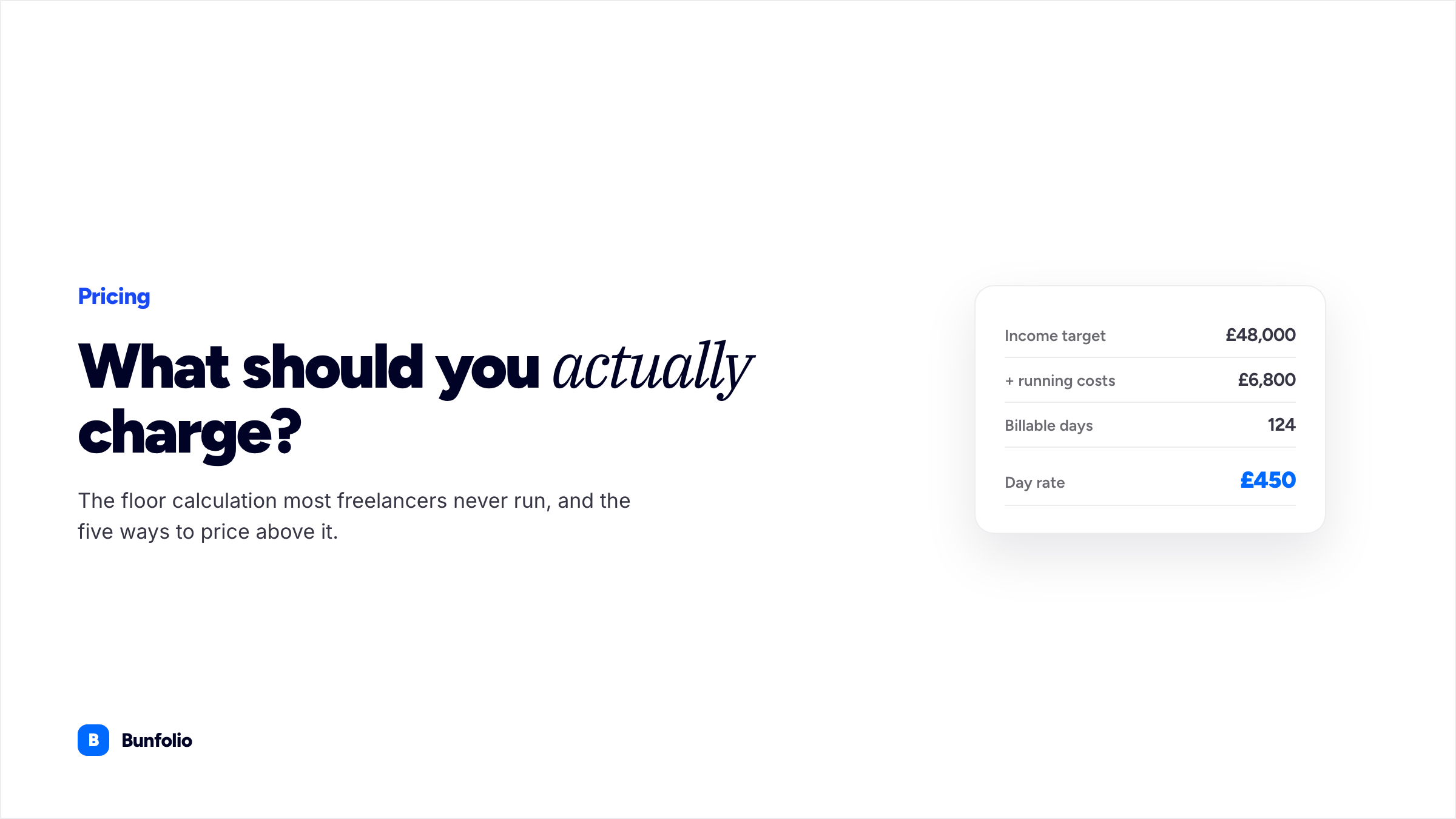
The floor calculation that tells you the least you can charge without going backwards, the five pricing models and who carries the risk in each, and how to raise your rates on clients you already have.
Almost every freelancer sets their first rate the same way: they take the salary they used to earn, divide it by roughly two thousand hours, and quote something close to that number. Then they spend the next two years wondering why the money never quite adds up, even in the months they were busy.
The reason is arithmetic, not confidence. An employed hour and a freelance hour are not the same unit. One of them comes with paid holiday, sick leave, a pension contribution, equipment, a colleague who finds the clients, and someone else covering the gap between projects. The other does not. If you price as though they are interchangeable, you have quietly agreed to work for considerably less than you did before.
This guide is about fixing that. It covers the floor calculation that tells you the least you can charge without going backwards, the five ways freelancers actually bill and who carries the risk in each, how to price fixed-scope work without being eaten by scope creep, how freelancer fees are written down in a quote and what a marketplace takes out of them, what to say out loud when someone asks your rate, and how to raise it on clients you already have. The numbers in the worked example are invented — they are there to show the method, not to tell you what you are worth.
Why hourly billing punishes you for getting better
Hourly billing has one genuine virtue: it is easy to explain, and neither side has to predict the future. That is why nearly everyone starts there. It is worth understanding what you are agreeing to.
When you bill by the hour, you are selling the one input you can never manufacture more of. Your income is capped by the calendar, and the cap is lower than it looks — nobody bills 40 productive hours a week for 48 weeks a year, and anyone who tells you they do is either counting badly or heading for a bad year.
Worse, hourly billing creates an incentive that points the wrong way. The developer who has solved a problem four times before fixes it in ninety minutes. The one seeing it for the first time takes two days. Under an hourly contract, the second one is paid more. You spend years getting faster and the market responds by paying you less for the same outcome. Every senior freelancer eventually notices this, usually while writing an invoice that feels insultingly small for work that was genuinely hard to be able to do quickly.
There is a subtler cost too. Hourly billing makes the client an auditor. It invites questions about how long something took rather than whether it worked, and it puts a meter on every conversation — which is precisely how you end up with clients who batch their questions to save money and consequently give you worse information.
None of that makes hourly wrong. It is the right instrument for genuinely open-ended work: ongoing support, exploratory research, "we don't know what we need yet". It is the wrong instrument for anything with a definable finish line. The rest of this guide assumes you will use it sometimes and want to stop using it by default.
Start with the floor, not with the market
The first number to work out is not what other people charge. It is the rate below which freelancing loses to employment — your floor. Everything above the floor is a pricing decision. Everything below it is a slow mistake.
The floor comes from three inputs: what you need the business to bring in, how much of the year you can realistically sell, and nothing else. Market rates matter enormously, but they belong in the next step, because a market rate you cannot survive on is not information you can use.
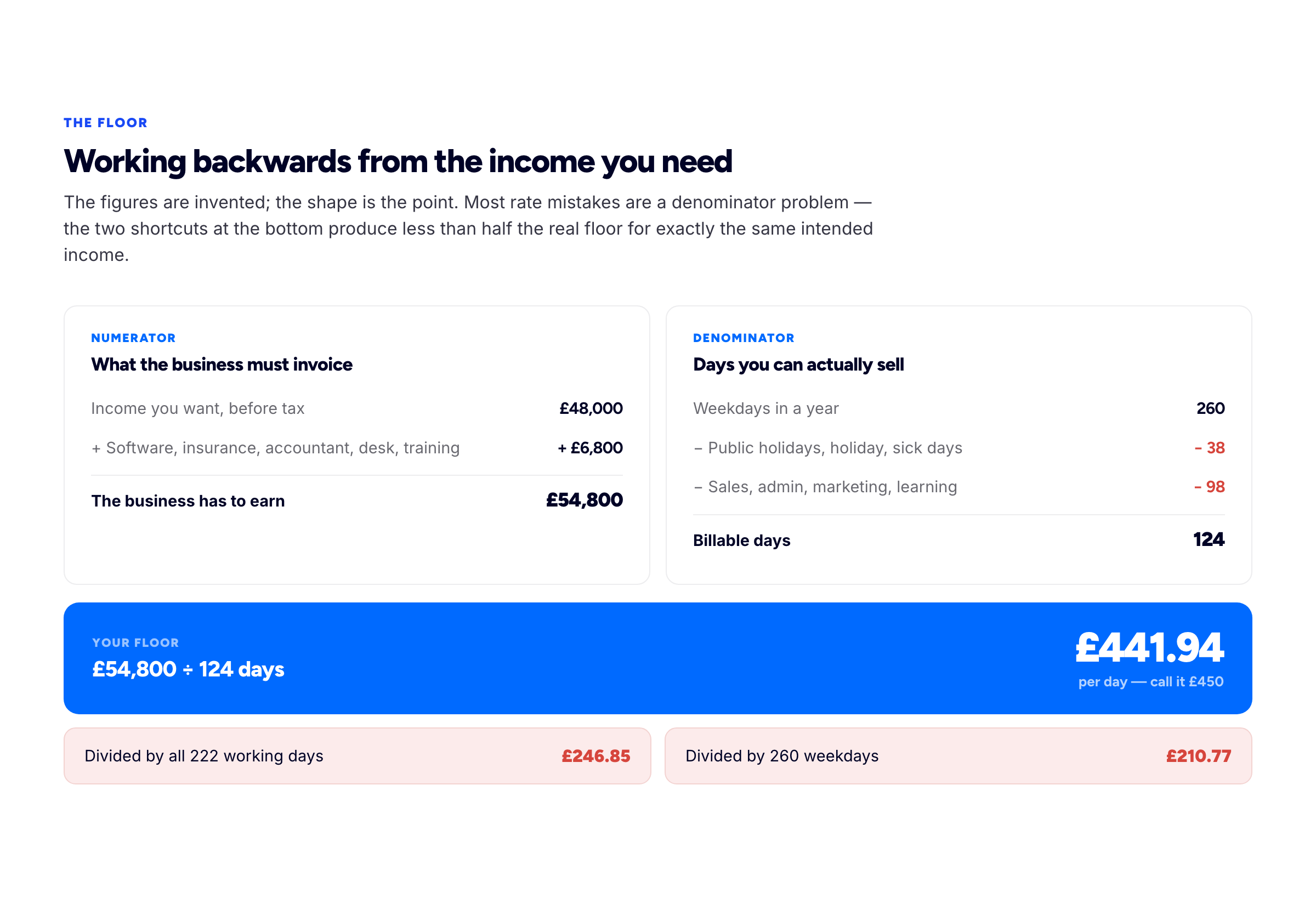
The arithmetic most freelancers never do.
Step one: the amount the business has to earn
Take the personal income you want, before tax. Then add every cost the business carries that an employer used to absorb. This is the step people skip, and it is the expensive one.
Our invented freelancer is Maya, a designer. She wants to pay herself £48,000 a year before tax. Her business costs for the year:
- Software subscriptions — £1,200
- Hardware, amortised over three years — £900
- Professional indemnity insurance — £400
- Accountant — £600
- Coworking desk — £1,800
- Phone and internet share — £600
- Conferences and training — £1,000
- Domain, hosting, portfolio — £300
That is £6,800 of costs. So the business needs to invoice £54,800 before Maya has earned her £48,000. Not £48,000. The gap is more than a month's income and it exists whether or not she has counted it.
Step two: the days you can actually sell
Now the denominator, which is where most rate calculations quietly fall apart.
A year has about 260 weekdays. Maya subtracts eight public holidays, five weeks of holiday she intends to take, and five days she expects to lose to illness or life admin:
260 weekdays
 - 8 public holidays
 - 25 days holiday
 - 5 days sick and personal
 = 222 working days
222 working days is not 222 billable days. A freelance business has a second job attached to it that nobody pays for directly. Maya's estimate of her unpaid year:
- Sales, calls, proposals and quotes — around a day a week, 44 days
- Admin, invoicing, chasing payment, bookkeeping — half a day a week, 22 days
- Marketing, writing, updating her portfolio — half a day a week, 22 days
- Learning and keeping current — 10 days
That is 98 unpaid days, leaving 124 billable days — about 56% of her working year. In our experience that figure is realistic rather than pessimistic for an established solo freelancer, and optimistic for someone in their first year, when sales takes far more than a day a week.
Step three: divide, and notice what the shortcut costs
£54,800 divided by 124 billable days is £441.94. Call it a £450 day rate — roughly £64 an hour across a seven-hour billable day.
Now look at what the two common shortcuts would have produced. Dividing by all 222 working days gives £246.85. Dividing by 260 weekdays — the "annual salary ÷ working year" method almost everyone starts with — gives £210.77. That is less than half the real floor, for exactly the same intended income.
This is the single most useful thing in this guide. The difference between a freelancer who is comfortable and one who is exhausted and broke is very often not talent or client quality. It is a denominator.
Step four: the tax correction
Maya's £48,000 was before tax. If she actually meant £48,000 in her bank account, and her effective combined rate on that income is around 30%, she needs roughly £68,570 of pre-tax personal income. Add the £6,800 of costs and the business needs £75,370, which over 124 days is a day rate of £607.82 — call it £610.
Your own tax position will be different; the point is the order of operations. Work out the take-home you want, gross it up for tax, add business costs, then divide by billable days. Doing those steps in the wrong order is how a rate that looked generous turns out to be a pay cut.
The floor is a floor, not a price
Once you have the number, hold it loosely in one direction only. You can charge more than your floor — that is where profit, savings, slow quarters and eventually not working every billable day come from. You cannot charge less than it for long, because the shortfall does not announce itself. It shows up two years later as no pension, no buffer, and a laptop you cannot afford to replace.
Then, and only then, look outward. Ask three or four freelancers at your level what they charge — most will tell you if you tell them yours first. Look at what agencies quote for the same work, which is typically several times a solo rate and tells you what the ceiling of client tolerance looks like. If your floor sits above everything you find, that is real information: either your costs are high, your billable days are too few, or you are in the wrong market segment.
The five pricing models, and who carries the risk
Pricing arguments usually get framed as hourly versus fixed price, which misses what is actually being negotiated. Every pricing model is an agreement about who absorbs the cost when the work takes longer than expected. That is the whole thing.
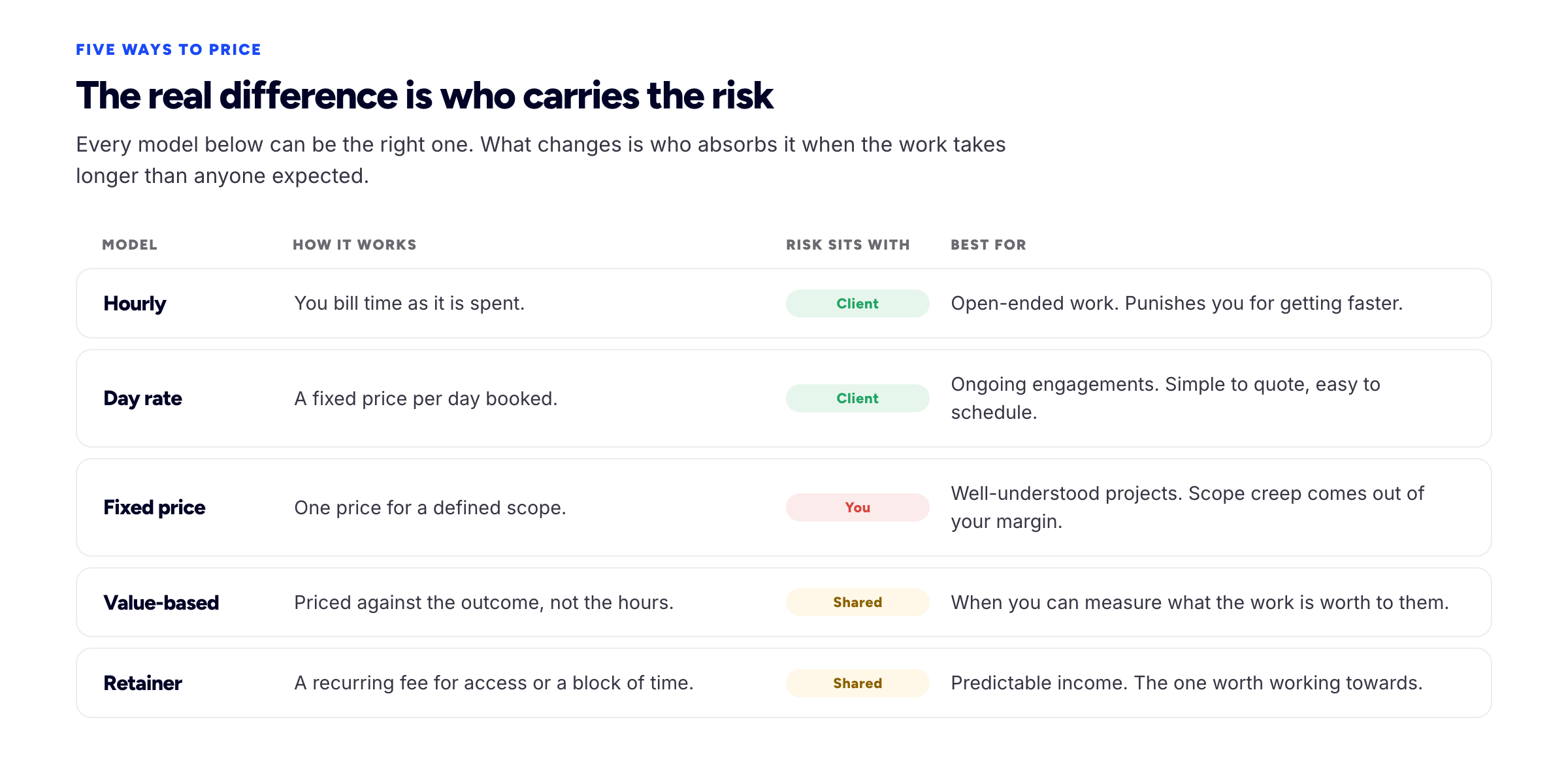
Who carries the risk is the real difference between these.
Hourly — the client carries the risk
If the work doubles, the invoice doubles. That is safe for you and uncomfortable for the client, which is why hourly contracts attract caps, timesheets and questions. Best used for open-ended support, ad-hoc work, and any engagement where the scope genuinely cannot be described in advance. Always agree a cap or a review point; open-ended hourly with no ceiling makes cautious clients anxious enough to stop asking for things.
Day rate — the client carries the risk, with less friction
A day rate is hourly with the meter hidden, and that alone improves the relationship. Nobody debates whether a call was 40 or 55 minutes. It suits work booked in blocks — a week of development, three days of research, a two-day audit — and it makes your availability legible, which helps clients plan.
Two rules make day rates work. Define a day (ours would be seven focused hours, not nine), and set a minimum booking, usually half a day. Being asked for "just an hour on Thursday" three weeks running destroys more of your week than three full days would.
Fixed price — you carry the risk
You quote a number for a defined outcome. If you are efficient, you keep the difference; if you misjudged, you eat it. This is the model that rewards experience, because experience is mostly accurate estimation, and it is the first step away from selling time.
It only works with a scope you can describe precisely enough to defend. Fixed price on a vague brief is not pricing, it is gambling with someone else's optimism.
Value-based — you carry the risk, at a higher price
Here the price is anchored to what the outcome is worth to the client rather than what it costs you to deliver. A checkout flow that recovers a meaningful share of abandoned orders is worth a multiple of the days it takes to build, and pricing it at cost simply hands that value to the client for free.
Value-based pricing requires two things most engagements lack: a client who can quantify the outcome, and enough discovery for you to be confident in the number. It is not a trick for charging more for the same conversation. If you cannot finish the sentence "this is worth roughly £X to you per year, here is how I got there", you are doing fixed price with extra steps.
Retainer — the risk is shared, and so is the certainty
A monthly fee for guaranteed availability or an agreed scope of ongoing work. Retainers are the closest thing freelancing has to stability, and two or three of them turn a volatile year into a predictable one.
Price them on access, not on hours, or you have just invented a worse hourly contract with a discount attached. Cap the scope, state what is included, state what is not, and review the arrangement every quarter — retainers drift, always in the client's favour, unless someone puts a date on the calendar.
Pricing a fixed-scope project without losing money
Fixed price is where freelancers get hurt, and almost always in the same three ways: optimistic estimates, undefined scope, and no mechanism for changes. All three are solvable in the proposal.
Estimate in days, then add contingency. Break the project into tasks, estimate each in half-days, and total it. Then add 20–30% — not because you are bad at estimating, but because the unknown unknowns are real and they are never in your favour. If Maya estimates 12 days at her £610 rate, that is £7,320; with 25% contingency it is £9,150, quoted as £9,500. The contingency is not padding you should feel guilty about. It is the price of the client not carrying the risk.
Write the scope as a list of deliverables, plus an exclusions list. The exclusions list is the one people skip and the one that saves the project. "Includes: five page designs, two rounds of revision on each. Does not include: copywriting, photography, CMS build, or design of pages not listed above." Nobody argues with a list they agreed to in writing.
Price the revisions. Unlimited revisions is an offer to work for an unbounded amount of money you have already been paid. Two rounds is normal; a third is quoted separately.
Have a change process, and use it cheerfully. Scope creep is rarely malicious — it is a client having a good idea in week three. The failure is not the idea, it is you absorbing it silently. "Happy to add that. It is about a day and a half, so it would take us to £10,400 and push delivery to the 14th — want me to put it in writing?" That sentence, said calmly and without apology, is worth more over a career than any negotiation tactic.
Stage the payments. A deposit before you start — a third is common — then a milestone, then the balance on delivery. Never hand over final files before the final payment clears. This is not distrust; it is the same terms every agency operates on, and clients recognise it as normal.
Most of this belongs in the written proposal rather than a conversation, which is why the proposal is doing more of the pricing work than the number is. We break the structure down in how to write a freelance proposal.
What to say when a client asks your rate
The moment that costs freelancers the most money lasts about four seconds. Someone asks what you charge, and you hesitate, hedge, or name a number and then immediately explain it away.
Three things help.
Say the number plainly, then stop talking. "My day rate is £610." Not "my day rate is around £610 but obviously it depends, and for a project like this I could probably be flexible." The second version discounts before anyone has asked. Silence after a price is uncomfortable for roughly two seconds and then it is just silence.
Ask about budget before you quote, without embarrassment. "Do you have a budget range in mind for this?" is a completely ordinary procurement question and most clients answer it. If they genuinely have no idea, give a range anchored on comparable work: "Projects of this shape usually land between £8,000 and £12,000 depending on how many templates we end up with." A range tells them whether to continue and costs you nothing.
Quote the outcome, not the hours. "£9,500 for the full site, delivered in six weeks, including two rounds of revisions" is a proposition. "About 15 days at £610" invites a negotiation about whether it really needs 15 days — a conversation in which the client has an opinion and no information.
If your rate is genuinely too high for a client you want, the move is to reduce the scope, not the price. Drop a deliverable, extend the timeline, remove a revision round. What you charge per day should be one of the last things you are willing to move.
Raising your rates
New clients are easy: you simply quote the new number, and the anxiety you feel is invisible to them. Existing clients are the hard part, and it is where the money actually is, because your long-standing clients are usually your worst-paid ones — priced at whatever you were worth when you were less experienced and more nervous.
When to raise
The signals we would act on: you are consistently busy and turning work away; you have not raised your rate in over a year; you have added a genuine capability since the last increase; you catch yourself resenting a particular client's invoices; or your floor calculation has moved because your costs or your target income have.
Being fully booked is the clearest of these. If you win nearly everything you quote for, your price is below what the market will pay. A win rate somewhere well short of everything is a healthy sign, not a problem.
How to do it
Give notice, apply it to new work, and do not apologise. Something like:
Hi Sam — a quick note on rates. From 1 November my day rate goes to £680. Anything already booked or quoted stays at the current rate, so this only affects new work from that date. I have really enjoyed the last year of projects and I am planning to keep the same availability for you. Happy to talk it through if it is useful.
Four things are doing the work there. A date, so it is a decision rather than a negotiation. Honouring existing quotes, which removes any sense of ambush. A signal that you intend to continue, which is the thing the client is actually worried about. And no justification — you do not owe an explanation of your costs, and offering one invites a discussion of whether your costs are reasonable.
Six weeks of notice is generous and easy to give. For retainers, time it to a review point.
Some clients will leave. That is the mechanism working, not failing — a 15% increase means you can lose a meaningful share of your lowest-paying clients and still be ahead, with time freed for better work. What makes this bearable is having somewhere for new enquiries to come from, which is why raising rates and keeping your portfolio site current are the same project. If yours is out of date, Bunfolio will get a free one live on your own subdomain in an afternoon. Rate increases are frightening in exact proportion to how empty your pipeline is.
Markets, timezones, and what "the going rate" means
Rates vary enormously by client location, sector and channel, and the variation is mostly about the client's budget rather than your skill. The same work for a venture-funded company in a major city, a mid-size manufacturer in a regional town, and a two-person startup will support three genuinely different numbers.
Two practical consequences. First, price against your client's market, not your own — where you live affects your costs, not the value of the work. A freelancer in a low-cost country delivering to clients in an expensive one who prices against local costs is leaving a lot on the table, and often signalling inexperience while doing it.
Second, know which channel you are in. Work won through general marketplaces sits in a price-sensitive, highly comparable market where you are one of many similar-looking options. Work won through referral, reputation or your own site is priced far less comparably, because there is nothing next to you on the page. That difference is worth more than most rate negotiation skills, and it is the strongest argument for building direct demand — the ground we cover in getting your first freelance clients.
Timezone is worth pricing explicitly rather than absorbing. If a client needs a substantial overlap with a timezone that costs you your evenings, that is a real constraint and it is entirely reasonable to price it — a premium, a defined overlap window, or a limit on synchronous hours per week.
Freelancer fees: what you charge, and what the platform takes
"Freelancer fees" means two different things depending on who is asking. A client usually means the fee a freelancer charges them. A freelancer usually means the cut a marketplace keeps before the money arrives. You need a clear answer to both, because the second one changes the first.
How freelancers quote their fees
Almost every freelance fee you will see is one of four structures. The risk each one puts on you is covered in the pricing models section above; this is the short version of how each is written down in a quote.
- Hourly rate. "£65 an hour, billed in 15-minute increments, capped at 20 hours a month unless agreed in writing." The cap and the increment belong in the quote, not in a later argument.
- Day rate. "£450 a day, where a day is seven hours; minimum booking half a day." Defining the day is what stops a day rate turning back into an hourly one.
- Project fee. "£9,500 for the deliverables listed, two rounds of revisions, paid a third upfront, a third at the design sign-off, a third on delivery." A project fee is only as good as the deliverables list attached to it.
- Retainer. "£2,000 a month for up to four days of work and next-working-day replies, reviewed every quarter; unused days do not roll over." State what happens to unused time, or the client will assume it rolls over indefinitely.
Whichever you use, write the fee, what it covers, what it excludes and when it is paid on one page. The terms that make a fee collectable — deposits, late payment, who owns the work before it is paid for — are in what a freelance contract needs, and what to do when an invoice goes quiet is in how to get paid on time.
Platform fees, and how to price around them
Marketplaces take their fee out of what the client pays you, so the rate in your profile is not the rate you earn. Two examples, taken from each platform's own pages when we checked them on 5 October 2026:
- Upwork says on its help page about the Freelancer Service Fee that the fee "ranges from 0% to 15% per contract", that you see the percentage before you send a proposal or accept an offer, and that it is fixed once the contract begins.
- Freelancer.com lists its project fee on its fees and charges page as 10% or $5.00 USD, whichever is greater, on fixed-price projects, and 10% on hourly projects.
These change, and other marketplaces set theirs differently, so read the current fee page of any platform before you set a price on it rather than trusting a figure in a blog post, this one included.
The arithmetic for pricing around a platform fee is to divide, not to add. To take home a rate after a fee, divide the rate by one minus the fee. If Maya wants her £610 floor on a contract with a 10% fee, she needs to charge £610 ÷ 0.9, which is £677.78. Adding 10% to £610 gives £671, and leaves her short on every day she bills. At a 15% fee, the same floor needs £717.65.
Then add the costs the fee does not cover: payment processing, withdrawal charges and currency conversion all come off afterwards on some platforms. Put them into the business costs in step one of the floor calculation, so they are priced in rather than discovered.
Platform fees are also the strongest argument for owning a channel that takes nothing. A client who finds you through your own site or a referral pays your rate and you keep all of it. That is not a reason to avoid marketplaces in your first year, when they may be the fastest route to a first review. It is a reason to move repeat clients, and your best new ones, onto direct terms as soon as the platform's own rules allow it.
The discount trap
Discounting feels like a way to win work. Mostly it is a way to win worse work.
A discount without a reason teaches the client that your price was never real, which makes every future quote a starting position. It also selects for exactly the clients you least want: in our experience, the accounts that push hardest on price reliably go on to demand the most revisions, the fastest turnarounds and the longest payment terms. Price sensitivity and general difficulty are close companions.
If you do discount, always take something out in exchange. A longer timeline. A smaller scope. Payment fully upfront. A case study and a named testimonial. Multiple projects committed at once. The exchange preserves the principle that the rate is the rate, and the price only moved because the deal did.
Two special cases deserve honesty. Working free or cheap "for exposure" is worth it only when you can name in advance the specific thing you are buying — a portfolio piece in a sector you want to enter, a logo you may display, a testimonial from a recognisable name. Buy it deliberately, once, with a defined scope, and then stop. And genuine mates' rates for a friend's project are fine, provided you write the scope down exactly as you would for anyone else. Undocumented favours are how friendships end.
When to walk away
Some work is priced correctly at "no". The signals we would treat as decisive:
- The budget is below your floor and the scope will not shrink. You are not choosing between this project and nothing — you are choosing between this project and the time to find a better one.
- They will not put the scope in writing. A client who resists specificity before the money is involved will not become more specific afterwards.
- They want a fixed price on an undefined brief, and every request to define it comes back vague.
- They negotiate hard on price and terms before any work has started. That is the most cooperative this relationship will ever be.
- They will not pay a deposit, and cannot say why.
Declining is a two-line job and does not need to burn anything: "Thanks for thinking of me — this one is not a fit for my rates, but I would be glad to look at future work, and I am happy to point you at someone who might suit the budget better." Referring on is genuinely useful; the person you refer to remembers it.
Frequently asked questions
How much should I charge as a beginner freelancer?
Run the same floor calculation, but be honest that your billable-day count will be lower in year one — sales takes far more time when nobody knows you. Many people start slightly below their eventual target and raise every few months as work comes in, which is reasonable provided the increases actually happen. Set the review dates in your calendar now, or the "temporary" starting rate becomes permanent.
Should I put my rates on my website?
Publishing a starting price, or a range per service, filters out the mismatches that waste the most time on both sides and pre-qualifies everyone who does contact you. If your work is genuinely bespoke, "projects typically start at £5,000" does most of the same work without committing you. Publishing nothing is the option that costs you the most unpaid calls.
Is a day rate better than an hourly rate?
For most freelancers, yes. It removes minute-counting, makes booking simpler for the client, and stops small requests fragmenting your week. Keep an hourly rate available for genuine ad-hoc support, and set a minimum booking so it does not become your default.
How do I know if my rate is too low?
The clearest tell is winning almost everything you quote for. Others: you are busy and still short of money, you resent the work, or you cannot take unpaid time off without the year falling apart. None of those are signals to work harder. They are signals about the number.
What do I do when a client says my rate is too high?
Ask what budget they are working with, then decide whether a smaller scope fits it. "That is above my rate for the full scope — but for £6,000 I could do the three core pages and leave the blog for a later phase" keeps the conversation alive without moving your rate. If nothing fits, say so pleasantly and leave the door open.
What are typical freelancer fees?
There is no single typical figure worth quoting, because fees vary by discipline, client market and channel far more than by skill. What is consistent is the structure: an hourly rate, a day rate, a fixed project fee or a monthly retainer. Work out your floor with the calculation above, then check it against what three or four freelancers at your level actually charge.
How much do freelance platforms take?
It depends on the platform and changes over time. When we checked on 5 October 2026, Upwork's help page put its freelancer fee at 0% to 15% per contract, and Freelancer.com's fees page listed 10% (or $5.00 USD minimum on fixed-price projects). To keep your rate after a fee, divide your rate by one minus the fee rather than adding the percentage on top.
How often should I raise my rates?
Review annually and raise whenever the review says so — a modest yearly increase is far easier to deliver and to accept than a single large correction after four years of standing still. Tie the review to a fixed date so it does not depend on you feeling brave that week.
How we put this guide together
Bunfolio builds portfolio sites for freelancers, so this guide comes from the pricing questions freelancers ask us, from what they publish on their own services pages, and from the pattern we see in which freelancers end up with stable years and which do not. The method — floor first, then market, then model — is the one we would use ourselves.
Every figure in the worked example is invented and labelled as such. The arithmetic is real and you can substitute your own numbers into it; the £48,000, the £6,800 of costs and the 124 billable days are illustrative, and your tax position in particular will differ. Nothing here is accounting or legal advice — for tax rates, allowable expenses and the correct structure for your business, ask an accountant in your own country.
The platform fees are the only third-party figures in this guide, and each comes from the platform's own page, checked on 5 October 2026: Upwork's help centre article on the Freelancer Service Fee (support.upwork.com) and Freelancer.com's fees and charges page (freelancer.com/feesandcharges). Platforms revise these, so treat them as dated and check the live page before you price.
We have deliberately not quoted rate statistics. There are a great many confident average-rate figures circulating for freelance work that trace back to self-selected surveys, single platforms, or no identifiable source at all, and repeating them would make this guide less trustworthy rather than more. Where we make a claim about what works, it is either arithmetic you can check or presented explicitly as our judgement.
More from the blog
August 23, 2026 · 24 min read
How to Get Paid on Time as a Freelancer
The payment terms that prevent a late invoice, and the five-rung escalation ladder for chasing one — from a neutral nudge on day one to a formal letter before action.
July 12, 2026 · 22 min read
Should You Niche Down as a Freelancer?
Three axes you can specialise on, how far along the spectrum is far enough, and the honest cases — thin markets, early careers, volatile sectors — where staying broad is the better call.
August 11, 2026 · 23 min read
How to Write a Freelance Proposal That Wins the Work
A seven-part structure with a length budget for each section, the scope split that prevents disputes before they start, and what to send when the client goes quiet.