
August 28, 2026 · 13 min read
What to Put in a Freelance Contract
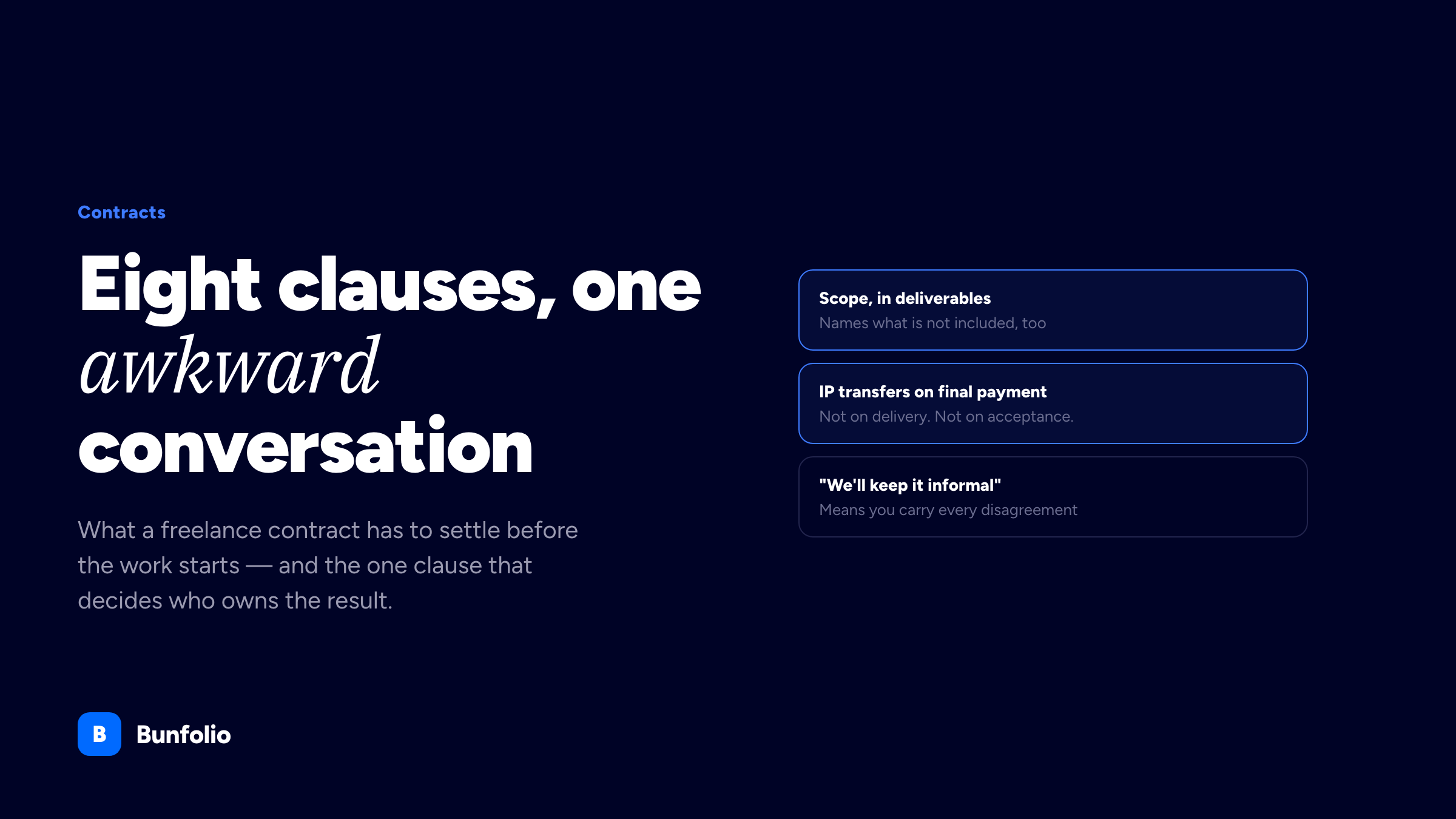
Eight clauses, the scope wording that prevents most disputes, why rights should transfer on cleared payment rather than delivery, and the portfolio-rights line freelancers forget to ask for.
Almost every freelancer who has been badly burned was burned by something a contract would have settled in one sentence. Not a dramatic breach — a disagreement, eight weeks in, about something that felt too obvious to write down at the start. What "finished" meant. Whether the third round of changes was included. Whether the client could use the work before paying for it. Whether you could put it on your website.
A contract is not primarily a legal weapon, and thinking of it that way is why people avoid one. Almost no freelance dispute reaches a courtroom; the cost is nearly always absorbed quietly, as unpaid extra work or an invoice that goes unpursued. What a contract actually does is force the two of you to discover, in week zero rather than week eight, that you disagree.
A note on what this is. This guide is general information about the terms freelance agreements usually cover, not legal advice. Contract law differs by country and sometimes by state or province, employment-status rules vary considerably, and the consequences of getting some of this wrong are financial. For anything high-value or unusual, have a lawyer in your jurisdiction look at it once — a single review of a template you will reuse for years is among the cheapest professional expenses available to a freelancer.
The eight clauses
A workable freelance agreement is short. Two or three pages covers the overwhelming majority of work, and a shorter document that both parties read beats a twelve-page template that neither does.
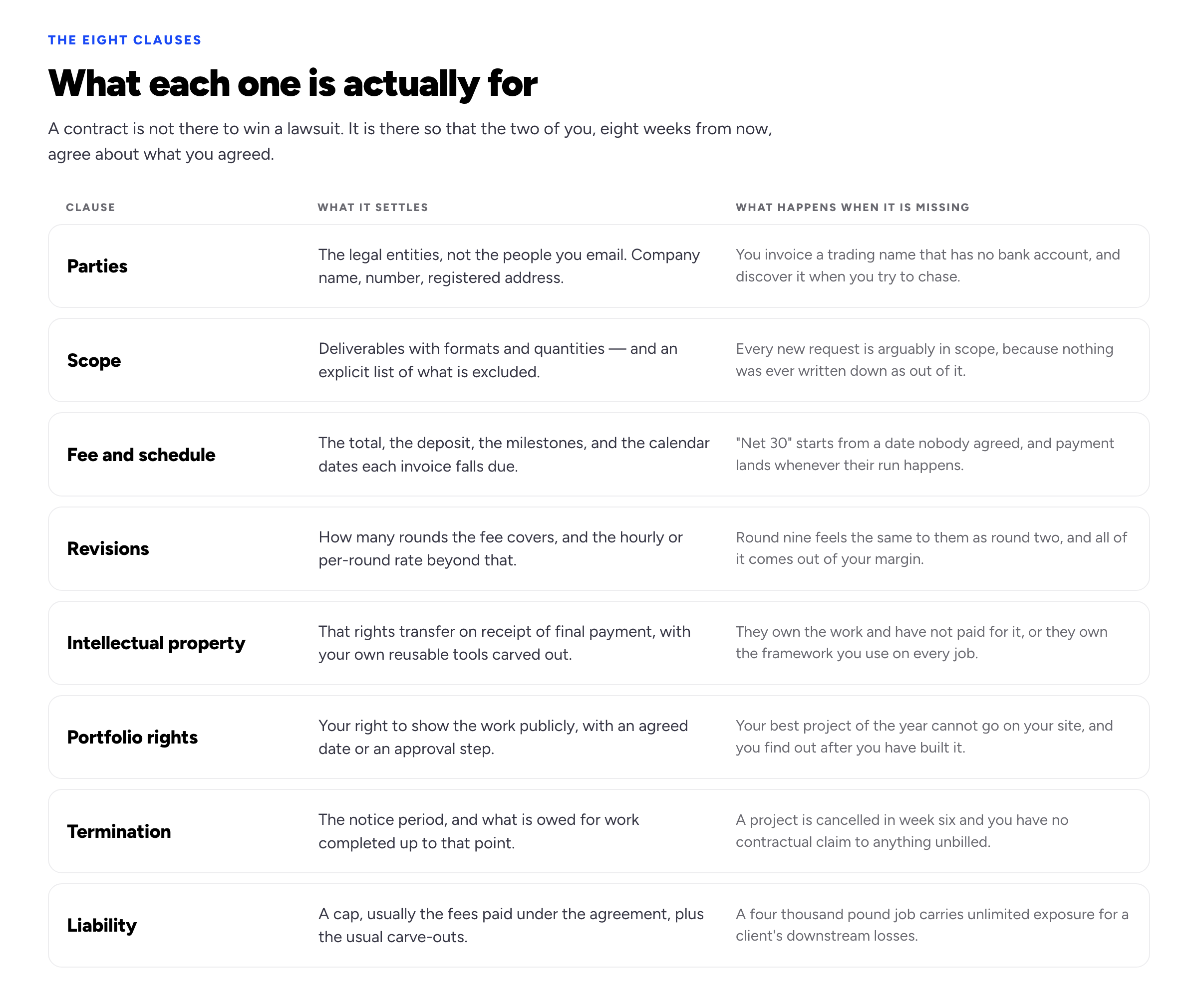
The third column is the argument for each clause. Every one of them is a conversation somebody has already had.
Three of these are worth expanding, because they cause most of the trouble.
Scope: the clause that prevents most disputes
Scope creep is rarely malicious. It is the natural result of two people holding different pictures of the same project, and it compounds because each individual request is genuinely small. The client is not trying to get free work; they are asking for a reasonable thing, and there is nothing written down that distinguishes a reasonable thing from a new project.
Write scope as deliverables with quantities and formats, not as a description of activity. "Website design" is not a scope. "Design of five unique page templates, delivered as a Figma file with a component library, plus one round of developer handover" is a scope, because it is falsifiable — either there are five or there are not.
Then write the exclusions, which is the part people skip and the part that does the work. An explicit "not included" list — copywriting, photography, ongoing maintenance, CMS setup, additional page templates, stakeholder workshops beyond two — is not hostile. It is the thing that lets you say "happy to do that, it is outside the current scope, here is what it would cost" without it feeling like a refusal. Without the list, that same sentence sounds like you are inventing a boundary on the spot.
Pair scope with a change process in one sentence: additional work is quoted and confirmed by email before it starts. That sentence converts an awkward negotiation into an administrative step, which is the entire point. Much of this belongs in the proposal too, where it does double duty as a demonstration that you have done this before.
Revisions
Unlimited revisions is not generosity; it is an open-ended commitment priced as a closed one. Two rounds is a common default for design and copy work, and the number matters less than the definition. Say what a round is — one consolidated set of feedback from the client, gathered into a single reply — because the alternative is fourteen separate emails over three weeks, each technically part of "round one".
State the rate for further rounds. Round nine feels identical to round two from the client's side, and the only thing that reliably slows the cycle is a number attached to it.
Intellectual property, tied to payment
This is the clause that matters most and the one most often left out, usually because both parties assume the answer is obvious. They assume different answers.
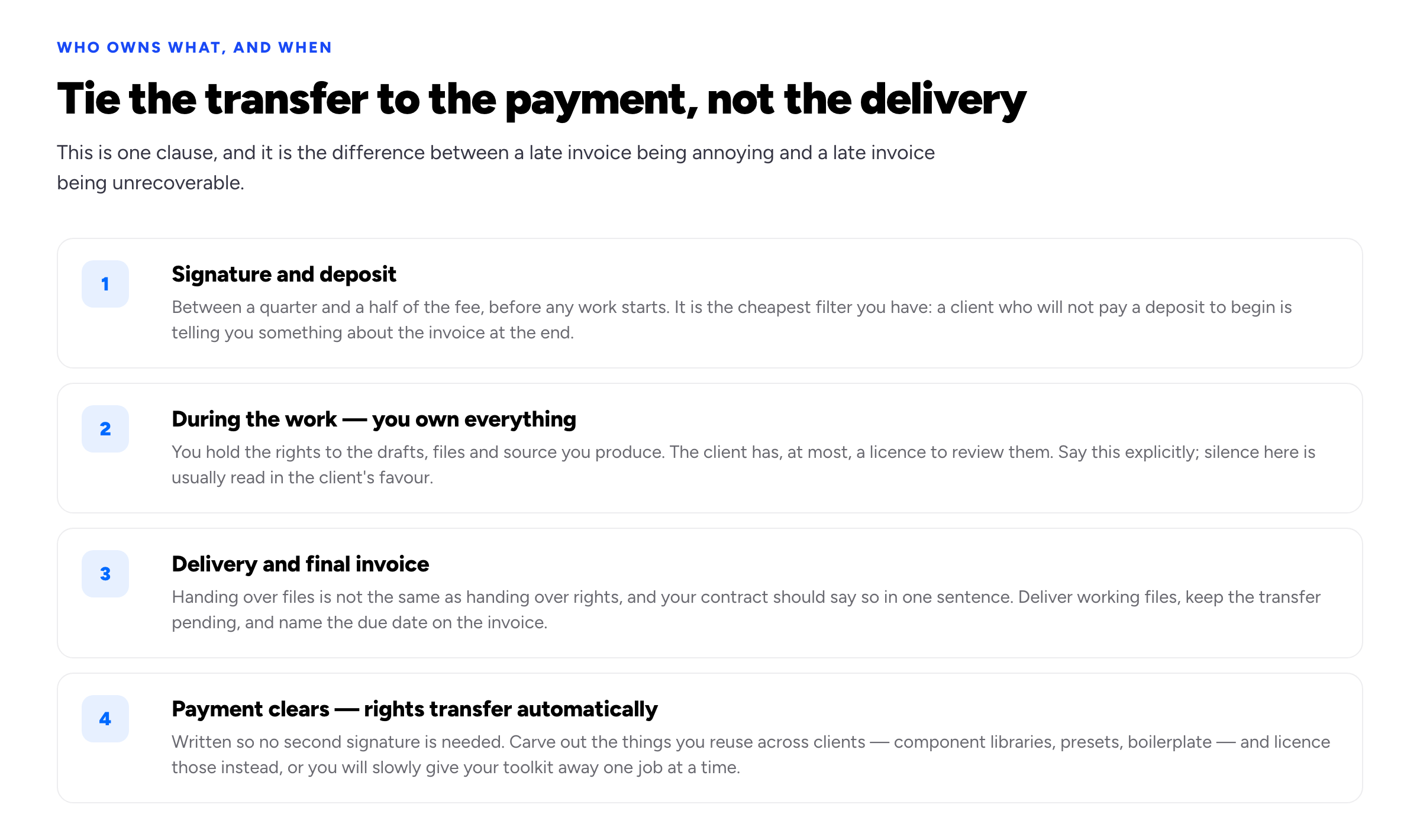
The transfer is tied to cleared payment, not to delivery and not to acceptance.
Three things to get right.
Transfer on payment, not on delivery. If rights pass when you hand over the files, an unpaid invoice leaves you with no leverage and the client with everything they wanted. If rights pass when payment clears, a late invoice is a problem the client also has. Write it so the transfer happens automatically on cleared payment, with no second signature needed — otherwise you have created a new negotiation at the worst possible moment.
Carve out your own tools. If you bring a component library, a boilerplate repository, a set of presets, a research template or a piece of code you wrote before this client existed, say explicitly that these are excluded from the transfer and licensed to the client instead. Without that sentence, a broadly-drafted assignment clause can hand over the toolkit you use on every job, one client at a time.
Understand what "work for hire" means where you are. The phrase is borrowed from US copyright law, where it has a specific and narrow statutory meaning that does not apply to most freelance arrangements — the US Copyright Office's circular on works made for hire sets out the actual conditions. Elsewhere it may mean nothing at all, and rights transfer by assignment instead. Copying the phrase from an American template into a contract governed by another country's law is a common and avoidable mistake.
Portfolio rights: the clause freelancers forget
You will want to show this work. Your ability to do so is not automatic, and it is much easier to secure before the project than after.
Ask for a short clause granting you the right to display the work publicly for self-promotion. Where a client is genuinely sensitive, the usual compromises work: publication after an agreed date, publication subject to their written approval, or permission to describe the work without naming them. Any of those is better than silence, because silence means asking a busy client for a favour six months later, when nobody remembers the project fondly enough to reply.
Do the same for a testimonial: agreeing at the start that you may ask for a short quote at the end costs nothing and roughly doubles the chance of getting one. Both of these are the raw material of the case studies that get you the next job, which makes them commercial terms rather than administrative ones.
Payment terms that prevent a late invoice
Late payment is mostly a design problem, and the design happens in the contract.
- A deposit before work starts — commonly 25% to 50%. It covers your exposure if the project dies, and it is a diagnostic: a client who will not pay a deposit is showing you something about the final invoice.
- Milestones for anything over a few weeks. Never let unbilled work accumulate past a month. Milestone payments also give you a natural pause point if things are going wrong.
- A named due date, not a payment window. "Net 30" starts from a date nobody agreed. "Due 14 October 2026" does not.
- An interest or late-fee clause. Its value is as a lever in a polite email rather than as revenue. In the UK, statutory interest and recovery costs on commercial invoices are available even without a clause, under the late commercial payment rules; other jurisdictions differ, and your own clause is what makes the position unambiguous.
- A pause clause. The right to stop work on overdue invoices, stated in advance, so that stopping is contractual rather than a threat.
What to do when an invoice goes past its date is a separate discipline, covered in how to get paid on time as a freelancer.
Does a small job need one?
The question is usually framed as whether a £400 job is worth the paperwork. It is the wrong frame: small jobs go wrong at roughly the same rate as large ones, and the loss hurts proportionally more because you have less margin absorbing it. What changes with size is not whether you need an agreement but how heavy it should be.
For genuinely small work, a written email that both parties reply to is a real agreement in most jurisdictions, and it is enormously better than nothing. Five lines covers it:
Deliverables: three social launch graphics, supplied as PNG and source files. Not included: copywriting, additional sizes, printed formats. Fee: £400, 50% on acceptance of this email and 50% on delivery, due within 14 days. Revisions: two rounds of consolidated feedback; further rounds at £60/hour. Rights in the finished files pass to you once the final payment clears; I keep the right to show the work in my portfolio from launch. Reply "agreed" and I'll start Monday.
That paragraph settles seven of the eight clauses and takes four minutes to write. The habit is the thing worth building — freelancers who use an agreement on small jobs are the ones who have one ready when a large job appears, and the ones who feel no awkwardness asking, because they have asked forty times before.
Getting it signed without killing the deal
The fear behind most missing contracts is that raising one will make you look difficult at the exact moment the client is deciding. In practice the opposite is true with every client worth having: a clear agreement is the most professional signal you send all month, and it is the first evidence they have of how you handle detail.
What helps:
- Send it as a normal step, not as an event. "I'll send the agreement over this afternoon — it's two pages, the scope and dates are in section one" frames it as process rather than suspicion.
- Keep it short and in plain language. Long documents get forwarded to legal; two readable pages get signed by the person you have been talking to.
- Use e-signature. Friction is what kills signature, and printing and scanning is friction. Most jurisdictions have long recognised electronic signatures for ordinary commercial agreements — in the US under the E-SIGN Act, in the EU under eIDAS — though the details of what qualifies vary.
- Never start on a promise. "Send the paperwork over, we'll sort it out" is the single most reliable precursor to a bad engagement, and it is on the list of red flags for a reason.
When the client sends their contract instead
Larger clients will have their own paperwork, often drafted for suppliers considerably bigger than you. You can usually negotiate, and asking is normal rather than presumptuous. Read for four things in particular:
Unlimited liability. A four-thousand-pound project should not carry exposure for a client's downstream losses. Ask for a cap at the fees paid under the agreement. This is the most common single amendment freelancers request and it is very often granted.
Indemnities. Broad clauses making you responsible for third-party claims. Narrow them to claims arising from your own work — not from how the client later used it, and not from materials they supplied.
Exclusivity and non-competes. Occasionally reasonable, frequently drafted far too widely. A clause preventing you from working with anyone in the client's sector for two years is not a detail; it is a material restriction on your business, and it should be priced or removed.
Assignment of everything you create. Watch for language sweeping up all work produced during the engagement, including your own pre-existing tools. Add the carve-out.
Also check the payment terms and push back on anything beyond thirty days. Sixty or ninety-day terms are common in large organisations, are usually presented as immovable, and are more negotiable than they look — particularly if you ask before you have started rather than after.
Status, and why some clients get nervous
One clause type exists for reasons that have nothing to do with your relationship with the client: the terms confirming that you are an independent contractor rather than an employee.
Most countries operate some test distinguishing genuine self-employment from disguised employment, and the consequences of getting it wrong — back taxes, social contributions, penalties — usually land on the client. That is why a client who has been fine about everything else may suddenly become particular about how a contract describes your working arrangements, and it is not personal.
What tends to matter across jurisdictions, in substance rather than in wording: whether you control how and when the work is done, whether you supply your own equipment, whether you can send a substitute, whether you carry financial risk, and whether you are integrated into the client's organisation like a member of staff. A contract saying you are a contractor while the reality looks like employment will generally lose to the reality — the test is applied to what actually happens, not to the label.
Practically, this means two things for you. Do not agree to terms describing a relationship you are not going to have, because the paperwork will not save either party. And expect long, full-time, single-client engagements to attract more scrutiny than short project work — this is the underlying reason some clients insist on fixed-term arrangements or route work through an intermediary. The specific rules are jurisdiction-dependent and change; this is a question for an accountant where you are, not for a template.
What to do this week
If you currently work without contracts, do not attempt to build a perfect one. Get to a workable document and improve it as things go wrong:
- Take a reputable template for your country and your discipline — professional bodies and freelancer associations usually publish one — and cut it down to the eight clauses above.
- Have a lawyer read it once. One review of a document you will reuse for years is a good trade.
- Attach your scope and exclusions to it per project, and keep the rest fixed so you are not redrafting each time.
- Use it on the next job, including the small one. Especially the small one, where the friction of asking feels highest and the habit is actually formed.
How we put this guide together
This is general information, not legal advice, and it is deliberately jurisdiction-neutral where the law is not. Freelance contract law, employment-status tests, statutory interest on late payment and the mechanics of rights assignment all differ by country; several also differ within a country. Anything valuable, unusual, or involving a client much larger than you is worth a single paid review by a lawyer where you are.
The eight-clause structure and the recommendation to tie rights transfer to cleared payment are our own guidance, based on what we see going wrong for freelancers building portfolios with Bunfolio — very often the portfolio-rights clause, which surfaces only when someone tries to publish the work and discovers they cannot.
Where this guide states something checkable, it is sourced: the narrow statutory meaning of "work made for hire" is set out in the US Copyright Office's Circular 9; UK statutory interest and recovery costs on late commercial payments are described by GOV.UK; electronic signature frameworks are the US E-SIGN Act and the EU's eIDAS Regulation. Deposit percentages, revision counts and payment windows are conventions we observe rather than rules, and the figures used as examples are invented.
Related reading: how to write a freelance proposal that wins the work, how to get paid on time as a freelancer, and freelance client red flags.
More from the blog

September 18, 2026 · 22 min read
How to Put Freelance Work on a Resume
Nobody rejects a resume because the applicant freelanced. They reject it because they could not work out what they were looking at. The one decision that sets your layout, what to call yourself, and h...

October 5, 2026 · 16 min read
How to Become a Freelance Photographer: From Good Photos to Paid Work
A practical path from "I take good photos" to paid freelance work: choosing a niche, the kit you actually need, and building a portfolio before you have clients. Plus the business basics photography a...
September 30, 2026 · 16 min read
What Is Freelancing? A Plain-English Guide to Freelance Work
Freelancing is selling a skill to several clients one job at a time instead of working for one employer. How a freelancer differs from an employee, contractor or gig worker, one freelance job from enq...