
August 20, 2026 · 25 min read
How to Ask Clients for Testimonials That Actually Persuade
Why an unattributed quote is worth nothing, the narrow window when the ask succeeds, and the questions that produce evidence instead of a compliment — with request emails you can copy.
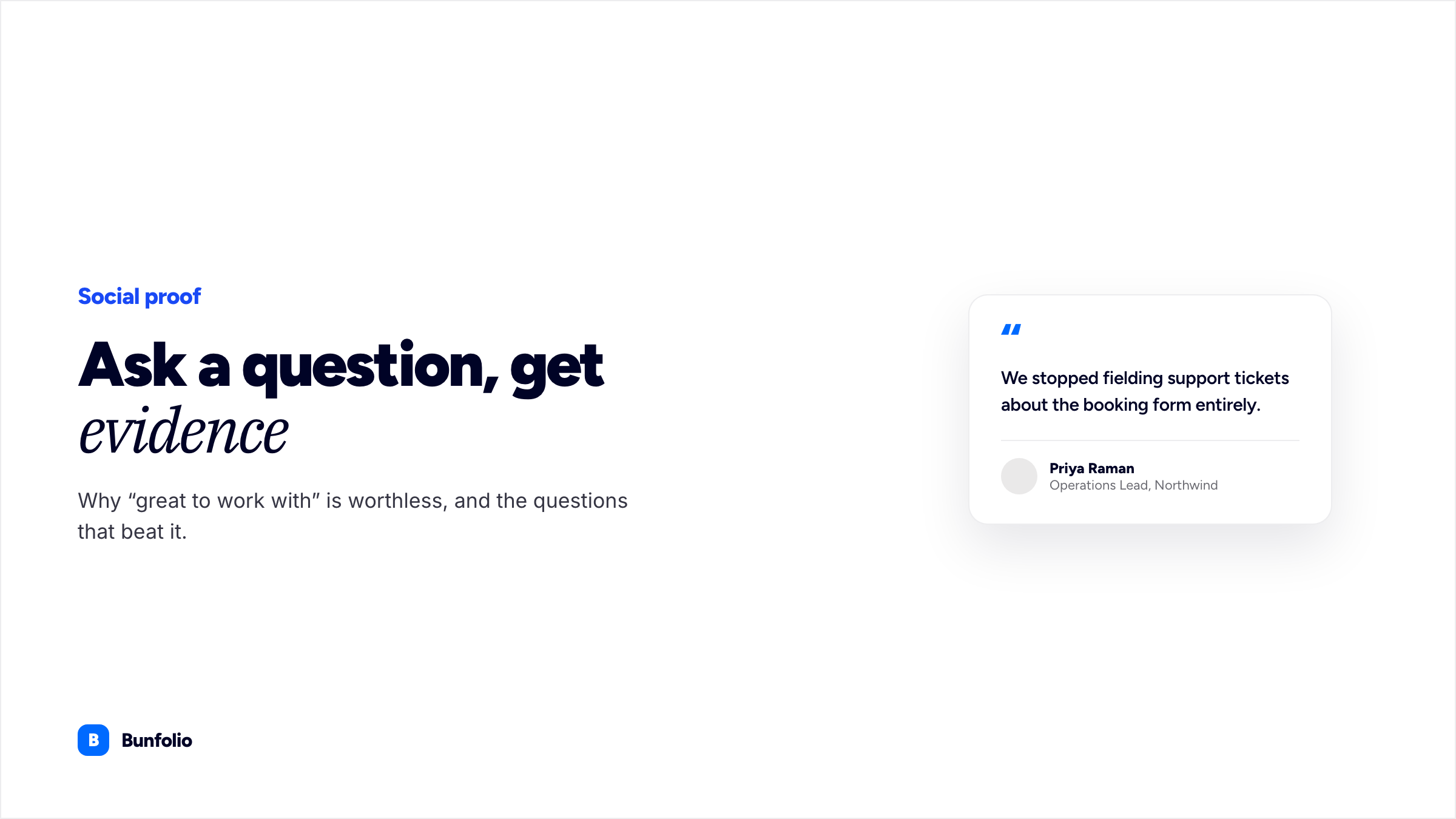
Most freelancers ask for testimonials in the worst possible way, at the worst possible moment, and then quietly conclude that clients do not like writing them. The message usually goes out three months after the invoice was paid, says something like "would you mind writing me a quick testimonial?", and either gets ignored or produces a sentence so bland it makes the portfolio weaker rather than stronger.
The problem is not that clients are unwilling. In our experience they are usually happy to help and slightly relieved to be asked — it costs them nothing and it repays a favour. The problem is that the request asks them to do a writing job they have no brief for. "Write me a testimonial" is an open essay prompt handed to a busy person who does not know what good looks like, so they fall back on the safest thing available: a pleasure to work with, highly recommended.
This guide covers the whole chain — what makes a testimonial persuasive in the first place, when the window for asking opens and closes, the exact wording of three requests you can copy, the questions that produce evidence instead of compliments, what to do when the quote comes back weak, where the quotes belong on your site, and how to handle permission, NDAs and clients who say no.
An unattributed testimonial is worth close to nothing
Start here, because it changes what you ask for. A visitor reading your site knows perfectly well that you typed every word on it, including the words inside the quotation marks. A quote signed "— Client, 2024" carries no information at all. It is not evidence; it is decoration shaped like evidence, and experienced buyers discount it instantly.
What makes a quote work is that it is checkable. Not that anybody will check it — almost nobody does — but that they could. The moment a reader can see a real name attached to a real role at a real company, the quote stops being your claim about yourself and becomes somebody else's claim about you, made in public, under their own name, with their professional reputation attached in a small way. That is the entire mechanism.
What attribution has to include
A usable testimonial carries four things, and you should treat any quote missing more than one of them as incomplete:
- Full name. First names only ("Sarah, marketing manager") read as anonymised, which defeats the purpose.
- Role. The reader is calibrating whether this person was in a position to judge your work. A CTO saying your code was clean means something different from a founder saying the same thing.
- Company or organisation. The single strongest credibility signal in the block, and the one people most often forget to ask for.
- A face or a link. A small photograph, or a link to their LinkedIn profile or company site. Optional, but it converts a plausible quote into an obviously real person.
Ask for all four at the same time you ask for the quote, in the same message. Coming back a week later to ask "sorry, could I also use your job title and company name?" is a second favour, and second favours have much lower response rates than first ones.
Compliment versus evidence
The second thing that separates a working testimonial from a decorative one is whether it describes what happened or what you are like. Compare two quotes about the same project:
Working with Dan was fantastic. He is responsive, professional and a real pleasure to have on the team. Highly recommended.
We came to Dan with a checkout that was losing people at the payment step and no idea why. He rebuilt it in three weeks, kept our Black Friday deadline, and the drop-off at that step roughly halved. He also wrote the handover doc our own developer still uses.
Both are genuine. Only one is useful. The first could have been written about any freelancer in any discipline — swap the name and it still works, which is precisely the test it fails. The second could only have been written by somebody who was actually in the room, and it tells a prospective client what category of problem you solve.
The crucial point, and the reason this guide exists: you get the first quote by asking for a testimonial, and the second by asking a question. The client's writing ability is not the variable. Your prompt is.
When to ask
Timing does more work here than wording. There is a window, it is narrower than most people assume, and the majority of freelancers miss it entirely.
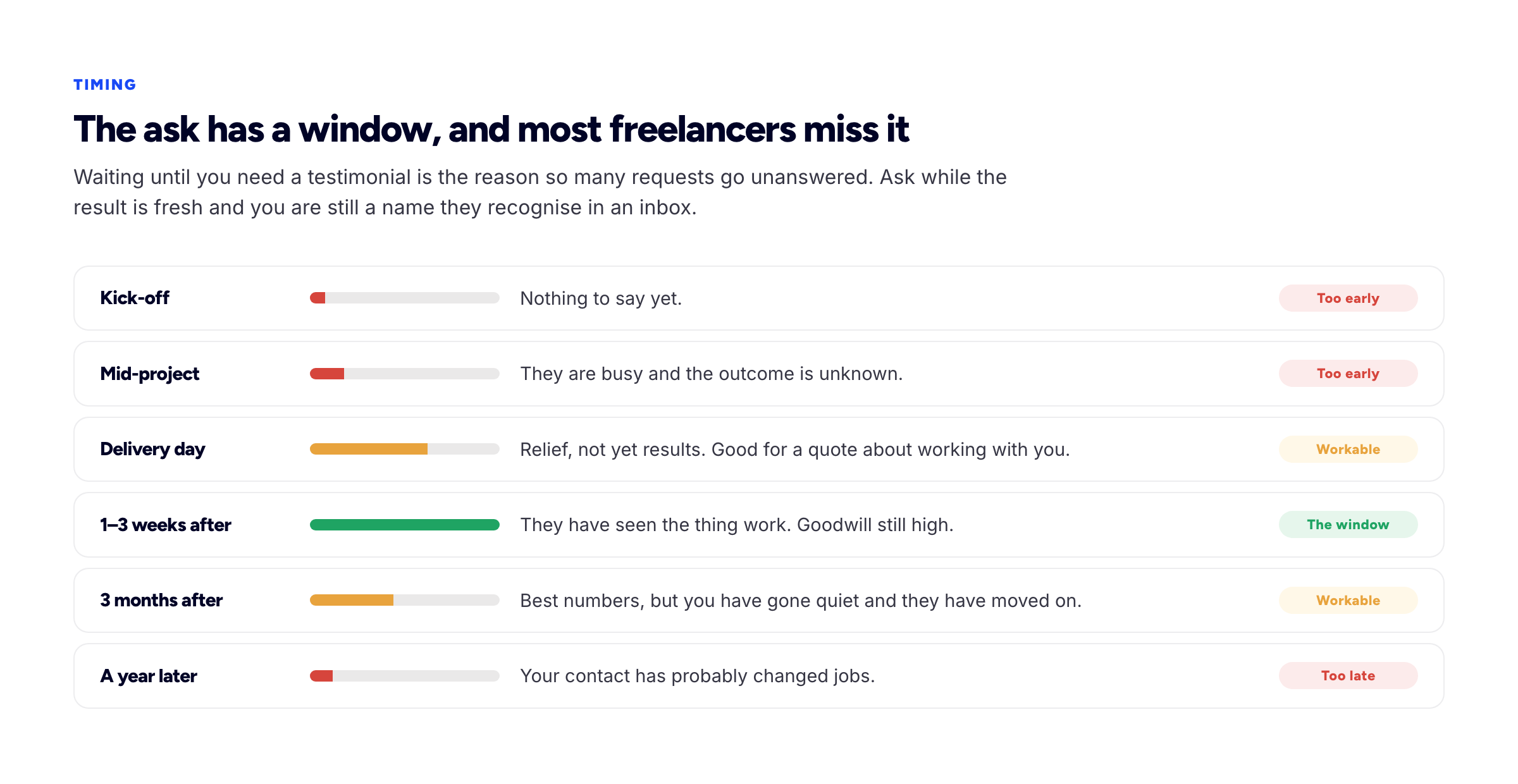
The ask has a window. Most freelancers miss it by three months.
The window: right after something went well
The best moment is the first few days after a delivery that landed — the launch went out, the redesign went live, the report was well received internally, the client emailed you something with an exclamation mark in it. At that moment three things are simultaneously true: the details are fresh in their head, their goodwill towards you is at its peak, and the project is still on their desk rather than buried under the next one.
A month later, all three have decayed. The specifics have blurred into "it went well", the goodwill has been spent on the next vendor, and writing about your project now means recalling it from cold. That is when you get "a pleasure to work with" — not because they are being lazy, but because that is genuinely all that is left in memory.
Do not wait for the project to be formally closed. If you are on a six-month retainer, the window is after each visible win, not after the contract ends. Waiting for the end of a long engagement can mean waiting a year for a testimonial about work you did in the first fortnight.
Why asking when you need one fails
The most common pattern we see is the panic ask: work has gone quiet, the portfolio looks thin, and so a round of requests goes out to everyone from the last two years on the same afternoon. It rarely works, for a few connected reasons.
Old clients have to reconstruct the project from memory, so the quotes are vague. The request arrives with no context, so it reads as a cold favour rather than a natural end-of-project step. And you are asking under time pressure, which usually shows in the wording — vaguer, more apologetic, easier to postpone. A request that says "whenever you have a moment, no rush at all" gives an already-busy person explicit permission to never reply.
The fix is to make the ask part of your delivery process rather than a marketing activity. It belongs in the same checklist as the final invoice and the handover document.
The second window, and the follow-up nobody sends
There is a second, weaker window worth knowing about: two to six months after delivery, when the results are actually visible. The client who could only say "the new site looks great" in week one can, in month four, tell you that enquiries went up or that the support inbox stopped receiving a particular question.
If you got a quote at delivery, a short follow-up later — "did the change end up doing what we hoped?" — is both a genuine client-service question and the single easiest route to a stronger, outcome-based version of the quote you already have. It also, not incidentally, tends to surface repeat work.
How to ask: three requests you can copy
The mechanics matter less than people think, with three exceptions. Ask by email or in whatever channel you already use with that client, not through a testimonial-collection tool that sends them a branded form from a company they have never heard of. Ask a named human, not a shared inbox. And make the reply as cheap as possible.
Below are three versions. Adapt the specifics; keep the structure.
1. Immediately after a delivery that went well
This is the one you will use most. Note that it asks questions rather than for a testimonial, states the length, and says exactly where the words will appear.
Subject: One quick favour before I close this out
Hi Priya,
Really glad the new booking flow landed well — thanks for being decisive on the date-picker question, it saved us a week.
Could I ask a small favour? I keep a short set of client quotes on my site, and I would love to include one from you. Rather than make you write something from scratch, three questions — a sentence each is plenty:
1. What was the situation before we started, and what was the risk if it stayed that way?
2. What has actually changed since we launched?
3. Was there anything about working together that surprised you, good or bad?
I will edit your answers into two or three sentences and send them back for approval — nothing goes on the site until you have signed it off. If you are happy for it to be attributed, I would use your name, your title and Northbeam. Totally fine if you would rather not.
Thanks either way — it has been a good project.
Dan
Five things are doing the work in that email. It leads with something specific about their contribution rather than yours. It replaces the essay prompt with three answerable questions. It caps the effort ("a sentence each"). It removes the risk by promising approval before publication. And it gives an easy no.
2. The long-running client with no obvious endpoint
Retainer and ongoing work has no natural moment, so you have to make one — usually a milestone.
Subject: Six months of the support retainer
Hi Marcus,
We passed six months on the support retainer last week, which felt like a reasonable moment to take stock. The uptime figures and the ticket backlog are in the attached one-pager.
While I have your attention — would you be willing to give me two or three sentences I could use as a client quote? The thing I would most like to capture is what changed operationally for your team, rather than anything about me personally. Something along the lines of: what was the support situation like before, what is it like now, and what would you tell another company considering the same arrangement?
Happy to take a rough set of bullet points and tidy them into something you approve.
Marcus, no obligation at all — say the word and I will drop it.
Dan
3. The small job, or the client you have not spoken to in a while
For a one-week job or a client from last year, the request has to be proportionally smaller. Do not send three questions for a three-day project.
Subject: Quick one about the landing page
Hi Ana,
Hope the launch went well. I am refreshing my site and I wondered if you would be up for a one-line quote about the landing page build — specifically what it changed for you, if anything measurable came out of it.
One sentence is genuinely enough. If it is easier, reply with a couple of rough notes and I will draft something for you to approve or rewrite.
No problem at all if you would rather not.
Dan
Send these as plain text. A designed HTML email with a "Leave a review" button converts a personal favour into a marketing request, and the response rate drops accordingly. Adapting one of these to your own project is where people stall, and our professional email generator has an ask-for-a-testimonial setting that will draft it from your notes for you to cut down.
The questions that produce evidence
This is the core of the whole thing. Everything else in this guide is secondary to what you actually put in front of the client.
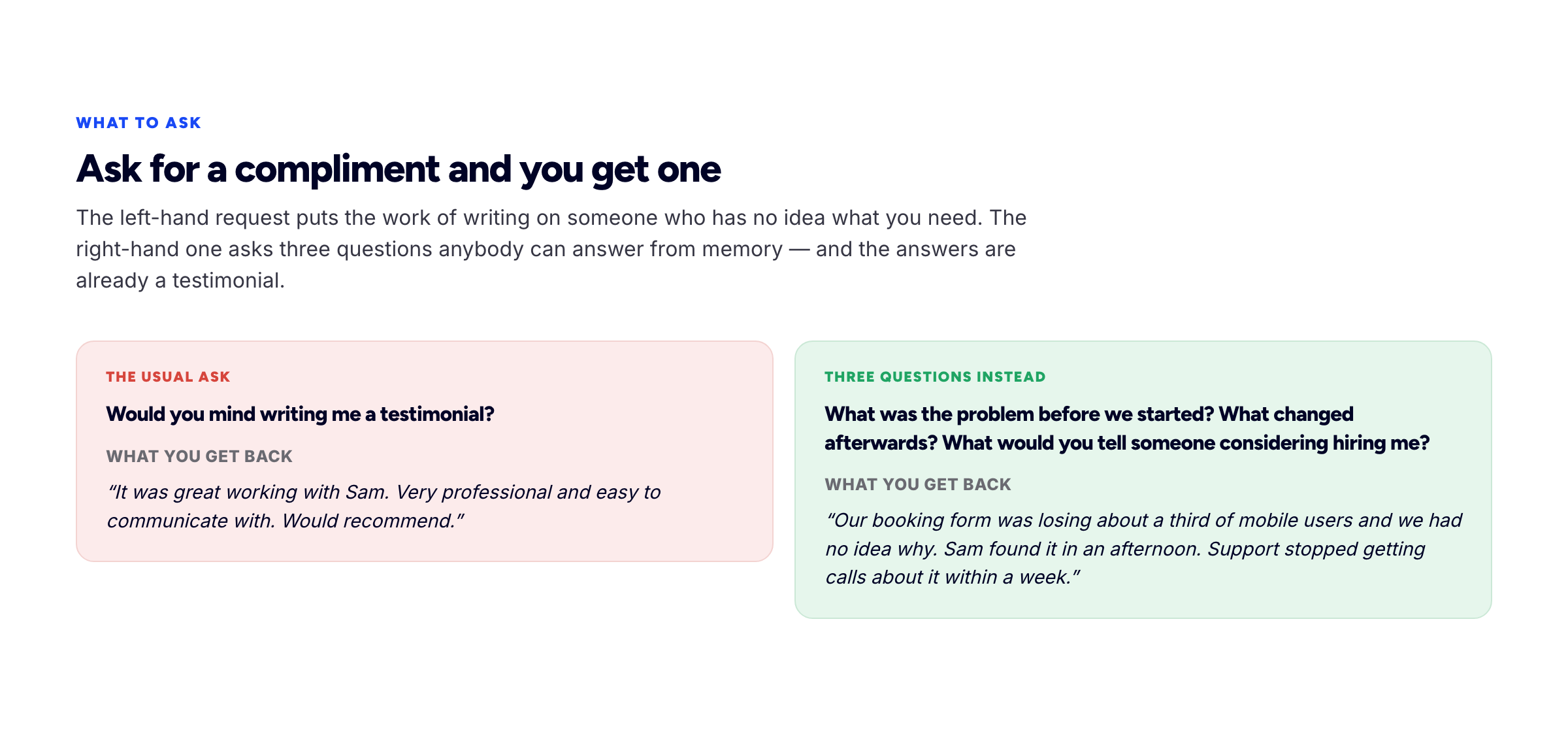
Ask for a compliment and you get one. Ask a question and you get evidence.
Pick three from the list below. Never send more than four — past that the request stops feeling like a favour and starts feeling like homework, and the reply rate falls off sharply.
- What was the situation before we started? Establishes the problem, which is what makes the outcome legible to a stranger.
- What has changed since? The outcome question. This is the one that produces numbers, when numbers exist.
- Was there a moment you were unsure this would work? Produces the most persuasive kind of quote there is — one that admits doubt and then resolves it, which reads as unmistakably real.
- What did you expect to be difficult that turned out not to be? Surfaces process strengths the client would never think to mention unprompted.
- Who would you recommend me to, and for what kind of job? Gives you a positioning line in the client's own words, which is often more useful than the praise.
- What nearly stopped you hiring a freelancer for this? Excellent for pre-empting the exact objection your next prospect will have.
Avoid "how was your experience working with me?" and "what did you like about the project?" Both are politeness prompts, and they return politeness. The test for any question you are considering: could the client answer it truthfully without knowing anything specific about the project? If yes, cut it.
Editing the answers
You will usually get back three loose paragraphs rather than a polished quote, which is exactly what you want. Your job is to compress, not to embellish. Cut to two or three sentences, keep the client's own phrasing wherever it is concrete, remove filler, and leave every fact untouched. Then send the edited version back with a line like "here is what I would use — change anything that does not sound like you."
Two lines you must not cross. Do not add a fact the client did not state, including a number they did not give you. And do not stitch sentences from different parts of their reply together in a way that changes their meaning. Tightening is fair; authoring is not.
When the quote comes back bland
Sometimes you ask three good questions and still get "Dan was great to work with, highly recommended." This is recoverable, and the recovery is one polite follow-up rather than a shrug.
The move is to thank them, take the compliment at face value, and ask one narrow question. Narrow is the operative word — you are not sending the brief again, you are asking for a single missing detail:
Thanks Priya, that is kind of you. One tiny follow-up if you have thirty seconds: could you say what the booking flow was like before we changed it? People reading my site have usually got the same problem, and the "before" is the bit that helps them recognise themselves. Even a half-sentence would do it.
That works most of the time, because the client is not being difficult — they simply did not know that the "before" was the useful part. If it does not work, use what they gave you. A short, warm, attributed quote from a real named person at a real company is still meaningfully better than nothing, and it costs you nothing to place it somewhere secondary on the page.
What you should not do is quietly rewrite their bland quote into a specific one and publish it under their name. It is a small dishonesty that becomes a very large problem the first time a prospect mentions the quote back to the client in a meeting.
Offering to draft it for them
This comes up constantly and deserves a clear answer, because the practice sits on a line and it matters which side you land on.
Acceptable: the client sends you rough notes, bullet points or answers to your questions, and you shape their material into clean sentences, which they then read and explicitly approve before publication. That is editing. Nothing in the quote originates with you.
Acceptable, with care: the client says "I am snowed under, just write something and I will sign it off." You write a draft based only on things you know to be true and that they have said to you at some point, send it clearly marked as a draft, and invite them to change anything. Include a line inviting rejection: "rewrite it however you like, or bin it — no offence taken." The approval has to be real and unambiguous. "Yeah fine" in a reply is enough; silence is not.
Not acceptable: writing a quote, publishing it under someone's name, and telling yourself they would have agreed. Also not acceptable: putting a number in a draft the client never gave you, on the grounds that it is "roughly right". If you are drafting, you are constrained to claims the client can verify from their own knowledge in ten seconds.
The honest version of drafting has a useful side effect: because you write the draft, the outcome and the specifics are in it from the start, so the approved quote tends to be far better than what a busy person would have produced from a blank page.
Permission, named clients and NDAs
Getting a lovely quote and then discovering you cannot publish it is a common and entirely avoidable waste. Sort permission at the same time you ask.
Be explicit about three things: where it will appear (your portfolio site, possibly LinkedIn or a proposal), how it will be attributed (name, role, company, optionally a photo or a link), and that you will not use it anywhere else without asking. One sentence covers all three, and it visibly lowers the perceived risk of saying yes.
For anyone at a larger organisation, remember that the individual might not have the authority to put their employer's name behind a supplier quote. Some companies route this through marketing or legal; a few forbid it outright. Make the fallback easy so a policy problem does not turn into a total loss:
- Named, with company. The strongest form. Always ask for this first.
- Named, company generalised. "Priya Raman, Head of Operations at a UK logistics company." Still a real person; still checkable via LinkedIn if they consent to a link.
- Role only. "Head of Operations, mid-sized logistics firm." Weak, but honest, and acceptable if you say plainly that the client cannot be named.
- Private only. Some quotes can be shared in a proposal or a one-to-one conversation but not published. These are still worth collecting.
Where an NDA is in play, treat the testimonial the same way you would treat the work itself. The safe move is to write what you would like to publish, send it to your contact, and ask them to confirm it is cleared — in writing, in an email you keep. The same principle covers project write-ups, and the approach carries over directly from the guidance on describing confidential work in a freelance portfolio website that wins clients.
Where testimonials go, and how many
Collecting good quotes and then dumping all of them onto a page called "Testimonials" is the most common way to waste them. A wall of praise is skim-proof: readers recognise the format, assume it is curated, and scroll past the lot. Placement beats volume.
One quote near the top
Your single strongest, most specific, best-attributed quote belongs high on the home page — near the hero, before the work. It is doing a particular job there: answering "has anyone else trusted this person" while the visitor is still deciding whether to keep reading. One quote. Not a carousel, which most people never advance past the first slide of anyway.
Quotes next to the work they describe
The highest-leverage placement, and the one most freelancers miss. A quote about the checkout rebuild belongs inside the checkout rebuild project, not in a general pile at the bottom of the page. In context, the quote stops being praise and becomes corroboration of the specific story you just told.
Inside a case study this is stronger still: a client sentence dropped in at the point where you describe the result turns your account of what happened into a jointly witnessed one. There is a full structure for that in how to write a portfolio case study — the short version is to place the quote after the outcome, never before the problem.
Three to six on a dedicated section, if at all
If you do keep a testimonials section, keep it short and make each entry earn its place. Three excellent quotes from three different types of client outperform twelve interchangeable ones, because variety of client type tells a reader "this works for someone like me" — which is what they are really scanning for.
Two placement details that are worth the five minutes: put testimonials as real text in the page rather than as images of text, so they are readable by screen readers and searchable; and put one near your contact section, where it does its final job of reassuring somebody who is halfway through deciding to email you.
What to do when you have none yet
Every freelancer starts here, and the answer is not to leave the section empty and hope.
First, widen your definition of a client. A testimonial is a credible person vouching for your work. That includes a colleague or manager from a previous job, someone you did a favour for, an open-source maintainer whose project you contributed to, a person you mentored, or the organiser of a volunteer project. "Ex-manager at your last agency" is real, checkable attribution.
Second, go back through what people have already said to you. Most freelancers are sitting on unrecognised testimonials in old Slack messages, project emails and LinkedIn recommendations. You cannot publish a private message unilaterally, but you can absolutely ask: "you said this at the time and it stuck with me — would you be happy for me to use it on my site with your name?" That is the easiest yes in this entire guide, because the person has already said the words.
Third, treat the first testimonial as a deliverable of your first paid job, however small. It compounds: the first named quote makes the second client easier to win, and the second easier still, which is why it is worth accepting a smaller first project partly to get one. The mechanics of landing that first job are covered in getting your first freelance clients.
Until then, do not fake it. Placeholder quotes, unattributed praise and "what clients say" sections with no clients are transparent to exactly the audience you are trying to convince. Leave the section out and let the work carry the page.
When a client declines
Some will say no, and a few will say nothing at all. Both are fine, and neither means the work was bad.
Company policy is the most common reason, followed by not wanting to be publicly associated with outsourced work, followed by simple inertia. None of these are judgements on you, so do not read them as one, and do not ask twice. A single gracious reply — "completely understood, thanks for considering it" — costs nothing and keeps the relationship intact for repeat work, which is worth far more than a quote.
When you get a no, ask a smaller question instead. Would they be willing to be a private reference for a prospect who asks? Would they be happy with an anonymised version? Would they consider a LinkedIn recommendation, which is their platform rather than yours and sometimes clears an internal policy that a website quote does not? One of these usually lands.
For silence, one follow-up after roughly a week is reasonable, framed as a nudge rather than a chase. After that, stop. The cost of pushing is a relationship; the value of the quote is not that high.
Keeping them current
Testimonials age, in two ways that both matter. A quote from four years ago suggests your best work is behind you, and a quote from someone whose job title has since changed can look like carelessness to anyone who checks.
Once a quarter — the same session in which you refresh the rest of the site — do three things. Retire anything older than about three years unless it is exceptionally strong. Check the roles and companies are still accurate, or add the year so an older title reads as historical rather than wrong. And add whatever came in since, replacing the weakest quote rather than simply appending.
The habit that makes this painless is collecting continuously and publishing selectively. Keep every quote you gather in one document, with the date, the project, the attribution and whether it is cleared for publication. Then the quarterly refresh is a five-minute selection job rather than a fresh round of asking.
A routine you can actually keep
Turn the whole of the above into two habits and you never have to think about it again.
At the end of every project that went well, send the three-question email within a week of delivery. Put it in your delivery checklist next to the final invoice so it is not a decision you make each time.
Once a quarter, spend twenty minutes on the file: chase nothing, but send the two-to-six-month follow-up to clients whose results should be visible by now, confirm permissions you were unsure about, and swap the weakest quote on the site for the best new one.
Two habits, maybe an hour a year in total, and the compounding effect is that by the time you need social proof, you already have it — which is the only state in which asking is easy.
Frequently asked questions
How do I ask for a testimonial without sounding needy?
Ask early, ask specifically, and give an easy exit. Neediness in these requests comes almost entirely from over-apologising — long preambles about how sorry you are to bother them signal that you think you are imposing, which suggests the work might not have merited it. Two sentences of context, three questions, one line saying no is fine. Confident and brief reads as routine, and routine is what you want it to feel like.
Should I use a form or a testimonial collection tool?
For most freelancers, no. A branded form from a third-party service turns a personal favour into a marketing funnel, adds a login or a step, and strips out the context of your working relationship. A plain email in the thread you have been using all project is both easier for the client and more likely to produce something specific. Tools make sense at volume — dozens of clients a year — not at typical freelance scale.
What if the client writes something inaccurate?
Correct it before publishing, and say why. Clients sometimes credit you for work you did not do or misremember a figure. "Just so I do not overclaim — the analytics work was actually your in-house team, so I have taken that line out" is an easy message to send and it strengthens their trust in you rather than weakening it. Publishing a flattering inaccuracy is a risk you are carrying on their behalf, and it will not age well.
Are LinkedIn recommendations as good as testimonials on my site?
They are different tools and it is worth having both. A LinkedIn recommendation is more credible, because it lives on the recommender's profile where you cannot edit it — but it is on rented land and most prospects will not go looking for it. A quote on your own site is under your control and appears exactly where the buying decision happens. The useful pattern is to ask for the site quote first, then ask whether they would be willing to post something similar on LinkedIn, and link to it from your site so the reader can verify it.
How many testimonials do I actually need?
Three good ones will do most of the work. What matters more than the count is coverage: quotes from different types of client, in different situations, that between them suggest you handle the range of work you are advertising. A fourth quote saying the same thing as the first three adds almost nothing, whereas one quote from a different sector can open up a whole category of enquiry.
Can I offer a discount or a gift in exchange for a testimonial?
We would advise against it. Paying for praise changes what the praise is, and if a prospect ever finds out — the client mentions it, or your incentive is documented somewhere — you lose the credibility of every quote on the page at once, not just that one. It is also unnecessary: a well-timed, well-structured ask has a high enough success rate that you do not need to buy the answer. Thanking someone properly afterwards is a different matter, and worth doing.
How we put this guide together
Bunfolio builds portfolio sites for freelancers, so the advice here comes from watching which testimonial sections get filled, which stay empty, and what the quotes people do collect actually say. The email templates and question sets are our own, written for this guide as worked examples rather than transcribed from real client correspondence — the names and projects in them are invented.
We have deliberately not quoted any of the trust statistics that dominate this topic. Search for testimonials and you will find a dense layer of confident percentages about how many buyers trust online reviews as much as personal recommendations, most of which trace back to a marketing blog citing another marketing blog with no identifiable underlying study. Repeating one would make this guide look more authoritative and be less trustworthy, so every claim above about what works is presented as our judgement, drawn from practice rather than from a figure we cannot check.
The one hard rule in this guide that is not a matter of judgement is the honesty line around drafting and editing quotes. Publishing words under someone's name without their genuine approval is a misrepresentation regardless of how well it converts, and it is the one part of this we would not soften.
More from the blog
September 26, 2026 · 15 min read
What Is a Freelance Artist? How the Work, Pay and Rights Actually Work
A freelance artist is paid by the job, not by a salary, and keeps the copyright unless they sign it away. How freelancing differs from commission, in-house and gallery work, where the money comes from...
September 20, 2026 · 24 min read
ATS-Friendly Resume Format: What Actually Breaks
An applicant tracking system is a database with a form on the front, not a judge. Here is the two-minute test that shows you exactly what the parser sees in your own file, the failures that genuinely...
September 15, 2026 · 16 min read
How to Make an Art Portfolio for School, Studios, Galleries and Clients
The same artist needs a different portfolio for an art school, a studio, an open call and a commission client. How to choose and cut pieces for each, photograph and caption the work, and build a portf...