
September 15, 2026 · 16 min read
How to Make an Art Portfolio for School, Studios, Galleries and Clients
The same artist needs a different portfolio for an art school, a studio, an open call and a commission client. How to choose and cut pieces for each, photograph and caption the work, and build a portfolio from scratch in eight weeks.
Most advice on how to make an art portfolio quietly assumes there is one portfolio. Pick your best pieces, photograph them nicely, put them somewhere, done. The trouble is that "somewhere" decides almost everything. The same artist, with the same body of work, will send a different set of images to an art school, a games studio, a gallery's open call and a stranger who wants a painting of their dog — and the set that wins one of those will lose the others.
So this guide starts with the destination and works backwards. First, the four places an art portfolio usually goes and what each one is really judging. Then the parts that apply to all of them, and a six-to-eight-week plan if you are starting with very little. If what you actually need is the website that holds your work, we cover that separately in our guide to building an art portfolio website; this post is about the portfolio itself.
What an art portfolio is, and why there is no single one
An art portfolio is a curated selection of your artwork, presented so that a particular reader can judge a particular thing about you. It is not an archive of everything you have made, and not a neutral "best of". It is an argument aimed at someone, and the argument changes with the someone.
Here is the practical consequence. Keep one master folder of everything worth showing, well photographed and properly captioned. Then build a separate, deliberately smaller edit from it for each destination.
Start with where the portfolio is going
Nearly every art portfolio is heading to one of four places. Each is read by different people looking for different evidence.
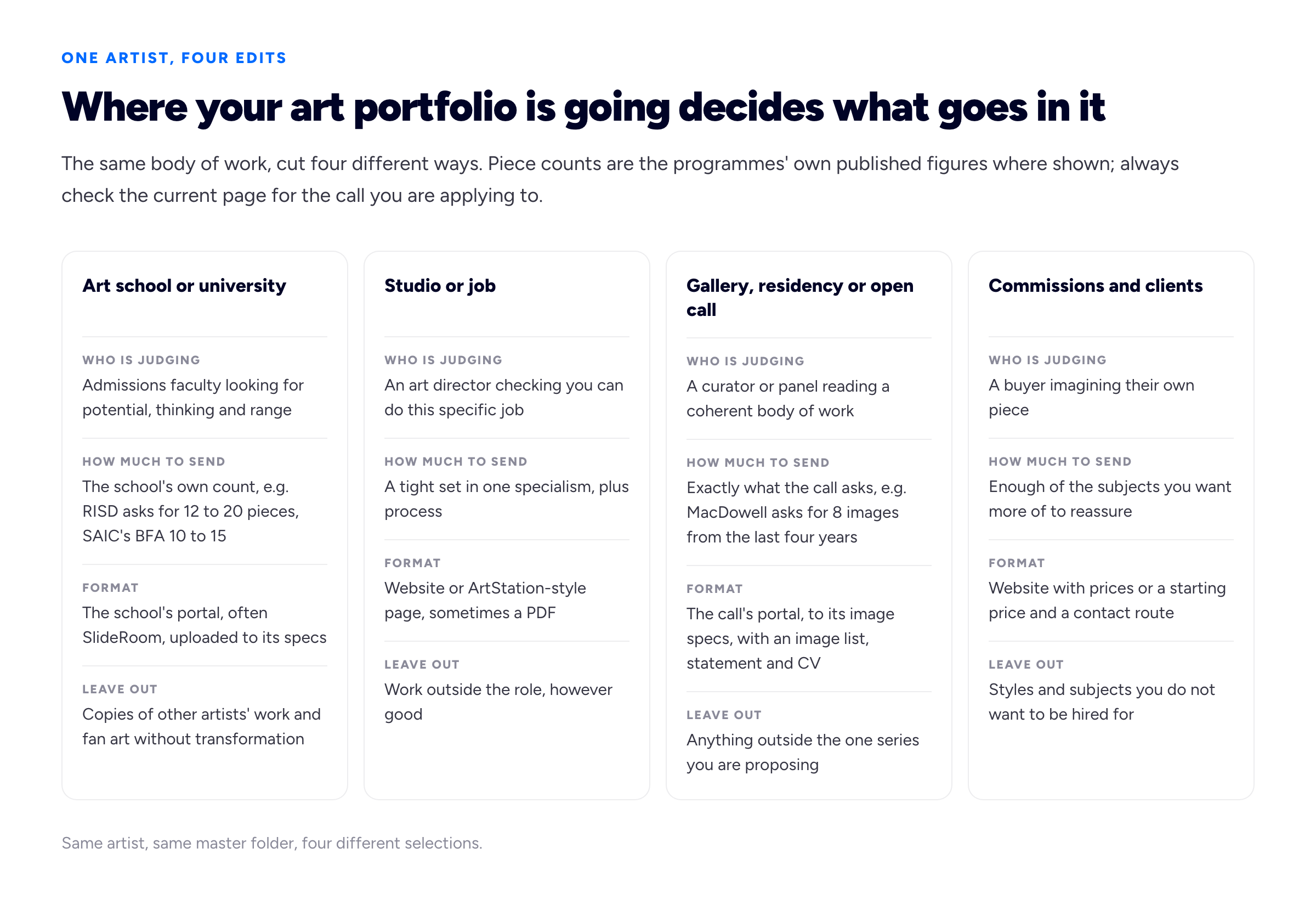
Keep one master folder and cut a new selection from it for each destination. The columns disagree on purpose.
1. Art school, university or a high-school programme
Admissions portfolios are the most rule-bound of the four, and the rules belong to the school, not to any general guide. Read the programme's own page before you choose a single piece. To give a sense of how much they vary: RISD's first-year application page asks for "12–20 examples of your most recent work", recommends including some drawing or painting "from direct observation (rather than from imagination, photograph or video)", and allows research or preparatory work in "up to three—but no more than three" of the uploads, which go through SlideRoom. SAIC's portfolio requirements by degree ask BFA Studio applicants for "10–15 pieces of your best and most recent work" and list sketchbooks among acceptable materials. University of the Arts London's portfolio advice talks in projects rather than pieces — "between 3 to 5 projects" — and wants to see research, process and outcome.
Three schools, three different units of measurement: there is no universal number, so distrust anyone who gives you one without naming the school. What these readers share is that they are judging potential rather than polish. They want to see how you look, how you think, and whether you will do something interesting with four years of teaching. Range across media helps here, as it rarely does elsewhere.
If you are in the US and taking AP Art and Design, that portfolio is its own animal again. The College Board's AP 2-D Art and Design portfolio has two sections: a Sustained Investigation of 15 digital images (some may be details or process images) and Selected Works of 5 works with commentary.
2. A studio or job: concept art, illustration, animation, games
A studio art director is not assessing your potential. They are asking one narrow question: can this person do the job we are hiring for, next month, to our standard? That rewards specialisation. A character-concept portfolio should be mostly characters; an environment artist's should be mostly environments. A gorgeous still life in a creature-design portfolio shows that you did not read the job advert.
Process matters more here than anywhere else, because studios hire for how you reach a finished image: thumbnails, silhouettes, variations, callouts. Show fewer finished pieces and more thinking behind a few of them. Our illustration portfolio guide covers how commercial illustrators organise this by market.
3. Gallery, residency and open-call submissions
Curators and selection panels read your work as a body, not a sampler. They want a coherent series with a clear set of concerns, presented exactly to the call's specification. Range actively hurts you here: six unrelated experiments read as someone who has not found their work yet.
The specifications are strict and specific to each call. MacDowell's work sample requirements for visual artists ask for eight examples "completed within the last four years", with a preferred file size under 3 MB each, one work per image, and two of the eight allowed to be details or installation views. The CaFÉ platform, which many US calls use, sets a minimum of 1,200 pixels on the longest side, under 5 MB, JPEG only, and recommends 1,920 pixels or more in the sRGB colour profile. Expect to need an image list, a short artist statement and an exhibition CV alongside the images.
4. Commissions and private clients
Someone thinking about commissioning you is doing something different again: imagining their own piece. They scan your work for subjects and treatments close to what they want, then look for a price and a way to ask. So this edit is ruthlessly commercial. Show more of the work you want to be paid for and none of the work you would dread being asked to repeat. Give a starting price, explain the process in a few steps, and make the contact route obvious.
What to include in an art portfolio: choosing and cutting
Once you know the destination and its count, the selection process is the same everywhere. Start from the master folder, not from memory, and work in three passes.
- Filter by destination. Remove everything that does not serve this reader. For a studio, that is anything outside the role. For an open call, anything outside the series. For a school, anything that is purely copied.
- Rank what is left. Lay it all out as thumbnails on one screen and order it strongest to weakest, ideally with someone whose eye you trust.
- Cut from the bottom. A portfolio tends to be remembered by its weakest piece, because that is the one that makes a reader wonder whether the good ones were luck. If you are hesitating about a piece, it goes. Sending the lower end of a school's range with no weak links is almost always better than filling the upper end.
Then sequence it. UAL's advice is to "start and end with your strongest work to make a good first and last impression". In between, group work so it reads as a body — by project, series or idea — rather than shuffling for variety.
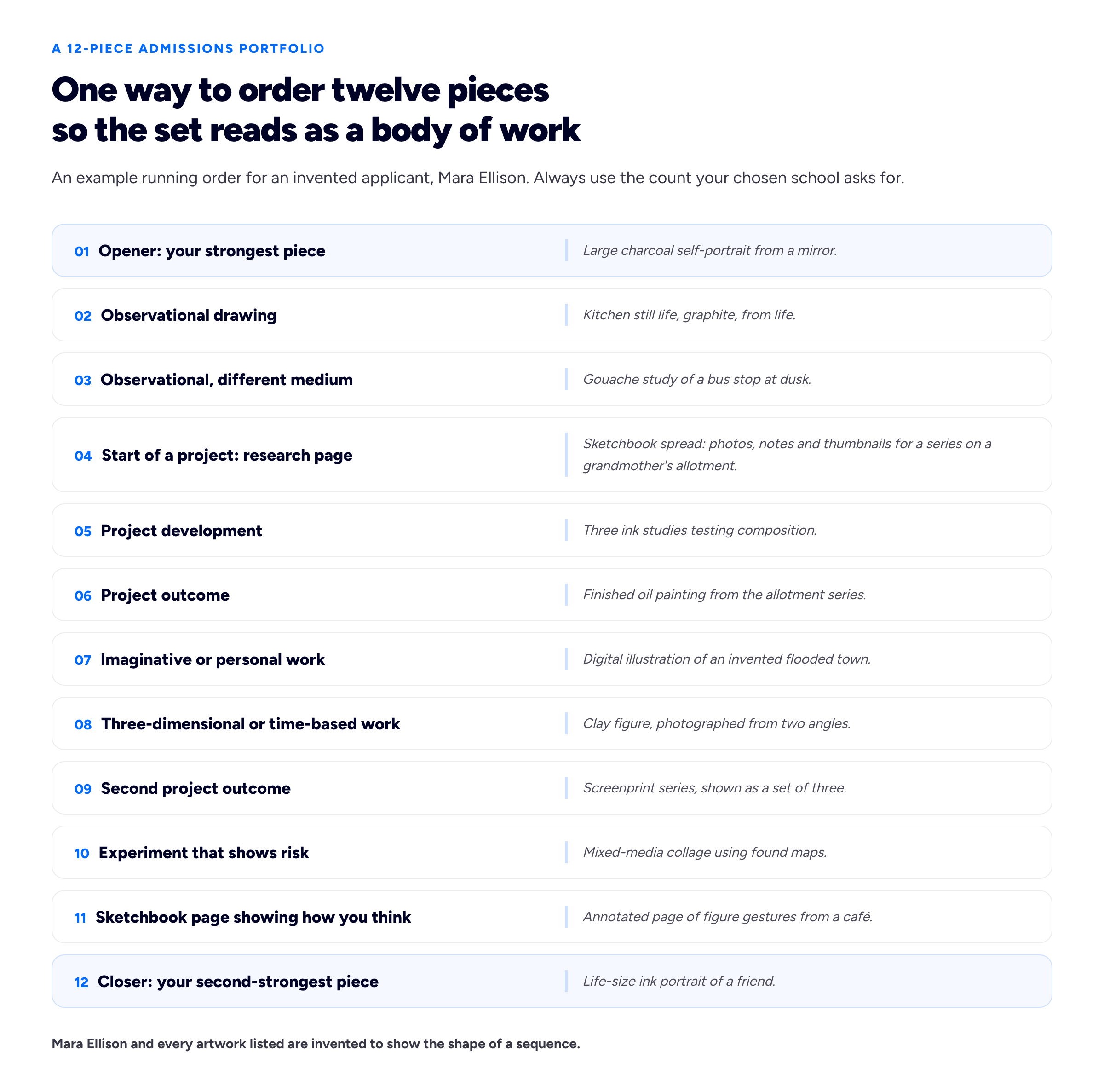
Strongest first and second-strongest last, with projects shown as research, development and outcome in the middle. Adapt the proportions to the school's own guidance.
Observational versus imaginative work
Observational work is drawn or painted from something in front of you: a still life, a room, a person, a street. Imaginative work comes out of your head, or from references you have combined. Both matter, but they prove different things, and the balance depends on the destination.
For admissions, observational drawing is the evidence that you can actually see — proportion, light, space — and it is hard to fake. That is why RISD names it explicitly, and why "from direct observation (rather than from imagination, photograph or video)" is worth taking literally. Drawing from a photograph is a different skill, and a set copied entirely from photos tends to show it in flattened perspective and camera lighting.
For studios, imaginative work is the job, but a few observational studies explain why your invented worlds hold together. For galleries and commissions, the distinction matters less than the series or the subject.
Sketchbook pages and process
Sketchbook pages are not filler. For schools and studios they are often the most revealing images in the set, because they show how you arrive at an idea rather than only where you ended up. The trick is to edit them like finished work.
- Choose pages that show thinking: research, annotations, thumbnails, failed attempts that led somewhere.
- Photograph spreads flat, evenly lit, with the whole page in frame; do not crop off the gutter so tightly that the page looks like a loose drawing.
- Respect the limit. RISD caps research or preparatory work at three uploads. If a school gives you a cap, treat it as a ceiling, not a target.
Photographing your art properly
A panel judging from a screen is judging the photograph, not the painting. A good piece in a bad photo loses to an average piece photographed well.
- Light it evenly. Indirect daylight — near a window, out of direct sun — is the easiest good light. Avoid on-camera flash, which leaves a hot spot and glare, and mixed light sources, which tint one side of the image.
- Shoot square-on. For 2D work, hang or prop the piece vertically, put the camera at its centre and parallel to its surface, and fill the frame. Slight tilting turns rectangles into trapezoids that no amount of cropping fixes well.
- Kill the glare. Photograph glazed work out of its frame if you can, and angle lights to the sides for varnished surfaces.
- Check the colour. Set the white balance, or include a grey or white card in a test shot, then compare the image with the actual piece on a decent screen. Correct to match the work, not to improve it.
- Crop to the edge of the work for 2D pieces, unless the call asks for installation views. No floor, no wall, no fingers.
- 3D work needs more than one view. Photograph against a plain background, from two or three angles, and include one detail and one shot with something that shows scale. MacDowell's allowance of two detail or installation images out of eight is a useful signal of what panels expect.
- Name the files sensibly:
surname-title-year.jpg, or whatever the call asks for. "IMG_4821.jpg" makes a panel's admin harder and can scramble your order. - Export to spec. Keep a full-resolution master, then export copies at the pixel size, file size and colour profile each destination asks for.
Our photography portfolio guide goes further into colour and export.
Captions and the image list
Every piece needs a caption, and every formal submission needs an image list — a numbered list matching your images in order. The standard fields are the same almost everywhere:
- Title — in italics, or "Untitled" if it genuinely has none.
- Medium — specific: "oil on linen", "graphite on paper", "digital, Procreate".
- Dimensions — height before width (then depth for 3D), in the units the call uses.
- Year — when it was completed.
- One line of context, where the format allows: the assignment, the series, or what you were testing.
For school submissions, mark whether a piece was an assigned project or self-directed; RISD's page notes that work can be either. For studio applications, state your role on anything collaborative. For commissions, add availability or "sold". An example: Allotment, October, oil on board, 40 × 50 cm, 2026 — from a series painted on site over six weekends.
A short artist statement
Galleries and residencies usually ask for a statement; studios and commission clients rarely care. Keep it short — a paragraph or two — and concrete. Say what you make, what you are interested in, and how the work goes about it. Name materials and subjects. Avoid theory you cannot explain plainly, and adjectives about your own work ("powerful", "striking").
A usable shape: one sentence on what you make, one or two on the question or subject the work returns to, one on process, and one on what you are working towards. If the call wants a project proposal instead, answer the call's question rather than pasting in your general statement. For the self-introduction that sits on a website instead, our guide to the portfolio about page covers the tone.
Formats: PDF, slides, portal upload or website
The destination decides the format, and it is almost never your choice.
- Portal upload — most schools, open calls and residencies. Individual images with fields for each; upload in your chosen order, which is usually the order reviewers see.
- PDF — common for job applications and direct gallery approaches. One work per page, caption beneath, your name and website on every page, small enough to email.
- Slides — some foundation courses and interviews ask for a presentation; UAL recommends landscape pages and a minimum 12-point size for annotations.
- Website — the right home for commission work and where studios expect to find you. It does not replace a portal upload: if a school or call asks for files in its system, a link is no substitute.
For the thumbnails that make a website's grid work, see our note on portfolio thumbnails; for how many pieces a website can carry, our guide to how many projects a portfolio needs.
How to start an art portfolio from scratch
If you have a handful of pieces and a deadline two months away, do not try to finish everything you have ever started. Make targeted new work instead. A realistic six-to-eight-week plan:
- Week 1: requirements and audit. Read the destination's page and write down the count, format, specs and any required pieces. Photograph everything you have and mark each piece keep, maybe or no.
- Weeks 2–3: observational foundation. Draw from life every day, even for twenty minutes. Aim for two or three finished observational pieces in different media.
- Weeks 3–5: one project, start to finish. Pick a subject you care about and take it through research, development and outcome, keeping the sketchbook pages.
- Weeks 5–6: fill the gaps. Compare your set to the destination. Missing colour? 3D? A personal piece? Make the one or two pieces that close the gap.
- Week 7: photograph, caption, cut. Shoot everything properly, write the image list, and show the set to someone honest. Cut the weakest.
- Week 8: format and submit early. Export to spec, upload in order, and submit a few days before the deadline, so a failed upload or a wrong file size is a nuisance rather than a missed year.
If you are building a professional portfolio rather than an admissions one with little client work behind you, our guide to a portfolio with no experience covers self-initiated briefs and labelling them honestly.
Common mistakes
- One portfolio for everything. The most common and most expensive mistake.
- Filling to the maximum. A range is a range; the lower end, all strong, beats the upper end with weak pieces.
- Copies presented as your own. Fan art and master copies can be useful practice, but submitted without transformation or credit they undermine you, and AP's policy requires credit and "observable transformation" for any preexisting work.
- Photographs that lie — wrong colour, glare, skew, or a heavily filtered image that does not match the piece a panel may later see in person.
- Ignoring the spec. Wrong pixel size, wrong format, wrong count. A portal can refuse a file that misses its minimums, and a panel is under no obligation to chase you for a replacement.
When you want the work online as well — for commissions, or so a studio can find you — Bunfolio's free portfolio website puts it on your own subdomain from a Google sign-in and a short form. Use it alongside the portal uploads, not instead of them.
Frequently asked questions
What should an art portfolio include?
Your strongest recent work, chosen for where it is going: observational drawing, personal work and some process pages for a school; one specialism with process for a studio; one coherent series with an image list, statement and CV for a gallery; the subjects you want more of, with a price, for commissions. Caption every piece with title, medium, dimensions and year.
How many pieces should be in an art portfolio?
Whatever the destination asks for. Published figures vary widely: RISD asks first-year applicants for 12 to 20 pieces, SAIC's BFA Studio for 10 to 15, UAL for work from 3 to 5 projects, and MacDowell for eight images.
What is the 70/30 rule in art?
It is an informal composition heuristic, not a portfolio standard: the idea that a picture tends to feel more resolved when one element dominates — roughly seventy per cent light to thirty dark, or warm to cool, or busy to quiet — rather than splitting fifty-fifty. We know of no admissions office, gallery or studio that uses it to judge portfolios, and there is no single authoritative source for it. Treat it as a teaching rule of thumb.
What is the 80/20 rule in art?
Again informal, and used in more than one way. Some teachers apply the Pareto idea to practice — most of your improvement comes from a small share of focused exercises — and some use it as a composition ratio like the 70/30 rule. Neither is a portfolio requirement.
Can ChatGPT make a portfolio?
It can help with the words — drafting an artist statement to rewrite in your own voice, tidying captions, checking an image list — but it cannot make the art, and AI-generated images presented as your own work are generally not accepted. The College Board's AI guidance for 2026–27 says plainly that "using generative AI tools to create final submitted artwork is prohibited", allows generative AI only during "research, ideation, practice, experimentation, and revision", and requires students to disclose any AI use. RISD requires that any work "supported or created by AI" include a description of your process and tools. Check each destination's own policy, and disclose.
How we put this guide together
The four-destination framework, the three-pass selection, the twelve-piece running order, the photography checklist, the statement shape and the eight-week plan are our own recommendations, not an industry standard. Weigh them as opinions with reasons attached.
Every number in this guide comes from a primary page we read, and we name the programme each time rather than generalising. We have left out the widely repeated claims about how many seconds an admissions officer or art director spends on a portfolio; we could not trace any of them to a published method. We did the same for the "70/30" and "80/20" rules: we found no authoritative origin, so we describe them as the informal heuristics they are.
Sources: RISD's first-year application page (piece count, observational work, the three-upload cap on preparatory work, SlideRoom, the AI description requirement); SAIC's portfolio requirements by degree; UAL's portfolio advice (3 to 5 projects, strongest first and last, landscape pages, 12-point annotations); the College Board's AP 2-D Art and Design portfolio page, its portfolio policies and its AI guidance; MacDowell's work sample requirements; and CaFÉ's guide to preparing image files. Requirements change every cycle, so check the current page for the call you are applying to.
Mara Ellison, her artworks and the caption example in the text are invented for illustration and describe no real artist.
Related reading: building an art portfolio website, the illustration portfolio guide, how many projects a portfolio needs, a portfolio with no experience, the photography portfolio guide and what a freelance artist is, for when the portfolio starts bringing in paid work.
More from the blog
October 3, 2026 · 16 min read
How to Make a Resume Stand Out: What to Change on the Page
A resume stands out by being the easiest one in the pile to say yes to, not by looking different. Here is how to rebuild the top of page one, turn duties into results (even without numbers), tailor ho...
September 9, 2026 · 19 min read
Motion Design Portfolio: What Studios Look At Before the Reel
A showreel proves something moved well. It cannot prove you designed it, timed it, or built any of it — and on a five-craft job the silence reads as a claim to all of it. Why style frames outrank the...
September 3, 2026 · 21 min read
How to Make a Fashion Design Portfolio
Ten unrelated garments answer a question nobody asked. Brands hire the ability to develop a range, so the unit is the collection: research through to flats, a spec sheet and a fitting page. Plus the t...