
November 18, 2026 · 19 min read
Words to Describe Yourself, and How to Make Them Believable
Good words to describe yourself are specific and provable: reliable, thorough, calm, candid, curious, resourceful, decisive, patient and persistent all work, as long as each comes with evidence and a sentence showing it in use. Pick three that do different jobs, check that former colleagues would recognise them, and drop the tired ones like hard-working and passionate.

Good words to describe yourself are specific, believable and tied to something you have done: reliable, thorough, calm, candid, curious, resourceful, decisive, patient, persistent, methodical and adaptable all work, provided each one comes with a piece of evidence and a sentence that shows it in use. "Calm" on its own is a claim anyone can make; "calm — I was the person who took the call when a flood closed two of our blocks" is a fact somebody can ask you about. Pick three words that do different jobs (one for how you work, one for how you are with people, one for how you think), make sure the people you have worked with would recognise them, and avoid the worn-out ones — hard-working, passionate, team player, perfectionist — that every other candidate uses.
Most pages ranking for this phrase give you a list of a hundred adjectives and stop. A list is the easy part. The hard part is making a word believable, choosing the three that are actually yours, and knowing how the same words change shape in an interview answer, a resume summary, a LinkedIn About section and a portfolio bio. That is what this guide covers, with one invented candidate followed all the way through.
The short version, if you need words now
If you have an interview this afternoon, these are safe, specific choices, grouped by what they describe. Pick no more than one from each group.
- How you work: reliable, thorough, methodical, organised, persistent, efficient.
- How you are with people: candid, patient, approachable, diplomatic, tactful, supportive.
- How you think: curious, analytical, practical, resourceful, sceptical, observant.
- How you lead: decisive, steady, accountable, fair, clear, encouraging.
- How you make things: inventive, meticulous, versatile, experimental, economical, visual.
Why a word on its own does nothing
Every adjective you can use about yourself is free. The listener, whether an interviewer, a recruiter or a client reading a bio, is deciding whether the word is true. They cannot check it, so they look for something that would make it hard to say if it were false.
That gives you a simple test, and we use it for every word in this guide. A word to describe yourself needs three things:
- The word. One adjective, chosen because it is accurate, not because it sounds impressive.
- The evidence. One specific thing you have done that a stranger would accept as proof of it: a task, a number of your own, a decision, a piece of feedback.
- The sentence. The word and the evidence together, in a line you could say aloud without sounding as though you are reading.
Compare "I am resourceful" with "I am resourceful — when our repairs contractor went into administration I had a list of three local firms who could cover emergency call-outs by the end of that week." The second version does not need the word at all. That is the sign you have chosen well: the evidence would make the listener reach for the adjective themselves.
The word bank, with evidence and a sentence for each
Here are twenty words in five groups. For each one we give the kind of evidence that makes it believable, and a sentence showing it in use. Swap the details for your own. Several use our invented candidate, Leon Abara, a tenancy officer at an invented housing association called Tidewell Housing, who you will meet properly further down.
Words for how you work
- Reliable. Evidence: something that ran every week or month because of you, without reminders. "I have sent the arrears report every Monday for two years, and nobody has had to ask for it once."
- Thorough. Evidence: a mistake you caught that others missed. "I found the duplicate payments because I check every line against the bank statement, not the totals."
- Methodical. Evidence: a process you set up and others still follow. "I wrote the checklist we use for every new tenancy, so a sign-up takes the same steps whoever does it."
- Persistent. Evidence: something you finished after other people gave up on it. "The damp case had been open for a year; I chased the surveyor, the contractor and the tenant until it closed."
Words for how you are with people
- Candid. Evidence: a time you said the unwelcome thing early. "I told the board the new rent system would miss its launch date while there was still time to move it."
- Patient. Evidence: a hard conversation that went well because you took your time. "Some of my tenants need three visits before they trust me with the letter they have been hiding."
- Diplomatic. Evidence: a dispute between two parties you settled. "I mediated between two neighbours over a shared garden and neither of them moved out."
- Tactful. Evidence: a sensitive message you were trusted to deliver. "I am usually the one asked to phone families after a bereavement about the tenancy."
Words for how you think
- Curious. Evidence: a question you asked that led somewhere. "I asked why one estate had twice the repair requests of its neighbour, and it turned out to be one faulty boiler model."
- Analytical. Evidence: data you turned into a decision. "I sorted a year of complaints by type and showed that most of them were about the same two contractors."
- Resourceful. Evidence: something you solved without the usual means. "With no translation budget, I found two tenants who were happy to interpret at a residents' meeting."
- Observant. Evidence: something you noticed early. "I spotted that a tenant had stopped collecting post, and that visit was the start of a safeguarding referral."
Words for how you lead
- Decisive. Evidence: a call you made with incomplete information, and what happened. "When the lift failed on a Friday night, I booked temporary rooms for the two residents who could not use the stairs, and sorted the cost on Monday."
- Steady. Evidence: a bad week you kept calm through. "During the flood I was the person on the phone, so the rest of the team could be on site."
- Accountable. Evidence: a mistake you owned and fixed. "I sent a notice to the wrong address, rang the tenant to apologise before he found out, and changed how we check addresses."
- Clear. Evidence: something you made easier to understand. "I rewrote our eviction-warning letter so that the first line says what the tenant needs to do."
Words for how you make things
These matter most to designers, writers, photographers and anyone whose work can be looked at.
- Inventive. Evidence: an idea of yours that shipped. "The fold-out map on the festival programme was my idea, and it is the page people kept."
- Meticulous. Evidence: a standard you hold that others notice. "I check every export at the size it will be printed, which is how I caught the faded logo before the run."
- Versatile. Evidence: range across real projects. "This year I shot a wedding, a product catalogue and a theatre poster."
- Visual. Evidence: explaining with pictures where others use words. "I turned the forty-page tenancy agreement into a one-page diagram, and the housing team now hands it out."
Words that have stopped working, and what to say instead
Some words are not wrong so much as used up: readers see them so often that they no longer register. The fix is almost never a fancier synonym. It is to drop the adjective and say the thing it was standing in for.
- Hard-working. Everyone claims it, and no employer has ever advertised for the opposite. Say what the work was: how much, how long, under what conditions.
- Passionate. It describes a feeling the listener cannot check. Name the specific part of the work you like and why. That is more interesting and more believable.
- Team player. Usually means "I get on with people", which is expected. Describe a time you helped someone else's work succeed.
- Perfectionist. Often heard as a disguised weakness, or as someone who misses deadlines. If you mean thorough, say thorough and prove it. If you are using it as your weakness, read our guide to answering the weaknesses question first.
- Self-starter, go-getter, results-driven. Recruitment jargon that nobody uses about themselves in real life. Give the result.
- Detail-oriented. Fine in principle, worn out in practice, and awkward if your application has a typo in it. Name the detail you caught.
- Creative. A claim the work should make for you. If you have a portfolio, point at it; if you do not, describe one idea of yours that was used.
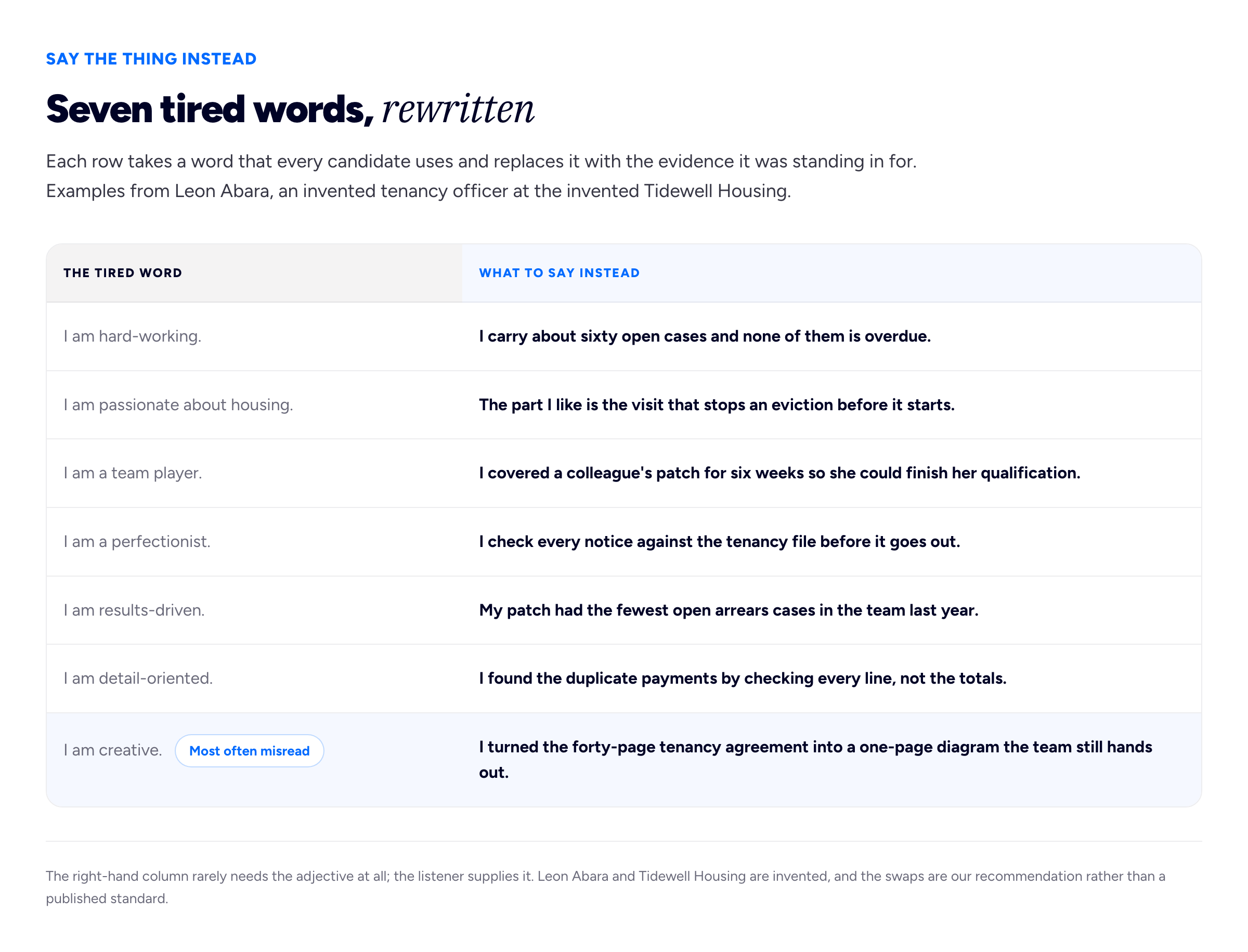
The rewrite almost always deletes the adjective, because the evidence says it for you.
How to pick your three words
The common mistake is to choose words you would like to be true. The better way is to find the words other people already use about you, because those are the ones that will survive an interviewer's follow-up, a reference call and the first month in the job. Here is the process, using our invented candidate.
Leon Abara has been a tenancy officer at Tidewell Housing for four years and is applying for a resident engagement role at another association. His first instinct was "hard-working, friendly and passionate", which describes half the sector. This is how he found better ones.
1. Ask two or three people who have worked with you
Choose people who have seen you on a bad day as well as a good one: a former manager, a peer, perhaps a client. Ask a narrow question, because "how would you describe me?" gets you politeness. Leon messaged his former manager, Freya Lund:
"Hi Freya — I'm applying for a resident engagement role and I'm trying to describe myself honestly rather than in CV language. If you had to give someone three words for what I was like to manage, what would they be? And is there one moment that made you think of each? Blunt is fine, and no pressure to reply."
The second question is the important one. A word from someone else is useful; a word with the moment attached is your evidence, ready made. Freya replied with "steady", "straight" and "stubborn, in the good way", and attached each to a specific case.
2. Mine the feedback you already have
You have more written evidence about yourself than you think. Look through appraisals and review notes, thank-you emails from colleagues or customers, LinkedIn recommendations, client reviews on freelance platforms, and anything a manager wrote when you left a team. Copy every descriptive word and every repeated verb into one list. You are looking for repetition: a word that turns up from three different people in three different years is not flattery.
Leon found "calm" in two appraisals, a tenant's thank-you card that said he "never once made me feel stupid", and a line from a contractor who called him "the one officer who actually reads the report".
3. Turn the verbs into adjectives
Feedback is often written in verbs: "always follows up", "explains things simply", "spots problems early". Translate them. "Always follows up" becomes persistent or reliable; "explains things simply" becomes clear or patient; "spots problems early" becomes observant.
4. Test each word against a story
For each candidate word, write one sentence of evidence. If you cannot, drop the word, however much you like it. Leon dropped "friendly" (true, but no story made it interesting) and kept "steady", which came with the night of the flood.
5. Choose three that do different jobs
Three synonyms waste two slots. "Organised, efficient and methodical" says one thing three times. Aim for one word about how you work, one about how you are with people and one about how you think or lead, so the set describes a whole person. Then check the set against the job: a resident engagement role is mostly people and persuasion, so at least one word has to be about that.
Leon's three became steady, candid and thorough. Freya's "straight" became "candid", which reads better in an interview, and "stubborn" became the evidence for thorough: the damp case he would not let close until it was fixed.
Using your words in each place they are asked for
The same three words should appear everywhere you describe yourself professionally, but they take a different shape in each. In an interview they are spoken and short; in a resume they mostly disappear into evidence; on LinkedIn and in a portfolio bio they set the tone of a longer piece.
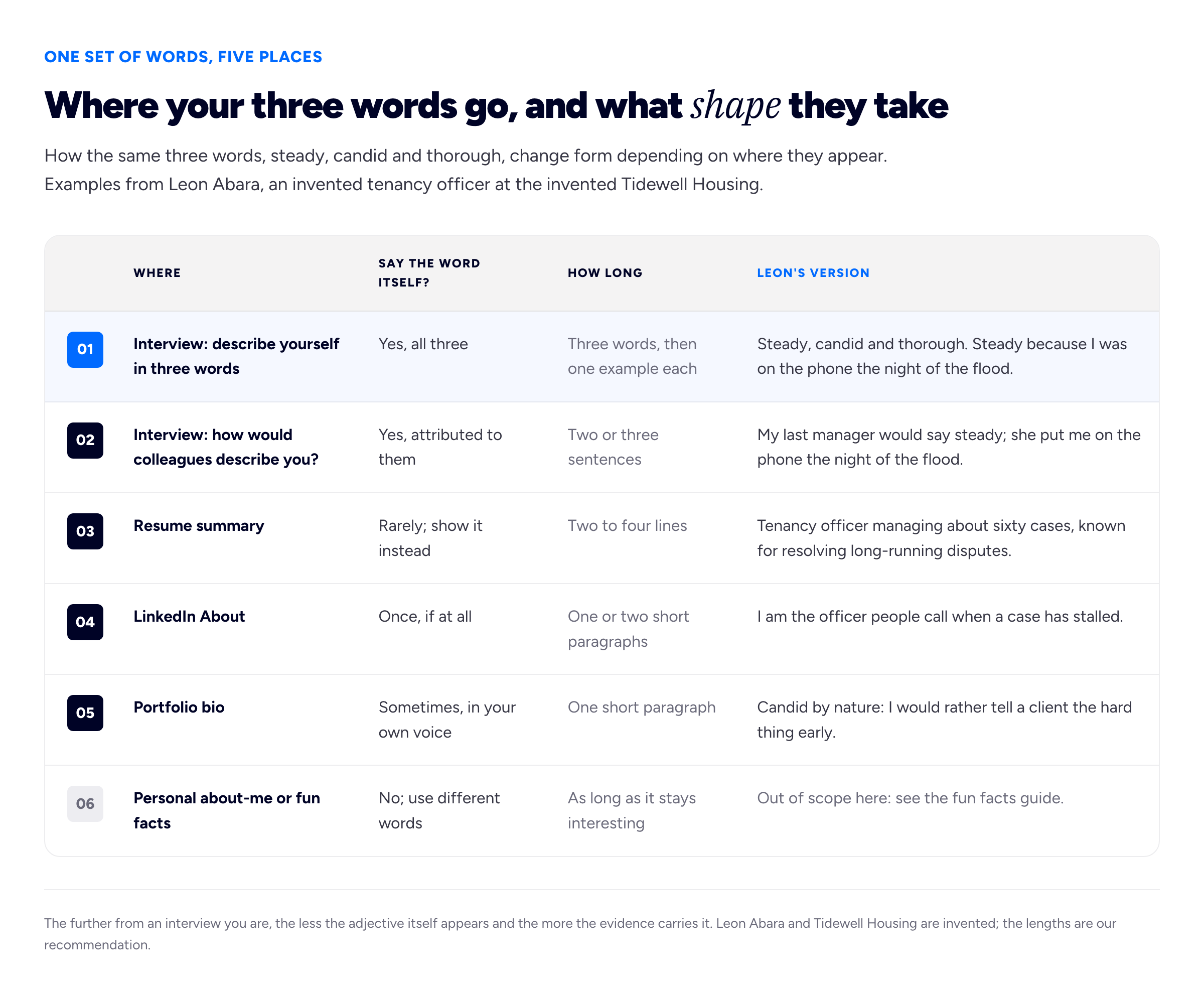
The words stay the same across every context; only how loudly you say them changes.
The interview question: "describe yourself in three words"
This question is a test of self-knowledge, delivered in a hurry. The interviewer is not grading the words; they are listening for whether you have thought about yourself before, and whether the words match what they have seen in the last half-hour. A candidate who has spent the interview talking over people and then says "a good listener" has answered a different question.
Say the three words, pause, then give one short example for each. Our recommendation is to keep the whole answer under a minute:
"Steady, candid and thorough. Steady because when the flood closed two of our blocks, I was the one on the phone to residents all night so the team could be on site. Candid because I would rather tell a tenant the hard news on the first visit than the third. And thorough because I keep a case open until it is actually fixed, not just until the contractor says it is."
Expect a follow-up: "Which of those is the most important?" or "Which would your colleagues disagree with?" Have an honest answer ready. For the second, pick the word that has a cost: "thorough" sometimes means slower, and saying so makes the other two more believable. If the interview opens with the broader version, use the guide to answering "tell me about yourself", which is a different question with a different structure; your three words can sit inside it but should not replace it.
"How would your colleagues describe you?"
This variant is easier if you followed the process above, because you have their words already. Attribute them honestly: "My last manager would say steady" is stronger than "people say I'm steady", because it names someone the interviewer could, in principle, ask. Never quote a reference with words they did not use. The next step in many hiring processes is a reference call, and a mismatch there costs more than a modest answer here.
A resume summary
A resume summary is the place adjectives do least, because the reader is scanning for facts. Your three words should shape what you choose to say rather than appear as words. Compare these:
- Before: "Hard-working, passionate and detail-oriented tenancy officer with excellent communication skills."
- After: "Tenancy officer at Tidewell Housing, managing about sixty cases across three estates. Known for resolving long-running disputes and repairs that had stalled, and for plain-English letters residents act on."
"Known for resolving long-running disputes" is thorough; "plain-English letters" is candid and clear. Neither word appears. Our guide to writing a professional summary covers the structure in full.
A LinkedIn About section
LinkedIn's own help page describes the About section as the place to express "your mission, motivation, and skills" (read on 16 November 2026). That is useful: it is the one professional place where how you work and why you do it are expected, not tolerated. Write in the first person, put your three words to work in the opening lines, and use one short story to carry them.
Leon's opening: "I am the tenancy officer people call when a case has stalled. Four years at Tidewell Housing have taught me that most problems get smaller when somebody says the hard thing early and then follows it through." That is candid and thorough, without either word. If you want a starting draft, our free about me generator takes your words and evidence and gives you something to edit.
A portfolio bio
A portfolio bio is the context where one of your words can appear plainly, because the work sits right next to it and does the proving. A designer can write "meticulous" two inches above a project that shows it. Use one word, not three, keep the bio short, and let it set the tone for everything else on the page. Our collection of portfolio bio examples shows the shapes that work, and the free bio generator will draft one in the length you need. If you have a portfolio site, the bio is also where a reader decides whether to keep scrolling, so it is the one place a well-chosen word is visibly checked against your work.
Personal descriptions, and where this guide stops
Everything above is about describing yourself at work. Icebreakers, team introductions and "tell us something about you" forms want something lighter, and professional adjectives sound stiff there; our list of fun facts about me handles that. Dating profiles are a different problem altogether, and we do not cover them.
Edge cases and mistakes
Your words contradict the job. "Cautious" is a fine word for an auditor and a strange one for a role that asks for quick decisions in a crisis. Choose, from your accurate words, the relevant ones. If none fit, that is worth knowing before you take the job.
You are early in your career. The evidence can come from study, volunteering, part-time work, a society you ran or a group project. "Reliable — I opened the café at seven every Saturday for two years" is real evidence. What you cannot do is borrow the words of a senior manager: "strategic" from a graduate invites a question nobody can answer at that stage.
You are changing careers. Pick words that travel. Patient, candid, thorough and resourceful work in almost any job; "technical" or "commercial" are tied to the field you are leaving. Your evidence comes from the old job and the word explains why it matters in the new one.
You picked a negative word dressed up. "Stubborn", "intense" and "blunt" can be honest, and sometimes they are what a colleague said. Translate them into the version that names the strength — persistent, focused, candid — and keep the original in reserve for the follow-up about your weaknesses, where honesty about the cost is the point.
Frequently asked questions
What are good words to describe yourself?
Good words are accurate and provable: reliable, thorough, calm, candid, curious, resourceful, decisive, patient and persistent all work well. The word matters less than the evidence behind it, so choose ones you can back with a specific example. Avoid the overused ones, such as hard-working, passionate and team player.
How do I describe myself in three words in an interview?
Say three words that describe different things — how you work, how you are with people and how you think — then give one short example for each. Keep the whole answer under a minute, and make sure the words match how you have come across in the interview. Be ready for a follow-up asking which word matters most or which a colleague would disagree with.
What adjectives should I avoid?
Avoid words every candidate uses and nobody can check: hard-working, passionate, team player, perfectionist, self-starter, results-driven and, unless you can prove it, detail-oriented. They are not false, but they no longer register. Replace them with the evidence they were standing in for.
How do I find the right words if I do not know how to describe myself?
Ask two or three people who have worked with you for three words and one moment behind each, then read your old appraisals, thank-you emails and reviews for words that repeat. Turn repeated verbs into adjectives, and keep only the words you can back with a story. The words other people already use about you are the ones that survive a reference call.
Should I put adjectives in my resume?
Sparingly. A resume summary works better when it states facts that imply the adjective, such as how many cases you managed or what you are known for resolving, rather than stating the adjective itself. One well-placed word is fine; a string of them reads as filler.
What is a good word to describe yourself on LinkedIn?
Use the same words you would use in an interview, but let a short story carry them rather than listing them. LinkedIn describes the About section as a place for your mission, motivation and skills, so write in the first person and open with the line that shows how you work. One adjective near the top is plenty.
How we put this guide together
Bunfolio builds free portfolio websites and career tools, which means we read a great deal of the writing people produce about themselves: summaries, bios, About sections and the drafts that go into our generators. Almost everything in this guide is our recommendation, not sourced fact. The five groups in the word bank, the word-evidence-sentence test, the list of tired words and their replacements, the five-step process for choosing your three words, the shape of each context in the second diagram and the suggested lengths are our judgement. There is no authority that publishes a correct list of words to describe yourself, and we have not pretended there is.
The one platform fact we state comes from the source: LinkedIn's help page Edit the About section on your profile, read on 16 November 2026, which describes the section's purpose in the words we quote. That page does not give a character limit for the About section, so neither do we; the figures that circulate elsewhere could not be confirmed on any LinkedIn page we opened.
We have deliberately left out the figures that usually decorate pages like this: claims that recruiters spend a set number of seconds on a profile, that some percentage of hiring managers dislike a particular word, or rankings of the "most overused" adjectives drawn from unnamed samples of profiles. We could not trace any of them to a published method, sample and date, and a number nobody can source looks like evidence while being none.
Every person and organisation named here is invented: Leon Abara, his former manager Freya Lund and Tidewell Housing, along with every quoted sentence, message and example attributed to them. They were written as models to adapt. Use your own evidence, because a borrowed word will not survive the follow-up question.
Related reading: how to answer "tell me about yourself", how to answer "what are your weaknesses?", how to write a professional summary and portfolio bio examples.
More from the blog

November 17, 2026 · 19 min read
How to Add a Promotion on LinkedIn (and Make It Read as Progress)
To add a promotion on LinkedIn, add the new title as a separate position at the same company, dated to the month it took effect, then give the old role an end date with no gap. LinkedIn groups positio...
November 16, 2026 · 19 min read
How to Answer "Tell Me About Yourself" (With Worked Answers)
Answer "tell me about yourself" in 60 to 90 seconds: one sentence on what you do now, one or two things you have done that match the job advert, and why this job is your next step. Leave out your life...
October 28, 2026 · 19 min read
References on a Resume: Should You List Them, and How?
Usually not on the resume itself, and never "available on request". When references do belong on the application, how to choose referees who will actually help, how to ask and brief them, the referenc...