
October 22, 2026 · 19 min read
Fun Facts About Me: How to Find Ones That Land
How to dig your own fun facts out of six kinds of memory, what makes one land rather than fall flat, how to pitch it for a first day, a team meeting, an interview or a written bio, the two-truths-and-a-lie and three-facts formats, and a long list of examples to adapt.
A good fun fact about you is one true, specific sentence that takes under ten seconds to say and makes the listener want to ask one question back. "I once spent a summer driving an ice-cream van round a village of four hundred people" works. "I love travelling" does not, because nobody can ask anything about it that they could not ask about anyone. It does not need to be impressive or personal; it needs a detail and a door left open.
If you are in a hurry, here are three you can adapt straight away: "I can name every station on the line I grew up on, in order, in under a minute", "My first paid job was folding programmes at a football ground, and I still fold everything in thirds", and "I have been to the same small campsite in Wales eleven years running and never once had dry weather." Swap the details for your own and they become yours.
Most pages answering this question are a list of other people's facts, which is no help if you do not have a twin and cannot juggle. This guide does the part they skip: a method for digging your own facts out of six kinds of memory, what separates one that lands from one that lands awkwardly, how to pitch it for a first-day intro, a team meeting, an interview or a written bio, the "two truths and a lie" and "three fun facts" formats, and then a long list grouped by category for you to adapt rather than borrow. The people in it — Juno Abara, Felix Montague and the team at Brightloom Studio — are invented to show the method working.
The short version
- Specific beats impressive. A number, a place or a name turns an ordinary fact into a memorable one. "I have read every book by one author" is flat; "I have read every novel one author has written, and the twenty-ninth twice" is a fact.
- Short beats complete. One sentence, two at most. The story is what you tell when someone asks; the fact is the trailer.
- Leave a question hanging. The best facts make people say "wait, why?" or "how?" That follow-up is the point of an icebreaker, because it starts a conversation you did not have to carry.
- Choose what you would happily talk about for five minutes. Whatever you say, someone will ask about it at lunch.
- Nobody is owed anything private. Health, family circumstances, religion, money, relationships and trauma are never required, and a good fun fact never needs them.
What makes a fun fact land
An icebreaker is not a test of how interesting you are. It is a device for handing other people something easy to say to you. A fun fact has four jobs, and most weak ones fail only one.
It is specific
"I like cooking" describes a third of the room. "I make the same lemon cake every Friday and I am on version nineteen" describes you, and it already contains its own follow-up question: what was wrong with the first eighteen? A number, a proper noun or an odd detail does it; one per fact is enough.
It is short
In a round of introductions, everyone is half listening while they rehearse their own line. A fact that needs a run-up ("so, this is a bit of a long story, but…") loses the room before it arrives. Get to the surprising part in the first clause and stop; if it needs context, people will ask.
It invites a follow-up
Compare "I have been to Iceland" with "I have been to Iceland three times and never seen the Northern Lights." The second one is a little story with a problem in it, and everyone wants to know whether you are going back. A useful check: after you say it, can a stranger think of a question in two seconds? If the only possible reply is "nice", the fact has closed the door it was supposed to open.
It is the right size for the room
A fact can be too big as well as too small. "I was once airlifted off a mountain" is specific and invites a follow-up, and it will also stop a Monday stand-up while everybody wonders whether they are allowed to laugh. Pitch it to the lightest version of the conversation you want to have.
How to find your own facts: six places to dig
"I have nothing interesting about me" is the usual reaction, and it is almost never true: the interesting facts have simply stopped seeming interesting to you. The trick is to stop searching for "fun facts" — a category your memory does not file anything under — and ask narrower questions instead. Work through these six with a pen. Aim for two raw memories per category, then sharpen the best three.
1. Places
Where have you lived, worked, stayed, got lost, or been repeatedly? Not the most exotic place — the oddest relationship with a place.
- Have you lived somewhere small, unusual or with a funny name?
- Is there a place you keep going back to, or one you have been to many times without ever seeing the main attraction?
2. Skills, especially useless ones
Oddly specific skills beat practical ones, because they are funny and harmless. Can you identify bird song, tie an unusual knot, or reverse a trailer?
- What can you do that you learned for one specific reason and never used again?
- What did you teach yourself from videos?
3. Odd jobs and first jobs
First jobs are an icebreaker goldmine because nearly everyone had a strange one, and they are safely in the past. Paper rounds, summer work, festival stewarding, costume characters, pantomime stagehand, fruit picking.
- What was the first thing anyone paid you to do?
- What job taught you a habit you still have?
4. Near-misses and coincidences
Things that almost happened are often more interesting than things that did, and they carry no boasting. You nearly became a vet; you missed a flight and met your best friend in the queue to rebook; you were once one number away on a pub quiz jackpot.
- What nearly happened instead of what did?
- What is the strangest coincidence you have been part of?
5. Numbers
Counting something you have done is the fastest way to make a plain fact specific. How many times, how many years, how many countries, how many cups, how many kilometres, how many attempts.
- What have you done far more times than most people?
- What streak are you on?
6. Collections and small obsessions
Anything you have more than ten of, or have given an unreasonable amount of attention: postcards, enamel pins, houseplants, every episode of one podcast.
- What do you own a slightly silly number of?
- What could you talk about for twenty minutes without notes?
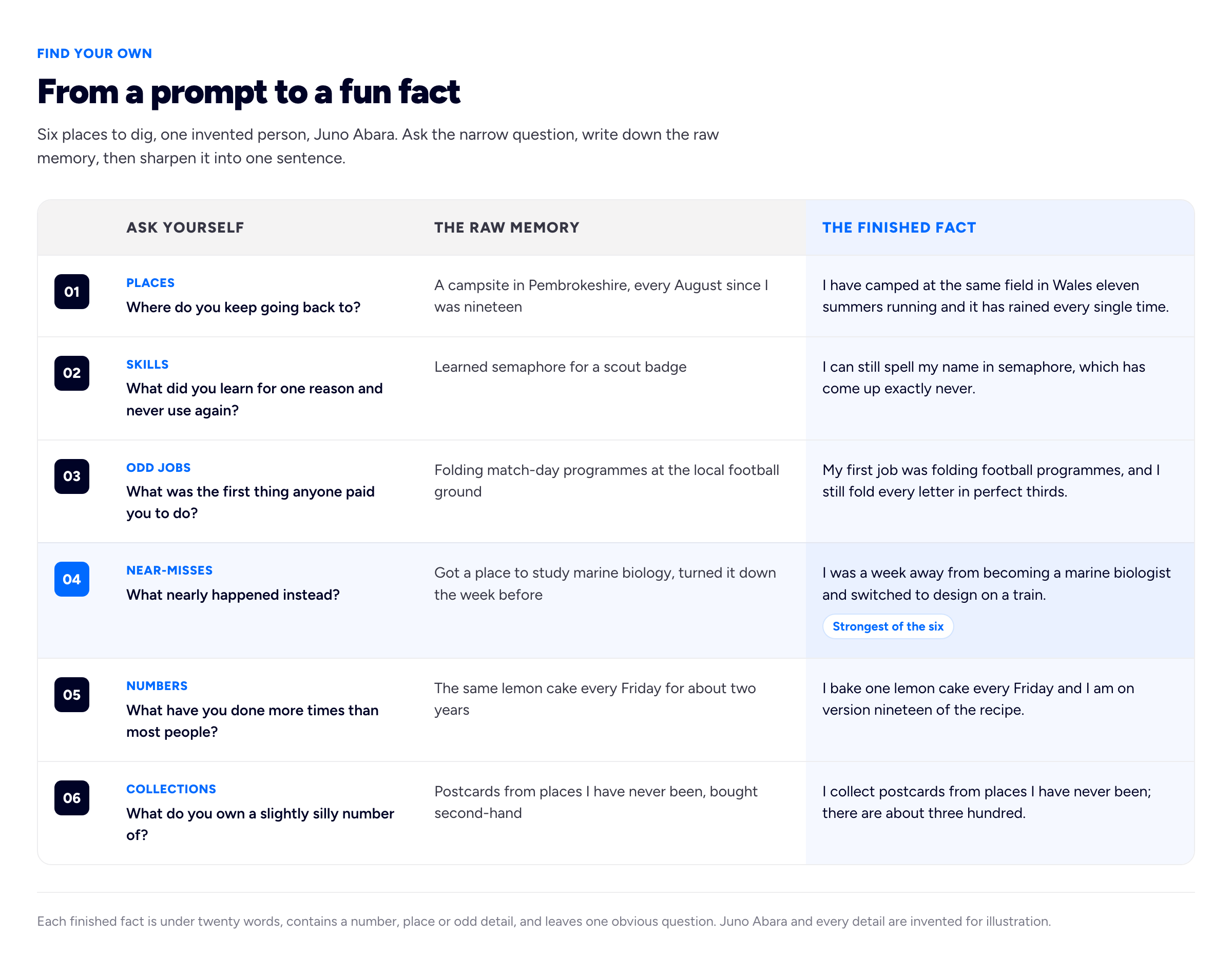
The middle column is where most people stop. The work is the last step: cut the run-up, keep the detail, and end on the part that makes someone ask why.
Sharpening a raw memory into one sentence
Once you have a page of raw memories, choose the three you would most enjoy being asked about — not the three that sound cleverest. Then put each one through the same four cuts.
- Cut the backstory. "When I was at sixth form, my friend's uncle ran a…" becomes nothing. Start at the strange part.
- Add one specific. Replace "a lot", "loads" and "a few times" with a real number, and "somewhere in Scotland" with the place.
- Put the twist last. English sentences land on their final words, so finish on the surprise: "…and it has rained every single time."
- Say it aloud once. If you stumble or run out of breath, it is two facts. Pick one.
Here is the method on a single fact. Felix Montague is starting as a junior developer at Brightloom Studio, an invented product agency, and the onboarding call asks everyone for a fun fact. His first draft is: "I'm really into running and I've done quite a few races." True, but it gives nobody anything to ask except "how many?" — which is the detail he left out. His second draft is: "I've run twelve half-marathons." Better, but it is a number without a story. His third is: "I've run twelve half-marathons and finished every one within four minutes of the same time." That is a fact with a question built in.
Calibrating by setting
The same fact can be perfect at a club social and slightly off in an interview. The shape stays the same — specific, short, a door left open — but what counts as the right size changes with the room.
A work icebreaker or first day
The aim is to be easy to talk to at the coffee machine afterwards. Light, positive and slightly self-deprecating works best: a first job, a harmless skill, a hobby with a number in it. Avoid anything that sounds like a boast about money, status or travel budgets, and anything that would make a new colleague feel they ought to match it.
A team meeting or offsite round
You probably already know these people a little, so the fact can be slightly more personal and slightly odder. This is where a niche skill or a strange coincidence works, because colleagues enjoy discovering a side of someone they sit near.
A job interview
Interviewers sometimes ask for "something about you that is not on your CV" or a fun fact to close the conversation warmly. Two adjustments. First, prefer a fact that quietly shows a trait the role values — persistence, curiosity, care with detail — without announcing it. Felix's half-marathon pacing fact suggests consistency without his ever saying "I am consistent". Second, keep it clearly away from anything an employer should not be weighing up, such as family plans, health or religion. If the honest answer to "what else should we know?" is more substantial, that is a different question, and answering "why should we hire you" covers it.
A class, course or club
Students and club members are usually sorting each other by shared interests, so a fact that someone else in the room might share is ideal: a game, a team, a town, a fandom, a skill relevant to the class. "I grew up on a farm and can tell you which way a sheep will run" gets you a lab partner in a biology class.
A written bio or About page
In writing, nobody can ask the follow-up question, so the fact has to work on its own and close the loop more than a spoken one would. One line, at the end, after the work has been described: it is what makes a competent professional read as a particular person. Our guide to writing a portfolio About page calls this the "human detail" block and gives it thirty to fifty words; our portfolio bio examples show where it sits in a short bio. On a site you are using to win work, it helps when the detail connects to how you work — Juno Abara's lemon cake on version nineteen says "I iterate" to a client without the cliché.
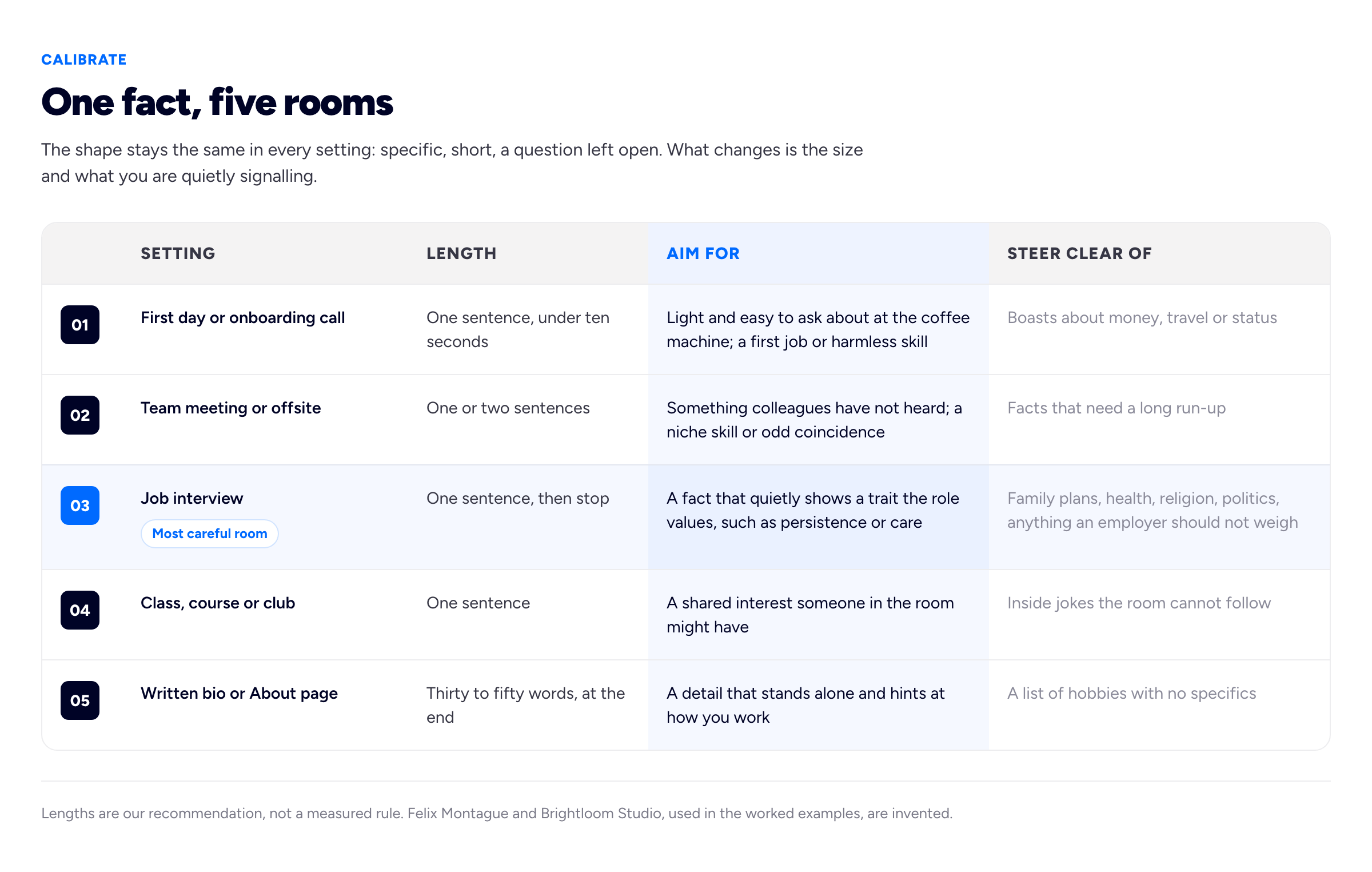
Read down the right-hand column before an interview: everything there is fine to share with friends and simply the wrong size for that room.
The two classic formats
Two truths and a lie
You say three statements; the group guesses which one is false. It is the most common icebreaker game for a reason — it makes everyone listen to your facts properly, because they are trying to catch you out. Three rules make it work.
- Make the lie plausible and at least one truth implausible. If your lie is the only surprising statement, it is found instantly. The game is fun when the strangest one turns out to be true.
- Keep all three the same length and tone. A long, detailed truth beside a short, vague lie gives the lie away.
- Have the story ready for the true surprise. When the room is shocked that you really did once sleep in an airport for two nights, they will want the story, and that is the reward.
Here is a set Juno might use: "I have camped at the same field in Wales eleven summers running. I once won a sandcastle competition on a beach in Cornwall. I can spell my name in semaphore." The sandcastle is the lie, and most people guess the semaphore.
Three fun facts about me
Some forms, class introductions and onboarding documents ask for three facts. The mistake is choosing three of the same kind — three hobbies, three places — which reads as a list rather than a person. Pick from three different categories so the set has range: one from your past (a first job, where you grew up), one from your present (something you are doing or learning now), and one that is simply odd (a skill, a collection, a coincidence). Felix's three for the Brightloom onboarding document:
- "My first job was dressing up as a giant carrot for a supermarket opening."
- "I am learning Portuguese, entirely so I can follow one football commentator."
- "I have run twelve half-marathons and finished every one within four minutes of the same time."
Past, present, odd — and each has a question attached.
Fun facts about me: examples to adapt, by category
Use these as shapes, not scripts: keep the structure and replace the detail with something true about you. A borrowed fact falls apart at the first follow-up question, which is the whole purpose of saying it.
Places
- I grew up in a village with more sheep than people, and we had a sheep census to prove it.
- I have been to Rome twice and have still never seen the Colosseum.
- I have been the only guest in a hotel, twice.
- I once missed a stop on a night bus and woke up in a different county.
Skills and party tricks
- I can identify about thirty birds from their song alone, and I am insufferable on walks.
- I can fold a fitted sheet properly, and I will teach anyone who asks.
- I can whistle with two fingers loudly enough to stop a taxi in the rain.
- I can solve a Rubik's cube, slowly, using a method I learned from one video.
Jobs, first jobs and odd jobs
- My first paid job was a costume character at a garden centre, and I have the photographs.
- I spent one summer as a festival steward and can still put up a tent in the dark.
- I worked in a cinema for two years and have seen one film forty-odd times.
- My first job was washing up in a café, and I still stack a dishwasher like it is being inspected.
Near-misses and coincidences
- I was a week away from studying something completely different and changed my mind on a train.
- I sat next to my future flatmate on a delayed flight before either of us knew we were moving to the same city.
- I have the same birthday as both of my closest friends.
- I once found a book in a charity shop with my grandmother's name written inside — a different woman, same name.
Numbers and streaks
- I have done the daily crossword for over a thousand days in a row.
- I have visited every county in Wales and keep a map on the fridge to prove it.
- I am on version nineteen of the same cake recipe.
- I have watched one film every Christmas Eve for twenty years.
Collections and small obsessions
- I collect postcards from places I have never been; there are about three hundred.
- I own more houseplants than chairs, and all of them have names.
- I have a spreadsheet of every pub quiz I have done, with our score and the question we argued about.
- I keep the ticket from every gig I have been to, in a shoebox, in order.
Food
- I have never had a cup of tea, and I am British.
- I will put chilli on anything, including, once, ice cream.
- I have eaten the same breakfast every weekday for three years and see no reason to change.
Safe for work and interviews
- I learned to code by building a website for my football club's fixtures.
- I am the person who reads the terms and conditions, and I once found a typo in one.
- I keep a notebook of every useful shortcut I learn; it is on its fourth volume.
- I volunteer one morning a month at a repair café fixing toasters.
What to leave out
"Fun fact" sounds informal, which tempts people to share more than they meant to, and it tempts facilitators to push. A few things are worth knowing before the round reaches you.
- You never have to disclose anything private. Health, disability, family circumstances, sexuality, religion, immigration status, money and past hardship are yours to share or not. A fact can be completely true and entirely trivial, and that is a perfectly good answer.
- Avoid facts that set a bar. "I have been to sixty countries" or "I have a holiday house in Portugal" can leave others feeling they have nothing to match. Choose something the person after you can follow.
- Avoid the shock fact. Dangerous stunts, injuries and close calls with death make a room uneasy rather than curious, especially at work.
- Skip anything that mocks a group. Self-deprecation works; jokes at the expense of a place, an accent or a profession often land on someone present.
If you are running the icebreaker yourself, say any fact is fine, however small, and offer a fallback prompt such as "your first job". That keeps it fun for the person who would rather not be the centre of attention.
If you really think you have no fun facts
The six prompts above usually turn up a dozen in ten minutes. If they do not, three fallbacks always work. First, a strong opinion about something trivial: "I think the best biscuit is a plain digestive and I will defend it." Second, something you are learning right now: "I am three weeks into learning the ukulele and can play exactly one song." Third, a small habit: "I alphabetise my spice rack." A fun fact is not a measure of how interesting you are; it is a small, generous handle you offer so people can start a conversation with you.
Putting one on your portfolio
Written bios read like a category for the same reason spoken introductions do. One specific human line at the end of an About page is what turns a list of skills into a person a client wants to work with, and the fact you sharpened for an icebreaker usually works there almost unchanged. If you are building that page on Bunfolio, make it the last line of your About text; the About page guide covers where it sits and the bio examples show it in context.
Frequently asked questions
What is a good fun fact about me?
A good fun fact is true, specific and short, and it invites a follow-up question. "I have run twelve half-marathons and finished each within four minutes of the same time" is better than "I like running", because it contains a number and a small mystery. Choose something you would enjoy talking about for five minutes, because someone will ask.
How do I come up with fun facts about myself?
Do not search for "fun facts"; ask narrower questions. Think about places you keep returning to, skills you learned for one reason, your first or oddest job, things that nearly happened, things you have done an unusual number of times, and anything you collect. Write two memories for each, then sharpen the best three into one sentence each.
What are three fun facts about me examples?
Choose one from your past, one from your present and one that is simply odd, so the set has range. For example: "My first job was dressing up as a giant carrot", "I am learning Portuguese to follow one football commentator", and "I can spell my name in semaphore." Three hobbies in a row reads as a list rather than a person.
What fun fact should I share at work?
Something light and easy to ask about afterwards: a first job, a harmless skill, a hobby with a number in it. Avoid boasts about money or travel, shock facts about injuries, and anything private.
What should I say if an interviewer asks for a fun fact?
Pick a fact that quietly shows a trait the role values, such as persistence or care with detail, and say it in one sentence without explaining what it proves. Keep away from family plans, health, religion and politics.
Do I have to share something personal?
No. A fun fact can be entirely trivial — a habit, a skill, an opinion about biscuits — and that is a complete answer. Health, family, relationships, religion, money and difficult experiences are never required, and a good facilitator will say so.
How we put this guide together
Everything in this guide is our own recommendation rather than a research finding. The four tests for a fact that lands, the six categories to dig in, the four cuts that turn a raw memory into a sentence, the setting-by-setting calibration and the past-present-odd rule for three facts all come from writing introductions, bios and About pages for our users at Bunfolio, not from a study. Where we suggest a length — one sentence, under ten seconds, thirty to fifty words on an About page — that is a working guide, not a measured rule.
We have cited no statistics, and that is deliberate. Pages on this topic sometimes open with a figure about how quickly people form first impressions or how many employees dread icebreakers; we could not trace those claims to a published method, sample and date we were willing to stand behind, so we left them out. The advice works without them: a specific, short, true fact that invites a question is easier to listen to than a vague one, and you can test that in your next meeting.
Juno Abara, Felix Montague and Brightloom Studio are invented for illustration, as are every fact attributed to them and every example in the lists. The examples are templates to adapt with true details of your own, not facts to borrow.
Related reading: how to write a portfolio About page, portfolio bio examples, how to answer "why should we hire you", questions to ask the interviewer and what to bring to an interview.
More from the blog
October 20, 2026 · 19 min read
Signs an Interview Went Well (and Which Ones to Ignore)
Most lists of good interview signs are really lists of good manners. Here is which signals carry information because they cost the interviewer something, which are politeness every candidate gets, whi...
August 2, 2026 · 20 min read
How to Write the About Page on Your Portfolio
The page that decides whether someone likes you, not whether you are capable. Six blocks, about three hundred words, and why writing in the third person gives you away.
August 6, 2026 · 14 min read
How to Write a Portfolio Case Study (With a Six-Part Template)
A six-part skeleton with word budgets, the sentence-level difference between describing activity and presenting evidence, and what to do when you have no numbers or the work is under NDA.