
October 15, 2026 · 19 min read
Why Should We Hire You? How to Answer It Without Bluffing
The question is not asking you to praise yourself. It wants a short case: the one or two requirements that actually decide the job, your evidence for each, and what you would do in the first weeks. How to find those requirements in the advert, a four-part structure, worked answers for eight situations including no experience, and what quietly fails.
Answer it by naming the one or two requirements that actually decide this job, giving one piece of real evidence for each, and saying what you would do in your first weeks. Match, evidence, plan. Do not describe your personality, and do not say you are a hard worker and a fast learner, because every other candidate says it and none of them is asked to prove it. Our recommendation is about a minute spoken: three or four sentences. Say it in your own words, because the next thing you will hear is "can you give me an example of that?", and a borrowed answer has nothing behind it.
Every page ranking for this question hands you ten sample answers to memorise. This guide teaches you to build your own out of the advert, the only document that knows what this employer is short of. We read one invented advert line by line, give you a four-part structure and a five-point version, write eight answers for eight situations, show where evidence comes from when you think you have none, and prepare the two follow-ups.
The same question, in all of its wordings
These are one question, and the answer above fits all of them.
- Why should I hire you? The same question from someone who owns the decision alone, usually your future manager.
- Why should we employ you? "Employ" and "hire" mean the same thing. "Employ" is commoner in British, Irish and Indian adverts.
- Why must we hire you? Why will I hire you? Wordings of the same request: nobody wants a necessity proved.
- What makes you the best candidate? The same question wearing a suit.
Two words this guide uses. A requirement is something the employer needs the person in this job to do. Evidence is a specific thing you have already done that shows you can. "I am organised" is an opinion; "I ran the delivery diary for four fitting teams" is evidence.
What the question is actually testing
It looks like a confidence test. It is not. Interviewers ask it late, and they are checking three things.
Can you tell what matters in this job? An advert lists eight or ten things, and only one or two are why the role exists. Lead with your qualifications and your software list and you have shown that you read the advert without understanding it. Lead with what they are short of and you have shown judgement, which is what they cannot test any other way.
Do you have evidence? Claims are free, and the interviewer is deciding whether to spend their next question asking you to back this one.
Will you still be making sense in two minutes? A rehearsed paragraph followed by silence is worse than a hesitant answer you own. The answer is a door, and they walk through it.
How to find the two requirements that decide the job
You want the one or two things that, if the person they hire cannot do them, the hire has failed.
- The first three bullets. Adverts are written top down by whoever will manage the role, so the daily reality goes first and the bottom is copied from last time.
- Anything repeated. A phrase in the summary, again in the bullets, again in the "about you" section: somebody is worried about it.
- The complaint behind the wording. "Keep customers informed before they chase" is not a duty; it describes what is going wrong now.
- The essential list against the real problem. That list exists so applications can be rejected defensibly. It is a filter, not a reason to pick you over the three others who also met it.
- The title against the responsibilities. Where they disagree, believe the responsibilities.
The advert we will use
Everything below uses one invented example: Keldale Interiors, a kitchen retailer with eleven showrooms, hiring a Customer Support Coordinator under a manager called Ruth Calloway. Its ticketing system is invented too, and we call it Fernway.
You will own a queue of live installation enquiries from first contact to resolution, keep customers informed when a delivery date moves before they have to chase us, log every contact in Fernway so the showroom can see the history, and work with fitters and showroom managers to agree a fix. Essential: GCSE English and maths, confidence on the phone, Microsoft Excel.
"Before they have to chase us" gives the game away, and in the full advert it appears twice more. "From first contact to resolution" is the other. So the two deciding requirements are closing things yourself rather than passing them on, and telling the customer bad news first. The GCSEs, the phone and Excel are filters: answer with Excel and you have answered a different advert.
What the answer becomes
Our candidate is Dani Kovac, two years on the helpdesk of a plumbing supplies firm called Marchwood Supplies. No kitchens experience, never used Fernway.
"The two hardest things in the advert are closing an enquiry yourself instead of handing it on, and telling someone a date has slipped before they find out. Both are what I do at Marchwood: I took over an unanswered email queue nobody owned and got it to empty by the end of my second week, and I ring people the day a date moves rather than the day they notice. Plumbing supplies is the same angry call about a missing part, so only the product is new. In my first month I would learn Fernway and spend a day with a fitting team."
Two requirements, two pieces of evidence, one honest gap in half a sentence, and a plan.
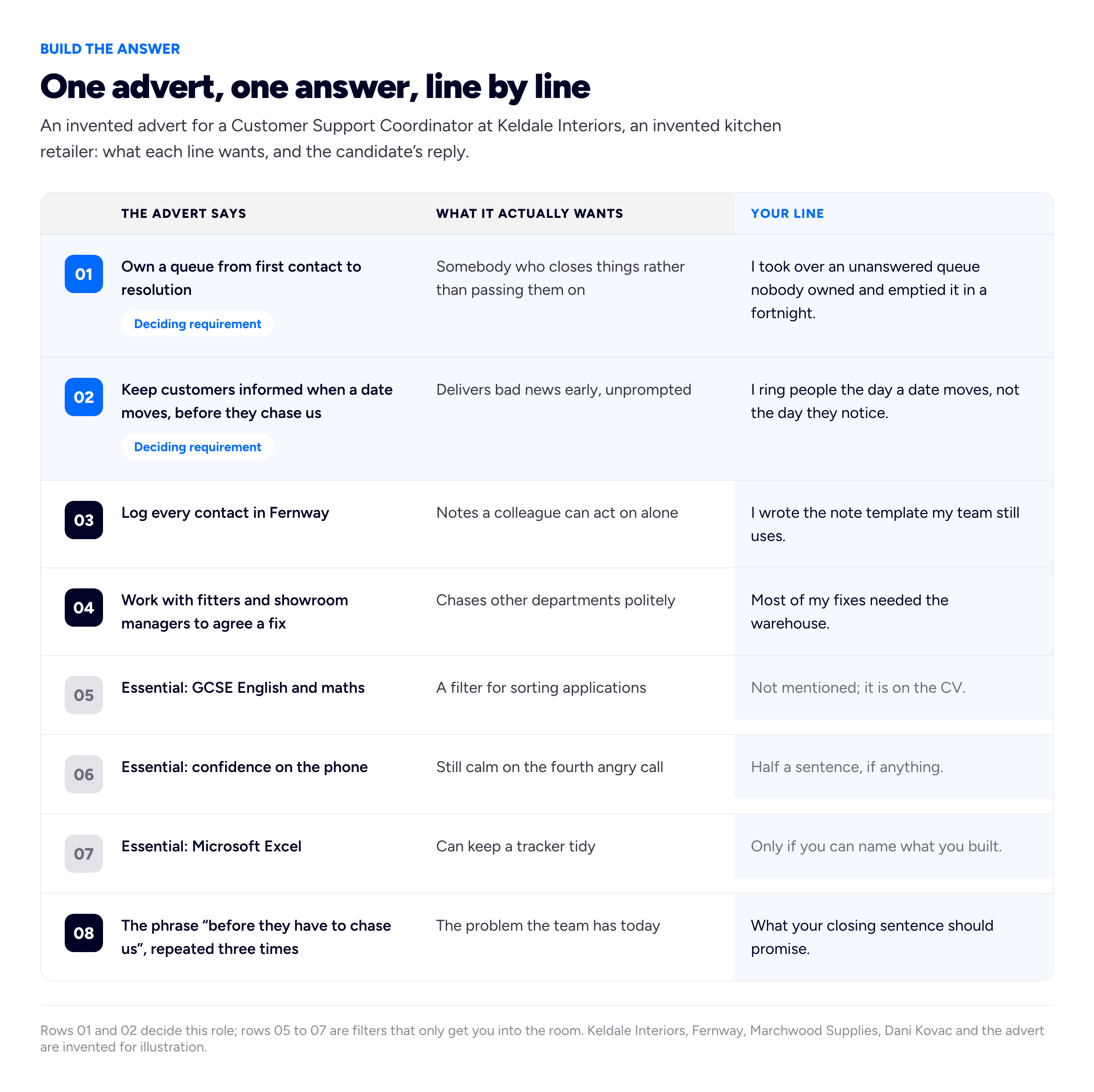
Rows 05 to 07 are the ones most candidates lead with, and they change nobody's mind.
A four-part structure, and the five-point short version
This is our recommendation rather than a published rule. It lets you build an answer for any advert in ten minutes.
- Match. One sentence naming the requirements you think decide the job. Say where you got them, which shows the judgement rather than claiming it.
- Evidence. One sentence per requirement, each a thing you did rather than a quality you have.
- Fit. One sentence on what makes you easy to drop into this team, with any honest gap and what you would do about it.
- Close. One sentence on your first few weeks. Almost nobody includes it, and it is the part interviewers remember.
On length, our recommendation is about a minute spoken, or roughly a hundred to a hundred and sixty words written down. Under twenty seconds sounds unprepared; past two minutes the interviewer is waiting rather than listening.
The five-point version
People search for this as "why should we hire you in 5 points", and the request is fair. Here is ours, in the order you say them.
- The requirement that decides it. "You need someone who closes enquiries rather than passing them on."
- Your evidence. "I took over an unowned queue and emptied it in a fortnight."
- The second requirement and its evidence. "And someone who warns people early. I ring the day a date slips."
- Why you would settle in quickly. "Same customer, same problem, different product."
- What you would do first. "Learn Fernway, then spend a day with a fitting team."
Say those five without reading them and you can answer this question for any job after ten minutes of preparation.
Eight worked answers, by situation
These were written by us as models to adapt, not transcribed from real interviews, and the people are invented. All eight want the same Keldale role. None contains a company statistic, because a real candidate does not have one to hand and an interviewer can tell.
No experience at all (a fresher)
Arun Pillai, no paid work history.
"The advert asks twice for someone who tells a customer a date has moved before they chase. I have not done that in a job, but I have done it: I ran the ticket desk for my college's show, and when the venue changed I phoned everyone who had booked. That is why I know I can make the unpleasant call first."
Why it works: it does not pretend the experience exists, and answers the deciding requirement with something that happened.
Recent graduate
Lena Ozturk, business degree, one summer in a call centre.
"Two things stood out: owning an enquiry to resolution, and logging it so the showroom can pick it up. My summer on a broadband helpdesk was all of the first, because I was the last line. The second is the part I enjoy, having been the person reading someone else's three-word note."
Why it works: the degree is not offered as a credential, and the answer attaches to a real problem.
Career changer
Jonah Whitely, eight years teaching secondary school.
"I am changing field, so let me be direct about what transfers. The hardest ask here is telling people bad news before they find out, and I have spent eight years ringing parents about things they did not want to hear. The second is chasing other departments until something is fixed, which is most of what a head of year does. What I lack is retail and a ticketing system, so my first month would go on both."
Why it works: it names the change and turns the missing experience into a plan rather than an apology. Evidence from another field reads better on a page than in a room, which is why a career portfolio is worth building before a change of direction.
Freelancer or self-employed
Nadia Brecht, four years freelance as a virtual assistant.
"Working for myself, nobody else owns the problem, which is what your first bullet describes. For a haulage client, Harlingford Logistics, I was the inbox: bookings, complaints, chasing the depot. When a delivery slipped I rang the customer before the driver was late, because otherwise I was the one being shouted at."
Why it works: self-employment becomes evidence of ownership. If your history is clients rather than jobs, putting freelance work on a resume covers how to group it.
Internal candidate
Lucy Fenn, two years in the Derby showroom at Keldale.
"I am on the other end of these calls already, and I can tell you where the handover breaks: the note says a date changed, not who agreed what with whom. The risk with an internal move is arriving assuming I know the job, so I would sit with the team for a week and listen."
Why it works: it uses what only an insider knows, then disarms the one thing an insider is suspected of.
Overqualified
Rafael Duarte, formerly head of customer operations at a larger retailer.
"You may wonder why I want a coordinator role having run a department, so let me answer that first. I spent three years in meetings about queues rather than in them, and the part I was good at was the queue. I would also be careful not to arrive rearranging your process, which is Ruth's call."
Why it works: it raises the objection first, gives a reason that does not insult the role, and declines the behaviour they fear.
Returning after a gap
Hannah Searle, three years out of work as a carer.
"I have been out of paid work for three years caring for my father, so I will say it plainly. Those years were made of this work: coordinating district nurses, a pharmacy and two hospital departments that did not talk to each other, and ringing people the moment a date moved. Before that, five years on a utilities helpdesk."
Why it works: the gap is stated once and then used, and it re-anchors experience a date-skimmer would miss.
Missing one stated requirement
Omar Zidane, strong on everything except the ticketing system.
"The gap first: I have never used Fernway. I picked up two other ticketing systems, the second in a week with nobody free to train me, so I treat it as a week's problem rather than a reason not to apply. I have run my own queue to resolution for two years and I ring customers the day a date slips."
Why it works: leading with the gap removes its power, and bounding it returns the talk to what cannot be taught in a week.
Where the evidence comes from when you think you have none
"I have nothing to point at" is usually wrong, and where it is right it is fixable in a weekend. Evidence is any specific thing you can describe.
- Something you shipped. A document, a spreadsheet, a template, a process, a page: anything that exists because you made it.
- A problem you fixed. What was broken, what you changed, what stopped happening. No figures required.
- A responsibility you held. A rota, a till, a queue, a key, a shift you ran alone.
- Something unpaid. Committees, societies, a family business, a team you organised. Interviewers discount these far less than candidates assume, provided you describe it as work and not as a hobby.
- Something you made on purpose for this. Pick the deciding requirement and produce one small, finished thing that demonstrates it.
That last one is the real answer for a fresher or a career changer. Our guide to building a portfolio with no experience covers what to make and how to describe it honestly as a self-set exercise, and how to write a portfolio case study covers the write-up, which has the shape of a good interview answer. Where it lives matters too: portfolio versus resume sets out what each document does, the resume skills section argues for claiming only what you could demonstrate, and our free resume builder prints a clean single-column PDF.
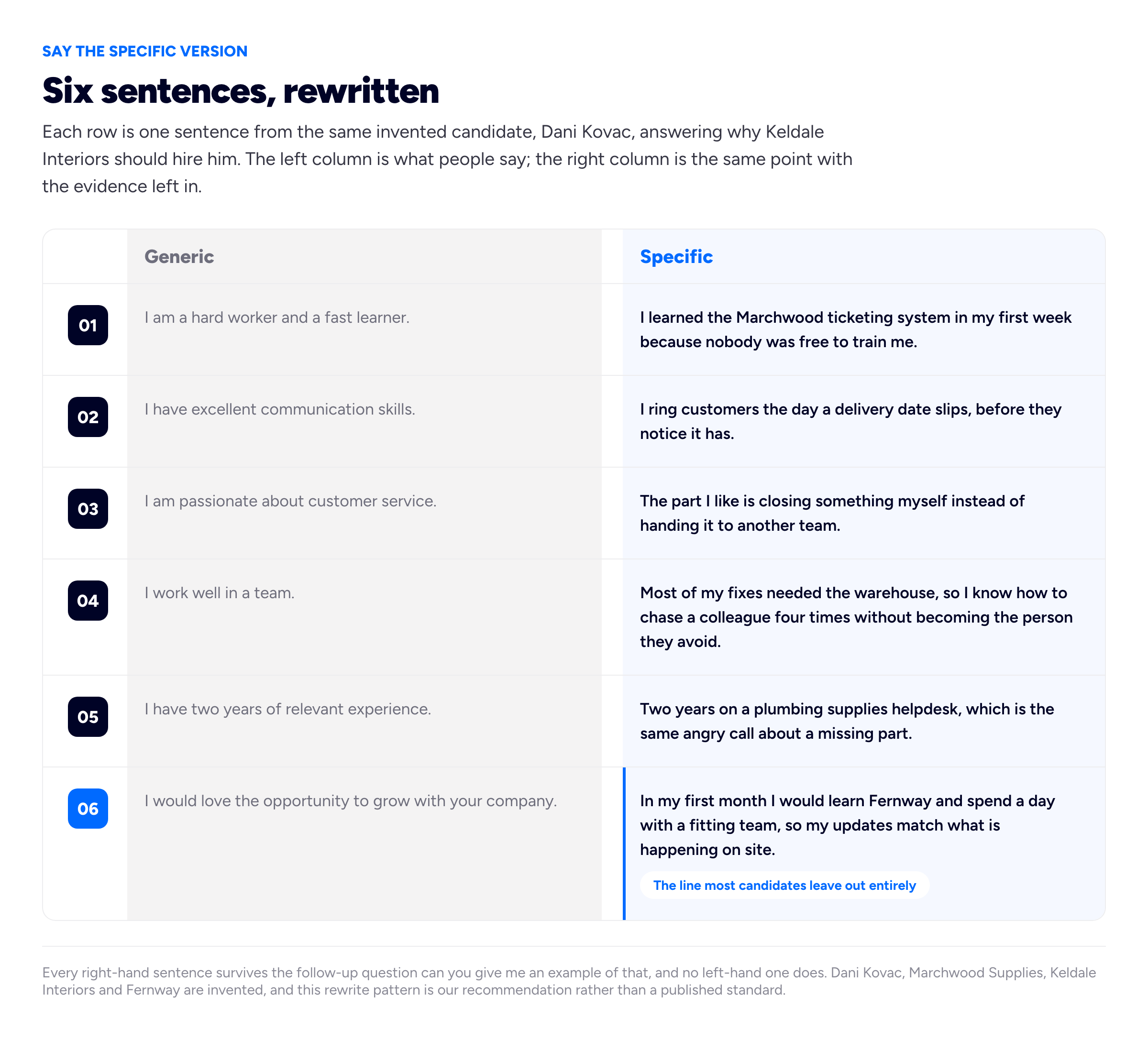
Read the right-hand column aloud: no sentence is a claim about character, and every one could be checked.
Six answers that fail, and the reason each one fails
- The flattery answer. "You are an industry leader and I would be proud to join your journey." It answers why you want them, not what they get, and praise is unverifiable.
- The hard worker and fast learner. The problem is not that it is untrue but that it is unfalsifiable: nobody claims to be lazy and slow, so it carries no information.
- The salary answer. "I will do it for less than you budgeted." Competing on price makes you a cost rather than a solution, and poisons a negotiation you have not had.
- The memorised paragraph. It performs beautifully and dies on "can you give me an example?" Memorise the five points, not the sentences.
- The answer about what you want. "This would be a great step for my development." Every word is your benefit. Your growth is legitimate to raise when you are the one asking, which questions to ask the interviewer covers.
- The over-claim. A system you watched someone use, a team you were in rather than led, a qualification you nearly finished. The cost is not the gap but what finding it does to everything else you said, as how to make a resume stand out argues.
The three questions this one gets confused with
All four are often asked in one interview, and answering two of them the same way is avoidable.
"Tell me about yourself"
That asks for your route to this room: where you are, how you got here, why this job is next. It is biography aimed at the role, while this one is an argument. If the first answer spent your evidence and your plan, the later one has nothing left.
"Why do you want to work here?"
That is about them: the product, the customers, why this employer rather than the one down the road. In a line, why do you want to work here is what attracts you and why should we hire you is what they gain. Research belongs in the first, evidence in the second.
"What are your strengths?"
The closest relative. Strengths are about you in general and can be answered without reading the advert. This one must be answered from the advert, naming the strengths the job is short of and leaving the others out. Anyone searching "what is your three strengths best answer" is really asking this one.
Practising it, and the two follow-ups
Practise out loud, because reading silently hides the sentences you cannot actually say, and practise against the advert rather than from a script. Our recommendation is three passes: write the five points as five short lines, say the whole thing without looking, then say it again having cut whatever you had to search for. If a phrase keeps collapsing it is not yours, so replace it with how you would say it to a friend.
Then prepare the two follow-ups, because they are near certain.
- "Can you give me an example of that?" Have a longer version of each piece of evidence ready: the situation, what you did, how it ended. This is the question a memorised answer loses on.
- "What would you do in your first few weeks?" If your close mentioned a plan, expect to expand it: learn the system, meet the people whose work you depend on, find what everybody works around. Do not promise changes before you have seen the job.
Rehearse this answer last, because it is built out of everything else you learned about the role. The practical half of getting ready is in what to bring to an interview, and the same requirement-first thinking is what makes an application open well, which is the subject of how to start a cover letter.
Frequently asked questions
Why should we hire you — best answer in short?
In five points: the requirement that decides the job, your evidence for it, the second requirement with its evidence, why you would settle in quickly, and what you would do first. About a minute, and no adjectives about your character. Shorter still: name what they need, prove you have done it, say what you would do first.
What if I have no experience?
Answer with the deciding requirement anyway, taking evidence from wherever it exists: unpaid work, study, a family business, something you organised, something you made for this application. Say plainly that you have not done it in a paid job, then describe the time you did it. "I have done this, just not for money" survives the follow-up; pretending does not.
Why should we hire you with no work experience as a fresher?
Lead with what you can show, one concrete thing per requirement: an event you ran, a project you finished, a shift you covered alone. Then give a realistic plan for your first weeks, including the help you would want. An interviewer hiring a fresher expects to train somebody, and is choosing who is worth training.
How long should the answer be?
Our recommendation is about a minute spoken, which is three or four sentences, or roughly a hundred to a hundred and sixty words written down. Under twenty seconds reads as unprepared; past two minutes the interviewer is waiting rather than listening. If you are over, cut the adjectives and the praise.
Is "why should we employ you" the same question?
Yes. "Employ" and "hire" mean the same thing, and the answer does not change. "Employ" appears more often in British, Irish and Indian adverts. The same goes for "why should I hire you", "why must we hire you", "why will I hire you" and "what makes you the best candidate": one question, several wordings.
What if I do not meet one of the requirements?
Say so first, in one sentence, then bound it: the closest thing you have done, how long you think closing the gap would take, and a reason to believe that estimate, usually a time you learned something comparable quickly. Then return to the requirements that cannot be taught in a fortnight. Leave the gap for the interviewer to raise and they choose the framing.
Should I mention salary?
No. Offering to work for less makes you a cost to be compared rather than a solution to be chosen, and it weakens the pay conversation later. Money belongs in its own discussion, after an offer or at least after you are asked.
What if they ask "why should I hire you" instead of "we"?
Answer it identically. The switch to "I" usually means the person in front of you owns the decision, often because they will manage you. Two adjustments help: speak to them rather than to a panel, and where your evidence touches something they said earlier, say so.
How we put this guide together
Bunfolio builds portfolio websites and gives away free career tools, so we spend a lot of time reading job adverts and the material people send against them. We should be straightforward about what that means: nothing here is sourced, because there is no authority to source it to. No standards body publishes a correct answer to an interview question. The four-part structure, the five-point version, reading the first three bullets and whatever the advert repeats, the rule that the essential list is a filter rather than a decision, the lengths we suggest, the rewrite pattern in the second diagram and all eight worked answers are our recommendation. Where we give a figure, it is our recommendation in those words.
We have deliberately left out the statistic that normally opens an article like this. You will have read that hiring managers decide in the first seven seconds, or the first few minutes; that some percentage of candidates give the same answer to this question; that a given share of interviews are lost on it. We could not trace any of those claims to a published method, sample and date, several appear to originate in marketing copy for recruitment products, and a figure nobody can source is worse than none, because it looks like evidence. The underlying points — that first impressions matter, and that most answers to this question are interchangeable — do not need a number to be true. For the same reason there are no percentages above and no survey findings.
Everything named here is invented, and consistently so: Keldale Interiors and its eleven showrooms, the manager Ruth Calloway, the Fernway ticketing system, Marchwood Supplies, the haulage firm Harlingford Logistics, the advert itself, and the candidates Dani Kovac, Arun Pillai, Lena Ozturk, Jonah Whitely, Nadia Brecht, Lucy Fenn, Rafael Duarte, Hannah Searle and Omar Zidane. The worked answers and every quoted sentence in both diagrams were written by us as models to adapt, not transcribed from a real interview. None should be used as it stands: an answer that is not yours will not survive the follow-up question, which is what this whole guide rests on.
Related reading: questions to ask the interviewer, what to bring to an interview, portfolio versus resume, building a portfolio with no experience, how to make a resume stand out and how to write a portfolio case study.
More from the blog
July 10, 2026 · 18 min read
Do Freelancers Actually Need a Website? An Honest Answer
Written by a company that sells websites, so it starts with the freelancers who genuinely do not need one. What a site does that a profile structurally cannot, the minimum version worth publishing, an...
August 6, 2026 · 14 min read
How to Write a Portfolio Case Study (With a Six-Part Template)
A six-part skeleton with word budgets, the sentence-level difference between describing activity and presenting evidence, and what to do when you have no numbers or the work is under NDA.

August 14, 2026 · 14 min read
Portfolio SEO: How to Get Your Portfolio Found on Google
What a portfolio site can realistically rank for, the six on-page fields that do most of the work, the speed thresholds Google actually measures, and what is not worth your time.