
October 20, 2026 · 19 min read
Signs an Interview Went Well (and Which Ones to Ignore)
Most lists of good interview signs are really lists of good manners. Here is which signals carry information because they cost the interviewer something, which are politeness every candidate gets, which point both ways, what to do while you wait, and how to read the silence when the date passes.
The few signs that an interview went well are the ones that cost the employer something: a specific next step with a date and a name attached, questions about your notice period, your references or when you could start, being walked round to meet people who were not on the schedule, and an interview that overran because the conversation got more detailed rather than because it wandered. Almost everything else people list — smiles, nods, "great answer", a warm goodbye, "we'll be in touch" — is ordinary politeness, and interviewers are expected to show it to every candidate. Even the good signs are weak evidence on their own. Read them as a pattern, write down what happened while you still remember it, and keep applying until there is an offer in writing.
Every page ranking for this question gives you fifteen or twenty signs and presents each one as if it meant something. This guide does the opposite. It sorts the signals into the ones that carry information, the ones that are only manners, and the ones that point both ways, explains why a friendly interviewer tells you very little, and then covers the part the lists skip: what to do while you wait, and how to read silence when the date you were given comes and goes.
Why most "signs" tell you almost nothing
Start with what the interviewer is trying to do. They are not only assessing you. They are also representing the employer to someone who might turn the job down, tell friends about the experience, or apply again in two years for a better role. So most organisations that interview seriously ask their interviewers to be warm, attentive and encouraging to every candidate, and the good interviewers would do it anyway, because a relaxed candidate gives better evidence than a frightened one.
That has an awkward consequence. The behaviour candidates read most closely — friendliness, eye contact, encouraging noises, laughter at a small joke — is the behaviour that is supposed to be identical across the whole shortlist. If it is working as intended, it carries no information about you at all. It tells you that you met a competent interviewer.
The second problem is that you are a biased reader of your own interview. You came out of the room with a feeling, and you will remember the moments that match it. If you felt good, the nod after your second answer becomes a sign. If you felt bad, the pause before the next question becomes one. Neither was a sign; both were a person thinking.
The third problem is that the decision is often not about you. Interviewers compare. You can give the best interview of your life and lose to an internal candidate, to someone with a qualification you lack, or to a budget that was frozen the week after. None of that shows in the room.
So the useful question is not "did they seem to like me?". It is "did they do anything that costs them time, effort or commitment, and that they would only bother doing for someone they are seriously considering?". That is the test every signal below is put through.
The signals that actually carry information
These are worth noticing because each one costs the interviewer something. None is proof, and the section on how little a single signal proves explains why. But together they are the closest thing to evidence you will get before an offer.
A specific next step, with a date and a name
"We'll be in touch" is said to everyone. "Declan will call you on Thursday afternoon to arrange a second conversation with our operations director" is not, because it commits a named person to a named action on a named day, and somebody now has to do it. Specificity is the signal. The more concrete the next step — who, what, when — the more likely it is that you are in the group they intend to take forward.
How it misleads: some interviewers explain the full process to every candidate as a matter of courtesy, including the date of second interviews. Listen for whether the next step was described as the process or as your next step.
Questions about your notice period, references or start date
An interviewer asking how much notice you have to give, whether your references can be contacted this week, or whether you could start before a particular date is doing planning work. They are checking whether hiring you is practical. Nobody bothers to plan around a candidate they have already ruled out.
How it misleads: plenty of application forms and interview scripts ask every candidate for their notice period as routine, and a recruiter screening call almost always does. The question means more when it comes late in the interview, from the hiring manager, and with a follow-up — "so if we moved quickly, could you be here by the start of next month?".
Questions about salary that get specific
Being asked your expectations is routine. Being asked whether a particular figure would work, or having the package explained in detail — pension, hours, the bonus scheme — moves into negotiation territory. People rarely negotiate with someone they will not make an offer to.
Being introduced to people who were not on the schedule
If the interviewer leaves the room and comes back with a colleague — "I'd like you to meet the person you'd be working alongside" — or walks you past the team on the way out and stops to introduce you, they have spent other people's time on you. That is a real cost, and it usually means they want a second opinion on someone they are leaning towards.
How it misleads: on a site visit or assessment day, meeting the team may be built into the timetable for everybody. It is the unplanned introduction that carries the information.
An interview that runs long for a substantive reason
Overrunning on its own means very little. An interviewer who loses track of time while telling you about their weekend is having a pleasant afternoon. An interviewer who overruns because they kept digging — asking for the next level of detail on a project, working through a real problem from their team with you, moving from "tell me about a time" to "how would you handle what we're dealing with now" — is spending time they had not planned to spend on a candidate they find worth it.
The distinction is between length and depth. Ask yourself whether the extra time went on harder questions or easier ones.
The interviewer starts selling the job to you
Early in an interview, the interviewer is buying. If the balance shifts and they start persuading you — why the team is a good place to work, how much you would learn, what the role leads to — they have begun to worry about whether you will accept. That worry only exists for candidates they want.
How it misleads: a hiring manager struggling to fill a role may sell it to everybody. It is stronger when it arrives late in the conversation and is aimed at things you said mattered to you.
They ask whether you are interviewing elsewhere, and want the timeline
On its own, this is a routine question. With a follow-up — "when do you expect to hear from them?", "would it help if we moved faster?" — it becomes the interviewer checking whether they are about to lose you. Again, that concern is reserved for people they want to keep.
A worked example: one interview, read honestly
Here is how this looks in practice, with an invented candidate. Mei-Lin Castro is interviewing for a transport planner role at Harrowgate Logistics, a regional haulier. Her interviewer is the operations manager, Declan Shaw. The interview is booked for forty-five minutes.
She comes out with a long list of what she thinks were good signs. Declan smiled a lot and said "that's a great example" twice. He laughed when she described a driver who once delivered a pallet to the wrong county. He walked her back to reception and shook her hand. He said they would be in touch by the end of next week. The interview ran to about an hour and ten minutes.
Read honestly, most of that is noise. The smiles, the praise, the laugh and the walk to reception are what a decent interviewer does with everyone; Declan would have done them for the candidate before her. "In touch by the end of next week" is a process timeline, not a commitment to her.
Three things are worth more. The overrun was not chat: after her answer about re-planning routes when a depot closed, Declan pulled up the next morning's schedule on his laptop and asked how she would handle two vehicles off the road. That is a real problem from his own desk, and he spent twenty-five unplanned minutes on it. Second, near the end he asked whether her notice was one month or three, and whether she had any holiday booked in the next six weeks — planning questions. Third, on the way out he stopped at the planning office and introduced her to the senior planner, who was not on the schedule.
That is a reasonable pattern, and Mei-Lin can fairly conclude that she is probably in serious contention. She cannot conclude that she has the job. She does not know how many others are being seen, whether one of them is already doing this work at a competitor, or whether the senior planner's view will count for more than Declan's. So she writes it all down that evening, sends a short thank-you note, and carries on with her other two applications.
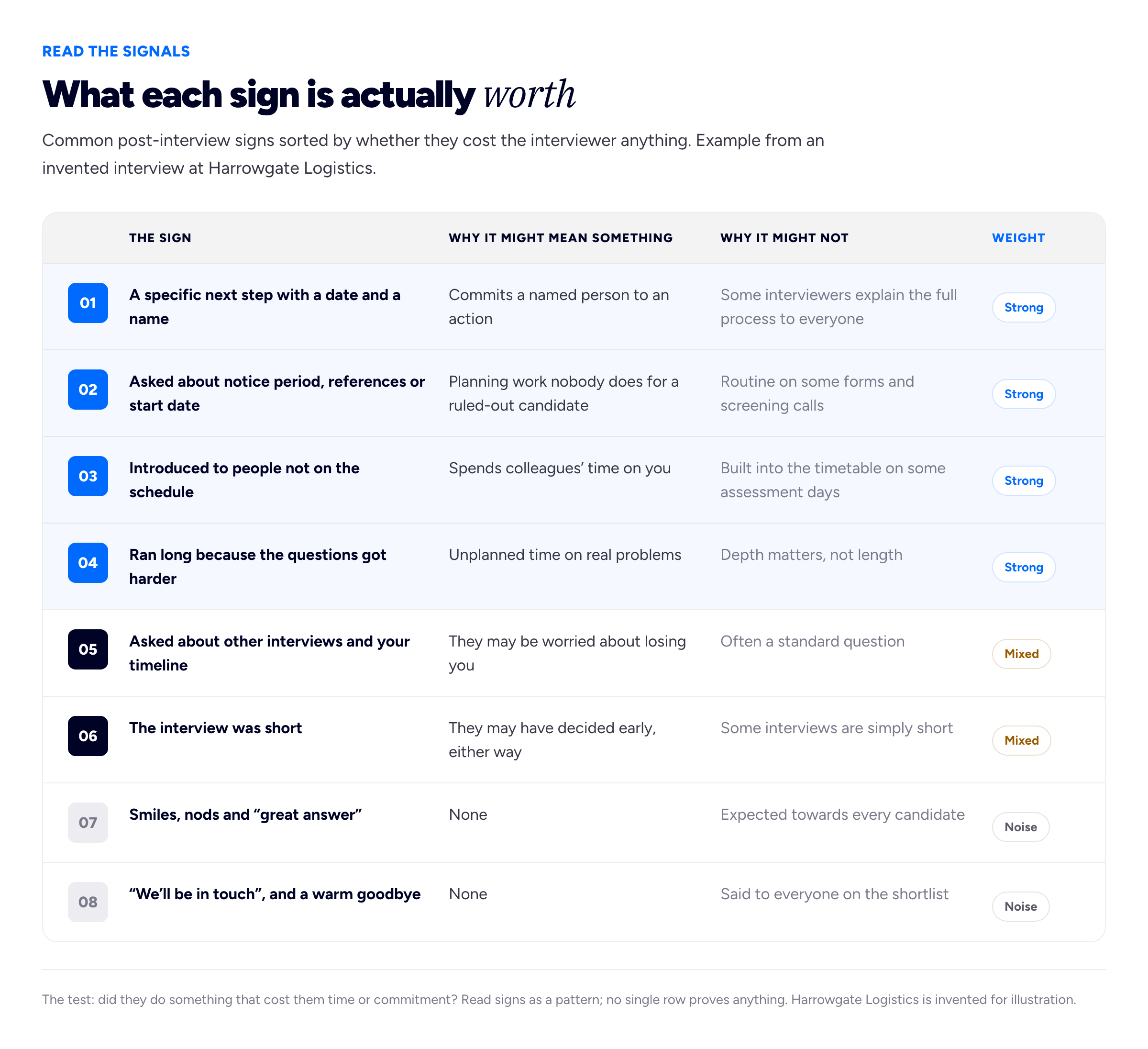
The top four rows each cost the interviewer something. The bottom two cost nothing, which is why they are offered to everyone.
Signs that are just politeness
These turn up on every list of positive signs. Each is pleasant. None separates you from the rest of the shortlist.
- Smiling, nodding and eye contact. Basic interviewing technique, and what keeps a nervous candidate talking.
- "Great answer" or "that's really interesting". Encouragement, used to keep the conversation moving. Interviewers say it to answers they score poorly too.
- Small talk at the start or the end. Rapport is part of the job, and the weather is not an assessment.
- Being walked out personally. Often a security rule or simply good manners.
- "We'll be in touch" or "you'll hear from us soon". True of everyone they saw.
- Being told about the company's culture, perks or office. Part of the standard pitch, unless it turns into the targeted selling described above.
- The interview finished on time. That is the schedule working.
Someone who reads friendliness as a decision feels misled when the rejection comes. They were not misled. The interviewer was doing their job well.
Signs that are ambiguous, or point the wrong way
Some signals feel decisive but genuinely cut both ways.
A short interview. It can mean they ruled you out early. It can also mean they were convinced early and saw no reason to keep asking, or that the slot was always short and you misjudged it. Unless it was well under the booked time with no explanation, read nothing into it.
Hard questions and pushback. Candidates often leave a tough interview convinced it went badly. But interviewers usually push hardest on people they are taking seriously, because that is where the decision is close and they need better evidence. An easy, pleasant interview where nothing was tested can be the worse sign. A good answer to the hard follow-up is far more useful to you than a smile, which is also why it pays to prepare for questions such as "why should we hire you?" with real evidence rather than a script.
"When you join" language. Some interviewers slip into "when you start, you'll be working with…". Many people read this as a tell. Often it is just how the interviewer talks about the role, to every candidate, because describing a job hypothetically is clumsy. It counts only alongside one of the stronger signals.
"You'd be a great fit" said out loud. Better than nothing, but a few interviewers say it routinely to end on a positive note, and it is not their decision alone. Treat it as a mild positive at most.
What is a red flag in an interview?
The phrase is used in two ways, and both matter.
Red flags about your chances are rarer than candidates fear, because a well-run interview is warm to everyone. The ones that carry some weight are the reverse of the strong signals above: the interviewer stops probing early and moves through the remaining questions without following up; the interview ends well short of the booked time with no reason given; nobody mentions any next step at all; or the interviewer says plainly that they are looking for experience you do not have. Even these are only weak evidence. Some interviewers are simply quiet.
Red flags about the employer deserve at least as much attention, because you are deciding too. Watch for an interviewer who cannot describe what success in the role looks like, who is vague about why the job is open, who seems surprised by the questions you prepared, who is dismissive about the person who held the role before, or who pressures you to accept before you have the offer in writing. Your own questions to the interviewer are the best tool for drawing these out, and the answers to them tell you more than anything about the interviewer's manner.
How little any single signal proves
This is the section the other lists leave out, and it is the one worth remembering.
Suppose five people are shortlisted for one job. Four of them will be turned down, and several of those four will have had genuinely good interviews, with interested interviewers, detailed questions and specific talk about next steps. A good interview is the entry ticket to the final decision, not the decision. Nothing you saw in the room can tell you how you compared with the four people you never met.
Plenty of other things sit outside the room too. An internal candidate the panel is obliged to see. A reorganisation that changes the role. A budget approval that stalls. A second interviewer whose view counts for more. A reference that takes three weeks to come back. A strong external candidate who interviews the day after you. Any one of these can turn a good interview into a rejection or a long silence, and none of them says anything about how you performed.
So our honest advice is this: notice the strong signals, let a cluster of them raise your hopes a little, and change nothing about your behaviour until there is an offer in writing. That means you keep applying, you do not resign, and you do not turn down other interviews. The candidates who suffer most in this period are not the ones who misread a smile. They are the ones who stopped their search because of it.
What to do while you wait
The waiting period is not empty. There are a handful of things worth doing in a sensible order, and most of them are useful whatever the result.
- Write it down within the hour. Note the questions you were asked, the ones you answered badly, the names of everyone you met, anything said about timing, and the signals you noticed — sorted honestly into strong and polite. You will need this for a second interview, and you will want it if the answer is no.
- Send a short thank-you note the same day or the next morning. Two or three sentences, one of them referring to something specific from the conversation. It will not rescue a weak interview, but it is a small courtesy that keeps you in mind. Our guide to the thank-you email after an interview covers the wording.
- Prepare as if there is a second round. If there is, you will be glad of the head start. Look at the gaps your notes reveal and work on them.
- Keep every other application moving. Do not pause anything. If another offer arrives first, you can tell the employer you prefer — that sometimes speeds them up.
- Wait for the date you were given, plus a couple of working days. Deadlines slip far more often than candidates expect, usually for reasons that have nothing to do with them.
- Then follow up once, briefly. One polite email to the person who gave you the timeline: you enjoyed the conversation, you are still very interested, and could they let you know where the process has got to.
- If there is still nothing after another week, follow up once more, then let it go. Keep it friendly, because recruiters remember who handled silence gracefully, and roles come back.
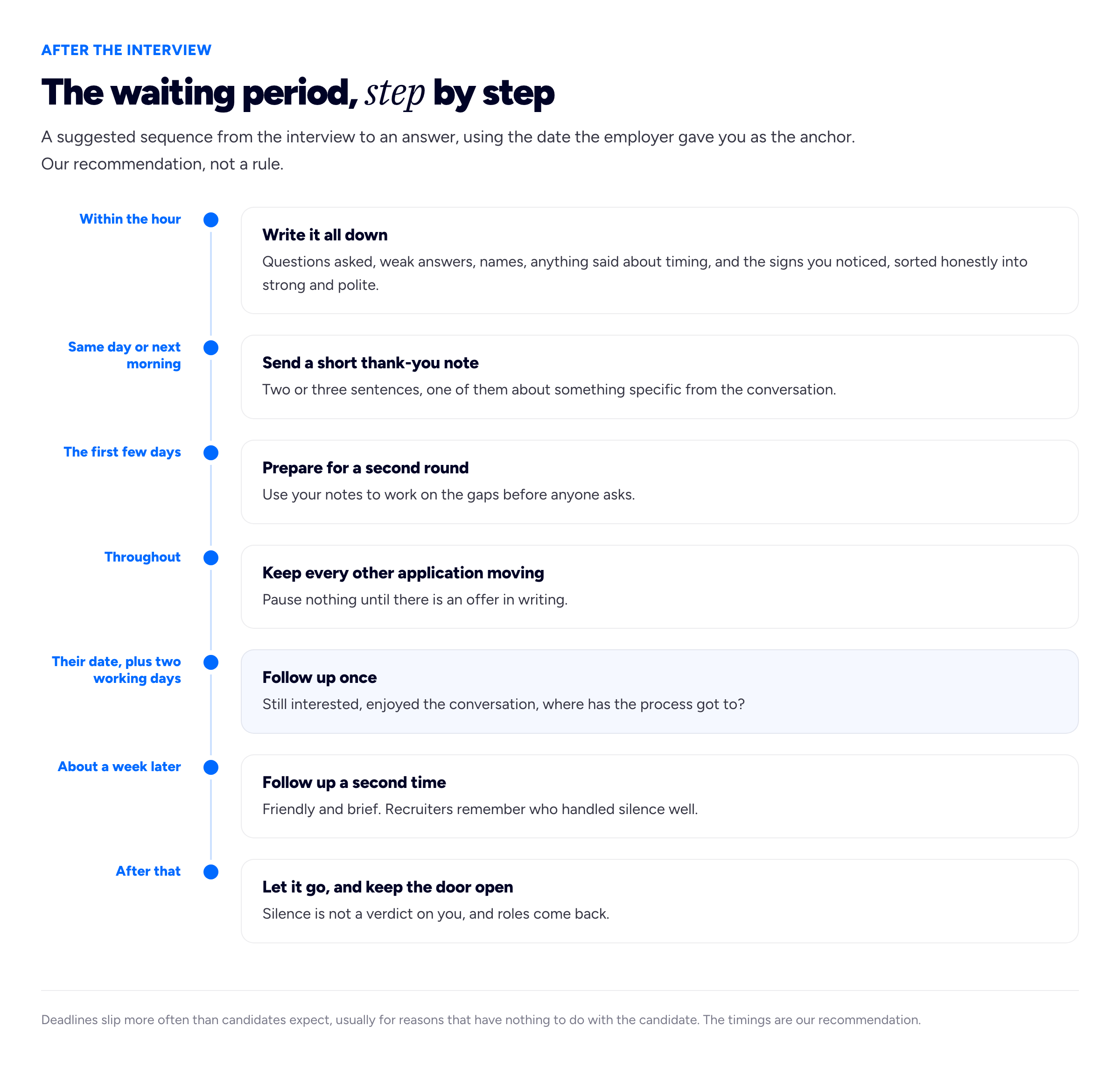
Every step on this timeline is worth doing whether or not you get the job, which is the point of it.
How to read silence
Silence is the hardest part, and it is also the most misread. Past the date you were given, it feels like a rejection. Usually it is not one — or not yet.
The common reasons for silence are dull. The interviewer is waiting on a colleague's view. Another candidate has a second interview booked next week. The person who signs off on the hire is on holiday. References are slow. An offer has gone to the first choice, and the rest of the shortlist is being held in reserve until that person says yes or no. That last one is worth thinking about: being the second choice who is offered the job a week later is common, and it only happens to candidates who stayed polite and available.
Some employers never send rejections at all. That is poor practice, but it is real, so decide in advance how long you will wait. Our recommendation is that two polite follow-ups with no reply, spread across a couple of weeks after their stated date, is enough to treat the application as closed in your own head — while leaving it open on paper, in case they come back.
Two things you should not do with silence: read it as a judgement on your interview, and fill it by changing your plans. A good interview followed by silence is still a good interview. Take what you learnt into the next one, and carry the same preparation — including the practical side of what to bring and when to arrive — into the next room.
Frequently asked questions
What are signs your interview went well?
The signs worth trusting are the ones that cost the interviewer something: a specific next step with a date and a named person, questions about your notice period, references or start date, being introduced to people who were not on the schedule, and an interview that overran because the questions got deeper. Friendliness and praise are expected towards every candidate, so they tell you very little.
What is a red flag in an interview?
For your chances, the stronger red flags are an interviewer who stops following up on your answers, an interview that ends far short of its booked time without explanation, and no mention of any next step. For the employer, watch for vagueness about what success looks like, unclear reasons why the job is open, and pressure to accept before you have a written offer.
How do you know if you have impressed the interviewer?
Look at what they did rather than what they said. An impressed interviewer usually digs deeper into your answers, starts treating you as a colleague by discussing real problems from their team, begins selling the role to you, and asks practical questions about when you could start. Praise alone is not evidence, because good interviewers encourage everyone.
How do you know if you passed the interview?
You do not know until you are told. The closest signs are being invited to the next round, being asked for referees' contact details, or being asked to confirm salary and a start date. Until there is an offer in writing, keep applying elsewhere, because several good candidates usually reach the final decision and only one is chosen.
How long should I wait to hear back after an interview?
Wait until the date you were given, plus a couple of working days, then send one polite follow-up. If you were given no date, our recommendation is to wait about a week. Hiring timelines slip often, and late news is not necessarily bad news.
Do interviewers tell you at the end if you got the job?
Rarely. Most interviewers have other candidates to see and colleagues to consult, so they cannot make an offer in the room even when they want to. If someone does make a verbal offer on the spot, thank them, and wait for it in writing before acting on it.
How we put this guide together
Nothing in this guide is sourced from a study, and we would rather say so plainly. The sorting of signals into strong, mixed and noise, the test of whether a sign costs the interviewer anything, the waiting-period sequence, the follow-up timings and the point at which to let an application go are all our recommendation, drawn from writing career tools at Bunfolio and from how hiring decisions are actually made inside organisations, not from measured data. Where a timing appears — two working days, about a week — it is presented as a recommendation, because that is what it is.
We have deliberately left out the figures that usually decorate articles like this: the claim that a certain share of interviewers decide in the first few minutes, the supposed average number of candidates per role, and the percentage of candidates who are said to hear back within a week. They change from page to page, and we could not trace any of them to a published method, sample and date we were willing to stand behind. The five-person shortlist in the section on how little a signal proves is a hypothetical to make the arithmetic visible, not a statistic. A number nobody can source is worse than none, because it reads as evidence.
Mei-Lin Castro, Declan Shaw and Harrowgate Logistics are invented for illustration, as are the interview, its timings, the route-planning problem and every detail in both diagrams.
Related reading: questions to ask the interviewer, how to answer "why should we hire you?", what to bring to an interview and the thank-you email after an interview.
More from the blog
October 22, 2026 · 19 min read
Fun Facts About Me: How to Find Ones That Land
How to dig your own fun facts out of six kinds of memory, what makes one land rather than fall flat, how to pitch it for a first day, a team meeting, an interview or a written bio, the two-truths-and-...
October 19, 2026 · 19 min read
Thank You Email After an Interview (and How to Follow Up)
Send it the same day, keep it under 150 words, and make it about one thing the interviewer actually said. What to reference, one email or several after a panel, subject lines, what to leave out, and w...
October 18, 2026 · 19 min read
What to Bring to an Interview (and How Early to Arrive)
The whole arrival on one page: what to bring sorted into always, sometimes and never, how early to turn up and why earlier is worse, how long to expect to be there, and what each of those answers beco...