
October 19, 2026 · 19 min read
Thank You Email After an Interview (and How to Follow Up)
Send it the same day, keep it under 150 words, and make it about one thing the interviewer actually said. What to reference, one email or several after a panel, subject lines, what to leave out, and when to follow up if you hear nothing, and when to stop.
Send a thank-you email the same day as the interview, or by the end of the next working day at the latest. Write a separate email to each person who interviewed you, if you have their address. Keep it under 150 words. Make it specific: mention one thing from the conversation that only that interviewer said, add one useful sentence the interview left out, and stop there. If you then hear nothing, wait until the decision date they gave you has passed, plus two working days, and send one short follow-up. Send a second about a week after that. After two follow-ups, stop chasing. All of this is our recommendation rather than a published rule, and the rest of this guide explains the reasoning so you can adapt it.
Most pages ranking for this question are a list of templates with a blank for the interviewer's name. A template covers the parts nobody reads twice. The parts that make the email worth sending are judgement calls, and a blank cannot make them for you: which moment of the conversation to mention, whether a panel gets one email or five, what goes in the subject line, what to leave out, how long to wait before chasing and when to give up. We follow one invented candidate, Tomasz Kowalczyk, after a first interview for a Data Analyst role at an invented research consultancy, Brackenridge Analytics, with the head of its insight team, Aisha Rahmani.
The short version
- When: the same day, a few hours after you leave. By the end of the next working day at the latest.
- How long: under 150 words. If it needs scrolling on a phone, it is too long.
- What it says: thanks, one specific reference to the conversation, one sentence that adds something, and a short close.
- Panels: one email per interviewer, each with a different reference. Never one email with everyone copied in.
- Subject line: plain and easy to search. Include the role, the word "interview" and the day.
- Follow-up: once their decision date has passed, plus two working days. Once more a week later. Then stop.
Is it proper to send a thank-you email after an interview?
Yes. It is normal in most office jobs and rude in none. Be clear about what it can do, though. It will not turn a weak interview into an offer, and leaving it out will rarely lose you an offer you had otherwise earned. Its real work is smaller and more practical.
First, it puts your name in the interviewer's inbox, in your own words, during the hours when they are writing up their notes. Second, it opens a channel: once you have written to the person who decides, any later follow-up is a reply in that thread rather than a cold message to a stranger. Third, it shows how you write.
The one way it can hurt is when it is careless. A misspelled name, last week's company name left in by mistake, or a paragraph of generic praise suggests you were not paying attention. A careless email is worse than none.
When to send it
Our recommendation is the same afternoon or evening, a few hours after you leave. That is early enough that the interviewer still remembers you clearly, and late enough that the email does not look as if it was written before you walked in. One sent from the car park eight minutes later reads as pre-written.
- A late-afternoon interview: send it early the next morning. An email that lands at 11pm still gets read with the morning's mail, and the late hour is the main thing it shows.
- A video interview: the same as in person. A call does not call for a faster reply.
- A Friday interview: send it on Friday. Do not hold it over until Monday, when the decision may already be moving.
- They said they would decide that day: send it within two or three hours, or there is no point sending it.
Before you write, spend five minutes on notes. While you are still on the journey home, write down the names of everyone in the room, spelled as they introduced themselves, and three things each of them said that you did not know before you arrived. If you brought a notebook, as our guide to what to bring to an interview suggests, this is what it is for. Everything specific in your email comes from those notes, and by the evening the details will have gone.
What the email has to do
A thank-you email has four jobs, and each takes a sentence or two.
- Thank them for something specific. "Thank you for your time" is the empty version. "Thank you for walking me through how the client reports are built" tells them you were listening.
- Refer to one moment from the conversation. This line does most of the work, so choose it carefully.
- Add one thing the interview did not leave room for.
- Close. Say you look forward to hearing from them, and sign off.
What to reference from the conversation
This is the decision that separates a good email from a template. Most people mention a pleasantry: "I enjoyed hearing about the company culture." Any candidate could have written it without attending.
Pick a moment where the interviewer told you about a problem: a project running late, a process that wastes time, a hire who left, a difficult client. Problems are what the job exists to solve, and interviewers often mention them in passing, usually in the last fifteen minutes once they have relaxed. When you name the problem back to them, it shows you understood what the role is for, which is the same instinct a good answer to "why should we hire you?" relies on. Three tests:
- Only this interviewer could have said it. If the sentence would fit an email to any company, choose another.
- It came from them, not from you. Quoting your own best answer back to them is a pitch, not a reference.
- You can connect it to something you have done in one clause, not a paragraph.
In Tomasz's interview, Aisha mentioned, almost as an aside, that the weekly client dashboards take an analyst most of Monday to refresh, because the survey exports arrive in slightly different formats each week and have to be cleaned by hand. That is the moment to use. She raised it herself, it is specific to Brackenridge, and at his last job Tomasz rebuilt a refresh with exactly that problem.
The one sentence that adds something
Every interview leaves something out. You thought of a better example on the way home, there was a link you could not show them, or you gave a vague answer to a question that mattered. The thank-you can fix one of those, and only one, in a sentence or two. Good additions are short and can be checked: a link, a figure you could not remember in the room, or a clearer version of one answer. Tomasz stumbled over how he would check a dataset for duplicate respondents, so his addition is one sentence on how he would actually do it, with no apology. What you must not do is re-interview by email, with three paragraphs about your strengths that nobody asked for.
A worked example: Tomasz's email to Aisha
This is the email Tomasz sent on the afternoon of his interview. Every name and detail is invented.
Subject: Thank you: Data Analyst interview, Tuesday
Dear Aisha,
Thank you for this morning, and especially for showing me how the client dashboards are put together. Seeing the live version made the role much clearer than the advert did.
The point about Mondays going on cleaning the survey exports stayed with me. At my last job I rebuilt a weekly refresh with the same problem, so that the formatting differences were handled before the data reached the report, and it took a day's work down to about an hour. I would be glad to talk through how I did it.
I also gave a muddled answer on duplicate respondents. What I would actually do is match on respondent ID and timestamp first, then flag near-matches for a person to review rather than deleting them automatically.
I look forward to hearing from you.
Best wishes,
Tomasz Kowalczyk
tomasz.bunfolio.com
It is about 140 words. The opening thanks her for something she actually did. The second paragraph uses the problem she raised and connects it to one thing he has done, with a figure he can stand behind if she asks. The third fixes one answer in one sentence without grovelling. It does not say he is a great fit, repeat his CV, ask when she will decide or attach anything.
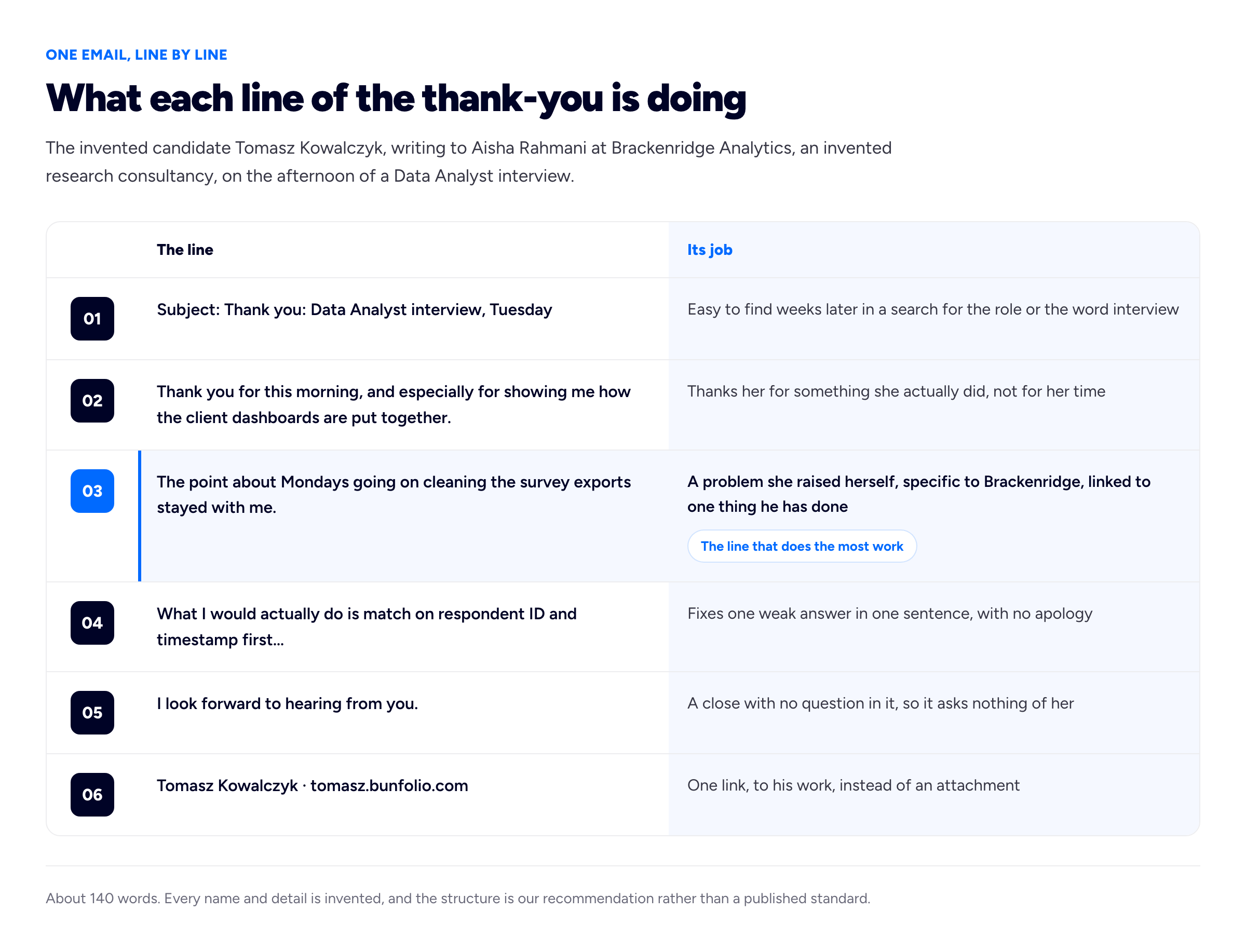
Row 03 is the one a template cannot write for you: it depends on what was said in that room.
Subject lines
The subject line has one job: the interviewer should be able to tell what the email is and find it again. People search their inbox by the role, by your name or by the word "interview", and a clever subject line fails all three searches. Subject lines that work:
Thank you: Data Analyst interview, TuesdayData Analyst interview: thank youThank you for today: Tomasz Kowalczyk, Data Analyst
Avoid exclamation marks, "Quick question" (it is not one, and they will be annoyed when they find that out), "Checking in" on the same day, a blank subject, and anything that tries to be memorable. The memorable part belongs in the body.
Should you reply in an existing thread or start a new email? If the interviewer arranged the interview with you directly, replying in that thread is fine, but change the subject so the thank-you does not sit under "Interview confirmation". If a recruiter or a scheduling system arranged it, start a new email. A reply to an automated calendar invitation often goes to an address nobody reads.
Panel interviews: one email or several?
Several. Send one email to each person who interviewed you and whose address you have, each built on something different that person said. Do not send a single email with everyone copied in.
This is the judgement call templates miss. Panels compare notes, and your emails often end up side by side in the same recruitment system. Three identical emails with only the first name changed look worse than one, because the copying is obvious. Each needs its own reference, which is why the notes on the journey home matter most after a panel. How much to write depends on the person's role in the interview:
- The person who led it, usually your future manager, gets the full version.
- Someone who asked substantive questions gets three or four sentences built on those questions.
- Someone who mostly listened gets two sentences. People who say little often still have a vote.
- The recruiter or coordinator gets a separate, shorter note thanking them for organising the day. That is also the right place for any practical question.
If you do not have their addresses, do not guess them from the company's email format. A wrong guess bounces or reaches a stranger. Write one email to whoever arranged the interview, name each panel member with one line about something they said, and ask whether they would pass your thanks on. If an agency recruiter put you forward, thank them first, the same day, and ask whether to write to the hiring manager directly. Going around a recruiter who is negotiating for you costs you an ally.
What not to put in it
The template pages mostly add things. Most of the judgement is in what you leave out.
- A summary of your CV. They have it and have just spent an hour with it.
- "I am confident I am the best candidate." You have not met the others; they have. Let the specific detail make the case.
- Attachments nobody asked for. They get caught by filters and rarely get opened. Put one link in your signature instead.
- A long apology for a weak answer. Fix it in one sentence or leave it alone. A paragraph of regret makes the weak answer the thing they remember.
- "When will I hear back?" That belongs at the end of the interview. If you forgot to ask, ask the recruiter in a separate note.
- Flourishes. "I was truly inspired by your visionary approach" sounds as if it was written by someone, or something, that was not in the room.
- Anything left over from last week's email. Search the draft for the previous company's name before you send it.
How do I send a short thank-you email?
Sometimes the short version is right: after a fifteen-minute screening call, after a second round when you have already written once, or to a panel member who asked a single question. It still needs one specific detail. It just drops the addition.
Dear Aisha,
Thank you for the second conversation today, and for introducing me to the client services team. Hearing how they use the dashboards with clients was useful context for the role.
Best wishes,
Tomasz
That is about forty words, and it is complete. A short thank-you fails when it loses its detail: "Thanks for your time today, I look forward to hearing from you" is not wrong, but nobody remembers it.
How to say thank you professionally
"Professional" here means the register you would use with a senior colleague you like but do not know well: polite, direct and free of padding. Match their greeting: if they introduced themselves as Aisha, "Dear Aisha" or "Hi Aisha" is right, and if you only know them as Dr Rahmani, use that until they say otherwise. Thank them once, at the start; three thank-yous in ninety words reads as nervous. Prefer "I enjoyed" and "it was useful" to "honoured" and "humbled". "Best wishes" or "Kind regards" are fine sign-offs. Read it aloud once before sending.
The follow-up email when you have heard nothing
The thank-you and the follow-up are different emails, and people often merge them. The thank-you goes out whatever happens. The follow-up goes out only when a deadline has passed in silence, and its only job is to find out where things stand.
Everything depends on one fact: the date they said they would decide. If you did not ask, ask the recruiter now, and in future ask at the end of every interview, as our guide to questions to ask the interviewer suggests. A follow-up sent before their own date tells them you were not listening. One sent after it is reasonable, because they are the ones running late.
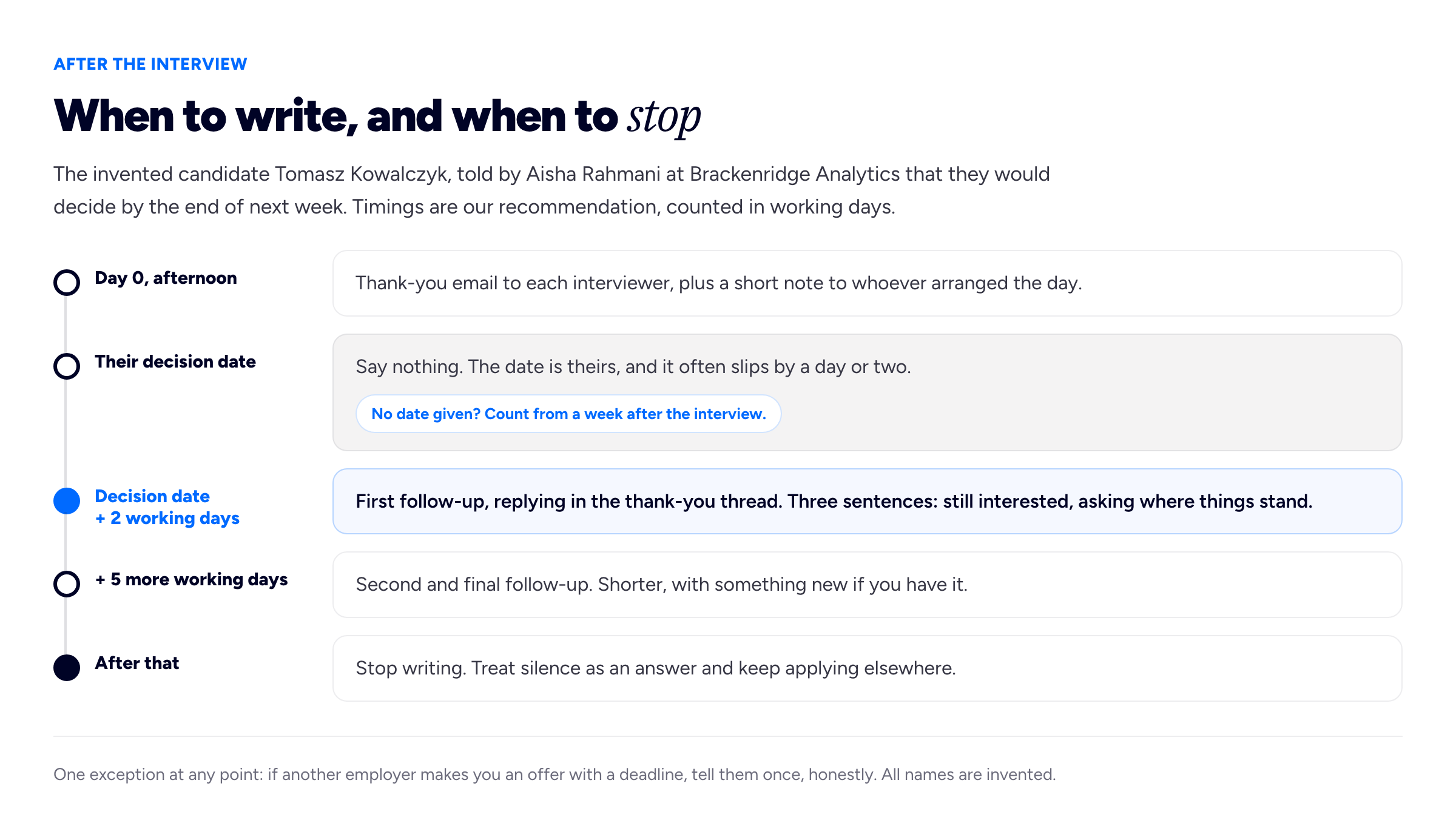
The quiet step is the hardest: waiting two working days past their date feels slow, but it is what makes the follow-up reasonable rather than impatient.
The first follow-up
Wait until two working days after the date they gave you. Decisions slip for ordinary reasons, so a day or two of silence tells you nothing. If they gave no date, count from a week after the interview. Then reply in the thread of your thank-you, so the context sits underneath, in three sentences:
Dear Aisha,
I hope the week has gone well. I wanted to check where things stand with the Data Analyst role, as I remember you hoped to decide by the end of last week. I am still very interested, and happy to send anything else that would help.
Best wishes,
Tomasz
It does not ask "did I get it?", make them feel guilty about the deadline or make the case for hiring him again. Mentioning the date they set is enough, and putting it in the past tense keeps it from sounding like a complaint.
The second follow-up, and when to stop
If nothing comes back, send one more about five working days later. Make it shorter, and include anything new if you have it: a relevant piece of work you have since finished, or a change in when you could start. Then stop. Two follow-ups, three emails in all counting the thank-you, is our recommended limit. That is not because a third would be rude. By then the silence is the answer: either a no nobody has got round to sending, or a process that has stalled for reasons you cannot change. A third chase cannot help, and it can count against you if the role reopens later.
The exception: another offer
If another employer makes you an offer with a deadline, you may write once more at any point, as long as you are honest. Say you have an offer, give the date you have to reply by, and say Brackenridge is still the role you would prefer, if that is true. Never invent an offer to speed them up. Employers sometimes ask who made it, and a lie told to win a job is a poor start to it.
How do I reply to a thank-you email after an interview?
This question means two things, depending on who is asking.
If you are the candidate and the interviewer replied to your thank-you, answer only if their message needs an answer. If they asked for something, such as the piece of work you mentioned, send it the same day. If they simply wrote "Thanks Tomasz, good to meet you too", you do not need to reply. A reply starts a chain they then feel obliged to continue, and leaving them the last word is perfectly polite. If you want to acknowledge it, one line ("Thank you, Aisha, I look forward to hearing from you.") is the limit.
If you are the interviewer, a short reply is a kindness that takes thirty seconds. Thank them, give a realistic date for a decision, and do not hint at the outcome either way, because an encouraging tone that turns out to be misleading hurts more than silence. If the date slips, tell them.
Your signature, and the one link
The signature is the one place a thank-you can carry evidence without pitching. Keep it to your name, a phone number and one link. If your work can be shown, such as an analyst's dashboards, a designer's projects or a writer's published pieces, make that link a portfolio page with two or three relevant examples rather than an attachment. The interviewer can open it on a phone between meetings, and it is still there when they forward your email to a colleague. If you do not have one yet, Bunfolio builds a free one on its own subdomain from a short form or your LinkedIn profile, which is where Tomasz's invented address comes from. Any page you control will do. What matters is that the link leads to the work rather than to claims about it.
Frequently asked questions
Should I send a thank-you email after a phone screen?
Yes, a short one, to whoever called you: two or three sentences with one detail from the call. If it was an agency recruiter, ask them whether to write to anyone else.
Is a handwritten note better than an email?
Not as the main thank-you. Post often arrives after the decision is half made. If a card suits the employer, perhaps a small business or a role where a personal touch fits the work, send the email the same day and treat the card as an extra.
Should I send a thank-you if I do not want the job?
Send a short, polite note anyway, and if you are certain, withdraw in it: "Having thought it over, I do not think the role is the right fit for me, and I wanted to tell you now rather than take up more of your time." People you meet at one employer turn up at others.
What if I made a mistake in my thank-you email?
If you misspelled their name or named the wrong company, send one short correction straight away with a one-line apology. If it was a typo anywhere else, leave it. A second email about a typo draws more attention to it than the typo ever would.
They said they would decide tomorrow. Should I still send it?
Yes, within a couple of hours of leaving. It may be the last thing they read from you before they decide, so make the detail count and leave out anything that needs a reply.
How long should I wait to follow up after a final interview?
Use the same rule: two working days after the date they gave, or a week after the interview if they gave none. Final rounds often need sign-off from someone senior, so a short delay at that stage means less than it would after a first round.
How we put this guide together
Bunfolio builds portfolio websites and gives away free career tools, so we read a lot of what people send to employers, including the emails that follow an interview. We should be clear about what that means: nothing here is sourced, because there is no authority to source it to. No standards body publishes the right gap between an interview and a thank-you, or the right number of follow-ups. The same-day timing, the 150-word limit, the four jobs of the email, the rule that the reference should be a problem the interviewer raised, one email per panel member, the two-working-day wait, the two-follow-up limit and every example email are our recommendation. Where we give a figure, it is our recommendation in those words.
We have deliberately left out the statistics that usually open articles like this: that some percentage of hiring managers say a thank-you note affects their decision, or that a given share of candidates never send one. We could not trace those figures to a published method, sample and date. A figure nobody can source is worse than none, because it looks like evidence. The practical case for the email does not depend on a number, so there are no percentages above.
Everything named here is invented: Tomasz Kowalczyk, Aisha Rahmani, Brackenridge Analytics with its dashboards and survey exports, the Tuesday interview, and the address tomasz.bunfolio.com. The example emails and every quoted sentence in both diagrams were written by us as models to adapt, not copied from real correspondence. As with any model email, the part worth sending is the part you cannot copy: what the interviewer actually said to you.
Related reading: signs an interview went well, questions to ask the interviewer, what to bring to an interview, why should we hire you?, putting a portfolio link on your resume and portfolio versus resume.
More from the blog
October 20, 2026 · 19 min read
Signs an Interview Went Well (and Which Ones to Ignore)
Most lists of good interview signs are really lists of good manners. Here is which signals carry information because they cost the interviewer something, which are politeness every candidate gets, whi...
October 18, 2026 · 19 min read
What to Bring to an Interview (and How Early to Arrive)
The whole arrival on one page: what to bring sorted into always, sometimes and never, how early to turn up and why earlier is worse, how long to expect to be there, and what each of those answers beco...
July 27, 2026 · 29 min read
UX Designer Portfolio: What Gets You the Interview
Your screens cannot carry the argument, so the writing has to. The three passes your portfolio gets, a case study spine with word budgets, a skeleton you can copy straight into a draft, and why proces...