
October 21, 2026 · 19 min read
What Are Your Weaknesses? How to Answer It Honestly
The interviewer is not hunting for a flaw. They want a real weakness that is not central to this job, one example of it costing you, what you now do about it and evidence it is working. How to choose it from the advert, why "perfectionist" fails, the three-weaknesses version, and worked answers for students, career changers and senior candidates.
Name one real weakness that is not a core requirement of the job you are applying for, give one concrete example of it costing you something, say what you now do about it, and give one piece of evidence that the fix is working. Weakness, example, fix, evidence. Do not say you are a perfectionist or that you work too hard, because the interviewer has heard both a hundred times and hears them as a refusal to answer. Our recommendation is three or four sentences, under a minute spoken, and in your own words, because the next thing you will hear is "and how is that going?", and a memorised answer has nothing behind it.
Most pages ranking for this question hand you a bank of sample weaknesses, which is why so many people end up asking strangers on forums whether the advice can be trusted. A weakness from a list was chosen for being safe in general; the question is whether it is safe for this job. This guide teaches you to choose your own from the advert in front of you, with answers for a student, a career changer and a senior candidate, plus the "three weaknesses" and "strengths and weaknesses" versions.
The same question, in all of its wordings
These are one question, and the method below answers all of them.
- What are your weaknesses? Plural, but one well-chosen weakness answers it unless they ask for more.
- What is your greatest weakness? Not a request for the worst thing about you: "greatest" means the one that matters most at work.
- What are your strengths and weaknesses? Two questions joined together. There is a section on it below.
- Tell me three weaknesses. A harder variant, asked precisely because one prepared answer will not cover it. Also below.
- What would your last manager say you need to work on? The same question asked through someone else, which makes a humble-brag sound even stranger.
- What is an area for development? The polite, appraisal-style wording. Same answer.
Two words this guide uses. A core requirement is something the person in this job must be able to do from the first week, or the hire has failed. A fix is a specific thing you now do differently, not a feeling that you are improving. "I'm working on it" is not a fix; "I set myself an hour, then I ask" is.
What the interviewer is actually listening for
It looks like a trap: confess something and lose the job. It is not. The interviewer is listening for four things, and only one of them is the weakness itself.
Can you see yourself clearly? Everybody has something they do less well. A candidate who cannot name one either has not thought about it or will not say.
Will you tell the truth when it is uncomfortable? A small, low-stakes test of whether you will say "I got that wrong" later, when it matters more.
Do you understand what this job needs? Pick a weakness at the centre of the job and you have shown that you did not read the advert; pick one far from it and you have shown that you did.
Do you act on what you learn about yourself? This is the part that actually decides the answer. A weakness with a working fix is evidence of the trait every employer wants and cannot test directly: that you get better without being told twice.
They are also checking for a red flag: a weakness that would make you unworkable in this particular job. That is the only way this question costs you the offer, and choosing well avoids it.
Why "I'm a perfectionist" fails
The humble-brag answers are the ones that dress a strength up as a flaw: I am a perfectionist, I work too hard, I care too much, I find it hard to switch off, I am too detail-oriented. They are the advice everyone was given, which is exactly why they no longer work.
They fail for three reasons. First, the interviewer has heard them so often that they register as "this candidate is not going to answer", which is the opposite of the honesty being tested. Second, they do not survive the follow-up. "What has your perfectionism actually cost you?" has two answers: a vague one, which confirms the dodge, or a real one, such as missed deadlines or work you would not hand over, which turns out to be a genuine weakness you failed to prepare. Third, some become real problems taken literally: "I work too hard" in a team that runs on shift handovers means "I will not hand over".
There is an honest version of the perfectionist answer, and it shows the difference. "I used to rewrite reports three or four times before sending them, and a draft my manager needed on Tuesday reached her on Friday. Now I send a first version by the agreed day and ask what is missing." That names a cost, a fix and a result. If it is true, say it. If not, choose something else.
How to choose a real weakness that is not the job
The single most important step happens before you say a word, and it is reading the advert. You are looking for the one or two things this job cannot do without. The same method is in our guide to answering "why should we hire you?": read the first three bullets, notice what is repeated, and treat the essential list as the floor. Those are the areas your weakness must stay away from.
Then sort your honest candidates into four groups.
- Core requirement: avoid. If the advert says accuracy is essential, "I sometimes miss small details" tells them not to hire you, however good your fix. Save it for a job where it matters less.
- Humble-brag: avoid. Anything that is really a compliment, for the reasons above.
- Adjacent to the job: usable with care. A weakness that touches a duty without being the duty. It needs a strong fix and real evidence, but when you have them it is the most persuasive kind, because the fix lands on something they need.
- Absent from the job: safe. A real weakness the advert never mentions, or a learnable gap in something listed as desirable. Most good answers come from here.
The advert we will use
Everything below uses one invented example: Pinewell Health, a group of community clinics, hiring a Patient Bookings Coordinator.
You will manage the appointment diary for three clinics, answer patient calls and emails, rebook cancelled appointments the same day, keep every record accurate in our booking system, and flag recurring problems to the practice manager. Essential: accuracy and attention to detail, a calm phone manner, comfortable with spreadsheets. Desirable: experience in a healthcare setting.
Accuracy appears twice, once as a duty and again as an essential. A calm phone manner is the other non-negotiable: some of the people ringing will be unwell or worried. So those two are the core, and no weakness of yours should live there.
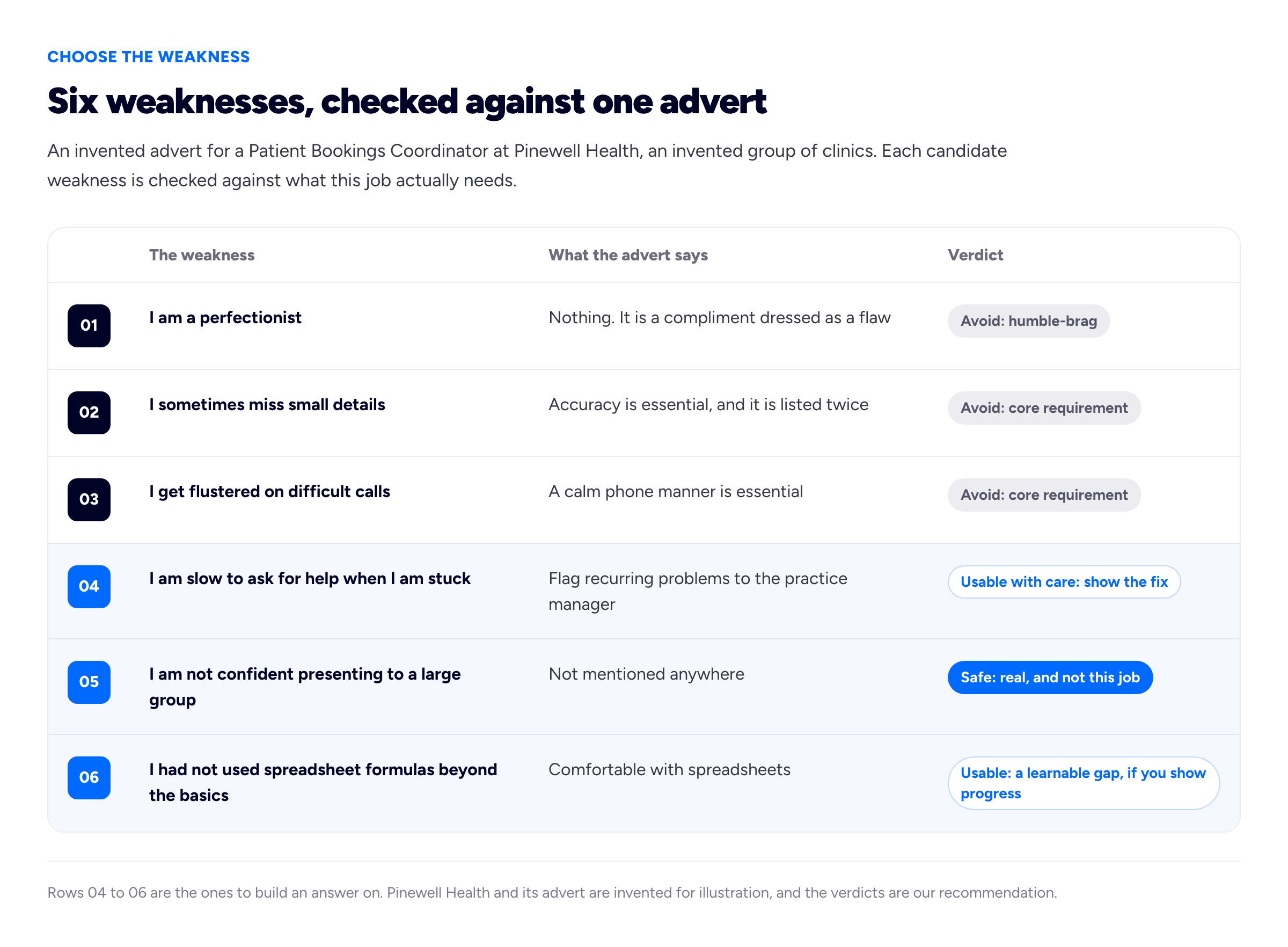
The two weaknesses that would cost this candidate the job are the two that sit on the advert's essential list.
Row 06 sits close to an essential, but "comfortable with spreadsheets" is a low bar. A gap in formulas is learnable; "I have never used a spreadsheet" would not be.
Where real weaknesses usually come from
If nothing comes to mind, you are probably looking for a character flaw. You do not need one. Try these three places.
- A skill this job does not lean on. Public speaking for a back-office role, financial modelling for a design role.
- A working habit with a cost you have noticed. Taking on too much, being slow to ask for help, over-preparing. The easiest to show progress on.
- A knowledge gap you are closing. A tool, a regulation, a domain. Strongest for career changers.
Leave out anything private or medical, anything that is really a complaint about a former employer, and anything that sounds like a reliability problem, such as lateness or losing your temper.
The four-part structure
Once you have chosen the weakness, the answer has four parts, in this order. Each is usually one sentence.
- The weakness, said plainly. No softening introduction ("well, I suppose if I had to pick something…"). One clear sentence shows the self-awareness the question is testing.
- A concrete example. One time it cost you something: a deadline, an afternoon, a mark, a customer. Specific enough that it obviously happened. This is what separates a real weakness from a recited one.
- What you now do about it. A specific, repeatable behaviour. Not "I've been working on it" but the rule, the tool or the habit.
- Evidence that it is working. One recent moment where the fix did its job. This is the part almost everyone leaves out, and it is the part that turns a confession into a reason to hire you.
Keep the weakness in the present tense. "I used to struggle with this, but I have completely solved it" sounds like an evasion, because a weakness you no longer have is not an answer to the question. "I am still slower at this than I would like, and here is what I do" is honest and still finishes on the fix.
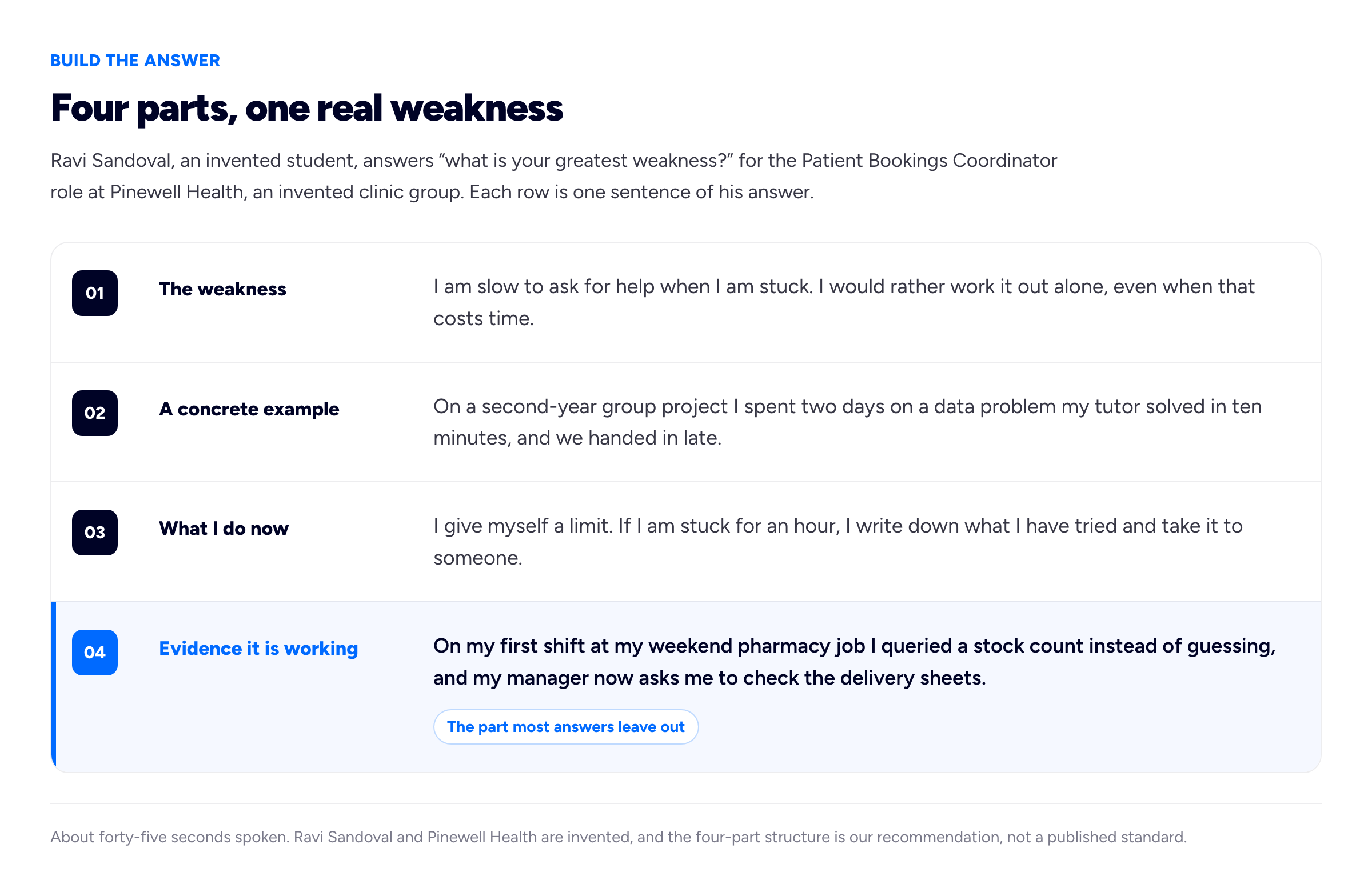
Row 04 is what makes the interviewer believe rows 01 to 03.
Ravi chose row 04 of the first diagram on purpose. Being slow to ask for help is adjacent to "flag recurring problems to the practice manager", so his fix lands on a duty in the advert. That only works because he has real evidence; without the pharmacy shift, he would have been better choosing row 05.
How long it should be
Our recommendation is three or four sentences, roughly forty-five seconds to a minute spoken, or about eighty to a hundred and twenty words written down. The example is where people run long. One sentence of what happened and what it cost is enough; if the interviewer wants more, they will ask.
Worked answers, by situation
These show the method applied, not answers to borrow. None of them would transfer to a different candidate unchanged; that is the point.
A student, or no work experience
The interviewer knows you have less to draw on. Take the example from your course, a club, volunteering or a part-time job. Avoid "I lack experience", which describes being a student and has no fix you can show. Choose a habit instead.
Ravi's full answer for Pinewell Health:
"I'm slow to ask for help when I'm stuck. I'd rather work it out alone, even when that costs time. On a second-year group project I spent two days on a data problem my tutor sorted out in ten minutes, and we handed in late. So now I give myself a limit: if I'm stuck for an hour, I write down what I've tried and take it to someone. On my first shift at my weekend pharmacy job, I queried a stock count rather than guessing, and my manager now asks me to check the delivery sheets."
A student with no job at all could finish on a course example instead, such as the dissertation meeting booked in week two rather than week eight. Evidence does not have to come from paid work; it has to have happened. Our guide to building a portfolio with no experience covers where else it comes from.
A career changer
Your weakness is often already obvious: you have not done this kind of work before. Name the knowledge gap, bound it, and show it shrinking. It is the one situation where a gap in something the advert mentions is the best answer, because the interviewer will ask about it anyway.
Greta Halvorsen, also invented, spent nine years running the front desk of a city-centre hotel and is applying to Pinewell Health for the same coordinator role. The advert lists healthcare experience as desirable, and she has none.
"The honest gap is healthcare itself. I know how to keep a busy diary calm, but I don't yet know how patient records work or what I can and can't say on the phone. When I was preparing for this application I read the guidance on patient confidentiality that clinics share with new reception staff, and I've started a short online course in data protection for health settings, which I finish next month. The first thing I'd want in week one is to sit beside whoever runs the diary now and learn your rules before I touch a booking."
Greta finishes on a plan rather than a result because her fix is still in progress. That works for a knowledge gap with a specific plan; it would not for a habit you claim to have fixed.
A senior candidate
The weakness has to be a senior one. A director who answers "I'm not great with spreadsheets" has not answered: the interviewer wants to know how you lead and delegate. Senior answers usually come from a working habit at the scale of a team: stepping in to do the work yourself under pressure, putting off a difficult performance conversation, deciding fast and consulting late.
A head of operations applying to run Pinewell Health's clinics might say: "When things go wrong I step in and fix them myself, which is quick but means my team never learns that fix. At my last organisation, when two leads left in the same month, I found three processes only I understood. Now when something breaks I ask the person who owns it to lead the fix, and I sit in on the review instead of running it. This year our clinic managers handled two system outages without me." The evidence is other people now doing what the candidate used to do alone. At senior level, that is what a fix looks like.
When they ask for three weaknesses
Interviewers ask for three precisely because one rehearsed answer will not stretch to cover them. The method is the same; the discipline is in variety.
- Take each from a different source. One skill the job does not lean on, one working habit, one knowledge gap. Three habits sounds like a personality problem; three skill gaps sounds like the wrong candidate.
- Give the full four parts to one, and a sentence or two to the others. Lead with your best-evidenced weakness; for the other two, the weakness and what you do about it.
- Check all three against the advert. The third weakness is where people panic and reach for something core. Prepare all three in advance.
Greta's three, for the same job:
"The biggest is healthcare knowledge, which I'm closing with a data protection course I finish next month, and I'd want to learn your rules before I touch a booking. Second, I'm not confident presenting to a large room. I'm fine with a guest or a team of five, but a forty-person briefing still makes me over-prepare, so I've started volunteering to do the five-minute update at my current staff meetings. Third, I take on too much. When a colleague is busy, I offer to cover before checking my own day. I now look at my own list before saying yes, and I've stopped finishing late most weeks."
A desirable gap, an absent skill and a habit with a fix. Nothing on the essential list.
"What are your strengths and weaknesses?"
Answer the strength first, briefly, then the weakness in full: it is the half they are really listening to.
The strength should be one of the one or two things that decide the job, with one piece of evidence: exactly what our guide to "why should we hire you?" builds. The weakness should come from somewhere else. Making it the "shadow" of the strength ("I'm very thorough, so sometimes I'm slow") often reads as a humble-brag in two parts, and pulls your weakness towards the centre of the job, where your strength lives. Our recommendation is to keep them separate.
For Ravi: "My strength for this role is accuracy. I checked the weekly delivery sheets at the pharmacy for a year and I'm the person who finds the missing line. My weakness is that I'm slow to ask for help…" and then the four parts, slightly shortened.
What quietly fails
- "I don't really have any." The worst available answer: it fails the self-awareness test outright.
- The humble-brag. Perfectionist, work too hard, care too much. Covered above.
- A core requirement. True and honest, and a reason not to hire you for this particular job.
- A weakness with no fix. "I'm disorganised" and then silence.
- A fix with no evidence. "I've been working on it" is a hope until one recent example makes it a fact.
- A story that blames someone else. The interviewer hears how you will describe them in two years.
- Something too personal. Health or family. The question is about work.
- Overselling the cure. A weakness you have completely solved is no longer an answer to the question.
- A recited answer. If it came from a list, it will not survive "can you give me an example of that?"
The follow-ups to prepare
"Can you give me another example?" Have a second, more recent moment ready. It is the single best check that the weakness is real.
"How would that affect you in this role?" Answer honestly, with the specific duty from the advert it touches and how your fix applies. Ravi: "Flagging recurring problems to the practice manager is exactly the habit I've built, so I'd expect to raise things earlier than you'd need."
"What would your current manager say?" Something consistent with what you have just said. A reference describing a different weakness is worse than either one.
At the end, you can show the same honesty from the other side: asking what people in this role find hardest in their first three months is one of the stronger options in our guide to questions to ask the interviewer.
Frequently asked questions
What is a good weakness to say in an interview?
A real one that is not a core requirement of the job, with a concrete example, a fix you now use and evidence that the fix is working. "Good" depends on the advert: public speaking is a safe weakness for a bookings coordinator and a disqualifying one for a trainer. Read the essential list first, then choose from skills the job does not lean on, working habits with a fix, or knowledge gaps you are closing.
Is it all right to say "I'm a perfectionist"?
Only if you can name what it has cost you, such as late work or a draft you would not send, and what you now do differently. Said on its own, it reads as a compliment in disguise, and interviewers hear it so often that it signals you would rather not answer. Most people are better choosing something else.
What weaknesses should a student with no experience give?
A working habit, with the example taken from your course, a club, volunteering or a part-time job. Avoid "I lack experience", which describes being a student rather than a weakness, and has no fix you can show. Being slow to ask for help, over-preparing, or taking on too much in a group project all work well, provided you can show the habit improving.
How do I answer "tell me three weaknesses"?
Take each from a different source: one skill the job does not need, one working habit and one knowledge gap. Give the first the full structure and keep the other two to a sentence each, so the whole answer stays near a minute and a half. Check all three against the advert beforehand, because the third is where people reach for something core in a panic.
Should my weakness be related to the job?
It should not be a core requirement of the job, but it can touch the job if you have a strong fix. An adjacent weakness with real evidence is the most persuasive answer, because your fix lands on a duty they need. If you do not have that evidence, choose a weakness the advert does not mention at all.
Can I say I don't have any weaknesses?
No. It fails the question outright, because what is being tested is whether you can see yourself clearly and say so.
Is "what is your greatest weakness" a different question?
No. "Greatest" means the one that matters most at work, in practice the one you are actively working on. Answer it with the same four parts; treating it as a request to confess the worst thing about you usually produces an answer that is too personal.
How we put this guide together
Bunfolio builds portfolio websites and gives away free career tools, so we spend a lot of time reading job adverts and the material people send against them. We should be clear about what that means: nothing here is sourced, because there is no authority to source it to. No standards body publishes a correct answer to an interview question. The four-part structure, the four groups for sorting a weakness against an advert, the three places real weaknesses come from, the approach to the three-weaknesses and strengths-and-weaknesses variants, the lengths we suggest and every worked answer are our recommendation. Where we give a figure, it is our recommendation in those words.
We have deliberately left out the statistics that usually decorate this topic: the share of candidates who say "perfectionist", the share of interviewers who reject it, the number of seconds a hiring manager takes to decide. We could not trace any of those to a published method, sample and date, and a figure nobody can source is worse than none, because it looks like evidence. The underlying points do not need a number to be true, so there are no percentages above and no survey findings.
Everything named here is invented: Pinewell Health and its three clinics, the Patient Bookings Coordinator advert, the candidates Ravi Sandoval and Greta Halvorsen, the pharmacy, the hotel and the unnamed head of operations. The worked answers and every quoted sentence in both diagrams were written by us as models to adapt, not transcribed from a real interview. None should be used as it stands: a weakness that is not yours will not survive the follow-up question, which is what this whole guide rests on.
Related reading: why should we hire you?, questions to ask the interviewer, what to bring to an interview, building a portfolio with no experience and how to make a resume stand out.
More from the blog
October 17, 2026 · 18 min read
Questions to Ask the Interviewer (and What Each Answer Tells You)
Everyone publishes fifty questions and nobody says which three to ask. Here is how to choose them from the role in front of you, grouped by what the answer reveals rather than by topic, with what a go...
October 15, 2026 · 19 min read
Why Should We Hire You? How to Answer It Without Bluffing
The question is not asking you to praise yourself. It wants a short case: the one or two requirements that actually decide the job, your evidence for each, and what you would do in the first weeks. Ho...

July 21, 2026 · 20 min read
Adobe Portfolio Alternatives, Compared Honestly
What Adobe Portfolio actually is, whether you already own it without knowing, and the six places a portfolio can live — compared on how each one charges and what you are left holding when you stop pay...