
November 16, 2026 · 19 min read
How to Answer "Tell Me About Yourself" (With Worked Answers)
Answer "tell me about yourself" in 60 to 90 seconds: one sentence on what you do now, one or two things you have done that match the job advert, and why this job is your next step. Leave out your life story, your CV read in order, adjectives about your character, and anything about salary or why you are leaving.
To answer "tell me about yourself", give a 60 to 90 second summary of your working life in three moves, aimed at the job in front of you. Start with the present: what you do now, in one sentence a stranger would understand. Go back to the past for one or two things you have done that match what this advert asks for most. End with the future: why this job is the sensible next step, which hands the conversation back to the interviewer. Leave out your childhood, your hobbies (unless they are evidence), your full CV read in order, and anything about salary or why you are leaving.
Most pages ranking for this question say something like that, then hand you a dozen scripts to memorise. This guide explains why the order matters, builds one answer from an advert line by line, writes five more for different situations, covers phone, video and panel interviews, rewrites the weak sentences people actually say, and ends with the written version forms ask for. The aim is an answer that is yours, so it survives the follow-up question.
What the interviewer is actually asking
It sounds like an invitation to talk about anything. It is not. The University of Sheffield's careers service calls it "the simplest form of an opening question", one meant to settle you in, but it is still judged. The interviewer is checking whether you can summarise yourself (rambling here predicts rambling later), whether you have understood the job (what you choose to mention shows what you think the role is about), and where to go next. That last one matters most: interviewers pick up threads you leave them. Mention a report you rebuilt and the next question is about that report, which you have prepared for. Mention your gap year and the next question is about your gap year. As the nidirect guidance for Northern Ireland puts it, the interviewer is not looking for your life story.
Present, past, future, and why that order works
The structure this guide recommends is present, past, future, with one bridge to the advert running through it. It is not the only structure people teach. The other common one is chronological: education, first job, second job, now. We recommend against it for most people, for a practical reason. Chronological order spends its first twenty seconds on the oldest and least relevant part of your history, which is exactly when the interviewer is paying most attention. Present first puts the most relevant fact at the front.
Present: one sentence on what you do now
Your current role, the work, and who it is for. Not your title alone, which means little outside your organisation. "I'm an operations analyst" is a title. "I'm an analyst at a housing association, where I build the monthly reports the repairs team uses to decide which jobs go first" is something a listener can picture.
If you are not working, the present is still what you are doing now or have just finished: a degree, a contract that ended, a caring role. No apology needed.
Past: one or two things that match the advert
Not your history: your evidence. Pick the one or two things that most closely match what this job needs, one sentence each. The interviewer has your CV; they want to hear which parts of it you think matter here.
Future: why this job is the next step
One or two sentences on why you applied, framed as where your work is going rather than what you want to get. "I want to grow" is about you. "I want to do this kind of work for clients rather than for one internal team, which is what this role is" is about the job. Then stop. The last sentence should hand the floor back.
The bridge: the advert, threaded through
The bridge is not a fourth section. It is the habit of echoing the advert's own concerns, in your words, in each part, so the interviewer hears an answer that could only have been given to this job.
How long to talk for
Our recommendation is 60 to 90 seconds. Published guidance tends to set the ceiling a little higher: Harvard Catalyst's interview toolkit suggests a "1-2 minute response", and nidirect says to keep it under two minutes. We aim lower because this is the opening question and the interviewer has a list to get through. Under thirty seconds sounds unconsidered; past two minutes they are waiting rather than listening. When we read our own model answers aloud at a calm pace, 60 to 90 seconds came out at roughly 150 to 220 words, so that is a useful size to draft to.
Building one answer from one advert
Everything below uses one invented example. Fernhill Analytics is a small consultancy that produces reporting for housing and local-government clients. It is hiring an Analyst, Client Reporting, who will report to Tomasz Wierzbicki, its head of client delivery. This is the part of the advert that matters:
You will turn messy client data into monthly reports that busy people actually read, explain what the numbers mean to account managers who are not analysts, and spot problems in a client's data before the client does. Essential: SQL, and experience presenting findings to non-specialists. Desirable: Power BI.
Three phrases decide this job: "reports that busy people actually read", "explain what the numbers mean" to non-analysts, and "before the client does". SQL and Power BI are filters. Everyone who reaches the interview has passed them, so they do not distinguish you.
The candidate is Ama Boateng. She has spent two years as an operations analyst at a regional housing association, and before that she worked for a year on the customer contact team at the same organisation. She has never worked at a consultancy.
"I'm an operations analyst at a housing association, where I build the monthly reports our repairs managers use to decide which jobs go first. The part I've got best at is making those reports readable: when I took them over they were a forty-tab spreadsheet nobody opened, and I cut them to one page with three charts and a short note on what had changed. Before that I spent a year on the phones in customer contact, so I know what it's like to be the person who needs the answer and doesn't want the method. I'm applying because I want to do that same work across several clients rather than one, and because your advert describes the problem I enjoy most, which is turning data people don't trust into something they'll act on."
That is about 135 words, a little under a minute at a calm pace, which leaves room for a pause. There is no software list (SQL is on her CV and will be tested anyway), no degree and nothing about why she is leaving. And Tomasz now has three threads to pull: the forty-tab spreadsheet, the customer contact year, and what "data people don't trust" means. Ama should have a two-minute story ready for each.
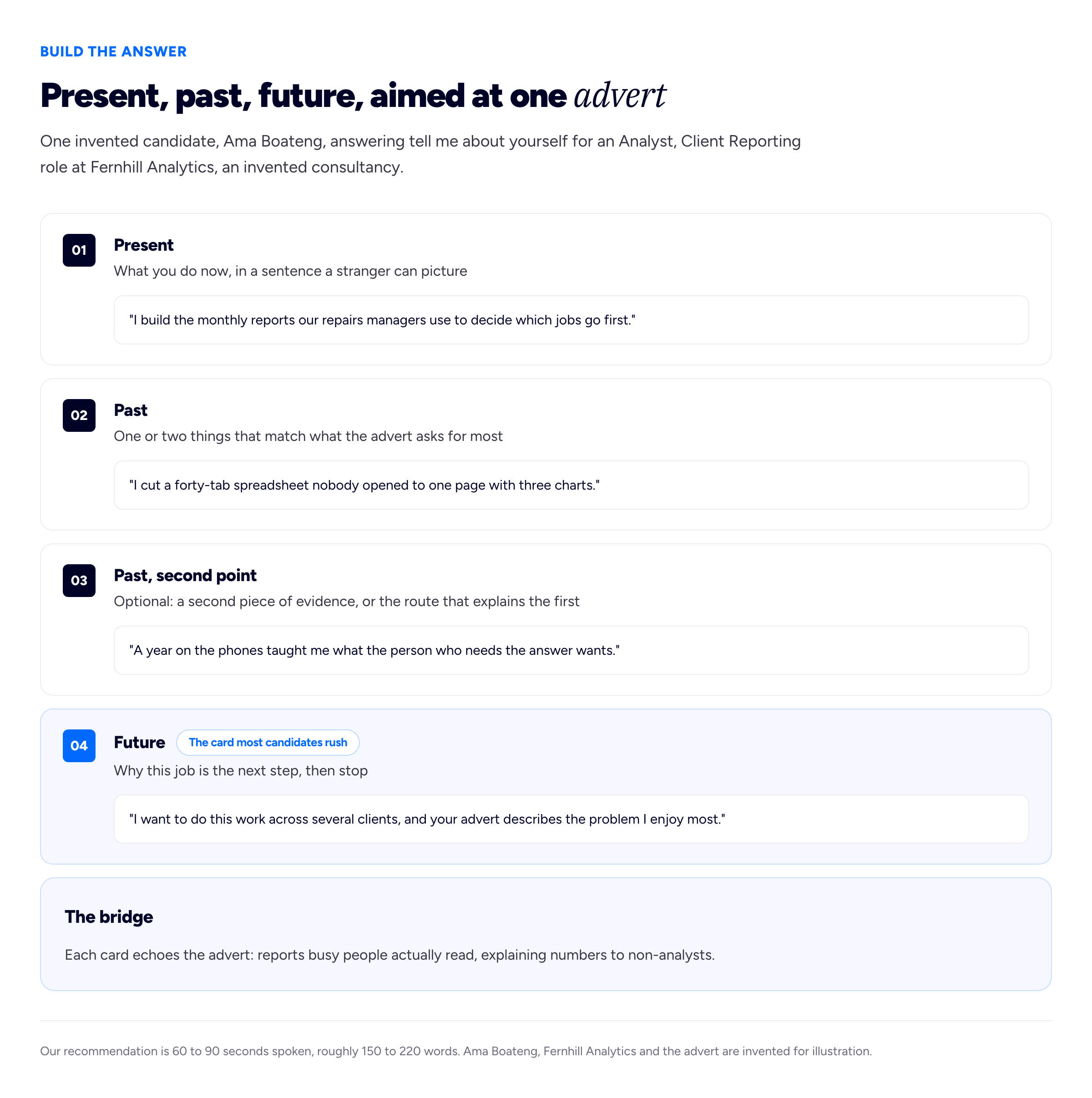
Each card is one or two sentences; the band underneath is what makes the answer belong to this job and no other.
Five worked answers for five situations
The structure stays; the contents change. These are our models to adapt, all aimed at roles at Fernhill Analytics.
Recent graduate
A graduate with a geography degree, a dissertation built on public housing data and a summer temping in an office.
"I've just finished a geography degree, and the part I liked most was my dissertation, which used public housing data to map repair waiting times across one council area. The hardest part wasn't the analysis, it was writing it up so my supervisor, who isn't a statistician, could follow the argument in ten minutes. Over the summer I temped in an office doing data entry, which taught me how messy real records are. I applied here because your advert is about exactly that combination: untidy data, and people who need the conclusion without the method."
Why it works: the degree is mentioned as the present, not as a credential, and the evidence is something specific she did inside it. A summer temp job becomes useful rather than embarrassing because it is tied to the advert.
Career changer
A secondary-school maths teacher of six years moving into analysis.
"I teach maths at a secondary school, and I'm changing careers, so I'll be direct about what carries over. Most of my job is explaining numbers to people who would rather not hear about them, which is your second line almost word for word. For the last three years I've also run the department's assessment tracking, in a shared spreadsheet I rebuilt so heads of year could see which classes were slipping without asking me. I've done an evening course in SQL this year. What I want next is to do the analysis full-time, and a consultancy suits me because the audience changes every month."
Why it works: it names the change in the first sentence, then refuses to apologise for it. The evidence comes from inside the old job. If you are making a similar move, a career portfolio lets an interviewer see the transferable work rather than take your word for it.
Freelancer moving in-house
Someone who has freelanced for four years building dashboards for small charities.
"For the last four years I've been freelance, building reporting dashboards for small charities, usually for a trustee board that meets quarterly and has twenty minutes for the numbers. That's taught me to put the conclusion on the first page and the method in an appendix nobody opens. I've done the whole job alone, from cleaning the data to presenting it, which is useful but means I've never had a colleague check my work. That's a large part of why I'm applying: I want to do the same work inside a team, with clients I see every month rather than every quarter."
Why it works: it answers the unspoken worry about freelancers, whether you will stay, with a reason about the work rather than income. If your history is a list of clients rather than employers, putting freelance work on a resume covers how to group it so the CV and the answer tell the same story.
Returning after a gap
Someone who spent three years out of paid work raising young children, after five years in a finance team.
"I've been out of paid work for three years looking after my children, and I'm coming back now they're both at school. Before that I spent five years in the finance team at a property company, where I owned the monthly management accounts and, in my last year, rebuilt how we reported arrears to the board so they could see trends rather than a single month. This year I've refreshed my SQL through an online course and done some volunteer reporting for a local food bank. I'd like to come back into analysis rather than accounts, and client reporting is the closest match to the part of my old job I was best at."
Why it works: the gap is stated once, plainly, and then the answer moves on, with recent volunteering giving the present some substance.
Senior candidate or manager
A head of analytics at a large organisation applying for a senior role at Fernhill.
"I lead an analytics team of six at a large housing group, and my job now is less about building reports than deciding which ones should exist. The thing I'm proudest of is cutting our regular reporting by about half, by sitting with each team and asking what they actually used, and replacing the rest with three dashboards and a short monthly briefing that I write myself. Before that I was an analyst for eight years, so I've done the job I'm now managing. I'm applying because I want to do that same editorial work across several clients, and because your advert's line about reports people actually read is the argument I make internally every week."
Why it works: instead of reciting a whole career, it gives one decision that shows judgement and proves working-level credibility in a sentence. The "about half" is a figure the candidate knows from their own work; never use one you would have to look up.
Phone, video and panel: what changes
The content stays; the delivery changes.
- Phone screen. Often with a recruiter rather than the hiring manager, and often shorter. Our recommendation is the short end, about 45 to 60 seconds, because there is nothing to look at and listeners on the phone lose the thread faster. A card of five words in front of you is fine; a script is not, because reading is audible.
- Video interview. Look at the camera rather than at the face on the screen when you are making your main point, because that is what reads as eye contact on the other end. Leave a short pause after you finish, since a lag can make it look as if you are still talking. For a pre-recorded video with a timer, aim to finish with a few seconds to spare rather than being cut off mid-sentence.
- Panel. Start by speaking to the person who asked, then let your eyes move to the others as you go, and return to the questioner for your final sentence. If you know who is on it, let the bridge touch each member's concerns.
The practical side of each format, from charging a laptop to bringing a printed CV, is in our guide to what to bring to an interview.
What to leave out
Most weak answers fail on what they include.
- Your life story. Where you grew up and why you chose your degree use up your best seconds.
- Your CV, read aloud in order. They have it. Reading it back tells them you do not know which parts matter.
- A list of adjectives. "Hard-working, passionate, a team player." Nobody claims the opposite, so the words carry no information.
- Why you are leaving. It invites a question you may not want yet. If they ask, that is its own question, and our guide to reasons for leaving a job covers how to answer it.
- Salary, hours or benefits, and complaints about any employer, even mild ones.
- Personal details you are not obliged to share. Family plans, health, religion, age. You can mention family as the reason for a gap, as in the example above, but you never have to.
- Hobbies, unless they are evidence. "I run" tells them nothing. "I run the results spreadsheet for my running club, which is how I learned SQL" tells them something.
Before and after: six sentences rewritten
Find the sentences that are claims and replace them with things you did. Six common ones, rewritten for Ama:
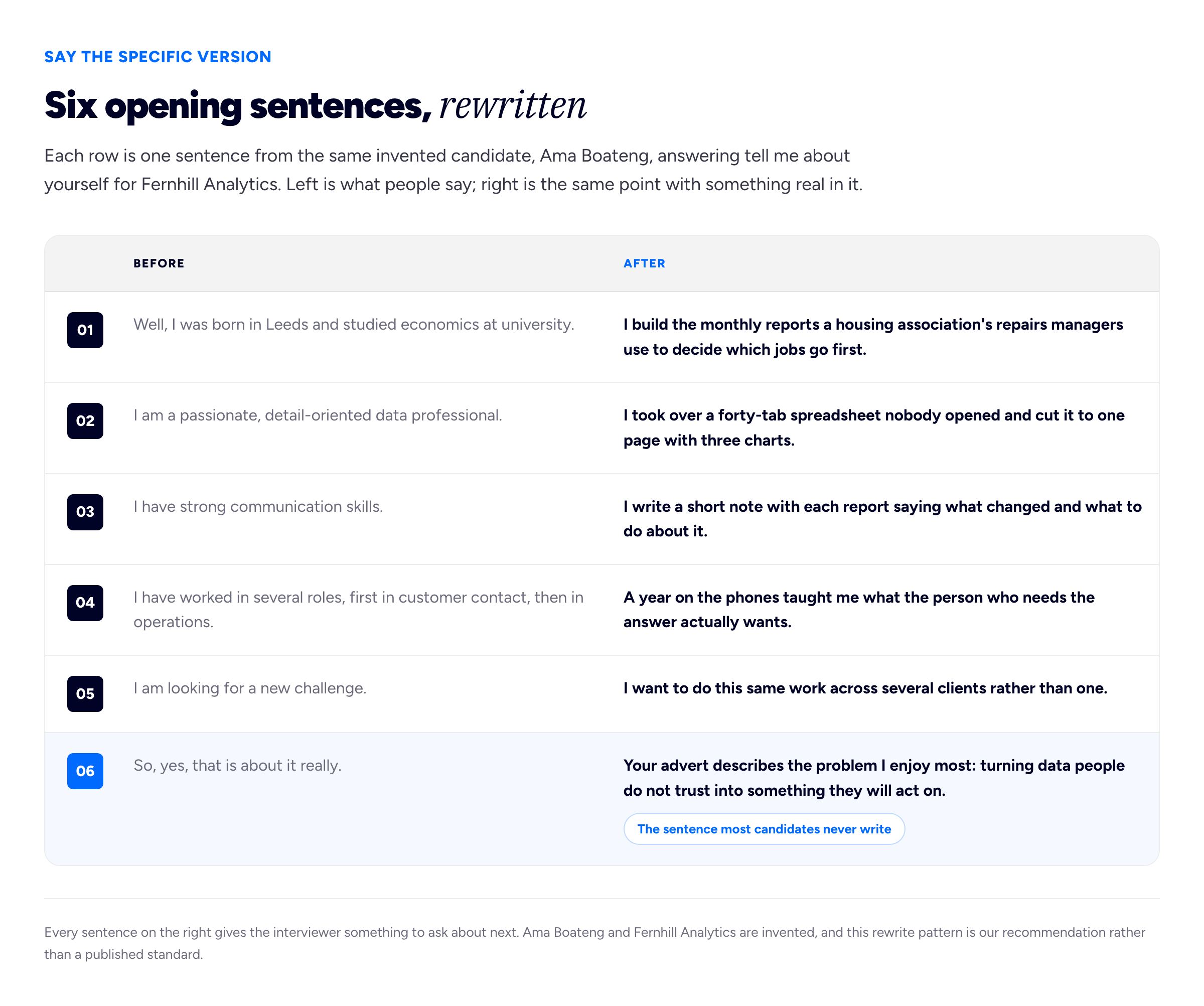
Read the right-hand column aloud: it is nearly a complete answer.
The last row matters most: trailing off with "so, that's me" wastes the most memorable position in the answer.
How to rehearse without sounding scripted
A prepared answer only sounds prepared if you memorised sentences rather than points. Our recommended method:
- Write it out in full once, so you know what you want to say and roughly how long it is.
- Reduce it to four or five words, one per part. For Ama: "repairs reports", "forty tabs", "phones", "several clients". Throw the full version away.
- Say it aloud from the words alone, three times, on different days. It will come out slightly differently each time. That is the point: you are learning the route, not the sentences.
- Record one attempt and replace the phrase you always stumble on with how you would say it to a friend.
- Practise the follow-ups more than the answer. For each thread you left, have the longer story: what the situation was, what you did, how it ended.
- Do one run-through with another person who interrupts with "tell me more about that".
Rehearse this answer alongside the others it shares material with. If you have used your best story here, decide now which story you will use for "what are your weaknesses?", so you are not reaching for the same one twice.
The written version: forms, profiles and "about you" boxes
Application forms and online profiles ask the same question in writing: "tell us about yourself", "personal statement", "about you", "summary". The structure is the same, but writing changes three things.
It can be shorter. A reader skims. Our recommendation is three to five sentences, or roughly 60 to 120 words, unless the form gives you a word limit, in which case use most of it but not every last word. Draft in a document first so a character limit cannot cut you off mid-sentence.
Write it in the first person on forms and portfolio pages, in the same present, past, future order.
Every claim can be checked against your CV, so round nothing up. Ama's form version might be:
"I'm an operations analyst at a housing association, where I build the monthly reports our repairs managers use to prioritise work. I rebuilt those reports from a forty-tab spreadsheet into a one-page summary with a short note on what changed, and I now present them at the monthly managers' meeting. I'm applying to Fernhill because I want to do the same work for several clients, with people who need the conclusion more than the method."
The CV version of this is a professional summary, which is tighter still and has its own conventions. For a portfolio site or a LinkedIn "About" section, where the reader is less likely to be comparing you against an advert, the portfolio bio examples guide covers the longer, warmer version. If you want a first draft to edit rather than a blank box, our free about me generator produces one from a few details,. A portfolio site also gives an interviewer who wants to see the reports you mention somewhere to look.
The questions this one gets confused with
"Walk me through your CV" does ask for chronology, so go in order there. "Why should we hire you?" asks for an argument rather than a summary, and is covered in our guide to answering "why should we hire you?"; keep at least one piece of evidence back for it. "Why do you want this job?" expects research into the employer that your future sentence only touches. And at the end, when you are asked whether you have questions, you can pick up your own threads, which questions to ask the interviewer covers.
Frequently asked questions
What is the best way to answer "tell me about yourself"?
Use present, past, future. Say what you do now in one sentence, give one or two things you have done that match the job advert, and finish with why this job is your next step. Keep it to about 60 to 90 seconds, and leave out anything the advert does not care about.
How long should my answer to "tell me about yourself" be?
Our recommendation is 60 to 90 seconds spoken, which is roughly 150 to 220 words. Published careers guidance tends to give a ceiling of around two minutes. On a phone screen, aim for the shorter end, because listeners lose the thread faster without anything to look at.
Should I talk about my personal life?
Only where it is relevant or it explains something on your CV, such as a career break. You are never obliged to share family, health or other personal details. Hobbies are worth including only if they are evidence of something the job needs.
How do I answer "tell me about yourself" as a fresher with no experience?
Start with what you have just finished, such as a degree, a course or an apprenticeship, then give one specific thing you did inside it that matches the advert: a project, a dissertation, a society you ran or a part-time job. End with why this role is the right first step.
Should I memorise my answer?
Memorise the points, not the sentences. Reduce your answer to four or five key words and practise saying it from those, so it comes out slightly differently each time. A memorised paragraph sounds rehearsed and falls apart when the interviewer interrupts with a follow-up.
How do I end my answer?
End with a sentence that ties you to this job, such as why it is the right next step or which part of the advert you are drawn to, and then stop. Avoid trailing off with "so, that's about it", because the last sentence is the one the interviewer remembers and the one they will pick their next question from.
How we put this guide together
Most of this guide is our recommendation rather than sourced fact, and we would rather say so. The present-past-future structure, the argument against chronological order, the 60 to 90 second target, the ten-minute preparation sequence, the advice for each interview format, the list of things to leave out, the rehearsal method, the written word counts and every worked answer are ours. The rough figure of 150 to 220 words comes from timing our own model answers read aloud, not from a study of speech rates.
Where we cite published guidance, we read it ourselves on 16 November 2026: the University of Sheffield careers service's page on interview question types, which describes this as an opening question; nidirect's common interview questions, the source of the life-story point and the two-minute ceiling; Harvard Catalyst's before the interview toolkit, which suggests a one to two minute response; and the National Careers Service's top 10 interview questions, which advises showing your skills through examples.
We have deliberately left out the figures that often decorate articles on this question: claims that interviewers form a judgement within a set number of seconds, the share of candidates said to fail the opening question, and percentages of hiring managers who supposedly rank it as the most important. We could not trace any of them to a published method, sample and date, and a number nobody can source is worse than none. The senior candidate's "about half" belongs to an invented answer and is not a statistic.
Ama Boateng, Tomasz Wierzbicki and Fernhill Analytics are invented for illustration, as are the advert, the unnamed candidates in the five worked answers, their employers and every quoted sentence in both diagrams. Use them as models to adapt, not as answers to say: an answer that is not yours will not survive the follow-up question.
Related reading: how to answer "why should we hire you?", how to answer "what are your weaknesses?", questions to ask the interviewer and what to bring to an interview.
More from the blog

November 18, 2026 · 19 min read
Words to Describe Yourself, and How to Make Them Believable
Good words to describe yourself are specific and provable: reliable, thorough, calm, candid, curious, resourceful, decisive, patient and persistent all work, as long as each comes with evidence and a...
October 22, 2026 · 23 min read
Fun Facts About Me: How to Find Ones That Land
How to dig your own fun facts out of six kinds of memory, what makes one land rather than fall flat, how to pitch it for a first day, a team meeting, an interview or a written bio, the two-truths-and-...
October 21, 2026 · 22 min read
What Are Your Weaknesses? How to Answer It Honestly
The interviewer is not hunting for a flaw. They want a real weakness that is not central to this job, one example of it costing you, what you now do about it and evidence it is working. How to choose...