
October 30, 2026 · 19 min read
Reasons for Leaving a Job: What to Say and Write
A true reason, said without blame, then turned towards the job you want. What the question is really checking, a short form-field line and a spoken answer for eight common reasons, and honest wording for the hard cases: being fired, a bad manager, a short stay, a gap and several short jobs in a row.
Give a true reason, in neutral words, then turn it towards the job you are applying for. On an application form that is one short line, under ten words: "Contract ended", "Role made redundant", "Relocated to Leeds". In an interview it is thirty to forty-five seconds: what happened, said without blame, and why this job is the sensible next step. The interviewer is listening less to the reason than to two things behind it: whether you would leave them for the same reason, and whether you are running away from something or moving towards something. Never criticise a former employer, never invent a reason, and make sure the form, your CV, your LinkedIn profile and what a reference would say all tell the same story.
The rest of this guide applies that to the eight common reasons and the five hard ones (fired, a bad manager, a short stay, a gap, several short jobs in a row), with a form-field version and a spoken version of each.
What the question is really checking
You will meet it twice. On the application form it is a "reason for leaving" box beside each previous job, sometimes with a character limit or a drop-down; nobody reads a paragraph there. In the interview it is "Why are you leaving?", "Why did you leave your last role?" or "Tell me about the move from your last company", and you get a little more room, but not much. Either way, the person asking is listening for four things.
Will you leave us for the same reason? The main one. If you left for lack of progression, they are checking whether their role has any. If you left for remote work and this job is in the office four days a week, your honest reason has just told them you will be unhappy. The reason has to be one this job solves, or at least does not repeat.
Are you moving towards something or away from something? "I wanted to lead a team" is towards. "My manager was impossible" is away. An answer that is only about escape says nothing about why you want this job, and suggests any job that was not the last one would do.
How will you talk about us when you leave? Every criticism of a former employer is heard as a preview.
Does the story hold together? The CV dates, the form, the account in the room and, later, a reference. A story that changes between the form and the interview worries an interviewer far more than any reason given honestly.
The shape of a good answer
Our recommendation is three parts, in this order.
- The fact. What happened, in one plain sentence. Not a defence, just the reason. "The contract finished in March."
- The neutral bridge. One sentence that closes the topic without bitterness, or shows what you took from it. "It was a good eighteen months and I'd go back to that team tomorrow."
- The turn. Why this job is the logical next step. This is the sentence that answers what they are really asking, and it should take most of your time. It overlaps with answering "why should we hire you?", so the two answers should agree.
Use the past tense for what went wrong and the present or future for what you want, which moves the conversation forward on its own. And stop when you have finished: an answer that runs past a minute nearly always contains a sentence you would rather not have said.
The example we will use
Nell Farrow, an invented video producer, is applying to Kilnworth Media, an invented digital publisher, for a Senior Video Producer role. Her interviewer is Rafe Okonkwo-Reid, Kilnworth's head of video. Her history has easy and hard cases in it: a first job at an agency she left after seven months, three good years at a regional publisher, then two years at a production company that ended when her team was made redundant in June. Her earlier employers are left unnamed.
The Kilnworth advert asks for someone to "own a weekly series from pitch to publish" and to "mentor two junior editors". Nell's answers all turn towards those two phrases.
The good reasons, and how to phrase each one
Most reasons for leaving are ordinary and need only clear wording. Each one below has a form-field version (under ten words) and a spoken version (thirty to forty-five seconds). Where an example is not Nell's, it belongs to an unnamed candidate.
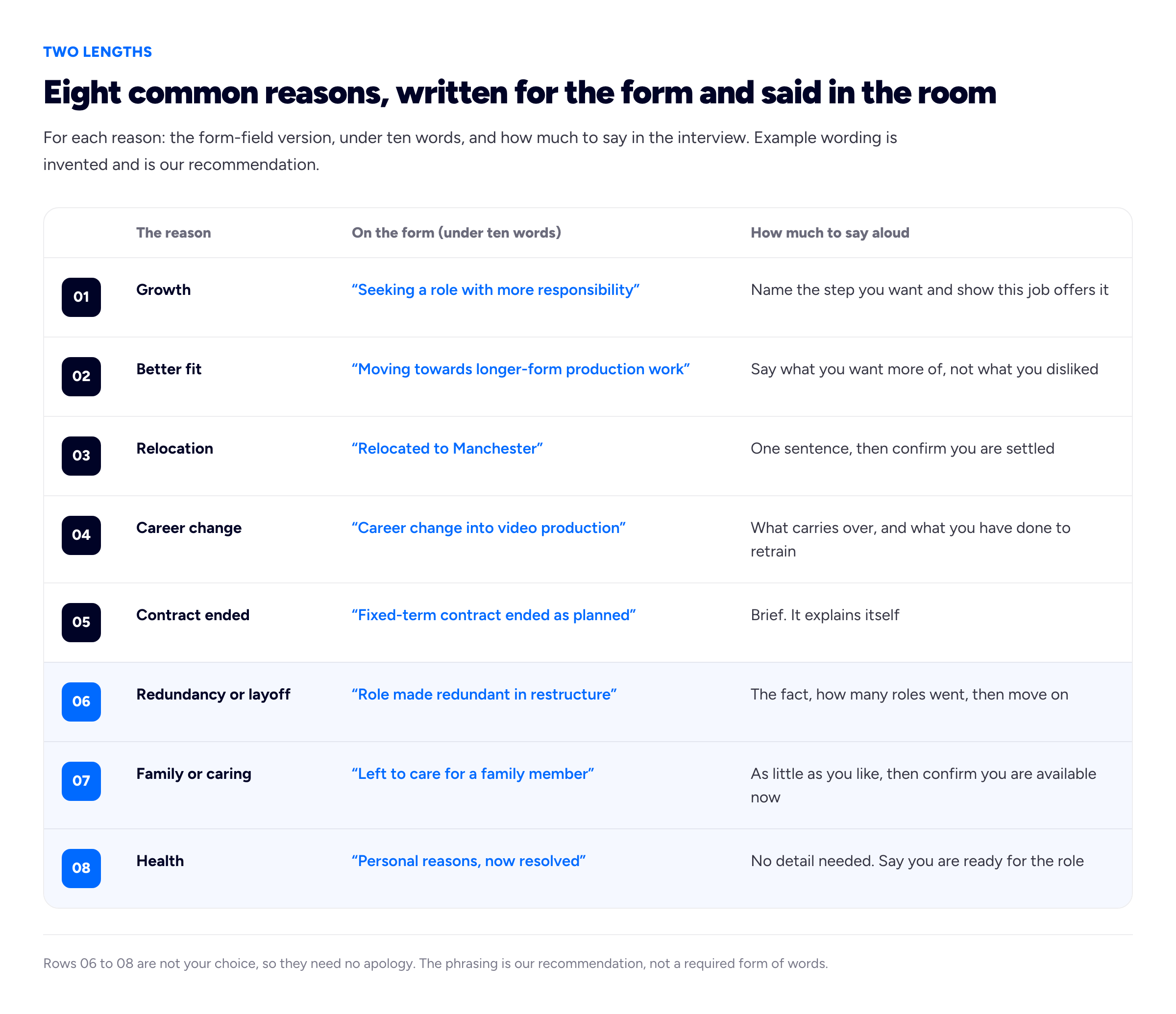
The form wants the fact; the interview wants the fact plus the turn towards this job.
Growth: you want more responsibility
The most common reason and the safest, provided this job actually offers the step you describe. Say you want to lead a team when the role has no reports, and you have explained why you will leave them too.
Form: "Seeking a role with more responsibility."
Spoken: "I've had three good years producing short news packages, and I've started training the newer editors informally. The next step for me is owning a series end to end and mentoring people properly, and there isn't a role like that where I am. That's exactly what this job is."
Notice what is missing: any suggestion that your employer is to blame. A team not having the role is neutral; a manager who "never noticed what I was doing" is a complaint.
Better fit: you want different work
Not more seniority but a different kind of work, size of organisation or pace. Describe what you want more of, never what you disliked.
Form: "Moving towards longer-form production work."
Spoken: "Most of what I make now is thirty-second social clips, and I'm good at them, but the pieces I'm proudest of are two longer documentaries I pitched on the side. I want that to be the job rather than the extra, and a weekly series is exactly that."
Relocation
Easy to explain, with one trap: the interviewer wonders whether you will move again. Say where you are and that you are settled.
Form: "Relocated to Manchester."
Spoken: "My partner took a job up here, so we moved in the summer and we've bought a place. My old role couldn't be done remotely, so I left on good terms. I've been looking for a production role in the city since, and this one stood out because of the series work."
Career change
Here the reason for leaving and the reason for applying are the same sentence. The worry is whether you know what the new field is like, so spend your time on what carries over and how you have retrained.
Form: "Career change into video production."
Spoken: "I spent six years teaching, and the part I loved most was making the video resources for my department. I did an evening course in editing last year and I've produced a short series for a local charity since. Teaching taught me to hold an audience, which matters in video."
If your evidence in the new field is thin, a small public portfolio of what you have made does more for this answer than any sentence.
Contract ended
A fixed-term contract, maternity cover or project role that finished on schedule needs no defending. Be brief, and say the work was finished rather than abandoned.
Form: "Fixed-term contract ended as planned."
Spoken: "It was a twelve-month contract to launch a new video desk, and it ran to the end. We shipped the format and they kept two of the series going. I enjoyed building something from nothing, and now I want a permanent role where I can stay with a series long enough to grow it."
Redundancy or layoff
Redundancy (the usual UK word; "laid off" is more common in the US) is not a reason you chose, and interviewers know it. The UK government's guide to redundancy rights describes it as a form of dismissal that happens when an employer needs to reduce its workforce, which is the framing you want: the cut was about the organisation, not you. Say so plainly, give a sense of scale, and move on without apologising.
Form: "Role made redundant in restructure."
Spoken (Nell's): "The production company lost its biggest client in the spring and closed the branded content team, eleven of us including me. It was a good team and I'm still in touch with most of them. Since then I've finished a short documentary, and I've only applied for roles where I'd own a series, which is what this is."
Family or caring responsibilities
Caring for a child, a parent or a partner is a reason you owe no detail about. Say as much as you are comfortable with, then answer the question the interviewer is too polite to ask: are you available now?
Form: "Left to care for a family member."
Spoken: "I stepped away for a year to care for my mother after an operation. She's well now and has support in place, so I'm fully available, and I kept my hand in by editing for a small business a couple of days a month. I'm ready to be back in a full-time team."
Health
You need not describe a health condition to an interviewer; "personal reasons, now resolved" is enough on a form. In the room, the useful sentence is about the present: that you are ready for this job. Whether and how to discuss a condition that affects work now, or adjustments you might need, has its own rules that differ by country and is outside what this guide can advise on; an official body or employment adviser in your country is the right source.
Form: "Personal reasons, now resolved."
Spoken: "I left for health reasons, which are now behind me. I took the time I needed and I've been working freelance for the last three months, which has gone well. I'm looking for a permanent role again, and this one fits what I want to do next."
The hard cases
The rule does not change: true, neutral, short, then turn forward. What changes is that a follow-up is likely, so prepare that too.
You were fired
Do not hide it or describe it in words that mean something else. If a form asks directly whether you were dismissed, answer truthfully: a false answer is what turns a difficult story into a disqualifying one, and a reference can bring it to light. What you control is the framing: what happened, what you learned, what you do differently. It is the weakness, fix and evidence structure from our guide to answering "what are your weaknesses?", and it works for the same reason.
Form: "Dismissed. Happy to discuss at interview." If there is only a drop-down, choose the true option and use any free-text box for that sentence.
Spoken: "I was let go after missing two client deadlines in my first six months. That's on me: I'd taken on more than I could deliver and didn't flag it early. Since then I've shared a written schedule with whoever I'm working for every Monday, and in my freelance work this year I haven't missed a delivery date."
If you dispute the reason, give the employer's stated reason neutrally and do not argue the case. "The stated reason was performance; I saw it differently, but what I took from it was…" is as far as it should go.
You left a difficult manager or a toxic workplace
Almost nobody hires the candidate who spends two minutes on a bad boss, even when the story is true. The interviewer cannot check your account, but they can see how you tell it. Make it about fit, not fault.
Form: "Seeking a more collaborative team environment."
Spoken: "My last agency worked in a very top-down way. Briefs came in fully formed and producers didn't get a say in the edit. I learned a lot about speed there, but I do my best work where producers shape the idea from the start, and this advert talks about owning work from pitch to publish."
That answer contains no adjective about a person. "Top-down" describes a style many good companies use; it just did not suit this candidate. Asked directly whether it was a difficult manager, "we had different ideas about how involved producers should be" is enough.
You left after a short time
A few months raises the question of whether you will do it again. Show you understand why it happened and that this role is different in exactly that respect. Owning a misjudgement reads far better than implying you were misled.
Form: "Not the right fit; left after seven months."
Spoken (Nell's, about the agency): "It was my first job and I took the first offer without asking enough about the work. It turned out to be almost entirely ad cut-downs. I gave it seven months, learned to edit fast, then moved to the publisher and stayed three years. I ask much better questions before accepting now."
The three years afterwards are the real answer: one short stay followed by a long one reads as a lesson learned.
A gap after leaving
Say what you did with the time in a sentence or two (caring, a course, freelance work, travel, recovery, or looking for the right role) and show you are current. You do not need to have filled every month with something impressive.
Form: If there is a box for gaps, "Career break: caring responsibilities" or "Job search and freelance projects".
Spoken (Nell's): "Since the redundancy in June I've finished a short documentary I'd been making at weekends, and been selective about what I applied for. I'd rather spend four months finding the right role than take the wrong one and be looking again in six."
Several short stints in a row
Three or four short jobs in two years is the hardest version, because "will you leave us too?" has evidence behind it. Do not explain each move separately, which sounds like a list of excuses. Group them, name the pattern honestly, and show what is different now.
Form: Give each its own short true reason ("Contract ended", "Company closed"). If several were contracts, our guide to putting freelance work on a resume shows how to group short engagements on the CV so they read as one line of work.
Spoken: "Two of those were contracts that ended as planned and one was a company that closed. The fourth I left too quickly, and I'd do it differently now. What I want next is somewhere I can stay long enough to build something, and this role is a multi-year job."
Keep the story the same everywhere it appears
Before you send an application, read across the four places your departure appears and make sure they agree.
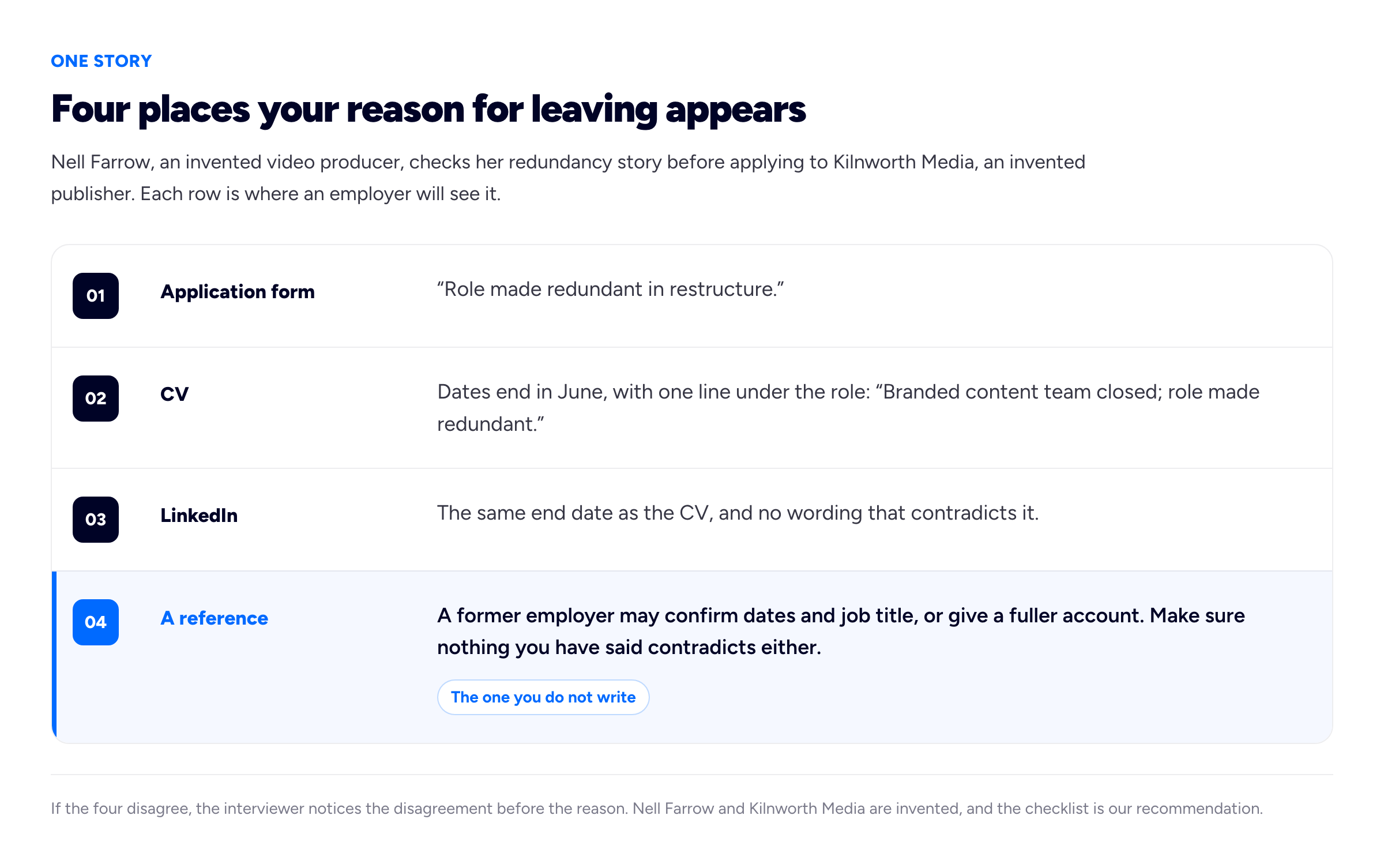
Three of the four you write yourself. The fourth is why the first three need to be true.
The form is the short version everything else should agree with. The CV usually gives no reason at all, which is fine, but its dates must match the form to the month; a single line under a role ("Contract role", "Team closed in restructure") helps only where it stops a reader assuming the worst. LinkedIn should carry the same dates as the CV; a recruiter who finds different end dates will ask why. If you are still employed, make sure your profile does not suggest you have already left.
References are the one you do not write, and the rules differ by country. In the UK, the advisory service Acas says an employer does not usually have to give a reference by law, with some exceptions, and that if one is given it must be accurate and fair; a basic reference often covers only job title and dates, while a detailed one can include the reason for leaving. Elsewhere, including the US, where practice varies by state and by employer, check your own country's official guidance; this guide is not legal advice. The practical point holds everywhere: assume the employer may learn your dates and perhaps your reason, and keep your account consistent with both. If you are unsure what a former employer would say, HR can usually tell you its reference policy, and asking a former manager to be a referee tells you how they would describe your departure.
Nell in the room
Rafe Okonkwo-Reid asked about two-thirds of the way through Nell's interview.
Rafe: "Your last role ended in June. What happened there?"
Nell: "The production company lost its biggest client and closed the branded content team, eleven of us including me. I'd been there two years and I'm still in touch with most of them. Since then I've finished a short documentary, and I've only applied for roles where I'd own a series. Your weekly series is the clearest example of that I've seen."
Rafe: "And the agency before the publisher? Seven months is short."
Nell: "It was my first job, and I took it without asking enough about the work. I learned to edit fast there, then moved to the publisher and stayed three years. I ask better questions now, which is why I asked earlier how much say producers have in the edit here."
Both answers are about forty seconds, neither criticises anyone, and the second turns the weak point into a reason to trust her judgement. The consistency check was already done: form, CV and LinkedIn all said redundancy, ending in June.
What never to say
- Anything negative about a named person, even if true.
- "For more money", on its own. Pay is a legitimate reason, but alone it suggests you will leave for the next small rise. Pair it with what else this role offers, and keep figures for the salary conversation.
- "I was bored" or "I just needed a change." Say what you want more of instead.
- A reason this job repeats. Leaving for remote work, then applying to an office role.
- A lie, or a misleading euphemism. "Mutual decision" for a dismissal. It only has to be checked once.
- Confidential detail. Client names, internal disputes, the terms of a settlement. Discretion is itself evidence you can be trusted.
- A long story. More than one "and then" means it is too long.
The follow-ups to prepare
"Would your last manager agree with that?" Say yes only if you are confident it is true.
"What would have made you stay?" Name something this job offers ("owning a series"), not "a better manager".
"Why now?" If you are still employed, tie it to a moment that makes sense: a big project finished, the ceiling of your current role, or this opening appearing.
If you are still in your current job, the leaving comes later; our guide to writing a resignation letter covers how to leave in a way that keeps the reference you may need.
Frequently asked questions
What is the best reason for leaving a job?
The true one, phrased neutrally and pointed at the job you are applying for. Growth, a better fit, relocation, a career change and a contract ending are all straightforward. What makes a reason strong is the turn: showing that this job offers what you left to find.
What should I put as a reason for leaving on an application form?
A short factual phrase under ten words, such as "Contract ended", "Role made redundant in restructure" or "Seeking a role with more responsibility". The form is not the place to explain. Say the same thing at interview.
How do I explain being fired in an interview?
Say so plainly, take responsibility for your part, and spend most of the answer on what you do differently now, with one piece of evidence. Do not argue the case or use a phrase that means something else, and answer a direct question on a form truthfully.
Can I say I left because of a bad manager?
Not in those words. Describe the working style that did not suit you in neutral terms, then what you want instead and why this job offers it.
Is "personal reasons" an acceptable reason for leaving?
Yes, especially for health or family matters you do not want to discuss. Add "now resolved" if it is, and in the interview follow it with a sentence about being ready for the role.
Will my old employer tell them why I left?
It depends on the employer and the country. In the UK, Acas says a reference must be accurate and fair and may include the reason for leaving, though a basic one covers only dates and job title. Rules elsewhere differ, so check your own country's official guidance.
How we put this guide together
Bunfolio builds portfolio websites and gives away free career tools, so we spend a lot of time reading applications and the questions that come with them. Most of this guide is our recommendation, not a sourced rule, because no authority publishes a correct answer to an interview question. The three-part shape, the four things we say the interviewer is listening for, every form-field and spoken wording, the advice on the hard cases, the consistency check and the list of things never to say are our own view.
Where we state a fact, we link the source we read: the UK government's redundancy rights page, and Acas on providing a job reference and what employers can say in a reference. Those pages describe the UK only. Rules on references, dismissal and health disclosure differ between countries, and in the US between states and employers, and we have not tried to summarise them. Nothing here is legal advice; if your situation involves a dispute, a settlement or a health condition, an official body or an employment adviser in your country is the right source.
We have left out the statistics that usually decorate this topic, such as the share of hiring managers who reject candidates for criticising a former boss, or how long a gap is too long. We could not trace any of them to a published method, sample and date, so there are no percentages above.
Everyone named here is invented: Nell Farrow, Rafe Okonkwo-Reid, Kilnworth Media and its advert, and Nell's three earlier employers, left unnamed. The other spoken examples belong to no real candidate and were written by us for illustration. None of the wording should be used as it stands; a reason for leaving only works if it is yours.
Related reading: why should we hire you?, what are your weaknesses?, how to write a resignation letter, questions to ask the interviewer and putting freelance work on a resume.
More from the blog
October 27, 2026 · 19 min read
How to Write a Resignation Letter (With Sample Letters)
The five things a resignation letter must say and what to leave out, why you tell your manager before you send it, how much notice you actually owe in the US and UK, a two weeks' notice email, and sam...

October 24, 2026 · 19 min read
Artist Statement Examples (and How to Write One Without Artspeak)
What an artist statement is and how it differs from a bio and a project statement, the four lengths to keep ready, a four-move method for drafting one, plain-language rules, an artspeak paragraph rewr...
October 14, 2026 · 18 min read
How to Write an Invoice (With a Freelancer's Template)
One complete freelance invoice built field by field, with the numbering rules, the lines that get approved, the covering email and what to do when it is late.