
October 14, 2026 · 18 min read
How to Write an Invoice (With a Freelancer's Template)
One complete freelance invoice built field by field, with the numbering rules, the lines that get approved, the covering email and what to do when it is late.
To write an invoice, put the word "Invoice" and a unique number at the top, then your name and address, the client's billing entity, the person who processes payments, the invoice date, the date the work was supplied, one line per deliverable with its price, the total, your payment terms with a named due date, and the account details to pay into. Add the client's purchase order or reference if they use one. Send it as a PDF.
That list appears on every invoicing page on the web. What does not is the part that decides whether you get paid: which entity to bill, how to number invoices so an accountant and a client's portal both accept them, how to describe a line so it is approved rather than queried, and what the covering email should say. This guide builds one complete invoice field by field, using an invented studio and client, then covers the email, the sending, and what to do when it is ignored.
What makes a document an invoice
An invoice is a dated, numbered request for payment for work you have supplied. It identifies both parties, says what is being charged for, how much is owed and by when. The practical test is narrower: it is a working invoice when someone in the client's finance team can enter it, match it to an order and pay it without asking you a question.
An invoice is a bill. It is one document named from either side: you issue an invoice, the client receives it, calls it a bill and records it as money owed. If a client asks for your bill, send your invoice.
An invoice is not a receipt. The invoice asks for payment and comes first; the receipt confirms the money arrived and comes after. If a client pays and then wants a receipt, send a copy of the invoice marked paid with the date and amount received. Never reissue it under a new number, or two numbers now cover one piece of work.
A quote or an estimate comes before the work. A quote is a price you offer to be held to; an estimate is an approximation. Neither asks for money, and at that stage the document you want is a proposal, which writing a freelance proposal covers. A statement only lists which invoices are outstanding, and a proforma asks for payment before anything is supplied; many finance systems will not enter either as an invoice at all.
Every field, in order, and the mistake people make
You do not need invoicing software for this: a word processor will do, provided the fields are present and the arithmetic is right. Every name and figure from here on belongs to an invented example — a one-person studio called Fernbank Studio, run by Ines Okoro, invoicing a four-practice dental group called Wrenbury Dental Group Ltd.
The label and your own details
Put the word "Invoice" at the top with the number beside it. GOV.UK's guidance is explicit that the document should be clearly marked as an invoice, and finance teams do route documents by what they are called.
Underneath, your legal name, any trading name, an address where post can reach you and one email address. GOV.UK asks sole traders for their own name alongside any business name, and companies for the full registered name, because a trading name is not the party to the agreement. The mistake: a brand name with no legal name behind it.
Who is actually paying
Two things go here and most freelancers write only one. The billing entity is the legal body that holds the budget and signed the agreement: here, Wrenbury Dental Group Ltd at its registered address, not the practice where the work happened. The billing contact is the person or shared inbox that processes invoices, and is rarely the person who hired you. Mark the invoice for their attention, as in "FAO Accounts Payable, Hollie Tarn".
Ask for both during the project: who should invoices go to, and is there a reference they need quoted? The mistake: billing the person you have emailed all month, who forwards it when they remember.
The three dates
The invoice date is the day you issue it, and your terms usually count from there. The supply date, which GOV.UK's guidance also asks for, is when the work was delivered: a single date, or a period such as "work supplied February 2026". The due date is a calendar date you work out yourself, not a formula. The mistake: dating it the day the work finished three weeks ago, and omitting the supply date, so nobody can match the invoice to a period.
The number, the lines and the total
One unique number per invoice, never reused. Then one line per thing charged for, each with a description, a basis where it helps, and an amount. Then a subtotal, any adjustment such as a discount or a deposit already paid, and a single total due in one named currency. The mistake: a total that is not the number you want transferred, usually because a deposit taken months ago was left off.
Tax, if it applies to you
This is the field this guide cannot fill in for you. Whether you charge a sales tax or VAT at all, whether a registration number must appear, and what a cross-border invoice needs are decided by where you are registered and sometimes by where your client is. The layout is the same everywhere: the tax line sits below the subtotal and above the total, so net, tax and gross read separately. Fernbank Studio is not registered to charge any sales tax, so the invented invoice has no tax line and says so.
Terms, payment details and their reference
Finish with the three things that turn the document into a payment. Your terms in one plain sentence with the due date in it. Your payment details in full: account name, account number and sort code, or IBAN and BIC internationally, plus the reference to quote, which should be the invoice number. And the client's own reference, exactly as given — not optional in a mid-sized company, where an invoice without a valid purchase order often cannot be paid at all.
The mistake: putting your bank details in the covering email rather than on the invoice, which is the document that gets filed and forwarded.
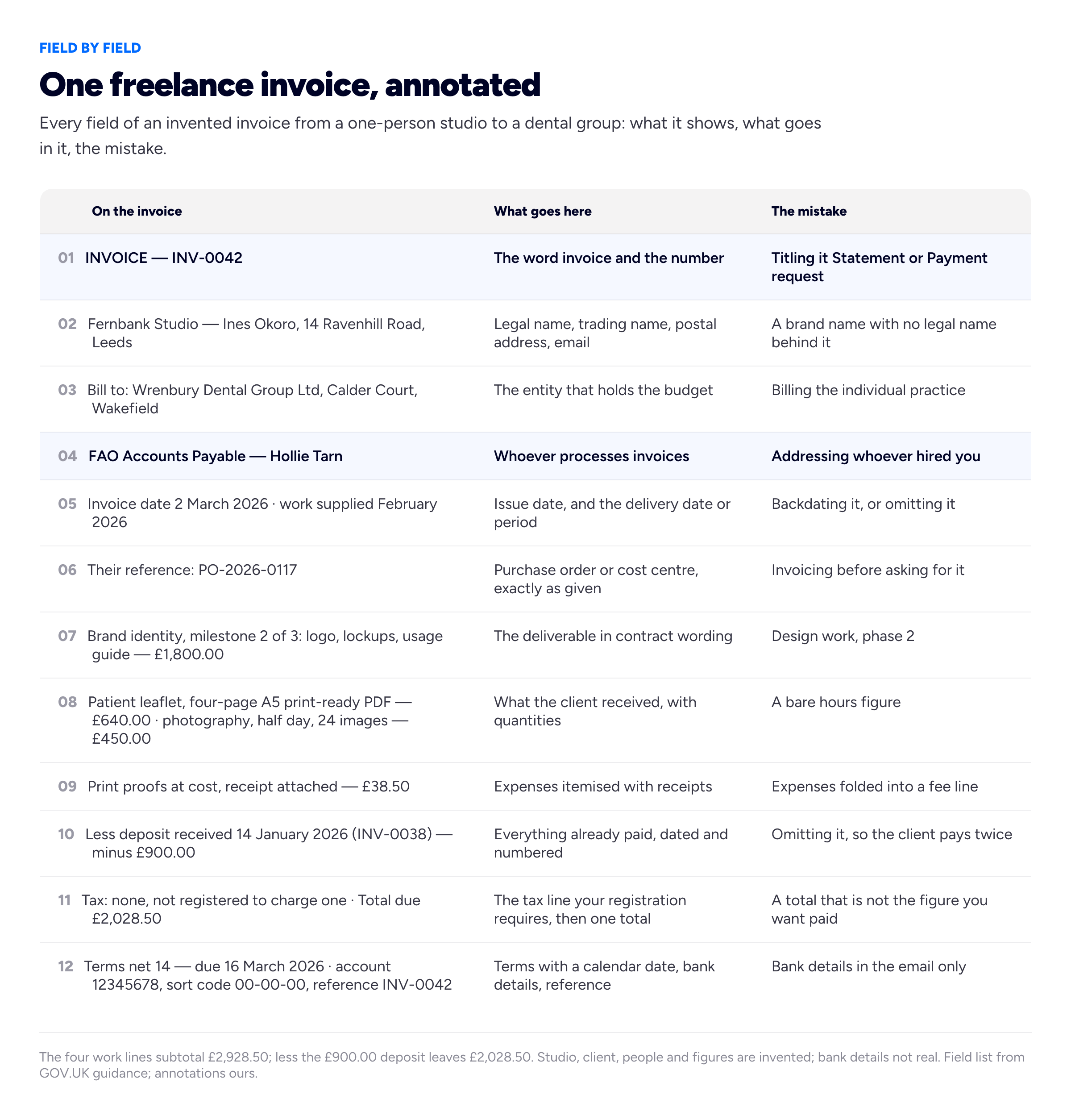
The four work lines subtotal to £2,928.50; the £900.00 deposit taken in January comes off, leaving £2,028.50 due on 16 March. Every figure in this guide reconciles to those.
If assembling that in a spreadsheet is the part you have been putting off, our free invoice generator lays out these fields, handles the totals and the rounding, and prints a PDF in your own browser. It carries one small "Created with Bunfolio" line at the foot, which is what keeps it free.
Invoice numbering that survives an accountant
An invoice number should be the dullest thing on the page, and the way to get it wrong is to make it clever. Use a short prefix and a zero-padded sequence: INV-0001, INV-0002. Four digits sort correctly in a folder and a spreadsheet, which INV-1 through INV-10 does not. GOV.UK's guidance asks for numbers that are unique and follow a sequence, and if one is used twice by mistake, for the next number in the series rather than a reuse.
- Sequential, with no gaps. If you cancel an invoice, do not delete the number: issue a credit note against it, or reissue with the next number and note why. A missing number looks like a hidden invoice to anyone reading your records later.
- One sequence across all clients. A per-client prefix is fine if each prefix is itself unbroken. Two invoices anywhere sharing a number is not.
- Never restart mid-relationship. Beginning again at 001 each January is defensible if the year is in the prefix,
2026-001. Doing it because it felt tidy is how you end up with two INV-0007s.
A date-only scheme such as 02032026 fails at the one job a number has. Send two invoices on the same day, which happens the moment you have three clients, and you have a collision. If you want the date in there, put it after the sequence: INV-0042-2026-03.
For a client you invoice monthly, keep the sequence global and let the supply period distinguish them: Fernbank's March invoice is INV-0042, for February's work, and April's is whatever comes next in the studio's own run. If the client must be visible in the reference, use a prefix such as WDG-0007, unbroken within that prefix.
Line items that get approved
A line item is read by someone deciding whether to approve a payment, often someone who did not commission the work. The question in their head is whether this is what was agreed and whether it has arrived.
So describe the deliverable rather than the effort, wherever your agreement allows. "Patient information leaflet: four-page A5, design and artwork, print-ready PDF" is approvable by a stranger. "32 hours at £20" is not, though the amount is identical, because approving it means knowing what the hours were for. If you bill hourly, keep the hours and rate as the basis but still name what they produced.
Match the wording to the contract: if the agreement says "five page templates", so does the invoice. A finance team that cannot map your words onto their paperwork parks the invoice and asks the person who hired you. Freelance contract essentials covers writing those deliverables down, which is the step that makes the invoice easy.
Deposits, milestones and retainers
A deposit is its own invoice with its own number, issued before work starts, then shown as a deduction on the final one with its date and original number beside it. Milestones work the same way: one invoice each, issued on acceptance, with a line naming which milestone it is and how many there are, as in "milestone 2 of 3".
A retainer is invoiced on a fixed day each period, usually in advance, and the line should say what the fee buys: "Monthly retainer, March 2026: up to three working days of design support, as agreed 12 January". A retainer line with no scope on it is the one queried in month four, when somebody new is approving it.
Expenses, extras and discounts
Itemise expenses separately from your fees, attach the supplier receipt, and say whether the amount is at cost or carries a handling charge. Never roll one silently into a fee line, because a client who finds it later wonders what else is in there.
Work outside the original agreement goes on its own line, with a reference to the approval: "additional practice photography, approved by email 19 February". An invoice is the worst place to discover that extra work was chargeable, and if that keeps happening, handling scope creep is the earlier conversation. Show a discount as a named deduction with a reason rather than a quietly reduced rate; the case for not discounting is in how much to charge as a freelancer.
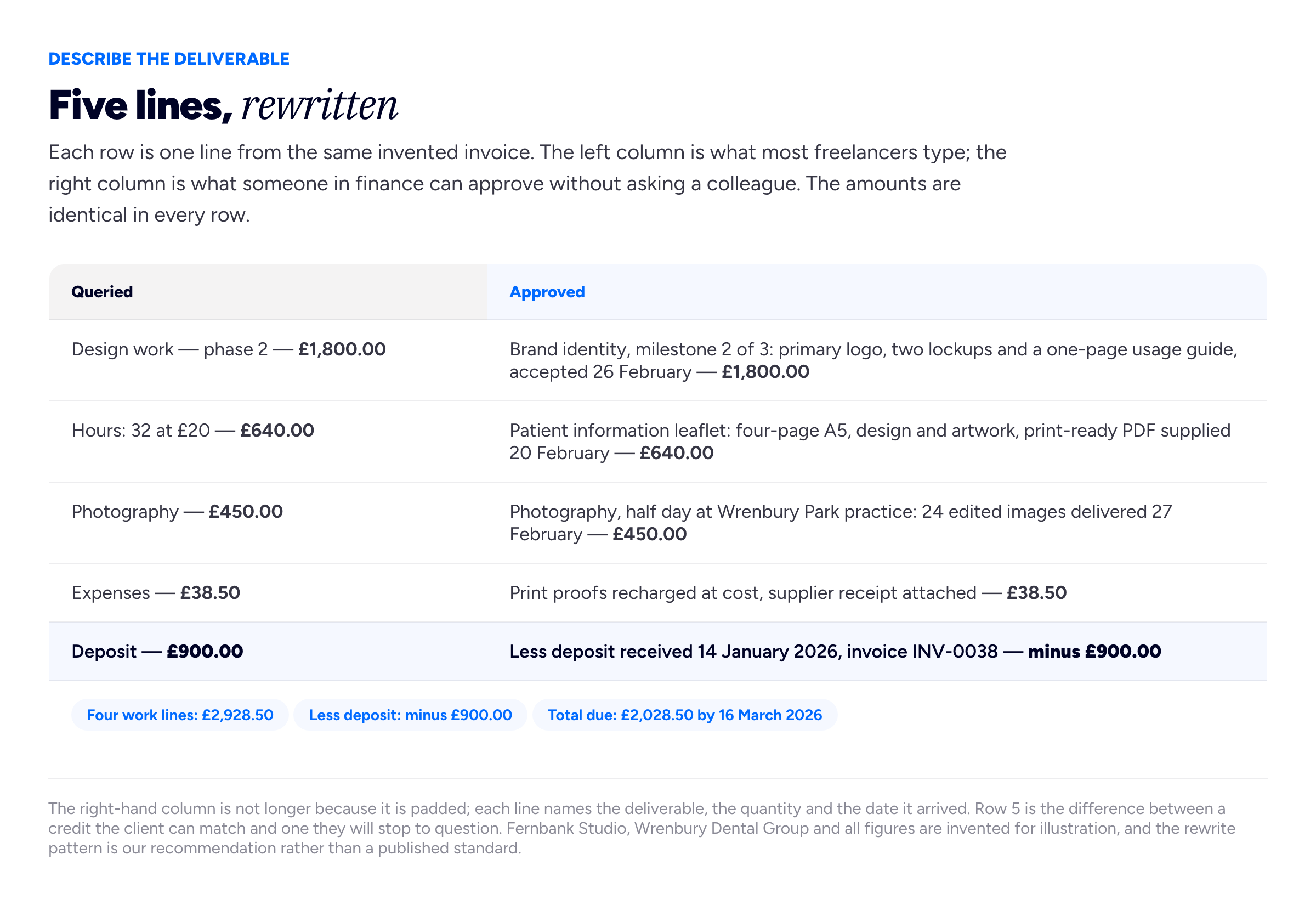
Nothing in the right-hand column is clever. Each line answers "what did we buy and did it arrive" before anyone has to ask.
Payment terms in plain words
"Net" means the full amount, with no early-payment discount, due within that many days. Net 14 is fourteen days from the invoice date, net 30 is thirty. It is a counting convention rather than a legal term, which is why the date matters more than the phrase: write "net 14 — due 16 March 2026" and there is nothing to work out. Some companies count from the end of the month the invoice falls in, so if their terms are "30 days end of month", ask what date that makes.
"Due on receipt" means payable immediately, and alone it is weak, because immediately is not a date anyone can schedule. Pair it with one: "due on receipt — payable by 5 March 2026". Short terms are also not always available: a large organisation may run supplier payments on a cycle, so asking when the run falls and getting in before it is worth more than arguing net 14 against net 30.
Deposits before work starts are normal practice, invoiced and cleared before anything begins. A client who refuses one is telling you something, and freelance client red flags covers what. If you charge interest or a fee on late payment, state it in one sentence repeating the contract, and know that some jurisdictions give you a statutory right to interest whether your contract mentions it or not.
How to send it
The invoice is a PDF, attached to a short email, addressed to the billing contact and copied to the person who hired you. A word-processor or spreadsheet file can be altered and renders differently on someone else's machine. Name it so it is findable without being opened: Fernbank-Studio-INV-0042-Wrenbury-Dental.pdf, not invoice_final.pdf.
The subject line is a filing label, so put in it what somebody will search for later.
Invoice INV-0042 — Fernbank Studio — PO-2026-0117 — due 16 March 2026
The body is four sentences that confirm what is attached and remove every reason to reply with a question. It should not apologise for invoicing or ask whether the amount is acceptable, which reopens a settled question; our freelancing habits make the same case for every client email. This is our invented example.
Hello Hollie,
Invoice INV-0042 is attached, for £2,028.50, covering February's work on the brand identity, the patient leaflet and the photography day at Wrenbury Park. It is raised against PO-2026-0117, the deposit paid in January has been deducted, and terms are net 14, so it falls due on 16 March 2026.
Bank details are on the invoice and the reference to quote is INV-0042. I have copied Samira, who commissioned the work, and I am happy to send anything else your process needs.
Best wishes, Ines
Send one invoice per email, because attaching three makes the whole set wait for whichever line someone queries. And if they use a portal, the email does not count. Supplier portals usually require you to register, submit against a purchase order and wait for an approval step, so ask during the project whether there is one, register before the first invoice rather than during it, and keep the confirmation.
Then diarise the day after the due date. If you are at the start of all this, starting out with no experience and getting your first freelance clients cover the stages before the invoice, and what freelancing involves covers the paperwork you now own.
When the invoice is late
Most late invoices were never refused. They were sent to the wrong person, missing a purchase order, or waiting on an approval nobody mentioned, so the first move is a question rather than a complaint.
Work to dated steps decided in advance, so you are following a process rather than deciding how annoyed to be. Taking our example's due date of 16 March: on the 17th, a short email asking whether it reached the right queue and whether anything is missing. A week later, a firmer one quoting the number, the amount and the days outstanding. A week after that, a phone call, because a call reaches a person and an email reaches a folder. Then pausing work, and a formal letter.
That ladder deserves a guide rather than a paragraph: getting paid on time as a freelancer has the wording for each rung and the point at which pursuing it costs more than it recovers. If chasing has become the relationship, ending a client relationship is the other half of the answer, and our free professional email generator has a setting for the chasing email itself.
Tax, records and what this guide cannot decide
Everything above is about the document. What an invoice must legally show, and what you must keep, depends on where you are registered, what for, and sometimes where your client is. Whether you charge a sales tax at all, whether a registration number must appear, whether numbers must be unbroken, how long copies are kept and what a cross-border invoice must state all differ by country and change over time. We have deliberately stated no rate, threshold or retention period here, because publishing the wrong one is worse than publishing none.
Go to the source for your own country. In the UK, GOV.UK publishes guidance on invoicing and taking payment from customers, with separate VAT guidance for registered businesses. In the US, the IRS publishes recordkeeping guidance for the self-employed, and sales tax is a state matter rather than a federal one. Elsewhere, your national tax authority publishes the equivalent. If you are near registering for a tax, or invoicing across a border for the first time, an hour with an accountant in your own country is the cheapest line in the project.
Frequently asked questions
What does an invoice look like?
One page. The word "Invoice" and a unique number at the top, your details on one side and the client's billing entity on the other. Then the invoice date, the supply date, lines with descriptions and amounts, a subtotal, any tax line that applies to you, and one total due. At the foot, the terms with a named due date and your payment details.
Is an invoice a bill?
Yes: one document named from different sides. You issue an invoice; the client receives it, calls it a bill and records it as money owed. Nothing in what it must contain differs. Sellers prefer "invoice" because "bill" is also used loosely for demands from a utility or a restaurant.
Is an invoice the same as a receipt?
No, and the order matters. An invoice asks for payment before the money moves; a receipt confirms it arrived afterwards. If a client pays and then asks for a receipt, send a copy of the invoice marked paid with the date and amount received, rather than a new numbered invoice, which would leave two numbers covering one piece of work.
What is an invoice number?
A unique identifier for one invoice, used to file it, pay it and reconcile it later. Use a short prefix and a zero-padded sequence such as INV-0001, and keep the sequence unbroken: no reused numbers, no deleted ones, no restarting mid-relationship. A date alone is not an invoice number, because two invoices can share a date.
How do I send an invoice through email?
Attach a PDF, never an editable document, named with your business name and the invoice number. Put the number, your name, the client's reference and the due date in the subject line so it can be found later. Keep the body to a few sentences confirming the amount, the reference and the due date, then send it to whoever processes payments and copy the person who hired you.
How do I invoice someone as a freelancer with no company?
In your own legal name, adding a trading name if you use one, with an address where post can reach you. A limited company is not a requirement for issuing an invoice, though registering for a sales tax may become one as you grow, which is a question for your own tax authority. Everything else is identical.
How do invoices work once I have sent one?
Your invoice is received, matched against a purchase order or an approval, scheduled into a payment run and paid. Each step can stall, which is why a missing reference or the wrong recipient delays payment more often than unwillingness does. Expect a remittance advice quoting your number, then mark it settled in your records and keep the copy.
Do I need invoicing software to write an invoice?
No. Any document carrying the fields with the arithmetic right is a valid invoice, and plenty of freelancers type theirs in a word processor. Software earns its cost once you are invoicing weekly and want numbering and bookkeeping handled. Between those positions, our free invoice generator lays out the fields and prints a PDF in your browser.
How we put this guide together
The sourced part of this guide is narrow and attributed where it appears: the field list, the request for a supply date, marking the document clearly as an invoice, the distinction between a sole trader's own name and a trading name, and the expectation that numbers are unique and sequential all follow GOV.UK's invoicing guidance. Everything else is our recommendation: the INV-0001 format, the argument against date-only numbers, describing lines by deliverable rather than by hour, and the four-sentence covering email.
We have left out the statistic that usually opens an article like this: the circulating claim that some percentage of freelance invoices are paid late, or that freelancers lose so many days a year to chasing payment. Those figures are widely repeated, several appear to originate in marketing material for invoicing products, and we could not trace any to a survey with a published method, sample or date. The point they illustrate, that late payment is common and a complete, correctly addressed invoice is the cheapest defence against it, does not need a number to be true.
We have also stated no tax figure: no rate, no registration threshold, no retention period, for any country, because those are jurisdiction-specific and change. The primary sources read while writing were GOV.UK's invoicing and taking payment from customers guidance and the IRS's recordkeeping guidance for the self-employed. Both are national; if you are elsewhere, your own tax authority publishes the equivalent. Nothing here is legal or tax advice.
Fernbank Studio, Ines Okoro, Wrenbury Dental Group Ltd, Hollie Tarn, Samira Deel, the Wrenbury Park practice, invoice numbers INV-0038 and INV-0042, purchase order PO-2026-0117 and every amount and date in the worked example and both diagrams are invented. The bank details in the diagram are deliberately not real.
Related reading: getting paid on time as a freelancer, freelance contract essentials, how much to charge as a freelancer, writing a freelance proposal that wins, handling scope creep and practical freelancing tips.
More from the blog
August 6, 2026 · 14 min read
How to Write a Portfolio Case Study (With a Six-Part Template)
A six-part skeleton with word budgets, the sentence-level difference between describing activity and presenting evidence, and what to do when you have no numbers or the work is under NDA.
October 4, 2026 · 22 min read
How to Write a Cover Letter for an Internship (With 3 Examples)
Little or no work experience? Here is how to read an internship advert and match each requirement to your coursework, projects, societies or part-time job, with the format to copy, a fill-in template,...
September 27, 2026 · 23 min read
How to Write a Letter of Presentation (With 6 Examples)
A letter of presentation is what Spanish, Italian and Portuguese speakers call a cover letter, and it also means a letter introducing yourself or your services to a prospective client. What each meani...