
October 1, 2026 · 16 min read
Freelancing Tips: 29 Practical Habits From First Client to Tax
The freelancing habits that prevent most problems before they start, grouped by stage from setting up to looking after yourself. Each of the 29 tips comes with a concrete action, a template line you can borrow and the mistake it prevents, plus a beginner's first five.
The freelancing tips that make the most difference are unglamorous: write a one-line offer a stranger understands, put the price and the number of revisions in every quote, take a deposit from new clients, invoice on the day you deliver, move a share of every payment into a separate tax account, follow up each proposal once, and keep a file of kind words from clients. Do those consistently and most of the problems freelancers complain about never start.
This guide collects 29 of those habits, grouped by stage: before you start, winning work, pricing and money, clients and contracts, delivering, running the business and looking after yourself. Each one comes with a concrete action, an example line you can borrow and the mistake it prevents. Where a topic deserves more than a few paragraphs, we link to the full guide.
Freelancing tips for beginners: the first five
If you are starting this month and want only five things to do, do these, in this order. Everything else in the guide builds on them.
- Write one sentence that says what you do and for whom. "I write product descriptions for independent homeware shops" is enough. If you cannot write the sentence, you are not ready to pitch.
- Put three pieces of proof on one page you can link to. Not ten, and not a PDF attachment. Clients open links on their phones between meetings.
- Work out your floor rate before anyone asks. Guessing on a call almost always means guessing low.
- Tell twenty people you know, one message at a time. Your warm network is where most first jobs come from, and it is the step most beginners skip because it feels exposing.
- Open a second bank account for tax on day one. It costs nothing and it is the habit that saves the most pain later.
If you have no client history at all, our guide on how to start freelancing with no experience covers how to make honest proof first. The rest of this page assumes you have a skill someone will pay for and want to run it well.
Before you start: your freelance business setup
1. Write a one-line offer
An offer is who you help, with what, and what they get. Template: "I help [type of client] with [problem] by [deliverable]." Example: "I help physiotherapy clinics fill their diaries by rewriting their website copy." Use the same line in your bio, your email signature and your proposals. The mistake it prevents is the vague "creative services" pitch, which forces every prospect to work out whether you are for them, and most will not bother.
2. Choose one type of client for now
You can do work for anyone; you should only market to one group at a time. It makes your examples relevant, your outreach list obvious and your referrals easier, because people know exactly who to send you. This is not a lifetime decision. Our piece on whether freelancers should niche down covers when to narrow and when to stay broad.
3. Make your portfolio a link, not an attachment
Put your three best pieces, your offer and a contact route on a single page with its own address. Each piece needs a line of context: what the problem was and what you did. A marketplace profile can sit alongside it, but it belongs to the platform. We cover why in do freelancers need a website, and our guide to a freelance portfolio website that wins clients covers what goes on it. Bunfolio will build you a portfolio site for free on a subdomain if you want one up this week.
4. Set your floor rate before your first quote
Your floor is what you need per working hour once unbilled time is counted: proposals, admin, invoicing, learning. A useful rule is to assume that only part of your week will ever be billable, then divide your target income by those billable hours, not by forty. Write the number down. When a client asks "what's your rate?", you are reading, not guessing. The full method is in how much to charge as a freelancer.
Winning work: how to get freelance work
Most searches for how to find freelance work end at a list of job boards. Boards matter, but the habits below decide whether anything you send gets a reply.
5. Message your network individually, not in a broadcast
A post saying "I'm freelancing now!" gets likes. A personal message gets introductions. Template: "Hi Sam — I've gone freelance doing website copy for clinics and wellness businesses. Here's my page: [link]. If anyone you know mentions their site isn't bringing in bookings, I'd be grateful if you thought of me." You are asking them to remember you, not to hire you, which makes it easy to say yes. Our guide to getting your first freelance clients covers networks, communities and cold outreach in depth.
6. Answer the client's problem in your proposal's first line
Clients skim proposals. Open with their problem in their words, then how you would solve it, then proof. Example opening: "You said your checkout page loses people at the shipping step — I'd start by testing a single-page checkout, as I did for a candle shop last spring." The mistake it prevents is the "Dear Sir/Madam, I am a passionate designer with five years' experience" opening that every other bidder also sent. Our freelance proposal guide has the full structure.
7. Send fewer, better-fitting proposals
Three proposals to jobs you are a strong fit for beat thirty generic ones, and on platforms that charge for submitting proposals they also cost less. Before you apply, ask: can I show one piece of work that looks like their problem? If not, skip it.
8. Follow up once after five working days
Silence is not a no; people get busy. One short, useful follow-up is professional. Template: "Hi Priya — just checking my proposal for the clinic site reached you. Happy to answer questions or adjust the scope if the budget has moved." Then stop. Chasing three times reads as desperate and rarely changes the answer. If you struggle with the wording, our free professional email generator drafts a polite version you can edit.
9. Keep a wins file for testimonials
Make a single document and paste into it every kind thing a client says: emails, chat messages, voice-note transcriptions. Note the date and the project. When you need a testimonial, you ask permission to quote something they already said, which is far easier for them than writing one from scratch. Our guide on how to ask clients for testimonials has the exact wording.
Pricing and money: freelance income and taxes
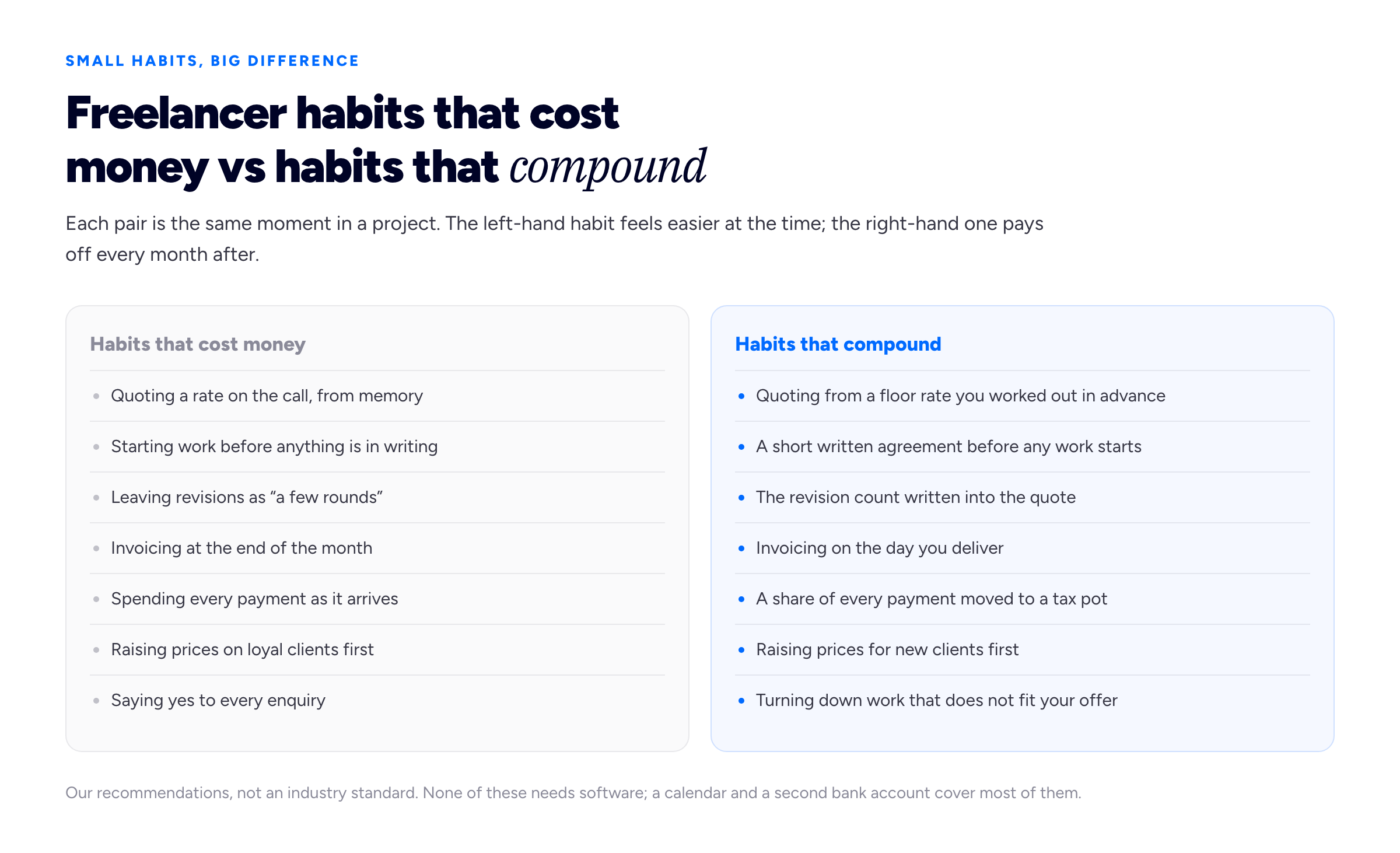
Every pair describes the same moment. The difference is usually ten minutes of effort that would otherwise turn into an awkward conversation weeks later.
10. Quote per project, with the revision count in the quote
Clients compare a project price with the outcome; they compare an hourly rate with someone cheaper. Put the scope, the deliverables, the timeline and the number of revision rounds in the quote itself, not only in a contract they may never read. Example line: "Five pages of website copy, delivered in two weeks, including two rounds of changes; further rounds at £90 each." That one sentence prevents most arguments about scope later.
11. Take a 50% deposit from new clients
A deposit tests that the client is serious, funds your time and turns your relationship from "will they pay?" into "how do we finish?". Template: "I start once the 50% deposit has cleared; the balance is due on delivery." Repeat clients with a good payment record can move to normal terms. Anyone who refuses a deposit for a first project is telling you something useful.
12. Invoice on the day you deliver
Every day you wait is a day added to when you get paid. Send the invoice with the final files, with a number, a date, what was delivered, the amount, the due date and how to pay. Our free invoice generator makes one without an account. For the deposit, payment terms and polite chasing sequence, read how to get paid on time as a freelancer.
13. Keep a "tax pot" account
As an employee, tax was taken before you were paid. As a freelancer it usually is not, so open a separate savings account and move a fixed share of every payment into it the day it arrives. What share depends on where you live and how much you earn, so ask an accountant or use your tax authority's guidance. Two verified examples: in the US, the IRS gives the self-employment tax rate as 15.3% (12.4% Social Security, 2.9% Medicare), on top of income tax, and says you generally need to make estimated payments through the year if you expect to owe $1,000 or more. In the UK, gov.uk says that if your gross trading income is over the £1,000 trading allowance you must register for Self Assessment, and that you must tell HMRC by 5 October if you need to file a return for the previous tax year.
14. Raise prices for new clients first
Raising rates on everyone at once risks losing the clients who pay your bills. Raise them for new enquiries first; if new clients accept the higher rate without fuss, you have evidence the price is fair. Then give existing clients notice, with a date. Template: "From 1 March my rate for new projects is £X. For ongoing work with you, it changes from 1 June." The mistake it prevents is staying at your launch price for years because the conversation felt awkward.
Clients and contracts
15. Get it in writing before any work starts
Even a short email both of you reply "agreed" to is better than a call and a handshake. It should cover what you deliver, by when, for how much, how many revisions, when you are paid and who owns the work once it is paid for. Our freelance contract essentials lists the clauses that prevent the most common disputes.
16. Answer every extra request with a change note
Scope creep happens one reasonable-sounding request at a time. Do not refuse and do not quietly absorb it; price it. Template: "Happy to add the pricing page. It's outside the original scope, so it would be £250 and push delivery by three days. Shall I go ahead?" The client decides, in writing, and you stay friendly. Our guide to freelance scope creep has more scripts.
17. Listen for red flags on the first call
"It should only take you an hour", "we'll pay you once the project makes money", "our last three freelancers didn't get it" and a refusal to pay any deposit are all worth noticing. One red flag can be a misunderstanding; two is a pattern. Our list of freelance client red flags covers the rest and what to say back.
18. Have a polite exit line ready
Some clients cost more than they pay. Decide in advance how you would end things: finish or hand over the current stage, invoice for work done and recommend someone else. Template: "I don't think I'm the right fit for the next phase, so I'll wrap up the current milestone by Friday and send everything across." See how to fire a freelance client for the full process.
Delivering the work
19. Confirm the brief back in your own words
Before you start, send a short summary: "So, to confirm: a new homepage and two landing pages, aimed at first-time customers, live by 14 November. Anything I've got wrong?" It takes five minutes and catches misunderstandings while they are still free to fix.
20. Send an update before the client asks
A two-line note every few days ("Homepage draft done; starting the landing pages tomorrow, on track for the 14th") stops the "any news?" email and builds trust faster than any portfolio piece. Clients rarely complain about too much clarity.
21. Build buffer into every deadline
Estimate the work, then add time for feedback delays, illness and the bit that always takes longer. Deliver early and you look reliable; deliver late and the quality barely matters. The mistake it prevents is quoting your best-case timeline as if it were your normal one.
22. Close every project with a handover and an ask
Send the final files, a short note on how to use them, the invoice, and one question: "If you're happy with how it went, would you mind if I quoted your email from last week on my site?" The end of a project is when the client is most pleased with you; it is also the moment most freelancers forget to ask.
Running the business
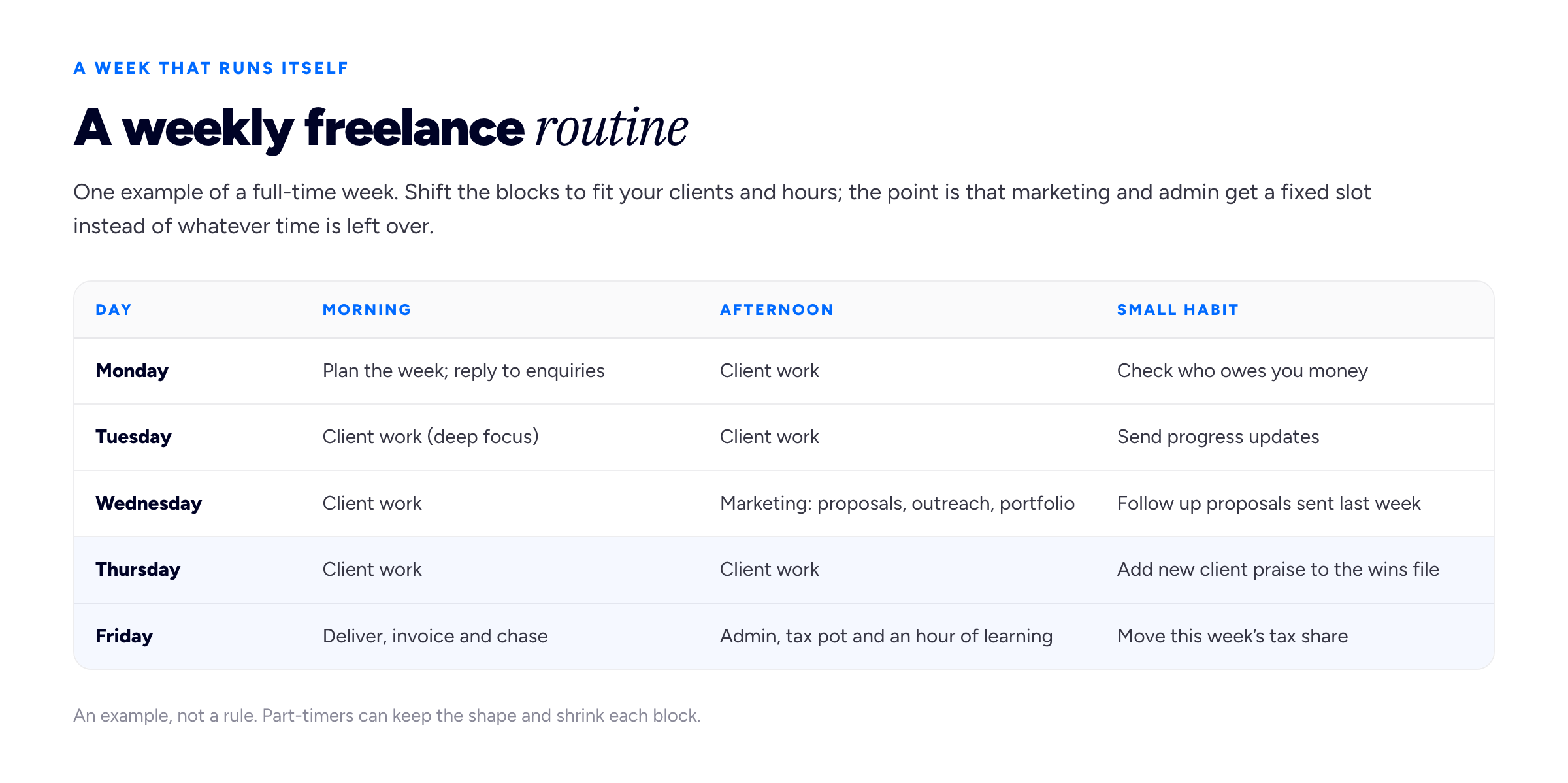
The fixed Wednesday marketing slot matters most: freelancers who only market when work dries up get a gap between every project.
23. Block a fixed slot for admin and marketing
When you are busy, finding the next client feels optional; when the project ends, you have nothing in the pipeline. Put marketing and admin in the calendar as recurring appointments with yourself and treat them like client meetings.
24. Record where every enquiry came from
A simple spreadsheet with four columns (date, name, source, outcome) is enough. After three months you will know whether referrals, your portfolio site or a marketplace actually bring paying work, and you can stop spending time on channels that do not.
25. Keep three conversations open at all times
Aim to always have a few live leads: a proposal out, a past client you have checked in with, an introduction pending. Template for checking in: "Hi Tom — it's been six months since the brochure. If the spring campaign is on the cards, I have space in March." It costs one message and often turns into repeat work.
26. Review your offer and prices every quarter
Once a quarter, look at your enquiry log, your hours and your income. Which jobs paid best per hour? Which clients were draining? Drop the work you dislike that pays least, and adjust your offer line to describe the work you want more of.
Looking after yourself
27. Set working hours and say them out loud
Put them in your email signature and your contract: "I reply to messages Monday to Friday, 9am to 5pm." Clients respect boundaries that are stated up front far more than ones you enforce suddenly after months of answering at midnight.
28. Build a cash buffer before you need it
Separate from your tax pot, save towards a few months of personal costs. Freelance income is uneven: a late payer and a quiet month can collide. A buffer lets you turn down a bad client instead of accepting them out of fear.
29. Schedule learning, and do not take every job
Book an hour a week for getting better at your craft, and accept that saying no is part of the job. Every hour spent on a poorly paid project that does not fit your offer is an hour not spent finding a better one. The aim is not to be busy; it is to be booked with work you would happily show.
Frequently asked questions
How do I start freelancing as a beginner?
Choose one skill and one type of client, write a one-line offer, put three pieces of proof on a page you can link to, set a floor rate and tell the people you know individually. Add a marketplace profile as a second channel. From the first job, use a written agreement, take a deposit and set tax money aside.
How do I get freelance work with no reviews?
Lean on people who already trust you. Former colleagues, managers and friends who run businesses can hire or refer you without reviews. On platforms, send a few well-matched proposals that open with the client's problem and link to work that looks like it, rather than many generic ones.
How do I find freelance work consistently?
Make marketing a fixed weekly slot rather than something you do when a project ends, keep a few conversations open at all times, check in with past clients every few months and record where enquiries come from so you can double down on what works.
How much should freelancers set aside for tax?
It depends on your country, income and expenses, so there is no single honest percentage. Pick a share with an accountant or your tax authority's guidance, move it into a separate account on every payment, and check it against your actual bill at the end of the year. In the US, remember self-employment tax sits on top of income tax.
Do I need to register a business to freelance?
Not always as a company, but you usually do need to tell your tax authority. In the UK, for example, gov.uk says you must register for Self Assessment if your gross trading income is over £1,000. Rules vary by country and state, so check your own government's guidance before your first invoice.
What is the most important freelancing tip?
If we had to pick one: put everything that matters in writing before work starts, including the price, the revision count and when you will be paid. Most freelance disputes come from something both sides assumed but never wrote down.
How we put this guide together
The 29 tips, the stages, the habit comparison and the weekly routine are our own recommendations, drawn from the problems that come up again and again in freelance work. They are not an industry standard, and you should adapt them to your field, country and clients. The template lines are starting points to edit, not scripts.
We deliberately left out the kind of figures that fill other freelancing tips articles: average freelance earnings, the percentage of freelancers who fail in the first year, how many proposals it takes to win a job and "most in-demand skills" rankings. We could not trace any of them to a published method we trusted, so none appear here. We also did not quote marketplace fees, because they change; check each platform's current fee page.
The tax facts come from primary sources, all read on 3 October 2026: the IRS pages on self-employment tax (the 15.3% rate and its parts) and estimated taxes (the $1,000 rule), and the gov.uk pages on the trading allowance and registering for Self Assessment (the 5 October deadline). Tax rules change and depend on your circumstances; consult a qualified adviser for your own situation.
The clinics, the candle shop, the homeware shops and the people named in the templates (Sam, Priya, Tom) are invented for illustration and describe no real client. The prices in the example lines are placeholders, not going rates.
Related reading: how to start freelancing with no experience, getting your first freelance clients, how much to charge as a freelancer, freelance contract essentials and how to get paid on time.
More from the blog
September 30, 2026 · 16 min read
What Is Freelancing? A Plain-English Guide to Freelance Work
Freelancing is selling a skill to several clients one job at a time instead of working for one employer. How a freelancer differs from an employee, contractor or gig worker, one freelance job from enq...
September 25, 2026 · 15 min read
How to Start Freelancing With No Experience: Build Proof, Not Years
Clients do not hire years of experience; they hire evidence that you can do their job. How to pick a skill someone will pay for, manufacture honest proof, package it on one page with a first price, fi...
September 15, 2026 · 18 min read
Data Analyst Portfolio: What a Reviewer Opens First
The review lasts under a minute and almost none of it is reading. What a hiring reviewer actually does in that minute, why the Google capstone project now works against you, how to write a project up...