
November 4, 2026 · 18 min read
How to Become a Model: An Honest, Safety-First Guide
Pick the kind of modelling that fits you, take plain digitals agencies can use, submit for free, and check every agency before you sign. What fashion, commercial, fitness, parts, curve and mature work ask for, the scams to walk away from, advice for parents, test shoots and TFP, and what a first booking looks like.
To become a model, work out which kind of modelling fits you, take a set of plain, unretouched photos of yourself called digitals, and send them through the submission pages of agencies that book that kind of work. Submitting is free. If an agency signs you, it earns its money as commission on the jobs it books, out of what the client pays. Before you sign anything, check that the agency is real and read the contract at home. And keep one rule above every other: you should never pay an agency to represent you, list you or photograph you. That single rule screens out most of the scams in this field.
Below: what each type of modelling actually asks for, how to take digitals an agency can use, how to check an agency, the scams to walk away from, what changes under 18, test shoots, and what a first booking looks like.
The short answer, in six steps
- Pick a lane. Fashion and runway, commercial and lifestyle, fitness, parts, curve, mature and creator work ask for different things. Most people fit one or two.
- Take digitals. Plain clothes, daylight, little or no make-up, no filters. Four to six phone photos are enough to start.
- Find agencies that book your lane and send each one exactly what its own submission page asks for.
- Check every agency before you meet it: search its name, look for a licence or registration where your area requires one, and ask which clients it books.
- Read any contract at home, with someone you trust, before you sign.
- Build your book through test shoots, never through a "portfolio package" you are told to buy.
Which kind of modelling fits you
"Model" covers several jobs with different clients and different agencies. Knowing your lane decides which agencies you approach and what your digitals need to show. Many agencies run separate boards for these; some specialise in one.
Fashion and runway
Catwalk shows, designer lookbooks and fashion editorials: the work most people picture, and the narrowest lane. Fashion agencies often publish physical requirements on their submission pages, most commonly a height range and sometimes an age range, because sample clothes are cut to particular sizes. Those requirements vary from agency to agency and city to city, so read the page of each agency you are considering rather than trusting a number from an article, including this one.
Commercial and lifestyle
Commercial models sell products and services rather than clothes: the person in a bank advert or a café campaign. Clients want people who look like their customers, so this lane takes a much wider range of ages, heights and builds, and asks instead for an easy, believable expression and the ability to take direction. For many people it is the most realistic way in.
Fitness and sport
Sportswear campaigns, gym advertising and training content. Clients want a body visibly trained for the activity, and often real skill: a runner who runs well on camera. If you have a sport, show it.
Parts
Hands, feet, legs or hair in close-up for jewellery, nail products, shoes and skincare. Parts models are booked on the condition of one feature and on stillness. Some agencies have a parts division, and you submit close, well-lit photos of the part alongside your regular digitals.
Curve and plus-size
Many agencies run a curve board for fashion, swimwear and commercial clients. It books on fit and proportion, so agencies may publish their own size guidance; read it there, and submit honest digitals in fitted clothing.
Mature and classic
Brands sell to everyone, and many agencies have a board for models in their forties and well beyond. Plenty of people start here with no earlier modelling. Clients want warmth and character more than any measurement.
UGC and creator work
User-generated content sits next to modelling rather than inside it: a brand pays you to film yourself using its product, and you handle the filming, light and edit, usually with no agency involved. If you like the camera but do not fit an agency's lane, our guide to building a UGC portfolio covers how to start.
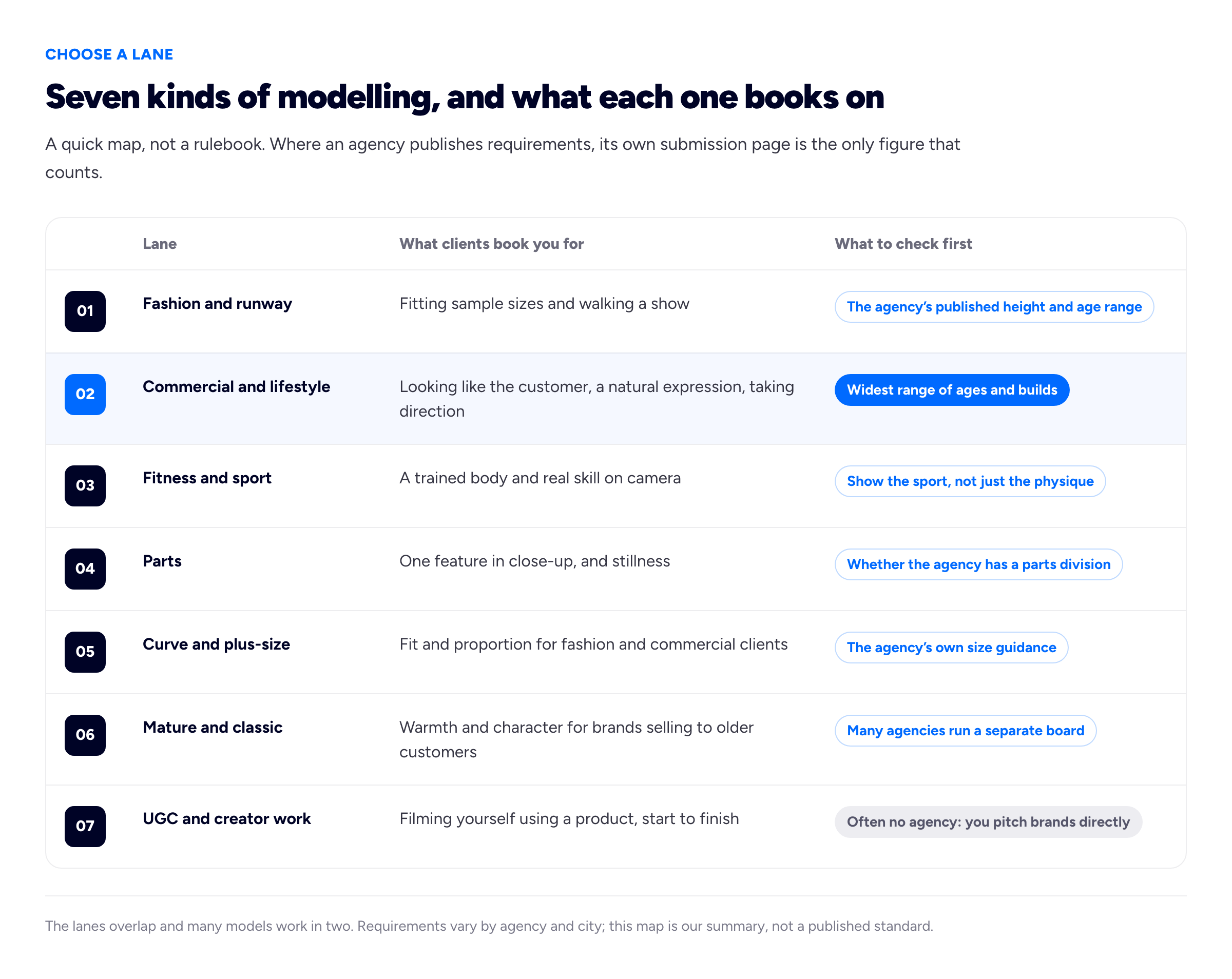
Most people fit one or two lanes. The agency's own submission page settles any question about height, age or size.
Height, age and "requirements": what is real
Firm-sounding numbers circulate online: the minimum height for runway, the age at which you are "too old". Where an agency publishes a requirement, it means it. But those figures belong to each agency, differ between agencies and cities, and change, and we know of no industry body that sets one standard for all of them. Treat any secondhand number as a rumour and go to the submission page of an agency you would actually sign with. Being outside one agency's range is useful information, not a verdict on whether you can model.
Digitals first: the photos agencies actually ask for
Agencies want to see what you look like today, not what a photographer and a retoucher can make of you. That is what digitals, also called polaroids or snaps, are for. Our guide to the model portfolio website explains how they fit into a full book; here is how to take your first set.
What to wear
Something plain and fitted so the agency can see your shape: a black or neutral vest or T-shirt with slim jeans or leggings. No logos, patterns or baggy layers. Many agencies also ask for a swimwear shot because it shows proportion; if the page asks for one, a plain swimsuit or bikini is what it means, and nothing more revealing. Bare feet or simple flats unless heels are requested, and hair pulled back in at least one shot so your face and jawline are clear.
Light and background
Face a window in daylight, against a plain light wall. Overcast light is kindest because it fills shadows evenly. Avoid midday sun, which makes you squint, and overhead room lights, which shadow your eyes. Turn off the flash.
The usual set
- Face, straight on, neutral, mouth closed.
- Face, smiling, naturally.
- Profile, chin level.
- Waist up, straight on.
- Full length, front, arms relaxed.
- Full length, side, and a back view if asked.
Have a friend hold the phone at about chest height for full-length shots, at normal zoom; the wide lens stretches whatever is closest to it.
What to leave out
No filters, no beauty mode, no retouching. A smoothed face is the most common reason a submission is set aside, because the agency cannot tell what you look like. If the photos look a little ordinary to you, they are probably right.
How to submit to an agency
There are three ways in: online submission, open calls and being scouted. Online submission is now the main one: an agency's "become a model" or "submissions" page asks for your digitals, measurements, age, location and sometimes a social handle. Some agencies also hold open calls, set times when you can walk in. Both are free at a legitimate agency.
Zuri Lacombe, an aspiring model we invented for this guide, wants commercial work. She lists the agencies in her nearest city with a commercial board and reads each submission page. They ask for different things: one wants three photos and a height, another six photos and a short video of her saying her name and turning slowly. She sends each exactly what it asks for, with accurate measurements, rather than one email with twenty photos to all of them.
Then she waits. Many agencies say they only reply if interested, so silence is the normal answer. If nothing comes, take new digitals in a few months and try again.
Zuri's reply came from Pascal Ondaatje, an agent at Silverbirch Models, an invented agency, asking her to come to the office with fresh digitals and no make-up. Meet at the agency's real office, in working hours, and take someone with you if you like. A meeting in a hotel room or someone's flat is not a normal agency meeting.
Being scouted
Agents do approach people in shops, at events and on social media, and it is also the oldest door scammers use. Take the person's name and the agency's name, then check the agency through its own website rather than any link or number they give you. The US Federal Trade Commission warns about unexpected texts from "talent scouts" and advises never replying to or clicking links in unexpected messages.
How to check an agency is real
The FTC's guidance on modelling scams gives a sensible routine, and its central test is the business model: legitimate agencies "get paid when you get paid".
Search, then search again
Search the agency's name with "scam", "review" and "complaint", as the FTC suggests. Look at the models on its board: are they working, for clients and in campaigns you can find? Check that the address on its website is an office.
Look for a licence or registration where one is required
The rules differ by country and, in the US, by state, so look up what applies where you live. The FTC advises asking whether an agency is licensed or bonded if your state requires it, and checking the licence is current. Two examples of what an official rule looks like:
- New York State. Under the Fashion Workers Act, the state Department of Labor says that from 21 December 2025, model management companies that do business, represent models or are based in New York must register with it, and it publishes a list of registered companies you can check. Its page on their duties says they may not require a deposit or collect a fee from a model for signing, may not take commission above 20 percent of a model's total pay, and must give a deal memo before work begins. They also need a model's clear written consent before creating or altering a digital replica.
- The UK. GOV.UK says agencies finding work for fashion and photographic models cannot charge any upfront fees, including for putting a model's details in a publication or on a website.
No scheme where you live does not mean anything goes. The other checks still apply, and so does the rule about which way the money moves.
Ask who it books
The FTC suggests asking for references and contacting companies the agency says it has placed models with. Ask which clients it has booked for models like you recently. A genuine agent answers easily; vague talk of "big brands" with no names is a reason to slow down.
Read the contract at home
A real agency lets you take the contract away. Read it with a parent, a friend or a lawyer, and look for the commission rate, how long it runs and how it ends, whether it is exclusive and where, what costs can be deducted from your pay, how and when you are paid, and who controls the use of your image. The FTC says to get everything in writing, spoken promises included, and keep copies somewhere safe.
The scam patterns to walk away from
Modelling attracts predatory operators because newcomers are often young, new to contracts and keen. The FTC lists most of these patterns; the last two are our own additions.
- An upfront fee to register, be listed or "secure your spot". The FTC says real agencies do not charge for a test shoot, your photographs or to secure your spot.
- A "portfolio package". You will be taken on once you have professional photos, which the agency's photographer can do for a fee. The FTC says agencies should not make using their photographers a condition of getting work.
- Paid classes as the price of signing. A genuine agency gives advice; it does not sell a course as a condition of representation.
- Guaranteed work or big earnings. The FTC notes that modelling work is irregular, so such promises are a red flag.
- Pressure to sign today. The FTC says scammers rush you to sign. The deadline exists to stop you reading.
- Payment in cash, gift cards, wire transfer or cryptocurrency, all hard to reverse.
- Requests for nude or explicit images. No legitimate agency needs them; a plain swimsuit shot, when its page asks, is the most it needs. Do not send them, keep the messages, and report it.
- A meeting somewhere other than an office: a hotel, a car, a flat, or a shoot you are told to keep quiet.
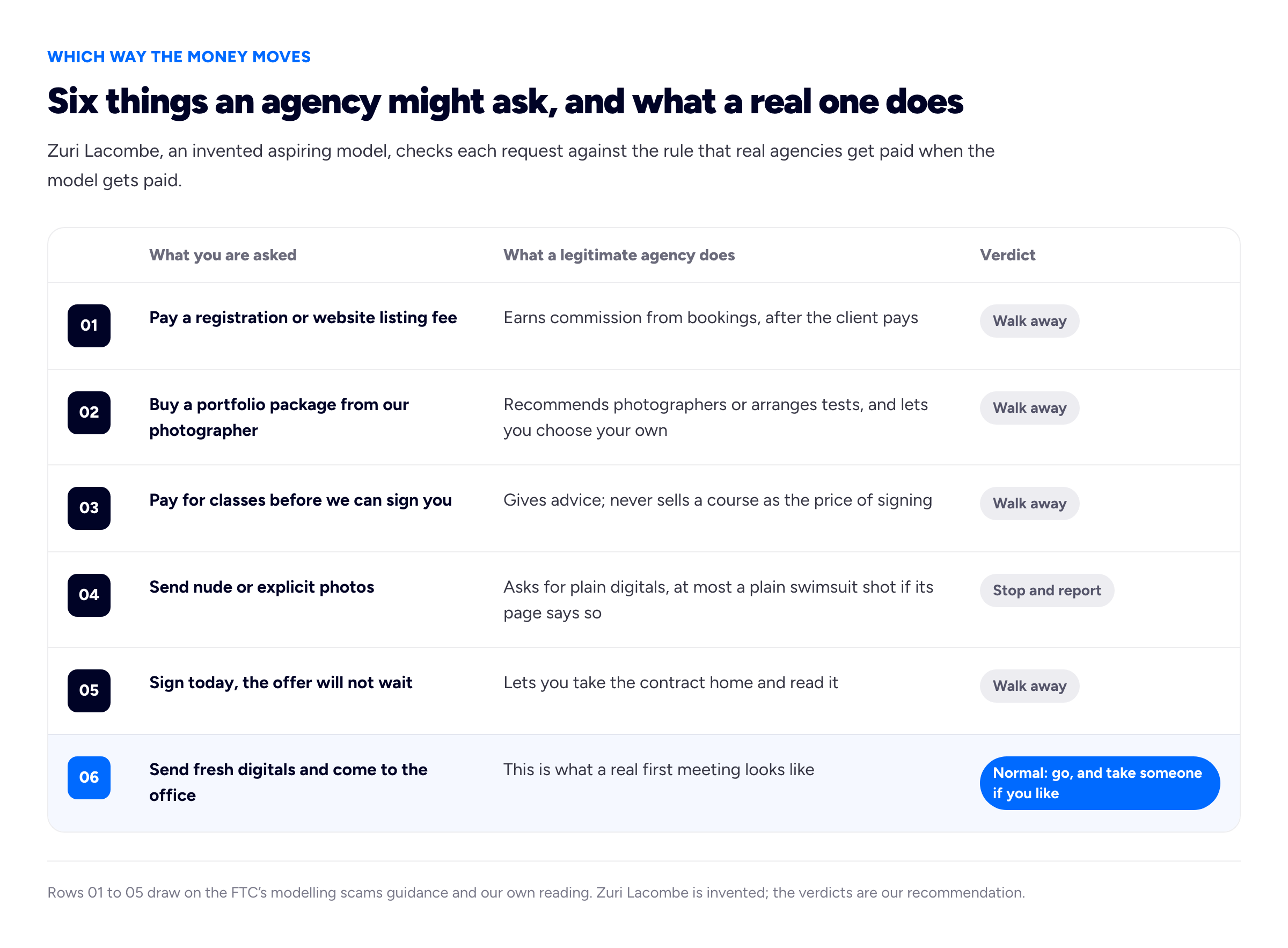
Five of the six requests fail the same test: money or images flowing the wrong way before any work exists.
If you have already paid, act fast: the FTC says the sooner the better, so contact your bank or payment provider at once. In the US, report it at ReportFraud.ftc.gov; elsewhere, to your national consumer protection or fraud body, and to the police if anyone asked for explicit images.
If you are under 18: a section for parents too
Children and teenagers do model, and parents are the first line of defence. The FTC's guidance says the child modelling market is very small, that legitimate professionals usually ask for casual snapshots rather than professional photos, and that "next child star" casting calls are often a way to sell expensive classes. If the talk moves quickly from your child's potential to what you need to buy, you are in a sales meeting. Our recommendations:
- A parent or guardian handles every message, meeting and contract. A legitimate agency expects that.
- A parent attends every meeting and every job, with no exceptions for "closed sets" or "private tests".
- Check the rules on child performers where you live. Many places have their own rules on permits, hours and protecting a child's earnings. Look on your state labour department or national government website, not in the agency's summary.
- Keep school first, and never post your child's measurements, school or location publicly.
Teenagers applying themselves should know a real agency will want to speak to a parent. If someone asks you to keep it from your parents, that is the clearest warning sign there is.
Test shoots and TFP
Once signed, or while an agency is deciding, you will need a few strong images beyond digitals. These come from test shoots: sessions with a photographer, often with hair, make-up and styling, where everyone is building a portfolio. Agencies often recommend photographers they trust, and arrangements vary: some tests cost the model nothing, some involve a fee to the photographer, and some agencies advance the cost and recover it from later earnings. Any cost should be explained in writing, with the amount, before the shoot; New York's rules, for example, require a model's written approval after an itemised calculation before upfront costs come out of pay. What separates a legitimate test from a scam is choice and timing: you are not paying before you can be considered, and you are not forced to use one photographer at their price.
TFP, "time for prints", is a shoot where nobody is paid and everyone gets the images for their portfolio. It is a fair way to build a book before you have an agency, with care:
- Check the photographer's existing work matches what you need.
- Agree in writing the purpose, wardrobe, location, and how and when you get the images.
- Bring someone, or tell someone where you are and when you will be back.
- If the brief changes on the day toward less clothing than agreed, you can say no and leave.
- Agree how the images may be used: a portfolio is one thing, a stock library another.
What a first booking looks like
The casting. Pascal tells Zuri a client is casting for a commercial shoot. At the casting, or go-see, she hands over her comp card, has a few photos or a short video taken, and leaves within minutes. Many castings are now self-taped video. Most do not lead to a job, and that is normal.
The hold. If the client is interested, she may be put "on hold" or "on option" for certain dates: in the running, so keep those days free, but not yet confirmed. Ask your agent how holds work at their agency, because practice varies.
The confirmation. If chosen, she gets the date, hours, location, fee and usage: where and for how long the client can use the images. Wherever you are, ask for these in writing.
The day. A call time, hair and make-up, wardrobe, a lot of waiting and a burst of shooting. Arrive on time with clean hair and skin, take direction, be pleasant to the whole crew, and post nothing from set until you know the client allows it.
Payment. The client pays the agency, which deducts its commission and any agreed costs and pays Zuri, often weeks later rather than days. Ask what the usual timing is, and keep a record of every job, fee and date.
Building your portfolio and comp card
Your book is what your agency uses to sell you: current digitals, a few strong test images and, in time, published work. Your comp card is a printed or digital card with a few images, your name, your agency and your measurements. Agencies usually design these for their own models in house style, so wait for yours rather than paying someone to make one.
Our guide to the model portfolio website covers the book in depth: how many images, their order, keeping your stats accurate, and personal safety once a site is public. Starting from nothing? Our guide to a portfolio with no experience applies here too. A personal site earns its place once you have work to show, especially in commercial, fitness and creator work where you may pitch clients yourself; Bunfolio offers a free one on a subdomain, though your agency's page will be the one clients see first.
Modelling without an agency
Local businesses, independent brands, photographers and creators hire freelance models directly, and UGC work is almost always direct. You then do the agency's job yourself: finding clients, agreeing fees, contracts and chasing payment. Our guides to freelance contract essentials, client red flags and writing an invoice cover that side, and every safety rule here still applies.
Frequently asked questions
How do I become a model with no experience?
Take plain digitals in daylight, find agencies that book your type of modelling, and submit through each one's own submission page. Agencies sign people with no experience all the time; they look for potential, not a finished portfolio.
Do I have to pay to become a model?
No. A legitimate agency earns commission from the work it books for you. Never pay to be represented, registered or listed, or be made to buy photos from the agency's photographer. The FTC treats requests like these as signs of a scam.
How tall do you have to be to be a model?
It depends on the agency and the lane. Some fashion and runway agencies publish height requirements, and they vary, so check each agency's submission page. Commercial, fitness, parts, curve and mature work generally book on other things.
What are digitals in modelling?
Plain, unretouched photos showing what you look like now: face straight on and smiling, profile, and full length front and side, in fitted plain clothes and daylight.
How do I know if a modelling agency is legit?
Check that it earns from commission rather than fees, that its models book real clients, that it is licensed or registered where that is required, and that it lets you take the contract home.
What is TFP in modelling?
Time for prints: an unpaid shoot where everyone gets the images for their portfolio. Agree purpose, wardrobe, location and image use in writing, and bring someone with you.
How we put this guide together
Bunfolio builds portfolio websites, including sites for models and creators, so we spend time reading agency submission pages, model portfolios and the questions people ask before they start. Most of this guide is our recommendation: the seven lanes and what each books on, the digitals checklist, the submission routine, the advice for parents, the TFP checklist and the walk through a first booking are our judgement, not a published industry standard. Practice around holds, test shoots and comp cards varies between agencies, so ask yours.
Where we state facts, we have linked the primary source we read: the US Federal Trade Commission's guidance on modelling scams and its alert on virtual casting call scams; the New York State Department of Labor's pages on model management registration and management companies' duties under the Fashion Workers Act; and GOV.UK's guidance on fees for fashion and photographic models. Rules on agencies, fees and child performers differ by country and, in the US, by state, and these sources cover only their own places. We have deliberately given no height, age or size requirements, because they belong to individual agencies and we found no official standard behind the figures that circulate. For the same reason we have left out statistics on how many people get signed or what models earn: we could not trace any to a published method, sample and date.
Everyone named here is invented: Zuri Lacombe, Pascal Ondaatje and Silverbirch Models, along with the unnamed client and crew.
Related reading: model portfolio website, UGC portfolio, portfolio with no experience, freelance client red flags, freelance contract essentials and makeup artist portfolio.
More from the blog
October 25, 2026 · 18 min read
What to Wear to an Interview: Read the Dress Code First
Wear what the team wears on a good day, one notch smarter, in clean clothes you can walk and sit in. How to find out an employer's real dress code before the day, what one notch above means sector by...

October 5, 2026 · 16 min read
How to Become a Freelance Photographer: From Good Photos to Paid Work
A practical path from "I take good photos" to paid freelance work: choosing a niche, the kit you actually need, and building a portfolio before you have clients. Plus the business basics photography a...
October 1, 2026 · 16 min read
Freelancing Tips: 29 Practical Habits From First Client to Tax
The freelancing habits that prevent most problems before they start, grouped by stage from setting up to looking after yourself. Each of the 29 tips comes with a concrete action, a template line you c...