
September 7, 2026 · 15 min read
Makeup Artist Portfolio: The Photograph Is the Product
A flawless face shot under salon spotlights arrives orange, blurred and texture-free — the makeup was excellent and the evidence is worthless. The three books this discipline needs, the retouching line that deletes your own work, who owns a test shoot, and how to shoot a face on a phone.
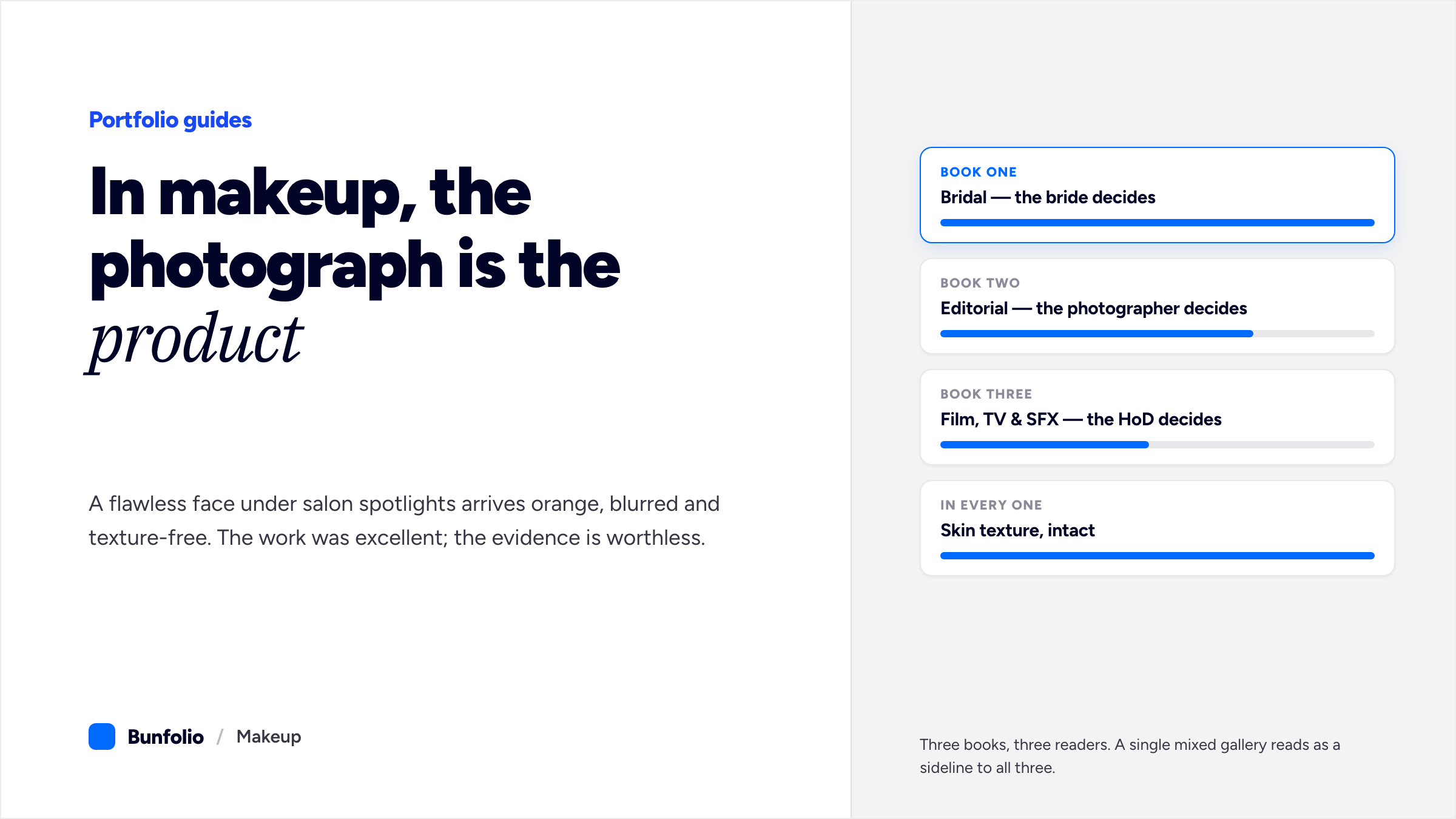
In most creative fields the portfolio shows the work. In makeup it shows a photograph of the work, and that is a much harsher arrangement. A flawless bridal face shot under a salon's overhead spotlights, at arm's length, on a phone in portrait mode, arrives as a blurred, orange, texture-free face. The makeup was excellent. The evidence is worthless. Meanwhile a competent look photographed by a window on a grey afternoon books work for two years.
So the first thing to accept is that a makeup portfolio is a photography problem as much as a makeup problem, and that this is unfair but not negotiable. The second is that "makeup artist portfolio" describes at least three different books — bridal, editorial and film — which share almost nothing except your kit.
This guide covers which book you are actually building, how to get usable images without a budget, who owns the photographs from a test shoot and how to ask for them properly, the retouching line you cannot cross without erasing your own work, how to photograph a face on a phone so the skin survives, and what a bride needs to see that a photographer does not. The general structure of a portfolio site sits in our guide to a freelance portfolio website that wins clients, and this post does not repeat it.
Three books, three readers
The most common mistake in this discipline is a single mixed gallery — a bridal look, then a blue graphic liner, then a prosthetic wound, then a bride again. Each viewer reads it as a portfolio in which their thing is a sideline.
A bride wants to know you have done her wedding, in her light, on her skin, forty times. A photographer wants to know you can build something interesting on set and take direction. A production wants to know you can hold continuity across a fourteen-hour day and keep a kit clean. Those are three different arguments and they need three ordered sets, even if some images appear in more than one.
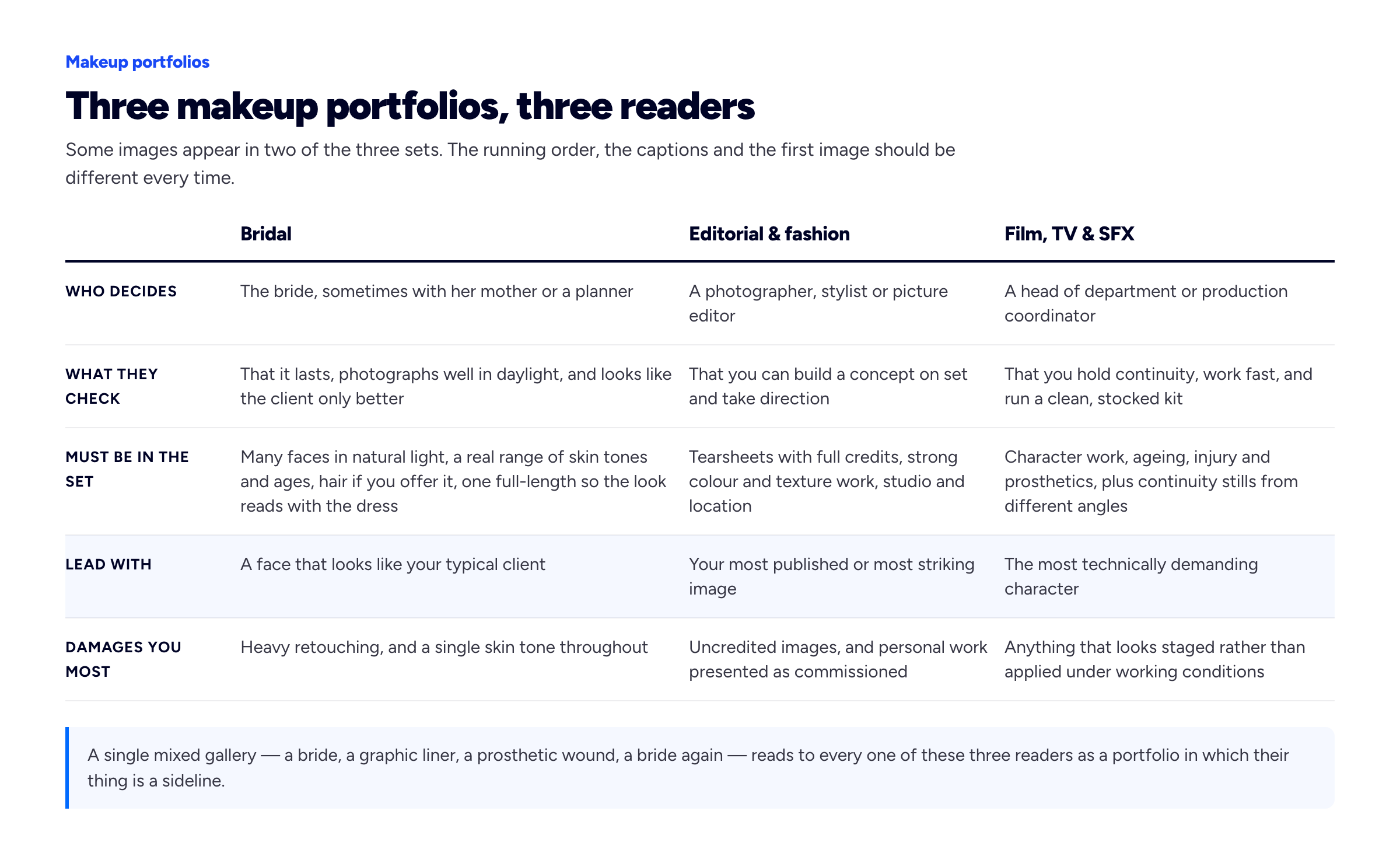
Some images will appear in two of the three sets. The running order, the captions and the first image should be different every time.
Retouching is where this discipline loses its credibility
There is a line, and crossing it destroys the thing you are trying to prove. A makeup portfolio exists to show what you did to skin. If the retouch removes texture, you have deleted the evidence and published a picture of a filter.
The workable rule:
- Allowed: colour correction and white balance, dust and lint on clothing, a stray hair across the face, a background distraction, an exposure fix.
- Allowed with care: a spot that appeared on the day and is not representative — the same standard a photographer would apply.
- Not allowed: skin smoothing, frequency separation used to erase pores, liquify, and any app filter. Also not allowed: shooting through your phone's beauty mode, which does the same thing invisibly and is on by default on a lot of handsets.
Every experienced viewer of makeup work can spot smoothed skin instantly, and what they conclude is not "nice retouch". It is "I cannot see the base work, so I have to assume it needed hiding". Texture is the product. Keep it.
Building a book when nobody has paid you yet
Testing — collaborative shoots where nobody is invoiced — is how essentially every makeup portfolio starts, and it works, provided you treat it like a job rather than a favour.
- Find people at your level or slightly above. A photographer with a portfolio you respect, a model who needs the same images you do. Everyone is there for material.
- Agree the concept before the day. A one-page reference — three images, a colour direction, the skin finish you are aiming for, what the shot needs to show. Vague tests produce vague images.
- Agree usage in writing before the shutter fires. This is the step people skip and regret. See the next section.
- Shoot for your needs, not only the photographer's. Their favourite frame is often a wide, moody, half-lit shot in which your work is invisible. Ask for two clean, well-lit, close frames for you, and one detail of the eye. It takes ninety seconds and it is what your portfolio actually runs on.
- Take your own reference on the day. A phone frame by the window, before the shoot begins, is your insurance against images that never arrive — which happens often.
Bridal is the one area where you can also build honestly without a photographer: real clients, photographed carefully by you, with permission. Which brings us to the part that causes actual disputes.
Who owns the photograph
Almost universally, copyright in a photograph belongs to the photographer who took it, not to the people who appear in it or who contributed to what is being photographed. Doing the makeup does not give you rights in the image. The UK Intellectual Property Office sets out the general position in its guidance on ownership of copyright works, and the US Copyright Office covers the same ground in its FAQ on who owns a copyright. Nothing here is legal advice, and the details differ by jurisdiction and by what you signed.
Practically, this means you need permission — a licence — to put a test shoot in your portfolio, and the time to get it is before the shoot, in a message you can find again. It does not need a solicitor. It needs to be specific:
Confirming for the shoot on the 14th: I can use the retouched images on my website, portfolio and social accounts, with no time limit, crediting you as photographer. No paid advertising use without asking you first. Happy to reciprocate on credits.
Two more habits that prevent trouble:
- Always run the credit list. Photographer, model, stylist, hair, nails, agencies. It is the currency of the industry, it costs nothing, and a portfolio full of uncredited images reads as either careless or borrowed.
- Get the model's agreement separately for real clients. A bride is not a model and has not consented to appear on a business website by hiring you. Ask afterwards, in writing, and accept a no gracefully. Our guide to showing confidential work in a portfolio covers the wider version of that conversation.
Photographing your own work on a phone
Most of your bridal book will be images you took yourself in a hotel room forty minutes before the ceremony. It can look good. Six things do nearly all of it:
- Turn off beauty mode and portrait mode. Both smooth skin. Portrait mode also blurs the jaw and ears, which is exactly where blending is judged.
- Find a window and turn the overheads off. Stand your client so the window is in front of them, slightly to one side. Mixed lighting — daylight plus a warm ceiling bulb — is what makes skin go orange in one half and grey in the other.
- Tap to lock exposure on the cheek. Not on the background. Phones expose for the whole frame and will underexpose a face against a bright window every time.
- Shoot from slightly above eye level, from about a metre. Closer than that and the lens distorts the nose; further and you lose detail.
- Include the neck and the jaw. A cropped face hides the join. Showing it is a statement of confidence and the thing other artists look for.
- Take three frames: face on, three-quarter, and one eye detail. Three consistent frames per client turns a phone snap into a portfolio entry.
Keep the background plain and repeat it. A consistent backdrop across twenty images is what makes a self-shot bridal set look professional rather than incidental — the same consistency argument we made about grids in choosing portfolio thumbnails.
Before-and-after, and when it looks like a scam
Before-and-after is powerful in bridal and essential in SFX, and it is also the format most easily discredited. The failure mode is a "before" shot taken in bad light, with no expression, hair scraped back, from an unflattering angle, next to an "after" in beautiful light. Readers recognise the trick, and the conclusion is that your work needs help. Hair work carries the same risk, which is why our hair stylist portfolio guide fixes the light and angles before anything else.
An honest pair holds everything constant except the makeup: same window, same angle, same distance, same expression, same crop, taken minutes apart. It is less dramatic. It is far more convincing, and it is the version other artists will trust.
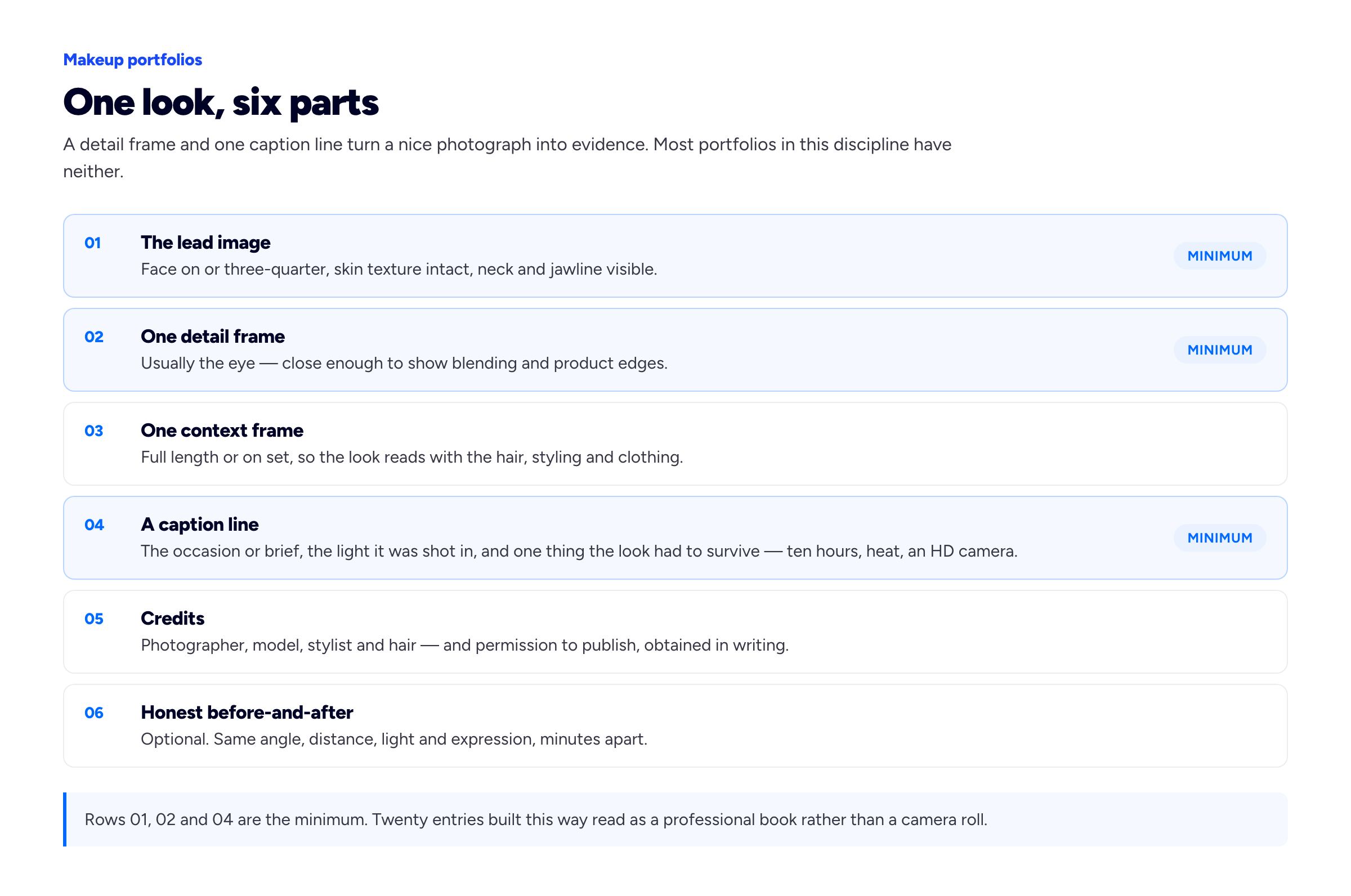
A detail frame and one caption line turn a nice photograph into evidence. Most portfolios in this discipline have neither.
Skin in the book
This one is commercial as well as professional. A portfolio in which every face has the same undertone tells a large share of the people reading it that you have not worked on skin like theirs, and they will book someone else rather than ask. It is the single most common reason a technically good bridal book underperforms.
Deliberately build range into the set: depth and undertone across the spectrum, mature skin, textured and acne-prone skin, monolid and hooded eyes, and at least one look where you clearly matched a deep base rather than approximating it. If your current work does not contain that range, that is a testing brief, not something to apologise for in the about section.
The pages a bridal client needs that other clients do not
Bridal is a booking business, and the portfolio is only half the page. A bride comparing three artists is trying to answer practical questions, and the artist who answers them in public usually wins:
- A price signal. A full rate card is optional; a "from" figure is not. Withholding it entirely filters out serious enquiries as effectively as a high price.
- Where you travel. A radius, a region, and whether you charge for it.
- How the trial works. When it happens, what it costs, whether it comes off the balance.
- What the morning looks like. How long per face, how many people you can do, when you arrive, whether you stay for photographs.
- Deposits and cancellation, in plain words. The freelance contract essentials post covers the underlying terms.
- Testimonials with the wedding date and venue type. Anonymous praise persuades nobody; specifics do. There is a script for asking in how to ask clients for testimonials.
Kit, hygiene and credentials
A short, unglamorous paragraph about hygiene practice is one of the strongest trust signals available to a makeup artist and hardly anybody publishes one: disposable applicators, decanting rather than double-dipping, brush sanitising between clients, what you do about cold sores and eye infections. It signals a professional rather than an enthusiast.
Add insurance if you carry it, any qualifications with the awarding body named, and a note on the products you work with if that is part of your positioning. Cosmetic regulation is a live area — in the United States the FDA's cosmetics pages and its guidance on the Modernization of Cosmetics Regulation Act are the primary sources — but keep any claim you make about products and safety to what you can support.
A pre-send audit
- Is this one book aimed at one reader, or three books mixed together?
- Is skin texture visible in every image, with no smoothing and no filters?
- Does the set include a genuine range of skin depths, undertones, ages and eye shapes?
- Does every image have written permission behind it, from the photographer and, where relevant, the client?
- Is every collaborative image credited in full?
- Is there at least one detail frame per look, close enough to show blending?
- Are the jaw and neck visible somewhere in the set?
- Do any before-and-after pairs hold the light, angle and expression constant?
- For bridal: is there a "from" price, a travel area, a trial explanation and a timing note?
- Does the site load quickly on a phone — are the photographs compressed — and does your name find it in a search engine?
Frequently asked questions
What should a makeup artist portfolio include?
Fifteen to twenty-five looks aimed at one market, each with a lead image showing intact skin texture, a close detail frame of the eye, and a one-line caption naming the occasion, the light and what the look had to survive. Add full credits for collaborative images, a genuine range of skin tones and ages, and — for bridal — a "from" price, a travel area, how the trial works and what the wedding morning looks like.
How do I build a makeup artist portfolio with no clients?
Test. Find a photographer and model at a similar level, agree a concept and the usage terms in writing before the day, and shoot deliberately for your own needs rather than only the photographer's: two clean, well-lit, close frames and one eye detail per look. Photograph friends and family properly by a window in the meantime, and treat each one as a real entry with a caption and a detail frame. Ten well-shot, well-captioned looks beat forty phone snaps.
How many looks should a makeup artist portfolio have?
Roughly fifteen to twenty-five for one market. The weakest images set expectations more strongly than the best ones, so deleting the bottom three usually improves a book more than adding three. If you work across bridal and editorial, build two ordered sets rather than one mixed gallery.
Can I use a photographer's photos in my portfolio?
Only with permission. Copyright in a photograph generally belongs to the photographer, and doing the makeup does not give you rights in the image, so ask for usage in writing — ideally before the shoot — covering your website, portfolio and social accounts, with a credit. Get the client's or model's agreement separately, because a bride hiring you has not consented to appear on a business website. This is general information rather than legal advice, and the position varies by country and by what you signed.
Should my makeup portfolio be Instagram or a website?
Both, doing different jobs. Instagram is where work is discovered and shared; it cannot be ordered, cannot carry your pricing and travel information, is not findable when someone searches your name, and is not an account you own. A page at your own address is the permanent, ordered, captioned version a bride can send to her partner or a producer can forward to a coordinator.
How do I photograph my own makeup work?
Turn off beauty and portrait modes, switch the overhead lights off and use a window in front of the client and slightly to one side, tap to lock exposure on the cheek rather than the background, shoot from about a metre and slightly above eye level, and include the neck and jaw so the blending is visible. Take three frames each time — face on, three-quarter, and one eye detail — against a plain background you can repeat.
Do before-and-after photos work?
They work when they are honest and they backfire when they are not. Hold everything constant except the makeup: same window, same angle, same distance, same expression, same crop, minutes apart. A "before" that is deliberately unflattering — bad light, no expression, hair scraped back — is recognised immediately and suggests the work needs help to look good. The page around the images counts too, since a coloured background changes how skin reads from one frame to the next.
Do I need certification or insurance on my portfolio?
Certification is not required to be booked in most contexts, and naming a qualification with its awarding body is more useful than the word "certified" on its own. Insurance is worth stating if you carry it, particularly for weddings and for venues that ask. The most underrated addition is a short, plain paragraph on hygiene practice — disposables, decanting, brush sanitising between clients — which does more for trust than a list of credentials.
How we put this guide together
Bunfolio builds portfolio sites, so we spend our time reading what freelancers publish and watching where a page loses the person who could book them. The recommendations here are our own judgement rather than industry standards, and you should weigh them that way: the three-books split and its running orders, the retouching line and the argument that smoothing deletes the evidence, the six-point phone method, the six-part structure for a single look entry, the honest before-and-after test, and the claim that skin range in the set is a commercial issue and not only a professional one. They come from a consistent pattern in what makes an enquiry arrive — visible technique on visible skin, in conditions the reader recognises — and what makes one disappear.
We have deliberately cited no statistics: no booking rates, no percentages of brides who check a website, no figures on how long anyone spends looking. The beauty industry circulates a great many confident numbers of that kind and we could not trace them to a primary study we would stand behind, so they are absent rather than borrowed. The look counts and image counts here are ranges we consider workable, offered as opinion.
Where a claim is factual it points at a primary source. The position on photograph ownership refers to the UK Intellectual Property Office's guidance on ownership of copyright works and the US Copyright Office's FAQ on who owns a copyright, which are the documents themselves rather than summaries. The regulatory pointer is to the FDA's cosmetics pages and its MoCRA guidance. None of this is legal advice; copyright and consent rules differ by country and are overridden by whatever you actually signed, and you should read the agreement in front of you rather than our summary of the general position. Phone camera features are described as they commonly behave and vary by handset and software version.
The usage-permission message, the wedding date, and every client, shoot and look referred to as an example above are invented for illustration. They exist to show the shape of a well-evidenced entry and a clearly worded request. They do not describe real work or a real agreement, and no example copy here should be reused as a claim about anything you did.
Related reading: the photography portfolio website guide for the other half of every test shoot, how to ask clients for testimonials for the proof you cannot make yourself, showing confidential work in a portfolio for permission, freelance contract essentials for deposits and cancellation, and how much to charge as a freelancer for the pricing page.
More from the blog
October 24, 2026 · 19 min read
Artist Statement Examples (and How to Write One Without Artspeak)
What an artist statement is and how it differs from a bio and a project statement, the four lengths to keep ready, a four-move method for drafting one, plain-language rules, an artspeak paragraph rewr...
September 26, 2026 · 18 min read
What Is a Freelance Artist? How the Work, Pay and Rights Actually Work
A freelance artist is paid by the job, not by a salary, and keeps the copyright unless they sign it away. How freelancing differs from commission, in-house and gallery work, where the money comes from...
September 14, 2026 · 18 min read
Hairstylist Portfolio: How to Photograph, Organise and Prove Your Work
A hair portfolio is judged from the back, at the root and in daylight, yet most are built from one mirror selfie after the blow-dry. This guide covers the six-frame shot list, believable before-and-af...