
October 24, 2026 · 19 min read
Artist Statement Examples (and How to Write One Without Artspeak)
What an artist statement is and how it differs from a bio and a project statement, the four lengths to keep ready, a four-move method for drafting one, plain-language rules, an artspeak paragraph rewritten, and six example statements across painting, photography, ceramics, illustration, digital and installation work, each annotated.
Most artists can talk about their work for an hour in the studio and then freeze in front of a box that says "Artist statement (300 words max)". What comes out is either a list of materials with no reason attached, or borrowed theory that could describe anybody's work.
Neither is a talent problem. Nobody teaches the form, and the examples people find to copy are often the second kind, written to sound like a catalogue essay rather than to help a stranger look at a painting. A good statement is closer to a well-written wall label than to an essay: short, concrete, in your own voice, and useful to someone who has just met your work.
Below: how a statement differs from a bio and a project statement, which length suits which application, a four-move drafting method, the plain-language rules that keep it out of "artspeak", and example statements across six mediums, each annotated. Every example and artist is invented, so take the shape and leave the words.
If you are still choosing what goes into the portfolio, start with our guide on how to make an art portfolio, which covers selection by destination, and come back here for the writing.
Artist statement, artist bio and project statement: three different texts
Applications often ask for more than one of these at once, and the most common mistake is sending the same paragraph three times. They answer different questions.
An artist statement is about the work. It says what you make, how you make it and why you keep making it. It is usually written in the first person and the present tense, because it describes a practice that is still going on.
An artist bio is about you. It is the factual record in short form: where you trained or how you learned, where you live and work, notable exhibitions, residencies, awards and collections. It is normally written in the third person, because galleries and festivals lift it straight into press releases and programmes. Our portfolio bio examples cover the form in detail.
A project or series statement is about one body of work. It explains a single series, exhibition or proposal: what this group of pieces is, where the idea came from, and how the works relate. It is narrower and more specific than your general statement, and it may describe work that does not exist yet, as in a residency proposal.
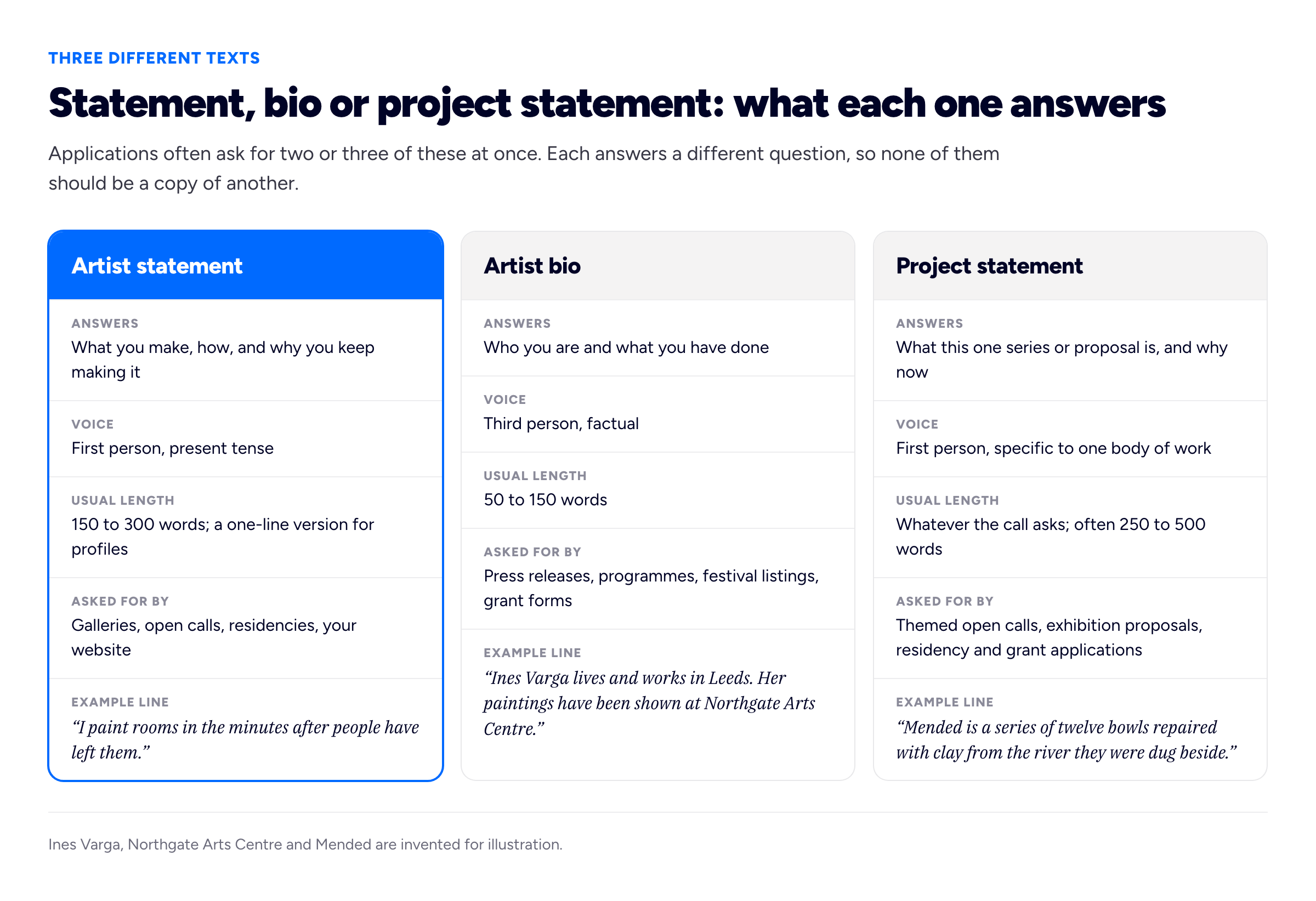
The same artist needs all three at different moments. Write the statement first; the other two are easier once it exists.
When each one is asked for
- Gallery submissions. A statement plus a CV, and sometimes a short bio. The statement should describe the work, not your ambitions.
- Open calls and juried exhibitions. Often a short statement, and for a themed call a project statement that addresses the theme.
- Grants and residencies. Usually a statement and a proposal, sometimes a bio as well, each with its own limit. Two we checked while writing this: the Mountain Lake Biological Station's ArtLab residency application asks for an artist statement of "250 words or less", and the Inspired By residency form linked to Taliesin West asks separately for a bio of 150 words maximum and a statement of 300 words maximum.
- Art-school applications. Often a personal statement or a short written response about your work and interests. At this stage nobody expects a mature practice, so the honest version — what you have been making, what you want to learn — beats an imitation of a professional statement.
- Your portfolio website. A statement on the About page or the landing page of each series, alongside the bio and CV. Here the reader may be a collector rather than a curator.
Four lengths, and when to use each
You need one statement at four lengths, written from the same core, so you can answer any form without starting again. We recommend writing the longest first and cutting down: cutting is easier than inflating, and the long draft forces you to work out what you think.
Here is one invented painter, Ines Varga, at all four lengths.
One line (roughly 10 to 20 words). For an Instagram bio, the top of a website, an exhibition label, or the "describe your practice in one sentence" box.
I paint rooms in the minutes after people have left them.
About 50 words. For directories, artist profiles on marketplaces, the short field on an application, and the summary at the top of a longer statement.
I paint rooms in the minutes after people have left them: kitchens after dinner, waiting rooms after the last appointment, a classroom at four o'clock. I work in oil on small birch panels, from memory and quick notes rather than photographs. I am interested in what a space still says about the people who used it.
About 150 words. The workhorse. Most galleries and many open calls want something close to this, and it fits on a website without scrolling.
I paint rooms in the minutes after people have left them: kitchens after dinner, waiting rooms after the last appointment, a classroom at four o'clock. Nobody appears in the paintings, but everything in them has just been used — a chair pushed back at an angle, a coat still on a hook, a mug with a tea bag left in it.
I work in oil on small birch panels, rarely larger than 30 centimetres, from memory and from notes I make on the spot. I avoid photographs because a camera records everything equally, and memory keeps only what mattered.
The question I keep returning to is how much of a person a room can hold once they have gone. I want the paintings to feel like walking into a room a little too late. If you find yourself guessing who was there, the painting is doing its job.
About 300 words. For residencies, grants and some galleries that ask for a fuller account. The extra length should go on specifics — a recent shift in the work, how a particular series came about, what you are testing now — not on more abstract claims.
For 300 words, Ines would keep the version above and add two short paragraphs: how the work moved from public rooms to domestic ones after she painted her late grandmother's flat during its clearance, and what she is testing now, painting one room at three intervals after it empties. Both are things only she could write, which is the test for anything added at this length.
Which length to send
Use the limit you are given and stay comfortably under it. With no limit given, send the 150-word version. Never paste 300 words into a box that asks for "a few sentences"; ignoring a limit tells the panel something before they read a word.
How to draft an artist statement: four moves
A statement that works is usually doing four things, in roughly this order. The order can bend, but a missing one leaves a gap the reader notices.
- What you make. The objects, images or events, described so that someone who has never seen them could picture them. Name the medium, the scale and the subject.
- How you make it. Materials and process, but only the parts that explain the work. "I use oil paint" tells nobody anything; "I paint from memory rather than photographs" tells them a great deal.
- Why: the question you keep returning to. Not a grand theme, but the specific curiosity that keeps you making the next piece. Phrase it as a question to yourself first; you can turn it into a statement later.
- A way in for the viewer. One sentence that tells someone standing in front of the work what to look for or what the work hopes they will feel. This is the move most statements skip, and it is often the most useful.
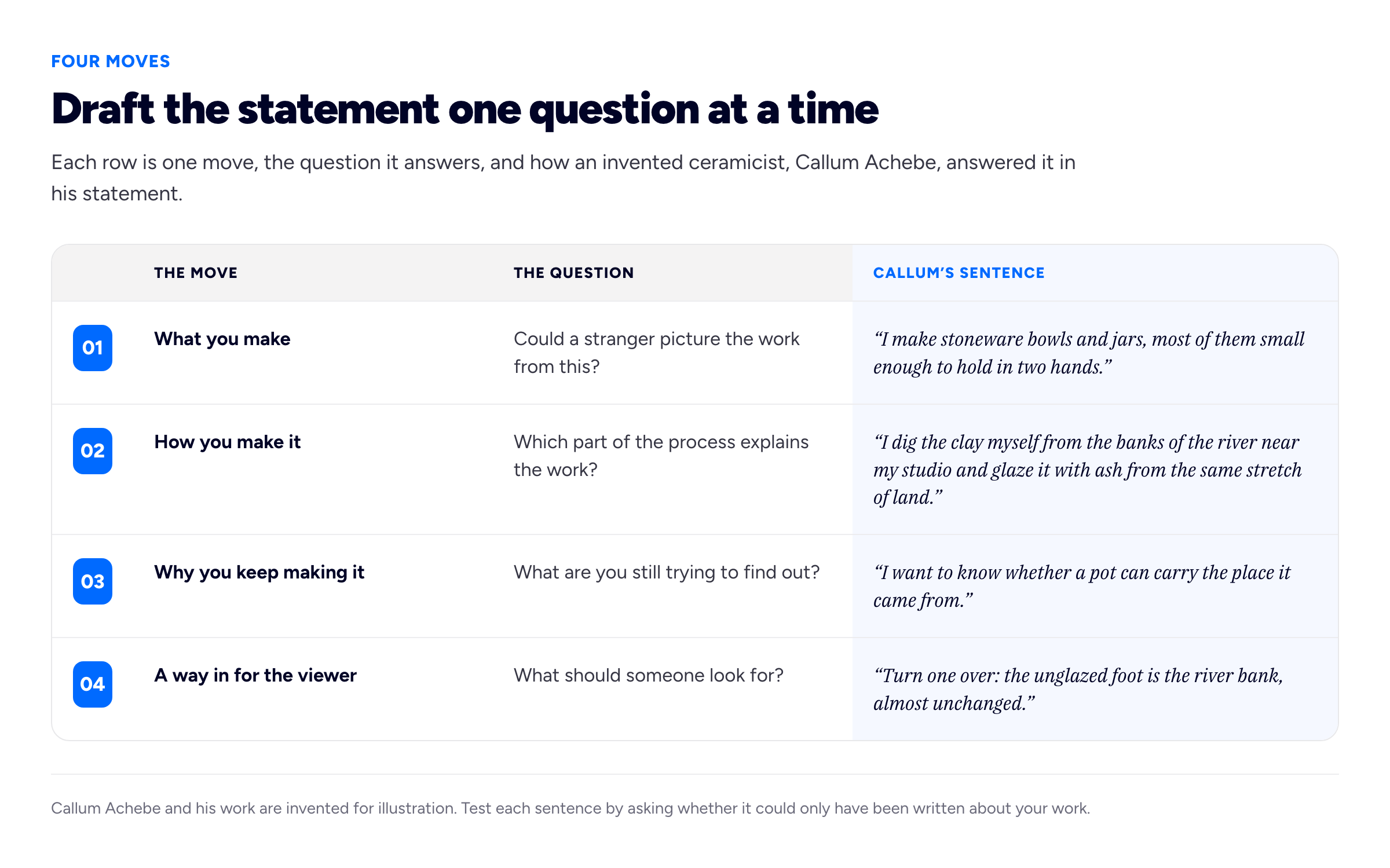
The four moves, filled in by an invented ceramicist. The order can bend, but a statement missing one of them usually feels it.
Getting the raw material out
Most people cannot write a statement cold. Three exercises help, and none of them involves writing anything good.
Talk first. Record yourself explaining one finished piece to a friend who is not an artist, then transcribe it. Spoken sentences are plainer and more specific than written ones, and the "why" often slips out unprompted.
List the nouns. Write down every physical thing in the work and the process: the materials, the tools, the places, the objects depicted. A statement built on nouns is concrete by default.
Finish the sentence "I keep coming back to…". Write ten endings without stopping. One of them is usually the real question. Callum Achebe's tenth was "whether you can tell where a pot was made by holding it", which became move three almost word for word.
Then draft fast, leave it a day, and read it aloud. Cut anything you would be embarrassed to say to a curator's face.
Plain language versus artspeak
"Artspeak" is the dialect of the bad statement: long abstract nouns, verbs like "interrogates" and "problematises", and claims so general that they cannot be wrong. Its real fault is that it gives the reader nothing to hold and makes very different work sound identical. Our rules, which are a recommendation rather than an industry standard:
- Write in the first person and the present tense. "I paint", not "the artist's practice engages with painting".
- Lead with concrete nouns. Name the materials, the subjects and the places before the ideas. Ideas land better once the reader can see the work.
- Give every "explores" an object you can point to. "Explores memory" says nothing; "paints my grandmother's flat in the week it was cleared" says what the exploring looks like.
- Do not praise your own work. "Striking", "powerful", "evocative" and "unique" are for the viewer to decide. Describe; let them judge.
- Use theory only if you can explain it in a sentence to someone outside art. Never drop a name to borrow its authority.
- Apply the attribution test. Remove your name and put the statement on a table beside five others. Could a stranger match it to your work in a group show? If not, it is not specific enough yet.
A before-and-after rewrite
Here is an invented paragraph of the kind panels see every round. It is not quoted from anyone; it was written to collect the habits in one place.
Before: My practice interrogates the liminal spaces between presence and absence, problematising notions of domesticity through an embodied engagement with materiality. Through a multidisciplinary approach, I seek to destabilise the viewer's relationship with the everyday, opening up a dialogue around memory, loss and the politics of space.
Read it again and try to picture the work. You cannot. It could be painting, sculpture, video or performance. "Liminal", "materiality", "dialogue" and "the politics of space" are doing no descriptive work. Nothing in it could be checked, so nothing in it is believed.
Here is the same artist — Ines Varga, as it happens — saying what she actually means.
After: I paint rooms in the minutes after people have left them: a kitchen after dinner, a waiting room after the last appointment. Nobody appears in the paintings, but everything has just been used. I work in oil on small panels, from memory rather than photographs, because memory keeps only what mattered. I want each painting to feel like walking into a room a little too late.
What changed: the abstract nouns became objects (a kitchen, a waiting room, a mug); "materiality" became "oil on small panels"; "presence and absence" became "nobody appears, but everything has just been used", which says the same thing in a way you can see; and the vague "dialogue with the viewer" became one concrete sentence about how the painting should feel. It is shorter, and it sounds more serious.
Artist statement examples by medium
Each example below is about 100 to 150 words, the length most galleries and calls want. All were written for this post. The note after each one, on why it works, is the part worth copying.
Painting
I paint the edges of towns: retail parks at closing time, roundabouts, the fenced ground behind supermarkets. These are places people pass through without looking, and I spend weeks looking at them. I work in acrylic on large unstretched canvas, pinned to the wall, building colour in thin layers so the sodium orange of the street lights glows through everything above it. Each painting starts from a drawing made on site, in the car, in about twenty minutes. I am interested in whether a place designed to be ignored can be beautiful if you give it enough attention. I hope you notice, after a while, that there is almost always one lit window.
Why it works: it names the subject in three precise images before any idea appears; the process detail (thin layers, drawing in the car) explains the look of the paintings; the "why" is a real question; and the last line hands the viewer something specific to find.
Photography
I photograph the same stretch of coastline, about two kilometres long, every week. I have done this for six years, on a medium-format film camera, always from the same five spots. The pictures are not meant to be seen alone. Laid out in sequence, they show erosion, tides, a beach café opening and closing, a fence moving inland. I print them small, in grids, so that the changes become the subject rather than any single view. I keep returning to the question of how slowly something has to change before nobody notices. The work asks you to compare rather than admire.
Why it works: the constraint (one stretch, five spots, six years) is the work, so the statement leads with it; the presentation decision (small prints in grids) is explained by the idea; and the last line tells the viewer how to look, which matters for serial work that would otherwise be read one image at a time.
Ceramics
I make stoneware bowls and jars, most of them small enough to hold in two hands. I dig the clay myself from the banks of the river near my studio and glaze it with ash from the same stretch of land, so each pot is made almost entirely from one place. The clay is unpredictable: it holds iron and grit that crack and speckle in the kiln, and I leave those marks in. I want to know whether a pot can carry the place it came from. Turn one over: the unglazed foot is the river bank, almost unchanged.
Why it works: this is Callum Achebe's statement, built on the four moves above. The material story is the meaning, so it does not need a separate theory paragraph; it explains the "flaws" before a buyer can mistake them for faults; and the final instruction is physical, which suits work people handle.
Illustration
I draw small, dense scenes of people at work: market traders setting up at dawn, a hospital kitchen at full tilt, a bike repair shop on a Saturday. Every figure is doing something specific, and I research each job by sketching on location before I draw it properly in ink and digital colour. My illustrations appear in books and magazines, but my own projects are where I get to spend a month on one picture. I am interested in the skill that goes into ordinary jobs and how rarely anyone draws it. Look closely and you will find the person who is taking a break.
Why it works: illustrators often skip the statement or write a sales pitch. This one describes the work, names the process (location drawing, ink, digital colour) and admits the commercial context without letting it take over. The final line plays the same game the pictures do.
Digital and new media
I make software that draws. Each piece is a small program that grows a pattern from a simple rule, and runs on a screen in the gallery for the length of the exhibition, never repeating. Some respond to the room: the sound level, the number of people, the light. I write the code myself and print selected moments as large inkjet prints, so there is always one fixed version beside the live one. I keep asking how much of a picture I need to decide before it becomes mine, and how much I can hand over to a rule. If you come back on a different day, the work will have changed.
Why it works: it explains what the viewer is looking at in plain terms (a program that grows a pattern) without jargon; it covers what a buyer actually receives (the prints); and the "why" names a real tension in generative work rather than reaching for words like "algorithmic subjectivity".
Sculpture and installation
I build large, temporary structures from materials borrowed from the place where they are shown: scaffold boards from a building site, chairs from a community hall, crates from a market. Each installation stands for the length of the exhibition, then every piece goes back to where it came from. I photograph the borrowing and the returning, and those photographs are the only part that lasts. I am interested in what a room full of ordinary things becomes when they are arranged with care, and in sculpture that leaves nothing behind. The labels list where every object came from, and you are welcome to read them as part of the work.
Why it works: installation statements are where artspeak breeds fastest, because the work is hard to photograph and easy to theorise. This one stays on what happens physically — borrow, build, return — and lets the idea follow from the process.
Adapting the statement to each destination
The core statement should travel. What changes is the frame around it.
A themed open call. Suppose Northgate Arts Centre runs an open call on the theme of repair. Callum would not paste in his general statement. He would write a project statement that answers the call: "Mended is a series of twelve bowls, each cracked in the kiln and repaired with clay from the same river bank it was dug from. For this call I want to show repair as a return to the source rather than a patch." The panel asked a question; the first sentence answers it.
A residency or grant. These usually want what you will do, not only what you have done. Keep your statement as it is, and put the plan in the proposal: what you will make, with what, over what period, and why this place. The panel reads both, so do not repeat yourself.
Art school. Write about what you have made, what you noticed making it and what you want to learn next. If you are just starting out, a short honest statement about a small body of work beats a long one about a practice that does not exist yet.
Your own website. The one-liner on the home page, the 150-word version on the About page with the bio and CV beneath it, and a short project statement above each series. If you are building that site, our guide to the art portfolio website covers curation, sequencing and image settings. Bunfolio is one free way to put it on its own web address, though any portfolio host that lets you write a proper About page will do.
Frequently asked questions
What is an artist statement?
A short piece of writing, usually in the first person, that explains what you make, how you make it and why. Galleries, open calls and grant panels use it to understand your work quickly.
How long should an artist statement be?
As long as the application allows, and no longer. With no limit given, around 150 words is a safe default. Residencies and grants sometimes allow more — the two calls we checked for this guide set limits of 250 and 300 words — so keep a 300-word version ready, plus a 50-word and a one-line version for profiles and short fields.
Should an artist statement be written in first or third person?
First person, in almost every case. The statement is your account of your own work, and "I" reads as direct and honest. The bio is the text that is usually written in the third person, because others reuse it in press material. If an application explicitly asks for third person, do what it asks.
What is the difference between an artist statement and an artist bio?
The statement is about the work: what, how and why. The bio is about you: training, location, exhibitions, residencies, awards. A panel often wants both, so they should not repeat each other.
Can I use AI to write my artist statement?
It can help tidy a draft, but it cannot know why you make your work, and a statement assembled from general patterns tends to come out as artspeak. Calls set their own rules on AI use, so check first. Start from your own recorded explanation and use any tool only to edit it.
How we put this guide together
The three-text distinction, the four lengths, the four-move drafting method, the plain-language rules and the attribution test are our own recommendations, not an industry standard; weigh them as opinions with reasons attached.
We have not included any statistics about how long curators or panels spend reading a statement, or how many applications are rejected for a weak one. The figures that circulate on this could not be traced to a primary source with a published method, and we would rather make the point without a number than borrow one we cannot stand behind.
The two word limits we mention come from application pages we read on 24 October 2026: the Mountain Lake Biological Station's ArtLab application (artist statement, "250 words or less") and the Inspired By residency application form associated with Taliesin West (bio of 150 words maximum, statement of 300 words maximum). Limits change every cycle and differ between programmes, so always check the current page for the call you are applying to.
Everything presented as an example in this post is invented. Ines Varga, Callum Achebe, the unnamed artists, Northgate Arts Centre, its open call and the series Mended do not exist, and every example statement, including the "before" paragraph, was written by us for this guide. None is quoted or adapted from a real artist's statement.
Related reading: how to make an art portfolio for choosing the work the statement sits beside, building an art portfolio website, portfolio bio examples for the third-person text, how to write a portfolio About page and what a freelance artist is.
More from the blog
October 4, 2026 · 22 min read
How to Write a Cover Letter for an Internship (With 3 Examples)
Little or no work experience? Here is how to read an internship advert and match each requirement to your coursework, projects, societies or part-time job, with the format to copy, a fill-in template,...
September 27, 2026 · 23 min read
How to Write a Letter of Presentation (With 6 Examples)
A letter of presentation is what Spanish, Italian and Portuguese speakers call a cover letter, and it also means a letter introducing yourself or your services to a prospective client. What each meani...
October 16, 2026 · 16 min read
CV vs Resume: The Difference and Which One to Send
In the US a CV is an academic record and a resume is the short document; in the UK and most of the world, "CV" is the name for that short document.