
September 14, 2026 · 18 min read · Updated October 5, 2026
Hairstylist Portfolio: How to Photograph, Organise and Prove Your Work
A hair portfolio is judged from the back, at the root and in daylight, yet most are built from one mirror selfie after the blow-dry. This guide covers the six-frame shot list, believable before-and-afters, texture range, colour correction, consent, licence and reviews, and how to start with no clients.
A hairstylist portfolio is a curated set of your own work, organised by service and hair texture, that shows clients and salon owners what you can actually do. To make one, photograph every look the same way from the front, side and back, keep twelve to twenty of your strongest and most varied looks, caption each with the service, and put them on a page with your prices, licence, reviews and a way to book.
A hair portfolio has a problem that most portfolios do not: the best view of the work is the one the client never sees. A precision bob is judged from behind. A lived-in blonde is judged at the root, three inches from the scalp, in daylight. A curly cut is judged dry, a day later, after the client has done it themselves. Yet most stylists' portfolios are made of the same frame — the client in the chair, facing the mirror, lit by the ceiling, seconds after the blow-dry — which shows almost nothing a knowledgeable viewer is looking for.
The rest of this guide covers the order of work, who reads a hair portfolio, how to photograph hair so the work survives the camera, before-and-afters people believe, texture range, colour and colour correction, client consent, where Instagram and booking apps fit, prices, licence and reviews, the printed interview book, and how to start with no clients at all. If you also offer makeup, the makeup artist portfolio guide covers that side, and this post does not repeat it.
How to make a hairstylist portfolio, step by step
The reasoning behind each step is in the sections that follow. In order, the work looks like this:
- Choose your main reader. Clients choosing a stylist, a salon owner hiring one, or a photographer booking for a shoot. The running order of the whole portfolio follows from this choice.
- Set up one photo spot. A plain wall near a window, one light source, a strip of tape on the floor. Every client from now on is photographed there.
- Shoot the same six frames for every client. Front, both profiles, back, one close detail and one with movement. For before-and-afters, shoot the "before" in the same spot, dry, before the client sits down.
- Ask for consent in writing. Before anything is posted, and with a back-view-only option for clients who would rather not show their face.
- Sort by service and texture, not by date. Cuts, colour, colour correction, curly and coily hair, extensions, bridal and event styling: whichever you offer and want more of. A gap in the grid tells you which looks to shoot next.
- Edit to twelve to twenty looks. Fewer, consistent entries beat a large uneven set. Caption each with the service and what it involved; colour work gets a fuller caption, covered below.
- Add the practical details. Starting prices, your licence, where you work, a handful of real reviews and a booking link.
- Publish it, link it from Instagram and your booking app, and keep a printed version if you are interviewing at salons.
The same steps make a hairstyling portfolio for session and editorial work; only the reader and the running order change, with published credits and shoot work moved to the front.
Know who is reading it
Before you choose a single photograph, decide which of three readers the page is for, because the running order changes completely.
The client choosing a stylist is scanning for one question: have you done hair like mine, and made it look like the result I want? For this reader, the portfolio should be organised by service and texture, with prices and a booking route never more than a scroll away.
The salon owner or education manager is judging whether you can be trusted with their clients and their reputation. They look for consistency across many heads rather than one spectacular one, clean sectioning in the back view, even colour at the regrowth line, and whether your finishes look like something a client could recreate at home. Many salons also ask for a practical on a model, so the portfolio's job is to get you into that room, not to replace it.
The photographer, stylist or editor booking a session hairstylist wants published work with credits, evidence that you can build a shape that reads on camera, and signs that you can work quickly and take direction.
Most independent and booth-rental stylists are writing for the first reader. Newly licensed stylists are usually writing for the second. Build for your main reader and keep a separately ordered set for the other, even if some images appear in both.
Photographing hair so the work survives
Hair moves, reflects and shifts colour with every light source in the room, and its most important angles are the awkward ones. Six habits fix most of it.
- Move the client out of the chair. A styling chair puts the client below your eye line, in front of a mirror full of reflections and clutter. Stand them against a plain wall near a window instead, and shoot at head height. Use the same wall every time.
- Kill the mixed light. Salons are lit for working, usually with a mix of warm and cool fittings, and the camera tries to average them. The result is blonde that looks brassy on one side and ashy on the other. For colour work especially, turn off the overheads near your photo spot and use daylight alone, or use one consistent light source you have tested.
- Lock exposure on the hair, not the room. A phone exposes for the whole scene, so a dark head of hair against a bright window turns into a black shape with no texture. On an iPhone, Apple's guide to using camera tools explains that you can touch and hold the focus area until AE/AF Lock appears, and drag up or down beside it to adjust exposure. Android camera apps have equivalents, but the wording varies by manufacturer.
- Shoot the back, every time. For a cut, the back and profile are the proof. For colour, the back shows the placement and blend. A portfolio with only front views is a portfolio of faces with hair around them.
- Get one detail frame close enough to read. For colour, that is the root and the transition. For a cut, it is the perimeter or the graduation. For texture, it is a few curls at a size where definition and frizz are both visible.
- Take one frame with movement. A head turn or a hand run through the hair shows whether a cut falls back into shape and whether colour holds its dimension when it moves.
Leave filters off, and do not touch hue or saturation in editing. Adjusting white balance so the wall looks neutral is honest; nudging a copper warmer or a blonde cooler is not, and a colourist viewing your page will notice. If a result only looks right with a filter, it is not the result, and the client who books that service will arrive expecting the filter.
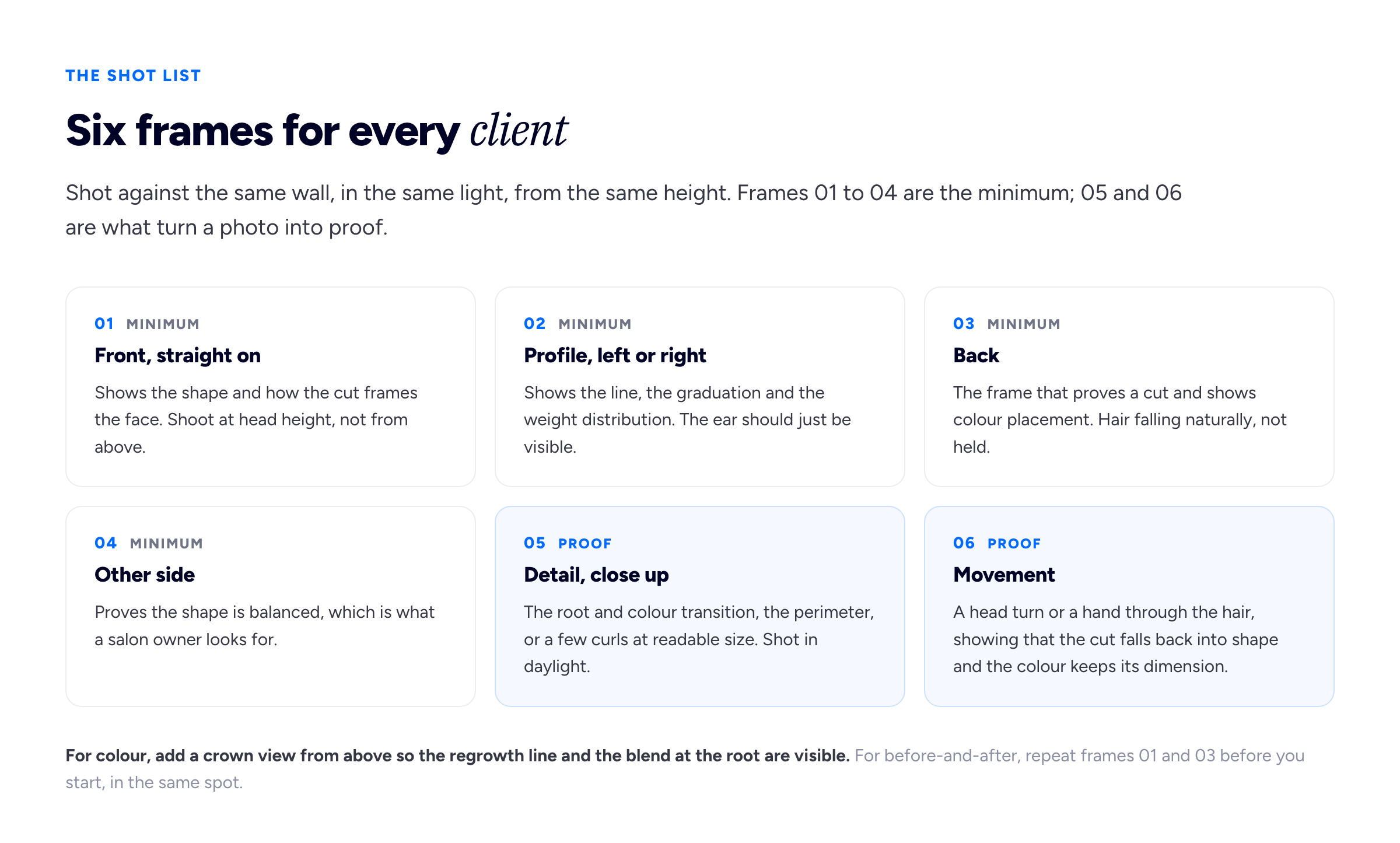
Six frames take about ninety seconds. Taken the same way every time, they are what makes forty clients read as one body of work.
Before-and-afters people believe
Before-and-after is the most persuasive format in hair and the most easily discredited. The familiar failure is a "before" taken wet, in the chair, under the overheads, from an unflattering angle, next to an "after" styled, outdoors, in golden light. Viewers recognise the trick instantly, and the conclusion they draw is that the result needed help.
A pair people believe holds everything constant except the hair: the same wall, the same light, the same distance and height, the same angle, and hair in a comparable state — dry to dry, not wet to blown-out. Mark a spot on the floor with tape and shoot the before frames there before the client sits down. If you use an iPhone, Apple's guide notes you can turn on Exposure Adjustment under Settings, Camera, Preserve Settings so a locked exposure is not reset when the camera reopens, which helps keep a series consistent.
The honest version is less dramatic and far more convincing, and it is the only kind a salon owner takes seriously.
Texture range is a commercial question
Hair varies enormously in curl pattern, strand thickness and density, and a client scrolling your page is looking for heads like their own. A client with tight coils who scrolls through thirty images of straight, fine hair does not conclude that you are good at straight hair. She concludes that you are not for her.
This is no longer a niche concern in training either. California's AB 2166, chaptered in September 2024, requires barbering and cosmetology courses to include instruction on providing services to people with all hair types and textures, including various curl or wave patterns, strand thicknesses and volumes of hair, and requires licensing examinations to test that knowledge. Every texture is being treated as part of the job, not a specialism.
Your portfolio should reflect honestly what you do. If you cut and colour across straight, wavy, curly and coily hair, show all four, and label the service and texture on each entry so a reader can find their own. If you do not yet work confidently with a texture, it is better to say so than to imply otherwise with silence. A line such as "I cut curly hair dry and am building my coily work — book a consultation first" is both honest and useful. If you specialise — curly cutting, locs, silk presses — lead with it.
A simple audit makes the gaps visible. Draw a grid with your services down the side and the four broad texture groups across the top, and count how many portfolio entries you have in each cell.
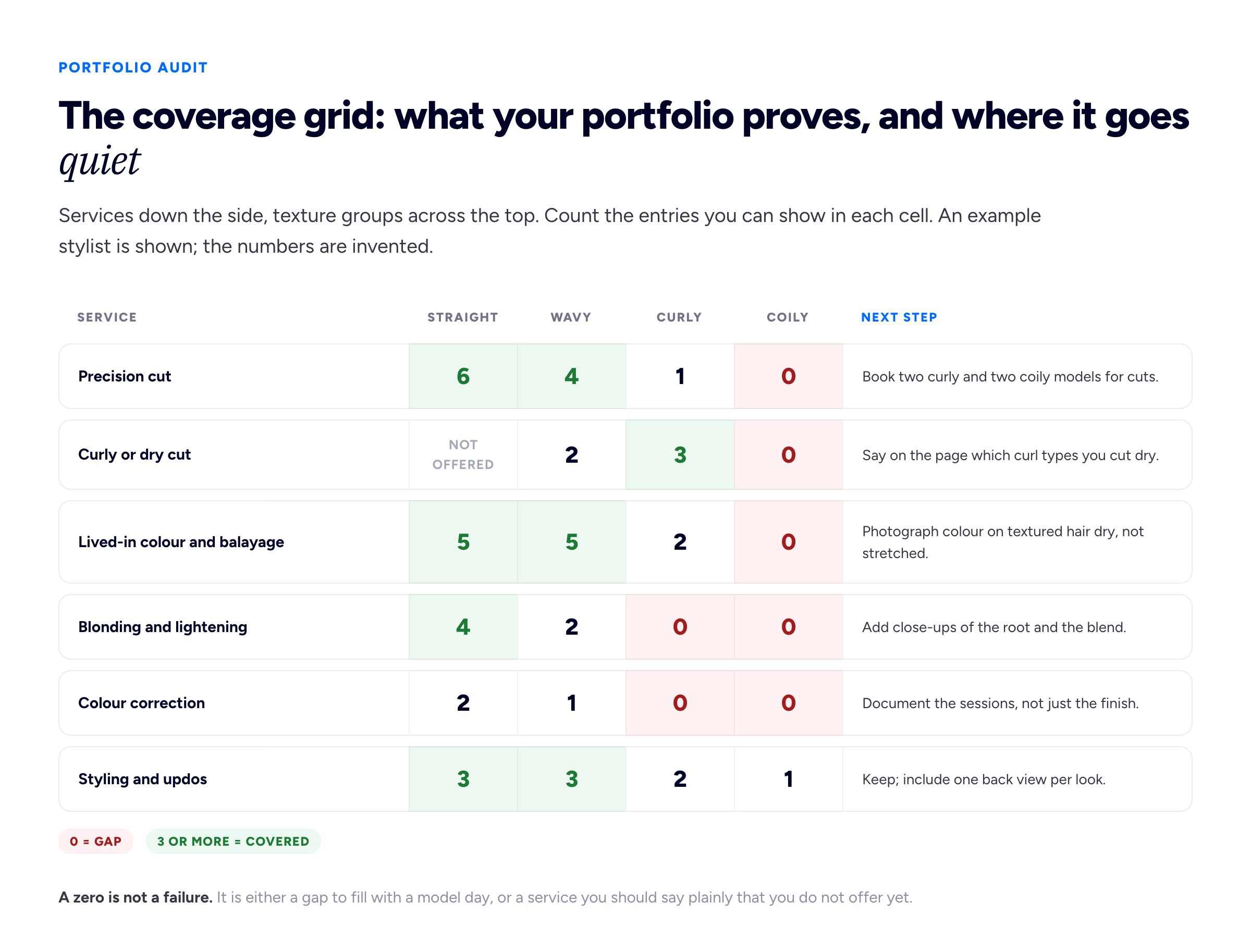
Most stylists who draw this grid find that their portfolio says something narrower than their skills do. The fix is usually a few booked model days, not a rebuild.
Colour work and colour correction
Colour is where a photograph lies most easily and where clients are most specific, so a colour entry needs more than a picture. For each colour piece worth showing, give the reader four things in a line or two of caption: where the hair started, what the goal was, how many sessions it took, and what the upkeep looks like. "Box-dyed dark brown to soft caramel balayage, two sessions six weeks apart, toner refresh every eight weeks" tells a prospective client more than any adjective.
Colour correction deserves its own section, because it is the service clients are most anxious about and the one where honest documentation sells best. Show the starting point clearly, in the same light as the finish. If it took three sessions, show three stages, not a before and a triumphant after. Admitting that a correction took three visits is exactly the reassurance an anxious client wants.
Who has to agree before a client goes on your page
A client who books a cut has not agreed to become an advert. In the United States, the right to control commercial use of your name and likeness — the right of publicity — is, as Cornell's Legal Information Institute summarises in its entry on publicity rights, largely a matter of state law, which is one more reason not to guess. None of this is legal advice, and the rules differ between states and countries. The practical habit is simple regardless: ask, in writing, before you post a recognisable face.
Hi Maya, your colour came out beautifully. Would you be happy for me to use the photos on my website and Instagram? I can crop to the back and side views if you'd rather your face wasn't shown. Completely fine to say no.
Offering the back-view-only option does two jobs: it makes a yes easier, and the back view is often the more useful image anyway. Keep the reply, and take the image down if the client changes their mind.
Photographs taken by a photographer on a shoot are a separate question. Copyright generally belongs to whoever created the work, as the US Copyright Office's FAQ on ownership sets out, so styling the hair does not give you rights in the picture. Agree how you may use the images before the shoot, and always credit the team. The makeup guide linked above walks through the wording.
Instagram, booking apps and a site of your own
Instagram is where clients discover you and where you show that you are busy and current. Its limitations as a portfolio are structural: the feed is ordered by date, not by service, and since early 2025 the profile grid shows posts as tall rectangles rather than squares, so an image composed for a square crop can lose the hair at the edge. Compose portrait, keep the head central, and check how each post looks on your grid.
Booking platforms often double as a small portfolio. StyleSeat's help centre, for example, encourages professionals to tag photos to the correct services so that the menu shows results beside the thing being booked. That is a genuinely good idea, and worth copying wherever you present your work: an image next to the service it proves. Check each platform's terms on how it may use your photos.
A site of your own does the thing neither can: it puts your best work in the order you choose, with captions, prices, your licence, reviews and a booking link on one page that you control and that turns up when someone searches your name. Bunfolio gives you a free portfolio site on your own subdomain, with Google sign-in, and you can connect a custom domain later if you want one. The broader case is in do freelancers need a website. Before uploading, run large phone photos through an image compressor; a gallery of full-size originals loads slowly on the phone your client is holding.
Prices, your licence and reviews
Show prices, or at least starting prices. Hair pricing depends on length, density and history, so a single figure is rarely honest. "From" prices with a sentence on what moves them — length, thickness, previous colour — are the usual answer, with colour correction marked consultation-only. If you are still setting your rates, how much to charge as a freelancer walks through the arithmetic.
State your licence plainly. In the United States, cosmetology licensing is set state by state, and boards commonly require the licence itself to be displayed where you work. New York's appearance enhancement law, for example, requires a licence certificate to be posted in a conspicuous place in the premises where the licensed work is done. Your website is not the place the law is asking about, but a line such as "Licensed cosmetologist, State of New York" does build trust. Check your own board's advertising rules before publishing a licence number; this is not legal advice.
Collect reviews properly. Ask clients soon after the appointment, and make it easy with a direct link. Do not offer a discount or a freebie in exchange for a positive review. The Federal Trade Commission's rule on consumer reviews and testimonials, announced in August 2024, bans fake reviews and prohibits incentives conditioned on a review expressing a particular sentiment. Our guide on how to ask clients for testimonials has wording that works.
A physical book for the salon interview
At a salon interview, a phone passed across the table is an awkward way to talk through your work. A slim printed book, or a tablet with the images in a set order, is better. Twelve to twenty entries is enough; each should show front and back, with a line underneath naming the service, the texture and what was hard about it.
Order it for the salon you are visiting. A colour-led salon should see your colour first; a salon known for precision cutting should open on your cleanest back view. End with your strongest texture range, because that answers the question they may not ask aloud about whether you can take anybody who walks in. Leave a small card with the address of your site, or a code that opens it — a free QR code generator will make one that points straight at your own address.
Newly licensed, with no clients yet
Every stylist starts with an empty book. The ones who fill it quickly treat it as a project.
- Keep your school work, with permission. Mannequin work proves technique; real heads prove you can do it on a person. Show both, and label which is which.
- Run model days. Offer a set service — a cut, a gloss, a curly cut — at a reduced rate or free, to people with the textures and lengths your grid is missing. Be clear in advance that photos are part of the deal, get the consent in writing, and photograph every one the same way.
- Assist, and document what you are allowed to. Assisting a senior stylist is where most people learn fastest. Ask before photographing their clients, and credit the stylist if the work was theirs.
- Build one test shoot. Team up with a photographer and a makeup artist at your level for a single editorial look. It shows that you can build a shape for the camera, which a salon owner will notice.
More on the principle in building a portfolio with no experience.
Frequently asked questions
What should a portfolio for a hair stylist include?
Your best work organised by service and hair texture, with front, side and back views of each look, one close-up detail, a short caption naming the service and what it involved, starting prices, your licence and location, a few real reviews, and a clear way to book or get in touch.
What is the difference between a hairstylist portfolio and a resume?
A resume lists where you trained, your licence and the salons you have worked in. A hairstylist portfolio shows the hair itself: what your cuts look like from the back, how your colour blends at the root, which textures you work with. Salons usually want both, and a client only ever wants the portfolio. Our comparison of a portfolio vs a resume covers how the two fit together.
How many photos should be in a hair portfolio?
There is no official number. In our view twelve to twenty well-shot looks is enough for a client-facing page, with three to six frames each, and a printed interview book works best at a similar size. Range and consistency matter more than volume.
Is Instagram enough, or do I need a portfolio website?
Instagram is good at discovery and at showing that you are active, but it is ordered by date, not by service, and you do not control the account's rules. A site lets you put your work in order with prices, reviews and booking in one place, and it is what you send a salon owner. Most stylists benefit from both, linked to each other.
Can I post photos of my clients' hair?
Ask first, in writing, and accept a no. Offering a back-view-only version, with the face not shown, makes consent easier and is often the more useful image. Rules on using someone's likeness vary by state and country, so treat that as general guidance rather than legal advice.
How do I make a hair portfolio as a new stylist?
Start with school work, labelled as such, then run model days aimed at the services and textures you have not yet shown, photograph every head the same way, and add one collaborative test shoot. A small, consistent book reads as more professional than a large, uneven one.
How we put this guide together
Bunfolio builds portfolio sites, so we spend a lot of time reading what freelancers publish and noticing where a page loses the person who could book them. Several recommendations here are our own judgement, not industry standards, and you should weigh them that way: the three-readers split, the six-frame shot list, the coverage grid, the four-part colour caption, the back-view consent option, and the suggested sizes of twelve to twenty entries for a page or a printed book.
We have deliberately cited no statistics. Confident figures circulate about how many clients check Instagram before booking; we could not trace any to a primary source we would stand behind, so they are absent rather than borrowed.
Where a claim is factual, it points at a primary source: Apple's guide to iPhone camera tools for exposure lock and Preserve Settings; the text of California's AB 2166 for textured-hair training; New York's appearance enhancement law, section 408, for licence display; the FTC's announcement of its reviews rule; Cornell LII's entry on publicity rights; the US Copyright Office's ownership FAQ; and StyleSeat's own set-up guide. The Instagram grid change was announced by the company in January 2025 and widely reported. None of this is legal advice; licensing and consent rules differ by state and country, and your own board's rules are the ones that apply.
The consent message, the client name Maya, the colour caption and the numbers in the coverage grid are invented for illustration. They show the shape of a clear request and a well-documented entry, and do not describe real clients or real work.
Related reading: a freelance portfolio website that wins clients for the structure of the whole site, the photography portfolio website guide for editing and image weight, choosing portfolio thumbnails for a consistent grid, and portfolio bio examples for the few lines that go above your work.
More from the blog
November 2, 2026 · 19 min read
Upwork vs Fiverr: Which Suits the Way You Work?
Upwork has you pitch for posted jobs with Connects; Fiverr has buyers order a fixed-price Gig you defined. Who each suits by service and experience, how the first job happens on each, the fees, paymen...

October 5, 2026 · 16 min read
How to Become a Freelance Photographer: From Good Photos to Paid Work
A practical path from "I take good photos" to paid freelance work: choosing a niche, the kit you actually need, and building a portfolio before you have clients. Plus the business basics photography a...

September 30, 2026 · 16 min read
What Is Freelancing? A Plain-English Guide to Freelance Work
Freelancing is selling a skill to several clients one job at a time instead of working for one employer. How a freelancer differs from an employee, contractor or gig worker, one freelance job from enq...