
November 2, 2026 · 19 min read
Upwork vs Fiverr: Which Suits the Way You Work?
Upwork has you pitch for posted jobs with Connects; Fiverr has buyers order a fixed-price Gig you defined. Who each suits by service and experience, how the first job happens on each, the fees, payment protection and payouts quoted from each platform's own pages, the risks of relying on either, and alternatives by category.
Upwork and Fiverr both connect you with paying clients, but they work in opposite directions. On Upwork, clients post jobs and you go to them: you write a proposal, spend Connects to send it, and compete with other applicants. On Fiverr, you list a fixed-price service, called a Gig, and buyers come to you: they search, compare and order. Choose Upwork if your work varies from project to project, needs scoping before it can be priced, or runs on an hourly or ongoing basis. Choose Fiverr if you can package what you do into a clear deliverable with a set price, such as a 300-word product description or a 15-second logo animation. Whichever you choose, keep a portfolio website that you own, because neither profile belongs to you.
Below: how a first job happens on each, what each platform's own pages say about fees, protection and payouts (with the date we read them), reviews, risks and a few alternatives.
The short version: two models, not two brands
It is more useful to see this as a choice between two ways of selling than between two companies.
- Upwork is a job board with payments attached. A client describes a project, sets a budget or an hourly range, and invites proposals. You read the brief, decide whether to apply, and pitch. Price and scope are negotiated for each contract.
- Fiverr is a shop window. You decide in advance what you sell, at what price, with how many revisions and in how many days. A buyer who likes the listing orders it. Custom offers exist, but the starting point is a product you defined.
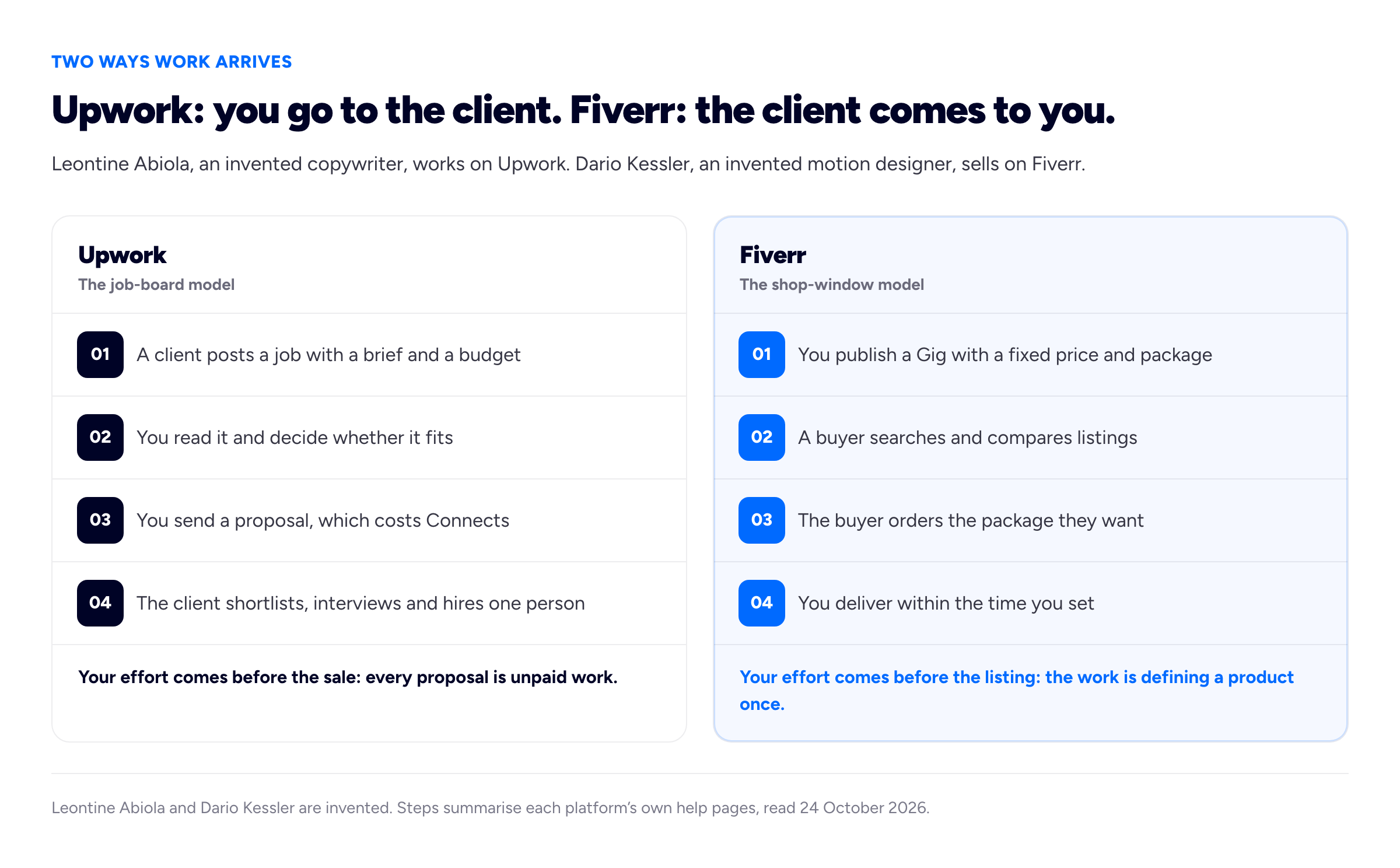
The same freelancer can do well on either, but the work before the first sale happens in a different place.
How Upwork works for a freelancer
On Upwork you build a profile, browse job posts in your field and apply to the ones that fit. Upwork's own help page describes Connects as "the virtual tokens freelancers use on Upwork to submit proposals for jobs". The number a proposal needs is not fixed: in Upwork's words, "the number of Connects you'll need varies per job and can change during the time the job is posted". Connects "cost $0.15 (USD) each and are sold in bundles". The same page says eligible new users "may receive a one-time bonus of 50 Connects", and that Connects are returned if a client cancels a project before a contract is made. We read the Understanding and Using Connects page on 24 October 2026.
So applying costs a little money and a lot of time. Leontine Abiola, our invented copywriter, might read twenty posts in an evening and write four tailored proposals; if none gets a reply, she has spent Connects and an evening for nothing. That is the trade: you choose the work you go after, and pay for that with unpaid pitching.
Contracts on Upwork are either hourly, where you log time and bill weekly, or fixed-price, where the client funds a milestone and releases it when the work is approved.
Upwork suits work where every brief is different and the price depends on the details, and people who are good at answering a brief precisely, because the proposal is the sale.
How Fiverr works for a freelancer
On Fiverr you publish Gigs. Fiverr's help page for freelancers says "your Gigs (offered services) showcase your talent and provide the information clients need to place an order". A Gig has a title, a description, samples and pricing, and many sellers offer it in tiers. Buyers search, compare and order. There is no per-pitch cost like Connects, although Fiverr sells optional advertising and a subscription called Seller Plus.
Dario Kessler, our invented motion designer, does not write proposals. He spends a weekend defining one product: a short animated logo reveal, in three tiers by length and number of revisions, with clear delivery times and four samples. When an order comes in, the scope is already fixed.
The completion rule matters for cash flow. According to the same page, an order counts as complete once you deliver it, the client has three days to respond (fourteen for Gigs that involve shipping), and if they do not respond in that window the order is treated as complete. We read How Fiverr works for freelancers on 24 October 2026.
Fiverr suits work that can be productised: a defined deliverable, a predictable effort and a price that does not depend much on the client. Open-ended projects that need a discovery call before anyone can price them are harder to sell from a shop window.
Who each suits, by service and by experience
These are our observations, not platform rules.
By the kind of work you do
- Variable, scoped projects (a website build, a content strategy, a research report): Upwork fits more naturally, because the client's brief does the scoping and you price against it.
- Repeatable, packaged deliverables (a thumbnail, a jingle, a 500-word blog post, a short animation): Fiverr fits more naturally, because a buyer can order without a conversation.
- Ongoing hourly work (virtual assistance, community moderation, support engineering): Upwork's hourly contracts are built for it.
Leontine's writing ranges from a single landing page to a three-month content plan, so Upwork's per-project pricing suits her. Dario's most requested job is close to identical every time, so a fixed Gig suits him.
By how much experience you have
Both platforms reward history, so the first job is the hardest on either: a new Upwork profile competes on its proposals, and a new Fiverr Gig competes in search against listings with many reviews. In our experience, people who already have a few strong samples and can write a sharp, specific proposal tend to find Upwork's first job more within their control; people who can define a tight, attractive product and price it well tend to find Fiverr's first order comes with less writing. If you are starting from nothing, our guides to what freelancing is and getting your first freelance clients cover the groundwork that comes before either platform.
Getting the first job on each
On Upwork: fewer, better proposals
Our recommendation: apply to fewer jobs, sooner, and make each proposal clearly about that client.
- Filter hard. Skip posts with vague briefs, budgets far below what the work needs, or signs that the client wants free samples. Our article on freelance client red flags lists what to look for.
- Answer the brief in the first two lines. The client sees a preview before opening your proposal. Lead with their problem and your specific plan, not your biography.
- Attach one relevant sample, not ten, and ask one question that shows you read the brief.
Leontine's opening line to a client who needs website copy for a physiotherapy clinic is not "I am an experienced copywriter with a passion for words". It is: "Your brief mentions patients bouncing off the booking page; I'd start there, with a rewrite of the three steps before someone books." Our full guide to writing a freelance proposal that wins walks through the structure.
On Fiverr: one sharp Gig before five vague ones
- Define one product precisely. What exactly does the buyer receive, in what format, in how many days, with how many revisions?
- Write the title the way a buyer searches. Plain words that describe the result ("animated logo reveal for YouTube intros") rather than clever ones.
- Show real samples. If you have no client work yet, make two or three self-initiated pieces in exactly the style you are selling, and label them honestly.
Dario's first Gig description says what is included, what is not (no custom illustration, no sound design), and what he needs from the buyer before starting: a vector logo file and the brand colours. That list heads off the misunderstandings that lead to a bad first review.
Fees, payment protection and payout, from the platforms' own pages
Every figure below is quoted from the platform's own help page or annual report, with the date we read it. Fees change, so check the live page before you rely on any of them.
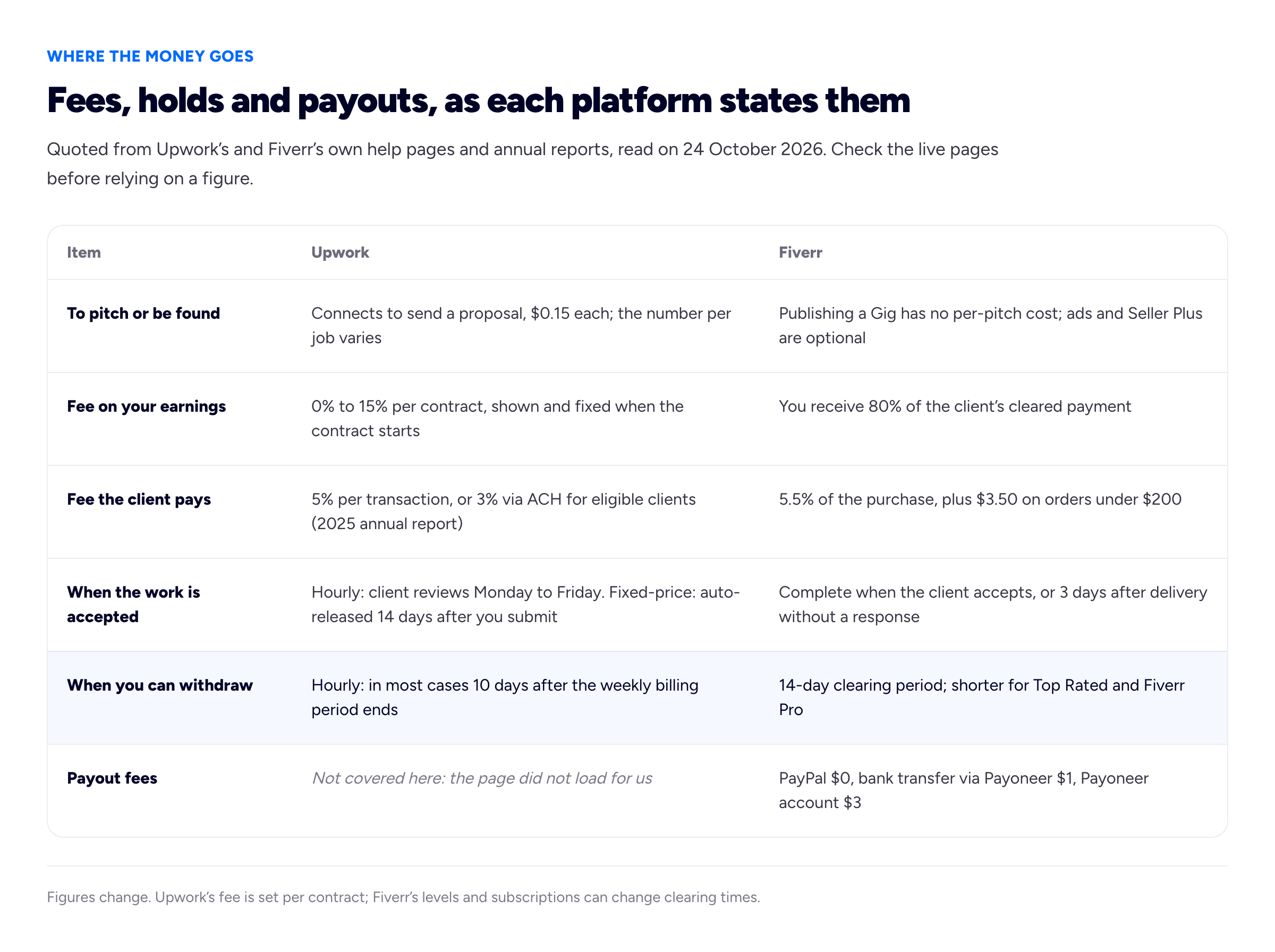
The headline percentages are only part of the picture; on Upwork, Connects and unpaid proposal time are also a cost of getting the job.
Upwork's fees
Upwork's Freelancer Service Fees page, read on 24 October 2026, describes the freelancer fee as "the fee you pay on your Upwork earnings" and says "the fee ranges from 0% to 15% per contract", fixed once the contract begins. The same page says freelancers working with Enterprise clients typically pay 10%, that Upwork Payroll and Any Hire contracts carry no fee, and that Direct Contracts carry a reduced fee without stating it. Upwork's annual report for 2025, filed with the US Securities and Exchange Commission on 12 February 2026, explains the background: the variable structure was introduced in May 2025 for new contracts, the fee depends "on platform-specific supply and demand factors, such as project type, job availability, and client demand", and contracts formed before May 2025 keep a flat 10% fee.
The client pays a separate fee. The same report states: "We charge a client marketplace fee of 5% on each transaction—or 3% if paid via ACH for eligible clients," with higher rates on a premium Business Plus plan.
A simple illustration: on a $1,000 fixed-price contract where Upwork shows a 10% fee at the start, you would receive $900 before any payout or currency costs; at 15% you would receive $850. Read the rate Upwork shows before you accept.
Upwork's payment protection
For fixed-price contracts, Upwork's Fixed-Price Payment Protection page (read 24 October 2026) says that project funds, formerly called escrow, "act as a neutral holding place for client payments while work is in progress". Protection requires the milestone to be fully funded before you start, so look for the "Funded" label. Clients release payment once they approve the work, or after a fourteen-day review period that starts when you use "Submit Work for Payment". Work done without an active, funded milestone is not protected, nor is work delivered outside that submission flow, work that does not match the agreed scope, or work submitted after the contract has ended without written agreement.
For hourly contracts, Upwork's Hourly Payment Protection page lists conditions that must all be true, including: "You logged your hours with the time tracker in the Upwork Desktop App", "You added memos or activity labels in your work diary that describe the work", "You stayed within the contract's weekly limit" and "You have verified your identity". It excludes work diary segments that were "added manually", were idle, were over the weekly limit, or had missing or inadequate memos. In short: track time in the app, write a memo for every block, and stay inside the cap.
On timing, Upwork's hourly payments page says "in most cases, you are paid for your time 10 days after the weekly billing period ends each Sunday": hours are invoiced on Monday (UTC), clients have until Friday to review, and earnings become available the following Wednesday. Bonus payments skip review but carry "a five-day security hold". We could not load Upwork's page on withdrawal methods and fees, so we do not state them here.
Fiverr's fees
Fiverr's How Fiverr works for freelancers page, read on 24 October 2026, says freelancers receive "80% of the client's cleared payment" once an order is complete. The page does not name the remaining 20% as a fee, but that is the difference.
The buyer also pays. Fiverr's page on paying for orders (read the same day) states: "The standard service fee is 5.5% of your purchase amount, and we add a $3.50 fee to orders under $200." Each payment carries its own fee, so an extra or a tip is charged separately.
Using those two figures, a $100 Gig costs the buyer $109 ($100, plus $5.50, plus $3.50 because the order is under $200), and you receive $80 once it clears.
Fiverr's clearing period, payouts and protection
Fiverr's freelancer page states: "Funds are subject to a 14-day clearing period before they become available for withdrawal," and says Top Rated and Fiverr Pro freelancers can have a shorter period; the company's 2025 annual report also lists "faster payment clearance" among Seller Plus subscription benefits. Neither source we read gave the shorter period in days, so we do not state one.
Fiverr's withdrawals page, read on 24 October 2026, lists PayPal with a $0 withdrawal fee and a $1 minimum, bank transfer via Payoneer at $1 with a $20 minimum, and a Payoneer account at $3 with a $10 minimum. It also notes short waiting periods, such as 24 hours after your first withdrawal or after changing your withdrawal method, and that "withdrawals are final and can't be undone".
On disputes, Fiverr's chargebacks and freelancer protection page says that when a completed order is reversed as an unauthorised card or PayPal charge, Fiverr "may compensate you for the main service, not including any extras, through the Seller Protection Program", reviewed case by case. For service disputes it tries to recover the funds; if Fiverr wins, the funds return to your earnings with a 45-day clearance period. If you have already withdrawn the money, the amount becomes a debt on your account.
What the numbers mean in practice
Do not choose on the headline percentage alone. On Upwork, a lower fee can be offset by Connects and unanswered proposals; on Fiverr, the 14-day clearing period delays cash. Build both into your rate. Our guide to how much to charge as a freelancer shows how to work platform fees into a price, and getting paid on time covers the cash-flow side.
Reputation, reviews and visibility
Upwork uses the Job Success Score. Its help page (read 24 October 2026) calls it "a metric that measures your clients' satisfaction with your work on Upwork", calculated from "client feedback, reasons why past contracts ended, higher-value projects, and long-term customer relationships", recalculated daily over your 6, 12 and 24-month history. It adds that feedback from a client flagged for poor collaboration or suspended for breaking the terms "will not count against your JSS". The page did not state how many contracts you need before a first score appears, so we do not guess.
Fiverr uses levels and a Success Score. Its freelancer page says "each Freelancer level unlocks new benefits and opportunities, with level badges displayed on Gig cards and profiles", that levels depend on performance and client relationships, and that Fiverr Pro is the highest tier.
In our experience, three habits protect a young reputation on either: agree scope in writing before you start, since most poor reviews follow a gap between what each side thought was agreed; set delivery times you can beat; and close each job with a short summary of what you delivered. Our guide to asking clients for testimonials covers asking for feedback without pressure.
The risks of building on either platform
Dependence on one platform
Your reviews, your score and your search ranking live inside the platform, and you cannot take them with you. A change to the fee structure, the search algorithm or the rules in your category affects your income directly, and you have no say in it. Upwork's own annual report notes that it changed its pricing model in 2025, and both companies' reports list pricing changes among their business risks. That is a reason not to let one become your only source of work.
Account suspension
Fiverr's enforcement policy (read 24 October 2026) describes warnings that expire after 90 days, restriction as "an intermediate action before permanent suspension", and permanent suspension after repeated warnings. For a suspended freelancer account it says: "If there are funds available in the account, the freelancer is required to wait 90 days to make a withdrawal." Appeals must be made within six months. Upwork's equivalent terms page did not load for us, so we do not summarise its rules, but its fixed-price and hourly protection pages both require your account to be in good standing.
The practical rules: read the terms for your category, avoid anything that looks like moving payment off the platform (both platforms treat this seriously; Fiverr's enforcement page links to a separate off-platform policy, and Upwork's annual report describes circumvention as a problem it works to prevent), keep copies of your briefs and deliverables, and withdraw earnings regularly rather than letting a large balance build up.
Competition on price
Both are global marketplaces, so on price alone someone can always undercut you. Compete on specificity instead: a narrow offer for a clear type of client is easier to choose and harder to undercut. Our article on whether freelancers should niche down goes into this.
Keep a portfolio site you own
Whichever platform you choose, keep a home for your work that does not depend on it. A personal portfolio site is the one place where your work, your positioning and your contact details stay under your control, whatever a marketplace does to its fees or search results.
- Proposals and Gig descriptions can point somewhere. Where the platform allows a link, a well-organised site shows your best work better than a profile gallery.
- Clients who find you elsewhere (through LinkedIn, a referral or search) have somewhere to land that is not a marketplace listing full of other freelancers.
- Your case studies outlive any one account. If an account is restricted, or a platform changes its rules, your evidence of good work is still online.
For more on whether it is worth the effort, read do freelancers need a website?, and for what to put on it, a freelance portfolio website that wins clients. Specialist guides for the two kinds of work in this article are copywriter portfolios and motion design portfolios.
Other platforms worth knowing, by category
These are categories, not recommendations. We did not check other platforms' fees, so we quote none; read each one's terms before joining.
- Other general bidding marketplaces. Sites such as Freelancer.com and PeoplePerHour also let clients post projects and freelancers propose, so most of the Upwork advice above applies.
- Screened or invitation-based networks. Some platforms vet freelancers before admitting them and match them to clients. Expect an application process before you can take work.
- Creative communities with job boards. Design and illustration communities such as Behance and Dribbble combine a portfolio with job listings. They are closer to a shop window than a bidding board. Our comparison of Behance and Dribbble against your own site covers what they do and do not replace.
- Niche job boards. Many fields have their own boards for writing, development, translation or design. They are smaller, but the clients are looking for exactly what you do.
- Your own network. LinkedIn, past employers and referrals carry no platform fee, and in our experience often bring the best-fitting work.
A sensible way to decide
Write down your three most common jobs. If you could price each without talking to the client first, set up one Fiverr Gig for the clearest of them. If each depends on the brief, set up an Upwork profile and send five careful proposals a week. Give either test eight to twelve weeks, track hours as well as earnings, and keep your own site and network going alongside it.
Frequently asked questions
Is Upwork or Fiverr better for beginners?
Neither is easier in general. Upwork tends to suit beginners who have a few strong samples and can write precise proposals; Fiverr tends to suit beginners who can define a narrow, clearly priced product. Try the one that fits how you already work.
How much does Upwork take from freelancers?
Upwork's Freelancer Service Fees page, read on 24 October 2026, says the fee ranges from 0% to 15% per contract and is fixed when the contract begins. Contracts formed before May 2025 keep a flat 10% fee, according to Upwork's 2025 annual report. Connects to send proposals are an extra cost.
How much does Fiverr take from freelancers?
Fiverr's help page for freelancers, read on 24 October 2026, says you receive 80% of the client's cleared payment for a completed order. Buyers pay a separate service fee of 5.5%, plus $3.50 on orders under $200.
How long does it take to get paid on Upwork and Fiverr?
On Upwork hourly contracts, the help page says you are usually paid 10 days after the weekly billing period ends; fixed-price milestones are released when the client approves or automatically 14 days after you submit. On Fiverr, funds clear 14 days after an order completes, sooner for Top Rated and Fiverr Pro freelancers.
Do I still need a portfolio website if I am on Upwork or Fiverr?
We recommend one. Platform profiles and reviews belong to the platform. A site you control keeps your work, case studies and contact details in one place whatever happens to an account or a fee structure.
How we put this guide together
Bunfolio builds portfolio websites for freelancers, so we hear often from people deciding where to look for clients. We have no affiliate relationship with Upwork, Fiverr or any platform mentioned here, and nothing in this guide is paid placement. To be clear about the status of what is here: the comparison of models, the advice on who each suits, the first-job steps, the risk management habits and the decision test are our recommendations, not rules published by either platform.
Every fee, percentage, holding period and policy we state comes from a page we read on 24 October 2026: Upwork's help pages on freelancer service fees, Connects, hourly payments, hourly payment protection, fixed-price payment protection and the Job Success Score; Upwork's 2025 annual report; Fiverr's help pages on how Fiverr works for freelancers, buyer fees, withdrawals, chargebacks and policy enforcement; and Fiverr's 2025 annual report. Several pages, including both platforms' full terms of service and Upwork's page on withdrawal fees, blocked automated reading; where we could not read a page, we say so in the text and state no figure from it. Platforms change their pricing, so check the live pages before relying on any number here.
We have deliberately not quoted how many freelancers use each platform, typical earnings, or how quickly a first job usually arrives, because we could not trace those figures to a method, a sample and a date. The dollar examples are simple arithmetic on the quoted percentages, not real transactions.
The freelancers in the examples, Leontine Abiola and Dario Kessler, are invented, as is the physiotherapy clinic brief and every quoted line of proposal or Gig copy.
Related reading: getting your first freelance clients, a freelance proposal that wins, do freelancers need a website?, a freelance portfolio website that wins clients and what is freelancing?
More from the blog
October 20, 2026 · 19 min read
Signs an Interview Went Well (and Which Ones to Ignore)
Most lists of good interview signs are really lists of good manners. Here is which signals carry information because they cost the interviewer something, which are politeness every candidate gets, whi...
October 16, 2026 · 16 min read
CV vs Resume: The Difference and Which One to Send
In the US a CV is an academic record and a resume is the short document; in the UK and most of the world, "CV" is the name for that short document.
October 5, 2026 · 16 min read
How to Become a Freelance Photographer: From Good Photos to Paid Work
A practical path from "I take good photos" to paid freelance work: choosing a niche, the kit you actually need, and building a portfolio before you have clients. Plus the business basics photography a...