
September 19, 2026 · 20 min read · Updated October 5, 2026
Copywriter Portfolio: The Evidence Standard It Has to Meet
Your portfolio is advertising, so it has to meet the standard you would apply to any client claim. The proof ladder for showing copy in context, reporting results when you never had analytics access, agency credit and ownership, and labelling spec work honestly.
A copywriting portfolio has a problem that a photographer's does not. A photograph is the work. A headline is not the work — the work was the brief you were handed, the brief you argued into a better shape, the constraint you wrote inside, the six versions that were killed, and the one that shipped and moved a number. What you can actually put on a page is the last four words of that process, in a typeface you did not choose, detached from everything that made them good.
So most copywriting portfolios end up as a document of headlines, and most advice about them is about presentation: put it in a device mockup, pick a clean, text-first portfolio template, show a range of clients. That advice is not wrong and it is no longer sufficient, for a reason that has nothing to do with design.
Your portfolio is advertising. It is a piece of promotional material, about a service, making claims, aimed at a buyer. You would not let a client publish an unsubstantiated performance claim; the standard you apply on their behalf is the standard your own page has to meet. That is the frame for this guide — not how to make the portfolio look good, but what it has to be able to prove.
In short, a copywriter portfolio needs four to six pieces shown in context, each with the brief, the constraint and an honest account of what happened, chosen for the work you want next. This post is about the copywriter's specific case: conversion and brand copy, agency credit, results, and spec. If you are starting from nothing and need samples to exist at all, our guide to building a writing portfolio without clips covers that ground — the five kinds of sample worth making, a four-week plan, ghostwriting and NDAs — and this one deliberately does not repeat it.
What a portfolio has to prove now
Three years ago, a portfolio that demonstrated you could write a clean, persuasive headline was doing useful work, because not everybody could. That is no longer a scarce demonstration. Anyone evaluating you can generate forty competent headlines for their own product, for free, in the time it takes to read your About page. If your portfolio's implicit claim is I can produce good copy, the buyer's honest response is that so can the tab next to yours.
This is not an argument that copywriting is finished. It is an argument that the portfolio has to document a different thing. The parts of the job a model cannot hand over are the parts your page should now be built around:
- The brief you were given versus the brief you rewrote. Most bad copy is a faithful execution of a bad brief. "They asked for a launch email; the actual problem was that nobody understood what the product replaced, so we led with the thing it replaced" is a sentence no model produces on your behalf, because it requires having been in the room.
- The constraint. Legal review, a brand system that forbids the obvious word, a 28-character button, a claim the regulator will not allow, a founder who insists on a phrase. Copy written inside a hard constraint is visibly harder than copy written free, and only you can narrate the constraint.
- The version that was killed, and why. Judgement is most legible at the point of rejection.
- The thing you argued the client out of. The highest-value skill a copywriter has is talking a business out of the campaign it walked in wanting. It never shows up in the artefact.
Practically: every entry should carry two or three sentences of context that could only have been written by the person who did the work. That is now the load-bearing element of the page, and the copy itself is the evidence that the judgement produced something.
What goes in a copywriter portfolio, by the work you want
A copywriter portfolio is four to six pieces of your copy, each shown where it ran and explained in two or three sentences, plus a short line about the kind of work you take on and a way to contact you. Which pieces you choose should depend on who you want to hire you, because different buyers check for different things.
- Conversion and direct response. Landing pages, sales pages, pricing pages, checkout and sign-up flows. The buyer is a marketer who will ask what happened, so these entries need the strongest evidence: a live link or dated screenshot, and a result attributed honestly. Show the whole page, not just the headline, because the structure of the argument is the skill.
- Email. Sequences rather than single sends: onboarding, trial, launch, win-back. Show the sequence as a diagram with the purpose of each email, then two or three emails rendered on a phone. A single good email proves you can write; a sequence proves you can plan.
- Brand and advertising. Campaign lines, scripts, outdoor, social and the work that sits behind a brand: tone of voice guides, naming, manifestos. Agency copywriters often still call the portfolio "the book", and the reader here is a creative director judging ideas first. Lead with the idea in one line, then the executions across media.
- UX and product copy. Interface strings, error messages, empty states, onboarding screens. These are tiny, so the entry has to be mostly context: the screen before and after, the constraint (character limits, translation, legal), and what it changed for the user. A before-and-after pair of the same screen does more than any amount of description.
- B2B and long form. Case studies, white papers, product pages for technical buyers. Show an excerpt with a link to the full piece, and say who you interviewed and how much of the source material you had to work from.
If you do more than one of these, pick the two you most want more of and lead with them. A portfolio that shows everything at equal weight tells a buyer you will take anything, and buyers who have a specific problem prefer someone who has solved that problem before.
Showing copy in situ, without implying more than happened
A headline in a Google Doc communicates nothing — no medium, no audience, no surrounding page, no indication it ever existed outside your drafts. So everyone recommends mockups. The trouble with a mockup is that it is indistinguishable from a shipped thing, and a beautifully rendered landing page for work that never launched is a quiet lie.
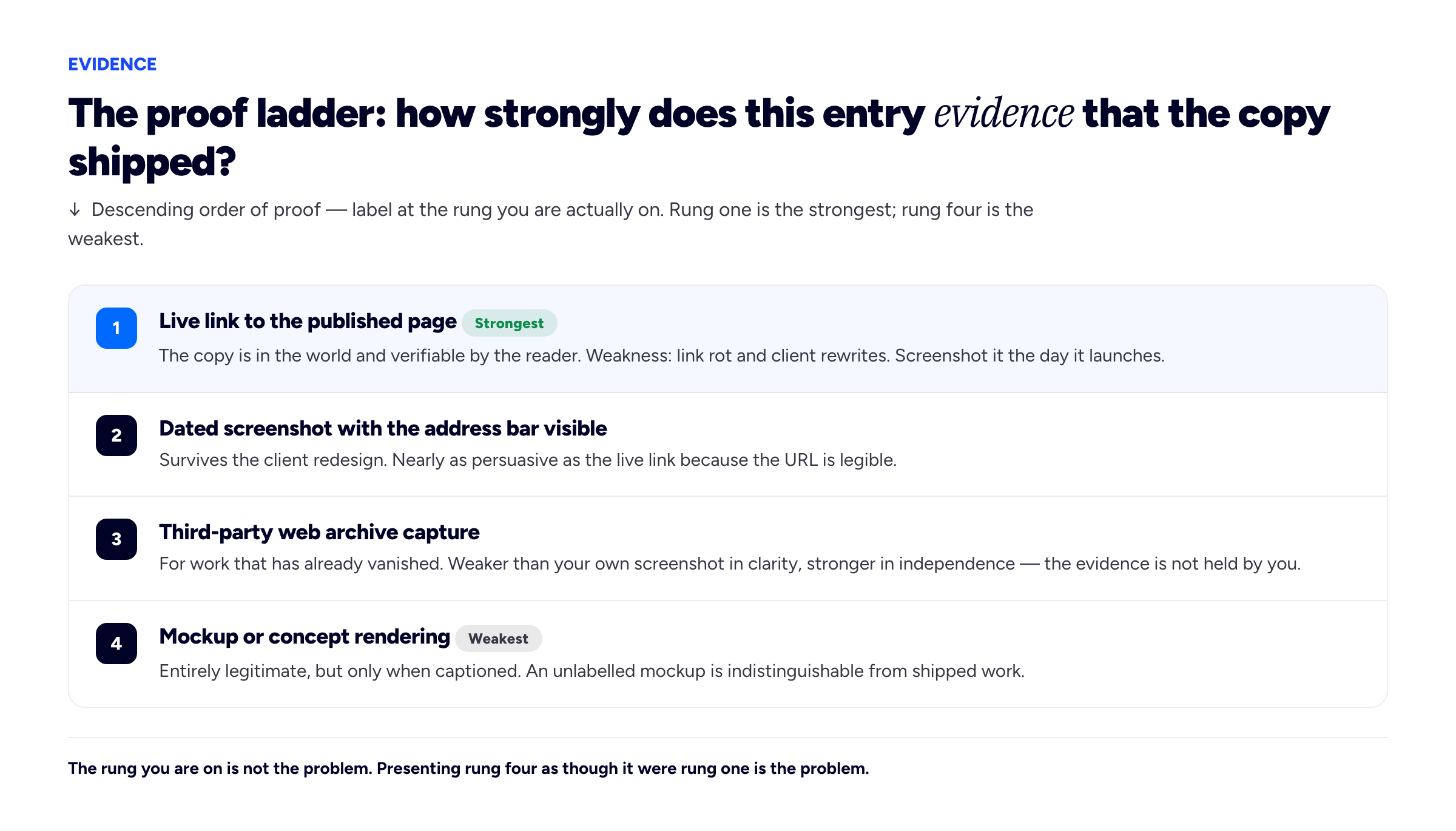
Use a proof ladder instead, and label honestly at whichever rung you are actually on.
A live link is the strongest rung. The copy is in the world, in context, verifiable. Its weakness is link rot and rewrites, so screenshot it the day it goes live.
A dated screenshot with the URL visible is nearly as strong and survives the client's redesign. Include the address bar. Date it.
An archived capture — a public web archive snapshot — is worth knowing about for work that has already vanished, because it is third-party evidence rather than your own file.
A labelled mockup is the bottom rung and is perfectly legitimate, provided the label does its job. "Concept — not published" in the caption costs you nothing with an honest buyer and protects you entirely from the one who checks.
Format matters more than copywriters usually allow for. Email copy should be shown as a rendered send, not as body text in a document, because the subject line, preheader and the point at which the eye stops are the work. Interface microcopy should be shown in the flow, in the state it belongs to — a button label out of context is unreviewable, and Nielsen Norman Group's own framing of UX copy sizes is a useful vocabulary here, distinguishing microcopy of fewer than three sentences from short-form of two to three paragraphs. Long-form sales copy needs to be readable at length, which means a real page rather than a carousel of crops.
Nobody minds a concept. What ends a conversation is discovering that the concept was presented as a campaign.
Results, and the standard they have to meet
Copywriters are hired to move numbers, so portfolios carry numbers, and a great many of those numbers are unfalsifiable. "+240% conversion" with no baseline, no time window, no traffic source and no statement of who measured it is the most common tell of a portfolio that is not to be trusted — not because it is necessarily false, but because it is unverifiable in a way that a competent marketing buyer notices immediately.
The standard here is not a matter of taste. The FTC's policy statement on advertising substantiation requires that advertisers "have a reasonable basis for advertising claims before they are disseminated", and states that a failure to possess and rely on such a basis "constitutes an unfair and deceptive act or practice". Where a claim is express — "tests prove", "studies show" — the Commission expects at least the advertised level of substantiation. In the UK, the ASA's guidance on substantiation is equally direct: marketers "must hold documentary evidence to prove claims that consumers are likely to regard as objective" before publication.
Your services page and your portfolio entries are marketing communications about your own business. Apply the rule to yourself.
The same applies to the testimonial block, which copywriters tend to treat as decoration. Under the FTC's endorsement guides, an endorsement must reflect the honest opinions of the endorser, and where a testimonial conveys a performance claim, the advertiser should possess adequate substantiation for it or disclose the generally expected result. A client quote saying you tripled their revenue is a performance claim you are publishing.
In practice, most copywriters have no analytics access at all, which the advice literature almost never acknowledges. Here is what to do in that situation, which is the normal situation.
- State the variable you changed, not the outcome you did not measure. "Rewrote the pricing page around the objection that came up most in sales calls" is a true, checkable, useful sentence.
- Attribute the measurement. "Client-reported: 18% lift in trial starts over the following six weeks" is honest, and the attribution is the part that makes it credible rather than the part that weakens it.
- Give the window and the baseline. A percentage without a denominator is not a number.
- Name what else changed. If the page was redesigned at the same time you rewrote it, say so. A reader who works in marketing already knows that a co-occurring redesign confounds the result, and will trust every other figure on your site more once you have shown that you know it too.
- When you have nothing, say what happened instead. "Adopted as the template for the rest of the onboarding sequence" is a real outcome. So is "the client rolled it out to two further markets".
The wider version of this problem, across marketing disciplines, is covered in our piece on marketing portfolio examples.
Agency work, credit, and who owns it
Almost no portfolio guide addresses the fact that the campaign is not yours. It is worth being precise, because copywriters routinely conflate two separate questions — am I allowed to show this and what may I claim about it.
On ownership: the US Copyright Office's Circular 30 on works made for hire sets out the two routes by which someone other than the writer becomes the author. One is work prepared by an employee within the scope of employment. The other is a specially ordered or commissioned work that falls within one of nine enumerated categories and is covered by a signed written agreement saying so. The practical consequence: if you are a staff copywriter, your employer owns the work by default. If you are freelance, a landing page or an email sequence often does not fall neatly within those nine categories, so ownership turns on the assignment clause in the contract you signed. "Can I show this?" is a contract question with a findable answer, not a matter of etiquette.
On credit: name your actual role. A campaign credit that reads "Copywriter — with art director X, creative director Y" is stronger than an unqualified claim, not weaker, because it tells an experienced reader you understand how the work was made. Claiming a campaign you contributed one line to is the fastest way to be caught, since advertising is small and the people reviewing you know the people who made it.
The work that got killed
Every copywriter has a piece they are proudest of that never ran. Advertising has a settled answer to whether it counts, and the portfolio literature never mentions it: the industry's own award schemes exclude it. Cannes Lions requires that an entry "is not speculative or conceptual advertising", that it was created "within the context of a normal paying contract and genuine brief from a brand", and that a senior executive at the commissioning brand has given permission for it to be entered. D&AD's terms similarly require work produced in response to a genuine client brief and made available to the public with the client's approval, explicitly excluding concept designs and work not signed off by a client.
Borrow the standard. Killed work can appear in your portfolio — it is often your best thinking — but it belongs in a clearly separate section, labelled as unreleased, with the reason it did not run if you are free to give it. That reason is frequently the most interesting sentence on the page. What it cannot do is sit in the main run of work as though a brand had bought and published it.
A related case, which is not the same thing: copy that has been approved and paid for but is under embargo until a launch. That is not killed work — it is work you may not show yet. Keep it out until the date, then add it.
Labelling spec work honestly
Spec work — a self-initiated campaign for a brand that never hired you — is genuinely useful. It is how most copywriters build a first portfolio, and it can show sharper thinking than client work because nobody diluted it.
The depth-leading article in this topic tells readers to write spec ads and invent projects, on the basis that clients and hiring managers will not care whether it was a real paying project. We think that is straightforwardly bad advice, and it is worth saying so plainly rather than quietly doing the opposite. They do care. They care because the entire value of a portfolio to a buyer is as evidence about what happens when a real client, with a real budget and real nerves, is involved. Spec work with the label removed does not add a data point; it corrupts the set.
The labelling itself is trivial. A line under the title — Self-initiated concept. Not commissioned by or affiliated with [brand]. — is sufficient, and it also protects you on the trademark question, which is the other reason to write it. A reviewer who sees three labelled spec pieces and one real client project reads you as a copywriter with one client and good instincts. A reviewer who discovers that four "clients" were all invented reads you as someone who misrepresents their experience, and there is no recovering the rest of the page after that.
Note that professional bodies use "spec work" for a different and more contested thing — unpaid work produced to win a pitch. AIGA's position on speculative work strongly discourages that practice, while noting that advertising and architecture operate to a different set of standards. Self-initiated portfolio pieces are not what that argument is about, but it is useful to know the term carries both meanings when a client uses it.
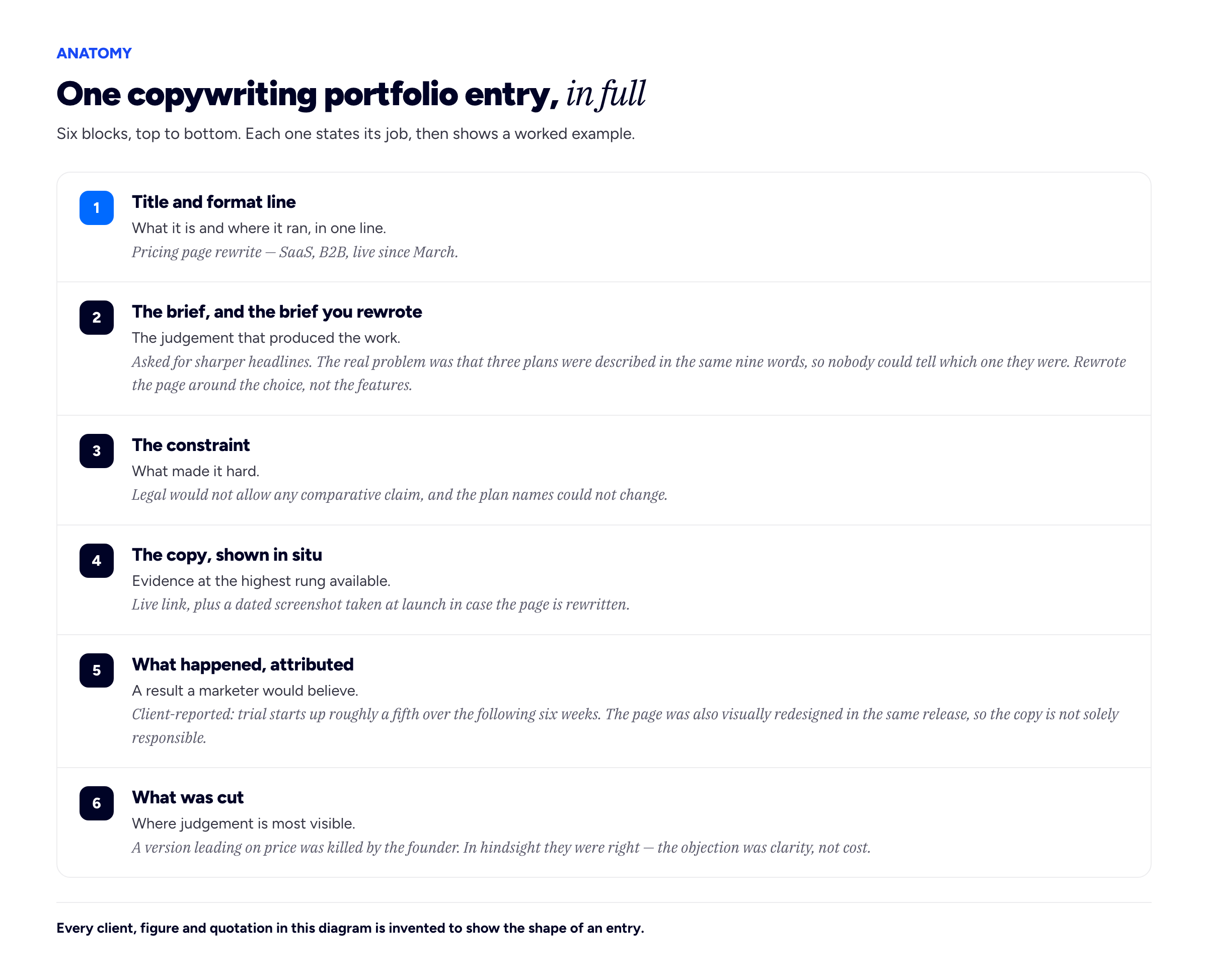
Blocks two, three and six are the ones a language model cannot write for you. They are therefore the ones now doing the persuading.
Where it should live
The platform question for copywriters is usually answered with a list of clip hosts. The useful way to frame it is by asking what your formats need to be rendered.
Clip hosts and portfolio services are built around the article — a headline, a publication, a link. That fits journalism well. It fits conversion copy badly, because an email sequence is not an article, a set of interface strings is not an article, and a landing page shown as a text excerpt loses the thing that made it work. If most of your output is published articles under your own byline, a clip host is a reasonable, low-effort choice. If most of it is commercial copy that lived inside someone else's interface, you need a page you can lay out yourself.
The second consideration is the address. A portfolio on a platform ranks under the platform's name and ends when the platform does; several of the services competing for this audience have themselves shut down or been acquired over the last decade, taking the URLs with them. A domain you own is the one line on your CV that does not depend on another company's roadmap. We make the general version of that argument in portfolio platforms versus your own website, and the practical mechanics of pages and structure are in what pages a portfolio website needs.
Whatever you choose, keep a private PDF of everything. Clients ask for one, procurement systems demand one, and a page can be down on the morning somebody wants to hire you.
Frequently asked questions
What should a copywriter portfolio include?
Four to six pieces, each with a title and format line, the brief and how you reframed it, the constraint you worked inside, the copy shown in context, an attributed result where one exists, and what got cut. An About page that says what kind of problems you take on, and an obvious way to make contact. Range matters less than depth on the formats you actually want to be hired for. If the entries are the part you keep postponing, our portfolio content generator will turn notes on one project into a first pass at the brief, the work and the result — a draft to rewrite rather than to publish, which for a copywriter is the only sensible use of it.
What does a good copywriter portfolio look like?
A plain, fast page with a one-line statement of the work you do at the top, four to six entries below it, and contact details at the end. Each entry shows the copy where it actually ran, a few sentences on the brief and the constraint, and an honestly attributed result where one exists. It looks less like a gallery and more like a set of short case studies, because the context is what proves you did the thinking.
How do I build a copywriting portfolio with no clients?
Write self-initiated pieces for real brands and label them clearly as concepts, take a small amount of pro bono work for an organisation you believe in, and write the formats you want commissioned rather than the ones that are easiest to invent. Our guide to building a writing portfolio without clips sets out a four-week plan for getting from nothing to a publishable set.
Can I show work I did at an agency?
Usually yes, once it has been publicly released, and credited accurately to your actual role alongside the rest of the team. Ownership sits with the employer or with whoever the contract assigns it to, so showing it is a permission question rather than a rights question. Check your contract for a publicity or portfolio clause, and ask in writing if it is silent.
Is it dishonest to use mockups?
No, provided the caption says what it is. A mockup of a concept, labelled as a concept, is a normal way to present an idea. A mockup of a concept presented in the main run of client work, with no label, implies a commission that did not happen — and that is the version that costs you the job when someone checks.
How do I show results if I never had analytics access?
State the change you made and attribute any figure to the client — "client-reported" is a strength, not a hedge. Give the baseline, the window and anything else that changed at the same time. Where you genuinely have no numbers, report what happened instead: the piece was rolled out to other markets, adopted as a template, or renewed.
Should I put AI-assisted work in my portfolio?
The relevant question is not whether a tool was involved but whether the entry demonstrates something a tool cannot supply. Lead every piece with the brief you reframed, the constraint, and the version you killed. If an entry would read identically had it been generated in thirty seconds, it is not currently doing any work for you.
How many pieces should a copywriting portfolio have?
Four to six is the common range, and the binding constraint is that every piece has to survive being asked about. A portfolio of four entries you can discuss in detail beats nine where three are unlabelled spec and two were largely someone else's.
Copywriter or content writer — does the portfolio differ?
Yes, in emphasis. A content writing portfolio is judged on published pieces, bylines, research depth and range. A copywriting portfolio is judged on whether commercial copy did a commercial job, which means context, constraint and outcome carry the weight that a byline carries elsewhere. If you do both, separate them on the page rather than interleaving.
How we put this guide together
Bunfolio builds portfolio sites, so a lot of our time is spent reading what freelancers publish about themselves and working out where a buyer stops reading. The frameworks here are our own recommendations rather than industry standards, and should be weighed as judgement: the proof ladder and its ordering, the six-block entry anatomy, the argument that the reframed brief and the killed version are now the load-bearing parts of an entry, the guidance on attributing results when you have no analytics access, and the specific labelling line for self-initiated work. They come from a consistent pattern in what makes a commercial buyer reply — context and an attributed number do the most good, and an unverifiable percentage does the most harm.
We disagree explicitly with one widely-read piece of advice in this topic, which tells readers that clients and hiring managers will not care whether a portfolio project was real. We have stated that disagreement in the body rather than quietly contradicting it, because a reader who has met both arguments can decide between them.
We have cited no figures for conversion lifts, portfolio review times, or what proportion of copywriting work is now AI-assisted. Numbers of that kind circulate freely in this topic and we could not trace them to a primary study we would stand behind. In a guide whose central argument is that unsubstantiated percentages destroy trust, publishing one would be self-refuting, so the gap stays.
Where a factual claim is made it points at a primary source rather than at a summary. The substantiation standard comes from the FTC's policy statement on advertising substantiation and the endorsement provisions at 16 CFR 255.1 and 255.2; the UK equivalent is the ASA's substantiation guidance. Readers elsewhere should find their own regulator rather than assuming these transfer. Ownership is described from the US Copyright Office's Circular 30, and we have deliberately not simplified the nine-category test, because the simplification is where copywriters get it wrong. The released-work standard is quoted from the published rules of Cannes Lions and D&AD; the spec-work position is AIGA's, and we have flagged that it addresses unpaid pitch work rather than self-initiated portfolio pieces. The copy-length vocabulary is from Nielsen Norman Group. None of these are legal advice; a contract question about your own work is a question for a lawyer in your jurisdiction.
Every client, campaign, figure and quotation used as an example above is invented for illustration — the SaaS pricing page, the trial-start figure, the founder, the legal constraint and everything in both diagrams. They exist to show the shape of a well-evidenced entry. They report nothing that happened, and none of the example copy should be reused as a claim about real work.
Related reading: building a writing portfolio without clips for making samples from a standing start, marketing portfolio examples for the evidence problem across marketing, how to write a portfolio case study for the long-form version of an entry, and showing confidential work for copy you are contractually unable to publish.
More from the blog
September 16, 2026 · 20 min read
How to Put Your Portfolio Link on a Resume
Everyone tells you to put the link in your header and label it clearly. Nobody tells you what happens next — that the hyperlink often dies in the PDF export, that an applicant tracking system may neve...
September 18, 2026 · 22 min read
How to Put Freelance Work on a Resume
Nobody rejects a resume because the applicant freelanced. They reject it because they could not work out what they were looking at. The one decision that sets your layout, what to call yourself, and h...

September 20, 2026 · 24 min read
ATS-Friendly Resume Format: What Actually Breaks
An applicant tracking system is a database with a form on the front, not a judge. Here is the two-minute test that shows you exactly what the parser sees in your own file, the failures that genuinely...