
August 4, 2026 · 12 min read
How to Build a Freelance Writing Portfolio Without Clips
Why a well-chosen sample beats a published byline, the five kinds worth making, the four lines that turn a link into evidence, and what to do about ghostwritten work.
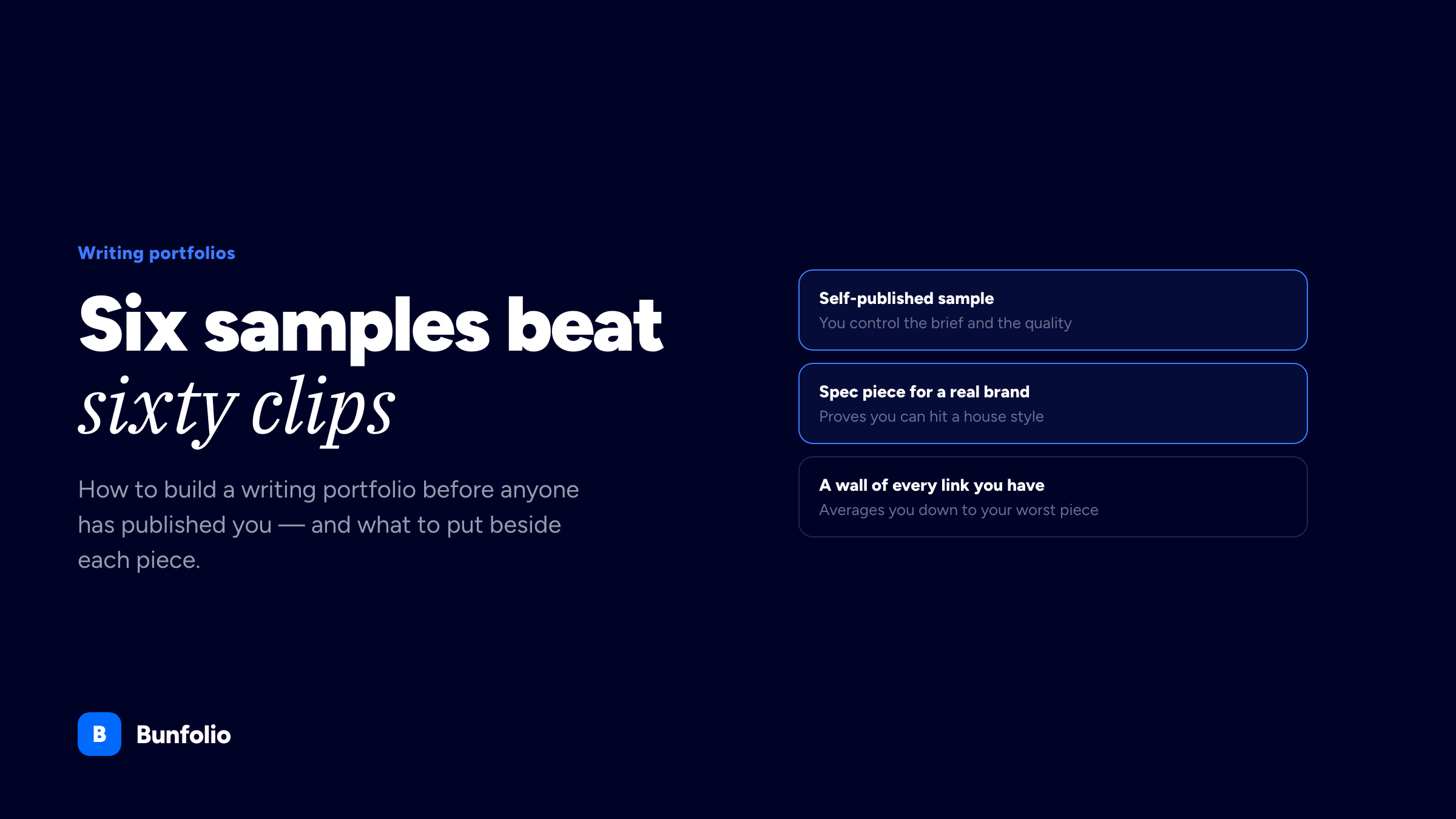
The clips problem is real but smaller than it looks. Editors and content leads do want to see published work, and if you have none, the standard advice — write samples — is correct. What that advice usually leaves out is that a sample is not a weaker substitute for a clip. For a lot of the work freelance writers are actually hired for, a well-chosen sample is better evidence than a published piece, because you chose the brief and can therefore show exactly the thing the buyer is worried about.
The buyer's worry, almost always, is not whether you can write. It is whether you can write to a brief: in someone else's voice, at the right length, on the day you promised, without needing three rounds of rescue. Published bylines only partially answer that. A spec piece aimed precisely at the client's house style answers it directly.
This guide covers the five kinds of sample worth making, how to write a spec piece that does its job, what to put beside each piece so a link becomes evidence, how many to show, what to do about ghostwritten and unpublishable work, and where to host the whole thing.
Five kinds of sample
These are not interchangeable. Each one answers a different question, and a portfolio of five identical blog posts answers only one.
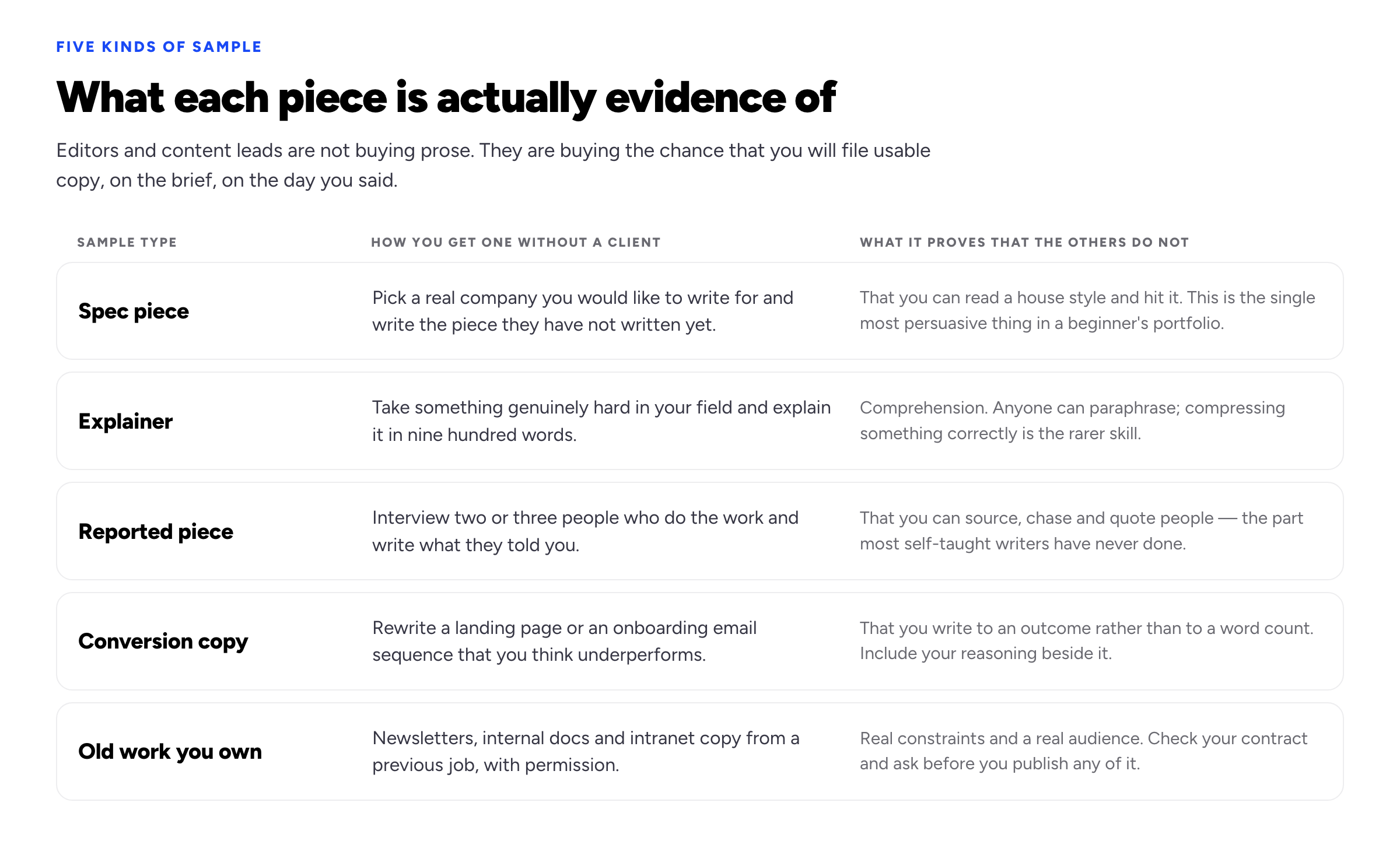
Most beginner portfolios are five explainers. The other four rows are where the differentiation is.
Two of these deserve more than a table row.
The reported piece is the one almost nobody does, and it is the reason to do it. Interviewing two or three practitioners and writing up what they told you demonstrates a set of skills — sourcing, chasing, quoting accurately, structuring around other people's words — that self-taught writers usually have never practised. It is also the fastest way to produce something genuinely new rather than a recombination of the top ten search results, which matters increasingly to editors who can generate the recombination themselves in seconds.
Old work you own is the most commonly forgotten source. Newsletters, internal handbooks, intranet copy, launch emails, support documentation, grant applications, conference abstracts. Two caveats, and they are firm ones: check your employment contract, because material produced in the course of employment usually belongs to the employer, and ask before publishing anything internal. "I wrote the customer onboarding emails at my last job, and here is what changed" is a fine portfolio entry; republishing the emails without permission is not.
Writing a spec piece that works
A spec piece is a real article written for a real company that has not commissioned it. Done casually, it produces a generic blog post with a logo on it. Done properly, it is the single most persuasive item a new writer can put in front of a buyer.
The method:
- Pick a company you would genuinely like to write for, in a sector you can be interesting about. Not the biggest name you can think of — one where you can read everything they have published in an afternoon.
- Read their last ten pieces and write down the pattern. Sentence length. Whether they use "we". Whether they use subheads as sentences or as labels. How they open. Whether they cite sources. Whether they ever say anything a competitor would disagree with. This document is half the work.
- Find the piece that is missing. The question their audience obviously has that they have not answered, or the piece they wrote two years ago that is now wrong. This is a demonstration of editorial judgement, and it is the part a content lead will notice.
- Write it to their length, in their voice, and stop where they would stop.
- Put a short note beside it saying what you were doing: which publication you were writing for, what gap you identified, and one or two specific choices you made to match their style.
That note is what converts the exercise into evidence. Without it, the reader sees a blog post. With it, they see somebody who reverse-engineers a house style before writing a word — which is exactly the person they want to hire, and a skill that survives whatever happens to the market for generic prose.
One decision to make deliberately: whether to send the spec piece to the company. There is a reasonable argument for it, and it occasionally works. But treat it as a pitch, not a gift — send a short note asking whether they want it, rather than an unsolicited two-thousand-word attachment.
The entry beside each piece
The most common structural failure in writing portfolios is a page of links. Links ask the reader to open, read and evaluate, and on a page of thirty of them nobody opens anything.
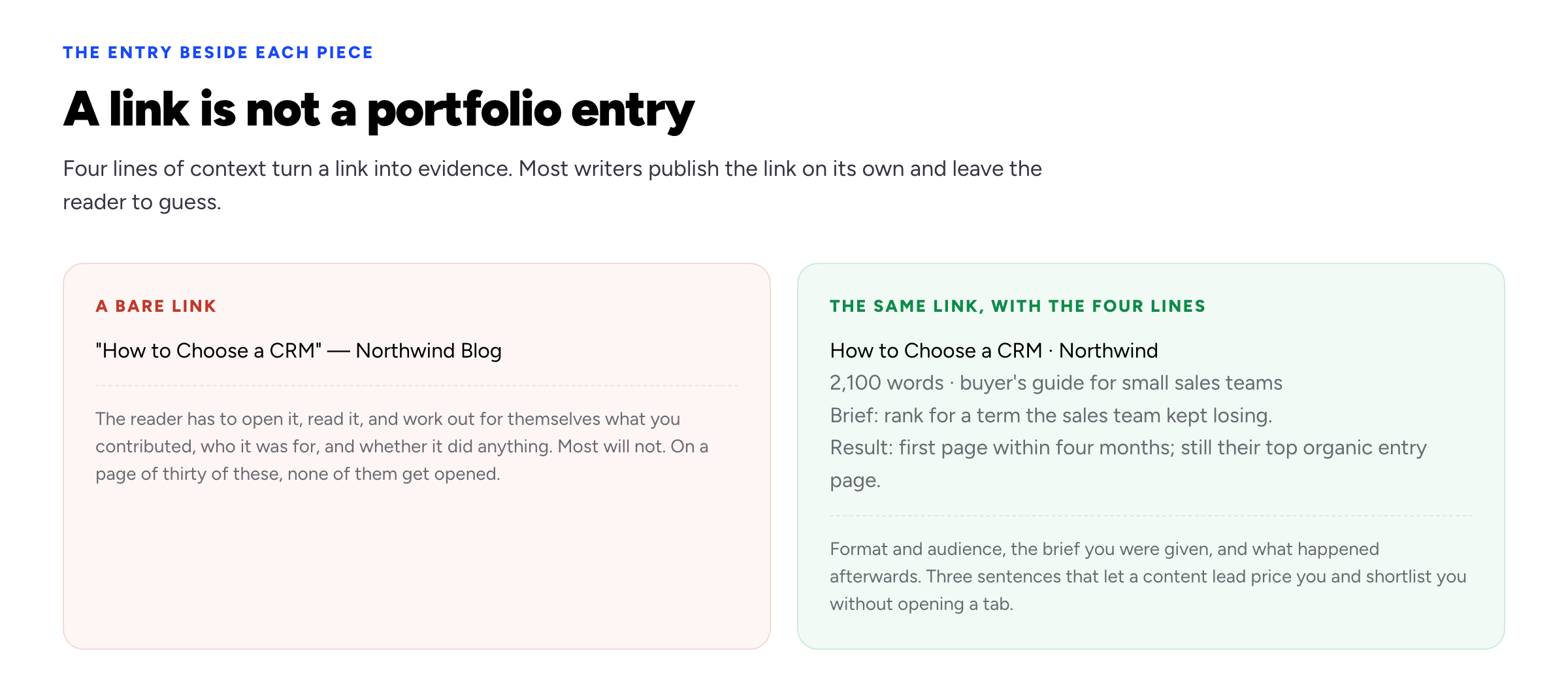
Four lines. They let someone shortlist you without opening a tab.
For each piece, give: the format and length (a 2,100-word buyer's guide), the audience (small sales teams evaluating their first CRM), the brief you were given or set (rank for a term the sales team kept losing), and what happened (first page within four months, still their top organic entry page).
If you have no result to report — which is normal, because writers frequently never find out — say what the piece was for instead. "Commissioned as the anchor piece for their Q3 campaign" is context. Silence is not.
How many, and in what order
Six pieces is a good target and twelve is too many. The arithmetic is the same as every other kind of portfolio: readers form an impression from the average, so a weak piece costs more than a strong piece earns. Six well-chosen pieces that cover different formats read as range. Twelve that cover the same format read as a content mill.
Order them by relevance to who you want to hire you, not by date or by pride. If you want technical B2B work, the technical B2B piece is first, even if the personal essay is better writing. And group them by format rather than by client — buyers scan for the format they need to commission.
One thing worth doing that almost nobody does: put a single line at the top saying what you write and for whom. "I write long-form documentation and developer education for infrastructure companies" tells a buyer in one sentence whether to keep reading, and makes you findable in a way that "freelance writer" never will. The same principle drives niching decisions more generally.
A four-week plan from zero to six pieces
Written for someone doing this alongside a job. The order matters: the hardest piece goes first, while the enthusiasm is still there.
- Week 1 — decide and read. Choose the two sectors you want to write for and the three formats you want to be commissioned for. Read fifteen published pieces across them and write your house-style notes. Nothing gets written this week, and that is the point: the writers who skip this produce six samples aimed at nobody.
- Week 2 — the reported piece. Send five interview requests on Monday; you will get two yes replies, which is enough. Do the interviews mid-week, write on the weekend. This is the piece most likely to stall, so it goes first while you have the most momentum.
- Week 3 — the spec piece and the explainer. The spec piece is the one to spend the extra day on. The explainer is faster than it looks if you pick something you already understand deeply and resist the urge to research it further.
- Week 4 — conversion copy, old work, and the site. Rewrite one landing page with your reasoning beside it. Dig out one thing you already own and clear it with whoever needs to clear it. Then build the page: six entries with four lines each, an About page, an email address. Publish on the Sunday whether or not it is finished.
Six pieces in four weeks is achievable because five of them are short. Resist making any of them your definitive statement on anything — a portfolio piece has one job, which is to make somebody confident enough to send a paid brief.
Five things that lose the commission
These come up often enough to be worth naming, and all five are fixable in an afternoon.
Typos in the portfolio itself. Obvious, and still the most common. A writing portfolio is the one artefact where a mechanical error is read as evidence about the product rather than the packaging. Read it aloud, then have somebody else read it.
Every piece the same length. Six pieces at 1,500 words says you can do one thing. A 300-word product description beside a 3,000-word feature says you can be commissioned for either, and short-form work is frequently better paid per hour than long.
No sign of an editor. Nothing in the portfolio suggesting you have ever been edited — no mention of a brief, a revision, a spike that got cut — reads as someone who has only ever published themselves. Say somewhere that you take direction well, and show a piece where you clearly did.
A voice that never changes. If all six pieces sound identical, a buyer concludes you have one register. Include at least one piece in a voice that is plainly not your natural one, and say so in the entry.
No stated availability or rate range. Buyers with a budget filter hard on this. You do not have to publish a number, but "taking commissions from October, day rate on request" removes two emails from the process and signals that you have a rate at all. What that number should be is a longer conversation, covered in how much to charge as a freelancer.
Ghostwriting, NDAs, and work you cannot show
A large share of well-paid freelance writing is invisible: ghostwritten executive posts, white papers under a company byline, copy nobody attributes. This is not a problem for your portfolio provided you handle it explicitly.
Ask for permission to reference it. Many clients will agree to you saying "ghostwrote a monthly column for the CTO of a Series B infrastructure company" even when they will not agree to a link. Get this in writing, and ideally settle it in the contract before the work starts rather than negotiating it afterwards.
Describe the shape when you cannot show the thing. Format, length, audience, and the outcome if you know it. An unlinked entry with real specifics is worth more than an omission, because omissions read as a gap in your record.
Do not paste NDA-covered text into a portfolio, and do not "lightly rewrite" it either. Rewriting confidential material does not make it yours, and the client whose white paper you paraphrased will recognise it.
Keep a private sample set. A small PDF of two or three pieces you can send on request, where the client has agreed to private sharing but not publication, covers most of what a public portfolio cannot.
Where to host it
Three broad options, and the trade-off is the same one every freelancer faces.
A clip-hosting service is fast and requires no setup. It is also a profile inside someone else's product: the URL is theirs, the ranking accrues to them, and the presentation is whatever the platform allows. Fine as a stopgap, poor as a permanent home.
Publishing on a general platform — Medium, Substack, LinkedIn articles — gets you published links, which is genuinely useful when you have none. Use it as a place to produce samples, not as your portfolio; a Medium profile is a feed, and feeds bury your best piece under your most recent one.
Your own site is the one worth arriving at. It ranks for your name, it lets you control the order and the context, it does not disappear when a platform changes its terms, and the four-line entries above are only possible when you control the layout. It does not need to be elaborate: a page of six entries, an About page, and a visible email address is a complete writer's portfolio. Our portfolio SEO guide covers the handful of fields that make it findable. Commissioning editors and in-house contract roles will still sometimes ask for a CV rather than the page, and a free one-page CV builder will produce one from the same material.
Keeping it current
Writing portfolios rot faster than design ones, because links break. Publications get redesigned, articles get pruned, whole sites disappear, and a portfolio full of 404s is worse than a short one.
Two habits fix this permanently. Archive everything you publish on the day you publish it — save a PDF and submit the URL to the Internet Archive's Wayback Machine, so that when the link dies you still have something to point at. And check your links twice a year, replacing dead ones with the archived copy and a note that the original is no longer live.
While you are in there, cut the weakest piece and replace it with something newer. A portfolio that stays at six pieces but changes composition every year is a better signal than one that grows to twenty.
How we put this guide together
The five sample types, the spec-piece method and the four-line entry format are our own recommendation, based on what we see working on writer portfolios built with Bunfolio and on the recurring shape of the problem: writers usually own more publishable evidence than they realise, presented as a list of links that does none of it justice.
We have avoided the widely-repeated figures about how long editors spend reviewing a portfolio, or what proportion of applications are rejected on samples alone. We have not been able to trace those numbers to a study anyone can read, and where this guide gives a count — six pieces, not twelve — it is a recommendation, not a finding.
The advice to attribute honestly, to label spec work as spec work, and to publish under your own name reflects the same standard Google describes in its guidance on creating helpful, reliable, people-first content, which asks who produced a piece and whether it shows first-hand experience. On archiving, the Wayback Machine accepts URL submissions from anyone at no cost, which is the cheapest insurance available for a portfolio built on other people's domains.
The CRM buyer's guide, its traffic result and the infrastructure-company column are invented examples written to demonstrate a format.
Related reading: how to write a portfolio case study, how to build a portfolio with no experience, and how much to charge as a freelancer.
More from the blog
September 29, 2026 · 16 min read
How to Become a Freelance Writer: A Realistic Step-by-Step Path
A realistic path into freelance writing: choose one kind of writing and one type of client, write three honest samples with no clips, and put them on a one-page portfolio. Includes a sample cold email...
July 9, 2026 · 13 min read
How to Build a Freelance Portfolio Website That Wins Clients
The eight sections a hiring client actually reads, how to choose which work to show, and the technical floor your site has to clear — plus a realistic weekend plan for getting it live.
October 5, 2026 · 16 min read
How to Become a Freelance Photographer: From Good Photos to Paid Work
A practical path from "I take good photos" to paid freelance work: choosing a niche, the kit you actually need, and building a portfolio before you have clients. Plus the business basics photography a...