
September 29, 2026 · 16 min read
How to Become a Freelance Writer: A Realistic Step-by-Step Path
A realistic path into freelance writing: choose one kind of writing and one type of client, write three honest samples with no clips, and put them on a one-page portfolio. Includes a sample cold email and editor pitch, pricing models, side-hustle contract checks, the admin minimum and an honest take on AI.

To become a freelance writer, pick one kind of writing that a specific type of client pays for, write three honest samples that look like the work they buy, and put them on a one-page portfolio with a clear offer. Then tell people you already know, pitch businesses or editors directly, and treat marketplaces as a second channel. You need no degree or byline, but you do need proof, a price and a written agreement.
The rest of this guide takes each step slowly, with sample messages, pricing choices and the admin most guides skip. If you are starting freelancing in general rather than writing in particular, our guide to starting freelancing with no experience covers the wider path.
How to become a freelance writer: start with what you sell
The phrase "freelance writer" covers several businesses that share a keyboard and little else. Help-centre articles for a software company, features pitched to a magazine and LinkedIn posts in a founder's voice are different products for different buyers. Many beginners stall by trying to sell all of them at once.
Almost nobody hires a freelance writer for words as such. A marketing manager wants readers who become customers; a product team wants fewer support tickets; a charity wants a funder to say yes. The client's outcome is what they will judge you on, and what your samples need to point at.
There is one official figure worth knowing about the job, and one reason not to lean on it. The US Bureau of Labor Statistics' Occupational Outlook Handbook for writers and authors says 65% of people in that occupation are self-employed, so freelancing is the normal shape of this work, not a fringe of it. The same page gives a median annual wage of $76,910 for May 2025, but it states that its pay data do not include self-employed workers. That median describes salaried writers. It tells you nothing about what freelancers earn, and we have not found a trustworthy figure that does.
Choose your freelance writing niche
Before samples, choose a lane: one type of writing and, ideally, one type of client. "Freelance writing niches" are usually discussed as subject areas (health, finance, travel), but the more useful first decision is the kind of writing, because that decides who buys it, what proof they want to see and how the work is priced.
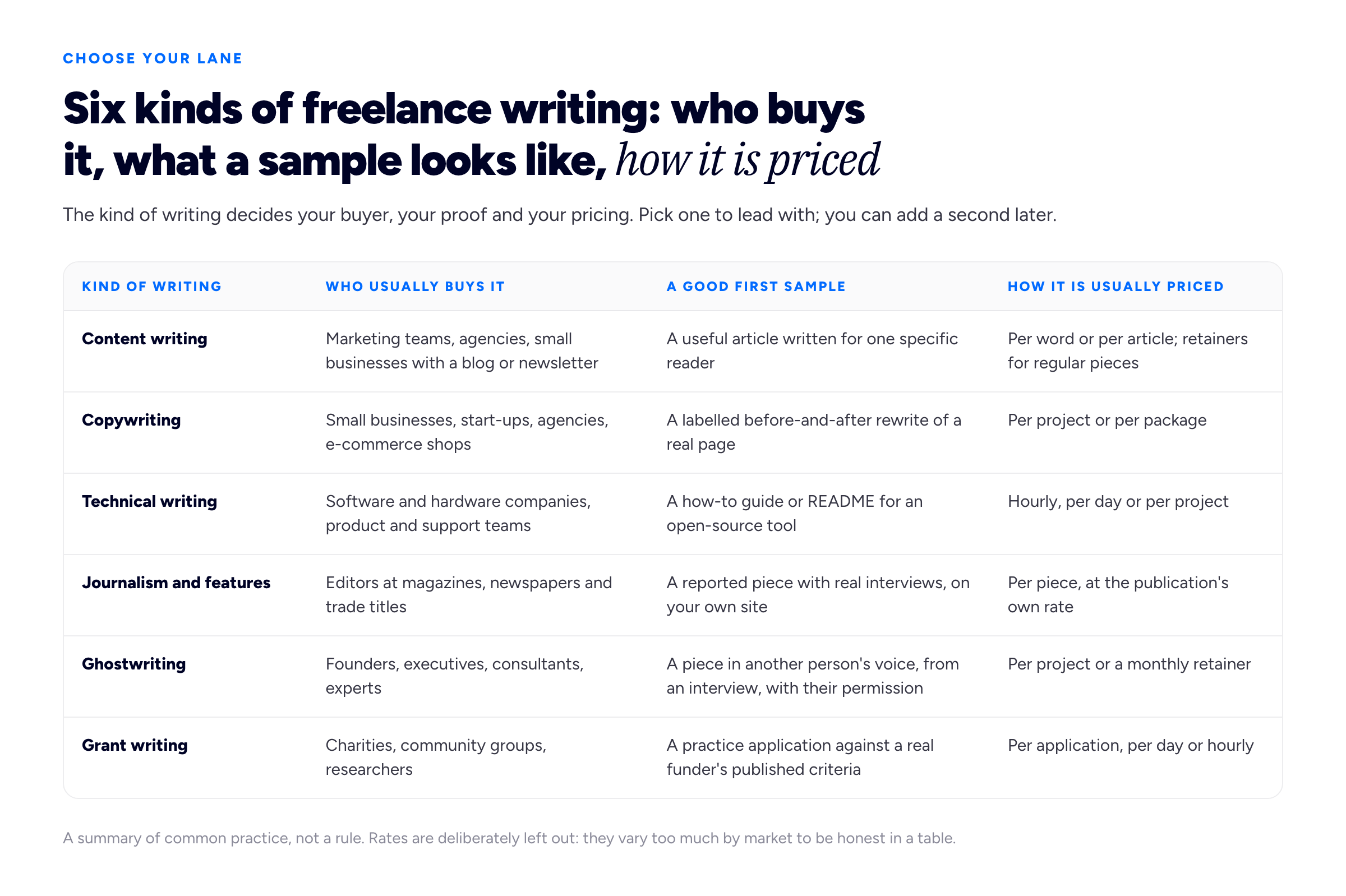
The kind of writing decides the buyer, the proof they will want and how they expect to be charged.
Content writing
Blog posts, guides, newsletters and long-form articles for businesses that use content to attract customers. It is the most common entry point and the most crowded. What keeps a content writer hired is usually subject knowledge and research: writing something a reader in that field finds genuinely useful, not a rewording of the first page of search results.
Copywriting
Website pages, landing pages, sales emails, product descriptions and ads: words whose job is to get someone to act. It is shorter work, judged more directly on results, and buyers want to see your thinking as much as your sentences. Our guide to the copywriter portfolio covers how to present it.
Technical writing
Documentation, help-centre articles, API guides and manuals, where clarity beats style. If you have worked in software, engineering, healthcare or any field with complicated procedures, this is often the lane where your existing knowledge counts most.
Journalism and features
Reported pieces for publications, sold to editors through pitches. Trade titles covering one industry are often more open to new writers with relevant knowledge than big consumer magazines. Editors care about the story and your access to it more than your portfolio design.
Ghostwriting
Articles, LinkedIn posts, speeches and books published under someone else's name. The skill is listening: interviewing a person and writing in their voice so well they would believe they wrote it. Much of the work can never be shown, which makes samples harder; we come back to that below.
Grant writing
Funding applications for charities, community groups and researchers. It rewards careful reading of a funder's criteria, plain explanation and reliable deadlines. Be cautious about any arrangement where you are paid only if the grant succeeds: you carry all of the risk for a decision you do not control.
Once you have the kind of writing, narrowing by subject usually helps too: "content writing for physiotherapy clinics" is easier to find clients for than "content writing". Our piece on whether freelancers should niche down covers the trade-offs, including when a narrow niche becomes a trap.
Freelance writing samples when you have no clips
"Clips" is the journalism word for published pieces, and the classic trap: no one publishes you without clips, and you cannot get clips without being published. The trap is weaker than it sounds, because most freelance writing clients are businesses, and they care whether a sample looks like what they need, not where it appeared.
Three samples are enough to start. Each should be the kind of piece your chosen client buys, written for a reader they would recognise. Here are the honest ways to get them, from weakest to strongest.
- A self-initiated piece on your own site. Write the piece you would write for your ideal client and publish it under your name, labelled as a sample.
- A labelled rewrite of a real page. Rewrite a real business's weak page, with a short note on why. Mark it "unsolicited rewrite, not commissioned", and never imply the business endorsed it.
- Transferable work from a job or course. Reports, guides or funding bids you wrote as an employee or student count, if you may show them or can anonymise them.
- A guest post or a small real job. A piece for a community site, a charity newsletter or a friend's business, agreed in writing, gives you a sample someone else chose to publish.
For ghostwriting, interview a friend who runs a business and write the post they would have written, with their permission to show it. For technical writing, an open-source project with a thin README is a ready-made brief. For grant writing, a practice application against a real funder's published guidance shows you can read criteria and answer them.
What does not work: samples on a topic your client would never publish, AI drafts lightly edited and presented as your own writing, and anything that pretends to be client work when it was not. Our guide to a portfolio with no experience goes further into labelling.
A one-page writer portfolio
You need a link that opens cleanly on a phone and answers three questions in under a minute: what do you write, for whom, and can I see it.
- A line that says what you write and for whom. "I write blog articles and guides for independent physiotherapy clinics" beats "wordsmith and storyteller". A clinic owner knows in one read that you are for them.
- Your three samples, each with a sentence or two of context: who it is for, what it is meant to do and, for unsolicited pieces, the label.
- A short offer. One or two things a client can buy, in plain words: "A 1,500-word article, researched and edited, delivered within ten working days, with one round of changes."
- A short "about" that earns trust: relevant background, subject knowledge, how you work.
- One way to contact you, visible without scrolling far.
Our full guide to the freelance writer portfolio covers layout, how many pieces to show and how to present work you cannot link to. If you want a page live this week without paying, you can make a free portfolio site on Bunfolio; any simple, fast page that you control will do the job.
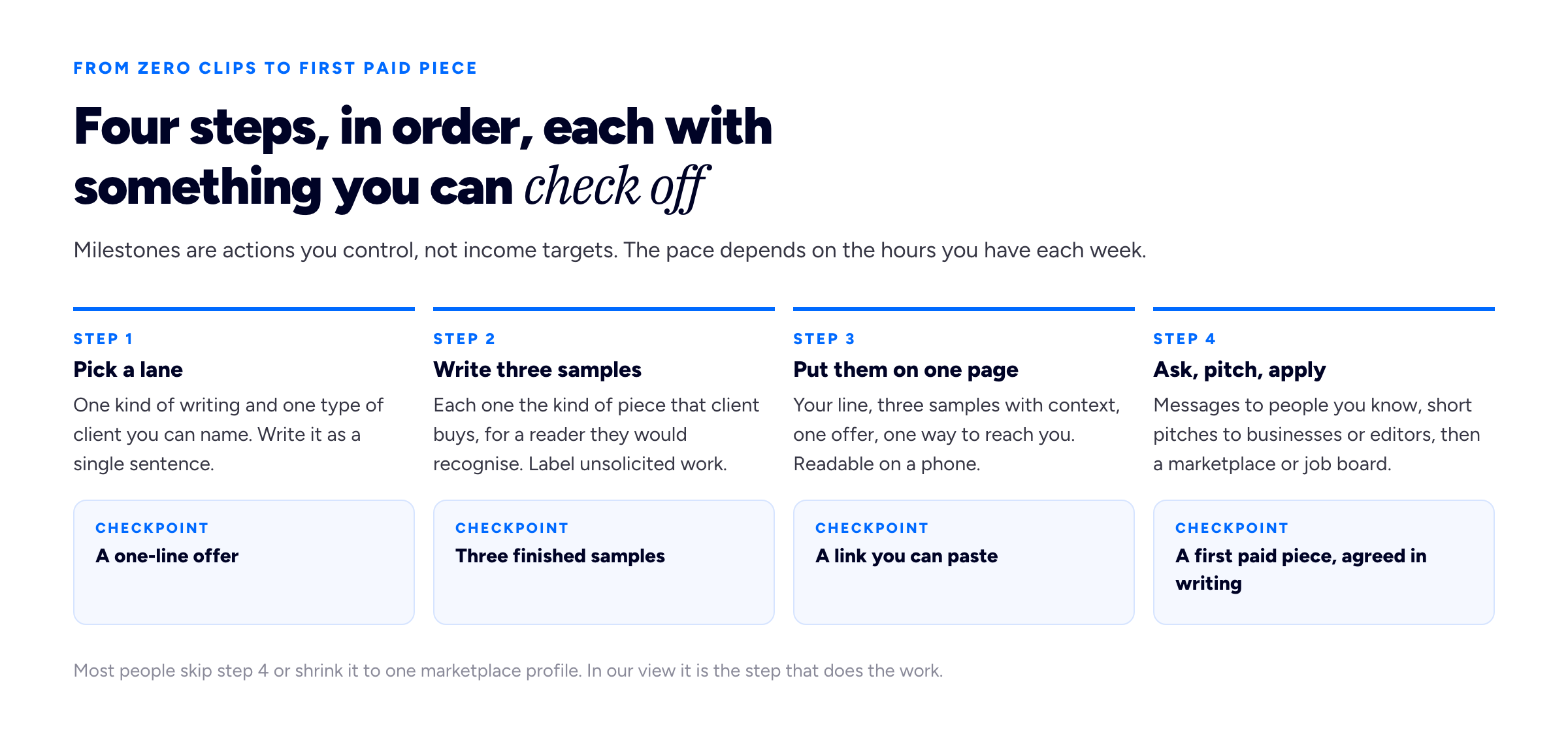
The order matters: a pitch without a portfolio link is easy to ignore, and a portfolio nobody is sent to is never seen.
How to find freelance writing jobs
There are five places the first jobs come from. They are not equally comfortable, and the least comfortable tend to work best.
Your warm network
Former colleagues, friends who run businesses, people from clubs and volunteering. Send individual messages, not a group post, saying what you now write and for whom, with your link, and asking whether they know anyone who might need it. Our guide to getting your first freelance clients covers this channel in depth.
Cold emails to businesses
Choose businesses in your niche whose writing you could visibly improve, find the right person, and send a short, specific email. Here is the shape, for an invented bike shop:
Subject: Your e-bike buying guide
Hi Priya, I write web content for independent bike shops. I read the e-bike guide on Fernhill Cycles' site this morning; it is clear, but it stops before the questions most buyers ask in the shop: range on hills, charging, what servicing costs. I would expand it into a full guide that answers those, written so it can rank for the searches people make before they visit. Two samples of similar work are here: [link]. If it is useful, I can send a short outline first, no charge. Thanks, Sam
It is about their page, not your career; it names a specific gap; it offers a small next step; and it is short. Send a handful well rather than a hundred badly, and follow up once at most.
Pitching editors
For journalism and features, the unit of sale is the pitch: a short email proposing one specific story. Read the publication first, find the right section editor, and check whether they publish pitching guidelines. A pitch to an invented trade title might read:
Subject: Pitch: why small bakeries are dropping delivery apps
Hi Tom, I would like to pitch a 1,200-word feature for Independent Baker on small bakeries leaving the big delivery apps to run their own delivery. I have interviews lined up with three owners who switched and one who switched back, covering the costs they weighed and what happened to orders. I spent six years managing a bakery, and my reporting for a local food site is here: [link]. Could this work for your spring issue? Best, Ana
One story, why now, why you, what the reader gets. If you hear nothing, one polite follow-up after a week or two, then pitch it elsewhere.
Marketplaces
Upwork, Fiverr and similar platforms bring buyers to you, and some writers build real businesses there. They also mean competing with a large pool of sellers, often on price, with no reviews at first, and the platforms take a share of your earnings. Fees change, so read each platform's own current fee page before setting a price there. Treat a marketplace as one channel alongside your own page; our guide to writing a freelance proposal that wins applies directly to platform bids.
Job boards
Writing job boards and the careers pages of agencies list paid work openly. Popular listings draw many applicants, so a short application linking to one relevant sample beats a long one linking to everything.
How to make money as a freelance writer: pricing
There are three common ways to price writing, and the right one depends on the kind of writing and the client's habits.
- Per word. Common in content writing and journalism. Easy to budget, but it rewards length over usefulness and underpays research-heavy short pieces.
- Per project. A fixed fee for a defined deliverable: a five-page website rewrite, a guide, a grant application. It ties price to outcome and rewards you for getting faster, if the scope is written down.
- Retainer. A monthly fee for an agreed amount of work, such as four articles or a weekly newsletter. Predictable income, and where good content and ghostwriting relationships often end up.
Whichever you choose, start from your floor, not from a guess about what the client will tolerate: what you need to earn per working hour once unpaid time for pitching, invoicing and revisions is counted. Then time a typical piece, research included, and check the price covers it. We give no rate figures: they vary too much by country, niche and client. Our guide to how much to charge as a freelancer works through the floor calculation step by step.
On how to make money writing more broadly: the reliable money tends to come from clients who return. Ask satisfied clients what they need next before you go looking for new ones.
Freelance writing as a side hustle
Most people start alongside a job, which is usually sensible: it removes the pressure to take bad work to pay rent. It brings three things to check.
Your hours
A few protected hours a week, at fixed times, produce more than intentions to "write at weekends". Quote turnaround times that fit those hours; a client would rather hear "ten working days" and get it in eight than hear "three days" and wait a week.
Your employment contract
Read it before you take a first client. Some require permission for outside work, some forbid working for competitors or your employer's clients, and some have ownership clauses that reach further than you would expect. Never use your employer's equipment, time or confidential information. If anything is unclear, ask HR in writing or take advice.
Conflicts of interest
Writing for a company in the same market as your employer, or about a subject you deal with confidentially at work, is where problems start. Choose a niche that does not overlap with your day job's clients or competitors, at least at first.
The admin minimum
You do not need to register a company to take a first writing job. You do need three things from the first paid piece.
A written agreement
Even a short email both sides reply "agreed" to. It should state what you will deliver, the length and format, the deadline, the fee, how many rounds of changes are included, when you will be paid, whether your name appears on the piece and who owns the rights once it is paid for. Our freelance contract essentials lists the clauses that prevent most disputes.
A proper invoice
Your details, the client's details, an invoice number, a date, what was delivered, the amount, payment terms and how to pay. Our free invoice generator makes one in a few minutes without an account, and our guide on how to get paid on time covers deposits and chasing late payment.
Money set aside for tax
As a freelancer, tax is usually not taken before you are paid, so set a share of every payment aside the day it arrives. Rules vary by country; check your own tax authority. In the US, the IRS says the self-employment tax rate is 15.3% (12.4% for Social Security and 2.9% for Medicare), and you must file Schedule SE if your net earnings from self-employment were $400 or more. That is in addition to income tax. The IRS also says individuals generally have to make estimated tax payments if they expect to owe $1,000 or more when they file, across four payment periods in the year.
AI and freelance writing, honestly
If clients can generate text themselves, why pay a writer? Because what they still pay for is what a tool does not supply on its own: knowing the subject, interviewing people, deciding what is worth saying, checking facts and taking responsibility for the result.
Expect clients to ask how you work. Some forbid AI-generated text in contracts; some worry about accuracy, sameness or ownership. On that last point, the US Copyright Office's report on copyrightability (Part 2 of its AI series, published January 2025) concludes that copyright does not extend to purely AI-generated material, that prompts alone do not currently provide sufficient control, and that using AI to assist rather than stand in for human creativity does not affect protection.
Our recommendation is simple. Decide how you use AI, if at all, and say so before you start: for research summaries, outlines or nothing. Follow each client's policy exactly. Never present generated text as your own writing, in samples least of all, because the samples are the promise of what the client will get.
Frequently asked questions
How do I start freelance writing with no experience?
Pick one kind of writing and one type of client, write three samples like what that client buys, and put them on a one-page portfolio with a clear offer. Then message people you know and pitch a few businesses or editors. Experience comes from the first few jobs; proof is what gets you them.
How to be a freelance writer without a degree?
Most freelance clients never ask about qualifications; they judge your samples. The BLS notes that salaried writing jobs typically ask for a bachelor's degree, but freelance clients are buying finished work. Subject knowledge from a job or hobby often matters more than a writing qualification.
Is freelance writing a good side hustle?
It can be: you can start with a laptop, work in small blocks of time and grow slowly, if you can protect regular hours and keep deadlines alongside a job. Check your employment contract for outside-work and ownership clauses first, and avoid writing for your employer's competitors.
How much do beginner freelance writers make?
It varies too much to give an honest figure. We could not find a trustworthy published number for freelance writers' earnings, and the official BLS median for writers excludes the self-employed. What decides your income is arithmetic you control: how many clients, at what price, how often they return.
Where can I find freelance writing jobs as a beginner?
Start with your own network, then cold emails to businesses in your niche and pitches to editors. Marketplaces and writing job boards are useful second channels. A few specific messages usually beat mass applications.
Should I use AI as a freelance writer?
Only in ways your client knows about and accepts. Many clients have policies on it, and purely AI-generated material is not protected by copyright in the US, according to the Copyright Office. Use it, if you use it, as a helper for research or outlines, and never in your samples as a substitute for your own writing.
How we put this guide together
The order of the path, the six-lane breakdown, the three-sample approach, the one-page portfolio structure, the cold email and pitch shapes, and the advice on pricing and AI use are our own recommendations, not an industry standard.
We deliberately left out several kinds of claim that fill other articles on this topic: per-word "going rates", average beginner earnings, how many pitches it takes to land a job, and rankings of the "highest-paying" niches. We could not trace any of them to a published method we trusted. We also left out marketplace fee percentages, because they change; check each platform's current fee page.
Sources, all read on 3 October 2026: the US Bureau of Labor Statistics' Occupational Outlook Handbook for writers and authors (the 65% self-employed share, the May 2025 median wage, the note that its pay data exclude the self-employed and the typical degree requirement for salaried roles; page last modified 27 August 2026); the IRS pages on self-employment tax and estimated taxes; and the US Copyright Office's Copyright and Artificial Intelligence series, Part 2: Copyrightability (January 2025). Tax rules and thresholds change, so check the current pages and take qualified advice for your own situation. Nothing here is legal advice on employment contracts.
Fernhill Cycles, Independent Baker, the physiotherapy clinics and the people named in the sample messages (Priya, Sam, Tom and Ana) are invented for illustration and describe no real business or person.
Related reading: the freelance writer portfolio, the copywriter portfolio, getting your first freelance clients, how much to charge as a freelancer and freelance contract essentials.
More from the blog
October 5, 2026 · 16 min read
How to Become a Freelance Photographer: From Good Photos to Paid Work
A practical path from "I take good photos" to paid freelance work: choosing a niche, the kit you actually need, and building a portfolio before you have clients. Plus the business basics photography a...
August 4, 2026 · 12 min read
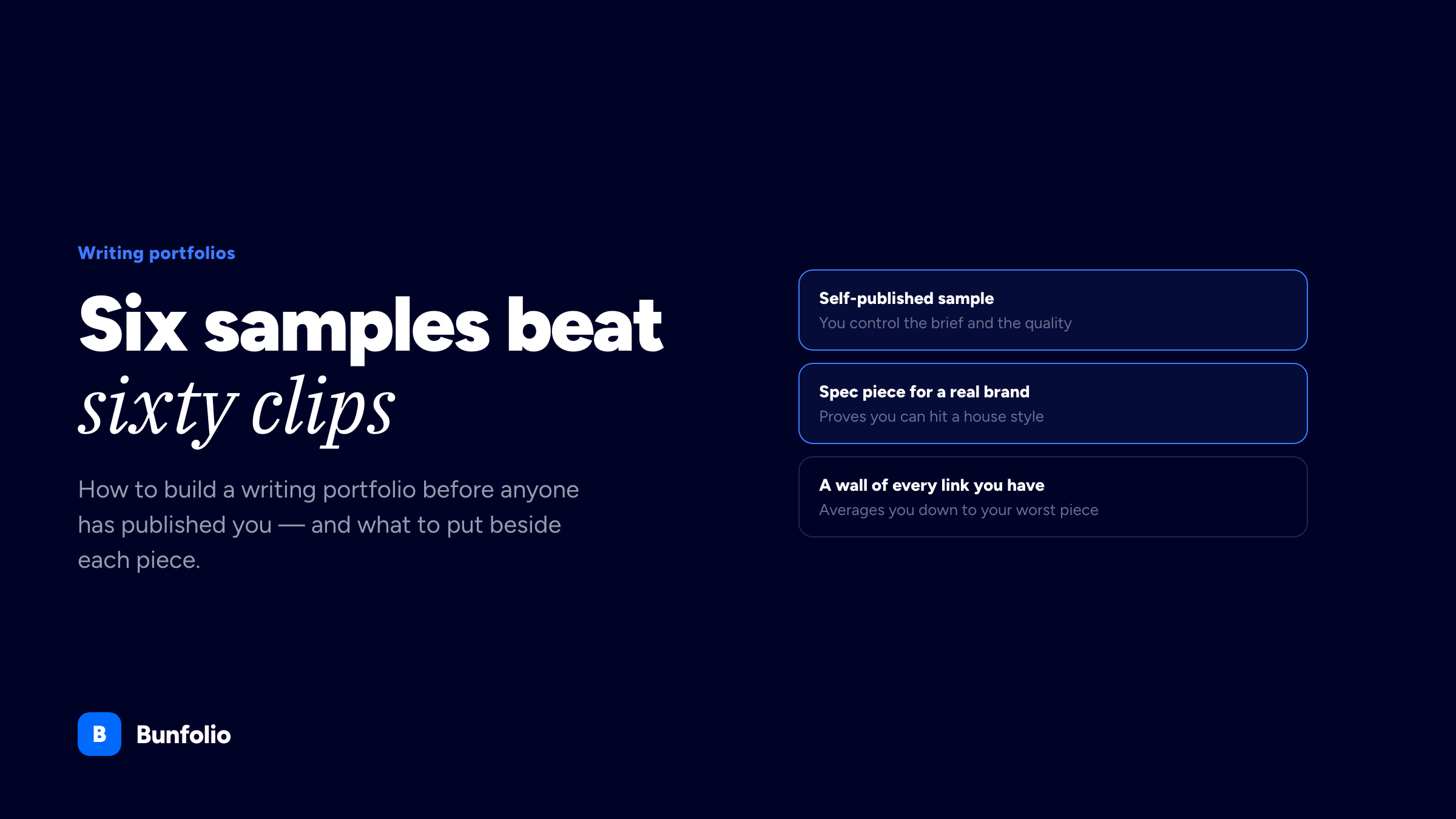
How to Build a Freelance Writing Portfolio Without Clips
Why a well-chosen sample beats a published byline, the five kinds worth making, the four lines that turn a link into evidence, and what to do about ghostwritten work.
September 30, 2026 · 16 min read
What Is Freelancing? A Plain-English Guide to Freelance Work
Freelancing is selling a skill to several clients one job at a time instead of working for one employer. How a freelancer differs from an employee, contractor or gig worker, one freelance job from enq...